Tag: Wally Olins

  • Obsolescence vis-a-vis Relevance


    By Avik Chattopadhyay


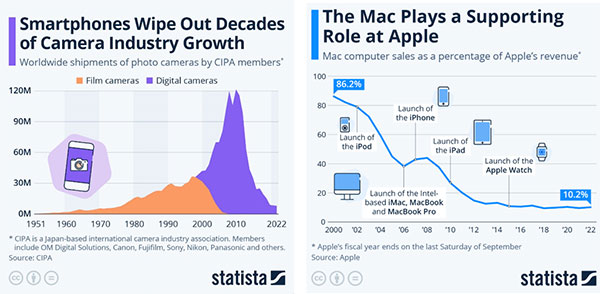
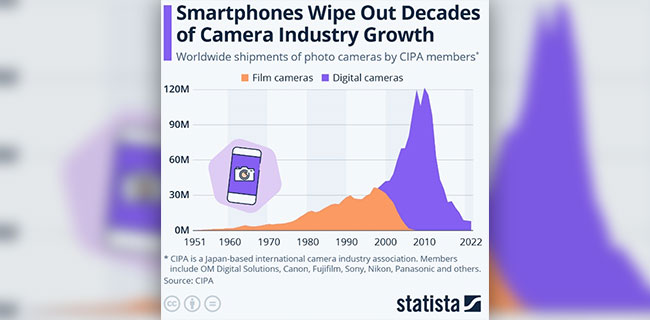
    Avik ChattopadhyayI came across two very interesting infographics by Statista last week. Though they are different pieces of information, to me they seemed bound by the common thread of a problem that every brand faces in its lifetime – obsolescence.


    Brands are scared by this very word. It is a stage in life that no brand wishes to ever experience. Yet, every brand must.


    I was discussing the infographic on cameras with a friend and he said, “These Japanese brands have become obsolete. They are nothing today. In just 15 years.” Little knowing, he had posed a crucial question that every brand manager would ask oneself and try the best to answer.


    Does a brand become obsolete?


    I do not think so, if it is a true brand in the first place. A brand is the promise of an experience, consistently delivered over time, as my guru Wally Olins used to say. Hence, a brand not merely a physical product, method or process. It is the experience that the product or method or process provides. Kodak was not about making cameras. It was about preserving memories. The day it forgot this basic and obsessed with making better cameras, it lost the plot. Just like Canon or Nikon or Panasonic or the hundreds of camera brands that believed their purpose was making a camera.


    Those that realised that their purpose was to help capture occasions, share experiences and create memories did not get bogged down by just one product format or process and devised new formats and methods. While many had written off the European camera makers in the 1990s due to the sheer dominance of the Japanese, they are back in business, collaborating with the smartphone makers in engineering their optics. So you have One Plus or Oppo collaborating with Hasselblad. Nokia had collaborated with Zeiss. Xiaomi has collaborated with Leica, which had a previous partnership with Huawei. Amongst the Japanese brands, Sony too realised its brand calling was much bigger than just a camera box, hence happens to be one of the largest optics partner for smartphone and smart device makers.


    If Colgate thinks of itself only as a toothpaste and not about dental health and happiness, its days are limited. Similarly if Maruti Suzuki thinks of itself as a maker of personal 4-wheeled vehicles and not as about democratising mobility in India, it will get gobbled up by someone who provides mobility solutions, however large it might be.


    A brand never becomes obsolete. A product does. A method does. A process does. And if a name thinks it is only the means and not the end, it surely does become obsolete.


    Now, the second infographic says that the Mac is now merely around 10% of Apple’s annual revenues. Which raised the second question in my mind – are brand relevance and obsolescence correlated? Which means, if a brand remains relevant, it cannot become obsolete, and vice versa.


    In just 22 years, the share of the Mac in Apple’s revenues has fallen by 8 times. Does that mean that the Mac is losing relevance in Apple’s future scheme of things? Does that imply that the Mac is on the verge of becoming obsolete?


    Not at all. The Mac continues to play a critical role in the larger ecosystem that Apple has created. Just that the ecosystem is so damn huge that its financial impact has reduced. However, it continues to do robust numbers, is always a focus at every annual product announcement day and is a critical lifeline for students and creative people. Without the Mac, the ecosystem will be incomplete and other business lines will get adversely impacted. And the fact that Apple keeps regularly upgrading the entire range demonstrates the key role it plays.


    So, a lesser share of revenue does never mean waning or lesser relevance of a brand both for the organisation as well as the marketplace. Even though share goes down, profitability can go up. And that critical brand can actually open doors for the organisation into other customer needs and applications. A student buying the first Macbook will certainly be a prime target for the phone, watch and every future solution that Apple comes up with.


    Just like the lesser numbers of the Tata Harrier does not imply it has lost its relevance vis-à-vis the Nexon and Punch. The Harrier plays a key role of demonstrating a certain level of engineering, design and performance shoulder to shoulder with a Honda, Hyundai and Kia. Hence, it plays a critical role for the larger Tata brand and its mobility ecosystem.


    The next time someone casually comments that a brand has become obsolete or irrelevant, just pause for a moment, give a deep think and then decide whether the statement holds any water, or is it just a temporary phase in the brand’s lifecycle.


    Peugeot had started off its brand lifecycle making water mills and steel knives and forks.

    So there!


  • Between a rock and a hard place!


    By Avik Chattopadhyay


    Avik ChattopadhyaySunday, July 11, was quite a tumultuous day in London. While in Wimbledon, Novak Djokovic fought his way to his sixth title on grass, just 8.8 miles away, Wembley was preparing for the Euro 2020 finals between England and Italy.


    Wimbledon was prim and proper, with people enjoying the game seated comfortably at centre court or relaxing on the lawns outside watching on large screens. Everything was very ‘English’ in its casual elegance and sportsmanship was displayed by one and all.


    Wembley was the epicentre of a gathering storm, with people drunk on the streets damaging public property, smashing car and shop windows, uprooting potted plants and dancing on police barriers. Everything was very ‘English’ in its feared hooliganism and total lack of social propriety towards one and all.


    What happened outside the stadium after the English lost in the penalty shootout has been shared across the world, with most English media embarrassed to cover and capture it in its brutal entirety.


    A popular social media message doing the rounds is, “Wimbledon is what England wants the world to see it. Wembley is what England actually is.”


    Screen captured from bbc.com


    So, what really is “England” as a brand?
    Is it actually Wimbledon with Wembley as an aberration?
    Or is it actually Wembley with Wimbledon as an elitist diversion?
    Or is it both in equal measure?
    Or is it a larger macrocosm with these sporting events as little parts?


    A more fundamental question that emerges is – is it England or London as a brand? Do Londoners believe they are distinct from the rest of England just like New Yorkers or Parisians do? Do they consider themselves just different or ‘better’?


    “Places as brands are some of the most complex to both understand and work on”, Wally Olins, one of the world’s last brand gurus, had told me in 2010 when he was working on the London brand as part of the oncoming 2012 Olympic Games.


    “Most place branding exercises end up being tourism campaigns,” he continued, “projecting an incomplete picture to the world at large and, more importantly, its citizens.”


    So, while the world was debating the racist hooliganism of London, there were these electric buses traversing the city carrying pithy messages in typical English humour. If one were to judge London by just a single event of either a Wimbledon, a Wembley or a London Bus, one would be very far from the total picture that depicts the city in her entire form and mind.


    Place brands are the closest to individual human brands in their complexity, mood swings, and multitude of manifestations. Their constituents make them so. Corporate and product brands are far simpler in contrast as there is greater ‘control’ on how the constituents behave.


    It is nearly impossible for place brands to be opaque to the world outside, be it a tourist, an investor, or an immigrant. Each stakeholder is well aware of all aspects of the place before experiencing it, investing in it or even wanting to be a part of it. It is not that the place willingly shares all its manifestations, but the actions of its constituents ensure this level of transparency. London would love to have wished away what happened before and after the football game, but a place does not have control over each of its constituents. And one can end up being a total embarrassment even if miniscule as today’s open world captures, amplifies and critiques it even before you can finish singing your national anthem!


    Just see what one virus from a bat did to brand China! All the hard work over the last three decades in building its ‘power and prosperity’ image came tumbling down because some constituents handled the situation so badly that it will take another three decades to restore any semblance of credibility and bonhomie with the larger world. In retrospect, it could not have been worse timed ahead of the 100th anniversary celebrations of the CPC!


    At the same time, place brands are also subject to stereotyping by the rest of the world. There are riots currently happening in South Africa but then discussion and outrage in social media circles is far lesser even though more than seventy people have already died. That is because a larger part of the world actually expects such happenings in that place. This is the other aspect of place branding that it cannot turn away from.


    Places and their citizens are stereotyped on historical records and their interpretations. A large part of this stereotyping is a post-colonial outcome with most ex-colonies taking considerable time to come out of the images cast upon them by their occupiers. The general narrative created is the deterioration of an ex-colony in quality of life, law and order and culture once it gains independence. Close to 70% of the world has spent the last half century in destroying these narratives primarily through action and credible demonstration rather than mere advertising.


    Hence whether Kerala is truly “god’s own country” will not be determined by only the tourist boats on the backwaters but also on people enjoying “beef fry and parotta” irrespective of faith and ensuring every child gets high-quality education.


    That makes place branding a slightly easier task!


  • The Wally We Knew


    By Rajesh Kejriwal


    Rajesh Kejriwal

    I rarely classify people, even those that i admire and like, as “fine human beings”. Wally, undoubtedly, was one of those fine human beings.


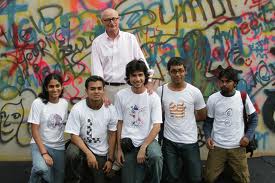
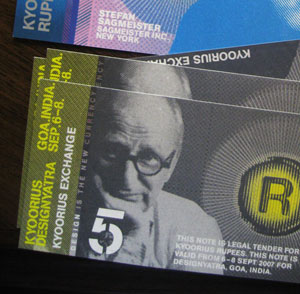
    I first met Wally when I Invited him to speak at Kyoorius Designyatra in 2007 and my first impression of him was that he does not suffer fools easily and has a zero tolerance for bull-shitters. So, in the beginning, i decided to handle him with kid gloves – something I have to do with many a speaker who have fragile egos or need attention. But within the first two hours of his presence at Designyatra, – I realised my mistake. Wally had a very warm side to him and really really cared about people. He said that I would do better looking after other speakers and that he would do better meeting young people and in his usual witty style said: let me be with people who admire me. This is one of the many many photos of Wally with youngsters at Designyatra in 2007 - It was amazing to see admiration in the young ones’ faces, and how he treated them with the greatest honour and love. He absolutely loved the currency with his image and took back an entire bundle of them.


    Avik Chattopadhyay on Wally: Brutally frank, eternally optimistic


    Avik Chattopadhyay, Marketing Head, Volkswagen India, was CEO – Indian Operations at Saffron Brand Consultants in 2010-11 and interacted with Wally as a client, employee and a friend


    By Avik Chattopadhyay


    I met Wally Olins in 1990, not in person, but through his book Corporate Identity.

    Since then I have been an admirer, client, colleague and well-wisher.

    What struck me most about “Sir” are his brutal frankness, brevity in expression and eternal optimism.


    Being around and with him, I have seen many who copy Wally Olins… his words, his opinion, his thoughts and even parts of his work. For, many amongst us want to ‘be’ Wally Olins. But Wally Olins was and remained himself.


    And that is what I have learnt from him… to stop living others’ lives and be myself. My identity, my truth and my being.


    That is what Wally Olins wanted in each of us.


    As individuals. As experiences. As brands.


    Avik Chattopadhyay is Marketing Head, Volkswagen India. He was CEO – Indian Operations at Saffron Brand Consultants from February 2010 to April 2011 and before he joined Saffron, he interacted with Wally when he worked with Apollo, one of Saffron’s first clients in India


    A few months later I got a mail from Wally. He was coming back as a delegate member of the London Mayor’s visit to India. He was in Mumbai over the weekend and asked if I would like to catch up. I met him on a Friday evening and learnt that he was totally free over the weekend.  He commented on how he drove from Mumbai to Kashmir back in the days he used to head what is now O&M India and that he loved the roadside dhaba food. I asked him out to lunch the next day and decided to take him out to Sunny Da Dhaba in Lonavala - That seven-hour journey for lunch, kind of, sealed a friendship that I have very fond memories of and will always cherish. At the end, he thanked me in his classic style – you know this is why I love Indians – who else could take you out for a total of seven-hour lunch –  a four-hour journey time for lunch and three hours over lunch.


    It was also that visit when he sealed the deal for Apollo and subsequently came back quite often to India and we met always. In the beginning of 2008, I connected Wally to Bajaj Auto and then he decided to open an office in India and made me a independent director of Saffron India and my journey with Wally began – a journey that has shaped me in many, many ways.


    The one very distinct quality about Wally was that he would say what he thought, would not tolerate second-rate thinking, writing or communicating and everyone who was around him would get balled, some of us who were close to him would get balled more frequently.


    One of the many things that I took from Wally was about being on time. Though i must admit Wally was always very anal about it – he would want to arrive at the airport a minimum of three hours earlier and if someone dropped him four hours earlier, he would love that person. We went to every meeting with a minimum of 15 minutes to spare and God forbid if the client delayed the meeting for more than 15 minutes. Once a Chairman kept us waiting for almost 70 minutes and I was bearing the brunt of his frustration during that period and trying to explain how this happens in India. At the end, when the Chairman walked in without an iota of feeling sorry for the delay and walked in and just started talking about his company. Wally stood and said – “So far its been a absolute displeasure meeting you and you have five minutes to change my perception about you. If you do, then and if you want, we can meet tomorrow at The Leela at four. The Chairman was dumbfounded but was immensely contrite, apologised profusely and said that he would meet Wally at The Leela.


    But that was Wally but he did it with a flair that was as brutal as it was charming and at the end, everyone still liked him. He is the only person i have met who would literally shame you with his words but win your heart at the same time with his twinkling eyes and witty humour. But when you knew him closely, you also realised that he had great patience in talking to his colleagues, spending immense amount of time explaining to them, guiding them repeatedly and was very caring to ensure that all the people under him grew with learning.


    Once we had some free time in Kolkata and he took me to the Victoria Cemetery and spent an hour guiding me, i was very impressed. It was only later that i realised that this was only his second visit and that the first one was almost fifty years back. But that was classic Wally – he had an insatiable curiosity and would absorb anything and everything.


    I have known Wally for the last seven years but those who really spent time with him also know that Wally was one person who made you so comfortable personally, became family and made you feel a part of his family. It’s been an honour and i feel blessed that i had the opportunity of being a part of Wally’s journey, of our families being close to each other.


    I know we have lost him but we have not lost him as a role model in my lifetime. My wife and children were equally devastated yesterday. He would sit down for hours with my daughter and advise her on her career. In his last visit, he invited her to London and work with him for four months. My daughter was planning to go in July this year. Sadly, Wally won’t be around, but am sure he will continue to advise her, painstaking as he always would, from up there.


    Rajesh Kejriwal is Founder and CEO, Kyoorius, a not-for-profit initiative that organises the Designyatra and various Design-related events. He is also Chief Editor and Publisher of Kyoorius magazine. After a successful D&AD-backed Design Awards last year, this year Kyoorius is also hosting the Advertising and Digital awards, backed by D&AD.


  • Wally Olins: The joys of eating with your fingers

    This column, originally titled ‘How I Like to Eat’ appeared in Kyoorius magazine in December 2013. Republished with permission from the publisher.


    By Wally Olins


    The other day I went out to a very smart dinner party in London. There were about twelve people there. The men were all wearing dinner jackets and bow ties and the ladies wore very glamorous, expensive frocks. We all stood about in a rather grand room having drinks, then we drifted into a vast dining room. The shiny mahogany table was decorated with mountains of candles and silver and, when I looked down, I saw a vast mass of cutlery and glass. There were four knives on one side and four forks on the other side of my place setting and two spoons and forks and a knife on top, together with several glasses, all of different sizes and shapes. There were, of course, side plates, dinner plates and plates on top of the dinner plates, all exquisitely decorated – if you like that kind of thing. My table napkin was so large I was nearly choked by it. Water was served; still or sparkling? White wine. Then red wine. Then a different red wine in a different glass. And it went on and on.


    Wally with students

    Naturally, as the various courses were served, mostly small bits of hugely decorated pastry stuff, everybody chased the tiny portions around their plate with a small knife that wouldn’t cut and a fork that wouldn’t hold. We all delicately nibbled away, starting with the knife and fork on the outside and gradually moving inside. It went on like that for quite a long time. For ever.


    Eventually a meat dish arrived. I just couldn’t properly slice or spear the piece of meat clinging to a fine bone on my dinner plate. It kept on slipping around. Eventually, I surreptitiously picked it up with my fingers, which I hid behind my vast napkin. That’s when I began to think how much nicer food tastes when you eat it like that. There’s something about cutlery and the whole paraphernalia of the way food is served in the west which seems to me to undermine its taste.


    Why can’t we eat with our fingers? I so much prefer sitting (not on the floor with knees crossed though) – just sitting, on a chair, at a table, tearing the naans and parathas apart while chomping away at some marvellous tandoori and rice and pilau and biryani and fish curry with lots of sauces on the side. It’s so much tastier and so much more fun. And I’m quite content with the Kingfisher beer that goes with it.


    India, for me, in the eating department you win hands down.


  • He came, He Conquered


    By Fatema Rajkotwala


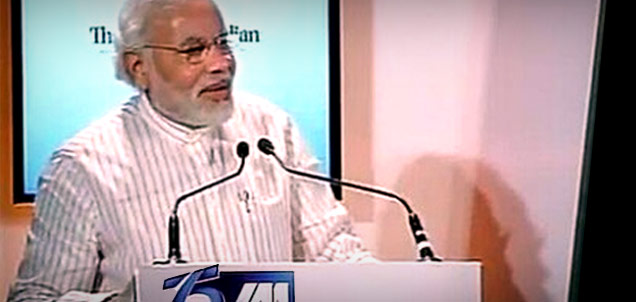
    Outside there were traffic jams as he made his way to Bandra Kurla Complex and then across the tracks to Taj Lands End. Inside the Ballroom of the hotel, the audience didn’t mind waiting. Media professionals of all levels gave him a standing ovation twice over.


    In many ways, it was an interesting choice to get Narendra Modi as Chief Guest. The Gujarat Chief Minister and the Bharatiya Janata Party’s Prime Ministerial candidate’s campaign for the elections is known on the importance he has laid on messaging and employing technology to reach out to people.


    Beginning by acknowledging the fact that as Indians we haven’t done enough to showcase our strengths to the world. He spoke on how we still lack confidence in ourselves as a global brand, a result of years of being subject to submission and foreign rule but even though India has taken the ‘brand route’, some indigenous products have acquired a symbolic value and become door-openers in the global market.


    Mr Modi encouraged Indian marketers to take tips from Mahatma Gandhi’s communication, write a book on it and present it as a case study as a sureshot way for India’s branding and make it an irresistible destination for the world to turn to. He suggested that marketers ought to move away from “impressive marketing” and instead strive for “inspiring marketing” to survive and flourish.


    Industry veterans and captains MxMIndia spoke with were suitably impressed.


    Said Brahm Vasudev, Chairman, Hawkins Cookers: “I thought Mr Modi’s content and delivery were excellent. I think his insights on marketing were top notch and I was very pleased to hear his thoughts.”


    Bobby Sista, who is now founder-trustee of Population First, “The entire day was worth my time. All the speakers were good in their own way and one gathered new insights from each other. From a marketing point of view, Mr Modi’s speech showed that he had no doubt in his mind as to what is Brand India and he spelt it out as we would do for any product or service by listing out values and attributes. We have so many strengths and home truths that he highlighted – from our spirituality to mythology to traditions to our today’s achievements in terms of products and services. And we have not marketed ourselves. He is a brilliant orator and as a marketing and advertising person, I wish we had him as the head of our fraternity. The interest in him is heightened due to the expectation that he will win the elections and judging by the way he is being treated, it does seem to be a possibility.”

     

    Sam Balsara

    Said Sam Balsara, Chairman and Managing Director, Madison World, “Mr Modi struck me as an outstanding communicator and not just an orator, to use his own words. I was truly impressed by what seemed like an impromptu speech on a topic that is arguably, not his subject and yet he spoke eloquently on it with well thought through ideas and concepts. Therefore, I feel that if he could come up with such ideas on what is not his subject, I’m sure he has some very good ideas when it comes to the economy, to uplifting our poor, education, employment and more. So, I think we owe it to ourselves to give him a chance.”

     

    Shashi Sinha

    Shashi Sinha, CEO, IPG Mediabrands echoed this view. “Mr Modi’s thoughts and suggestions on Brand India were excellent and it is evident that he is a great orator.”


    Said Suman Srivastava, marketing consultant and former adman: “As Mr Modi said, we tend to impress or inspire. This may be one of the many speeches he has given today and to think that we tire out after a few presentations… I am left inspired.”

     

    Suman Srivastava

    Mr Modi listed out a range of examples where there is a clear need gap between the global market and our products such as Indian architecture, music and dance, film industry, organic foods, herbal and holistic health care and more. He further highlighted how our rich culture and traditional values could help solve world problems such as global warming because of our beliefs such as respecting of nature and our resources, which were earlier considered orthodox and medieval. “Not everyone has to be sold the Taj Mahal but we have failed to look beyond it. Soft powers rule nations, more than economic or military strength. We have what the world is waiting for but we lack faith in our own product. If we meet global requirements with our legacy, our identity will spread. We have to fill Brand India in our minds; to speak, breathe and live it in order to turn it into a reality.”


    The IAA India chapter made Mr Modi an honorary member.


    The speakers before Mr Modi

    What makes a brand a brand? Are Indian brands still suffering from an apparent lack of confidence in the global market? Are we not recognizing and respecting our “Indianness” and using it to leverage our brand identity? How should marketers brand their corporate responsibility in a way that it builds and leverages their brand and the Indian society as a whole? These are some of the areas on which other conversations permeated at IAA’s Global Marketing Summit.


    To mark the platinum jubilee of the Indian chapter of the IAA (International Advertising Association), marketing stalwarts came together for the Global Marketing Summit on Monday (September 30) at the Taj Lands End, Mumbai.


    In attendance were global names such as Wally Olins, Chairman & Co-founder, Saffron Brand Consultants, UK; Will Platt-Higgins, Director, Global Account Partnerships, Facebook, USA; Arunachalam Muruganantham, CEO, Jayaashree Industries; Ashley Benigno, Director, Creative Expression, Global Brand Strategy & Marketing Creation – Nokia, Finland; Tyler Benson, General Manager – Marketing and Operations, Microsoft, SMSG, India; and Sanjeeb Chaudhuri, Regional Head for South Asia and Global Head of Marketing, Standard Chartered Bank. The gurus shared their insights on brandbuilding, the art of marketing in a competitive environment and the sustainable strategies to be deployed in the future in the Indian context. The marketing knowhow sessions were followed by a dinner session and speech by Hon’ble Chief Minister, Gujarat, Shri Narendra Modi.


    Pradeep Guha

    The agenda and vision for the daylong summit was introduced by Srinivasan Swamy, President IAA India and VP Development, Asia Pacific; Pradeep Guha, VP and Area Director, Asia Pacific, IAA; and Anurag Batra, Chairman and Editor-in-Chief, exchange4media group.


    Wally Olins, Saffron Brand Consultants, UK left the audience nodding in agreement with his eye opening presentation on ‘What A Brand Really Is’. Mr Olins firmly propagated brands to clearly define what they stand for and pronounced “authenticity” as the new zeitgeist for marketing. “A brand is not a logo, a tagline or a slogan. It is what you stand for visually. It is demonstrating what the company does visually. Emotional factors profoundly affect the way we think about brands. If there is no empathy and warmth with the brand then you cannot choose. What does the product stand for? Why should I buy it?”
     

    Wally Olins

    In his talk titled, ‘Encountering a fast changing virtual world and a real slowdown, how does a bank stay competitive?’ Sanjeeb Chaudhuri, Standard Chartered Bank shared handy marketing strategies needed in the banking sector. Looking at the challenges for the software industry, Tyler Bryson, General Manager – Marketing & Operations, Microsoft SMSG India spoke on his presentation, “Reimagining marketing in a digital world”. This was followed by a panel discussion on the ‘Future of Sports and Movie Marketing’.


    Sharing Nokia’s experiences and learning from their latest brand offering, Ashley Benigno, Nokia, Finland presented his talk themed on “Connecting to an Emergent Global Youth – Lessons from Nokia Asha’. Sharing their research and statistics on the Indian youth demographic, trends in internet usage worldwide and emerging behaviours, Mr Benigno highlighted how recent successful crowdsourced campaigns by Nokia in Asian countries such as the ‘Querty Me’ campaign and their experience and learning from them. “Participation, appreciation and awareness” and “resonance and relevance” are two key takeaways for the company.


    Another session that was unanimously applauded and enjoyed by the audience was by Arunachalam Muruganantham, CEO, Jayaashree Industries on his out-of-the-box presentation on his journey as a rural innovator, themed, ‘Marketing and beyond’. Mr Muruganantham’s story is an awe-inspiring one that begun by a simple problem definition within his own home – lack of access to affordable sanitary napkins by women in India. There on, he designed, tested and invented a low budget napkin-making machine that he then converted into a sustainable business model that today, helps offer livelihood, hygiene, dignity and empowerment to underprivileged women all over the world.


    Through his presentation, he dropped nuggets of pure marketing advice and wisdom to an expert audience after pointing out that he had received no formal education. “Be original; don’t copy. As a rule of marketing, don’t fear your future. Marketing is not done on a war footing; it should be a sportive and passionate approach. Be proud of your product. Your product, organization or business model should be the solution to a problem – that is, build your organization on measurable social impact.”


    Will Platt-Higgins from Facebook spoke about how marketers and advertisers can turn to Facebook, things to keep in mind while creating content and design, practical suggestions for brands in his presentation on ‘Building Brands on Facebook’. “Rather than building a brand community, brands need to enter a user’s community. There is a need to design for the Newsfeed but good creative is just good creative. Shared passions are a great way to connect with consumers. One per cent of brand apps get more than 2000 users, so if you are thinking about investing in apps, it is incredibly difficult.” Despite talks on Facebook fatigue, Mr Platt-Higgins argued “Effectiveness on Facebook for advertisers and marketers lies on the basis of the increasing scale of people using it, which in turn increases the time spent, at the new prime time, which is – all the time.” Talking about the evolved narrative on Facebook from fan base count to a greater understanding of ROI, these were the core learning, “Branded content, impressions, reach and placement matter on the Newsfeed”.


    Photographs of event awaited from IAA India Chapter


    Narendra Modi Photograph: www.NarendraModi.in


  • Playback: Where is the authenticity, asks Wally Olins


    This interview was conducted on the sidelines of the IAA Global Markeing Summit held on September 30, 2013.


    By Fatema Rajkotwala


    Wally Olins

    “Where is the authencity? What does your product stand for and why should I buy it?” These are some of the deep-ringing questions that Wally Olins, Chairman and Co-founder, Saffron Brand Consultants, UK raised at the Global Marketing Summit 2013 organised by the Indian Advertising Association India Chapter.


    The Global Marketing Summit, 2013 held at the Taj Lands End, Mumbai were treated to an insightful presentation from Mr Olins on “What a brand really is”.


    Mr Olins, a veteran in the field of brand-building and someone who have been closely associated with India over the years, defined what makes a brand a brand. Citing examples of clearly defined brands such as Harley Davidson and Loius Vuitton, he explained that a brand’s identity begins at the nature of human condition. “I do not believe the idea of branding floated from Harvard Business School on a bubble. It is about us. It is demonstrating what the company does visually. Emotional factors profoundly affect the way we think about brands. A brand is not a logo, a tagline or a slogan. It is what you stand for visually. It expresses feelings in a consumer. For example, Nike is equal to winning. If there is no empathy and warmth with the brand then you cannot choose. A brand idea is projected in everything you do through the product and services, communication, environment and behaviour.”


    Speaking about the illusion of brand valuation, Mr Olins spoke next on what is a brand is worth? He explained how while a brand’s valuation is governed by numbers; it is not absolute and final. It may rise or fall.


    Looking at the Indian journey towards globalization so far, Mr Olins took us back to how we view ourselves and our products as Indians. Be it with a revolt during our political movement with Swaraj, Mr Olins reminded us how our belief about western products being better demonstrates a constant lack of confidence by Indian brands. Even the way brands use multiple celebrities for endorsements, seems to dilute the very identity of a brand, he pointed out. “It seems that you are trying to be everything to everyone. What does the product stand for? Why should I buy it?”


    Within a globalised market, which has led to increased competition, he emphasized authenticity as the new zeitgiest. Mr Olins highlighted how more brands are relaising that we like authenticity. “In a culture of shouting the loudest, to compete globally, where you come from is more important than ever. That is why major brands, directly or inferentially, emphasise their origin. This presents a huge opportunity for India to create authentic Indian brands.”


    How can Indian brands use this global consumer attitude shift to their advantage? Mr Olins advised Indian brands to get their brand idea right. In certain spaces such as health, food, Bollywood pop culture, IT, frugal technology, textiles or scents, Mr Olins said that Indian brands have an inherent perceived advantage. “Be proud of your governance; exploit and develop it. Start building it; the world is waiting. It’s a slow burn but if you don’t other will.”


    Speaking on how Indian companies cannot expect to achieve the kind of growth that a Coca-Cola, a market player for over 100 years, has seen. Except for a few such as Apple, if you are an Indian company with an FMCG product or a product that is not software related, brand building is a long process over 10, 20, 40, 50 years. You have to invest money and be patient. You cannot try to enter markets by cutting prices all the time. You don’t pretend to be somebody else you’re not.


    Talking about advertising, Mr Olins said, “Advertising and promotion is one part of what a brand is. The key is to work out who you are and what you are trying to say and to whom and then work out how you are going to say it. The constant talk about advertising undermines these basic issues.”


    And some final words of wisdom from the Brand Guru: “Be who you truly are. Stand for something. Look at the big picture. Show your unique personality. Be consistent, coherent and speak with one voice. Use your leading Indian brands. Be self-confident.”