Tag: Vikas Mehta

  • World Cup cricket advertising in the times of digital


    With apologies to none at all

    By Vikas Mehta


    Vikas MehtaLast week and this week, am on the road and as such am watching the World Cup cricket, streaming on my phone or laptop. So, after a long time I am actually cut off from the traditional DTH media and have a unique opportunity to assess the state of advertising in a digital world. Let me start with my observations:

    It didn’t seem to be a Cricket World Cup event. Because I actually saw more cricket than ads.

    It was unbelievable that sometimes no ads were shown for 3-4 consecutive breaks. Can we even call them ad breaks anymore?

    Earlier Hero, LG, Pepsi were “traditional” advertisers and sponsor of global cricketing events. Then came the new age brands like Cred, Groww and Byju’s. Also: the online gaming brands like Dream 11, My Circle 11. Hardly anyone of these survive today as a mega event advertiser or sponsor.

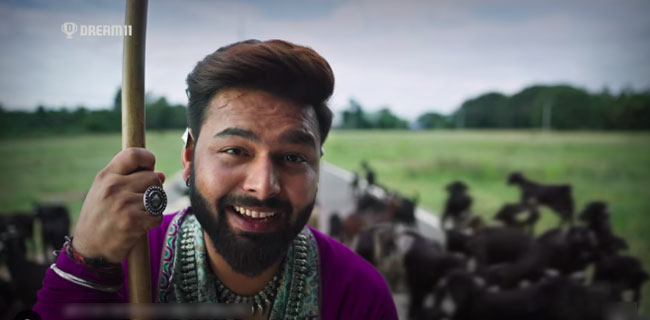
    And am I glad that Dream 11 is an exception that survives. Because it’s the only piece of communication which stands out with a good thought ”Uthana hai to uthana padega” (If you have to lift, you have to get up), alluding to the cricket heroes having to make an extra effort to lift the cup.

    Not only is the thought interesting its execution is also spot on by using the out-of-sight-out-of-mind Rishabh Pant as the anchor exhorting his teammates.

    Or does it point to the fact that Rishabh Pant is the next Virat Kohli or Dhoni in terms of his status and acceptance by the Indian public?

    Talking about execution there were two ads that I saw which had interesting thoughts. But the execution left a lot to be desired. First was Oreo. The thought of ‘mat bol’ (do not speak) captures the Indian thinking of ‘nazar lagna’. Of not talking about something because if we do then it won’t happen. It will be jinxed. And it sounds eerily true if one looks at all the campaigns run in the last decade which were in the hope and build up to India winning the world cup. But the straightforward mouthing of the concept by Dhoni and no creative leap points to a wasted opportunity

    The second one is Kit Kat. They have used the thought of fingers crossed. Though, my first thought was “fingers crossed” Indian enough for the masses to understand? The execution was better than Oreos straightforward narration but this too was a case of missed opportunity.

    But wait, I discovered that Kit Kat had done an exactly similar campaign in the UK in 2010 hoping England will win the Football World Cup. Well, so much for originality and creativity. And the gall to use a jinxed thought!!!

    It may also point to the fact that account planners are playing a bigger role in brand strategy. But were these ads also scripted by account planners? Oreo sure looks like one.

    On Kit Kat, one thought. Why doesn’t Nestle use Mrs Rohit Sharma? In almost all matches, not just at World Cup but even much before, my lasting image of hers has been sitting with her fingers crossed on both hands. She will be the best brand ambassador for fingers crossed. You read it here first, Nestle.

    And Dhoni is still endorsing more brands than the Rohit Sharma. Does it mean that Rohit is not as bankable, even though he is breaking records and is the Indian captain?

    I daresay that Bumrah seems to be more bankable than even Rohit. After Kapil, Sachin, Dhoni and Virat he is the next Boost endorser. And also Thums Up. Now, which brands have I seen Rohit Sharma endorsing? Hmm, let me think. An airline… was it Emirates? I think I saw him in a frame of Bookings.com too. But I saw Rahul Dravid also being used. And not many brands used Rahul, even during his heydays. You draw your own inference.

    Then brands like Booking.com and Mak Lubricants were desperate to connect to cricket. Howzatt for the perfect stay. Huh! Seriously?

    There were Parle brands like Kisme, Kacha mango bite, platina… but I forget what they were all about. Same for Sting. Or MRF. All eminently forgettable. And guess what, Sachin has ditched MRF for another tyre brand. Was it Apollo? Or did MRF ditch Sachin? Musical chairs, I say.

    But the other brand which caught my eye was Herbalife. Not for its insight, nor for its strategy and definitely not for its execution. But for the fact that it has used varied sports stars giving them equal prominence and weightage. Manika Batra, Mary Kom, Smriti Mandhana and Virat Kohli. It has also used Ronaldo for a long time. It was not a Kohli-dominated ad and Kohli just happened to be in it like all others. Brave decision. Because I am sure it must have paid many more times the amount paid to Kohli than others and still to resist the temptation not to give him a higher exposure is commendable.

    Amul must have been worried that it’s a jinxed sponsor given the results of Sri Lanka and Afghanistan. But last night’s result would have given it some relief. And of course South Africa is its trump card.

    My reckoning is that Disney Hotstar, did not anticipate the India-Afghanistan match to last for 85 overs. What otherwise explains the fact that close to end of the match, when 2 crore people had switched on the live streaming, they ran out of advertising inventory. While, when Afghanistan was batting and at the start of the Indian innings, with live streaming figure fluctuating between 90 lakh to 1.5 crore most of the advertising was scheduled. Go figure.

    And for the India-Pakistan match, I had both my laptop and my mobile switched on to Disney Hotstar and both had different inventory of ads. How does this happen? Different streams within digital too?

    So, are there any conclusions. Yes, one big one. Advertising in the times of digital is getting swayed by all digital parameters. It’s about measurements. It’s about brand presence. Disney Hotstar displays a figure of how many people are watching the livestream next to their logo on the top right-hand corner. And I think brands reach orgasam with such figures. Big metrics which run into crores of viewers (read measurable metrics) means everything. What happened to brand building? What happened to storytelling? Did those crores of people even register your brand? Or did they even connect with it?

    What else explains that almost all ads were straightforward presentation of benefits. Statement of facts. The types of services offered. So Lendingcart.com ad had no differentiation. No insight. No emotional benefit. It could have been and ad for Groww for all you know. That’s what Oreo did. Got Dhoni to mouth some superstition and then tried desperately to connect with the brand. There were some big brands. MRF, Parle, Pedigree…none tried any bonding with its target group. None tried to connect. No story telling techniques like twist at the end, stimulus response or even building momentum was used.

    Some brands may not feel the need to build a brand or differentiate. They may think they already have a strong positioning and they need to be just reminder brands. Maybe that’s why Finolex Pipes or Avalon cycles just used static presence of the brand name and maybe a line. But do all brands fall in this category? Categorically, no.

    And then the industry moans that it is losing relevance and not attracting talent or not getting enough remuneration. What you dish out is what you get. It’s not a chicken or an egg syndrome. It’s not a vicious cycle. Break the cycle. Start building brands. Rediscover the art of storytelling.

    Maybe I am jumping the gun. Maybe the next few weeks will prove me wrong. I did see some new ads in the India-Pakistan match from Credit Bee, Thums Up and Snickers. More about the same next time.


    Vikas Mehta is a senior marketing services and business strategist and educator based in Dehradun. He writes on MxMIndia every other Monday. His views here are personal.
     

  • A trip through an Urban Bharat landscape


    With apologies to none at all


    By Vikas Mehta


    Vikas MehtaI have always preferred bus trips wherever possible as it leads to some interesting observations of semi-urban and rural India: Bharat and Urban Bharat. And these observations lead to some very interesting insights. So, last week I got a chance to do a bus trip from Delhi to Dehradun, all in broad daylight. The unfortunate part was that the trip was non-stop, except for a five-minute relief break, so I could not take as many photos I wanted to and could not speak to local people. And as most of the photos were from a moving bus, they were all not as good as one expected. Most of what I am writing are observations and not insights, if you understand the difference between the two.


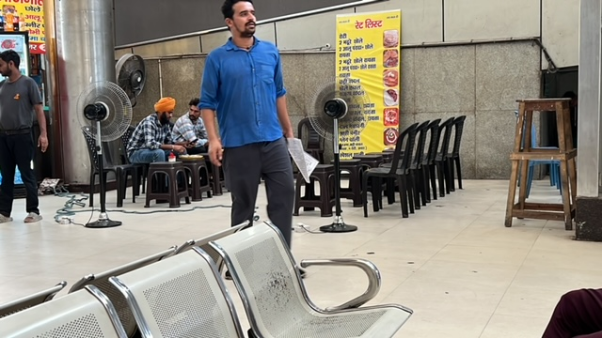
    My experience actually started at the Delhi ISBT (Inter-State Bus Terminal). This place, in lot of ways resembles a mini-Bharat and Urban Bharat. And the first thing I noticed was Jugaad. There are lot of shops selling snacks and also some staple Indian dishes like Puri-Alu or Rajma-Chawal, inside the passenger terminal. But this time I saw that a few of them had taken over empty spaces, put up two-three big fans, placed some chairs and stools in front of them so that the passengers could be lured into this cooler oasis and empty their wallets. I am sure the set-up was illegal as it was temporary, but it had the feel of a dhaba with some waiters trying to get customers inside.


    And then there were the booksellers. Selling pirated books. In two-three languages. Hindi, English and Punjabi. They could understand with your dress and luggage if you were an English or vernacular bookreader. I was approached by two sellers. Both had sorted out English books before they approached me.


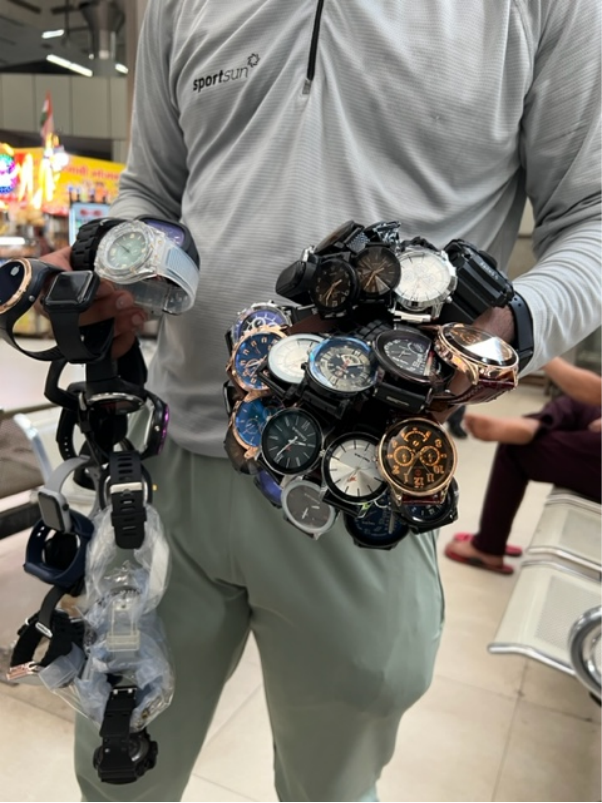
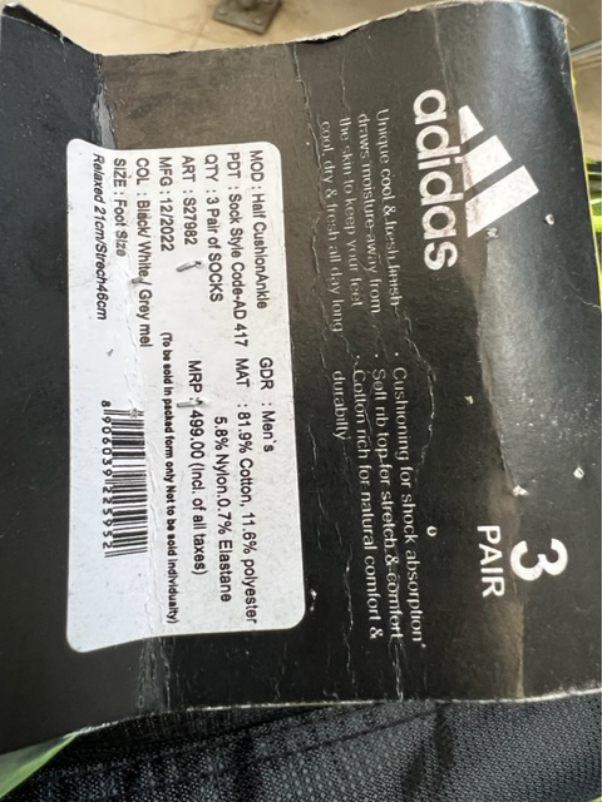
    There were socks-sellers and watch-sellers too. Again, all fake stuff but with the real label. The price printed for Adidas pack of three was Rs 499 but these were being offered for Rs 250. I bought one pack, without any haggling and the vendor therefore opened up a bit to me.


    According to him, these were bought for Rs 150 from some wholesalers at the Delhi borders. The vendors pay protection money of Rs 200 per day to some people at ISBT. Sellers like him manage to sell about 10-12 sets each day. There is haggling and per set anything between Rs 75-100 is profit. The travel cost and lugging of the same means about Rs 150-200 per day. So, at the end of the day. They are left with an earning of Rs 1000-1500. I asked him about his education. The guy was a BCom and so were the others, he said. They spend about 12 hours on their feet selling socks or fake watches. Or fake sunglasses. They come from villages in Haryana and UP and lack of jobs force them to come to Delhi and take up this job.


    I asked him what he hated most about his job. Lack of respect, he said. People are rude, haggle endlessly even if they have no intention of buying and are too smug in their own way. He then muttered “Maybe because they have a job, can afford to travel by AC buses, eat aloo-puri and drink Coke whereas I can’t afford to do the same.” “I do make decent money,” he added, “about 25-30k a month but it’s a back-breaking job and lack of respect hurts.” Plus, there’s the dealing with the protection gang, authorities raids when they seize all the goods, all that adds to the burden. He also confirmed that the stalls putting up eating areas was all controlled by the protection mafia in cahoots with the authorities. See photos below


    I used the socks. The quality as well as the branding on the socks sucks.


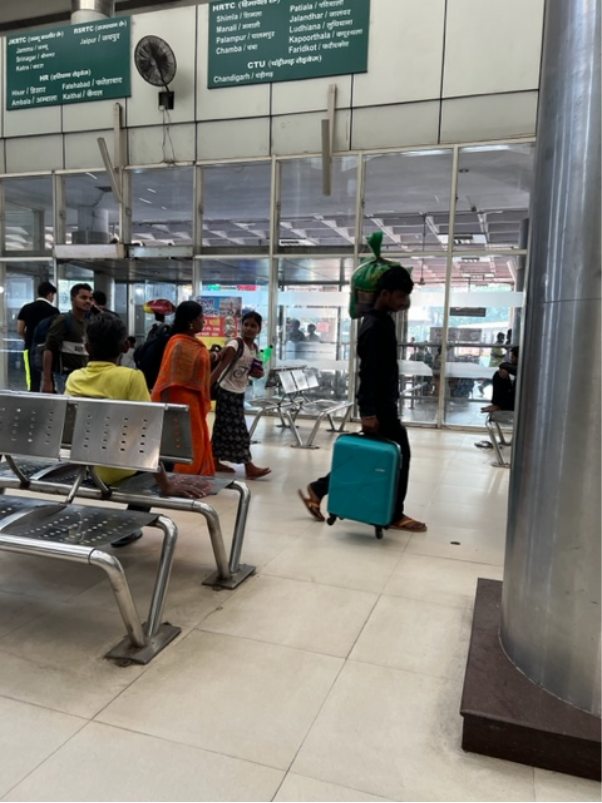
    ISBT also offers a kaleidoscope of clothes, both Indian and western, a smattering of various languages and a variety of luggage. Not just in terms of merchandise but also attire and accessories that passengers use. Lot of fake clothes, shoes etc being worn and a lot of mix of old and new, modern and traditional, utility and jugaad. This picture below really says it better than words. A traveller with a VIP strolley in one hand and a polythene gunny bag with god knows what on his shoulder.


    The first thing that hit me about an hour into the trip was the development that has happened on the route. I have been doing this route since my childhood. The route has changed with many bypasses and freeways that have come up. But the development along the route ensures that nothing remotely rural can be seen from the bus. Sure, one does get to see sugarcane fields, some fruit orchards, but these are all vanishing. As connectivity improves, land prices go up, the farmers realise that they are well off selling their land at good rates and starting some business. And the best business to start along highways is restaurants, dhabas and resorts. And therein lies a tale.

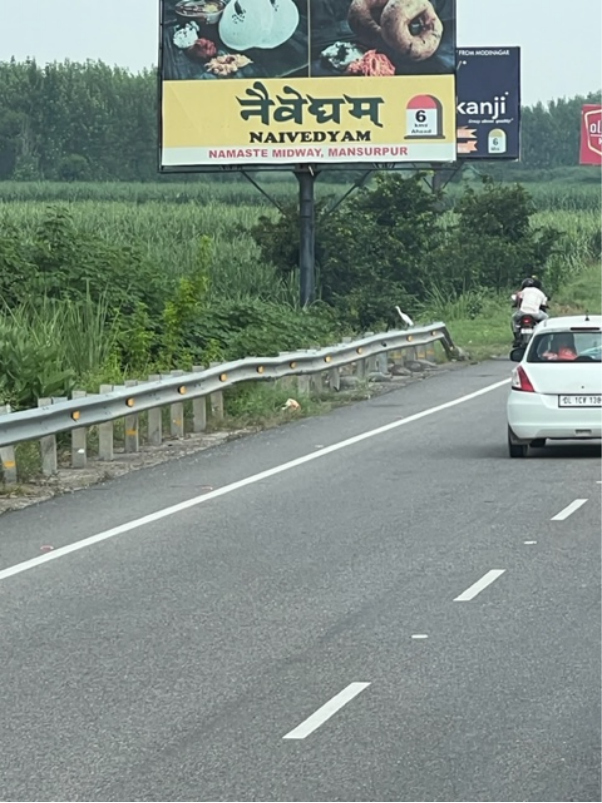
    Hardly a kilometre passes when you don’t see a dhaba. Eating spots of various cuisines, novelty items and amenities exist. And there are some interesting lessons in their branding and communication.


    Since this is the highway to Doon, Haridwar and then onward to Char Dhams of Kedarnath, Badrinath, Gangotri and Yamunotri, most of the dhabas are vegetarian. And to cue vegetarianism, they give all types of religious names to the dhabas. From the mundane, Krishna or Hanuman or Shiva or Dwarka to the more innovative ones like Mahalaya or Natkhat or Mahakaal or Rudraksh. Then there are the ones which cue masculinity. Pehelwan or Sardar or Nambardar. These serve non-vegetarian too. Some cue the cuisine with speciality cuisines like Marwari or Jain catching the eye.


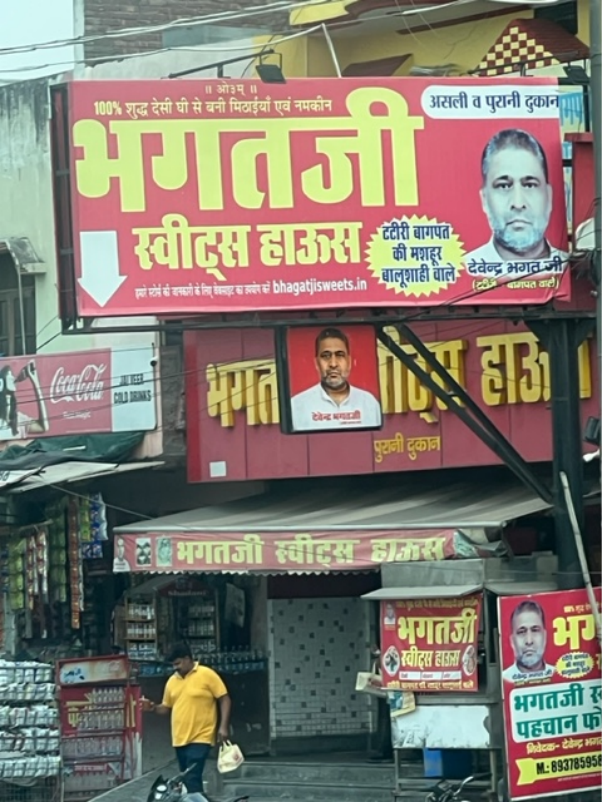
    Besides the name, the differentiation is happening in the offerings too. Jain Shikanji is famous for its Shikanji, a cool Indian drink that one looks forward to in summers. Today, it is a full-fledged restaurant offering all types of cuisine but still calls itself Jain Shikanji. Of late many other Jain shikanji wannabes have arrived on the scene. So this guy has put his photo on the restaurant, hoardings, any piece of communication, saying look out for the photo to recognise the true Jain Shikanji!


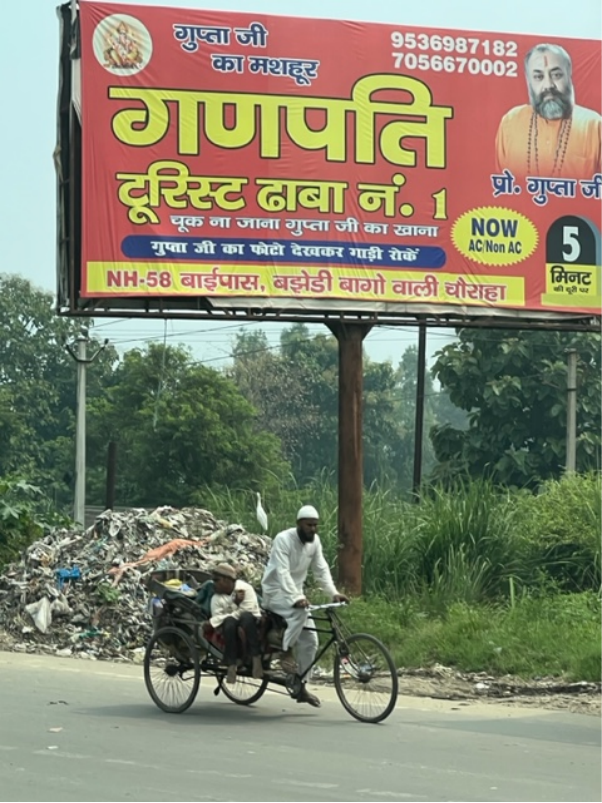
    And that’s a communication trick that many restaurant owners are following. I have seen restaurant-owners proudly declare that they eat in the restaurant and it has added to the credibility of the place. I have seen CEOs and owner of companies appearing in ads like the famous MDH owner or even Lee Iacocca of Chrysler, but here it’s just the photo of the owner being used to cue that this is the famous “fill in brand name”. Hoardings for Shiva Dhaba, Ganpati Dhaba, Jain Shikanji and even Bhagatji sweets dotted the highway.


    The other interesting thing about these desi entrepreneurs was that they had opened more than one outlet. Maybe it was franchised but I saw at least two-three of the above-mentioned brands in different locations.


    Another interesting aspect of the communication is that almost all of them showed a milestone. It was not about how far it was but about how long it will take to reach them. And mostly these hoardings would appear from 25-30 minutes away.


    Interestingly, some outlets which have by themselves become famous elsewhere have also opened on this route. Like Murthal parathas which have become famous in Haryana on the Sonepat highway are being aped by a local dhaba.


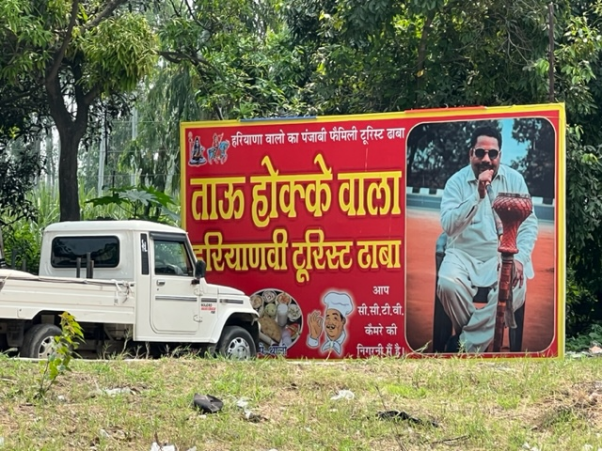
    But my favourite name and communication is in the picture below. It also shows the owner but his name and association is unique.


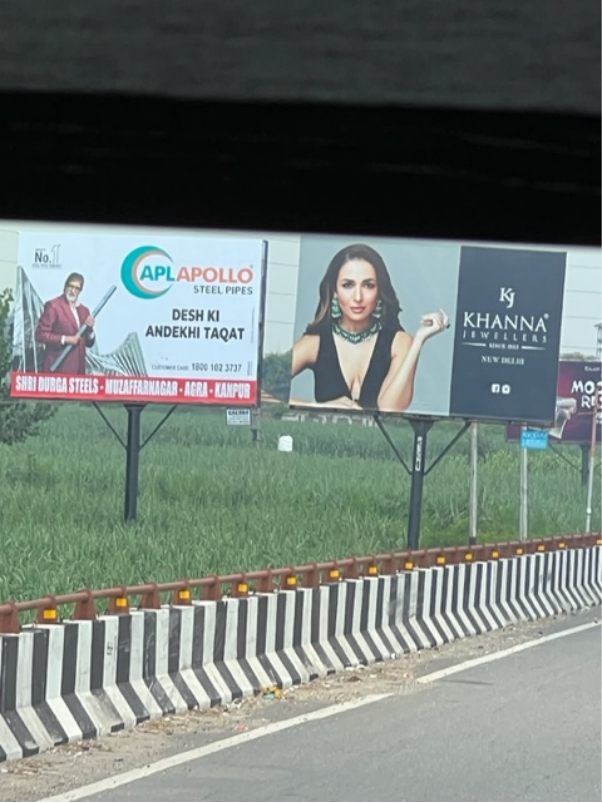
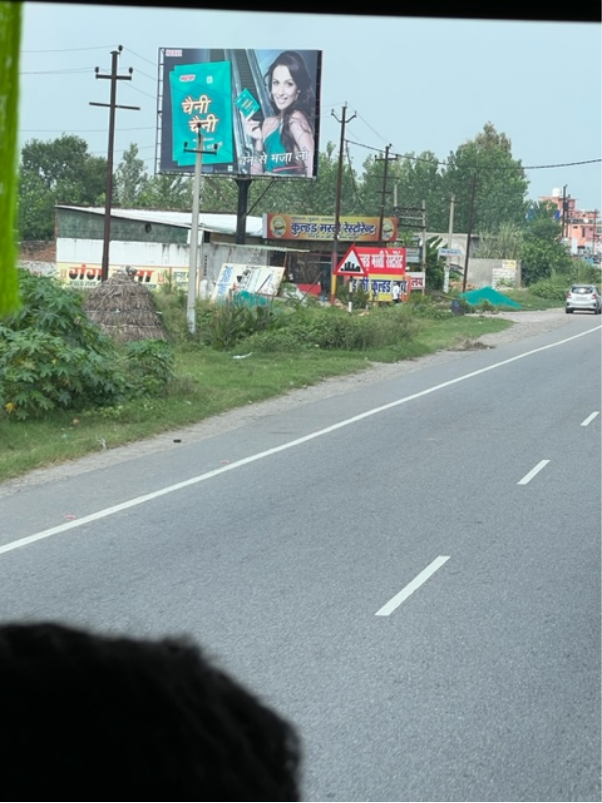
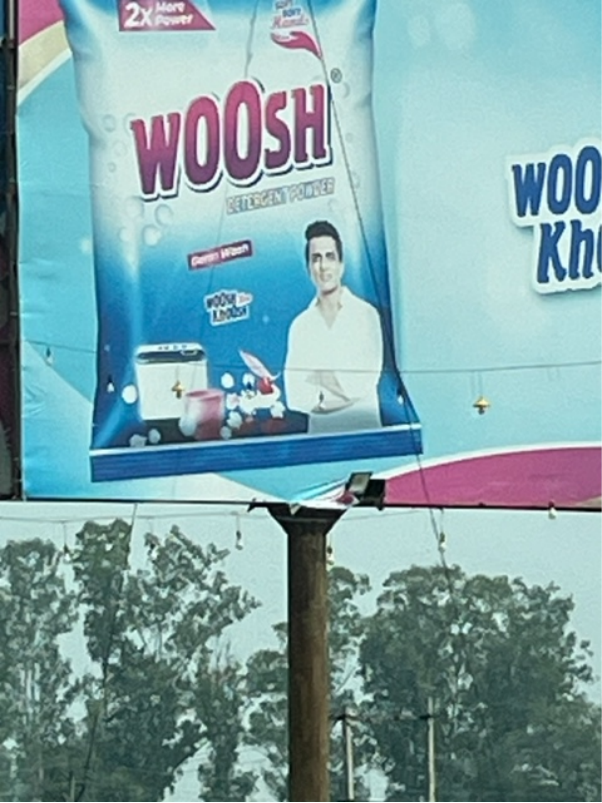
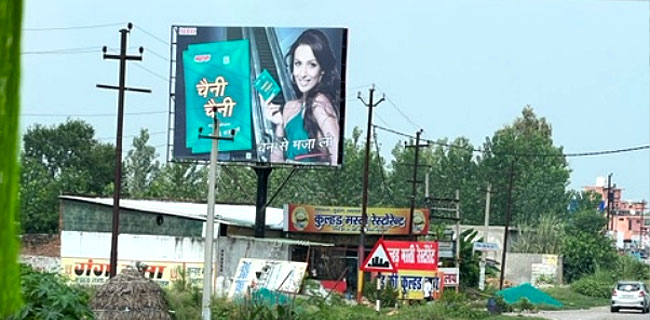
    During the trip it was quite fascinating to see the use of celebrities. I hardly saw any cricketer being used and not many top Bollywood personalities were on display too. Sure Akshay, Shah Rukh, Amitabh, featured in national brands like Apollo Pipes or Vimal Elaichi or Dollar vests. But it was celebrities like Sonu Sood in a detergent hoarding or Pankaj Tripathi promoting Lux undergarments or even Malaika Arora in Chaini Chaini Pan Masala who stole the show. Most of them were endorsing more than one brand. And not just national brand but also local brands like Swoosh detergent or Khanna Jewellers. Ajay Devgun was also very prominent as brand ambassador for many brands. I guess it was the raw earthy appeal of the male celebrities that was a major pull. Not the sophistication or urbanness of other endorsers. And of course, not to underestimate the raw appeal of Malaika Arora.


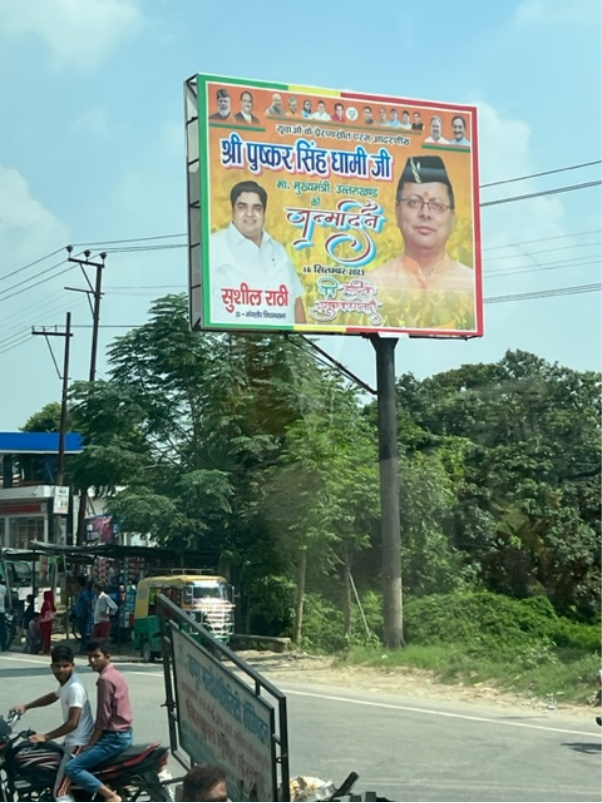
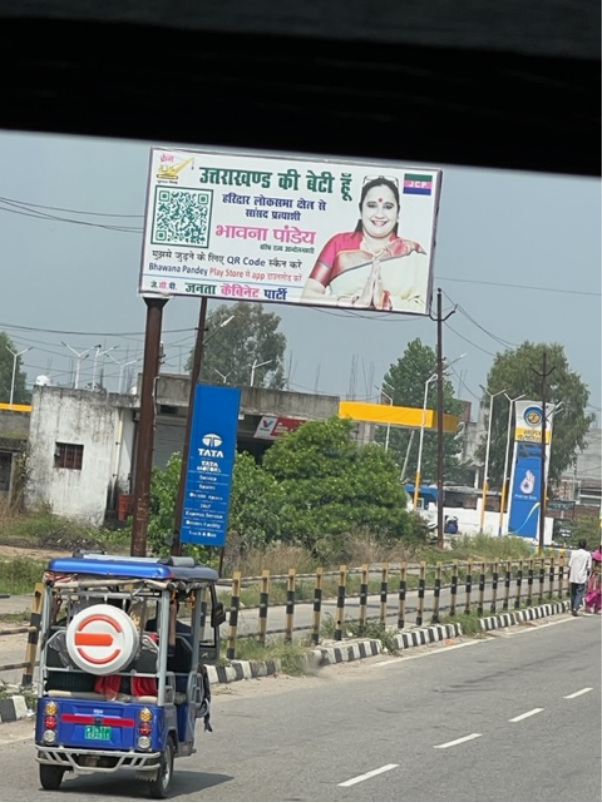
    While the celebrities enjoyed the limelight, politicians were not too far. Candidates were already lining up to highlight their candidature for the next elections. And smalltime politicians wishing the CM or the PM on birthday was not to be missed.


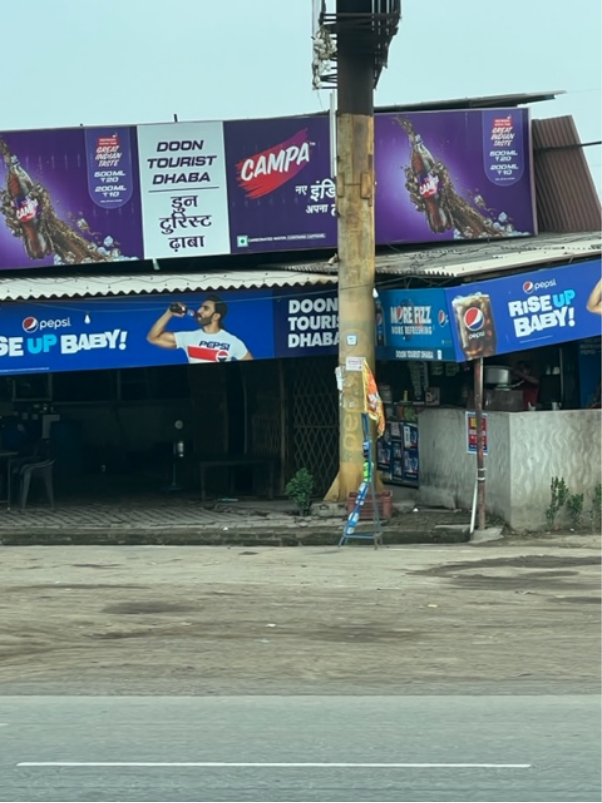
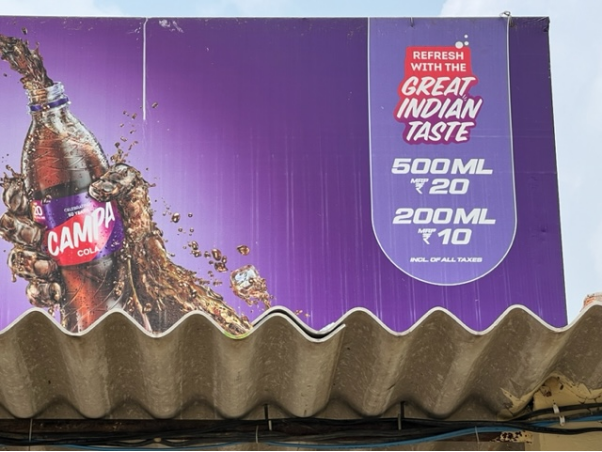
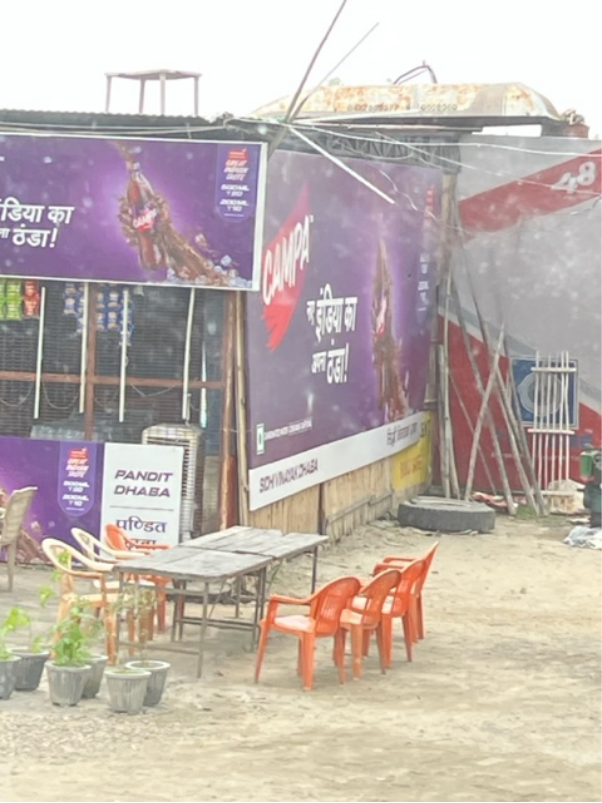
    I am sure most of you readers who are residing in metros have heard about the acquisition and the launch of Campa by Reliance Retail. But have you seen the product or its communication? The one brand that was ubiquitous in its presence throughout, be it wall paintings or restaurant signage or just plain hoardings, Campa had outsmarted both Pepsi and Coke. It had cleverly overshadowed Pepsi in some places and seemed to be the default soft drink through the route. It has an interesting line, Naye India ka apna Thanda. Clearly it is capitalising on the nationalistic mood and the Amrit Kaal fervour. And it does not fall shy of communicating its cheaper, sorry, competitive pricing too. At the five-minute stop, I asked the dhaba guy about Campa. He claims it sells very well because of its price and though it still has distribution and therefore availability issues it is giving Coke and Pepsi a run for their money. While Coke and Pepsi with big endorsements and advertising budgets seem to be going strong, it looks like Reliance Retail is building a solid foundation at the ground level.


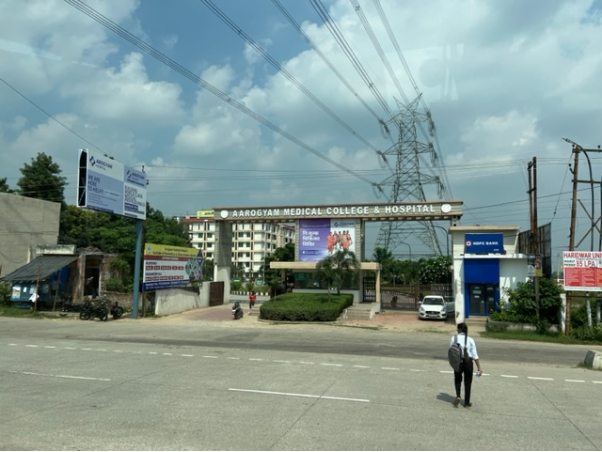
    Talking about nationalism, the impact of ayurveda was visible in outdoor communication and branding of various categories. An allopathy hospital was called Arogyam. Wall paintings associated with Gupt Rog (cue sexual illness) which have been omnipresent all along Indian highways for a long time now have an ayurvedic slant. Even some vegetarian restaurants had ayurvedic-sounding name. Near Haridwar there was a housing society calling itself Amrit Arogyam. The marketing and communication bug has not escaped Urban Bharat or even Bharat.


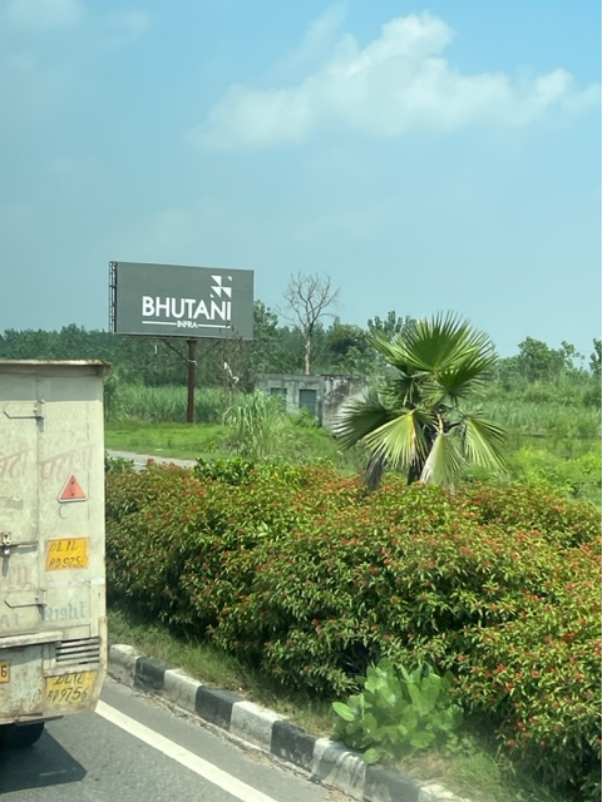
    Almost everywhere it was the local brands which stood out in their presence and communication. Be it Tehri TMT Bars or Tirupati Pipes, or even Bhutani Infra, these brands were present right throughout UP and Uttarakhand part of the route.


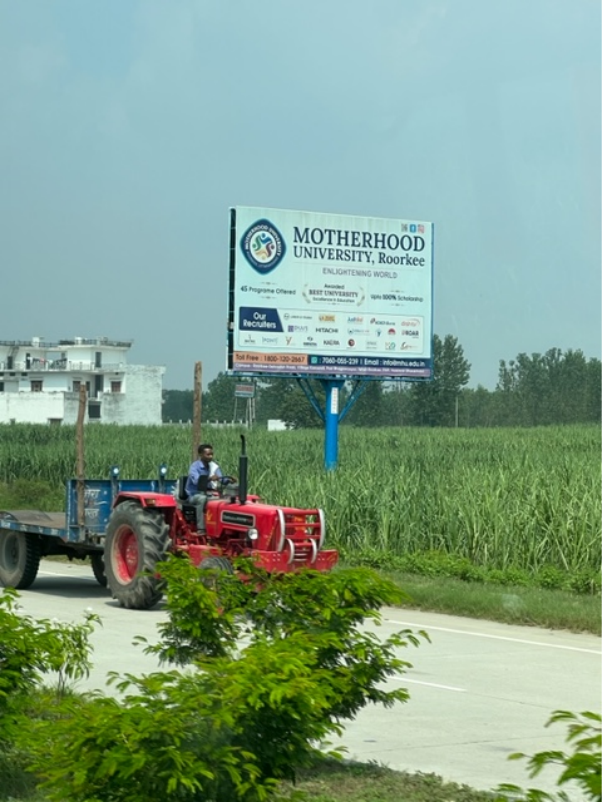
    As far as local brands are concerned, the education sector was dominant right through the route. I lost count of UG, engineering and management institutes that I saw on the way. Almost all were private deemed-to-be universities or colleges. And there was no shortage of private schools too. Motherhood University or Om Group of Institutions, here also branding was critical. It mostly had English names cueing a western approach or some had acronyms which sounded very western.


    But it was the school names that took the cake. Almost all had English names. Some even French-sounding and some outlandish. I mean a school called Good News School or called Laureate School. How many teachers or students would pronounce that correctly. In a country, where the dealer of Renault calls it Renolt and not Reno (right pronounciation), my mind boggles on what Laureate school would be called.


    As you can see, my four-and-a-half hour trip passed in a jiffy. There were some more observations like the presence of a many hoardings advertising a helicopter service to see the Himalayas, cashing in on the Char Dham route. Or wall paintings by Finolex Pipes wishing all Char Dham yatris a safe trip.

    But the one insight I got from all these observations is the importance of branding that is catching on even in Urban Bharat or Bharat. Culturally, we take our names seriously. It’s not just an art but also a science on how we name our children. The same seriousness is now going in the naming of various products and services. Who could have thought of a vegetarian restaurant called Natkhat (Naughty as in Lord Krishna ) or a school called St Kabeer. Do you call it Saint Kabeer or Sant Kabeer? Go figure.


    Vikas Mehta is a senior advertising professional and now a branding and business strategist and educator. After having worked in various geographies, he is now based in Dehradun. His views here are personal.


  • Vikas Mehta: The changing temperament of citizens

    With apologies to none at all

    By Vikas Mehta


    Vikas MehtaI have been a Urban Bhartiya citizen, living in Dehradun for almost 10 years now. Urban Bhartiya because while mid-size towns like Dehradun retain a local and slightly rural oriented stance to culture, traditions and habit, it has been quick to adapt to urban modes like consumerism, lifestyle and new products.


    The one area where Urban Bharat seems to be degenerating is unfortunately neither a rural nor a metro city phenomena. It is more a function of the change which has been sudden and not gradual. The rise of impatience and temper. Everyone seems to be having a short fuse and is in a great hurry.


    Cities like Dehradun were famous for a leisurely, almost lazy lifestyle. Shops would not open before 11 (they still do not) but would close by 7 (now they are open till beyond 9). And it was not uncommon for most shops to close for lunch for two hours in the afternoon. People would not commit to a time. I will see you around 12-12:30, was the common refrain and no one would bat an eyelid if that would become 1. Traffic was far and few with two-wheelers, also of the non-motorised types being more visible. There was no rush to overtake or to be ahead. Indeed, to a metro visitor, it would seem that the Lucknowi tehzeeb of ‘pehle aap’ was evident on the road too. And early mornings and evenings had more brisk walkers than traffic on the road. Polite small conversations on the road were not uncommon. Polite eye contact, recognition and acknowledgement, care for each other, exchange of festival greetings… all was par for the course.


    While the change was already underway when I moved to Doon, the situation has deteriorated quite rapidly in the last few years. Yes, unplanned growth and urbanisation is the primary cause of impatience and a sense of anger in almost everyone, but I think there is much more than meets the eye. The city is going through some major changes.


    From being a city that prided itself on individual houses to a city which is now being overrun by flats and apartments.


    A city that had narrow lanes which did not seem narrow for two-wheelers or walkers to a city, which still has narrow lanes but has now been dwarfed by four-wheelers of all sizes.


    A city where time was measured maybe in hours to a city, where every second now seems to be like an hour.


    A city which regarded tourists as guests to a city, which looks at tourists suspiciously like outsiders.


    A city, which was actually a village at heart with a sprawl of a city to a city which thinks that being smart is its pride. The city it seems is becoming too smart for itself.


    Primarily, the change is happening because of narrow outlook. Both literally and metamorphically.


    Maybe we are feeling hemmed in and claustrophobic. Both literally and metamorphically.


    Maybe there is a sense of being overrun. Both literally and metamorphically.


    Maybe there is a fear of missing out. Both literally and metamorphically.


    And maybe there is a true sense of alienation. Both literally and metamorphically.


    That is why, a two-wheeler driver is always angry because s/he is not happy being elbowed out.


    That is why a four-wheeler driver is on short fuse because s/he is not allowed to dominate the small lanes.


    That is why a walker refuses to acknowledge a co walker because they are fighting for the same limited space.


    That is why a visitor is looked at upon as an intruder because he is buying property and driving prices up.


    That is why there is anger and sadness to mass cutting of trees because the locals think it is only for the benefit of the tourists.


    And that is why the smart city project is dragging on because no one knows if the negative connotation of the word smart as in “smart boy” is what the city should look forward to.


    It’s uncanny how the physical change in a city can spoil the mood, behaviour and temperament of the city.


    We talk about consumer behaviour from a viewpoint of culture, language, tradition etc. But physical transformation also affects our behaviour.


    Frankly, it also tells us how much wrong is happening in the city.


    And I suspect a similar story is being played out in other Urban Bhartiya cities.


    I don’t know if a similar trend played out in the metros but I suspect the metros had never seen the ill-effects of a big unplanned city. They just did not know what they were getting into it.


    But we, the citizens of Urban Bharat, have seen our metropolitan cities. And we are seeing our small towns careening towards exactly the same place.


    So, we are mad, bad and definitely not glad.


  • Hospitality sector – no more hospitable?


    With apologies to none at all

    By Vikas Mehta


    Vikas MehtaAbout seven years ago, I planned a Europe trip for my family with a global travel agency, Indian-owned which had done a reverse acquisition of a more-than-100-year-old European parent company. The company was owned by Indians but headquartered in the UK. I took a bus tour package of 18 days covering seven countries and had paid the full amount which had run into a few lakh, got the necessary visas and were now just two-three weeks away from the departure date. The payment etc was facilitated by the agency’s office in Dehradun, where I stay.


    At that point we got a call from the travel agency’s head office in India, informing us that the tour beginning date that we had chosen was not operational and they gave us two alternative dates, both before the designated date. This was not acceptable to us as on those days schools were still on and both my daughter and wife would not be able to make it. But the agency was adamant saying it had no other dates as rest of the trips were fully booked. And then the customer representative threw the rule book saying that according to terms and conditions that we had signed on the agency could change the travel dates. The arrogance and take-it-or-leave-it approach was shocking. We were caught in no man’s land and a cancellation would mean forfeiting 50% of the money.


    The attitude of the travel agency was huge and crushing. Specially for my daughter. My regular readers will recall my earlier articles where I have emphasised on how we Indians do not take customer service and consumer rights seriously and give in too easily. In this case therefore, my basic instincts kicked in and I wrote an angry email to the Indian CEO of the agency in London detailing the arrogant and one-sided approach of his company.


    I was completely taken aback when I got an answer within a few hours from the CEO himself. He not only apologised for our experience but also informed me that a senior executive from Mumbai will call me and sort out the issue to our full satisfaction. And within an hour I got the call. The gentleman apologised profusely and then made us an offer. We will go for the tour on the dates that we had booked. We will follow the exact schedule of the trip with all inclusions as promised. The only difference being that the trip will not be in a bus but in a private vehicle with a chauffeur driving us for the 18 days and a local guide will accompany us at each destination. Just for us. In our vehicle.


    It sounded too good to be true. No? But it exactly happened that way. We had a seven-seater Mercedes van with a chauffeur for all the 18 days and each destination had a local guide, a three- or four-star hotel accommodation and we were driven to all the tourist spots. It was a royal treatment that we will never forget.


    So, why am I recalling this episode in such details now?

    Because I think the hospitality business in India has forgotten what hospitality is all about. We have a culture which says Atithi Dev Bhavo. A guest is like god. But nowadays a guest is treated like a lemon. Squeeze as much out of /herhim as possible and then discard her/him. In the service industry and specially in hospitality, one of the first principles of marketing is (getting a) repeat consumer. Make the consumer happy so that s/he becomes loyal to you. And keeps on visiting you again and again. It is also a fact that a loyal, happy consumer is cheaper to service and maintain than acquiring new consumers. And for that the attitude of happy, satisfied consumer at whatever cost is the uppermost priority.


    Take my example. After that episode where do you think that I went for my future holidays and travel bookings? And I shared this episode with all my friends and family. Where do you think, they went for their holiday bookings. Positive word-of-mouth is the second principle in the service industry. And in hospitality, word-of-mouth recommendation is worth its weight in gold. That’s the reason almost every marketing campaign in hospitality has an element of satisfied testimonial from consumers.


    I once remember at the one of the Taj restaurants, my kebabs were replaced without even asking as I had got busy talking on my mobile and these had gone cold. It was not the restaurant’s fault and yet they stepped in. Or at the Oberoi, where when we ordered a basket of bread comprising three different types of rotis, they just got a quarter each and brought fresh quarters as we finished off the hot ones. Nobody would have complained if the Oberoi restaurant had not done that. But then Taj and Oberoi are in a different league, most of the other five-star luxury hotels do not fall in the same league.


    And things seem to have changed for the worse, in the last few years. Even when the brands are at fault. The focus has shifted to buying loyalties. Loyalty programmes with their digital reach have become more important. Today, we talk about digitally generated word-of-mouth which has numbers but no empathy.


    It’s not about the bang for your buck but just your buck is what matters. As a result, short term profitability, immediate targets and lack of empathy seems to have become the norm. Arrogance has crept into the hospitality sector. Humans have been reduced to just a number. Let me give you three experiences that I have had in the past few weeks.


    We had a family get-together in Doon where my sister-in-law had come down from the US. We decided to throw a three-in-one party to celebrate three landmark birthdays which all were happening within a few months of each other, for my daughter, my mother-in-law and my wife’s niece. We chose a five-star hotel brand rooftop for a celebration with about 40 invited friends. Incidentally, we had a horrible dining experience at a premium property of the same brand last year. But since this was a different property, we went ahead with the event.


    And it was quite a sad experience. The service was slow and poor. The place leaked like a sieve when it rained, so we had to shift our tables two-three times. And worse was that a senior staff member who volunteered to help out was actually suffering from conjunctivitis. When I confronted him, he quietly disappeared. But can you imagine this happening in a premium hospitality brand? And the arrogance of the F&B head had to be seen to be believed. Inspite of all the troubles, we paid and cleared our bill in full immediately after the event. From the property there was no apology or even contrition.


    Next day, I sent a detailed mail to the property GM and also to the brand’s India CEO. There was no reply for 48 hours. I then sent another strongly worded mail and that’s when things started to move. The VP operations called. Apologised. Promised to look into the matter. Made the right noises and then landed in Doon four days later, on a routine trip. He invited us over to the premium property. Became a gracious host. Fed and hosted us in a yet-unopened-to-the-public bar. Again, made the right noises. Apologised, but threw up his hands in despair as the property where we were hosted was a franchised property and he claimed that they cannot do much with that management. Bewildering, as the brand name is of the hospitality chain. And as a consumer, I care two hoots if your business model prevents you from taking someone to task. Instead, we were introduced to the GM of the premium property and were told that he will take care of our any future interaction with the hotel. The GM promptly handed us his card which had his email and the hotel telephone number. I wrote to him on the email address thanking him for his hospitality. There was no response. Would you want to make Hyatt your destination after reading this?


    Then, two weeks ago we went on a short holiday to Goa. We have been Club Mahindra members for more than 15 years and enjoyed the new river resort at Assonara. The place was good but lacked in service and the food had some issues. We complained to the executive chef but the same problems persisted. I am not getting into the details, but the resort did fall short of service levels, compared to other resorts we had been to. In fact, we bumped into the CEO of Club Mahindra at the resort who was trying to travel incognito. He asked us to write to him with our experience which we did. And he responded very graciously. He mentioned the name of a senior executive who would look into our feedback. Well, that was two weeks ago. I have been getting messages and mails from Club Mahindra asking me to refer some friends or relatives. Do you think I will?


    The lack of action or any corrective step is glaring. Don’t get me wrong. I am not looking for any freebies or my expectations are not at all what happened during my Europe trip. It’s just that the hospitality industry seems to have strayed away from the core of keeping the consumers happy. Mistakes will happen. It’s how the brands bounce back after the mistake to keep the consumer happy, is what matters. A mere acknowledgement and mouthing of platitudes is not the solution. The tone, the action and the follow up is what matters.


    Finally, we flew back from Goa with Indigo. I need not get into the arrogance of Indigo but when I asked for a Cappuccino as part of my pre-booked meal, I was curtly told that no coffee was available. The reason? It seems Indigo is changing its menu from September 1 so it had run out of stock of some existing menu items. This was on August 20. And the arrogance is that the airline has no compunction or shame in telling me that. When I protested, I was curtly told to send my complaint via the link which I will get after the flight to rate my experience.


    Compare all this with my experience seven years ago. In all the cases involved now, the brands involved needed to maybe show contrition with some simple acts. But they chose not to. And served some platitudes which were right off some training manuals. The lack of intent in hospitality was very obvious.


    Has Atithi Dev Baha become just a tagline?


  • Air India- let’s not confuse logo with a mascot


    With apologies to none at all


    By Vikas Mehta


    Vikas MehtaOk, let’s begin with a question. What is the current Air India logo before the unveiling of the new logo? Simple question and the answer should be simple too. While we are all ranting about the new logo or mourning the demise of the Air India Maharaja, we must not forget to compare like to like.

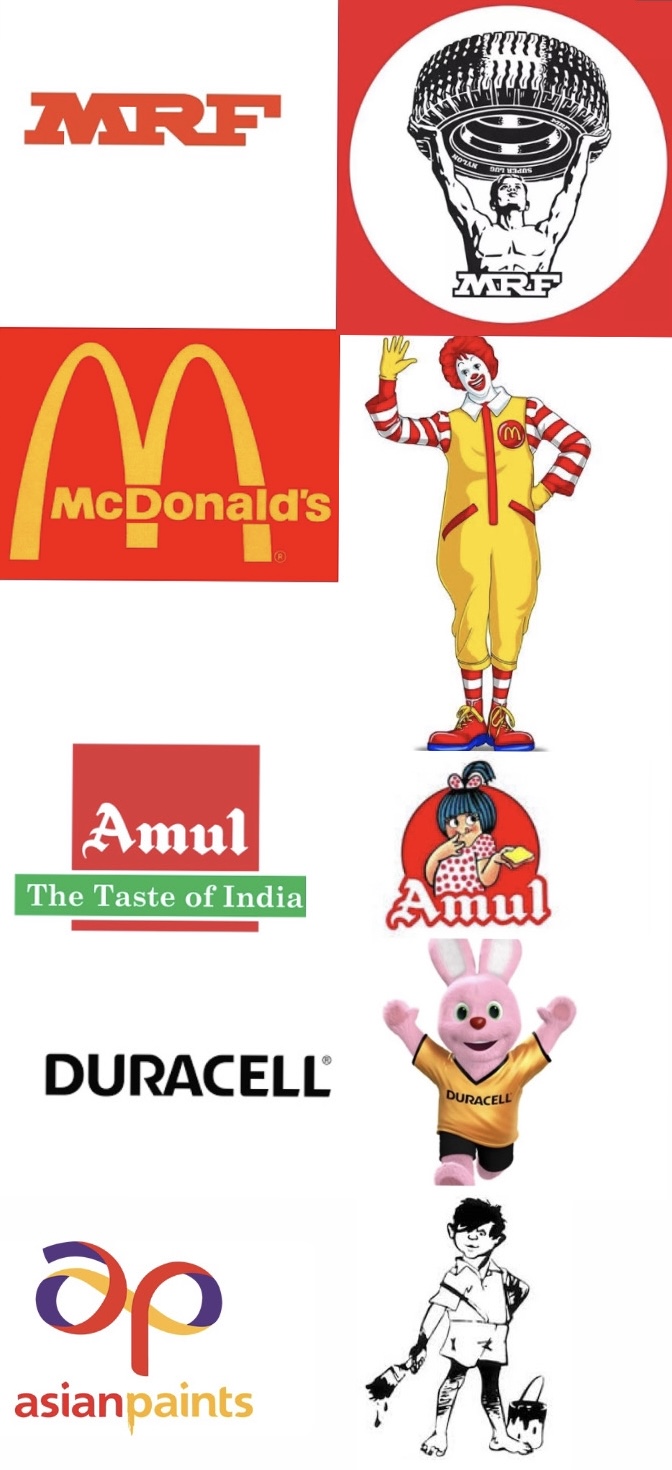
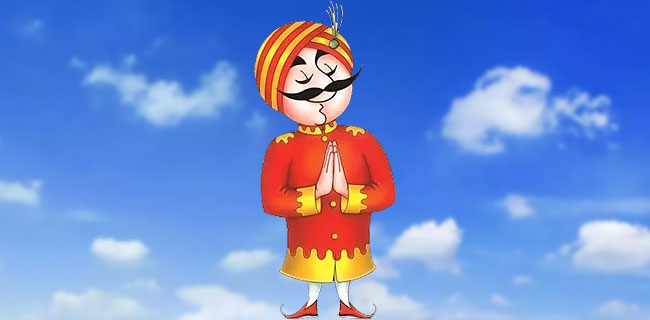
    Let’s get this very clear. Maharaja is not the current Air India logo. It never was. At best you can call it a mascot. I would prefer to call it brand personification. Every mascot, be it the Asian Paint Gattu or the Amul girl or KFC Colonel Sanders or the Michelin man for Michelin Tyres were not brand logos but mascots. Amul’s logo is the way it writes Amul in a distinct registered typeface. McDonald’s logo is its famous M arch. But its mascot is the clown, Ronald McDonald which you will find outside its outlets. Duracell Bunny is its mascot. Not its logo.

    Below are some examples of logos and some examples of mascot of the same brands.

    So, what is the difference between the two and can they be used interchangeably?

    Let’s dive in.

    Simply put, the logo is the identity of the company. It’s a reminder of the brand or company. The name. The mascot defines the value, personality and sometimes even the culture of the company. In a way, a mascot is the extension of a logo. Many companies incorporate the logo in the mascot or make it a part of it. KFC is a good example of the same. So is the Duracell bunny.

    Earlier, brands strived to have a mascot. Even in India, MRF had the muscle man. Cherry Charlie for Cherry Blossom shoe polish. Asian Paints Gattu. Air India Maharaja. These mascots told a story. They were the brand personified. Gattu was the personification of Asian Paints. It was a mischievous boy, maybe a brat who could not stop painting. And in old ads, Gattu painted anywhere. Even used a bald man’s pate. And the tag line that went with Gattu was ‘any surface that needs painting needs Asian Paints’.

    In India, all these mascots worked because the also transcended the literacy barrier. Specially in rural areas Gattu, MRF Muscle man etc stood out as they identified a brand and also what the brand stood for.

    But we must not forget that for all brands with a brand mascot, there were always two elements to play with. Twin identities. One was the brand logo. In many cases it was just the way the brand was written, with a tag line. And the second was the brand mascot. As media proliferation started and media started becoming more expensive with a premium on space or time, something had to give. Mostly, it was the mascot. Because the logo was the brand identity. Indispensable. And over a period of time most brand logos were just the way you write the brand. No separate design element also.

    So, coming back to my initial question. What was the last Air India logo? And in categories like airlines, logos become more important because that’s what you see on the planes. The airlines is recognised by its logo. Air India also went through various logo transformations. I think its most famous logo was the centaur.

    And its last logo, which is in current use, is the swan with the konark wheel inside it. Remember this?

    The new design that Air India has released is therefore a replacement of the same. The vista along with the way Air India is going to be written now is the new logo of Air India. It is not replacing the Maharaja. For all you know, the brand may continue to use the Maharaja as a property in a limited way. Or maybe a different version of the Maharaja which imbibes the thinking behind the new logo.

    I raise this point because I was dismayed to see not just marketing pundits but even national media announcing the death of the Maharaja when the new logo was unveiled. It may still happen. But it will not happen because a new logo has been designed. It’s not about a logo vs a mascot.

    And let’s not forget another point. Logo is not just a design to be seen in isolation. Logo cannot be judged immediately just because of a design element. Logo is what the company makes of it. And it evolves, registers and rules, over a period of time.

    The famous Nike swoosh. When Nike launched it, it was not exactly the current design but close to it. It evolved to what it is today. I am sure, if it was presented to the world then it would have met with outrage as a failed design. Nike was the name of the Greek goddess of victory. So, what had the swoosh to do with that? What Nike did over a period of time was identify the swoosh with its tagline, “Just do it”. Indeed, today the logo is so strongly identified with the brand that the brand name is not necessary when the logo of swoosh is around. Even Nike outlets today just have the swoosh logo outside. The brand name sometimes appears very discreetly in a small corner. Who would have thought of it, then? As I said, it’s what you make of the logo.

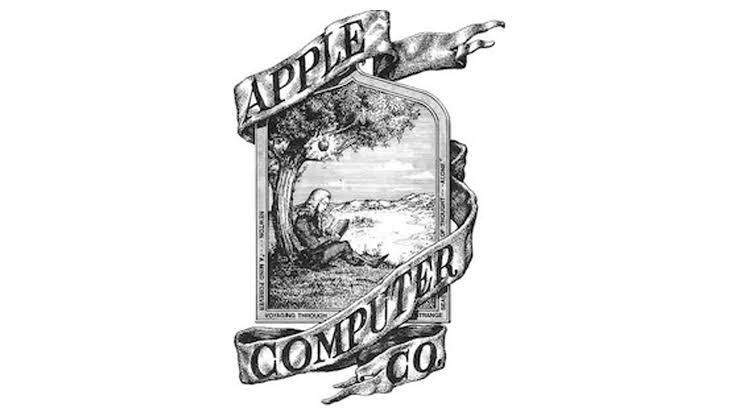
    Or take Apple. Imagine calling a technology company with the name of a fruit. And that too a half-eaten one! But today, Apple is the ultimate in technology and design. And the Apple logo is ubiquitous. Indeed, it’s so famous that in India I have seen the logo being used by even a potato chip manufacturer and as a garment brand too. This logo also evolved and was used in an iconic way on its products too. The logo is so important that a cursory check on Amazon and Flipkart reveal that most of the iphone covers have a punch at the back which reveal the logo. Full covers or covers without the punch are not many. For, who would want to own a iPhone without flaunting its logo. I am also amused that Apple still gives in its product boxes 2 stickers of its logo. And people use it. On their laptop bags, back packs, indeed even on cars and scooters. Again, it’s what you make of the logo.

    I would therefore not pass any judgment on the vista logo. It’s too early to make anything out of it. Even the critique that it’s not Indian is hollow. The brand is owned by a private company. It no more represents India. It’s as private or global as is British Airways or Air France. Why should it stick to representing India?

    How will Tatas use the logo? Will they be more creative with it? Will they strive to make it standout? Or will they just let it be one anonymous airline logo? Indigo has done very well with its logo of the dots as a plane, its typeface and the colour indigo.


    Indeed, even its airline code. It’s not 6E. It’s to be read as sexy. And all that has contributed to the brand personality. But that story is for another day.

    The ball is now squarely in Air India’s court to make the new logo count.


  • Is there enough Tomato in your Puree?


    With apologies to none at all


    By Vikas Mehta


    Vikas MehtaWe Indians have suddenly discovered a new food ingredient. Tomato Puree’ is now the talk of town of the urban and even semi urban Indian. Price of tomatoes is passe’. I actually joked with my vegetable vendor while asking him the price of tomatoes, that will he charge me for just asking the price. The fact is that at the price of a kilogram of tomatoes one could buy 4 kgs of Langda mango in Doon. (Last enquiry showed the price of tomatoes as Rs 250 per kg in my neighbourhood). The big issue today at retail outlets and on ecommerce sites is the availability of Tomato Puree’. I am told that in Mumbai there is already a blackmarket of the exalted product. Retailers are claiming that the demand has gone up by 6-8 times for the puree’.


    Now, I am no cook or an expert in food ingredients. But I was intrigued. Price of basic tomatoes was going through the roof. Every Tom, Dick and Harry worth their salt were asking people to use tomato puree’. The demand for the product had soared. Puree’ was being touted as the next best thing to fresh tomatoes and yet, wasn’t it processed food? Didn’t it have any other additive? And if tomato is costly, anything being made out of tomato should also see a price hike. Old stocks notwithstanding.


    Let me also confess that having worked on food brands, I do have some basic idea about Tomato Sauce and Tomato Paste. But Puree’ for me is a new one. So, I turned to my wife first for some information. I recollect that when we were in Egypt, tomato paste was a common ingredient found in local kitchens and it was used as a base for cooking of many a vegetable dishes. My wife informed me that puree’ is a much thinner version of the paste. It is more natural, less processed and closer to the actual flavour of tomato.


    Next, I looked up the web and found the following descriptors for puree’ and paste.


    Tomato puree is a product made from fresh, ripe tomatoes that are cooked, then blended into a thick liquid just slightly thicker than a typical tomato sauce. However, unlike tomato sauce which can be chunky, tomato puree is smooth and uniform. An acid (like lemon juice) and salt is usually added giving tomato puree a bright flavour.


    Tomato paste is a concentrated form of cooked tomatoes, where tomatoes are cooked, strained and recooked until most of the liquid has evaporated and the tomatoes reach a thick, pasty texture similar to toothpaste. Because tomato paste is cooked for a longer period of time, it has a deep red hue and sweet flavour thanks to the natural sugars present in the tomatoes. Like tomato puree, store-bought tomato paste may contain added acid and salt.


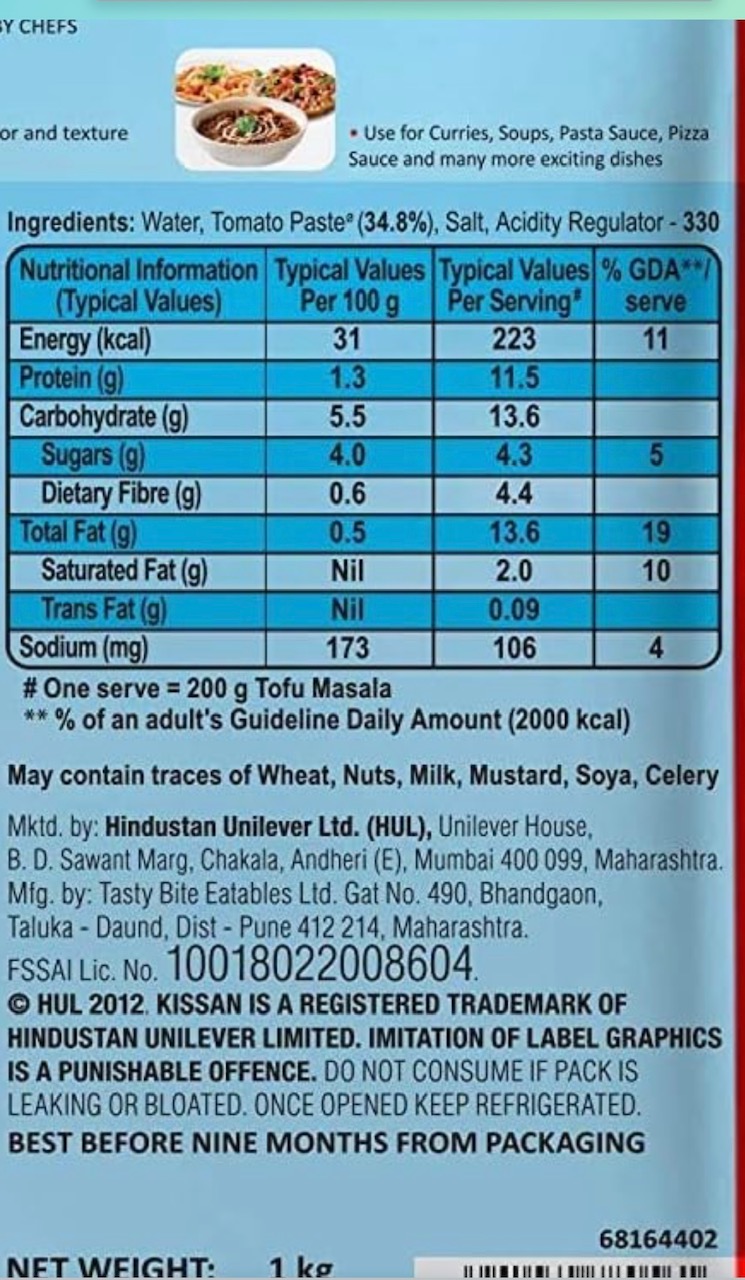
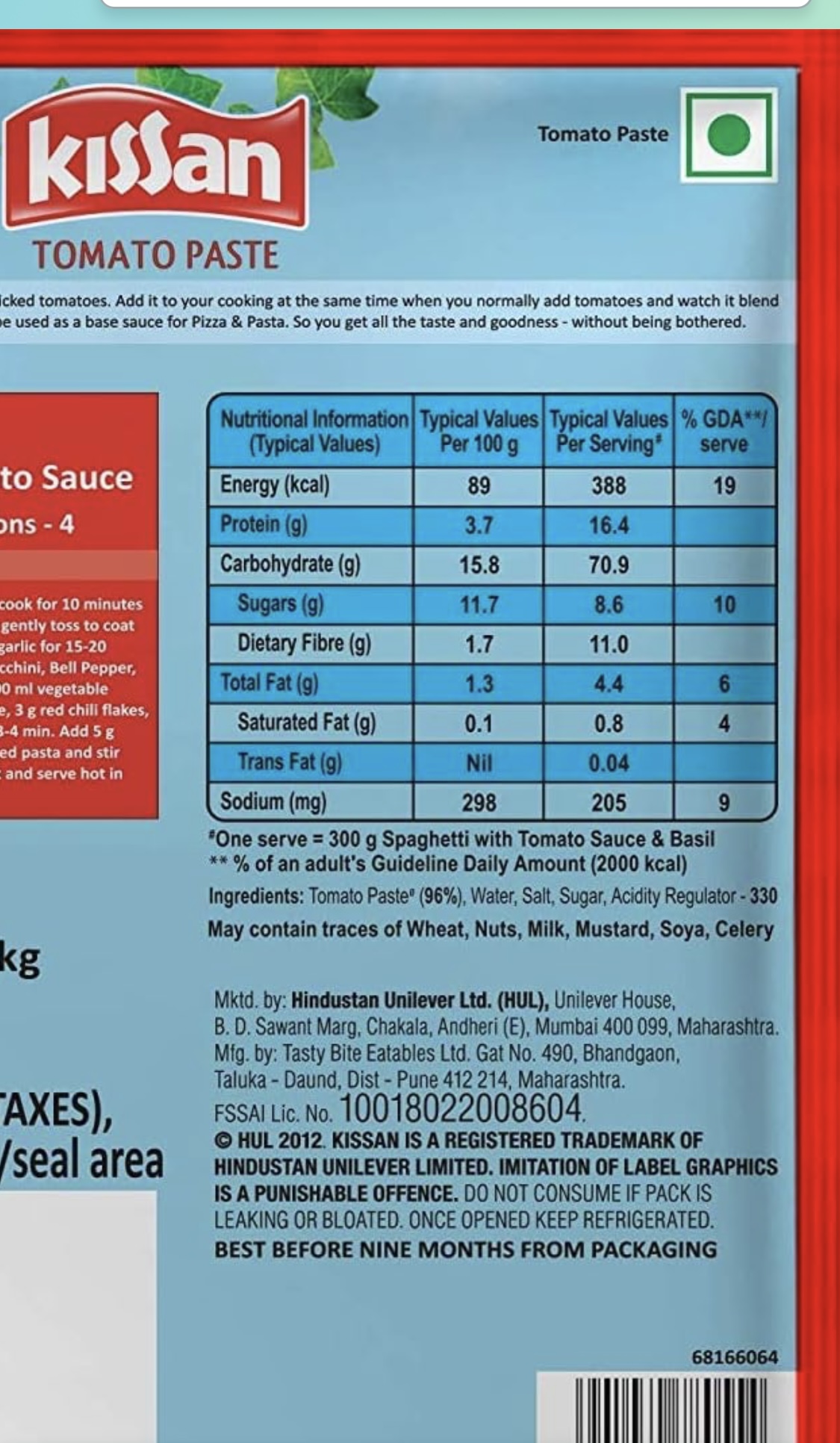
    Having armed myself with some basic knowledge I searched for actual products. The first brand I came across was Kissan puree’. And the ingredient information shocked me. It said water, tomato paste, salt and acidity regulator. Tomato paste? Not from tomato itself? And only 34.8% was tomato paste. So, what was the rest? Water, salt and acidity regulator. How could this therefore be a substitute for natural tomatoes. The rule when one writes ingredients on the pack is that the ingredients will come in a descending order of total composition. So, Kissan tomato puree’ is actually water mixed with tomato paste, salt and acidity regulator.  The good thing was that the brand was being honest but the brainwashing on puree’ does not prepare one for these facts. I mean how can something, read paste, which by definition is cooked twice so that it is devoid of water be used to make another product, read puree’ which is more liquidy? By adding water. So, we are being charged for adding water to paste?


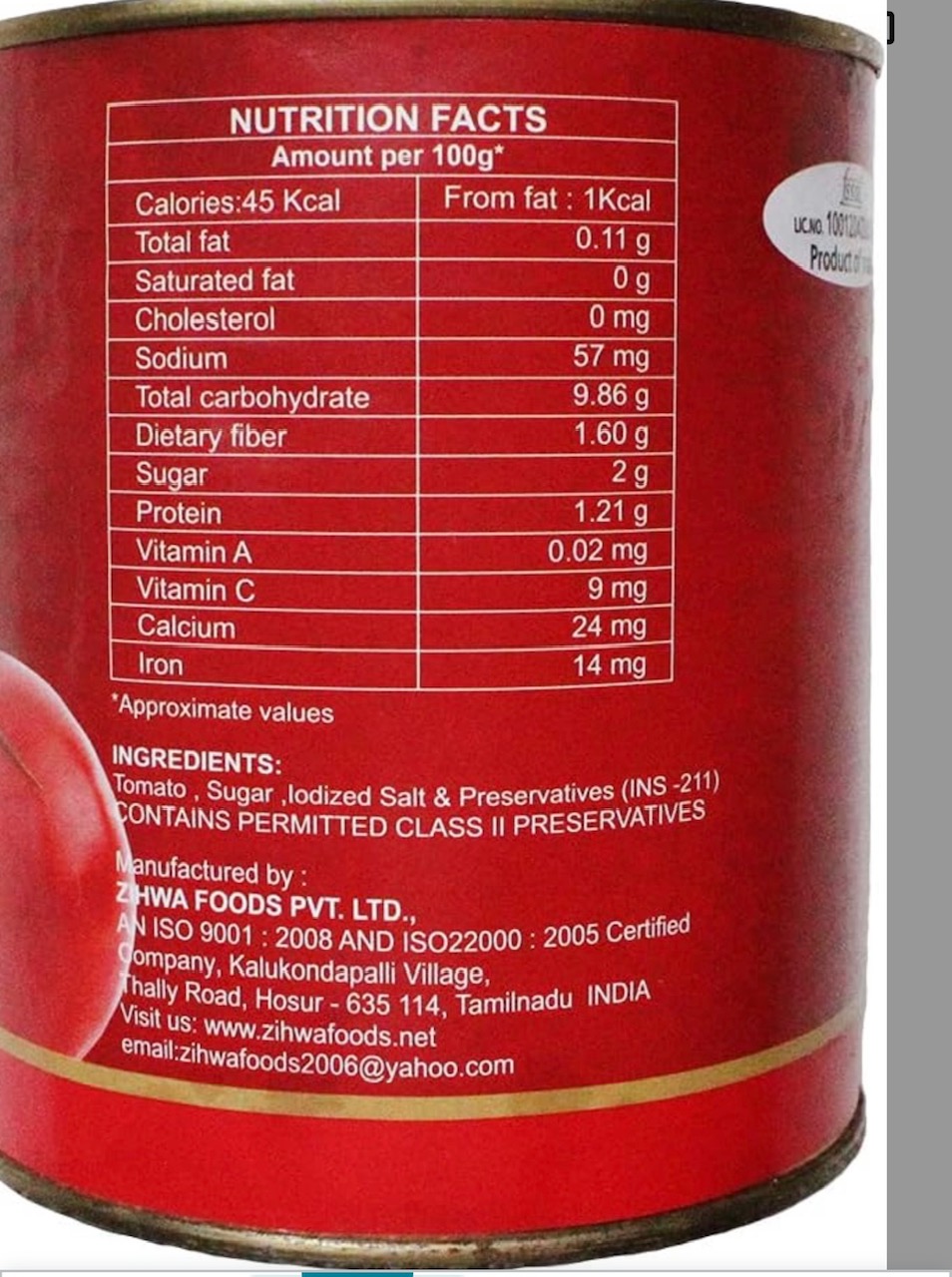
    The next brand I encountered was Topps puree’. In ingredient information it said tomato, sugar, iodised salt and preservative. Now, look at the inconsistency in the ingredient information. No mention of what amount of tomato or salt or preservative. Just by its absence it can be presumed that all is not healthy. Though tomato written as the first ingredient means that the brand has more of tomato.


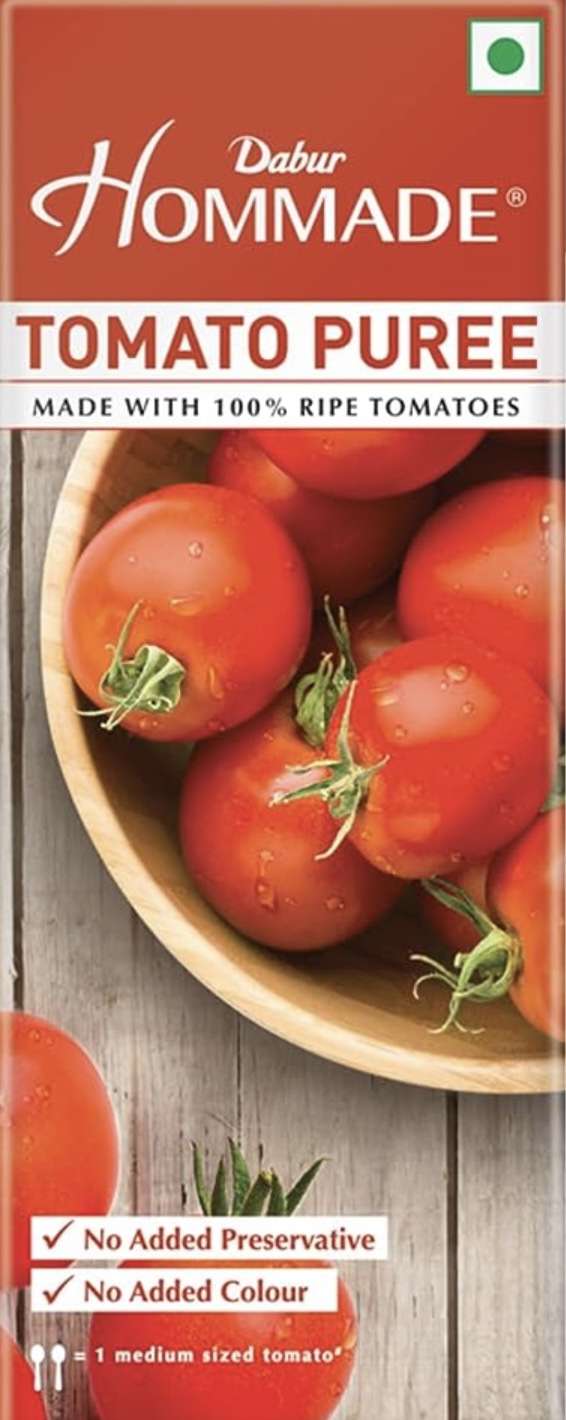
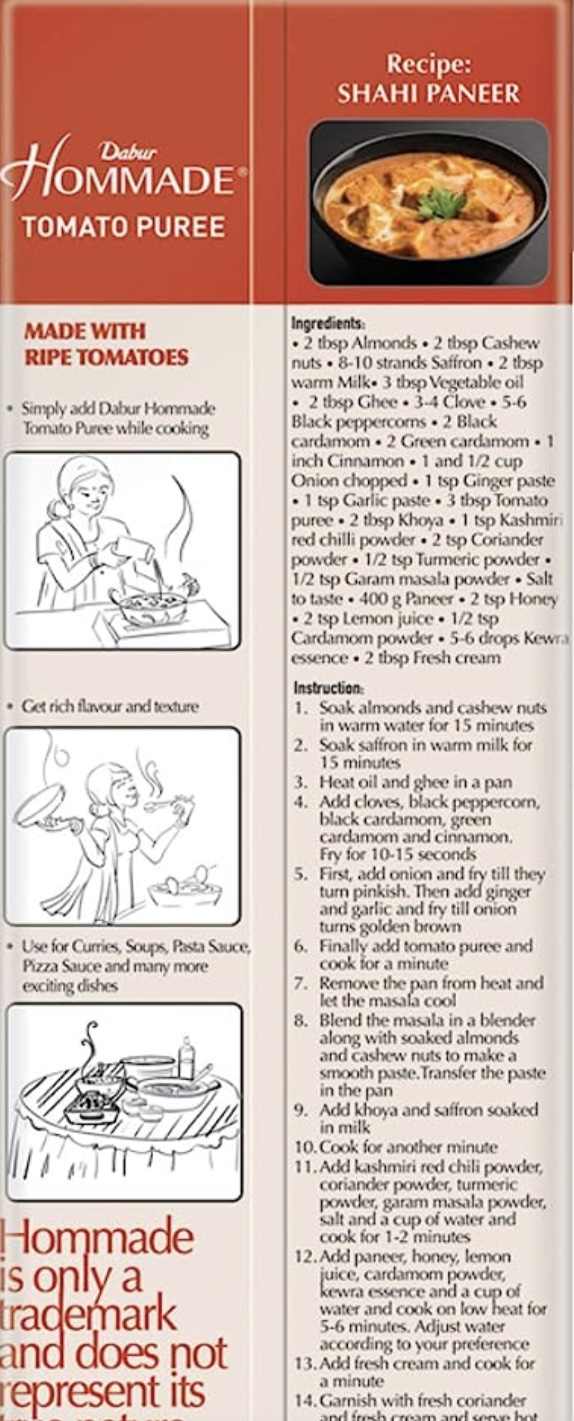
    But the real surprise about how rules regarding packaging, ingredient information and even branding are vague and open to interpretation happened when I came across Dabur Hommade Puree’. Sounded too good to be true. And it was. As behind the pack is a disclaimer which says “Hommade is only a trademark and does not represent its true nature.” Seriously? Hommade is a Dabur brand which is quite misleading but that’s another story. The pack says made from 100% ripe tomatoes. And yet if one looks at the ingredient story it is almost the same as Kissan. Water, Tomato paste (37%), acidity regulator and anti oxidant. Tomato paste?  So, what’s this about made from 100% ripe tomatoes. Misleading? To a lay consumer like me, definitely.


    I did look up Kissan Tomato paste also. Its ingredient story had Tomato paste (96%) as the first ingredient, followed by water, salt, sugar and and acidity regulator.


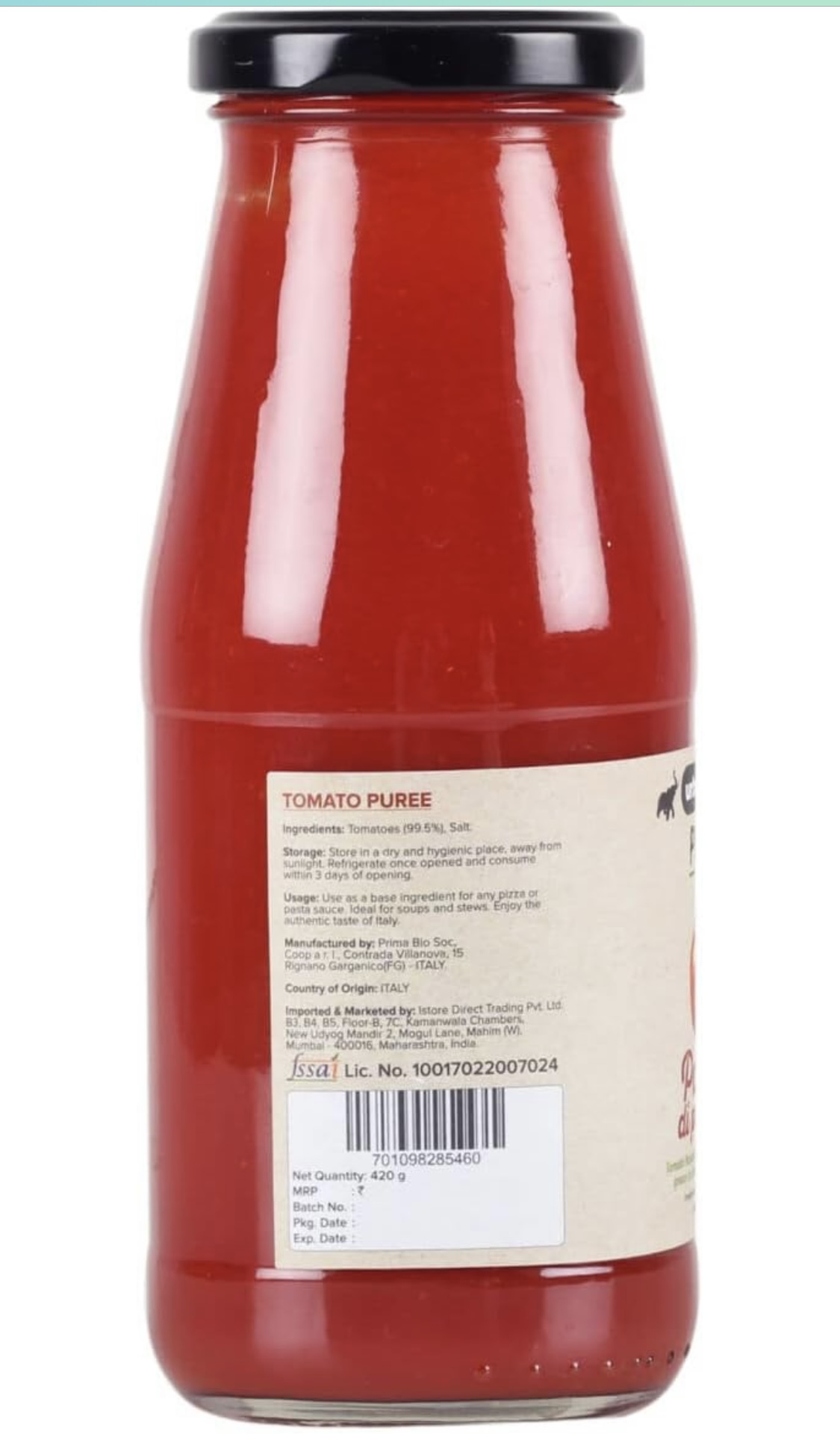
    And I also came across some imported Italian brands which had 96% tomatoes and salt as the only two ingredients in puree’.


    This is what I had written about in my last blog. We consumers are being taken for a ride. The packaging rules are not clear. Ingredient story is incomplete and sometimes not consistent with the claims. Phrases are being used as brand names which have to be defended within the packaging but in an obscure fashion. So called influencers who obviously are being paid then drive the gullible us to use products which are not exactly what they are supposed to be.


    I am sure that the legal departments of these companies will have arguments to counter all this. But, why do they need legal to justify a product?


    Looks like the Tomato story is not just about the price.


    Vikas Mehta is a Dehradun-based business strategy and marketing consultant and educator. He writes on MxMIndia every other Monday. His views here are personal.
     

  • Vikas Mehta: Jaago Grahak, Jaago

    With apologies to none at all

    By Vikas Mehta


    Vikas MehtaFour years ago, when my father passed away due to the negligence of doctors at Max Hospital Dehradun, I was advised by all and sundry including close relatives and friends that it is impossible to fight a big hospital and its might. There was no one who had a word of encouragement and most just shrugged their shoulders saying, what’s the point. Some even narrated their own cases where they had seen a relative or friend suffer due to carelessness of doctors but they just accepted it and moved on. That’s what I was being asked to do. Move on. Not to fight for my rights as a paying consumer.


    The life of a consumer in India is not easy. Inspite of competition, inspite of various forums available to voice the complaints, most consumers accept what they get, bad quality, broken promises, brazen flouting of laws… it’s an endless list. What surprises me is that inspite of all the technology available, it’s not easy to get your due as a consumer. Companies use the chimera of technology to become more inaccessible.


    I get enough messages every week from Jio Fiber encouraging me to use their app to self-repair any problem in my broadband connection. So, last week when my set top box was showing all the signs of working properly and yet I was not getting any internet connectivity, I used the self-diagnosis. It promptly did a diagnosis and declared that my router was not working. I was advised to restart my router by switching it off and on or by replugging the power cord. It continued to say that if the issue persists that I should clean the power cord and ensure it is properly connected! That was all. No further solutions. No contact number or mail id. How do I lodge a complaint? How do I get the router rectified?


    So, I did what an average Indian does. Look for contacts. Luckily, some senior Jio Fiber executives stay in my society. I got in touch and requested for help. A technician came, checked the router and reset my username and password. When I asked for an explanation, his simple response was that whenever this problem arises, I must reset my username and password. Now, I am sure this is not a problem that most Jio Fiber users face. Obviously, something was wrong with the router. And my router was hardly 18 months old. So, I got in touch with the executives again. I insisted that my router be thoroughly checked and if the need arises be replaced. Because I am not going to be resetting it every time the problem arose. And it did arise in less than 24 hours. First, they demurred but when I insisted, a technician came and said that my router needs to be replaced. Because I was in touch with some senior people, the replacement happened almost immediately and free of cost. But it happened.


    And that’s my point. We, as consumers, do not fight. We give up too easily. It’s almost like the companies with their products are doing us a favour and we must accept whatever is given to us. Maybe the philosophy of believing in fate extends to the consumer & product relationship too.


    The problem also is that almost all companies, all products and all brands are the same in terms of consumer service. So, even if the consumer theoretically has choice, there is no choice. Incidentally, I have a Airtel Fiber connection also. And it’s not any better in terms of service. My only solace is that both rarely go bad together!


    And the laws do not help us. Even if they are there. Most consumers do not even know their rights. Sure the government has tried to communicate consumer rights through some ads and PR. Jago Grahak Jago is one such attempt. But even if the consumer is aware, the process and outcomes are complicated and prone to delays. Plus there is the omni present fear of corruption creeping into the system. Not to forget the ambiguity in the laws and rules.


    Take the case of service tax which restaurants tend to levy. The government has clarified that this is not a tax but a service fee which is not mandatory. If a restaurant is charging the same, it must ask customers whether they are willing to pay it. And yet, many restaurants and hotels just slip it into the bill. Some association of hoteliers and restaurants even challenged the government’s mandate in court. I do not know what happened finally. But this is a typical example of ambiguity. Every time I dine out, I check if I have been charged service fees and some times it is there. In one or two cases, the restaurant managers have insisted that this is legal. Now, tell me who wants to get into an argument after a dine out? It spoils the whole experience. So, most diners just quietly pay up.


    Talking about awareness, today almost all retailers ask us for our mobile number, email id etc. The way it is done, when the bill is being prepared its almost like one should mandatorily divulge the data. How many know that one can refuse to give the data? I steadfastly refuse and when I do the retailer is quite surprised. Two days ago, at a Nike outlet when I refused to give my details the cashier was startled. He said, you are the first person who has actually refused to do so. I asked him whether he has been told not to sell to those who do not give their data? He smiled and said of course not. But we as consumers meekly give it away. And then we worry about data privacy.


    India desperately needs a Ralf Nader type of consumer activist. Someone who can work around the issues of misinformation, communication, interpretation of the law and most importantly, someone who can lead a movement. To educate and galvanise the consumers to their rights. Who cannot just inform, but also embolden them.


    Ah, yes! What happened to my father’s case? I complained to Indian Medical Council (IMC) with all the paperwork and attached proof. I followed it up even with the Union Health ministry. IMC instituted a bench which heard my case. It took time because Covid intervened, but I persisted. Max tried delaying tactics but I persisted. IMC also was slow (it was doctors judging other doctors), but I persisted. And I got justice. After two years. Eight doctors were found guilty and were censured and given some punishments. Even the CEO and COO of Max were held responsible, the IMC could not punish them as they were not from the medical fraternity, but the judgment said that I could legally start proceedings against them under the principle of vicarious liability; senior management are responsible for the action of the employees. Mind you, I fought this myself. No lawyer or any external help was used.


    So, If I could fight against a big name, if I could do it all myself without spending anything else but my time and if I could get justice as a consumer, if I could do it inspite of the pandemic, why can’t we all as consumers rise and fight for our rights? It’s our rights and our battle to lose. Let’s not wait for an Indian Ralf Nader but become our own small Ralf Naders.


    Vikas Mehta is a senior marketing and business strategist and educator. He writes on MxMIndia every other Monday. His views here are personal.
     

  • Air India Maharaja debate: barking up the wrong tree?


    With apologies to none at all

    By Vikas Mehta


    Vikas MehtaI call my column ‘With apologies to none at all’ for a reason. And my article today actually justifies the title.

    For the last almost a month, since it was announced that McCann Worldgroup India shall be handling the Air India account, marketing and advertising professionals have been tying themselves in knots arguing for and against the use of the iconic Maharaja identity for the brand. Arguments ranging from nostalgia, royalty, Indianness, contemporary image and what not have been flung in the rung. Suggestions like contemporise the Maharaja or that royalty is defunct in today’s day and age are being touted. Compromises are being suggested and a few are sticking their neck out, asking to bin the Maharaja.

    And this is where most marketers exasperate. It’s also the reason why digital experts are gleefully claiming that advertising is dead. For, we forget that while marketing is an art, it’s foremost a science. And when we think from the gut or the heart and not follow simple marketing dictums then advertising opens itself to debate about its existence. We tend to go all mushy-mushy, not following some simple logic that defines marketing.

    The one big mistake which I see all advertisers make is not defining their target group and more importantly, not understanding the difference between target group and the user. Please do indulge me for a moment.

    Everyone uses a soap but a Lifebuoy soap talks to a mother. A Lux soap talks to a youngster who aspires film star beauty. A Dove soap user talks to a slightly middle-aged lady who feels that she is losing the softness of her skin. That does not mean that Dove will not be used by young females or even men. Similarly, Lifebuoy is used by working men too. But the brand always talks to a predefined TG. Just because everyone uses a soap all soaps do not talk to everyone.

    So, everyone may be wanting to fly but Air India has to decide who will it talk to. Just as Indigo clearly decided that it will talk to the no-frills guy who wants to reach from Point A to Point B with some basic amneties at an affordable price. This person is not looking for meals or a newspaper or a luxurious seat. He or she just wants an inexpensive ticket with a professional experience and on time flights.

    The question that needs to be debated therefore is who will Air India be talking to. And once that decision is taken the debate about the Maharaja is resolved by itself. So, please indulge me again.

    Air India is very clear that it is not a no-frills airline. In industry parlance, it’s a full-service airline. Young fleet of aircraft (on its way). Tick. Comfortable reclining seats. Tick. Choice of meals as part of the ticket. Tick. Entertainment on board. Tick. Higher ratio of cabin crew to passengers. Tick. Frequent Flyer programme. Tick. Lounge facility. Tick. Choice of premium classes. Tick. So, the whole experience is premium, specially when compared to no frill airlines like Indigo.

    Therefore, when we are debating Air India’s Target Group, very clearly we are talking to the premium-seeker. Someone who prefers fine dining over quick service restaurants. Someone who would much rather be looking for a vehicle at Nexa and not Arena. Maybe, someone who is not into Maruti Suzuki at all but into Honda or Hyundai or Kia.

    Very clearly, we are talking to someone who has that much bit more to spend. Or someone who wants to be seen in a slightly elevated company. Someone who has tasted some success in life and wants to enjoy it. Now, for argument sake, let’s say that this person is mostly the Millennial. Gen Y.

    My question therefore is simple. What is Air India to this person? Maharaja? Premium? Royalty? Or is it bureaucratic? Not dependable? Poor service? Surly cabin crew? I am not giving any answers but I do think that millennials had the worst of Air India in terms of their brand experience and for them Air India is anything but Maharaja. So, does it make sense to pitch the Maharaja to them?

    On the other hand, the Tata story could appeal to the millennial. Caring. Customer-first. Quality. Trustworthy. All these are the association with the Millennials. And of course how the Tata group treated its employees and customers post the 9/11 carnage is something that the millennial empathises with.

    Therefore, if Air India has the millennial as its target group, then more than the Maharaja, it’s the Tata association which will work. And that’s just one option. There could be many more.

    I am in no way suggesting that Air India ditch Maharaja or use the Tata connection. I don’t have enough data or research to back me up but as a hypothesis, it could work. And that’s my point. Rather than aimlessly get into a debate about the goodness of Maharaja or its non-relevance today, the marketing and advertising gurus must first try and define the Target Group for Air India. Rest will follow automatically.

    There is a very interesting corollary to this. Is there any Target Group for which the Maharaja is relevant? Does this Target Group have sufficient numbers to be attractive enough as a target group?

    Am not sure if there is any? Tales, nostalgia, reminiscences and stories are not good enough. Experience is. Air India was a Maharaja when? In the sixties or maybe till early seventies. Is the nostalgia or reminiscences of a few vanishing breed good enough?

    Not to forget the fact that Air India aspires to be a major international player. Is an airlines from India, in today’s day and age all about royalty and land of exotic animals and snake charmers. Or is India shining for them?

    And what about the future? The current Gen Z. These people in a few years will be looking at premium flying experience. Does the Maharaja mean anything to them? Will a 50-60-year-old icon excite them?

    The answers are there. But only if we ask the right questions. Unfortunately, that’s not what is happening now.


  • Do we need Public Service Ads or Public Service Brands?


    With apologies to none at all

    By Vikas Mehta


    Vikas MehtaWhen I joined the world of advertising more than three decades ago, I was lucky to be part of Lintas, now Mullen Lowe Lintas. While there were advertising agencies which were producing very creative, hard-hitting ads or agencies which produced ads that were strategically sound and would not elicit a second glance, Lintas had positioned itself as an agency which built brands. Be it Surf or Lifebuoy or Kitply or MRF Tyres or Chrery Blossom… the list was long.

    What I also discovered was that Lintas was heavily invested into public service advertisements. Many memorable ads were made. Causes like anti-dowry, you are no better than a buffalo at an auction if you ask for dowry. Or anti-drugs, drugs means death; or even the one which used sugarcane juice vendors to highlight the importance of hygiene in avoiding diseases during monsoons. The last one, I remember, was effective enough to elicit protests from sugarcane juice vendors who protested outside Lintas offices at Express Towers in Nariman Point, Mumbai.

    But I always wondered how much of an impact the ads made amongst the target group. Sure it got awards, peer appreciation etc, but did they make a change in society?

    And this thought resurfaced when a friend with family had a close shave in a car crash because the husband in the front was wearing seat belt though she and children in the back were not and they did get bruised and cut. And I wondered why people still do not wear seat belts inspite of many public service ads and messages.

    The feeling got reinforced when I saw an emotive and impactful ad on not drinking and driving. Watch it here. And again, the same feeling resurfaced. Why do such well-made ads not really work?

    One can point to many a reason. Wrong targeting, not insightful, sporadic or inconsistent messaging and so on. But the answer is actually quite simple.

    And here I go back to the Lintas analogy. While some ads are creatively outstanding, some bang on strategy, are they really building a brand? Strangely, while Lintas built many great commercial brands, I do not think it build a public service brand.

    Any public service messaging remains just a message if one does not treat the issue as a brand. We don’t communicate a product. We communicate to build a brand. We communicate to ultimately sell Lux or Dove. Not a soap. We define a focused target group. We look deep to find an insight. We try and identify what should the rational and emotional benefit be. We create a desired response and then we also build a brand personality. Finally, a brand idea is crafted.

    Do we do all this in public service ads?

    The brutal answer is no. Most of the times we identify a cause, we try and find a creative insight and work to create and ad. And that’s why the ad does not work. It’s a one-off. It’s about maybe shock-and-awe. Or it’s about tearing emotions. It could also be a straightforward presentation of some interesting facts. It’s aimed at mostly everyone, or just your peers. It has no defined brand personality and most importantly, it has no ownership.

    The starting point needs to be ownership. Someone… it could be a corporate, it could be an NGO or even the government if it seriously wants to tackle an issue needs to take ownership of the issue. And then brand it. ‘Do not drink and drive’ is a message. Not a brand. Ditto for ‘smoking kills’ or ‘wear seat belts’. The brand-owner needs to find a phrase or a name which will be used in all pieces of communication. We live in a world of hashtags and acronyms. That could be the answer.

    And then create a brand document followed by a creative brief. Define the target group. They could be multiple. For example, in case of drinking and driving, it could be the millennial partygoers or a public transport driver. Write separate briefs. Create different pieces of communication. Decide the appropriate media.

    Currently, the thinking is more to create a shock-and-awe effect. In case of both drunk driving and seatbelts, most communication deals with what can happen if one does not wear seat belt or drinks and drives. But if we look at the issue from a brand perspective, the bigger issue could be (my perspective solely) that most millennials think that this will not happen to me. Or I know I can handle my drink. If we do a proper research amongst our decided target group, we will be able to actually pinpoint the actual issue. Reach an insight. Decide on our desired response.

    To do all that lets treat public service ads as brands.

    Let’s nurture the brand.

    Grow it.

    Make it effective.

    Spend on it strategically and with proper planning.

    If, the Got Milk (note the brand name) campaign with the brand idea of moustache could work to increase per capita milk consumption in the United States, no reason why a public service issue cannot be handled like a brand.

    What do you think?


  • Vikas Mehta: The Gen Z Redux – Part 2

    With apologies to none at all

    By Vikas Mehta


    Vikas MehtaUnsurprisingly, I received some bouquets and brickbats for my last post on Gen Z. Unsurprising also, since most of the parents refuted my views about Gen Z (I can only imagine how they are coping with their children) and some Gen Z actually complimented me on the article.


    However, there were some notable exceptions where the parents actually thought that I was onto something and gave me examples of their children. And in one case, a Gen Z actually queried me as to why I think some points about Gen Z were complimentary when he thought they were actually negative.


    Let’s dive in.

    The point which most parents grudgingly admitted to was the self-confidence and drive of Gen Z to achieve what they wanted. Their comfort with technology, specially. The disdain too, most agreed to but also admitted that they tend to ignore it as they are technologically not even close to the Gen Z.


    The interesting thing was that most parents were against the concept of multitasking. How can one study and listen to music and watch sports at the same time? Is the tendency to focus and be the best in one thing not a better approach? Is it multitasking or multi distractions, asked another.


    I do admit that traditionally multitasking may not be the best way forward for a youngster. It’s only a few geniuses who can be at the top of each task they are doing simultaneously. But, let’s not forget the times we are living in. We are switched on 24/7. There is information overload. Newer technologies and evolution of gadgets is a realty. And all this leads to peer pressure too. So, in my opinion, multitasking is a basic hygiene need. Unlike earlier times when multitasking was the prerogative of a few, today multitasking is a basic tool of survival.


    Just look at today’s education system and the overhaul that’s in the pipeline. Higher education institutes will have no option but to allow interdisciplinary subjects. A humanities student could choose programming as an elective. Or a computer science UG student could opt for economics as an elective. And it’s not just about taking an elective for fun. It is already serious business. I have met students of fine arts who admit that their drawing skills are poor but they use programming to express and illustrate their ideas. Now tell me isn’t this multitasking? Even honours courses today offer double specialisation. Multitasking anyone?


    And therefore, if students today are not picking up such options they are losing out on a skill which could soon be a requisite. And peer pressure, of course. “What, you are doing a course on charcoal sketching and you do not know how to use a computer to illustrate your idea?” Today, if youngsters are not multitasking, they are labelled as lazy. Parents, multitasking is a fact and it will soon be a defining feature of what your child is. Ignore it at your own peril.


    I was therefore pleasantly surprised when one of my students actually raised the quality issue on multitasking. Does multitasking leads to anything being done, especially when one is unable to compartmentalise, was the question posed to me? The youngster who asked me this was on an intense onsite internship. He was also being supportive of a friend thousands of miles away, who had lost a parent. At the same time, he was reading my blog and appreciating and commenting on its nuances. Hadn’t he had answered himself?


    Shorter attention spans and lacking an eye for details was another criticism I came across about Gen Z. Being a part of the generation where we were told that the god is in details, I could not have agreed more. But then let’s not forget that in today’s technology age there are enough tools available that take care of the above deficiencies. A proficiency in spelling or grammar is not a must to write a good research report, a thesis or even a news item. For there are enough software programmes available which will not only correct your language but will take your thoughts and ideas into a great prose.


    We fear that ChatGPT will allow machines to take over even the creative domain. My take is that programmes like ChatGPT cannot work unless you give them proper guidelines and directions. So, creativity can still belong to the human domain and finessing it could be the technology domain.


    Shorter attention span does have a downside, though. It also leads to short term thinking. Too much of living in the present. Not wanting to think beyond the obvious. We say that the leaders should be visionaries. Unfortunately, short attention span will not allow Gen Z to have a long0term perspective. There is a problem now. Let’s solve it. Long terms implications is either too much of an effort or let it become the prerogative of the machines. That’s where, in my mind, will the machines start taking over.


    I know, I am connecting dots and maybe being complicated. That’s long-term thinking. And because long-term thinking is an attribute that may dwindle if attention spans are limited. The more one debates, the more one analyses, the future become clearer. As one parent put it very nicely, my son says that overthinking is a weakness. It’s not. It’s a virtue. Cultivate it. Or the machines will take over that and we all know what Deep blue did to Garry Kasporov more than two decades ago.


    I think Gen Z is a quantum leap in generations in the last over a millennium. It’s like moving from LP vinyl records to digital music. Rather than fight this change we must embrace it. Only then can we identify and rectify its flaws too. Together.


  • Vikas Mehta: The Generation Gap with Gen Z

    With apologies to none at all

    By Vikas Mehta


    Vikas MehtaBeing the father of a teenager, I have always been interested in the behaviour and thinking of Gen Z. I have also befriended a few teenagers whom I teach, even being part of one of their WhatsApp group. So here are some random observations. I am not at all claiming that this is some scientific research or this being a definitive guide to Gen Z. But the idea here is to generate some hypothesis and trigger debate.


    There is a widespread belief that today’s youngster is more aloof and gadget or social media-driven. While I shall not dispute this, I think there is a huge upside to this. Today’s youngster is well-connected and definitely much better informed. And he or she has many more friends. May not be friends in the way we traditionally describe friends. Not the backslapping, meeting every day, knowing each other’s family types; but the online friend with whom they have video calls, exchange emojis and share information. The power of networking even without stepping out from their rooms is enormous. And it’s the last part that I think is making the difference.


    My daughter wants to do sports journalism abroad. Being a fan of Arsenal Football Club, she is part of some official Arsenal groups on Snapchat, Instagram etc. She soon had on her fingertips all relevant information and most importantly feedback and assessment of various universities, faculty, course content, fees etc. And all this was first-hand, through alumni, current students, friends’ network etc. She had seen enough videos, read pithy comments and had shortlisted her favourites. Rankings be damned, reputation be damned and even placement record be damned.


    When she presented her shortlist to me, I was amazed at its details and also at her clarity. Her sources of information were fellow youngsters in almost all continents. With just one thing in common: their love for football, and for Arsenal. I asked her as to why she did not depend on the websites of the universities. Why should I get influenced with one-sided, unidimensional information, full of only good content information when I can talk to some people across the globe who can give me an experienced opinion. Her riposte left me wondering whether I should look at the websites at all!
     

    This networking has allowed the Gen Z to be more confident. The assuredness with which they talk, the depth of the subject knowledge which is not limited to just books and the rise of innate curiosity has given rise to a more confident youngster.


    The other quality that I admire is the courage to accept failure. When I talk to some youngsters who are undergraduate candidates, one comes across youngsters who are maybe science students but who want to shift to humanities. This was unheard of till just a few years ago. Humanities or Arts was seen to be the domain of the laggards in education. And there was also a gender divide. Boys do not do arts. But that’s no more the case. I have met enough students, not just from the metros or urban India but also from small towns who admit that they made a mistake in their intermediate choice and are now willing to course correct. Of course, on prodding it is clear that parental pressure, which is influenced by the outdated thinking of medical or engineering as the only two rewarding career choices, was mainly the reason for their incorrect choice, but they are not ashamed to course correct or even shift to a perceived inferior domain.


    It’s amazing to see how quickly a Class 10 awkward, shy, unsure, obedient teen metamorphoses into a confident, forceful and opinionated youngster. All because of their comfort levels with technology.


    For this too, I will go back to the first point. Being better connected and networked the youngsters are better informed of their career choices and they understand that the choices are not limited. So, they embark on getting enough information to convince the parents and mostly are able to do so. Another tick in favour of technology.


    But, invariably, this also leads to a sort of disdain towards the parents. And the phrase, you command respect not demand it, starts ringing true. I think our generation is making many sweeping generalisations. Gadgets are spoiling the child. Humanities has no future. If you are not a CA, commerce is not a good career choice. High marks are the end-all of all education. While the parents are smug in these thoughts, the youngster with technology at the fingertips, with his/her networking and with his/her fellow tech-saavy friends knows that the world is very different to what his or her parent thinks. And so, the disdain.


    And therein lies a contradiction too. On one hand, parents are bemoaning too much time spent on gadgets and social media and, on the other hand, there is also the preening about the child being tech-saavy or being able to look for discounts on ecommerce sites. All this is not lost on the youngster. Nicknames, descriptors, unflattering adjectives are par for the course for parents. Do not get me wrong. The respect is not all gone but its scope is narrowed down to maybe just the parents efforts and struggles and what they have provided to the child. It’s the technology divide that causes the problem.


    That’s the reason why I think we should stop portraying technology as the evil which has overtaken our children. It’s not all gloom and doom. Excess of anything is bad and the same is true in the case of technology. So, let’s stop making technology our favourite whipping boy.


    Multitasking and time management are two areas in which Gen Z contradicts itself. The ability to multitask has increased. They will be chatting online, while watching a movie and at the same time finishing the homework. Maybe it’s the ability to compartmentalise each activity and very short focus spans that enable them to do multitask, but I do find quality in their execution. They are doing everything with great aplomb and zest.  Unfortunately, this has led them to ignore time management. Their confidence leads them to do things last minute, not plan and even the preparation falls short.


    But one area which really saddens me is the utter neglect that Gen Z has towards environmental issues. I know this will be an unpopular observation, but I think most Gen Z, while aware of the issues believe that the threat is still not real or upon us. The selfishness which our generation showed to grow and thrive individually at all costs is also visible in Gen Z. Sure, they make the right noises. Sure, many do work with environmental NGO’s. Sure, they will make some obligatory gestures and participation, but my understanding is that their thinking is about me first making hay. Me first fulfilling my wants and desires. Environment, sustainability, circular economy are good jargons. And these must be sprouted at the right forums, seems to be the thinking.


    Don’t get me wrong. I am no better. But, my time has come and gone. I did not seize it. My regret is that given so much technology, so much of networking and so much of knowledge, I would have expected Gen Z to not think like me, at least on this one issue.


  • IPL Advertising – An apt reflection of the advertising industry


    With apologies to none at all


    By Vikas Mehta


    Vikas MehtaSure, the IPL this year has been as exciting as ever. Sure, Gujarat Titans have established themselves as a force to reckon with. Sure, CSK with the evergreen M S Dhoni still around, have shown that they are not a spent force. Sure, Mumbai Indians with a 34-year-old spin bowler who was bought as an afterthought, being the leading wicket-taker, have proved that the game is now totally batsmen-dominated.

    And surely, the advertising during the IPL touched new depths of despair.

    I say this with conviction because of four solid reasons:


    One, a big number of brands used old ads which had been running on mass media for months. So, IPL which was once an event where new campaigns would be launched or for some brands like Vodafone ZooZoo, the IPL was the only platform to advertise had now become a rerun platform for old ads.


    Two, it was not a category like mobile phones, or chocolates or cold drink which dominated advertising but a category like Pan Masala with surrogate ads which dominated the advertising charts.


    Three, even new age category players like Cred or Phone Pe gave the tournament a miss.


    Four, there were very few ads which did not have a celebrity. Which means that lazy advertising was at work. Just get a celebrity and spend money on location was the celebrity mantra. Or get more than one celebrity and fit them in a frame, on location. Or better still get some old, well past their sell by date celebrities and fit them into split frames, on location. As a result, advertising ideas or stories were totally missing.


    The twist in the tale was one brand, Dream 11, which took the celebrity route and tried all the tricks of the trade mentioned above. And yet came up with the most compelling and memorable ad campaign of IPL.


    The trick in the tale was that Dream 11 started with an advertising idea. Cricket stars being challenged to cricket by film stars. With a simple but endearing idea that can spawn off many anecdotes, the brand continued to evoke interest right through the event with different executions.


    And the biggest reason why this campaign worked was that it had many executions. It was not a one-off but seemed like a continuous soap opera. With the idea firmly established the brand effortlessly continued the story with simple executions. The personal touch like Rohit Sharma ribbing Aamir Khan about his not attending award ceremonies or Aamir Khan being a stickler for perfection, kept the audience interest high.


    For a tournament that lasted for two months, it’s not easy for a brand to create interest and sustain it. And for a product like Dream 11 which is all about gaming, where each match means more footfalls, more revenue for the brand, the essential thing is to maintain interest and involvement. Dream 11 achieved this wonderfully. My only grouse with Dream 11 was that it could have involved the audience much more. With a firmly established idea and a galaxy of celebrities involved, they could have invited the audience to send in their own scripts. Some good ones could have been executed and some more even shared and acknowledged.


    Advertising has to go beyond just ads. In its glory days, before the advent of digital, the advertising folks would think of an activation idea. Today, that proactiveness or that going beyond the call of duty has been lazily surrendered to digital. The problem is not digital but the lack of an idea. That leads to a one off which just drowns in the sea of ads that are visible during an event like IPL.

     

    Mind you, there is a difference between having an idea which can be executed in different ways and just running a series of ads. Tata Neu and Tata Tiago go.ev. Both the brands which are from the IPL main sponsor stable, spend heavily and did make their presence felt during the tournament telecast. But in my mind, these were like a press announcement. Specially the Tata Neu coins ads. The brand was trying to exhort users to use the app more and get more rewards. It did have many executions. It did start with some promise. I thought there was a sliver of an idea in the continuity loop of buying something, getting some coins, buying something else with those coins but it looked as if the brand custodians themselves were not sure of the idea. The execution idea with humour involved could have been sustained but it was hastily abandoned with the need or pressure of increasing app usage and finally it was all about the announcements of extra coins etc. A pity as a floundering product like Tata Neu app could have been revitalised with an idea-led campaign and not just a series of ads.


    This was the promising beginning Tata Neu, And this was the abysmal level it dropped to. Pun intended after you watch the ad. Tata Neu drop


    Tiago ev.go tried to sell the category of electric vehicles with the hackneyed idea of “so many reasons to buy a EV” And the execution of why go.ev # number was worse. Again, they tried humour as a route but most executions fell flat. Another case of missed opportunity. Watch


    But for me the most tragic case of advertising on IPL was of Airtel. Tragic, because this brand was built on the back of some great advertising campaigns. Tragic, because the brand had a new offering 5G to talk about and in the absence of its biggest competitor Jio, which had dominated IPL in the recent year with its inane celebrity led advertising, Airtel had a unique chance to build on its legacy. Tragic also because Airtel is headed by one of the sharpest marketing minds in India and it is sad that Airtel produced this drivel under his watch. See it here.
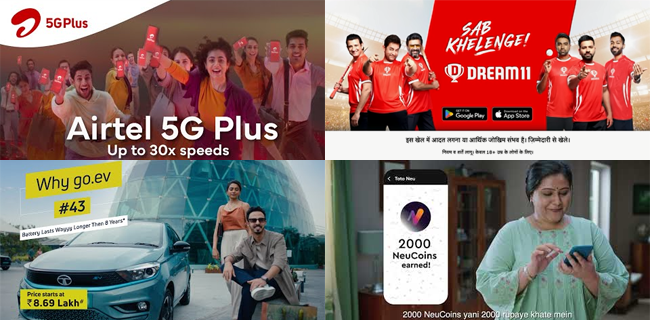
     

    And finally, an epitaph for soft drink advertising on IPL. The timing of IPL is just right for soft drink category. The onset of summer, the sight of players sweating, the humid conditions all add up to a great opportunity for the category. And yet Thums Up came with some apology of ads with Shah Rukh Khan and though Pepsi did come up with an interesting ad with Ranveer Singh, its presence was hardly noticed.


    It’s indeed a sad state of affairs when a category like Pan Masala with mostly washed out celebrities, dominated the IPL advertising scenario. It was an apt reflection of the sorry state of Indian advertising industry.