Tag: Uday Shankar

  • Amitabh Bachchan lends his voice to Kabaddi league

    By A Correspondent


    Come July 18 and the country will be treated to the fast-paced action of Star Sports Pro Kabaddi. The best of Indian and global Kabaddi talent will take centrestage at NSCI, Mumbai where the caravan style league commences. To ensure that the country at large is given a grand invitation for the second season, Star Sports has roped in superstar Amitabh Bachchan.


    Star Sports’ marketing blitzkrieg for the upcoming league reaches another level as the iconic film actor with an inimitable voice takes to the mike as well as composes for the latest commercial of Star Sports Pro Kabaddi.


    Uday Shankar, CEO, Star India, said, “Star has a deep and abiding commitment to growing the sport of Kabaddi. The inaugural season introduced the sport in an aspirational and cool avatar. We are delighted to partner with Mr. Amitabh Bachchan for the second season of Star Sports Pro Kabaddi, to help galvanize the sport across the nation.”


    The promotional film for Star Sports Pro Kabaddi, takes forward the #LePanga narrative in the form of a peppy, energetic and fast paced song composed and sung by Amitabh Bachchan. The underlying visuals have superlative game and in action portraits of the heroes of the sport.  What better booster than the baritone the country adores? This was the thought that motivated the very words of the film penned by India’s leading adman Piyush Pandey from Ogilvy.


    Highlighting the concept, Piyush Pandey, said, “The idea was to combine the martial energy of the great India sport with the great Indian tradition of ‘Veer Ras,’ one of the nine emotions or ‘Navrasas’ of our culture. With a sense of fun and fire, that is how I wrote this song. Thereafter Mr. Bachchan took over. He composed the music, sang the song and created a legendary track.”


    Star Sports Pro Kabaddi starts July 18 with the action live on Star Sports 2 and Star Sports HD2 in English; Star Sports 3, Star Sports HD3 and Star Gold in Hindi; Maa Movies in Telugu; Suvarna Plus in Kannada and Star Pravah in Marathi.


  • Murdoch’s empire makes 2 buys in India


    By A Correspondent


    There were film magazines and film magazines and film magazines. And then there was Screen. A brand born just four years after the country’s independence earned its rep of being a serious film trade publication.


    While Filmfare (and later Star & Style, Cine Blitz and Stardust) were built in the fanzine model, Screen was meant for people in the business of cinema or for serious consumers of film information.


    There were some trade publications like ‘Trade Guide’ or ‘Film Information’ or ‘Box Office’, but Screen was bigger. Editors like BK Karanjia and later years Udaya Tara Nayar and Bhawana Somaaya.


    But over the years, a decision to go in for softer content plus the concentration on film coverage in the dailies ensured that the popularity of Screen eroded, even as the respect for the weekly continued.


    Realising the Indian Express group launched the Screen awards and also went in for a digital edition. However, competition on the digital medium was stiff, as newer brands – with no ‘Established in 1951’ pedigree – gaining popularity amongst netizens.


    Albeit a brief period when Screen Awards were aired on Colors, the Express group and Star India have had a long and healthy relationship. In early 2014, Screen Awards moved to Life OK and while it was touted as a business decision, industry insiders had then said the reason why this was done was a bigger pact between Express and Star. But that didn’t happen immediately even as there were rumours that the Indian Express was looking at selling Screen at a valuation in the region of Rs 30 crore.


    On Monday, March 9, evening, Star India announced the acquisition to the media in general with exclusives to some favoured publications. As part of the transaction, Star will get exclusive ownership of the “Screen” brand franchise including all archival material and transfer of key employees. “The Screen acquisition will yield huge benefits for Star India and for hotstar our digital platform,” said Uday Shankar, CEO of Star India. “We couldn’t be more excited.”


    “Screen is a strong and reputable franchise and gives us access to the entertainment editorial suite and the tinsel world, where news that shapes trends is made by film stars, directors and producers,” Mr Shankar said in the communique, adding “The acquisition of Screen will allow us to strengthen and expand the content brand online while taking the awards platform to the next level. There are strong synergies and the combination of the quality content and awards franchise with Star’s presence across television and digital platforms is strategic and scalable.”


    “We are delighted to enter into a transaction with Star India. Screen is one of the most reputed film and entertainment properties in the country. We have built this business with lot of passion and are confident that Star will nurture it and take it to greater heights” said Viveck Goenka, Chairman and Managing Director the Indian Express Group.


    Speaking on the transaction George Varghese, CEO Indian Express said “Screen is one of our leading properties on the entertainment side of the business. Our decision was driven by our belief in Star’s focus to grow this business, which we believe would translate into adding value for all stakeholders including employees.”


    The acquisition will integrate the Screen awards property with Star, besides adding a consumer brand to the network’s digital business. The acquisition makes Star poised to become steward of the great Screen franchise that the Indian Express Group has built over the past many years. Star is uniquely positioned to preserve and build the market presence of Screen through its shared values and complementary resources. This acquisition will enable Star to expand the awards franchise and build the content brand to the next level by taking it online.


    Industry analysts say the Rs 30 crore valuation may seem high for the weekly print publication or just the brand, but add the awards to the bouquet and it’s a steal given the yearly fee that Star would be required to pay the Express group for the telecast of the awards. Another analyst who didn’t want to be quoted said that while Star could have set up its own awards, by buying the Screen brand name, it ensures that no other television network can take advantage of the Screen equity.


    Amongst film awards, while the Filmfare Awards are considered to be the #1 and most respected and sought after awards, Screen comes second followed by Zee Cine and IIFA and a slew of others. Stardust, which was until last year, the lowest in the ladder appears to have climbed the pecking order given that it has received a shot in the arm post the association with Colors.


    Star India is a fully owned subsidiary of 21st Century Fox which is owned by Rupert Murdoch. After the split in businesses recently, the news operations come under News Corp, which in turn has acquired VCCircle, a smartly packaged digital news site dealing in private equity, venture capital and start-ups. VC Circle also runs successful conferences and training programmes. On Monday, News Corp announced the signing of a definitive agreement to acquire the VCCircle Network, which includes VCCircle.com, Techcircle.in, VCCEdge, VCCircle Training, in addition to a premium-content driven conference business. The terms of the acquisition, which is expected to close in this month, were not disclosed.


    “This important investment is a sign of our faith in India’s future and our enthusiasm for working with and building up emerging talents in the country,” said News Corp Chief Executive Robert Thomson. “India is an increasingly meaningful part of our portfolio, which is itself increasingly digital and global.”


    “For the past decade, we have built a strong franchise with proprietary data, information, content, and networking capabilities around India’s digital business world,” said P V Sahad, Founder and CEO of VCCircle Network. “Being a part of News Corp will now allow us to accelerate our already aggressive growth plans.”


    VCCircle Network is owned by Mosaic Media Ventures Pvt Ltd and has about 100 employees across India, with its headquarters in Noida. Mr Sahad, and the management group, will become part of News Corp’s India team. Mr Sahad will report to News Corp Senior Vice President, Strategy, Raju Narisetti (formerly editor of ‘Mint’).


    The VCCircle acquisition builds on News Corp’s recent digital investments in India. In November, News Corp acquired a 25% stake in PropTiger.com, India’s leading online residential real estate platform. In December, News Corp acquired BigDecisions.com, which aims to help Indian consumers make smarter financial decisions through interactive, decision-making tools powered by sophisticated algorithms and data. News Corp also has a presence across India through its Dow Jones, Wall Street Journal and HarperCollins Publishers businesses.


    The question which everyone seems to be asking is what next will the Murdoch empire target for acquisition? Could it be more non-news publications with a strong digital play? Guess only time will tell. We’ll bring you a ringside view and some unbiased analyses.


  • Star India acquires broadcast biz of Maa TV Network

    By A Correspondent


    Star India and Maa Television Network have announced a deal under which Star India will acquire the broadcast business of Maa Television Network. This opens up an opportunity for major creative content innovation in the Telugu television market.


    The acquisition would give Star India access to the highly attractive Telugu TV market and a market where Star has a very limited presence till date. Maa Television Network is a leading broadcast network in Telugu language content and has a strong trajectory of growth driven by fiction content and movies.


    The strategic deal will come into effect upon complying with the necessary regulatory formalities and the broadcast business of Maa TV will be integrated with the business of Star India, once the policies and procedures in the acquired broadcast business of Maa TV are aligned with those at Star India.


    Uday Shankar

    “The Telugu market is an important market however the pace of innovation has been slow. We are keen to change this by acquiring a local presence and fundamentally changing the content quality paradigm. We were very impressed by the solid creative core and quality and depth of the management team at Maa Television Network. In a short span of time they have built a leading business which is poised to take the next leap. The acquisition fills a vital gap in our portfolio allowing our advertisers targeted access to a critical market,” said Uday Shankar, CEO, Star India.


    “The strategic decision to align with Star India and be part of a global media group will be a big leap in our efforts to take the Maa TV Network to the next level and strengthen the positioning of Maa brand in the entertainment industry. Star’s leadership in Indian media and entertainment industry and its parent company’s proven expertise in media business on global scale will enable Maa to offer more innovative, rich and differentiated entertainment content to the Telugu Diaspora worldwide,” said Nimmagadda Prasad, Chairman, Maa Television Network.


  • Announcing! Punit Goenka is Mediaahperson of the Year and Uday Shankar is Mediaahperson of the Decade


    By Pradyuman Maheshwari


    It’s that time of the year when we decide on who’s are those who have done well and who are those who haven’t all done that well.


    And since this is also the time that Impact magazine announces its Person of the Decade, we also thought of participating in the exercise. And then figuring whether our choice matches with Impact’s.


    The Mediaah! view is of course one person’s opinion, Impact’s belongs to the industry and is managed by WPP-owned IMRB. But as a process, it has its chinks.


    The first stage requires people to send in their nominees. This could be any name. You could even name the barman at Toto’s, if you please. The editorial team then sifts the names and adds on a few if they think a certain name deserves to be in the final list of nominees. Later,  a mail goes out to select industryfolk and the final winner is decided upon by voting on certain parameters. Now, given that the voting happens around October, whoever is making waves in the second half of the year is almost always the winner.


    This year, the nominees were:

    Sam Balsara

    Piyush Pandey

    Prasoon Joshi

    Punit Goenka

    BD Park

    Sachin and Binny Bansal


    If Sachin and Binny Bansal were in this list, then we thought Prime Minister Narendra Modi should’ve also been in it. After all, Impact has had Ambika Soni winning the award once and the PM has had a great year – winning the polls, super multiple media campaign and great use (and non-use) of the media after he got the top job.


    But that’s a decision of the Impact bosses and why get into it.


    BD Park is the bossman of Samsung,for those not in the know. Our view is he didn’t fit the list although Samsung has done some great work.


    We think Sam Balsara and Piyush Pandey have done some fantastic work on the BJP campaign and of course kept the flag flying high in their respective organisations – Madison World and Ogilvy. Ditto with Prasoon Joshi who was also elevated to an APAC role, won some good awards and also was part of the BJP creative offensive.


    But  is their achievement this year – note this year and not in their professional careers – big enough for the Person of the Year? I am not sure.


    The choice is now between:  Sachin and Binny Bansal and Punit Goenka.


    If the Impact Person of the Year selection process is to be seen and given that the public sentiment will naturally be towards the Flipkart Bansals, do you think they will bag the top honours. Or will they get the IPOY and Punit Goenka be made IPOY (Editorial Choice)? Or the other way around?


    My sense is that the Bansals are indeed deserving, but then from the branding and media perspective, PM Modi had a bigger impact.


    And the PM isn’t among the final nominees.


    As for Impact Person of the Decade, I am unaware of the procedure that’s going to be followed. There are various names that come to mind.


    Samir and Vineet Jain: for consolidating BCCL, warding off threats in Mumbai, leading Times Now to be the #1 in English News and leading India’s most successful media enterprise.


    Sir Martin Sorrell: He may not be a full-time in India but is active here and has a firm handle on his many businesses in the country. The last 10 years have seen Sirji’s empire rise and rise.


    Subhash Chandra:  Despite all the competition on the general entertainment channel front, his organisation is now no longer dependant on the flagship GEC for determining its fortunes. While he may keeping a tight grip on finances, he has taken the risks in the business and ensured he is one of the most profitable amount the big broadcasters.


    The Agarwals of Bhaskar and Guptas of Jagran: Consolidated their respective news empires with multiple editions in their markets. Made course corrections in some of their ventures and have moved far beyond the mindset of hinterland media magnates.


    Sam Balsara: for leading MadisonWorld remarkably, for being an industry leader and ironing out several issues


    Raghav Bahl: Would have been a worthy contender until he decided to exit Network18. Remarkable success story, but he may be the man to look for in the next decade with his digital forays.


    Arnab Goswami:  You may not agree with his brand of news television, but there can be no denying the fact that he’s the most watched news anchor today… and all of this has happened in the last six years.


    Uday Shankar:  Ensured Star Plus gets back to the top slot after being beaten by Colors and consolidated to be far ahead in the pack. Taken bold decisions to make Star India a mega-empire. Virtually controls sports broadcast in the country and is by far the most influent media professional in the country from amongst the non-owners


    There have been some others who have done some great work and we’ve some remarkable turnarounds. Shobhana Bhartia’s HT Media and CEO Rajiv Verma have done some splendid work on rebuilding the media conglomerate. Aroon Purie has ensured his empire stays relevant and continues to rise and Headlines Today becomes a force to reckon with. Kalanithi Maran with his Sun Network has continued to be the #1 in the South. Tarun Katial with the turnaround of Big FM. The retro positioning has worked wonders for the channel. Rajat Sharma’s stock is rising as India TV chief. Ashok Venkatramani has made a huge success of the MCCS channels after a forced rebranding.  Kartikeya Sharma’s iTV is gaining ground by the day. This list could go on.


    **


    So who is the Mediaahperson of the Year and the Mediaahperson of the Decade?


    Punit Goenka and Uday Shankar, respectively.


    Punit Goenka has consolidated ZEEL in a big way over the years and has taken his risks in programming and new iniatives. His role as BARC chairman has been tremendous and along with a sound team in Shashi Sinha as head of the techcom and Partho Dasgupta as CEO, is all set to deliver.


    And Uday Shankar.  Let’s repeat what we said before: Ensured Star Plus gets back to the top slot after being beaten by Colors and consolidated to be far ahead in the pack. Taken bold decisions to make Star India a mega-empire. Virtually controls sports broadcast in the country and is by far the most influent media professional in the country from amongst the non-owners. And add one more: he is the true inspiration for many (or should we say most) young professionals in the country. Rising from a rookie journalist to a mega-professional.


    **


    Many friends and acquaintances have asked me why we write about exchange4media events. Why publicise activities of competition? Why talk nice things of someone who damns you in private?


    Our view is simple: we are in the business of covering media, advertising and marketing. And by media, we mean all media. There are some who perceive as competition, a view cited as the reason for disallowing us to attend the Indian Marketing Awards on December 12.


    So is MxMIndia going to attend the Impact Person of the Year tonight (Friday, December 5). No, we are not. An invitation was sent to us. When we accepted it and asked if those who had sent it were sure that it was sent as part of the massmail from the Chairrman, the invitation was declined. Unfortunate, but then that’s the way the news media works. How many other Hindi news channels aired the India TV Aap Ki Adalat event live? Does an Indian Express ever cover the Filmfare awards? Such is life.

     

  • Star bags ICC broadcast for 2015-23 for India, Mid-East

    By A Correspondent


    The International Cricket Council (ICC) on Sunday announced jointly awarding audio-visual rights for ICC Events from 2015 to 2023 to Star India and Star Middle East.


    The decision was made by the ICC Business Corporation (IBC) Board, ICC’s commercial arm, during a meeting at the ICC headquarters in Dubai on Sunday. The decision followed a robust tender, bidding and evaluation process, which started in July 2014. During the process, which involved two rounds of bidding, the ICC received 17 competitive bids from various broadcasters across different territories for its audio-visual rights.


    While the final value of the rights fee agreed will not be disclosed, it is significantly in excess of the ICC’s previous commercial deals, notes the release. In 2006, the rights were sold to ESPN-Star reportedly for $1.1 billion. The figure for the 2015-2023 rights is rumoured to be in the region of $2 billion. The current cycle has seen ESPN Star Sports hold the audio-visual rights until the contract expires at the end of next year’s ICC Cricket World Cup 2015.


    Included in the new eight-year period are 18 ICC tournaments*, including two ICC Cricket World Cups (2019 and 2023), two ICC Champions Trophy tournaments (2017 and 2021) and two ICC World Twenty20 tournaments (2016 and 2020).


    Commenting on the decision to name Star India and Star Middle East as its successful bidders, ICC Chairman N  Srinivasan said: “We are delighted that our partnership with the Star group has extended to the next cycle of ICC Events. This illustrates the strong relationship we have built in the current cycle and the value we have delivered since 2007.  This commitment for the next eight years will ensure greater stability for ICC Members as well as increased funding for developing and established countries. Emerging nations will have access to the largest funding resource in the history of the game and the Board has fully endorsed this framework as the best means of safeguarding the future of the sport.


    Uday Shankar

    Uday Shankar, CEO, Star India, said: “We are delighted and honoured to extend our partnership with ICC. This is a tribute to Star’s commitment and ICC’s trust in our ability to take the great game of cricket to the next level. Star will constantly attempt to reinvent the viewer experience to make cricket bigger and bigger.”


    Giles Clarke, Chairman of IBC’s Finance and Commercial Affairs Committee, said: “This innovative and exciting partnership will underpin the long-term financial health of the global game and provide real stability for all our Members. It will help the ICC and our Members to grow participation in areas such as the women’s game where there have been great strides made as well as supporting the emerging nations. This deal benefits all ICC Members and will allow them to improve their competitiveness and public interest in a targeted and sustainable way.


    “This is a momentous day for world cricket which highlights the great commercial attractiveness of our sport and the ever increasing levels of interest in our outstanding world-class events.


    “The partnership will also guarantee increased promotion and marketing of the game in key markets across the globe.”


    ICC Chief Executive David Richardson said: “This agreement guarantees more money for all our Members, thereby underpinning the growth and development of the game.


    “Star has been an excellent partner for the ICC during the current rights cycle, promoting and supporting ICC Events and cricket in general in the sub-continent, and I am pleased that we now have a chance to build on that success over the next eight years on a global level.”


    ICC Events 2015-2023

    *The following ICC Events are included in the audio-visual rights packages:


    ICC major global events:

    ICC World Twenty20 2016 – India

    ICC Champions Trophy 2017 – England and Wales
    ICC Cricket World Cup 2019 – England and Wales
    ICC World Twenty20 2020 – Australia
    ICC Champions Trophy 2021 – India
    ICC Cricket World Cup 2023 – India


    ICC qualifying events:

    ICC World Twenty20 Qualifier 2015 – Ireland and Scotland
    ICC Cricket World Cup Qualifier 2018 – Bangladesh
    ICC World Twenty20 Qualifier 2019 – TBC
    ICC Cricket World Cup Qualifier 2022 – Zimbabwe


    Other ICC events:

    ICC U19 Cricket World Cup 2016 – Bangladesh
    ICC Women’s World Cup 2017 – England and Wales
    ICC U19 Cricket World Cup 2018 – New Zealand
    ICC Women’s World Twenty20 2018 – West Indies
    ICC U19 Cricket World Cup 2020 – South Africa
    ICC Women’s World Cup 2021 – New Zealand
    ICC U19 Cricket World Cup 2022 – West Indies
    ICC Women’s World Twenty20 2022 – South Africa


    The agreement with Star India and Star Middle East does not include host broadcast production rights, which the ICC has decided to reserve along with a host of other rights. The sales process for ICC’s reserved rights will be announced in due course.


  • SMJ to take ‘Change is possible’ tack in third season

    By A Correspondent


    Game-changing television series Satyamev Jayate is returning for a third season on Star Plus and key channels of Star Network. After influencing change at an individual, societal and policy level in the first two seasons, the show is returning with the core theme ‘Mumkin Hai’ or ‘Change is Possible’. The focus will be on creating hope and positivity, and showcasing how Satyamev Jayate has truly become a brand of the people.


    Uday Shankar

    Talking about the new season, Uday Shankar, CEO, Star India said, “We began Satyamev Jayate to build awareness around urgent social issues. But it’s now gone way beyond that and has emerged as the best showcase of the role media can and should play in driving change in the country. I am particularly proud that Satyamev Jayate has also become the most powerful platform to inspire individuals and groups and acknowledge the extraordinary contribution that seemingly ordinary people are making to our country. For us at Star India, it has given purpose to why we exist.”


    Aamir Khan, Producer and Host of the show added, “Ninety per cent of my time this entire year has been spent on Satyamev Jayate, and it is with great anticipation that I look forward to the new season. We have an unusual mix of topics, and some really moving and inspirational first person accounts. Importantly, the major new aspect of our show is what I am really looking forward to, and that is the live response of the audience. Hope is the key word for me and it is with great hope that I look forward to the show’s launch on 5th October.”


    Satyamev Jayate has created awareness on several issues, portraying success stories in a bid to encourage more people among us to take actionable steps toward positive change. The entire campaign for the new season has been divided in two phases focusing on the change already inspired by the show and how change is possible when all of us take active interest and act responsibly.


    The big innovation in the show this season is live show called “Mumkin Hai” wherein Aamir Khan will be interacting with viewers live through phone calls and social media interactions. This was based on feedback from viewers that they wished to interact and have their voice hear and their opinion registered. The live show will air right after the main episode and will be telecast each week from a different city in India.


    Satyamev Jayate launches on 5th October, Sunday mornings at 11 am. This season will have six episodes in total. The show will be aired in five languages (Hindi, English, Marathi, Tamil and Malayalam) across eight channels (Star Plus, Star Utsav, Star Pravah, Star World, Star Vijay, Asianet, ETV Telegu and Doordarshan).


  • Uday Shankar re-elected President of IBF

    By A Correspondent


    Uday Shankar

    Star India CEO Uday Shankar will once again be President of the Indian Broadcasting Federation (IBF), the apex body of television broadcasters in India. At the 15th Annual General Meeting (AGM) IBF held in New Delhi on Wednesday, and the Board of Directors meeting thereafter, Mr Shankar was elected President.


    The IBF Board also elected Punit Goenka as Vice President – Measurement, N P Singh as Vice President – Distribution, Rajat Sharma as Vice President – Strategic Affairs and Rahul Johri as Treasurer.


    Commenting on the development, Uday Shankar said: “I am privileged to be trusted by the members of IBF to lead the industry body at a critical juncture when the industry needs to leap to the next level by working collaboratively with the Government and other stake holders.”


    The move is seen to be significant as the all-important television viewership measurement system of joint industry body BARC is scheduled to be functional in the next few quarters.


  • ISL gets its title sponsor in Hero MotoCorp

    By A Correspondent


    Hero MotoCorp Ltd has signed a three-year deal to be the title sponsor of the Indian Super League – the first-of-its-kind franchise-based football league in the country.


    With this sponsorship, the much-awaited new football league, promoted by IMG-Reliance and Star India, will be called the ‘Hero Indian Super League’.


    Synonymous with some of the marquee Indian as well as global sports partnerships, Hero MotoCorp has for long had a steadfast commitment towards promoting various disciplines of sports including cricket, hockey and golf.


    Pawan Munjal, Managing Director & Chief Executive Officer, Hero MotoCorp Ltd, said, “Football is not just the world’s most popular game; it has today become a phenomenon sweeping across continents. I witnessed this myself while moving from one Brazilian city to another to watch the games at the recent World Cup. Like every other part of the world, India is also in the grip of this magic called football as millions of youngsters across the country are taking to the game with enthusiasm. The Indian Super League, therefore, is a timely initiative, and we are delighted to be partners in this journey for the common goal of promoting football in the country. As the Title Sponsor of the league, we are happy to being catalysts in bringing in much-needed professionalism and promote the game at the grass roots level to help identify and promote local talent.”


    Uday Shankar

    Uday Shankar, CEO, Star India, said, “The Hero name brings with it credibility, commitment and passion to the cause of sports. I am deeply pleased because Hero and Pawan Munjal are true ambassadors of sports with a commitment that goes beyond sponsorship. It is great to see them take centre-forward position to support ISL and the future of Indian football. We feel honoured and privileged to present the “Hero Indian Super League” to the growing base of Indian football fans.”


    Backed by the All India Football Federation (AIFF), the Hero Indian Super League is set to usher a new era of football in India. Featuring eight new clubs, the Hero Indian Super League aims to promote the game of football across India, in the newer markets and foster young local talent to take up the sport professionally.


    Each team at the Hero Indian Super League will have a minimum squad strength of 22 players, including 1 marquee player, 7 internationals and 14 Indian talent. Additionally, a team can increase its squad by 5 more players of its choice, outside of the central player pool draft.


    The eight clubs participating in the Hero Indian Super League includes, Atletico de Kolkata, Delhi Dynamos FC, NorthEast United FC, Kerala Blasters FC, Team Goa, Team Pune, Team Mumbai and Team Bangalore.


  • Star India’s Uday Shankar to speak at Paley Center for Media

    By A Correspondent


    Uday Shankar

    Star India CEO Uday Shankar will achieve a new milestone when he becomes the first Indian CEO from the M&E industry to speak at the Paley Center for Media, the premier institution dedicated to advancing the understanding of media and its role across cultures and societies. Uday Shankar will be addressing a breakfast session, which will be moderated by Bobby Ghosh, Editor Time International at Paley Dialogue on Friday, May 30 in New York. He will be introduced to the distinguished guests by James Murdoch, Co-COO, 21st Century Fox.


    The Paley Media Council is an exclusive, invitation-only membership community for entertainment, media, and technology industry executives and provides an independent forum for top industry leaders. Featuring candid conversations with the best minds in the industry, this year’s Paley Media Council will see an exclusive gathering in presence of the most distinguished guests from major American business organizations, foreign press organizations and leading social organizations.


    At this global media platform, CEO Uday Shankar will discuss the journey of STAR India and how the company has become India’s leading media business by using its programming to spark national discussions on a range of social and political issues. Most notably, the series ‘SatyamevJayate’, STAR’s hit talk show about India’s pressing social concerns, has become the premier platform through which Indians can discuss social issues. This achievement, combined with STAR’s track record of cultivating forward-thinking programming, casts STAR as a model for what a 21st century media business should look like—one that harnesses the power and reach of television to touch lives and create meaningful change.


    Since 1995, the Paley International Council Summit has provided an independent forum that brings together chief executives of the world’s most important media, entertainment, and technology companies to advance the exchange of ideas and to foster community among them. Informal and organized discussions cover a wide range of critical issues that define the media industry and its role in society for generations to come.


  • Uday Shankar to be next I&B minister?

    By A Special Conespondent


    New Delhi, April 1, 2014: With a new government imminent at the Centre, there have been murmurs in Shastri Bhavan on who the new information and broadcasting ministry will be.

    There is of course a concern on who will be the new Prime Minister, especially if the BJP doesn’t cross the 200 seat mark and has to compromise on a PM other than Narendra Modi.


    Uday Shankar

    Be that as it may, there’s one name that’s turning out to be a consensus if the NDA or Third Front dispensations come to power. And that’s the name of Uday Shankar, CEO, Star India. In fact it is learnt that even the UPA returns to power, he will be the candidate.

    A former journalist and Editor, Mr Shankar was head of news at Aaj Tak and later CEO of Star News. Even now, he’s often invited to panel discussions and seminars discussing issues concerning journalism.

    Given that he’s fully aware of issues concerning I&B as CEO of Star India and very active on various industry bodies, Mr Shankar may well be the new I&B minister, sources say. For more details on the story, please click here.


  • #FF14 Day 1: Text of Uday Shankar’s speech

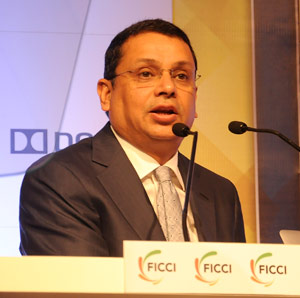
    Mr. Uday Shankar, Chairman of Ficci’s M&E Committee and Star India CEO giving the Opening Remarks at FICCI Frames 2014

    Opening Remarks by Uday Shankar, Chairman, FICCI Media and Entertainment Committee, and CEO, Star India, on Day 1 (March 12) of FICCI Frames 2014. Text courtesy: PR Department, Star India


    Good morning and welcome everybody.


    Honourable minister Manish Tewari, United States FCC Commissioner Ajit Pai, Dr. Khullar, Secretary Julka, my dear friends Punit and Karan, the wonderful team of FICCI that have organized this event, ladies and gentlemen.


    Amidst an environment of gloom and doom, the media and entertainment industry registered an impressive growth of 12% last year. The fact that we have been able to deliver this in light of an overall economic growth of 4% and a major resetting of exchange rates is a testament to the tenacity of the industry’s leaders and stakeholders. However, while delivering a growth rate three times that of the country at large is cause for satisfaction, the truth is that in dollar terms, we have barely made a dent this year. And, even more importantly, we remain at a great distance from the goal of growing the sector to 100 billion dollars.


    But, this is not a sector whose value is measured just by the size of its financial contribution. Media and entertainment remains central to defining the direction of India’s social and economic path; its work remains key to the imagination and inspiration of a billion Indians every day; and its health will be central to the ethos and values of the society we collectively shape.


    And, therefore, it is hugely important that we are gathered here in the days and weeks leading up to the national elections – one which comes at a particularly important time in our post-independence history. We have run the course on exploiting the momentum of the first set of economic reforms unleashed in 1991. We have created enormous opportunities and wealth for many. And, now, we are faced with a far more complex set of economic and social choices, including on the ideal role of the government, its relationship with industry and, in fact, the relationship of the private sector with the overall society at large.


    And no relationship is more important than the one between the government and the media. In many ways - and not uniquely to India - this is a relationship which by the very nature of its constituents is conditioned to be adversarial.Governments and political leaders are deeply aware of the power of shaping the message. The natural instinct of the state is to control the message. And, where it can, to control the messenger. The natural instinct of the media, whether the news media or the creative community, is to resist control, is to question authority. There is, therefore, tension inherent in the conflicting instincts of the two constituents.


    In India, that relationship has often moved from being just adversarial to flirting on the boundaries of dysfunctionality. Used to only a compliant state media, successive central governments have often used policy to limit free expression.And, increasingly, state governments have crossed the boundary to actually own and run private media enterprises.Why just run channels when you can integrate across the whole value chain, and run entire businesses from delivery to content?


    It is surprising indeed that irrespective of the political party or government, the expectation from the media is that they will always be flag bearers for the party line. So, there is no complaint when the media builds up the image of a clean, technocratic Prime Minister. Nor is there any problem when the media trumpets the idea of a youth leader or champions the development achievements of state leaders. But dare they cross the line into seeking accountability or evidence ofperformance, they are dubbed as incompetent, or worse,corrupt. What truly outraged me was the recent turn of events. It was the media that had created rock stars out of a bunch of street artists and protesters. It was the relentless 24 by 7 coverage of fasts and high decibel theatrics that created a political party from thin air and installed them in the government. You would have thought these leaders would have been grateful to the media for nurturing them. And, yet, even they resorted to accusations of corruption the minute the conversation turned to accountability for their choices and performance!


    Of course, the media has been more than just a silent victim in creating this environment. Too often, the news media has focused on what is sensational rather than what is important. Too often, the point of news seems to be to reduce the extraordinary diversity of the country to the most banal, a contest between extremes that can only be resolved through a shouting match on live television. With singular dominant narratives, the trend seems to be of creating heroes on a particular day only to be labelled as thugs and crooks the next.


    Legend has it that, in the early years of independence, Prime Minister Nehru used to write criticisms of his own government under pseudonyms published in leading newspapers. So concerned was he about a press that was not free and was not fiercely independent. It is ironic that today, it is perhaps easier to get articles published for a fee in newspapers than to place an honest criticism of the government. Nehru’s successors, both in politics and in the media, have strayed a long way away from that aspirational vision of the role of media in Indian society.


    Instead, it is now a broken relationship, and one that has dire consequences for both the industry as well as the government. The failure to establish credibility and importance has meant the industry perennially stays on a back foot, defending itself against every new wave of regulation aimed only at further curtailing its wings. In return, the government has not been able to leverage either the impact that mass media can have in India or harness the power of media as an economic engine that can create jobs and wealth.


    It is therefore appropriate that the weeks before the elections is the right time to call for a new contract between the government and the media. One that reaffirms both stakeholders to the theme of this year’s FICCI Frames: Transforming Lives.


    The central principle of this contract should be the recognition that this industry is a unique and powerfuleconomic enterprise. It is capable of creating employment and wealth much faster than most other sectors and with the ability to be a force multiplier, like it is in most countries. It is particularly relevant in India because it can be an employment generator without sizable public investments and without being hampered by the deficiencies of public infrastructure.


    Why would you not nourish an industry which has the potential to become a huge employer? Why would you not fuel an industry that can grow with more policy support than resource support?


    Second, the next government should recognize that it matters what the agenda of the Information and BroadcastingMinistry is. It matters what the Ministry sees as its dominant priority.  Do you see media as a tool for transforming lives thereby using it in the interest of serving the population or as something so powerful that it needs to be controlled? The regulatory agenda is one of the most crucial parameters that will shape how this industry will look like in the next 5, 10 and 15 years, and after some progress in the last few years, this agenda has now completely stalled. Whether in accelerating the digitization of television delivery, or creating progressive frameworks on consumer pricing, this agenda is waiting the arrival of a transformational government.


    And, this is particularly important when you review the media landscape today. It is littered with unviable and unhealthy media companies that cannot survive in the current framework. And unless all stakeholders are committed to retaining the vibrancy of the sector, the biggest victim will be free expression. No value is more important to this countrythan preserving the ability of a free media to showcase plurality in opinion and creative expression.


    I hope that the next few days will give us an opportunity to lay the foundations of a constructive relationship with a newgovernment for the next 5 years.


    Thank you.


  • Frames: Fifteen years of being the biggest M&E event in India

    Source: KPMG in India Analysis


    By A Correspondent


    The fifteenth edition of FICCI-Frames had reason for some special celebration. But, save the strong mention of this milestone, it would appear like any other Frames.


    The presence of a film star at the inauguration, the FICCI officebearers, a representative or two from the government and a large industry presence.


    Yet, it’s possibly the biggest event of the media and entertainment sector each year, and even the curation of the conference was wanting, as a celebration of the industry, it was unparalleled.


    But first a disclosure. MxMIndia is a media partner of the event, as it is of many FICCI M&E events through the year. Though that’s not the reason why we are covering the event. By the sheer presence of industry heavyweights around, it gains importance.


    Unlike the issue of digitization in the year 2012 which made the thirteenth edition of Frames such a huge pull, what we had last year was a disappointment. And this year’s edition is a continuation of that. To say that it’s a conference of the entire media sector may be incorrect. Successive editions of the event have given shoddy treatment to the print and sectors other than television and cinema.


    The FICCI-KPMG report on the sector -  in the backdrop of the various adspend reports published by media agencies – is a reference volume for the trade. Although the report is available online, the near-9MB, 293-page hardback is best consumed on print.


    An extract from the summary capturing the highlights of 2013:

    The Indian Media and Entertainment (M&E) Industry, one of the most vibrant and exciting industries in the world, has had a tremendous impact on the lives and the Indian economy. As the M&E industry widens its reach, it plays a critical role in creating awareness on issues affecting, channelling the energy of and building aspirations among India’s millions. As it entertains and informs the country, the M&E industry has been a catalyst for the growth of large parts of the Indian economy. Take for example, a villager – illiterate and previously unaware of what life has to offer, who begins to see a better life through entertainment programs on TV and aspires for a better life for him and his family. This drives demand for various products and services. These aspirations have been key to self motivated transformation taking deep root in India – Transformation not just from handouts and government schemes, but transformation stemming from ambition and aspiration. The media plays a significant role in our lives today and is all pervasive with touch points ranging from television to newspapers to films to radio to outdoor properties. With the addition of new media such as social networking services, animation and VFX, online gaming and applications running on mobile devices, a new dimension has been added to the world of media that was dominated by traditional media. In addition to their implicit impact, all media platforms provide a great opportunity to carry explicit messages to create social impact. Further, interactive and social platforms give people a voice.


    Examples include –

    • Films: Short films on disadvantages of tobacco consumption/smoking before each film screening in a theatre


    • Television: TV shows on social issues to raise awareness, such as Crime Patrol – Dastak (Sony Entertainment Television), Savdhaan India – India fights back (Life OK) and Satyamev Jayate (Star Plus).


    • Radio: Content highlighting social initiatives aired on radio such as Mirchi for Muzaffarnagar (Radio Mirchi), Munni Vardaan Hui (Red FM), and Green Ganesha (Big FM).


    • Print: Friends of Hindustan (Print campaign by Hindi daily Hindustan in Patna), Good is in our DNA (print campaign by DNA).


    Social Media: UNICEF India’s campaign of ‘Take Poo to the Loo’ on Facebook, Twitter and Youtube to spread the message of the harmful effects of open defecation;4 connects consumers with each other and provides a platform for opinion generation.


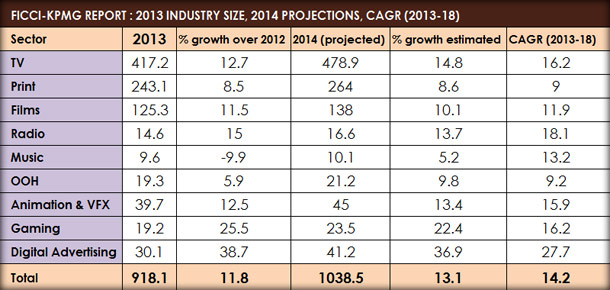
    In calendar year 2013, the Indian Media & Entertainment (M&E) industry registered a growth of 11.8 per cent over 2012 and touched INR 918 billon. The overall growth rate remained muted, with a slow GDP growth and a weak rupee. Lower GDP meant lower demand from the consumer and this impacted advertising. At the same time, the industry began to see some benefits from the digitisation of media products and services, and growth in regional media. Gaming and digital advertising were the two prominent industry sub-sectors which recorded a strong growth in 2013 compared to the previous year, albeit on a smaller base. For projections till 2018, digital advertising is expected to have the highest CAGR of 27.7 per cent while all other sub-sectors are expected to grow at a CAGR in the range of 9 to 18 per cent. Overall, the industry is expected to register a CAGR of 14.2 percent to touch INR 1785.8 billion by 2018.


    The Indian M&E sector showed some resilience and began to grapple seriously with some structural issues it has long talked about but not engaged with. These include TV and Print industry measurement, advertising volumes, inventory and rates, actions to see digitisation through and reap its benefits, working out the MSO-LCO relationship, copyright laws and operational efficiency. Many of these remain alive and will take a few years to sort through. Others, like phase III of radio – are still pending regulatory action.


    Increasing digitisation across sub-sectors of M&E industry, rate increases in TV, channel packaging by MSOs, innovative strategies to monetise digital content, rapid growth of new media powered by increasing smartphone penetration, and campaign spending during the general elections are likely to be the key levers of growth for the Indian M&E industry in 2014. A well thought out, consistent and long term outlook on regulation is also the key to create an M&E industry that is world class in scale and plays its part in transforming India.