Tag: Uday Shankar

  • Pro Kabaddi League aims to broaden reach in next season


    With four successful seasons completed in aspan of two years and the sport’s ever increasing popularity, Pro Kabaddi is now set to expand to up tofour new geographies. With the addition of these new teams, Pro Kabaddi is gearing up to surpass other Indian sports leagues in terms of geographic representation (teams from 11 states), number of matches(130+ matches), and duration of the league (13 weeks) in Season 5.


    The intended new states for Pro Kabaddiare Tamil Nadu, Haryana, Uttar Pradesh and Gujarat, chosen for their high affinity towards Kabaddi.


    Said Uday Shankar, Chairman and CEO, Star India: “Even for an optimist like me, the response we have seen for Kabaddi is surprising. Having seen its affinity in the country, it would be a disservice to the sport if we do not grow it further. All stakeholders have decided to come together to expand the league and given the pace at which this is growing, it might be just the first in a series of expansions in the coming years”,.


    Added Janardan Singh Gehlot, President, International Kabaddi Federation:  “Pro Kabaddi is a truly unique example of how a modern league has transformed the much loved but traditional Kabaddi into a modern sport. Star Sports as well as Mashal have created a magnificent example for the growth of India as multi-sport nation.”


  • 14% growth over 2017-21: FICCI-KPMG report


    By A Correspondent


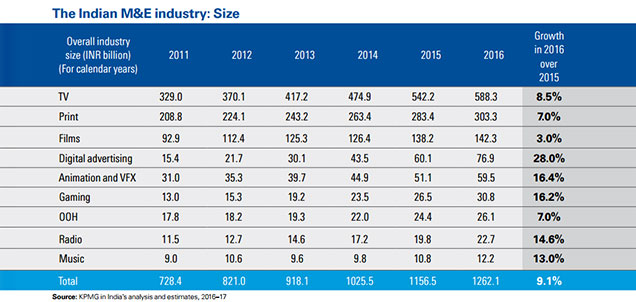
    The Indian media and entertainment industry in 2016 was able to sustain a healthy growth on the back of strong economic fundamentals and steady growth in domestic consumption coupled with growing contribution of rural markets across key segments. These factors aided the industry to grow at 9.1 per cent on the back of advertising growth of 11.2 per cent, despite demonetisation shaving off 150 to 250 basis points in terms of growth across all sub-segments at the end of the year. The ‘FICCI – KPMG Media & Entertainment Industry Report 2017’ launched at FICCI Frames 2017 in Mumbai, aims to capture a comprehensive picture of the industry’s growth story, challenges, future projections, and key underlying themes.


    The big story in 2016 has been the evolution of FTA channels post expansion of rural measurement in the television segment coupled with the impact of the 4G rollout and the resulting price wars. Both these factors have resulted in media consumption penetrating deeper into India, resulting in a realignment of strategy by media companies and advertisers alike.


    Compared to 2016, the industry is projected to grow at a faster pace of 14 per cent over the period of 2017-21, with advertising revenues expected to increase at a CAGR of 15.3 per cent. The year 2017 is likely to witness a marginally slower rate of 13.1 per cent as the economy recovers from the lingering effects of demonetisation and initial uncertainties arising from GST implementation.


    Commenting on the industry’s performance and way forward, Uday Shankar, Chairman, FICCI M&E Committee and Chairman & CEO of Star India, said: “The industry has gulped down the bitter pill of demonetisation trusting its long-term benefits and yet is set to bounce back to a steady growth, thanks to strong fundamentals. Building solid infrastructure and continued government support will help the industry reach the tremendous potential it holds for employment and creating socio-economic value for the country. A commitment towards a quick transition to digitisation will ensure growth for all stakeholders.”


    Added Girish Menon, Director, Media and Entertainment, KPMG in India: “[The year] 2016 was a mixed bag for the industry with digital media making its way to the centre stage rapidly from being just an additional medium. It is compelling existing players to rethink their business models. To accelerate growth, M&E organisations must rebuild their strategies to fit and thrive in the changing, digitally-oriented landscape. Nimbleness and flexibility will be at the core of sustainable businesses…. The long-term factors driving the future growth are expected to remain positive, with growing rural demand, increasing digital access and consumption, and the expected culmination of the digitisation process of television distribution over the next two to three years.”


    Sector-wise analysis:

    Television:

    The TV industry clocked a slower growth in 2016 at 8.5 per cent, attributed to tepid growth of 7 per cent in subscription revenues and a lower than estimated 11 per cent growth in advertising revenues. A key theme in 2016 was the emergence of FTA channels as a key focus area following the expansion in rural measurement by BARC and the resultant increased interest by both broadcasters and advertisers. Additionally, strong performance of sports properties and increased spending for the launch of 4G by telecom operators helped alleviate some of the pressure. The industry is expected to grow at a CAGR of 14.7 per cent over the next five years with advertising and subscription revenues projected to grow at 14.4 per cent and 14.8 per cent, respectively. The projections remain robust due to strong economic fundamentals, rising domestic consumption and growing contribution of rural markets coupled with the delayed, but eventual completion of digitisation.


    Print:

    The revenue growth rates of print continued to witness a slowdown at 7 per cent in 2016, as English newspapers remained under pressure. Regional language papers demonstrated strong growth, but were adversely affected by demonetisation given their high dependence on local advertisers. Print is expected to grow at 7.3 per cent, largely driven by continued growth in readership in vernacular markets and advertisers’ confidence in the medium, especially in the tier II and tier-III cities. Rise in digital content consumption poses a long-term risk to the industry.


    Films:

    Films grew at a crawling pace of 3 per cent in 2016. The segment was impacted by decline in core revenue streams of domestic theatricals and satellite rights, augmented by poor box office performance of Bollywood and Tamil films. Expansion of overseas markets, increase of depth in regional content and rise in acquisitions of digital content by over-the-top platforms are expected to be the future growth drivers that would help the segment bounce back at a forecasted CAGR of 7.7 per cent. However, factors such as dwindling screen count and inconsistent content quality could prove to be limiting factors.


    Digital advertising:

    Continuing to ride on a high growth trajectory with a 28 per cent growth in 2016, digital advertising has captured 15 per cent share in the overall advertising revenues, with a minor hiccup due to demonetisation. 4G rollouts and the resultant data price wars are providing further impetus to the growth as digital consumption and habits are becoming more mainstream. It is projected to grow at a CAGR of 31 per cent to reach INR294.5 billion by 2021, contributing 27.3 per cent to the total advertising revenues. Advancement in infrastructure, evolving audience measurement technology leading to better content and lowering data costs will drive user habits towards greater digital consumption, driving tremendous growth for the industry.


    Animation and Visual Effects (VFX):

    The industry grew at 16.4 per cent, driven majorly by a 31 per cent growth in VFX due to increase in outsourcing work, growing use of VFX in domestic film productions and increase in demand for domestic animated content on television. The industry is estimated to grow at a CAGR of 17.2 per cent over 2017–21.


    Out of Home (OOH):

    The industry registered a slowdown in growth rate at 7 per cent majorly due to adverse impact of demonetisation. OOH is projected to grow at a CAGR of 11.8 per cent primarily driven by development of regional airports, privatisation of railway stations, growth in smart cities, setting up of business and industrial centres, and growing focus on digital OOH.


    Radio:

    Radio recorded a 14.6 per cent growth led by volume enhancements in smaller cities, partial roll out of Batch 1 stations and a marginal increase in effective advertising rates. However, weak uptake in Batch 2 auctions of Phase 3 and delays in the rollout of majority of Batch 1 stations, coupled with adverse impact of demonetisation dampened the overall sentiment. Nevertheless, it is expected to be the fastest growing amongst the traditional mediums at a CAGR of 16.1 per cent, arising from operationalisation of new stations in both existing and new cities, introduction of new genres and radio transitioning into a reach medium.


  • Star Plus launches new campaign starring Aamir Khan

    By A Correspondent


    Star Plus has released a special Women’s Day communication featuring superstar Aamir Khan. Created by Ogilvy and directed by adman-turned-film-maker Nitesh Tiwari, the ad puts the spotlight on one of the nation’s biggest social issues of gender inequality and takes it head on.


    Said Uday Shankar, Chairman & CEO, Star India: ”We at Star believe that daughters are equally capable to bring laurels to their families and society. Our latest NayiSoch film reflects this confidence. It not only questions the gender discrimination that still exists, but also iterates our belief that it is time for fathers to step up and inspire their daughters with confidence and self-belief. Aamir Khan brings great credibility and empathy to the role of a father whose progressive thinking gives his daughters the freedom to flourish.”


    Notes a communique: “The brand film is a reflection of how in a nation of over 10 million shops and establishments, it is hard to find even a single one that holds the title of “And Daughters” – it is always ”And Sons”.”


    Indeed.


  • Star India unveils ambitious plans with “TED Talks India: NayiSoch”

    By A Correspondent


    Star India announced the greenlight of ‘TED Talks India: NayiSoch,” a global first Hindi TV talk show created in partnership withTED, the non-profit devoted to ‘ideas worth spreading,’ and hosted by Bollywood superstar Shah Rukh Khan. The show on Star Plus titled ‘TED Talks India: NayiSoch,’ will feature speakers sharing big ideas in TED’s signature format of short, powerful talks. This is the first time TED is collaborating with a major network and mega-star to produce a TV series featuring original TED Talks in a language other than English.


    Uday Shankar, Chairman & CEO, Star India, said, “At Star, we have always believed in pushing the boundaries with new ideas, creativity and fresh thinking. Nobody reflects this belief more than TED and we are thrilled to collaborate with them in bringing the power of ideas to our audiences with ‘TED Talks India NayiSoch.’ In an age of high volatility the role of ideas to fuel positive change cannot be overstated. We are delighted to have Shah Rukh Khan share our vision and lend his charisma to this exciting endeavour.”


    Shah Rukh Khan added, “Star India’s legacy of using television as an instrument of social change, and TED’s unequivocal drive to showcase simple but unique ideas in an effort to spark debate and conversation are a very powerful combination. I believe ‘TED Talks India-NayiSoch’ will inspire many minds across India. It is a concept I connected with instantly, as I believe that the media is perhaps the single most powerful vehicle to inspire change. I am looking forward to working with TED and Star India, and truly hope that together, we are able to inspire young minds across India and the world.”


    “It’s incredibly exciting to be bringing TED to India in this form,” said TED curator Chris Anderson. “The country is teeming with imagination and innovation, and we believe this series will tap into that spirit and bring insight and inspiration to many new minds. We’ve been so impressed by the passion of our partners at Star TV and our host Shah Rukh Khan. We cannot wait for the launch.”


    Juliet Blake, head of TV at TED and executive producer of the series, added, “The sheer size of Star TV’s audience, with more than 650 million viewers, makes this a significant milestone in TED’s ongoing effort to bring big ideas to curious minds. Global television is opening up a new frontier for TED.”


    Star India has always believed in disruptively powering social change through the power of its content to influence and impact people’s lives and thinking. Continuing with this journey ‘TED Talks India: NayiSoch’ will take forward Star’s commitment of creating social impact with Nayi Sochin India. Inspiring a billion imaginations is much more than a tag line, it’s a promise Star India delivers every day in ways that break away from the conventional, spark national debate and help shape the new India.


  • Punit Goenka is new IBF President

    By A Correspondent


    Punit Goenka

    Zee Entertainment Enterprises Managing Director and CEO Punit Goenka was elected  President of the Indian Broadcasting Foundation (IBF) at the AGM held New Delhi last week.


    The IBF Board also elected Rajat Sharma (Chairman, India TV), N P Singh (CEO, Sony Pictures Network), Sudhanshu Vats (Group CEO, Viacom 18), K Madhavan (Managing Director, Asianet Communications) as Vice-Presidents; and KVL Narayan Rao (Executive Vice-Chairperson, NDTV) as the Treasurer of the Foundation for a period of one year.


    Said Goenka, who is also chairman of joint industry body Broadcast Audience Research Council (BARC): “I am delighted to lead the Indian broadcasting sector at a time when there is a lot of churning and India is being looked upon as global destination for investments. In the ensuing and continuing efforts of making India as a broadcasting superpower, I wish to work in a most collaborative manner with the Government, Industry and other stakeholders for realisation of the sector’s value chain to the optimum.”


    Uday Shankar

    Outgoing IBF President Uday Shankar said, “I cannot think of a more suitable person than my dear friend, Punit Goenka to handover the leadership of IBF.  Over the years, Punit has eminently helped me in navigating IBF through these volatile times.  He is also the primary architect of Broadcast Audience Research Council (BARC).  His intelligence, dynamism and maturity will be great assets for IBF and the Indian media.”


  • Text of Star India CEO & co-chair FICCI M&E committee Uday Shankar’s speech at Frames 2016

    By A Correspondent


    Text of the keynote speech made by Uday Shankar, Star India CEO and co-chair FICCI M&E committee at inauguration of FICCI-Frames 2016


    Honorable Minister of Communications and Information Technology, Ravi Shankar Prasad Ji, Chairman TRAI R.S. Sharma, Mukesh Ambani, Ramesh Ji, friends from the world of media and entertainment.


    As co-chair of FICCI’s M&E committee, I have had the opportunity to address you for a few years now. I take this as a rare privilege and hence spend some time thinking through what I should say. A few weeks ago, as I was discussing the theme with some of my colleagues, a young assistant of mine – cocky on youth and his recent admission to Harvard Business School stated rather dismissively that there wasn’t anything new to be said as there wasn’t anything new happening in the M&E sector. While it sounded like a cynical assessment at that time it did set me thinking if there was indeed a grain of truth in what he said. On the surface, it does seem that not much has changed in the last several years except for some incremental growth or decline depending on which vertical you are talking about. Cable TV continues to struggle – struggling to improve its business case, struggling to improve its talent & technology quotient and above all to stay relevant in a rapidly changing world.  DTH, that set out to revolutionize distribution, increasingly seems to be intent on locking its destiny inside an isolated box in a networked world. Even the story of digitalization that started 6 years ago remains incomplete. The advertising revolution of the 90’s when a large number of international and Indian brands were built on television screens, doesn’t seem to be breaking new ground in terms of what I call brand revolution 2.0. Content creators, a community that I belong to, generally seem to be caught in a time warp with the same themes playing in a loop again and again –cursed destinies, rebirth and revenge and deference to elders in public while bickering in private, pretty much sums up what rules national entertainment. The quality of news of course, seems to cause only national consternation, with now even our friendly neighbor taking a pot-shot at our news channels! Over all, it seems the more things change the more they remain the same.  So maybe my colleague was right after all.


    But then is the picture really as gloomy as this? Because beneath the surface ofentrenched stagnation, quietly – almost stealthily -there is a gigantic disruption playing out. A disruption that’s shifting the ground from beneath our feet.


    My friends, allow me to recap the year for you.  The creative group to make the most waves last year were 4 youngsters, irreverent enough to take on our entire film industry and then build on that success by putting the entire country under a scanner.  This is a group who has the audacity to have a name so offensive that our news media calls them by their acronym AIB.  Yes, I am talking about All India Bakchod, who are perceived as comedians although this is not a group of people who make imbecile jokes while dressed in a funny manner.  More than once they have set the news agenda for the nation.  They have the gall to take on the combined might of big telcos and Mark Zuckerberg’sFacebook when they felt that the freedom of the internet was being parceled away.  They have used humour to put a spotlight on the state of fire stations in India or for that matter the behavior of the police force. As a group, these four youngsters made more headlines last year than probably all of the creative community put together.


    Very recently one of the pioneers of television entertainment told me that she was so frustrated by the frozen state of traditional media that she was going to create a digital enterprise to tell the stories that traditional media has been too scared to tell.  Of course, I am talking about the totally adorable – Ekta Kapoor.  Think about that for a moment – the person who created the archetype of saas and bahu feels the need to break away from these stifling constraints of the medium that she herself created.  Why?  When that happens, we all need to think hard.


    Friends, the most talked about launch in Indian M&E last year was not a new channel, or a new newspaper or a new production house – actually it was a mobile app that had the gall to ask consumers to go solo.  A call fundamentally at odds with the concept of content consumption in this country, that believes that the entire family watches TV together in the living room. Well, I am talking about the launch of our very own hotstar.  In just about a year, hotstar has been downloaded over 50 million or 5 crore times.  What is the implication of this?  Consider this – more people have watched the English Premier league on hotstar last year than on television.  Yes, EPL was watched by more people on hotstar than on television.  Even for a mass sport like cricket, in the larger cities, hotstar’s watch time is now starting to reach 50% of television.  I urge you to reflect on the potential of that statistic.   This infant service is already becoming a product of habit in India and now this year, my friends, we have set our sight on creating the first global Media & Entertainment product born out of India, when we take hotstar to the rest of the world in a few months.  The numerous and affluent south Asian diaspora which for the longest time has been frustrated by the lack of access to its favourite content will be able to watch cricket, movies and drama through hotstar.  While I am indeed happy for hotstar to be the pioneer, we are very aware that this is a trend that will get replicated again and again, very quickly.


    This colossal shift by no means is limited to television.  At the risk of earning her disapproval, let me share the story of my daughter – she is a serious academic whose job is to analyze the social sector and legislation for a living.  She is always on top of news and opinion articles and yet I have never seen her hold a physical newspaper in her hand.  Her daily dose comes exclusively from the digital universe. Her intake ranges from headlines under 140 characters to ebooks over 14 million characters long. She is a voracious consumer of movies and drama; yet goes to theatres morefor fun than for creative consumption.  Fixed schedule programming sounds as bizarre to her as silent movies to us.  She is obsessed with music but doesn’t own a single CD.  Her near infinite library rests entirely on her iPhone – the same goes for her friends and colleagues who use android devices.


    The world has changed.  There is a tectonic shift happening in our industry right in front of us.And yet, what we see in the world of traditional television is just stagnation. And this stagnation has been made worse by the funny denial that all of us seem to be living in. Even though this change is happening faster than anything we have ever seen, our approach towards it seems to be one of incrementalism.


    I see an even more obsessive desire to protect the antiquated business models that we have painstakingly built over the years and that technology and the youth are decimating like a bull-dozer rolling over glass bottles.  It reminds me of the story of a Japanese soldier who was left stranded and forgotten on a small island in the Pacific. Many years after Japan had lost the war and the world had returned to normal that lone soldier kept guarding that isolated island thinking he was still protecting the Japanese empire.  Herein probably lies the explanation why print companies found it difficult to make the transition to TV and why almost all the digital successes generally come from companies that did not exist even a decade ago.  This is because these are companies and people who are not chained by their legacy businesses.  Just imagine where businesses like Netflix, Twitter and Facebook were a decade ago and what global empires they have created in this short span of time.


    It is pretty clear to me that we are in a battle.  In this battle there are only two options that we have – we can either continue living in denial, hide back in our artificial walled gardens, watching as the bricks crumble down one by one or we can arm ourselves with the sameweapons that our challengers possess, and venture forth into battle, sometimes even against the same businesses that we have created. Change or Perish.


    There is one thing however that will continue to be the same: the power of stories. For those of us who had imagined a world where the so called user generated stories would unseat high quality creativity, the answer comes from the Netflix strategy.  Netflix – the most successful content provider in the US, the challenger to the media behemoths of the west has done so on the back of extremely high quality content, so much so that Netflix’s catalogue today represents the absolute best of American television.


    However there is a twist in the tale here.  No longer is the story enough, within the commoditized consistency of experience.  Technology and creativity are coming together to enhance the experience literally, almost daily.  Indians long used to a life of having to start all over again if the power went for a minute are rapidly getting used to being asked if we want to resume where we left off?


    The new screens have once again highlighted the importance of the story but they have introduced the centrality of the experience at the same time.  Design and engineering can no longer be divorced from the story – this is a radical departure from everything that we were taught all these years.  We learnt this the hard way through hotstar – how small changes even in the browsing experience could lead to dramatic shifts in consumption.  Today I am happy to remark that we at Star probably have more engineers in our team than any other media and entertainment company.  Equally we have more designers and more story tellers than anyone else because those are the three pillars on which we see future M&E companies getting built.


    Clearly, we need to change the lens with which we look at talent.  In this new world neither technology nor talent will be limited by geographical boundaries.  The best engineers are as likely to be in Berlin as in Bangalore.  We already know that best designers and animators for Hollywood no longer need to be there – because they are already in Goregaon and let’s not forget our very own Priyanka Chopra who is the first home grown star of a truly global show.  We are looking at a truly global world.  But this global world has no patience for traditional forms of reverence.  At Star, we are grappling with this everyday – when we inducted culturally diverse talent we had to create space for that cultural diversity to exist. But that’s easier said than done.  Technology going global, talent going global also means adoption of a new tradition.


    Recently, I just saw amazon.in selling cow dung cakes online.  This humblest of the humble, the most traditional of fuels, being sold at 350 bucks for a small packet.  To me, that is the real power of the world that we are going into.  Power of the idea that someone actually thought that there is a market out there for cow dung cakes and the fact that that market is willing to a pay huge premium for it.  And the fact that the internet has created a market place where ideas and creativity are the only constraints.


    In this context let me draw your attention to the illustrious gathering on this podium today because if India has to make that leap into the new world where everybody can create value for himself or herself by sheer innovation then this group here must deliver.  Minister Ravi Shankar Prasad is not just a senior minister of the Union Cabinet – he holds the key to India’s transition into this digital world.  Chairman R.S.Sharma will have to decide how much can he accelerate that leap, and finally the whole country is looking at Mr. Ambani’s initiative called Reliance Jio to unshackle that truly global, truly democratic dream of 125 crore Indians.  Let’s all hope that they do the right thing, for it is in the best interest of this country they all must succeed.

     

  • Sudhanshu Vats to chair IBF Credit & Collections Committee

    By A Correspondent


    The Indian Broadcasting Foundation announced the appointment of Sudhanshu Vats, Group CEO, Viacom18, as the Chairman of the IBF Credit and Collections Committee & Co-Chairman of the joint IBF- AAAI Sub-Committee.


    IBF in association with AAAI (Advertising Agencies Association of India) had formed a joint credit collections committee which scrutinizes, regulates and evaluates the credit worthiness of the advertisers active through AAAI member advertising agencies on IBF member channels. It plays a pivotal role in dispute resolution between channels and agencies vis-a-vis advertisers.


    Sudhanshu Vats, Group CEO, Viacom18, who is also an IBF Board member stated, “I am delighted to have been entrusted with this responsibility. Strengthening our relationship with the advertisers would be our goal and I look forward to introducing newer mechanisms in line with the global standards, to normalize the revenue mechanisms for all parties.”


    The outgoing Chairman I Venkat mentioned, “I know Sudhanshu would bring his ethos and greater clarity in the functioning of the Committee. I am thankful to all the members for their support and  their valuable contribution and also to Ashish Bhasin , the Co- Chairman of the Committee, AAAI  who helped me conduct these meetings in a more organised and transparent manner”.


    IBF President Uday Shankar says, ”Both Mr Vats and Mr Venkat have been valuable colleagues in the IBF Board and both deserve admiration and appreciation for taking up the task of revamping the broadcaster’s ad revenue flow. I am sure Sudhanshu will bring greater efficacy and democracy to the functioning of the Committee.”


  • Star India can now officially say ‘Meri Maa’

    By A Correspondent


    Star India has announced that it has successfully completed the integration of the broadcast business of Maa Television Network. With this integration, Star India enhances its outreach to South India markets, specifically Telugu-speaking viewers.


    With a bouquet of four channels, namely maa, maa Music, maa Movies and maa Gold, the Maa TV Network has a formidable presence in Andhra Pradesh and Telangana. However, it may be noted that as per BARC Week 47 ratings, ETV Telugu is a clear numero uno in the Telugu GEC genre. Maa is second with Zee Telugu a close #3.


    Said Star India CEO Uday Shankar in a statement: “We are pleased to announce the completion of the integration of the broadcast business of Maa Television Network, a journey that we had embarked upon in February, earlier this year. We are very impressed by the solid creative core and quality and depth of the management team at Maa Television Network and are delighted to welcome them to the Star family. The acquisition fills a critical gap in our portfolio and will allow our advertisers targeted access to the large Telugu speaking population. We plan to invest further in this important market to fundamentally change the content quality paradigm. I am confident that team Maa under the leadership of K. Madhavan will transform the content experience for Telugu viewers.”


  • Star partners HBO for exclusive programming content

    By A Correspondent


    Star India and HBO have announced an exclusive programming agreement that will take HBO Original content to a wider audience via both, the hotstar digital platform and the English channels on the Star India network.


    Star India is again set to redefine the viewing experience on one of the world’s fastest growing digital content platforms namely hotstar and for its viewers across India, with the very best of HBO’s Original programming including series like ‘Game of Thrones’ and ‘True Detective’.


    Uday Shankar

    Commenting on the deal, Uday Shankar, CEO, Star India, said, “Star is delighted to partner with HBO to bring world class HBO Originals programming for Indian viewers. Star will become the exclusive destination for screening HBO content in India – once again resetting the benchmark for quality and depth of content offering for its viewers. Fans will be able to watch their favourite HBO Original programs on hotstar on the same day as the telecast in the United States. Viewers will also be able to see the HBO Original programming on Star’s English channels.”


    Jonathan Spink, HBO Asia CEO, said “HBO is delighted to enter this new chapter in India with Star. Through the first release of our shows on Hotstar, Indian Audiences will now have unprecedented flexibility in how they consume HBO’s much loved premium programming.”


    Forthcoming series of popular HBO Originals that fans can look forward to include the popular Game of Thrones; True Detective; Silicon Valley; Veep; and Leftovers as well as new HBO  Original series in the forthcoming season which will include the Scorsese series Vinyl scheduled to air on 14 Feb and Westworld. In addition library favourites such as Entourage, Band of Brothers, The Sopranos and Curb Your Enthusiasm will also be available.


  • Rural ratings delayed, but are broadcasters rural-ready?


    Rural Ratings Delayed, But Are Broadcasters Rural-Ready?By Shailesh Kapoor


    The delay in the release of the rural ratings has been a topic of chatter in the broadcasting corridors over the last fortnight. Since a definitive date was announced, the delay has led to speculations, even rumors, including some that are imaginative and absurd in equal measure.


    Over the last year, since it became evident that rural ratings will be a part of their lives sooner than later, broadcasters have spent considerable resources in becoming “rural-ready”. The main area of focus has understandably been distribution. The other emphasis has been on consumer research. Having studied LC1 consumers extensively over the last few years, rural research is not entirely alien territory for broadcasters.


    But is that all that’s there to being rural-ready? Distribution is an enabler and consumer research is an input into programming and marketing. Hence, unless the rural-readiness reflects in content and brand strategies, it is not in place in real terms.


    That raises the pertinent question: Has anything changed on-air? Besides some of the GECs extending their primetime to ensure an early start (5pm/ 6pm), no other visible change reflects rural-readiness on-air. If anything, some changes have been a bit “anti-rural” in nature. A sizeable proportion of new launches over the last year are urban-skewed in their theme and treatment. It is evident they will lack rural traction.


    Stereotyping problems have continued, such as assumption that non-fiction viewers would rather read English than Hindi. Presentation language, as a result, continue to be inconsistent on-air, not just for GECs but even for movie channels. Liberal usage of English mars comprehension of several shows, including some fiction ones, even in the urban centers, and this has not changed either.


    The approach seems to be that of ‘be ready and then wait-and-watch’. The first ratings, whenever they are out, will mean a shift of gears. With channel and programme level data available to act upon, and the weekly clock ticking by, it would be time to act on high priority. All the rural research reports, from studies conducted in late 2014 and early 2015, will then come in handy.


    The genres that are likely to be least impacted from a content perspective are news and kids. Though both of them may lose overall TV viewing share in rural, like most other non-GEC genres, their rural content profile is likely to be similar to the bigger urban centers. A few other genres, especially infotainment and music, will have to take decisionson whether they want to invest resources in the rural markets at all.


    All this shall unfold when the rural ratings are released. Till then, the question of why they did not release on schedule, and what the new date is, will continue to keep us busy.


    So what’s delaying BARC’s rural ratings?By A Correspondent


    The much-awaited release of rural ratings data from Broadcast Audience Research Council (BARC), the joint industry body mandated by broadcasters, advertisers and advertising agencies to measure television audiences looks likely to be delayed.


    According to sources, broadcasters body Indian Broadcasting Foundation of which Star India CEO Uday Shankar is President, has written to the BARC board asking for the rural data to be delayed.  The reason:  there is need to let the current the data stabilise given some complaints of volatility. BARC started releasing its data from end-April 2015.


    BARC was scheduled to release the rural data by end-September and conducted road shows across major centres (Disclosure: MxMIndia had partnered the promotion of these roadshows).


    However, according to industry grapevine, there is more to the delay than the reason to stabilise. Sources have told MxMIndia that certain members of the ecosystem are dismayed with the delay and have questioned whether a leading channel whose ratings have been put to test by competition is behind the effort to delay the rural release.


    According to information we have received, Doordarshan officials are unhappy with the delay, and it is felt that if BARC pushes the release of rural data indefinitely, the I&B ministry may also step in.


    The BARC Board is scheduled to meet next week and will possibly deliberate on the issue.


  • What the fur! All India Bakchod gets Uday Shankar cheeky in his communiqué

    By A Correspondent

    Five years back, when our editor asked him to do a high five for Impact magazine, he was very hesitant on how it would impact his image. But those were early days still in his captaincy of Star India. Now, after having established itself as the #1 media professional in the country and as a gamechanger with the strides he has taken in sports broadcast, the former news journalist (and at heart still one), has been dramatically (and pleasantly) kewl in a press release we received on Tuesday.

    The communiqué was about how comedy entity All India Bakchod (referred to AIB to prevent the mouthing of an expletive in its name… chod, if you will still didn’t get it). And this is how Shankar’s quote read: “”I am told that based on extensive, exhaustive research, AIB are considered mildly entertaining and we should give them a show on our network. I have complete faith that we will regret this in the months to come.”

    We pinched ourselves. Did we read right? Is this the same Star India CEO who is always propah in his ways?

    The quote from Ajit Mohan, Head of Hotstar, was equally irreverent. “We are sort of excited to bring AIB’s brand of mature humor to our platform. This may be the start of a new era of quality content in India, I am told. Janta hamein maaf karein,” it said.

    Not surpisingly some copy-and-paste journos jointly simply Control-C-V-ed the release.

    We didn’t. We are MxMIndia.

    Okay, dudes, and if you notice we are trying to get effing hip and mother-effing happening without using Hindi gaalis like MCBC, but English expletives which make us sound very evolved.

    No, let’s leave all the smart talk to You Shanx and his boys and babes. Yo man!

  • Star Network sells its 25.99% in Balaji

    By Ravi Teja Sharma


    Rupert Murdoch-owned Star Network has sold its entire shareholding of 25.99% in Ekta Kapoor promoted Balaji Telefilms in a block deal on the Metropolitan Stock Exchange of India (MSEI) at an average price of Rs 63.6 a share. This values the block deal at around Rs 108 crore.


    “This confirms Star’s exit of a minority stake of 25.99% in Balaji Telefilms,” said Uday Shankar, CEO Star India.


    “Axis capital acted as advisors to Star and also executed the on-market sale on August 5th 2015. This is in line with our strategy to focus on core businesses where Star has the ability to shape and scale the future growth path of its investments. Our programming and contractual relationships with Balaji are deep and we continue to work on strengthening them to our mutual benefit,” he added.


    Star had bought 21% stake in the company in 2004 for Rs 90 per share and had raised it to 25.99% later through an open offer.


    The production house had an exclusivity deal with Star. Balaji Telefilms is known for some of the top soaps such as Kahani Ghar Ghar Ki, Kyunki Saas Bhi Kabhi Bahu Thi and Kasuati Zindagi Ki.


    Balaji Telefilms’ shares were up 19.96% to 95.25 at the close of trading on Wednesday.


    Source:The Economic Times

    Copyright © 2015, Bennett, Coleman & Co. Ltd. All Rights Reserved

    Licensed to republish