Tag: Times of India

  • Time for newspapers to up cover price!


    By Pradyuman Maheshwari


    The print media in India has reason to be sore with the government. Barring a few, most newspapers and magazine weren’t too negative on the previous regime, and in a sense contributed to its return to power. While some publications may indeed have aired anti-Narendra Modi views in the run-up to the elections, the dosage of that was limited and, one may say, controlled.

    Indian newspapers have forever worked on a lopsided business model. Masterminded by Times of India group vice-chairman Samir Jain in the 1980s, newspapers were being sold at very low cover price to attract and retain readers, and combat (and hence bleed) competition. The ‘invitation pricing’ policy was followed relentlessly by TOI and almost every old and new newspaper thereafter. Casseroles, soaps and assorted gifts were offered to readers in the form of subscription offers. But the price of the papers – especially the English-language ones – were far, far below the monies that went into the making of each issue.


    Newspapers that have profited over the last three decades have done so thanks to their leadership and thereby their ability to attract advertising or through allied or dramatically different businesses. Advertising from government or quasi-government organisations ensures that the money registers keep ringing even as the cost to consumer continues to be abysmally low.


    Over the last few years, as in the case of internationally sourced products like crude oil, the price of newsprint has also been rising. This has adversely impacted the bottomline of most print media businesses. In fact in the last few years, price of imported newsprint that is largely deployed by English as well as high quality regional papers, had skyrocketed. It went south in late-2018, but by then the ad volumes on print touched a new low. Adspends have been low for other media too, but print has been hit badly with digital steadily weaning away its readers. The Indian Readership Survey 2019 may have shown growth for newspapers but that’s only with the Total Readership metric. With the more widely acceptable Average Issue Readership, the future doesn’t look very bright – esp in the metros.


    So if the newsprint prices go north, the cover price should’ve also headed the same way, right? No, instead, newspapers have traditionally been quick to cut their content often even rejigging the mix. Publishers are worried that a hike in the cover price will impact their readership, which could well be true, but clearly the newspaper organisations need to integrate their digital operations better and foresee a future that helps them make monies from their e-presence.


    To blame the government for their new-found woes is incorrect. I am sure Prime Minister Narendra Modi will reverse the import duty hike. He has done that in the past, and could do it again.


    Yes, our readers are fickle in their ways. They don’t mind spending Rs 20 or whatever on a vada pav, idli sambar, chaat or jhaal-muri, but they will crib about Rs 10 for a copy of the morning newspaper or Rs 60 or 100 for a glossy and informative magazine.


    Newspaper owners meanwhile need to smell the coffee – or ink – and up the cover price. Over-dependence on government largesse is detrimental to an independent media. And it’s time that consumers learn to pay for quality content.


  • A shrinking space for Muslims in the Indian media


    By Ranjona Banerji


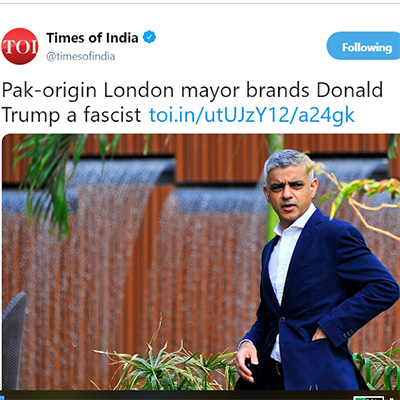
    The Times of India’s website ran a headline on June 2 which read like this: “Pak origin London mayor brands Donald Trump a fascist”.

    The underbelly of this tweeted headline is evident: Sadiq Khan is a Muslim. Sadiq Khan is mayor of London, elected by the people of London in 2016, but he is of Pakistani origin and by insinuation, how dare a Pakistani Muslim call the President of the United States a fascist, when and perhaps there is a further insinuation here, that Muslims and/or Pakistanis are fascists themselves.

    Is there an underlying message here for Indian Muslims from the mainstream Indian media? This is not from Opindia or Swarajya. This headline is from India’s largest read English language newspaper. If this headline was just one off, it could be dismissed as the work of a rogue sub-editor on a late night shift. But let’s not forget Times Now’s anchors like Navika Kumar and Rahul Shivshankar screaming themselves hoarse about how Hindus are in peril or that the Congress Party and Trinamool Congress only care about Muslims.

    What a difference from the newspaper group which once launched the “Aman ki Asha” campaign in 2010 together with the Jang group of Pakistan, to push for peace between India and Pakistan regardless of government policy.

    I mention Times of India because of the toxic undercurrent of its Sadiq Khan tweet. It is a mindset. According to various experts, this victory by the BJP and Narendra Modi represents an upsurge of Hindu pride. The co-relation to that is a rise in anti-Muslim anger. It’s not that we haven’t seen it before and as if it hasn’t been underlined by every lynching, every bit of violence in the name of “cow protection”, every mention of “termites”, every insinuation about graveyards and cemeteries, every move to push the NRC, every allegation that Bengal does not allow Durga puja celebrations but only Muharram processions or even every statement that the Congress only cares about Muslims and not about Hindus over the past five years. All these have insidiously made their way into the public discourse so that the anti-Muslim idea can be normalised.

    Political parties themselves have found themselves bamboozled by BJP strategy. The Congress ran around trying to prove that every member of the Nehru-Gandhi was a Brahmin. Shashi Tharoor took a pro-religion anti-Supreme Court line on the entry of women into Sabarimala. Mamata Banerjee and the Trinamool Congress are still being played by the BJP and Sangh Parivar on this issue.

    The role of the media in furthering this political game by the BJP and its cohorts cannot be ignored or even exaggerated. Often, journalists in their private capacities reveal themselves to be highly Islamophobic, prejudiced, susceptible to rightwing Hindutva propaganda, if not open advocates of anti-Muslim sentiments. I include their Twitter and Facebook profiles in this.

    Journalists who do not toe this BJP-line are as ever tagged lefties, commies, Maoists, Congress stooges and all the rest of it. But that is par for the course and hardly new.

    What is dangerous for democracy is when journalists are allowed by their media houses to be proud of their ignorance of democracy, of the Indian Constitution and of India’s diversity. The number of TV journalists especially who have put forward the line that one cannot criticise the Modi government because it has won an election is horrifying.

    The ignorance of journalists has also been exposed here. Partly because newsrooms are so young and so eager to get rid of institutional memory, partly because our education system is skewed and tampered with over the years. Who Delhi’s Khan Market is named after is a case in point. So is “Pak-origin” London mayor.

    As Muslims celebrate Eid today and tomorrow, notice how the focus on Ramzan, on post-fast celebrations, on Eid itself has reduced in the Indian media. The cultural impact of this will hit us down the years if journalists continue to give in to Hindutva propaganda and remove parts of India’s diversity from the public consciousness.

    What is in danger is not the Hindu or Hinduism, it is India’s future and the space for a combative, strong, holding truth to power Indian media.


    Ranjona Banerji is a senior journalist and commentator. She is also Consulting Editor, MxMIndia. Her views here are personal


  • Times Fresh Face announces launch of its 11th season

    By A Correspondent


    The Times of India has bought on board Livon to partner for the 11th season of its talent-hunt platform – Livon Times Fresh Face powered by Set Wet.


    Commenting on the contest, Sanjeev Bhargava, Director of Brand TOI said: “The Times of India is not only a chronicler of change but an enabler of positive change. We attempt to impact positive change in many different ways through initiatives that empower the citizens of this country to impact the environment, the health issues facing the country, improving the economic and political awareness in the country. One of the key areas we have identified is to empower the upcoming generations of Indians with self-confidence and recognition, opening the doors to new opportunities for them. Livon Times Fresh Face is one such initiative. We believe that by reaching out to ambitious and talented youth in colleges around the country, and encouraging them to recognize and showcase the power of their talent and personalities, we are not only giving these bright future stars a big platform but also inspiring thousands of other fellow students through our events and amplification in media. The change their talent can bring about is what will contribute to defining the future of this country.’’


  • From our archives: How Ashok Mahadevan innovated in his protest against the Emergency

    By A Correspondent


    In 1975, journalist Ashok Mahadevan inserted an ad in The Times of India that in many ways triggered the countrywide protest amongst political activists and the average India. We reproduce an interview which our former colleague Dyanne Lobo took with Mahadevan to mark the Emergency’s fortieth anniversary.


    Here’s the interview (original link): http://www.mxmindia.com/2015/06/how-ashok-mahadevan-innovated-in-his-protest-against-the-emergency/


    Forty years back, veteran journalist and former Editor of the Indian edition of Reader’s Digest was incensed with the Emergency and what it meant for free India. Then Deputy Editor of the Digest, Mahadevan was inspired by an ad in a Sri Lankan newspaper and inserted in The Times of India, which has now become one of the most enduring examples of how the country fought back the draconian government led by an ill-advised Prime Minister. On the eve of the forty years of that Dark Day, Dyanne Coelho interacted with Ashok Mahadevan who responded to her questions and also asked her to pick up some accounts from an article he wrote in the Reader’s Digest in 2010.


    The Q&A:

    What was the situation like especially for journalists during the days of the Emergency?

    For more than a year, the Prime Minister had been besieged by a nationwide movement against her led by her father’s old friend, the venerable Gandhian Jayaprakash Narayan (JP). Now, as she had done so often, Mrs Gandhi hit back ruthlessly. On June 25, she declared a state of “Emergency.” The press was muzzled, civil rights were abolished and tens of thousands of political activists, including JP, were arrested. In effect, India became a dictatorship. These momentous events—40 years ago this month—also enabled me to prank my way into becoming a small footnote in the history books. When I learnt the news on the morning of the 26th, I was incensed. India no longer a free country? As acitizen, even more as a journalist, it was intolerable. I had to do something. But what? Fear was spreading like an infection. When I asked a friend, who’d just flown in from the US, how it felt coming to a dictatorship, he told me to shush. People were too scared to jump queues at bus stops! I wasn’t exempt either; some of my politically active friends had been incarcerated and although I visited them in prison, I had no desire to join them there


    Was the idea of the obituary you published your idea? Tell us something about it.

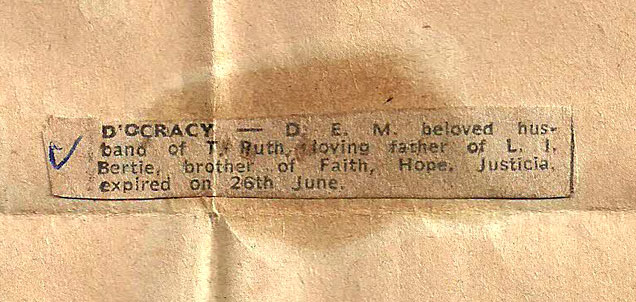
    I remembered an item available for publication in Reader’s Digest—I was then this magazine’s deputy editor, based in Mumbai— about the “death” of democracy. It had originally appeared in a Sri Lankan paper when an emergency had been declared in that country. The ingenious item dealt with the demise of “D.E.M. O’Cracy,” who left behind several relatives, including a son named L.I. Bertie. Why not put this item in the obituary column of the Times of India? I copied it down and made my way to the office of the Times nearby. The clerk in the classified advertisements department there told me he couldn’t accept it because it was too long. I began arguing with him; then, fearful that he might suddenly realise what I was up to, I shortened it. “Are you Bertie?” the clerk asked me. It took few moments to understand what he’d meant. “Oh, yes,” I bluffed. The obituary advertisement was accepted. I paid the small fee and left. Would the item appear? I spent an anxious night, and made sure I was the first in the family to grab the Times the next morning. And there it was! O’Cracy, D.E.M., beloved husband of T. Ruth, loving father of L.I. Bertie, brother of Faith, Hope and Justicia, died on June 26. I was overjoyed. But for it to have any impact, a lot of people—and not just those who read the obituary columns regularly—had to see the item. So I called up a friend in the Times and, disguising my voice, asked him if he’d read the day’s obituary column. “Who’s this?” he asked suspiciously. “Never mind,” I said. “Take a look at it.” He began grumbling, but obeyed, and I heard his voice rising in excitement as he read the ad aloud. “Make sure you tell everyone about it,” I said, hanging up. Word about my ad spread fast. Those who were against the Emergency loved it. Many people sent clips of it to everyone they knew. Among them, I later learnt, was the advertising director of the Times of India! (After the Emergency, he told me so himself.) The ad was even reproduced in foreign newspapers.


    Were you scared of a backlash from the government following its publication? Is that why you withheld your identity and changed your physical appearance?

    The police were called in to find out who had placed the ad. But they got nowhere. This may have been partly because I took some precautions. Shortly after the ad appeared, my wife Jessica and I were scheduled to appear in a Doordarshan programme featuring couples. Since there was a chance that the Times clerk would watch the show— Doordarshan was the only TV channel in those days—I shaved off my beard to look less like “Bertie.” (Several people grew beards to protest the Emergency; I was the only one to have removed his!) Naturally, there were all kinds of rumours about who’d placed the ad. In fact, one Digest reader who dropped into our office even told me a lurid story about how the perpetrator had been caught and tortured by the police! Of course, for all the publicity the ad received, it did not have the slightest effect on the Emergency. That was lifted only 19 months later when Mrs Gandhi, for reasons scholars still speculate about, announced that Parliament was to be dissolved and elections held. To everyone’s astonishment, her party was routed—she even lost her own seat—and the Janata Party formed India’s first non-Congress central government in mid-1977.


    The gutsy obituary drew attention to the situation in India even in the foreign media. What was the reaction when you finally revealed yourself as the person who published it?

    Apart from my friends who congratulated me for publishing the ad–I outed myself in the magazine Debonair, then edited by the late Vinod Mehta–the Times of India clerk who’d accepted the ad called me to say that he’d been punished by the Times for accepting it. Since I knew Mr Thirumalai, the then ad director of the TOI, I complained to him about penalising the clerk. Thirumalai angrily denied that any action had been taken against the clerk and revealed that that he’d been personally delighted by the ad (see article) etc. He then called the clerk and gave him a firing in my presence for lying to me!


    Do you think journalism today has evolved to an extent that we can be protected from such happenings in the future?

    I wish I could foretell the future and reassure you that journalism today has evolved enough to ensure that another Emergency is not possible. However, I think that, thanks to TV, and most importantly, the social media, I think there will be much more opposition to any attempt to impose dictatorship in India.


    In your opinion is the government today strong enough to prevent history from repeating itself?

    Power tends to corrupt, so the stronger a government, the more likely it is to rule dictatorially. All citizens, and especially journalists, should always be on guard against strong governments and fight dictatorial rule (non-violently) if it is imposed.


    Ashok Mahadevan photograph courtesy Reader’s Digest


  • Flirt with your city, says new TOI campaign for city pull-outs

    By A Correspondent


    The Times of India has launched a brand campaign for its metro supplements (TIMS) – Bombay Times, Delhi Times, Gurgaon Times, Chennai Times, Bangalore Times and Calcutta Times – titled ‘Flirt with your City’. The campaign aims to communicate its strengthened content and reinforce its positioning as the one-stop-destination for all news and gossip of city’s bustling social life and everything related to city’s popular culture.


    Conceptualised by JWT India, the brand campaign is set to communicate the spicier, buzzier, trendier content proposition to its readers.


    Commenting on the launch, Sanjeev Bhargava, Director, Brand TOI said: “TOI’s Metro Supplements (TIMS) creates affinity in a hyper local way like no other media – building conversations, highlighting happenings and hangouts, bringing alive engaging platforms and collaborations, all leading up to your City’s pop culture. Through its evolved content, the brand encourages motivates and excites the readers to explore their own city like never before! TIMS as a supplement brings its readers just that-right from fashion to culture to the popular to the unexplored. It helps you flirt with your city. Our product Bombay Times, Delhi Times, Gurgaon Times, Chennai Times, Bangalore Times, Calcutta Times and other supplements captures this social buzz like no other media. From the latest cinema review to newest cuisine in the town, from latest gig update to best fitness regime for you, from the newest earworm music to hottest celebrity gossip, our newspaper keeps one updated on the trending topics in and around the city. Our ‘Flirt with your City’ campaign is built around this key thought. So, pick up the newspaper, and stay updated with the social chatter of the city. Plan your weekdays and weekends, go out and explore the city. We have packed more fun, color, youthfulness in the paper and strengthened the content around movies, food, fitness, fashion, campus and music. With more engaging content, new exciting IPs and integrated activities, we intend to bring readers closer to their respective city, and reinforce the thought that it is one-stop shop of everything one needs to stay connect with the buzz in the city.”


    Added Senthil Kumar, Chief Creative Officer, JWT India: “To bring the TOI’s Metro Supplements (TIMS) essence to life, we have created a face-off, a musical city versus city rap battle between different cities, where people, icons, characters, rappers and even objects of each city are extolling the values of their city, the city as seen through the Times. The name of the city itself becomes an audio device.  For example, Kolkata is not just Kolkata, it’s also Goal-Kata, as football is the most popular religion here. The local music and local lingo leela is the vocal veins of this film, a binding factor, replete with city specific instrumentation and lyrics. It’s your City’s Daily Rap versus Another City’s Daily Rap. The visual style is mixed media brought alive from various elements of the city. It is an amalgamation of the slice of life, Stop Motion Animation, Hyper-Lapse captures, 2D Flash Animation, Compositing within Times Newspaper and Traditional Cell Animation and of course Times Newspaper headlines and snapshots from a day in the life of your city. The ambition for this campaign is to create a dynamic anthem for each city driven by its unique pop-culture with the City Times at the center of it all.”


  • India accumulates 18 shortlists at the 45th Annual One Show

    By A Correspondent


    Agencies in India have 18 finalists entries for the 45th annual One Show, as announced by The One Club for Creativity. McCann Worldgroup India, Mumbai leads the way with 10 finalists, including seven with McCann Health, Delhi for Ministry of Public Health, Afghanistan “The Immunity Charm”. Hindustan Petroleum has five finalists for its “Roads That Honk” campaign.


    Agencies in India with one finalist each are Ogilvy & Mather, Mumbai for RNW Media “#NotMusicToMyEars”, FCB India, Mumbai for Times of India “Shindoor Khela – No Condition Apply” and Famous Innovations, Mumbai for CaratLane “The Personalised Ring Box That’ll Get You a Yes”.


    This year’s One Show has 1,643 finalists representing 42 countries, selected from 19,800 total entries.  The US has the most finalists with 669, followed by the UK with 117, Japan with 94, Canada with 86, Germany with 78, Brazil with 70, France with 65 and Australia with 59.


  • TOI revamps What’s Hot page


    The Times of India’s metro supplements will sport a new What’s Hot section, informs a communique. Interestingly, the comment on the refurbished page comes to us only from the recently appointed brand head and not the editor, as one would expect of any announcement of an change in the content of a newspaper. Guess the times indeed are a-changin.


    So here’s what Sanjeev Bhargava, Director, Brand TOI said in the communique: “The refurbished look of What’s Hot should appeal to our readers because of a more reader-friendly look-and-feel and a stronger local connect. Keeping in mind the hyperlocal sensibility of our metro supplement as a brand, we believe that introduction of the city-specific logo is a perfect fit for our readers. Making the city pages specific, innovative, and brief, will aim to offer our readers, information of all the latest happenings in a fun yet informative manner.”


    Since the metro supplements (Bombay Times, Delhi Times etc) are tagged ‘advertorial, entertainment industry promotional feature’ and carry some content that’s paid for, we aren’t sure what the criteria for the selection and highlighting of items on the page will be.


  • Making The Times of India Relevant for New India


    Among the first things that Sanjeev Bhargava did when he joined The Times of India as its brand custodian was hire an all-new creative agency. Which he did, and appointed J Walter Thompson, the agency which he quit to move to the leading newspaper company. Before joining Bennett, Coleman & Co Ltd as Director – Brand (The Times of India and Mirror), he was Managing Partner, JWT and has also worked with FCB Ulka and the Mullen Lowe Lintas Group. In Mumbai for the Oppo Times Fresh Face contest, the fresh face of the Times of India brand spoke with MxMIndia.

    So you have hired a new agency and guess there will be a refresh?

    The Times of India is a very powerful brand and  has had a major influence on the landscape of India over the years.And the task is to continue to have that sphere of influence, continue to be a nation-building cause as it has been for past so many years.

    Right

    And to be able to do that one has to start acknowledging the fact that the landscape is changing.The media landscape is changing, the consumer habits and behaviour are changing. Their expectations from a media brand is changing and if you have to therefore continue to play the role that you played in the past we must create initiatives which engage the audience of today.

    That’s right

    So all initiatives, as we go forward, practically all initiatives the Times of India is doing will keep this fact in mind.

    This includes the Fresh Face contest?

    Oppo Times Fresh Face is a classic example of how we have looked at the existing property that we had from so many years for last 10 years. This is the 10th year, we but made it more contemporary, to make it more in sync with the times. Today, Young India lives in two worlds – the virtual world and the real world and while we have a role to play in the real world, we must acknowledge the virtual world as well and therefore Fresh Face of this year acknowledges that. It says we will recognise talent which understands how to live and how to profile itself in the virtual world itself not just the real world. So it’s all very well to have a great personality, great talent, but also need to have the capability to be able to profile that talent, profile that personality in the virtual world and that’s something that we incorporated in this year’s Fresh Face. So this is the kind of change that we are bringing about across many facets of our marketing initiatives for Times of India.

    So it’s basically making your communication more relevant for the digital generation.

    More relevant, more of interest. The fact is that today’s citizen of India is as knowledge-hungry as we were in our times. In fact, more so.

    Right

    And it’s knowledge hungriness. It is hunger for information and knowledge and I’m making a distinction between the two because a newspaper gives information and it also gives knowledge. In different aspects of its news-making, there is editorial, there is news, there are factoids, features and so on and so forth. Therefore there is a role that we play in the life of the citizen and as time progresses, it is important that we continue to remain relevant to even despite the fact that their attention span is now divided between many, many things that are offered to them through the digital medium, through the phone medium etc. as well and that’s where we are and that’s what we are planning to do as we go forward.

    Do you see that going forward, of course The Times, the paper the newspaper itself has over a period of time adapted to the changing times, some would say the faith, shorter stories and stories broken up into various elements?

    Yes

    Do you see that along with your advertising, some changes will happen in the newspaper too?

    Absolutely. The product has a very integral role to play. You are absolutely right. We have shorter stories. We have far more stories than any other newspaper in the country.

    Hmmm.

    So more stories per page is something that we are very proud of because we know that is what required for today’s reader and that is what we do very diligently and almost at a measurable manner we do it. So it’s a very important part of what we do as a paper. Then what we call rapid reading where we are able to consume a piece of news it is constructive in a way where there are factoids which are summarised somewhere, so you don’t necessarily have to read the entire thing if you want to consume the news at a skin level you can do that the paper is designed like that.

    Right

    There are many things that have been done over a period of time to make sure that we remain relevant, we remain interesting, we remain youthful for today’s citizen.

    Over the years, The Times of India has had efforts like Teach India…

    Yes, Lead India, Mann Ki Asha….

    So [given the new agency etc], will there be a shift?

    Yes and No

    How?

    The fact is that we will continue to be a force of nation-building… we take that role as a newspaper extremely seriously.It’s not something that I would compromise.

    Achcha

    So as we go forward with our marketing initiatives, these initiatives will empower  the young. They are about building a nation-building ethos. They are about constructing a stronger country from an intellectual aspect, from an empowering aspect. We need to do that and if we as the largest printed English newspaper country by the world don’t do that, I think we will be falling short of our responsibility as a corporate citizen as well. So that’s something we will not change. That will continue. What we will do is that there has to be an acknowledgement of the changing landscape and with the changing landscape, with the changing consumption habits on the media of Bharat. Readers are concerned as far as the citizens are concerned we must acknowledge that and we must incorporate that into our market plans to continue to build our business.

    Okay

    So that’s where we were not before. So, yes,what you will see will have a strong continuity with the past.

    Just to clarify, you had Taproot earlier and now you have JWT–

    JWT Mumbai. The Times of India – the English paper and Mumbai Mirror are with JWT. That is a shift that has happened. But Taproot continues to engage with BCCL as a group.

    Given that you are trying to reach out to the young, what will be the vehicle you will use for advertising?

    That will depend entirely upon the initiative, I can’t even answer that question because there are initiatives that are local. There are initiatives which are aimed at certain cohorts.  So it will depend upon initiatives, different initiatives with different audiences and therefore different media and that’s the technical question it depends on initiatives. It’s not a policy decision, it’s a technical decision.

    Does the media agency also change?

    No it continues to be Lodestar.

    Will the advertising for the Times of India change with the market – say Mumbai could be different from Kolkata or Chennai?

    No,  The Times of India is one brand. It does not change from city to city.

    Ok

    The product can change because issues, requirements, reader expectations from a product standpoint can different but the brand promise, the brand ethos, the brand equity that would not change.

    When do we see the advertising?

    Soon. It takes a little time for a big shift to adjust itself so it will I guess be in another month or month and a half.

    And how’s it working with your former agency from the other side of the fence?

    Oh that’s great because you know one understands the strengths and weaknesses of every organisation that you work in so it becomes more easier to deal with them. But I’ve lived with the industry for so long that I am familiar with most people in most agencies. So it’s not as if there’s much of the difference because I know  people in Lowe well, I know people in Ogilvy extremely well… it’s a small industry, not as if I’m unfamiliar with the people. It’s just that there are organisational strengths somewhere, there are logistical strengths of some agencies some other etc. It’s been a considerate decision at a very objective level, but Taproot has been extremely valued partner in the past continues to be even today and I have tremendous amount of respect for them as well.


     

  • By Invitation: Jaisurya Das on what makes Team Times Response tick


    The Times of India wasn’t the hottest paper in Mumbai or Delhi until the late 1980s. Although the newspaper had stalwarts as its editors and business heads, The Indian Express and Hindustan Times ruled Mumbai and Delhi amongst English newspapers. But around the time the newspaper celebrated its 150 years – sesquicentennial as it called it, things changed for what was disparaging referred to as the Old Lady of Boribunder.

    And as the fortunes began to favour the paper, it rechristened the adsales department as Response. The message sent with this name-change was simple: advertise in the TOI group, and you get the response.

    Over the years, the Response team – under the leadership of Pradeep Guha and several other ‘maharathis’ of Indian media – has grown to be a very well-oiled, well-knit unit. As media-watchers, we have observed this very closely and salute the camaraderie that exists, quite like that with the alumni of a B-School. Ex-Response team members are always around to help each other in their professional and personal pursuits. So what if they were fierce competitors when they were part of Team Response.

    Over the last few weeks, there has been a buzz about a congregation of old (and current) Response colleagues. It’s scheduled to happen on Sunday, July 16, in Mumbai.MxMIndia invited columnist and Contributing Editor Jaisurya Das to write this account of what made(and makes) Team Response tick:


    By Jaisurya Das

    In less than 48 hours from now, over 250 media, entertainment and advertising professionals will congregate at a not-so-happening mall in South Central Mumbai.

    No, this isn’t a convention of sorts, this is all of what one word can bring together :  ‘ Response ‘ for the fraternity and advertising sales for the rest, this amazingly close knit group is a case study by itself.

    There is nothing like this breed.

    They are fiercely loyal, bitch brazenly and yet work like a flash mob when it is their calling.  I have often wondered, as to what, keeps this humungous group of people together. Is it one man, machine or the sheer passion to excel.

    I never could opine on this when I was part of the system and a loyal soldier myself, but today, it is a different story; A story that is waiting to be told.

    From the days of large rusty Godrej tables, manual scheduling registers and the much greying ‘old school’ leaders, to spanking new offices, infrastructure and a leader that brought fame, fortune and chutzpah to the game…

    This, Ladies and Gentleman is Times Response !

    It has stood the test of time, literally, and yet there is something that makes it tick.

    Is it the perceivable sycophancy of a majority or just sheer bonhomie that keeps this amazing set of individuals together?

    Pradeep Guha

    What has to be said, must be said and no matter what media professionals, companies and principal shareholders feel, if there is any one force that has brought about sea-change in the business of media sales, it is Pradeep Guha.

    For a lot of people, he is nothing short of a deity who has powered their lives, fortunes and careers by his sheer pre-eminence.

    For others, a true mentor and a wonderful leader to work with, PG, as he is affectionately called, changed the way the business is done and gave it the much-needed sex appeal and zip that empowered his team of loyalists with confidence and a characteristic élan.

    PG moved and so did several hundreds of people in Response across the country. TOI moved on as well and they only grew albeit a few hiccups and bad PR in the process.

    What remained untouched was a fine bond, that no one could explain..

    Having interacted with sales teams across very many media companies, I can say with vehemence that there can never be a clone. Response as I knew it, was an institution by itself!

    Characterised by die-hard conviction and the amazing ability to multitask, be it organising world class events or just securing a campaign, this one department did it all..

    Pradeep Guha and his amazing secretariat that was aptly termed ‘Response Corporate’ remained the first and final word in this business. Yours truly has had the good fortune to have worked very closely with this formidable inner-circle on various initiatives that also paved the way for great bonds and lasting memories..

    Memories of a time that will probably never return.

    But for now, it will be bonhomie and fun all the way for 250-plus people who come together if only to get some 90 seconds for a warm hug..

    A hug, that will in the future, be the hallmark of the response that was and hopefully will be. Amen.


  • J Walter Thompson India wins creative mandate for TOI

    By A Correspondent


    The Times of India has appointed J Walter Thompson India as its creative agency. The business was awarded after a highly contested multi-agency pitch, notes a communique. The account will be handled out of the agency’s Delhi office.


    Sanjeev Bhargava

    The agency will handle all mainline advertising and services including the digital mandate for the English daily by being its strategic and creative partner.


    Commenting on the appointment, Sanjeev Bhargava, Director, Brand TOI said: “The strategic thinking that J Walter Thompson has contributed to business building coupled with a multi city high powered creative and servicing capability is what has made them the best choice for us. I am hoping for great work to come from this partnership.”


    Joy Chauhan

    Commenting on the win, Joy Chauhan, Senior Vice President and Managing Partner, J Walter Thompson Delhi said: “The Times of India has been one of the most precious wins for JWT Delhi in the recent past. It is precious because it is one of the biggest and the most iconic brands of India. We all know that this great publication is so much more than just a newspaper. The brand’s contribution towards the Indian society is second to none. We look forward to creating some path breaking work for this iconic brand.”


  • Times of India ‘Power of Print’ contest aims to push education of girl child


    The Times of India has announced the first edition of an attempt to bring out the best of print creativity in the country and make it work for a company or brand. In this competition, creative teams across agencies will vie for the top spot and not only win the Power of Print award at the Kyoorius Creative Awards (KCA) in June, but also see their winning campaign released in the pages of the Times of India group publications.


    Power of Print will be conducted as an open contest to create a print campaign based on a live brief set out by a brand/company. The idea is to get a ‘real’ brief from an advertiser with a real and current business problem that will help use the print medium as the solution for it. This initiative will seek to motivate communication agencies to come up with award-winning campaigns for a real cause / brand.


    Nestle India has come on board as the partner brand for the first year to promote a noble cause – #EducateTheGirlChild.


    The entries will be judged by an esteemed jury comprising Prasoon Joshi, Bobby Pawar, KV Sridhar, Raj Kamble, Agnello Dias, ArunIyer, Senthil Kumar, KainazKarmakar, Swati Bhattacharya, Shrijeet Mishra of The Times of India group and Chandrasekhar Radhakrishnan from Nestle.


    Speaking on this occasion, Suresh Narayanan, Chairman & Managing Director at Nestle India said: “We continue our corporate social initiative of #EducateTheGirlChild with the objective to sensitise and draw attention to the fact that society needs to embrace collective responsibility in ensuring that more girls have the opportunity to pursue education. We are very excited to partner with The Times of India group on this initiative and especially pleased that the entire advertising community is coming together to contribute their unique creativity towards this cause, leveraging the print medium.”


    Added Raj Jain, CEO at BCCL:“Power of print is a unique initiative by the Times Group to drive creativity and engage the best creative minds in print advertising. Print advertising is one of its kind and appeals to all the five senses. Just like a book is almost always better than the movie based on it, we believe print advertising has so much more to offer. We are glad that Nestle has come on board as the partner for the first year with a very noble cause to ‘Educate the Girl Child’. I think this program will help spur the creative minds and rekindle the romance with the medium.”


  • Should editors be liable for ads his/her news entity carries?

    Should an editor be liable for the ads his/her news entity carries? The questions warrants discussion and an answer given the legal tangle Kingshuk Nag, senior journalist, author and former Times of India Hyderabad editor finds himself in.

    Read his letter and send us your comments at editor@mxmindia.com. We will not reveal your identity if you’d like.

    Here’s the letter, published as is, with no changes made:


    Mr. Raj Chengappa,

    Chairman, Editors’ Guild of India

    New Delhi.


    Dear Raj:


    Can an Editor be charge-sheeted for misdeeds allegedly committed by advertisement department of the periodical that he edits?

    At first glance this would appear to be preposterous proposition, but I have been charge-sheeted by the Hyderabad Police on thewrong  premise that it is the Editor who controls the operations of the advertisement department.

    The facts of the case are as follows:

    The Central Crime Station (CCS) of the Hyderabad Police filed a FIR against me and some others (no 324 on 12/12/1914) under section 120 (B) (criminal conspiracy), section 379 (theft) andsection 467 (forgery of valuable security) of the Indian Penal Code (IPC). This was allegedly for ‘stealing’ some advertisements that came out in a rival newspaper and reproducing them in our own paper.


    After investigating the case for nearly two years, the Assistant Commissioner of Police (ACP) of CCS has now filed a charge-sheet in the court of XII Additional Chief Metropolitan Magistrate at Hyderabad. The sections of law under which the FIR was registered have now been altered.

    Now I (and some others) have been charged for violating Section 63 of The Copyright Act (1957). If the charges are proven I will be liable for a punishment that is not less than six months of imprisonment and which can extend to 3 years. A fine of not less than Rs 50,000 and which may extend to Rs 3 lakhs can also be levied on me.

    This letter has not been written for expressing my grouse against the police. Lawyers whom I have consulted told me that under The Press and Registration of Books (PRB) Act, 1867, the Editor notified under the Act and whose name is carried in the imprint line, is responsible for all matter carried under in the newspaper whether it is news, views, advertisement or something else. So is the publisher and the same is the case with the printer.

    I was the Editor (under the PRB Act) of the Hyderabad edition of The Times of India from July 2005 till September 30 2016, when I superannuated on reaching the age of 58. Earlier on between May 2000 and June 2005, I was the Editor (under the PRB Act) of the Ahmedabad edition of The Times of India.


    Coming back to the case mentioned above, it will be fought in the court of law on behalf by my lawyer and as they say, law will take its own course. I have no problem with is.

    My real problem is that the PRB Act is of 1867 vintage and the world has changed since then. Probably the Editor in those days was the master of all he surveyed. But this certainly is not the case today.

    As the world has changed, so has the economics of newspaper production and management. Because a newspaper that costs Rs 25 to produce is sold at Rs 5 or less, managements have increasingly taken recourse to advertisements to rake in revenues. These advertisement revenues go a long way in subsidizing the price of a newspaper for a consumer.But it also a fact that faced with pressure, certain publications resort to practices that can be termed as “paid news”. Stating it in general terms, ‘paid news’ are advertisements that are masquerading as ‘news’. While an advertisement is upfront, the ‘paid news’ deceives the reader because he thinks he ‘consuming’ genuine news.

    This letter is not to focus on the practice of ‘paid news’ but to point out that the Editor may be powerless to stop this practice yet he is liable for all the ‘paid news’ appearing in the periodical that he may edit. This is notwithstanding that some of the ‘paid news’ may violate various sections of law. The Editor is also responsible under law for all the advertisements published never mind that he has no control over their publication.

    Whatever be the case, there is need for looking once again at the PRB Act put in place a new Act that provides a contemporary realistic legal architecture to govern the operations of periodicals, including the role of the Editor.

    Needless to assert it is the business of the law makers to put in place a new framework for managing newspaper and periodicals. But in my humble opinion it is the job of the Editors’ Guild of India, as an important stakeholder, to flag the issue and initiate an internal debate amongst members and other respectable members of the press on this matter.

    My communication is to earnestly request you to start a debate on this very important subject. Believe me you will be doing our profession, a great favour.


    Sincerely,


    Kingshuk Nag

    Dated: 12 January 2017

    Email id and telephone number have been blanked out – Ed