Tag: Times of India

  • TOI launches video with Brut India

    By Our Staff


    The Times of India has launched a video with Sivakumar Sundaram, Chairman Executive Committee of BCCL in collaboration with Brut India, a digital video publisher,  that takes the viewer through a tour of TOI’s Mumbai office, its newsrooms, and the editorial meetings and then gives a glance into the printing press of the Times Group.


    Informs a communique: “The video continues with Sivakumar surprising and delighting readers by getting onto a bicycle and distributing TOI to their houses. He then sits down to discuss some of the challenges and future of TOI and how TOI is trying to address the need of its readers in this era of fake news. He talks about the credibility and authenticity of the news as well as the power of the printed word in the age of fake news. He also emphasised how TOI delivers curated news that can be consumed in 30 minutes every morning rather than scrolling through a deluge of digital news and information that may or may not be accurate.”


    Said Sivakumar Sundaram, Chairman Executive Committee, BCCL: “It is understanding the whole magic in this– the back story of how so many people at clockwork precision come together every single day to make your morning paper come alive and prepare you for the day ahead. Because print is the final word on the most authentic and credible news.”


  • Times of India launches festive campaign

    By Our Staff


    The Times of India is calling its festive period TGIF (Thank God It’s Festival) this year. Notes a communique: “The newspaper will celebrate the joys, hopes and dreams of the people of India during the long festive period from Raksha Bandhan to Diwali, under its umbrella theme, ‘Thank God It’s Festival’ in a multitude of ways, every day.”


    Other than various activities through this period, the ‘Leaders of Change’ issue last year on Independence Day will be out this year as well with a “bumper issue” on India’s 75th Independence Day.


    Adds the communique: “An economy which will see full colour celebrations after a long spell is an unmissable opportunity to grow one’s brand, and there isn’t a more reliable platform than The Times Group to showcase it. The Times of India with its unmatched reach of 54 editions and 1200+ towns is truly the only daily with a national footprint. It is the most trusted news brand in the country, as per the 2022 survey conducted by Reuters Institute and the most trusted English news brand when ranked out of 52 brands across media, as per Trust Index for English News Brands in India, Nielsen Media Report, March’22.”


  • Do we really need rules to control cross-media ownership?


    By Indrani Sen


    Indrani SenAlmost four months back on March 12, 2022, TRAI released consultation papers on media ownership, particularly related to cross-media ownership in India. This is not the first time that TRAI has raised the issue. However, after a comment made by the I&B Ministry, all the industry media bodies and associations have responded indicating unequivocally that there is enough plurality in the ownership of media in the Indian market and there is no need to be concerned about making regulations related to cross-media ownership.


    The western world has been grappling with the advantages and disadvantages of cross-media ownership over the last few decades. The seeds of cross-media ownership were probably sown during the post second world years during the 1950s when the American policy-makers had realised that control of world media can help to make America a superpower and encouraged transnational expansion of US media.  Since the 1980s, the business practices as well as the economic environment in the world began to change dramatically across industries with companies either merging or taking over other companies operating in the similar field and media industries also followed suit. However, American domestic media saw a dramatic change in cross-media ownership as the media ownership pattern changed dramatically due to mergers and take overs.


    “In the United States as of 1985, 90 per cent of all media companies were owned by 50 different companies. Through acquisitions of smaller companies by larger ones, 90 percent of media companies are now concentrated under the ownership of just five corporations: Comcast, Time Warner, The Walt Disney Company, News Corp and National Amusements.” (Source: https://www.lawyersnjurists.com/article/effect-of-cross-media-ownership/)


    In India, though the owners of Times of India, India Today, Hindustan Times, as well as some regional print media owners have cross-media ownerships, the magnitude of their holdings are far away from reaching any alarming stage or creating an environment of controlled messages influencing public opinions. In recent years cross-media holdings in India have created a free and competitive environment. The advocates for freedom of speech need not worry about control of public opinion due to cross-ownership ownership in India, particularly when under the present Government we seem to have indirect controls over the content of news media. The media associations’ claim that the plurality in media ownership is absolutely correct.


    If we examine the advantages and the disadvantages of cross-media ownership, then we find that the advantages probably out weigh the disadvantages in a country like India where media penetrations across traditional as well as new media have still huge scope of growth. The biggest advantage of cross media ownership is reduced cost which allows the media owner either to pass on the benefit to the consumers or to invest in further expansion of their media business and in the process if they also increase their profitability that should be excused as a normal part of doing any business. The creation of synergy is another important advantage of cross media ownership resulting in better products at reduced costs. The expansion of distribution network is another huge advantage along with increase in business security. As far disadvantages are concerned, the misuse of media power, the concern that one particular voice may become too powerful if distributed through different media vehicles across different media segments appears to be the main issue against cross media ownership.


    The four industry bodies, the IBDF, NBDA, INS, and AROI, representing TV broadcasting, print media, and FM radio companies, have strongly made the following points:

    1. There is no need for controlling cross-media ownership as there is enough plurality of ownership in Indian M&E market.

    2. There is no requirement for a common mechanism to monitor ownership of print, television, radio, or other Internet-based news media as already different mechanisms exist in different media sectors for monitoring editorial content, etc.


    While teaching the subject Economics of Media Business, I give examples of various vertical, horizontal and diagonal integrations done by different media houses in India. The proposed restraint on cross-media holdings will result in imposing control on the normal business activities in the media industry and discriminate against them in comparison with other industries are allowed do all three types of integrations. Such constraints would also violate the constitutional rights of the media houses from transmitting information and would hamper the constitutional rights of citizens to receive information under Article 19(1)(a).


    Finally, as the telecom companies have now become the biggest distributor of news and consumers are creating their own news/ circulating fake news on social media portals using the facilities offered by the telecom companies, it is fair to have a parity between the current rules and regulations governing media industry and the telecom industry and the TRAI should review the same before imposing new controls on traditional and digital media industries.


  • The More you Succumb, the More Dangerous the World Becomes


    By Ranjona Banerji


    Ranjona BanerjiOn July 22, the Income Tax department carried out a series of raids on the offices of the Dainik Bhaskar group across India.


    Even for those sleeping under a rock to avoid criticising the Modi government, these raids were a sign that someone up there in the higher reaches of power was angry. Very angry.


    The anger could be two-fold: The revelations this week of the Pegasus Project and that Bhaskar covered it widely.


    And that this Pegasus coverage only added to the rage the government had felt at the relentless manner in which this large chain of newspapers had covered the Covid-19 pandemic. Government lies on Covid cases, lies on the number of deaths, on the lack of oxygen in hospitals, on the dead bodies floating in the Ganga and other rivers and buried in shallow graves in riverbanks were exposed every day in both Gujarat’s Divya Bhaskar and Dainik Bhaskar editions elsewhere.


    National Editor Om Gaur took DB’s coverage even further in his edit page piece for the New York Times about the dire Covid situation during India’s second wave, which was headlined: “The Ganges is returning the dead”. As ever, negative international exposure enrages an image-conscious Prime Minister and his government.


    Whatever has irked the government more, it is clear that it is riled. And when that happens, there is a malicious, vindictive reaction. Perhaps for almost seven years, the Modi government has got so used to the lavish praise piled on it, for all its transgressions, mistakes, lies, aggressions, disasters, any resistance is seen as unacceptable. Okay, cut that “perhaps”. We know that this is a government, more than any other until now, which cannot handle dissent, disagreement, questions, opposition. And has been enabled by a captive mainstream media.


    Between the Pegasus Projects and its revelations, and these raids on a media house, where does the rest of the media stand? The old days when all newspapers ignored each other and operated in their separate silos have gone, and for the better, together with that ivory tower editor who barely comprehended what was happening in his own newsroom forget the nitty-gritties of the world itself. The media has to comment on itself and allow others to comment on it.


    The revelations that someone within the government of India was using/ had used Israeli-made military-purpose malware to both hack into people’s electronic devices, run surveillance on them and possibly also implant material into their devices has shaken the world and forced the media not involved in the investigation to take notice. But the voice of the media has been far from uniform and at times, shockingly pro-government even though journalists, citizens, businesspeople, activists and others have been targets.


    So how did we respond to the Dainik Bhaskar raids.


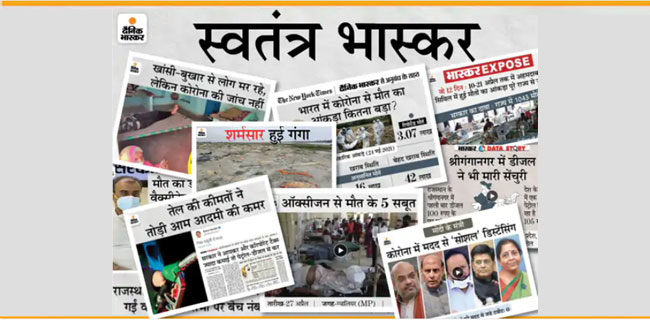
    Bhaskar itself called itself “Swatantra Bhaskar” or Free Bhaskar and announced on its front pages, with a series of images of its Covid and other coverage, that the government had to do what it had to do and the media group what it had to do.


    The Mumbai edition of the Times of India, July 23, had an article on Nation pages 11, the focus of which was the Opposition’s reactions to the raid. Shooting from the opposition’s shoulder, rather than straightforward coverage.


    The Economic Times, Mumbai, July 23, covered the possibility that industrialist Anil Ambani’s phone had been hacked as well as the corporate reaction to Pegasus on Page 6. But page 2 had Union minister Meenakshi Lekhi’s lies that Amnesty had distanced itself from the Pegasus Project, minus the clear clarification to the contrary that Amnesty had issued soon after.


    The Dainik Bhaskar raid was on Page 8.


    Hindustan Times, Mumbai, July 23, did better than its rival TOI. The first two pages were dedicated to the Olympics. Therefore, the Pegasus uproar in Parliament and the Ambani phone hack were on page 3. City page 5 had a single column on the DB raid in Mumbai. Nation page 5 ran with the raid as the lead, above the fold. And Nation page 7 had more Pegasus coverage. However once again, Lekhi, was allowed to run with her lie.


    The Indian Express, Mumbai has upped its game (although in the days to come expect more government ministers pushing Modi/BJP propaganda on their oped pages). The Dainik Bhaskar raid and Pegasus were on Page 1, continued on 2 as is the paper’s style. On Page 8, the Amnesty rebuttal to Lekhi’s claim made an appearance and Pegasus found space on the economy and world pages.


    The Hindu, Chennai had a much better showing, despite the photo of group head Malini Parthasarathy in Modi’s “illuminating” presence, which she put up on Twitter on July 22. Both the raid and Pegasus were on the front page, on page 10 in further detail. Pages 11 (nation) and 13 (world) had further Pegasus coverage.


    Of the English language papers MxM looked at, The Telegraph, Calcutta stood out. Both the raid on DB and Pegasus ran as the lead. The Ambani phone hack also found space. The lead story quoted DB National editor Om Gaur about why he thought the group was raided – the strong Covid coverage – as well as his NYT piece.


    Of the Hindi papers, Amar Ujala, Delhi had the best coverage: The raids on Dainik Bhaskar as well as the independent UP-based news channel Bharat Samachar were second lead, above the fold. No one else mentioned Bharat Samachar, which has been increasingly critical of the government.


    The Pegasus uproar in Parliament was the lead. Amar Ujala also mentioned prominently how Lekhi had called protesting farmers “mawalis” or hooligans. Most English newspapers ignored this stroke of genius from the Union minister.


    Rajasthan Patrika, Jaipur, carried the raid on the front page and also had an edit.


    Hindustan Delhi: Had the Pegasus arguments in Parliament, but focused on the IT minister as the lead. A small mention of the DB raid on Page 1 sent the reader to page 11, where Pegasus was also covered.


    Dainik Bhaskar’s biggest competitor, Dainik Jagran Delhi, carried a tiny mention of the raid on page 4.


    Regardless of the extent of the coverage we went through, all media owners and editors know what all journalists also know: that the more you succumb, the more dangerous the world becomes. You may think I was going to say that the more you resist, the more you are under threat. That is true. But unless you want the threat to last forever, you have to resist.


    Kudos to Dainik Bhaskar for its stand so far.


    And to those who have not been too afraid to cover the actions of a vindictive government.


    For those who cover up, well…


    Ranjona Banerji is a senior journalist and commentator. She is also Consulting Editor, MxMIndia. She writes on MxMIndia every Tuesday and Friday. Her views here are personal


     

  • TOI celebrates a decade of Android & iOS app launch

    By Our Staff

    The Times of India is celebrating the 10th anniversary of its presence on Android and iOS platforms. One of the first Indian publications to have mobile apps for readers,

    TOI Digital has unveiled ‘TOI+’ for involved news-readers who demand a premium news experience on digital.

    Said Puneet Gupt, COO – Times Internet: “The Times Of India has been a source of the most authentic and reliable news, offering latest and unparalleled views, honest facts, incisive reportage and more for over a decade now. Our decade-long effort to power its digital transformation has coincided with the shift in Indian consumer behaviour in favour of digital products and services. We thank our 10 million strong community of users for being a part of this incredible journey, and promise to continue to hold our core values at heart as the medium for delivering news takes on new avatars based on advancements in technology.”

    Added Durga Raghunath, Digital Head – Times Of India: “With Indian audiences gaining exponential access to connectivity and cheaper smart devices, higher digital ad spends are set to propel the online media sector to new heights in the coming decade. Further, seamless digital payments, telecom APIs and cutting-edge media analytics will enable digital-first journalism to thrive. At TOI, we welcome this new era for digital media, and our team of tech, product and editorial experts will continue to ensure we are able to offer the most personalized and relevant news experience as more of our users start using our apps to stay updated and demand a richer news experience, anywhere and anytime.”


  • TOI collaborates with Redmi Note 10 series

    By Our Staff

    The Times of India has released a campaign in their top eight editions to bring alive the unboxing of the new Redmi Note 10 series smartphones. The top flaps of the glazed French windows were of special glossy newsprint – giving the innovation a premium and upmarket feel, in sync with the new Redmi phones.

    Said Partha P Sinha, President Response, The Times Group: “What’s unique about the print medium is that it allows innovation and customisation in ways that bring alive a brand’s unique requirement. The ‘French window’ is one such innovation that engages readers through a ‘reveal’. It’s a great tool to bring alive a brand launch in an impactful manner. This is for the first time that a smartphone brand has used this innovation to market its product.”

    Added Sandeep KS, Associate Director – Redmi Marketing: “Our idea was to marry a smartphone unboxing experience with a format that can be enjoyed by consumers across the country. Times of India being the most read national daily was the ideal choice to execute this revolutionary front page innovation idea for a revolutionary product like Redmi Note 10 Pro Max for the first time ever for a smartphone”.


  • Why? Damn! Pray 🙏🏻


    By Pradyuman Maheshwari


    The question we ask Dr Bhaskar Das in today’s Das ka Dum is genuine. Ever since we got the news of the arrest of Partho Dasgupta, former BARC CEO, an industry biggie and President of the Advertising Club, we have been very disillusioned with the way things have unfolded over the last few months, in fact last few years.
     

    For, not only is Dasgupta a friend of the industry and ours, but his arrest and the charges made thereafter have shattered our faith in the A&M&E industry. Shattered our faith in the various systems, processes and provisions… in the checks and balances that exist.


    Over the last few days, we’ve spoken with many biggies in the business as also people who do the nuts-and-bolts work in the large agencies and television channels.


    There is surprise, shock and dismay. Almost everyone shared the sentiment with us.


    There are many questions:


    1. BARC is a joint industry body set up by broadcasters (60%), advertisers and advertising agencies (20% each). Did these stakeholders not see any chinks in the system all these years?


    2. The concern over Republic’s rise and rise was raised by news broadcasters soon after the channel was launched in May 2017. They even pulled out their watermarks in anger, a move that was poohpoohed by many in the business, MxMIndia included. What were the measures taken by the powers that be? Why wasn’t a detailed enquiry instituted earlier? Why did the BARC Board not do anything then? And if they did, why didn’t they act on stuff? Or if they think what’s emerging is untrue, then why don’t they speak up now?


    3. What is the view of the IBF, the ISA and the AAAI on this? After all they are stakeholders/co-owners of BARC. They are joint signatories on the BARC P&L and all legal documents. The broadcasters – the most aggrieved if there’s any hera-pheri in the system – have done precious little. The advertisers – who have the most to lose – appear to have been mute witness, and do not care much about what has happened.


    4. Arnab Goswami’s counter-argument – which was readied in superquick time – has some valid points. And his primary argument – that the meteoric rise of Republic Bharat happened when the “new dispensation” at BARC was in office – is not incorrect.


    5. The Times of India went to town with the news on Saturday – and its interpretation of the Friday press conference and statement by the Mumbai Joint CP wasn’t incorrect. But the question is if the logic was corrected after the investigations, how were Republic TV and Republic Bharat still the #1 in English and Hindi until the ratings were blocked for individual channels post October 8?


    The media ecosystem needs answers. The Nation Indeed Wants to Know.


    And if they don’t get them, it will lead to the collective loss and fall of the entire industry. Broadcasters first, advertisers second and media agencies third.


    Willy-nilly, each of the constituents is partly responsible for the way things are today.


    But, first, the collective wisdom of all these folks must prevail upon Arnab Goswami to take it easy. Without compromising on its editorial freedom, stop getting so belligerent with the Maharashtra government and Mumbai police and stop spewing invectives in the way he has been.


    The casualty right now is not just the industry, also the families of the individuals impacted and arrested.


    By the time you read this, Partho Dasgupta would’ve seen his stay in jail extended or could be out on bail. We’re hoping it’s the latter, so that he can come out and clarify his stand. And give us his side of the story.


    Knowing Partho, we know he will speak. Name names.


    We had a busy Christmas Eve and Christmas. Why do we get this feeling that our New Year’s Eve is also going to be as busy?! Sob.


  • Times of India joins Byju’s #KeepLearning campaign

    By A Correspondent


    The Times of India, in association with edtech major Byju’s, has announced the launch of the #KeepLearning campaign. The initiative intends to empower students, parents and educators with information and the best practices of online learning.


    Speaking about the initiative, Sanjeev Bhargava, Director – Brand, TOI said: “The pandemic has brought about several drastic changes in the way we live our lives. One of the sectors that have seen sizeable change is the education sector, which has swiftly transitioned and adopted a digital approach. As a media platform, we have consistently been drivers of effective change in society, building and supporting movements; with this legacy, we bring an endeavour to empower parents and educators while providing them with the best guidance and knowledge in association with Byju’s. Bridging the gap between the knowledge of how to leverage the various digital learning tools that have been developed for us, #KeepLearning will help children, parents and educators alike.”


    Added Sudha Natrajan, Director – Response, TOI: “Covid-19’s prevailing impact has forced people to live life indoors. The education sector has also moved from blackboards to digital screens, affecting the life of the students and forcing them to adapt to the digital way of learning. With TOI’s and Byju’s – #KeepLearning initiative, we aim to edify the parents and educators about how they can adapt to these changes and also help students adapt to the changing times for a better future. By using different approaches and digital tools we intend to create a bridge between the parents and teachers to drive them towards a better future for the students.”


    Said Mrinal Mohit, Chief Operating Officer, Byju’s: “Learning and education are an important part of our lives. With the advancement of technologies and availability of several tools, it is necessary to expand the scope of learning at every stage and educate ourselves on how we can harness the presented opportunity. With the #KeepLearning campaign, in association with TOI, Byju’s hopes to enlighten students, parents and educators about the ‘how-to’ of e-learning and bring about a change in the education sector.”


  • TOI’s housie gambit for readers

    By A Correspondent


    The Times of India (TOI) has launched a print-linked digital housie game called Times Housie Plus for readers to celebrate the festive season.


    Said Sanjeev Bhargava, Director, Brand – TOI: “Newspapers have always been a beloved companion for tea/coffee time breaks. Our games and puzzles have always found favour with our readers. Times Housie Plus is a re-interpreted version of the classic game of Housie, that all of us have played at some point in our life with our friends and families. We are making our newspaper more interactive and informative with this game. The clues will tell the readers more about their own city and country, and the entire family can play together to hunt and solve the clues.”


  • Gulzar celebrates #NewspaperMornings for Times of India

    By A Correspondent


    The Times of India has launched an ode to the morning newspaper habit of many/most Indians with a poetry penned by celebrated lyricist and poet Gulzar.


    Speaking about the campaign Sanjeev Bhargava, Director, Brand TOI said: “Across the world, newspapers are the most trusted source of news, and our readers already know that.  Reading a newspaper is not merely flipping through pages. We all have our unique way of reading our newspapers – some sit on a table, some lounge on floor, some start from front page, some go reverse and so on. The charm of reading a newspaper is an intimate and uninterrupted immersion into news, that is both relaxing and intense depending on the pace of its reader. The poetry narrates this experience from the eyes of the reader. During uncertainty, access to accurate information is critical. And, we stay committed to our readers to bring them unbiased and authentic news to ensure our relationship with our readers strengthen further.”


  • MxM Live with Partha Sinha. Free, Frank, Freewheeling


    So on Saturday, August 15, The Times of India had a blockbuster of an edition across many centres. Mumbai, Delhi, Gurugram, Kolkata, Chennai and Hyderabad and perhaps a few others. We thought it was a good time to pitch for an interview with Partha Sinha, President – Response at Bennett, Coleman & Co Ltd (BCCL), better known as The Times of India group.


    Sinha had joined BCCL with much fanfare in March this year, just a few days before the Lockdown was effected. We had wanted to interview him on the day we first heard of the news – sometime in late Jan or early Feb, but guess it had to be under wraps. And then the Lockdown happened, and we didn’t think it right to stress him.


    When we learnt from his team about the super-thick editions, we thought it would the right time to pitch. They agreed. And so did he.


    So without further ado, here’s the interview. Free, frank and freewheeling. The interview talks about the blockbuster edition but delves into his views on the print business. Heck, why are we telling you this. Watch. Enjoy. Like.


    (PS: if you’d like to share, here’s a short link: bit.ly/MxMParthaSinha)


  • The Times of India has bumper issues across key markets on I-Day

    By A Correspondent


    The Times of India had bumper issues on Saturday, August 15 with a total of 60 pages in Mumbai, 72 pages in Gurugram, 58 pages in Delhi, 78 pages in Hyderabad, 52 pages in Bengaluru and 46 pages in Chennai including supplements, as per a press release. The paper drew advertisers across Retail, Real Estate, Auto, FMCG, Consumer Durables, E-commerce and many more categories inviting consumers with amazing deals and messages, the communique added.


    Said Partha P Sinha, President – Response, The Times Group: “We believe these are the initial signs of good things to come. Companies are confident that this festival will see a big resurgence in spending and the economy will get back on its feet. It also establishes print as a credible and dominant medium for reaching out to premium audiences. There’s no better way to make an impact.”


    Added the communique: “The Times of India Group publications have recovered almost 90% of circulation in some markets and over 70% in most markets. This is another reason advertisers are coming back to print to re-build their market shares, as the distribution is fast reaching pre-lockdown numbers. Every Saturday for the last 3 weeks has seen The Times of India come out with 50+ pages across their key markets. Today, has been the highest since lockdown. A great way to unlock a new sense of freedom – that of positivity and confidence.”