
Tag: Times of India

  • CVL Srinivas | What makes TOI a formidable media brand

    By CVL Srinivas


    The Times of India has had an amazing journey of 175 years. It occupies a very unique position in the Indian media landscape. I grew up reading The Times of India. In my later years, as a media planner and buyer I have actively dealt with the TOI group. From 2008-2010, I was an employee of the TOI group in its Private Treaties now called Brand Capital) division. Having worked in media agencies or consulted for startups for pretty much the rest of my 20-odd years in the industry, the only time I didn’t have to explain what I did for a living was when I was employed with the TOI group.


    I have always admired the way TOI has built its own brands which in turn helped build some of the country’s best known brands. No matter what the purists might say about its editorial style or whacky headlines, it is a media brand that has not just moved with the times, but has often defined it. If the greatest form of flattery is imitation, then TOI surely has been the leader. Most if not all of its practices have been followed by many of its competitors.


    Given the challenging times that lie ahead for print media in general and English print in particular, it will be interesting to see how TOI manages to keep its lead. The forays into language dailies and the increased thrust in digital will need to work. Given the group’s track record, there is every chance that we will see more innovation in the years to come as the transformation from a largely English dailies led media business to a more diversified media company takes place.


    As an employee of the Times group, I had the good fortune of working closely with some of the finest minds in the media business. Though I had a short stint of two years, it was incredible learning, especially seeing things from the media owner side as against from the advertiser/agency side.


    The first thing that struck me was the sheer scale of the business. And the many moving parts that all synchronized so well day after day as if some magical glue had them all bound together. Despite being a very large organization things seem to happen very smoothly. It has a culture that encourages great ideas, big ideas and the machinery and discipline to execute flawlessly.


    For advertisers and agencies, The Times of India isn’t just a strong medium to connect with a powerful, youthful target audience, it is a media brand that adds colour, fizz and hype to a media campaign. A front page ad (or now a days the jacket) in the TOI gets a lot of attention and ends up becoming the topic of discussion for the day. The many innovations, be it in size, shape or placement of the ad, that TOI introduced have had a big role in ensuring print advertising stays relevant and top of mind. By combining digital apps with print ads, TOI is smartly riding the digital wave instead of drowning in it.


    The next 10 years in our industry will be much more dramatic than the past 175. Media consumption patterns will change as will business models. I am sure TOI will not just stay relevant but shape the times.


    CVL Srinivas is CEO, Group M South Asia


    (For the benefit of some our journalist readers who may not be in the know, Group M is billings-wise the largest media management agency in the world. Advertisers use various media agencies some of which are part of Group M – like Mindshare and Maxus – to plan their adspends and place their ads in print/ electronic/ digital/ outdoor/ others. Group M agencies represent the interests of large advertisers like Hindustan Lever)


  • Sidharth Bhatia | Times have changed, so has the Times

    By Sidharth Bhatia


    For most readers of the English language media, the Times of India is not just a newspaper, it is a habit that goes back generations. At least in Bombay, where the paper was founded, there must be families who have got the Times every morning for decades. In my own home, I recall reading it as a schoolboy, a college student and ever since. I have a personal connect too-I worked for its sister concern in the same building.


    But I speak of it not as a journalist, nor a former employee of sorts. My relationship with the Times is that of a reader and a Mumbai resident. And, as it turns 175 years, I must confess it is a relationship that has remained strong but one that has seen a few ups and downs.


    Ask any old time reader and they will tell you that the Times is no longer the paper it was. This is usually the response of those who love the good old days and feel the paper has given up on many of its earlier values-its journalism is often poor, the language is casual and full of mistakes, and its story selection too leaves a lot to be desired. (Too much entertainment and fluff is what they will say.)


    Of course the Times is not what it was, but that is because India is not what it was. India has changed tremendously in the last two to three decades-how exactly is not the point of this piece. But what is to be noted is that as the country’s leading paper, the Times of India has kept in step with those changes. Some may even argue that it has led those changes. The much-maligned Page 3 for example is a reflection of the aspirations of a new class of people who want to be noticed and admired socially. They want to feel they have “arrived.” The Times was the first to understand this emerging trend and introduced a full page which would have pictures of parties, with prominent guests showing off their finery. The older, more conservative readers sniffed at this vulgar display of wealth and status, but it became a hit. Every newspaper has a similar page now. For some years, that section is now run as a paid supplement through “Medianet”, which works on a commercial basis, so it is more an ad than news.


    For the record, I do not read that section, and I may not even be its target audience. But the main paper, which I devour every morning for almost an hour, gives me all the news in the city, the nation and the world. It offers cogent and high quality commentary on the edit page. (full disclosure-I occasionally write for it.) The business coverage is flimsy, since the paper no doubt thinks interested readers also buy the Economic Times, but the sports pages are comprehensive. It is the first paper that one picks up and it keeps one engaged over the morning cuppa.


    But of course, there is some merit in the statement – allegation? – that the Times of today is no longer the Times of yesterday. A few years ago it was noticed that the news pages of the Times were getting frivolous and devoted a lot of real estate to silly issues. By that people usually mean Bollywood. In recent years, gradually, filmstars have been nudged back into the supplements, though it is also a fact that they have now assumed a larger than life dimension in our daily lives.


    Perhaps what is more of a concern is that the paper – and this unfortunately applies to the mainstream media in general too – now speaks to and speaks of almost exclusively about the middle classes. The needs and demands of the middle class have now become most important. At one time, newspapers in India spoke up for the under privileged and the indigent, focusing on their problems and bringing these to the attention of the power structure. In the post-liberalisation era, the mainstream media has become a spokesman for the well off; the poor have been largely forgotten. In this, the media has abdicated a prime responsibility. This is obviously a generalization but one that has some merit. Ironically, the Times of India can be very feisty when it wants to be, and has been more activist than in earlier times. As the country’s leading paper, it needs to show the way through its coverage and articulate the voice of those who remain unheard and unseen.


    One hundred and seventy five years is not a small timespan. At a time when newspapers around the world are suffering, the Times of India has survived and thrived. It keeps opening new sections. The daily newspaper scene in India, with all its travails at the moment, is vibrant and robust and serves its purpose of bringing independent news to its readers. That is something to cherish.


    Sidharth Bhatia is a senior journalist, commentator and author. He can reached at @bombaywallah


  • Sangita P Menon Malhan | Re-discovering … The Times of India

    Sangita P Menon Malhan

    By Sangita P. Menon Malhan


    Whenever I revisited Michelangelo’s The Last Judgment or Altdorfer’s The Battle of Alexander, irrespective of how many times I had seen these art works before, I was always pleasantly surprised to stumble upon a rare detail, a hidden element that made me see these paintings in fresh light. The interpretations changed. There was a different message each time, and finally, it all converged to reveal the big picture. This is how I came to discover The Times of India, over the span of a decade when I researched for The TOI Story.


    Even as the newspaper celebrates its 175 years, it is ironic how little is known about it in the public space. Its first Indian owner was Ramkrishna Dalmia. He had built a fortune in jute and cotton, and bought this newspaper from its British owners in 1946. He was some sort of a critic of the government of the day (notably of Jawaharlal Nehru). Dalmia made a few bad speculative trading calls, and found himself in huge debt. The paper was transferred to his son-in-law and business partner Shanti Prasad Jain, and though “it remained in the family”, the Times of India effectively changed hands.


    When Shanti Prasad’s grandson, Samir Jain, came on the scene in the early 1980s, The Times of India was going through tough times. It had emerged from seven “zero years”, a period when the government had taken control after allegations of financial impropriety against the management. The industry was a in a traditional mould, with newspapers more levers of power and influence in a socialist set-up than genuine, viable businesses.


    The industry saw itself in the role of a nation builder, with erudite editors of the fourth estate expounding on government policy. Through the columns of the newspaper, they engaged in dialogue with the powers-that-be and the intelligentsia on the “issues” of the day. Besides, for Samir Jain, the other businesses of the family were in decline. Competition in the media industry was growing. India was seeing the first shoots of economic liberalization.


    With this context, the 1980s and ’90s became the defining period for the Indian media, with The Times of India at the centre of transformation. Samir Jain resolved that his newspapers will make money for him. Advertisers were required to pay much more, in accordance with the “value” that his papers were providing them. In turn, editorial content and design was made more lively, “relevant” and racy to appeal to the emerging urban consuming class. “Aggregating audience for the advertiser” became the credo of The Times of India.


    This was the seed for fundamental changes in the Indian media space. The advertiser, and by extension the audience that the advertiser was targeting, became the point of focus. This defined the new hierarchy of content. If this advertiser – and his target group – preferred local issues or more leisure, lifestyle and travel in the newspaper, so be it. If these readers wanted to quickly make sense of how policy announcements impacted their lives, write-ups were de jargonized and tailored to meet this need. Colour was introduced, first through glossy supplements and then across the board in the newspaper.


    To be sure, there was vehement resistance to these changes as they unfolded over a decade. Editors questioned the new paradigm where the entire organization would align with (or be subservient to) the advertiser. The newspaper was not to be treated as a commodity and the enterprise was not to be seen as a business. There was no scope for levity in content, declared the editorial cadre. They saw this as “trivialization”, “commercialization” and a “dumbing down” of the media.


    In a complex debate, both sides of the argument had their merits.  Over time, however, not only has The Times of India implemented most of what it set out to, its success has persuaded many leading rivals to follow suit and expand newspaper readership manifold.


    It may have gone overboard on occasions. People leading the change within the group admitted to me that in simplifying content for the reader, they may have erred into oversimplification of issues. Besides, there is always the conflict between news the reader “ought” to know versus news he “wants” to know. The Times of India may have neglected social and national issues in trying to stay relevant to the urban middle classes.


    They have tried to pull back and restore balance, not necessarily by changing the content in the newspaper. Rather, their social campaigns like Teach India and Lead India are meant to help the youth engage in social issues. The premise is that youngsters today prefer working constructively on problems, rather than only read and analyze them in newspaper columns.


    The Times of India, and its reclusive vice chairman (or VC) evoke extreme reactions. Without getting into judgments, I believe they have done away with the larger-than-life editor. The current editors who run the newspaper, brilliant they may be, but are barely known to their readers. We no longer have the signed editorials on the front page. They are well and truly aligned to the value system of the organization.


    The Times of India has also come in for flak for initiatives like Medianet. Shorn of frills, this means that space in the editorial columns of the paper’s supplements is available for a price. This is a tricky one. All one would wish for is that the disclosures are more visible and comprehensive, as is the norm for any self-respecting publication, though that would mean diluting the value proposition of Medianet.


    A clear positive for the newspaper is the way it has contributed to the state versus citizen discourse. It is clearly and deliberately on the side of the citizen, whether that has to do with the prioritization of news, the nature of issues taken up in its columns, the interpretation of policies and so on. It is not intimidating; it does not preach.


    Studying it over these years, I find this an innovation machine, forever balancing extremes.  It is, at times, the prima donna of the print medium – stylish, urban and uppity. At other times, it is the self-proclaimed ally of the citizen, comme Spiderman. To its competitors, it may have occasionally seemed like the dreadful Bhadrakali with her many arms. Journalists from the old school see it as the destroyer of the medium. Marketers hail its clever initiatives. The TOI manages to fit itself into several roles. It uses its plurality as a strategic weapon.


    For every Delhi Times – its advertorial, entertainment, promotional supplement – there is (was) a Crest. To offset the hype and hoopla around its glamour ventures – Miss India, Miss World, there is an Aman ki Asha, promoting Indo-Pak relations. It also gives voice to the drawing room angst of the middle class. It puts the spotlight on these issues, and is able to provide an outlet for the aspirations and often the collective indignation of the masses, even as it goes ahead and pushes its concept of Medianet.


    This X factor, with all its contortions, has become the hallmark of the newspaper. Its unpredictability and the rate at which it is willing to try something new keep it relevant and young. As the world around it becomes more and more turbulent, it is the innovation gene that will perhaps see it through in the future.


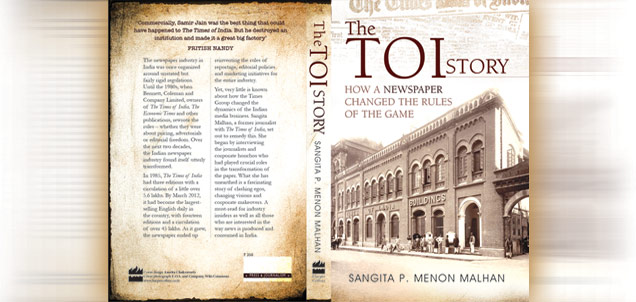
    New Delhi-based Sangita P. Menon Malhan is author of ‘The TOI Story’, a book on the Times of India, published by HarperCollins.

    The views expressed here are her own


  • The TOI Story & inside the mind of Samir Jain


    By Sangita P Menon Malhan


    Some interesting insights into Samir Jain’s personality emerge from the days when he was taking on the venerable editors of The Times Group. In many ways, it was also a decisive phase in that it laid the ground for the changes that happened later.


    He may have developed some dislike for journalists and the predominant position they enjoyed. He was uncomfortable with the fact that while the newspaper’s proprietor kept a low profi le, it was the editor, his employee, who was in the limelight. Politicians and bureaucrats pandered to the journalist while the proprietor was a mere bystander.


    There are yet others who concede that there may be a ‘hidden agenda’ against journalists, besides the imperatives for change. An editor, who worked closely with Samir Jain after the reorganization, but did not want to be named, admitted that Samir Jain did hold journalists in ‘deep disdain’ at that time.


    He recalled that sometime in 1986, The Times Group hosted a party in honour of Krishna Kumar, then a Union minister in Rajiv Gandhi’s government. When it was time for dinner and the guests were being ushered in, Krishna Kumar pulled a chair for Girilal Jain to sit. ‘I was standing close to Samir Jain,’ narrates the journalist; ‘he (Jain) said, “This party is thrown by the company and me. Is it not strange that the minister should pull the chair for the editorand not the owner of the paper?”‘


    So determined was Samir Jain to prove that he was superior to the journalists and to keep them in their place that he issued a directive that everyone be addressed by their designations. So, senior editors, who until then had been calling him by his fi rst name, had to switch to calling him JMD (joint managing director) and later, VC for vice chairman.


    When the government had taken control of BCCL for seven years, Samir Jain, then in his early twenties, believed that certain journalists of the paper had started it all by first making allegations of irregularities against the company to the government. It had been a difficult phase, and Samir Jain blamed the paper’s own journalists for creating the mess.


    ‘Samir carried the memory of those years. He thought the editors had to be shown their place,’ recalled Baljit Kapoor. ‘He thought they considered themselves too important. “After all,” he said, “the editor is just one of the employees of the company. He is just a processor of news.”‘


    Samir Jain wanted more control over the newspaper. Editors were taking their autonomy too far. Jain found that he could not appoint people of his choice; that it was tough to get something of his liking included in the paper, among other such ‘restrictions’. These stumbling blocks bothered him. In his early days, one of the top editors tried to belittle Samir Jain by treating him like a probationer. ‘Ladka theek hai. Lekin usey abhi padnaa hai, seekhnaa hai. The boy is okay but let him educate himself fi rst,’ he said. Samir Jain hated that. As a counter, he began circulating articles from The New York Times and other newspapers. He wanted it to be known that he was already educated, and contrary to the editor’s comments, well read.


    He began taking the editors head-on. At one interaction, he is believed to have said: ‘Please, all you editors listen. If you have an appointment with the prime minister, and if I call you, you must cancel the appointment and come to me.’ That quote has stuck. Although editors now make reference to it in a light-hearted way, it is unlikely that anyone violates that diktat even today. When the sensei says something, it is followed.


    He had trouble over the fact that while the goodwill generated by a newspaper accrued to the editor, the negative fallouts went over to the owners. ‘He would often say, “The balance of inconvenience is always with me.” He wanted his team to be completely on his side and fully with him, no matter what he did. And, when that did not happen, there was friction between the sides. Such situations bothered him, and they did not end well,’ recalled Pradeep Guha.


    Independent observers outside the organization have also corroborated Jain’s dislike for journalists. In his acclaimed book, Paper Tigers, Nicholas Coleridge writes: ‘Samir Jain views his editors and journalists as elements whose power needs to be constantly diffused (“those blue-blooded Brahmins of the editorial floor”). He takes pleasure in giving the best offices to his managers instead.’


    A rebellious streak, a certain amount of irreverence for convention and tradition – that constant and regular inverting of the pyramid persist even today. Does he go about it in an authoritarian, my-word-no-matter-what manner?


    Here again, there is no single or simple view. There are those who believe that in his single-mindedness, he brooks no resistance though his manner and approach may be understated. One of the edit page editors at the Times House said, ‘Samir Jain has established his own regime. His staff has to understand and accept him. The VC will not interfere in the day-to-day functioning of the newspapers.


    He is more the Puppet Master. He will throw an idea at you and have you fi gure it out. But you are expected to figure it out. ‘He likes high-quality discussions. He will never call a reporter for a discussion. It will mostly be editors or people on the edit page. He will size you up and treat you accordingly. But he is soft-spoken and gentle and will never give you a direct command. It will all be hints and subtle suggestions, and you will have to pick up cues.


    That makes him both interesting and difficult, depending on how much you are willing to invest in him.’ I asked this editor whether Samir Jain is temperamental, as is often alleged. ‘I have never seen him lose his temper. The VC likes equals. One would often see Swami (Swaminathan Aiyar, former editor-in-chief of The Economic Times, who continues to write a column for the paper and is a consulting editor) and the VC standing in the corridor and talking like old friends. When in a good mood, the VC will start his conversations with his Bengali editors with “Kaemon aachho?” (how are you?). ‘The problem is that most journalists don’t like to be given sermons, and certainly not by their publishers. They will not listen. And that becomes a point of confl ict,’ he said.


    Shubhrangshu Roy, editor of the Financial Chronicle, who earlier served at the ET, drew up a sketch in a matter-of-fact way. ‘Samir Jain is not the despot he is sometimes made out to be. He is not an anarchist. In fact, he is down-to-earth. I have never seen him lose his temper with anyone. He is actually a compassionate man. People have this terrible habit of demonizing him. One either hero-worships him, or tries to make a monster of him. ‘Samir Jain is an editor-publisher; he isn’t anti-journalist. He is, in fact, a better editor than most editors I’ve known; he knows his journalism. Samir Jain is the Holy Ghost of The Times of India – intelligent, intellectual,’ Roy added. He believed that editors have had trouble with him because of their own vested interests somewhere down the line. ‘Every editor who has worked with him has done so with a huge self-interest and an even huger ego,’ he argued.


    ‘In the contest between the publisher and the editor, the publisher wants to be the editor of the newspaper as much as the editor wishes to step into the publisher’s role. There is the classic confrontation between the two. But he tried to delink or demystify this. He transcended it. As an observer of journalism, I truly believe that Samir Jain is indeed a quintessential editor,’ Roy said.


    It is quite clear from talking to his editors that Samir Jain takes a keen interest in what gets carried in the editorial columns of his newspapers, even to this day. The intervention could be subtle – a gentle cue or a hint, sometimes leaving the editor to struggle with deciphering the full import and intent behind it. Or, given his fascination with good language, Samir Jain could actually get down to performing the task of a sub-editor. T.K. Arun, who was the edit page editor at ET when I met him, told me: ‘The VC is an excellent sub (sub-editor). Occasionally, he reads through articles published in the paper and goes about marking out superfluous words and expressions. He is very particular about the correct use of the definite article. In the old days, one thought that the lalas did not know anything about journalism, leave alone language. But he is exceptionally well read’.


    Abheek Barman, consulting editor at ET, seconded his colleague’s comment. He said: ‘The VC is a great one for semantics. He particularly likes interesting words and is very fond of neologisms. Once I used the word “zeitgeist” (German for the spirit of the times) in his presence, and he remarked: “No one uses words like this any more.” On the one hand, he wants the language in his newspapers to be simple and easily understood. But at a personal level, he likes using words that would make a person think’.


    Bal Mukund Sinha of the Navbharat Times said: ‘He pushes your boundaries. He will drop a hint, a clue, and you are encouraged to interpret it. If you get it wrong, he will gently tell you what he had envisaged. He will also often pretend that he knows little about the subject being discussed, and as you wax eloquently, he will listen patiently. Then, he will spring a “guru mantra” at you which will sum up the entire matter. His mind is so powerful…also…because he is so spiritual.’


    In many cases, the intervention initially leaves his editors aghast, until they come round. Samir Jain once came up with the line that it is alright to use words from the English language in the group’s Hindi newspaper. He believed that newspapers are not meant to nurture language. ‘”That is why in our English newspapers, we do not carry Shakespeare; we carry (author) Shobhaa De’s line which says, ‘That neighbourhood boy is very namkeen.‘ People understand this language and speak like this. And we must be able to relate to them,” he would say,’ said the editor from NBT.


    On another occasion, Samir Jain suggested that his Hindi daily do a story that English should be pursued by NBT readers for better career prospects. He wanted the newspaper to conduct a survey, asking readers whether their children studied in English-medium schools, and if so, why? “Expose the puritans,” he would say. “Be real; be practical.”‘ His suggestion wasn’t taken very well but the survey was undertaken. ‘We found out that he was right. Most NBT readers, who were questioned, did aspire for their children to be fluent in English. This is how he intervenes,’ Sinha explained.


    A member of the editorial team at ET said: ‘The VC is civilized and evolved. He will share his views with you. If you understand what he is saying, all the better for you…for you will have all the freedom you need to write your edits. And if he likes what you’ve written, you might even get a small note, with just an ‘S’ for a signoff, and a couple of points written almost illegibly.’Autocratic he may not be. But Samir Jain can be overbearing, like handing out diaries to all the editors, asking them to bring those to their meetings with him, take notes, and refer to them at subsequent interactions, and, being a little uncomfortable when the process isn’t followed by the oddball. Notebooks are promptly arranged for those who come to meetings without them. One is also supposed to write in them as he talks and shares his perspective.


    Here again, some parts of his speech could seem nebulous. ‘Trying to make sense of what he says could sometimes be an uphill task. That is true,’ said an editor at the Times House, without wanting to be identifi ed, of course. ‘He often cites some Vedic philosophy or complex analogies. His gyan (knowledge) monologue sessions are called “chemotherapy sessions” because it becomes very difficult to put up with them.’


    ‘When he doles out some religious funda, and sees that our eyes are glazed over, he would say, “I know you are non-religious people, if not atheists. Even so, you must read the Ashtavakra Gita, which was written as an atheists’ manifesto.” He loves it and knows it by heart. That is clearly his favourite book. But he will never insiston any point. He will generally suggest something like “Perhaps you could take a look at it, and see if you can write something,”‘ the editor said.


    ‘But the sessions with him have to be endured. Those are unstructured monologues. They could start with just two or three people. But if the conversation got interesting, he would keep calling more and more people. He would mention some names and say, “Unko bhi bulaa lijiyey” (Call them as well).’


    ‘And no matter what you are doing or are about to do, you are expected to just go upstairs, to the fourth floor,* equally perplexed, scribble pad in hand, of course, and listen to him basically talk to himself. But the sensitive part of all this is that he will never call you late in the afternoon or evening because he knows that that time is crucial for the edition to leave.’ (* The Fourth Floor is the Mount Olympus at the Times House, Delhi – a hallowed precinct that houses the offi ces of Chairman Indu Jain, Vice Chairman Samir Jain, Managing Director Vineet Jain and the top management of The Times Group. Visits to this part of the building are,more often than not, eventful. Special guests are entertained in the lunch room here. Entry is ‘by invitation only’).


    The editor went on: ‘One way to escape the gyan overdose is to feign a cough or perhaps sneeze in his presence. If you do that, he will immediately tell you, “You are not well. Perhaps you should leave.” By the way, he fusses over his health a lot, sometimes bordering on the hypochondriac. He has a sensitive throat. He is acutely averse to pungent smells and scents – perfumes, pickles and scented hair oils.’


    I was also told that Samir Jain has a time fetish. He will not be late. He usually comes in to office around 10.30 in the morning when the News Management Committee (NMC) meeting is supposed to start, and, if by any chance, it isn’t on, he is disposed to being rattled. On occasion s, he will mutter that they are ‘slackers’. ‘He doesn’t take very well to this lack of order and discipline,’ said one of the members of the NMC at the Times House The other thing about his morning ritual is that he will walk into the editorial side of the offi ce, put his head into a cabin and talk a bit with one of his editors. Or he may choose to ‘prevail upon’ the NMC. ‘He will sit and watch each and every one. Even if he is not directly looking at you, you better be aware that his eyes are on your every move,’ chuckled the man.


    There is a lighter side to Samir Jain, as emerged during a conversation with Gautam Adhikari. I met him in New Delhi in February 2002, the fi rst of three meetings. ‘One thing that most people do not know about Samir Jain is that he has a funny bone in him; he has a huge sense of humour; he can be an absolute imp. Sometimes during meetings with the staff, depending on what struck him as funny, particularly all the nodding and yesmanship, he would wink at me, and later, we would talk about it, and he would burst out laughing,’ he remembered. ‘There is so much to the man. He used to enjoy the comic, Asterix. Inspector Clouseau from the Pink Panther series was a character he was fond of. He liked Agatha Christie’s books and stories with suspense and wit. He has read every book written by P.G. Wodehouse and is very fond of Wodehousian words and sentences. Being from the same school, we spoke a similar, stylized language sometimes. So, we understood each other very well. He had also read enough Shakespeare to quote him back at me. Our conversations would be explosive,’ Adhikari reminisced.


    ‘He loved the stage, drama and musical comedies just as much as he loved the serious stuff. He would ask me to explain the central theme, the essence of a play to Meera (his wife), and then come up with his own interpretation,’ he recalled. ‘But very few people get to see that side of him. They think that he is either a radical innovator or a media mogul who fl oats in a sort of religious ether. But Samir Jain is far more interesting, far more intriguing,’ Adhikari maintained.


    Jug Suraiya is a raconteur with a sense of self-deprecating humour, who in his writings will take potshots at all things ‘sacred’ including The Times Group itself, always going for the ‘jugular’. Senior editors talk about the equation between Samir Jain and Suraiya, who could be the best of friends one moment and arguing animatedly the next. That makes Jug Suraiya one of the chosen few who can provide an incisive look into Samir Jain. I met this aloof, pensive, almost reclusive writer at the Times House when he was in charge of the edit page. He vaguely recognized me from my days at the paper, heard me out and proceeded to answer my questions dispassionately.


    ‘Samir Jain is a visionary,’ Suraiya said.14 ‘He wanted to cater to an entirely new readership. He did not want to listen to precepts,’ he added. ‘When Gorbachov (former president of the Soviet Union) was going to visit America, I wrote a singeing editorial which was supposed to be the third edit (the slot meant for light, off-beat editorials). But Samir liked it so much that he made it the fi rst edit, and said this is how editorials need to be written,’ he recalled. ‘He is a maverick genius. He likes to take risks. Money means nothing to him. Like a samurai, this is, for him, a game. It may even be a spiritual exercise,’ Suraiya surmised. ‘Samir Jain belongs to no one particular school of thought; he comes from the world of imagination.’


    Another person with a long association with Samir Jain, this time from the marketing team, had this to say: ‘Samir Jain is the Howard Hughes of India; a mystery man with an incredible mind. He has no material or worldly ambitions and that seems strange considering his focus on the business. He has no passion for sport, art or money in the raw sense of the word. He is, therefore, highly focused only on his goal.’


    Samir Jain is also mentioned as being empathetic and compassionate. But here again, there are sharp paradoxes to the man. He could swing between supreme unconcern, and an empathy that is so extreme as to be almost unnerving. Guha still cannot get over Samir Jain’s ‘acts of empathy and kindness’. When he spoke to me in August 2011, Guha remembered two instances with emotion. The first was when Guha’s father passed away. Samir Jain landed up at his home in Mumbai with homecooked meals in boxes, saying, ‘None of you must have eaten. Please have this.’ Samir Jain and Guha may no longer be as close as they once were. But the latter insisted he can never forget that gesture.


    ‘And on another occasion,’ Guha recalled, ‘he came back from a trip. He had bought shoes for me, and proceeded to fit my feet into them. He had an idea of the size and of the fit. How did he even do that? It was very surprising. ‘As a person, if he likes you and knows that you are with him fully in everything he does and that your interests – the greater good of the company – are aligned with his interests, then his is an association to cherish,’ Guha maintained. ‘He will look after your needs, your comfort – almost dote over you. He will let you be and allow you to take risks. And he will go all the way to support ideas that are aligned with the overall goal,’ Guha added.


    Several editors I met spoke of how the VC would personally serve food on to their plates at parties, or call for tea and proceed to make it for them. There have also been instances of a gentle reprimand at work, being followed by an invitation to dine at his home.


    Published with the permission of the publisher and writer


    The TOI Story

    (How a newspaper changed the rules of the game

    By Sangita P Menon Malhan

    HarperCollins Publishers India

    Cover price: Rs 350*

    Paperback, 261 pages

    (check amazon.in, flipkart.com for a lower price)

     

  • Is there room for DNA in Delhi and Mail Today in Mumbai?


    By Ananya Saha


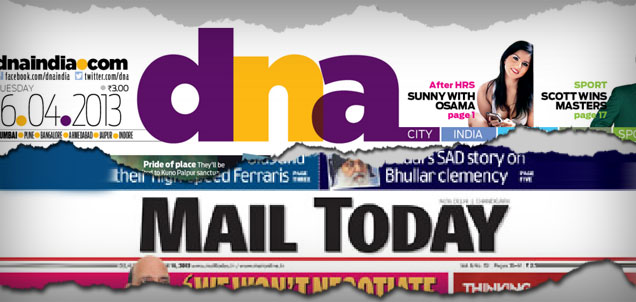
    Mumbai-based DNA is reportedly galloping ahead towards the capital. Launched on July 30, 2005, in Mumbai, DNA (short for Daily News & Analysis) is an English broadsheet daily owned by Diligent Media Corporation, now an Essel Group company. With presence in Mumbai, Bangalore, Pune, Ahmedabad, Jaipur and Indore, the recently refreshed daily is scheduled to be in Delhi on May 13. While NCR is seen as a battleground for the English heavyweights Times of India and Hindustan Times, many English dailies do not boast of good readership numbers in this market. Does the Delhi market need yet another English daily?


    Sundeep Nagpal

    “I don’t think there is too much room for another English daily in Delhi, at least in terms of readership,” says Sundeep Nagpal, Founder-Director of Stratagem Media, an independent media agency. “The English daily readership as a category, went up by about 5% around the turn of the last decade, but it’s back to the level that it was at, in 2008. However, what seems to be happening in most major markets, is that they seem to be able to absorb additional circulation to some extent. So, basically this suggests fragmentation,” Mr Nagpal adds.


    Anwesh Bose, Senior Vice President- Media, DDB Mudra is of the view that DNA is launching Delhi more with an image perspective in mind than revenues, for now. “With the Delhi launch they would be able to call themselves a national daily, finally,” he said. DNA has plans to eventually be present in all the four metros, and then launch its financial daily too in these markets. The Ahmedabad, Jaipur and Indore editions are franchised to the Dainik Bhaskar group, formerly joint venture partner of Zee in Diligent Media.


    Anwesh Bose

    But to capture readers and advertisers in Delhi, DNA would have to be aggressive in its positioning, and promotions, and adopt a push and pull strategy. As Mr Nagpal viewed it, DNA will have to create a market of its own and that would mostly happen in terms of a share of time spent on reading, and not as much in terms of new readers. Meanwhile, DNA has firmed up its team in Delhi with senior journalist Saikat Datta being appointed as the Resident Editor.


    Mr Bose said, “DNA would have to step into Delhi with deep pockets as they need to sustain for a long period of time before they can see profitability. Their strategy ideally should be of first of all establishing themselves as a brand that stands for something.” The new daily, according to him would have to come up with interesting ways of increasing their circulation, since the old methods of free gifting on long-term subscription does not hold any value anymore.


    While DNA is planning to enter Delhi, the capital’s compact daily newspaper – Mail Today – is getting set for a Mumbai launch this year. Mumbai has seen a reasonable healthy growth of 40 percent in readership of English dailies over the last six years, whereas Delhi has been at about 18 percent only, vis-a-vis 2005, asserts Mr Nagpal.


    Having launched in Chandigarh recently, Mail Today will have to compete with Mid-Day and Mumbai Mirror in Mumbai.


    AS Raghunath

    AS Raghunath, a senior print media brand consultant based in the capital, is of the view that Mail Today will be able to carve the niche in Mumbai. He said, “The Chandigarh and Delhi editions of Mail Today usually have a front ad jacket. So they do have a permanent source of revenue. Content-wise, Mail Today is a mixed bag and carries an ‘exclusive’, usually every day, which no other daily has. Even Twitter and Facebook communities quote Mail Today. Also, given the fact that Mumbai is a multi-newspaper market with English, Hindi, Telugu, Tamil, Gujarati dailies and publications, I am sure Mail Today will be able to carve a niche for itself.” He further added that while size will not be a challenge for Mail Today, any daily going in Mumbai would probably not add numerically to the market.


    On Mail Today’s stint in Delhi, Mr Bose remarked, “Mail Today is by no measure a success in Delhi… although, they have tried their best. It is bought more on relationship with the India Today Group than because of its content differentiation.” Mr Nagpal concurs that for a large cross-section of advertisers, Mail Today did not offer a unique/significant enough benefit.


    According to Mr Nagpal, “Mumbai Mirror (MM) has been able to create a huge dent in the market”. “It has stalled other competitors right where they were in their tracks and even eaten away their share considerably over the last five years, so I think MM is quite a success. But that does not mean that every new tabloid will do as well” he added. Mr Bose, however, holds a different view. He said, “Even with the might of TOI behind it, Mumbai Mirror could not make a huge dent, therefore it will be an uphill task for Mail Today to achieve success.” Mr Nagpal is of the view that Mumbai ought to be an easier market for Mail Today, for a whole lot of other reasons such as being more cosmopolitan, more adaptable, etc.


    The advertisers, obviously, would watch with interest as to the direction in which each of these publications grow in the respective markets. “It is sure that a lot of advertisers would get free space or space at a very marginal cost to begin with as the publications would want the advertisers to sample their product as well as it becomes a talking point with other advertisers for the publication. Also, there would be a lot of freebies during the circulation drive, so the consumer is going to make merry,” opined Mr Bose.


    Success or not, only time will tell. But it is sure a sign of healthy growth for the print sector. As Mr Bose concluded, “Print has seen a growth in 2012, where it grew by 9 percent compared to 2011. This year print would gain more as a lot of TV-friendly categories have shown interest in print, primarily to drive sales in a period of slowdown.”


  • Times of India launches ‘Alive’

    By A Correspondent


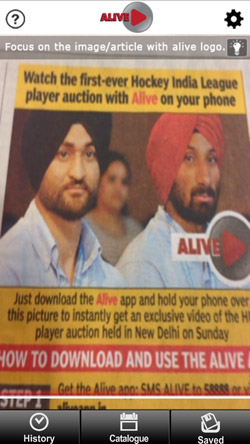
    The Times of India Group has soft-launched its Augmented Reality experience application, Alive. To its surprise, on the launch day of December 16th, the app was downloaded 250,000 times, leading to 300,000 augmentation views on a single day. This significantly surpassed internal estimates of about 15,000 downloads on day one. Augmented Reality is a technology that bridges the online and offline worlds using the mobile phone. It allows readers of the newspaper to interact with a print medium, and get access to rich media content, such as videos, photos, and polls. The Times of India’s Alive App boasts of being the first augmented reality service launched in India by a media company.

     

    On December 16, the most popular augmentation was a video interview between Arnab Goswami and Salman Khan, where Salman Khan sheds light on his darkest days when diagnosed with a disease. This story was augmented by 65,000 users over a four-hour period.


    Times Internet CEO Satyan Gajwani said, “We love bringing new technology solutions that add value to our users. Alive is exciting because it is a new dimension to a medium people are used to and comfortable with. We’ve thought hard about where AR actually adds value and where it’s just a gimmick, and we’re working to ensure that each augmentation brings something new to our readers.”


    BCCL Managing Director Vineet Jain, said, “Times of India believes in innovating constantly and out of the box thinking. This technology has existed for years as QR code readers, but no newspaper in the world has used it editorially to delight its readers. We are excited to bring a new level of interactivity to the newspaper every day, and there is more to come in the coming weeks. Times of India and Alive is just a small peak into how the future newspaper will look in the era of convergence.”


  • Is news media ownership a cause for worry?


    By Shruti Pushkarna


    Hardly had the news of the acquisition of English news channel NewsX by ITV Media Group and Hindi news channel Live India by Prosperity Agro filterd in, there were murmurs on whether it was vital for the government to impose entry barriers for the news media. ITV of course has been in the news for around five years and Live India already had a sizeable stake by a property developer HDIL.


    As part of MxM Mondays, we spoke to a cross-section of news media practitioners to offer their views on the issue.


    This issue of media ownership has been debated on in the past, and more so recently, because of the entry of corporate groups into the news media. Earlier this year we saw two big corporates enter the media domain, when Reliance Industries bought a stake in Raghav Behl-led Network18 and Aditya Birla Group invested in the Aroon Purie-led Living Media India.


    While big business owning media is not a new phenomenon, there are numerous instance of politicians owning and controlling sections of the media, especially in Southern India.


    Hence the question arises: Is it a cause for worry when people with non-media interests start owning the mass news media?


    Here are a cross-section of views from captains of the industry (in alphabetical order of their last names):


    Tariq Ansari, Chairman and Managing Director, Next Mediaworks Ltd

    Tariq Ansari

    The worry is not around who owns the media but whether they act in a way that is consistent with journalistic standards of integrity and fair play. We seem to have forgotten simple journalistic conventions like a declaration of interest from the owner of the publication/channel on stories in which there is a substantial commercial interest.


    Media, much like steel or fertilisers or communications, will eventually belong to those who have the means and desire to invest in it. The point about it being the preserve of a few is inexplicable. Nobody is stopping anyone from raising the capital to start a newspaper/magazine/TV station/radio station/website. We live in a free country. Anyone who has the ability to own media should be able to do so, without limitation. Clearly my preference would be that criminals or those with clear vested interest should not own media, but I am not sure if the law of the land can prevent this from happening.


    Vinod Mehta

    Vinod Mehta, Former Editor-in-Chief, Outlook magazine

    I am worried. Media diversity is very important for freedom of the press. I don’t want Media in the hands of a few owners. It should be open to all.


    And here’s what MxMIndia’s regular columnists say:
     

    Ranjona Banerji, senior journalist, columnist and Contributing Editor, MxMIndia

    Media ownership is a worry to the extent that journalists are not able to withstand corporate pressure. For instance, the Birlas started Hindustan Times and the Tatas has a stake in The Statesman (to name just two) and the battle between marketing and editorial is as old as the profession. The problem comes when senior editors capitulate and reader interest is surrendered or sacrificed. I would turn the spotlight back on journalists: are we fighting the good fight?
    _______________________________


    Mediaah/Pradyuman Maheshwari, editor-in-chief, MxMIndia:

    Many years back when I asked a leading industrialist why he was keen on starting a news channel he replied with the famed Deewar dialogue (some alcohol in the system did the trick): Aaj mere paas buildingey hai, gaadi hai, bank balance hai, but even then these guys owning newspapers and channels are ruling the world. We were in the late 1990s, and journalists and news media owners were indeed much sought after. That may have waned over the years, but the desire to own news media stays. What hasn’t changed is that the intent of owning the news media goes far beyond returns on investments.

     

    When the British ruled India, it was the desire to mobilize public opinion that led to several national leaders and even businessmen to embrace news. Post-Independence, with the birth of a new economy, it was a mix of nationalistic sentiment and also to use it as an ally in a tightly controlled business environment. The ’60s and ’70s saw the media taking off with magazines like the Illustrated Weekly of India, later India Today and several others in regional languages. The imposition of the Emergency got people to realize the importance of the news media as the liberalization of the economy and and the airwaves ensured that there is no looking back.


    Being a democracy, there are no entry barriers to the media. And rightly so. However, when a few years back a few real estate and assorted players jumped into news television there were representations to the information and broadcasting ministry that there ought to be tighter controls.


    The current murmurs are being heard because NewsX has been acquired by businessman Kartikeya Sharma. ITV, his media company, also runs the newspaper Aaj Samaj and regional and Hindi news network India News. And the reason for the concern: it was feared that being the brother of Manu Sharma who has been convicted in the Jessica Lallmurder case, he could misuse his position to influence the executive and the judiciary. Well, the Supreme Court upheld its sentence of life imprisonment in 2010, so evidently he didn’t achieve much. To be fair to Sharma, a senior editorial and business executive who has worked with him, told me that he saw no interference on content, especially on the Manu Sharma front.


    Clearly, the money power of rich businessmen and politicians cannot bring in readers or viewers, as the case may be or make a success of the media enterprise. In the late’80s, the Ambanis acquired Commerce Weekly and converted it into a business daily. They also acquired The Sunday Observer that was once edited by Vinod Mehta and was exceedingly popular.  The Ambani indulgence in the media failed despite hiring top journalists and publishing executives. They could only use the papers to fight a few minor battles, and even those without much success.


    Mehta worked and fell out with industrialists Vijaypat Singhani and L M Thapar as both found news too hot to handle and counter-productive to their primary businesses (and revenues). One had assumed he would meet the same fate when Rajan Raheja, a then-emerging industrialist with some interests in real estate, set up the Outlook magazine group. Mehta has led many battles with the mighty and powerful in his magazine and both Raheja and Mehta have survived each other.


    Save the Outlook example which is a good indicator of business interests and independent journalism co-existing, clearly big money is not enough to drive consumption of news media. My worry though lies elsewhere:

    1. Lack of transparency in the ownership of media.

    2. Creation of a monopolistic scenario with business groups investing in multiple and similar vehicles

    3. Level playing field for competition in case of vertical and/or horizontal cross-ownership, and

    4. Diversification of media companies  into entities beyond news


    1 & 2. Transparency requirements in media ownership are critical. When the government announced recently that a certain conglomerate doesn’t not have interests in the media, is it really the case, or is that what is on paper and hence deemed correct? While doubts have been raised about how the acquisition of a sizeable chunk of Network 18 via an independent trust would impact the editorial independence of the group, the real worry is the rumoured interests of the group in other media ventures too.


    Could we have a situation that a genre of channels or newspapers or the media entities in particular region of the country be owned – directly or indirectly – by one group? How do we tackle a monopolistic scenario such as this?


    3. The PR head of a radio station in Delhi once complained that she could never hope to get her press release into the two main English dailies in the city because both had their own FM stations. So, while the most inane event from the group’s radio station gets covered, the lady’s FM frequency never got a mention even for a big activity. So rampant is this blacking out of a rival group’s activities that it’s now considered standard practice. In many countries there are strict rules for horizontal and vertical cross-ownership. While the TRAI has suggested restrictions in vertical ownership (a TV channel can’t fully own a DTH or cable platform etc), horizontal ownership is fine (so a TV channel can also run a newspaper, radio station etc).


    4. The last of my worry areas can be a bigger concern, and, if misused, even graver than big business or a political party getting into the media. Many news media groups have invested in sectors outside of news and doubts have been expressed if there is any connect between the relationships with governments via the news media and the winning of such contracts.


    Even though the government at the Centre is weak, and we can be sure it will flex its muscles often enough in the run-up to various elections until 2014, I don’t see any immediate solution to the problem. But what can play a deterrent for those who abuse the media will be public opinion via social media.


    Sevanti Ninan, Editor, thehoot.org and Columnist, Mint

    Sevanti Ninan

    Yes, it is a cause for worry when people with vested interests start owning the mass media because political ownership of the media is increasing, and there are no transparency requirements on media ownership.


    Readers and viewers are unable to discern ownership-related biases. There is also a renewed trend of corporate investment in media increasing. Media companies are supposed to file ownership details with the registrar of companies, but one, it is not properly done, and two it is very difficult for lay people to access the correct and latest data.


    On the issue of media being a preserve of only a certain groups, even now it is fairly widely owned.


    Maheshwar Peri, Chairman, Pathfinder Publishing India Pvt ltd

    Maheshwar Peri

    In my opinion there is no cause for worry. I think, increasingly, the cause for worry comes from a few industrialists who’ve gotten into media. But if you go back to the flag bearers of Indian journalism in the 1980s, Indian Express was owned by RNG, an industrial group. So, to say that ownership by industrialists would hurt media is a slightly wrong way of looking at it.


    There is definitely a cause for worry when people get into media for reasons other than running it as a professional empire. If you look at some of the politicians who’ve come into media or political parties that are launching their own channels, that’s a cause for worry because they have a reason to dish out news which suit their needs and opinions.


    So there is a problem when people in public office get into media, but it’s not so much of a problem if industrialists or venture capitalists or any others moneybag get into it because they want to make it a commercially viable operation. And they know they can make it commercially viable only when the reader/viewer respects them. In case of politicians, they are not interested in making it commercially viable; they just want to ensure that their point of view finds a space in the public domain.


    I think unless a reader or consumer respects you, you won’t be able to sell beyond a point. So all of us, whether or not owned by corporates, are always trying to ensure that we give unbiased and credible information so that the reader continues to respect us as well as the advertiser continues to invest in us.


    And what makes one think that they have a better opinion about media than a fruit vendor? I don’t think there can be a classification of who has a better opinion about certain things in this country – we are a democracy. So the worse thing is to say that ‘these’ kind of people can get into media and ‘those’ kind cannot.


    Tarun Tejpal, Editor-in-Chief, Tehelka magazine

    Tarun Tejpal

    To some extent, there is cause to worry about media ownership. We have to air, discuss and examine issues of monopolies, cross media ownerships, and of cross business ownerships. And to try and build in some structural safeguards that both help ensure the financial viability of honest, robust media, and deter media owners from using their media instruments for unfair advantage in their other businesses.


    Theoretically, it (media) should be open to all. But we must build in safeguards that minimize the misuse of public discourse and public instruments of media. This is not easy, but a discussion must start on this issue at all levels.


    Paranjoy Guha Thakurta, Senior Journalist

    Paranjoy Guha Thakurta

    The growing corporatization of the Indian media is manifest in the manner in which large industrial conglomerates are acquiring direct and indirect interest in media groups. There is also a growing convergence between creators/producers of media content and those who distribute/disseminate the content.


    In India’s unique ‘mediascape’, it is often contended that the proliferation of publications, radio stations, television channels, and internet websites is a sure-fire guarantor for plurality, diversity, and consumer choice. There were over 82,000 publications registered with the Registrar of Newspapers. There are over 250 FM radio stations in the country. Despite these impressive numbers of publications, radio stations and television channels, the mass media in India is possibly dominated by less than a hundred large groups or conglomerates, which exercise considerable influence on what is read, heard, and watched.


    One example will illustrate this contention. Delhi is the only urban area in the world with 16 English daily newspapers; the top three publications, the Times of India, the Hindustan Times, and the Economic Times, would account for over three-fourths of the total market for all English dailies.


    However, what is unacceptable is media barons using news outlets as tools to further their business interests. In this country, as in the world over, large media corporations are clearly playing a bigger role in the political economy that they report on. Though a free media is fundamental to the existence of a liberal democracy, concerns about the accountability and transparency of media companies remain. For instance, the RIL deal has enabled Network 18, Eenadu, and the merged group to expand its offerings to benefit its stakeholders and its advertising target audiences. What remains to be seen is whether clear boundaries can be etched between the boardroom and the newsroom.


    There’s absolutely no doubt about the fact that if it’s truly going to be a responsive media, then the media should reflect the views, the interests, the aspirations of a larger section of population as possible. The problem with much of our media is that they are too busy trying to ‘reach’ consumers to potential advertisers than providing information to citizens.


    Next Week:

    Why do we all like to damn TAM?

    The Sectoral Innovation Council recommendations last week said that there was need for an alternative to TAM, short for the media research company formed by a jv of two international research biggies: Nielsen and Kantar. This is a view that has been expressed several times over the years.


    One of the main peeves against TAM is the number of Peoplemeter boxes present to collect data. Can 8000+ boxes effectively poll a populace of 1.2 billion, is what many broadcasters keep asking in public. In private though, not many are ready to pay up by increasing their subscription fee to enable the installation of more boxes across the country.


    Also, what’s happening to BARC, the joint industry body that was to provide an alternative?


    MxMIndia will speak to a cross-section of the industry to get answers. Meanwhile, if you have a view, email it to us at editor@mxmindia.com with the subject ‘MxM Mondays #2’


  • Comment: Jehangir Pocha on Media’s new Moguls

    By Invitation


    By Jehangir S Pocha


    Among all the transformations taking place in media, here’s the crucial one – the media baron is being replaced by the media conglomerate.


    Corporations are buying news properties once owned by individual proprietors at a rapid pace. Expectedly, media mavens and professionals are crowding conferences to express their angst: Are these oligarchs becoming media’s new moguls only to protect their empires and project their interests? Will they interfere every time a story is done on their favourite babu, minister or party?


    But this holier-than-thou approach that automatically assumes a media baron is better for journalism than a media conglomerate is as reactionary as it is wrong.


    A corporation owning a news property can be expected to slant or kill a story inimical to its core interests.  But those are few and far between.


    After all, how many core interests can a corporation have? On the other hand, many media barons have been notoriously whimsical, politicized, opinioned and ideological, slanting almost every story almost every day, and killing (or overlooking or underplaying) almost every story out of sync with their ideology, views or interests.


    In all democracies, the most slanted and ideological journalism has always been driven by media barons, from William Randolph Hearst, to Ramnath Goenka, Thaksin Shinawatra, Rupert Murdoch, Silvio Berlusconi, Michael Bloomberg and others.


    Their news properties have openly, sometimes shamelessly, displayed their biases.  Compare Murdoch’s Fox News with its corporate-owned competitors, NBC News (owned by General Electric), CBS (owned by Westinghouse), ABC (owned by Disney) and CNN (owned briefly by AOL). Which is most slanted? Which is most protective of vested interests? Which would any unbiased media professional rather work for?


    Yes, a media corporation might protect its pet politicians and restrain its news properties from covering its other businesses fairly. But many media barons do the same. Some appear to have more pet politicians than any corporation. In fact, often the “other business” of media barons is politics (consider Berlusconi, Thaksin, and Bloomberg).


    When it comes to coverage of oneself, it is India’s media barons who have constructed the self-serving maxim that “media mustn’t cover media”, leaving them free of all public scrutiny. That’s what’s allowed some of these tycoons to injure Indian media and dupe their viewer/reader by introducing poisonous practices like “paid news” and “private treaties”.


    It is highly unlikely that any media conglomerate would allow such practices precisely because of the fear of public scrutiny that publicly-listed and/or publicly known corporations naturally have. Companies run by professionals and overseen by a board of directors that includes independents and representatives from government-owned institutions are generally forced to put in place the systems and standards needed to run a business right.  Media barons exempt from oversight rarely do so.  This is why Murdoch’s newspapers spy on people and others don’t.


    This doesn’t mean concerns over how corporations will manage their new media enterprises can be ignored.


    As Indian media comes of age it must codify its journalistic standards and rigorously implement them through an independent body akin to Britain’s Media Standards Trust. Such a body should give India’s journalists protections, such as the legal right not to disclose a source, and freedom from prior restraint (attempts to prevent publishing/airing of an opinion/idea/story before it is published/aired).


    Every news organization must also be required to have an independent Ombudsman charged with ensuring fair and balanced coverage.  At the same time, this Ombudsman and/or the standards authority should also ensure journalists and news outfits respect the rights and reputations of others (anti-defamation), separate news from views, eschew ‘paid news’ and private treaties, protect national security, public order, and public health, and prevent incitement to hostility, violence or discrimination.


    Stringent regulations that prevent any monopolistic control of news are also essential to any democracy. To some extent, digital technologies and social media already ensure this. A smart line on Twitter or great video on YouTube can become more influential than an op-ed in the Times of India. But the government must still work to ensure there are enough voices in the media and that no one voice dominates the national discourse.


    Corporations enter (and sometimes dominate) the media business because it is highly capital-intensive. So, one effective way to maintain a plurality of views in news is to keep entry barriers and operating costs in the business low. For example, existing distortions in media policy, such as exorbitant “carriage fees” that benefit the well-heeled and hurt small news operations must be ended. Banks must be encouraged to lend to smaller media companies, capital requirements in the industry should be eased and more journalism schools built to develop a larger talent pool. Building stronger news-related services, like more text and video wire services, freelancer organizations, and shared news infrastructure, would also help newer and smaller players. Lastly, the government must pass laws to separate carriage from content, and control media cross-holdings.


    Ultimately, every kind of media owner – the government, individual, the public trust and the corporation – comes with pros and cons. India knows well the short-comings of the first three.  We will now discover the dangers of the fourth.  But as long as all four kinds of news organizations are allowed to exist and flourish – and are subjected to firm and fair regulation and oversight – the news media in India will remain strong and vibrant.


    Jehangir Pocha is CEO, INX News.

    The views expressed here are the writer’s and not necessarily those of MxMIndia.


  • [MJR] TV gets boring after IPL

    Ranjona Banerji

    By Ranjona Banerji


    The end of the IPL has seen a flurry of articles, analyses and edits – as well as some television breast-beating. Tuesday’s must-read is Ayaz Memon in The Times of India as he dissects the IPL and people’s reaction to it. TOI also carries an edit on the IPL – a day after everyone else.


    On TV, Rahul Kanwal of Headlines Today, wearing far too much make-up – almost like those pictures of stars like Rajendra Kumar and Biswajit with orange lipstick that movie halls used to carry – was in “hot pursuit” with BCCI chief TV spokesperson (if that’s not a designation it should be) Rajiv Shukla trying to solve all the problems with the IPL.


    The upheaval in the Uttar Pradesh Assembly also bothered our TVwallahs and led to one more verbal fisticuffs on Times Now. This followed another one on the Andhra High Court striking down a quota for minorities. One feels that TV channels need to stop inviting people like Ravi Shankar Prasad and Mohammed Owaisi on the same show as it only leads to acrimonious yelling rather than informed debate. Arnab Goswami did not even bother to control them. TV debates appear to have run through their usefulness. They provide little information or food for thought and now that the actors are the same on every channel night after night, there is no variety or novelty either.


    * * *


    The big news for newspapers in Mumbai was the horrific road accident on the Mumbai-Pune expressway where 27 members of a marriage party were crushed to death by a speeding truck. Several heart-wrenching details about the accident were in all the newspapers and were in fact almost too much to bear.


    The problems of no proper ambulance or paramedical services or the dangers of Indian roads and our lack of disaster preparedness were all covered. None of this makes the spectacle of accidental death any easier of course.


    The drought in Maharashtra is also now making almost a daily appearance in newspapers but I haven’t noticed it on TV yet. That is hardly surprising because unless there is mass-scale devastation, even 24 hour TV news channels struggling to fill in the gaps will not be interested. There is limited scope for engineered outrage and explosive TV debates when it comes to drought or even malnutrition.


    * * *


    The biggest media-related news was former British prime minister Tony Blair telling the Leveson inquiry into media ethics that politicians have to hobnob with the media in today’s world. He admitted to flying to Australia to convince Rupert Murdoch to support the Labour Party in the general elections. Interesting… Now how many Indian politicians would be so courteous to the Indian media?


    * * *


    On a personal note, was quite pleased to see the French Open get so much coverage in the newspapers. Of course, the IPL is over so there’s plenty of space… Hindustan Times gets top marks – but it has increasingly established itself as a newspaper which covers all sports not just cricket. Even the Times of India deigned to provide a little space to tennis and the Grand Slam which has just started in Paris. That is high honour indeed.


  • [MJR] IPL symptomatic of the end of civilization

    Ranjona Banerji

    By Ranjona Banerji


    There’s only one newsmaker this morning and that’s the IPL. As Manoj Tiwary hit a four over Chepauk stadium winning the title for the Kolkata Knight Riders, season five of a very successful Indian Premier League comes to an end.


    And what a season it has been – a film star team owner fights with a security guard, another film star team owner castigates a third umpire for being unfair to one of her players, a player assaults a woman at a party, five players are exposed for spot-fixing and the management is exposed for unfair processes in the buying and selling of players… have I left anything out?


    And then there’s been the cricket. The drama over Saurav Ganguly now being with the Pune Warriors, the expectation that Sachin Tendulkar would soon reach his 1000th Test century, the thrilling last ball finishes, the sentiment attached to Rahul Dravid and all the news finds.


    And of course, the media. For some, like the ultra-bore Boria Majumdar parked in the Times of India stable, the IPL is symptomatic of the end of civilisation. The erudite Ram Guha doesn’t like it either. A player misbehaves at a party and a couple of former players threaten to go on a hunger strike – which I don’t think happened. Or at least, everyone forgot soon after. The TV channels also decided that IPL was the thin end of the wedge before the human race sinks into an irreversible path of iniquity. I would say the same thing about TV news as far as the fate of the media in India is concerned but…


    Sharda Ugra in The Indian Express lauds the good things, hopes the BCCI will fix the bad things and then focuses on what was really wrong with the IPL – the terrible pre and post shows on Sony’s SET Max, Extra Innings. I think there may be an extra ‘a’ in there for some inexplicable reason. Having dispensed with the dispensable Mandira Bedi, we have had the unpalatable and hysterical Gaurav Kapoor and those two girls foisted on us. Isa Guha, since she understood cricket and took it seriously, was a rare breath of fresh air. Why those two badly dressed, screeching and oddly accented girls had to interview minor starlets on the grounds was not explained to us. The cheerleaders in the studio were the worst available. I cannot understand a word Navjot Singh Sidhu says so I was spared tearing my hair out. My only concern was that he needed to go on a diet. Ever since Harsha Bhogle had a hair transplant, I cannot but concentrate on his new fringe to the exclusion of his platitudinous and fatuous observations on cricket.

    Ugra, I have to confess, was not this nasty.


    Mid-Day’s headline “Ra.Won” is the winner of the day. The Hindustan Times gave us a sort of truncated report, obviously written in a hurry and the reporter clearly did not like Shah Rukh Khan. The Times of India had a better report – a real surprise since its sports coverage has sunk to new lows recently – but its reporter is clearly no fan of MS Dhoni’s and called him out for his “standard tricks”, in this instance, slow over rate towards the end of the match.


    Now that the IPL is over however, it will be interesting to see how our perpetual moaning machines in the media will fill up their time…


  • [MJR] 40 is new 60 in media

    By Ranjona Banerji


    Every day when I look in the mirror I know that 50 is getting closer. I do not grudge or regret my advancing years – I’ve enjoyed most of those that have gone by. It’s only when I open a newspaper that I get really sad about my age. Given that no one above the age of 40 can get a job in the media any more, the 13-year-olds who work in newspapers have decided that anyone above the age of 40 is doddering and on the brink of senile dementia.


    Cross 40 and you can be called a senior citizen, elderly, aged and any other such ageist term that you can think of. To actually avail of senior citizen benefits in India, you have to be between the ages of 60 and 65, so that particular descriptive has some technical connotations. But try explaining those to a 13-year-old who heads a news desk.


    Thanks to newspapers, the general public also get influenced. Mid-Day did a very good story earlier this week on how children were arrested for playing cricket in Vashi. The police said that a “senior citizen” had complained and that is why they took action. The senior citizen was 40. That is, at least 20 years before she can get a discount on a railway ticket. Good to know, I suppose, that age still commands respect.


    Wednesday’s Times of India tells us that two senior citizens and another person killed themselves. The first person was 71, the second was 34 and the third was 66. You feel for the 34-year-old – had he waited six years, he would have been a senior citizen too. When senior citizens kill themselves, by the way, they are usually depressed. I am guessing from reading newspapers.


    Oddly, these same newspapers will run stories about how 60 is the new 30 and 40 is the new 11. Clearly, the nine-year-olds who edit these feature sections are too young to read the rest of the newspaper, so have no clue what their classmates, sorry colleagues, are up to.


    Ah well, another day another grey hair.


  • [MJR] Mamata’s antics dominate the news

    By Ranjona Banerji


    The strange doings of West Bengal chief minister Mamata Banerjee continued to dominate print, TV and social media. The arrest of a Jadavpur university professor for forwarding a cartoon about her was compounded by news of another arrest of another professor for protesting on behalf of slum-dwellers in Kolkata. On Times Now, one lone “sort of” Trinamool Congress-Mamata Banerjee supporter said yes, but, maybe, should not, but. In print, edits and edit page pieces have consistently made fun of her and social media has of course been rife with criticism.


    It is also true that a lot of this anger is middle class rage which does not always translate but it is interesting nonetheless.


    Mumbai newspapers were not unnaturally taken up with Monday’s autorickshaw strike which crippled the suburbs. In the north, it was the chief ministers’ conference on matters of “federalism” and their general beefs with the Centre. Beef is the wrong – or is it right? – word to use here as a “beef-eating festival” organised by Dalit students at the university in Hyderabad has led to near-riot conditions with the right wing Akhil Bharatiya Vidhyarthi Parishad objecting.


    The Taliban attack on Afghanistan was an important part of the news cycle. The last couple of weeks have been minus the sort of media hysteria which has gripped us recently. This means that news can get its normal play without being whipped up and re-packaged as end-of-the-world scenarios.


    * * *


    The murky underbelly of fixers and operators which trawl the paths of Mumbai’s hopeful newbies searching for money, fame and glamour has been exposed by the three murders currently in the newspapers. Intriguingly, the same people are somehow involved in three deaths or connected at any rate.


    Although the cases have got much coverage, thankfully the sort of breathless hysteria which has coloured cases like the Aarushi Talwar-Hemraj murders or the J Dey murder-Jigna Vora arrest has been missing here.


    * * *


    It was a joy to read about Nari Contractor by Makaran Waingankar in Tuesday’s Times of India in what appears to be a nostalgia series called “Bombay Boys”. Made a change from the sniping and/or hagiography about current players practised by some young sports journalists these days!


    * * *


    Also interesting in TOI is an interview with Google co-founder Sergey Brin about how apps are reducing web freedom! Since I am app-less am guessing I should celebrate my freedom!