Tag: Times of India

  • Sumit Sen, Editor of TOI Kolkata, passes away

    By A Correspondent


    Sumit Sen, Editor of The Times of India, Kolkata, passed away on Sunday night after a valiant battle with cancer. He was 60.


    A keen and versatile journalist who cut his teeth in The Statesman before moving on to The Hindustan Times in 2001 and The Times of India in 2003, Sumit Sen was as passionate about his work till his last day in office as he was on the day he started out as a cub reporter on the crime beat.


    Even till Sunday evening ­ just an hour or so before his passing ­ he was planning a major campaign on the mystery around Netaji’s death and taking stock of the daily reports. Fellow journalists remember him for his enthusiasm, focus, and the way he made friends out of complete strangers.


    During his time with TOI, he gave the Kolkata edition a burst of energy, direction and fighting spirit. Always brimming with ideas, he would constantly coax colleagues to think out of the box, and stay ahead of the times. Under him, TOI Kolkata came to be known as a paper that was always fresh and positive.


    He fought through pain for the last nine months to carry on working the way he always did. When someone complimented him on his will power, he would brush it away and say, “I am simply taking this as another phase of life. This, too, shall pass.”


    Marcus Dam, who was with him at The Statesman and remained a close friend for over 30 years, said: “It was a WhatsApp message about two weeks ago. In response to a ‘hope u r doing well’, he sent back a smiley. He was a man of few words. His language was simple. He was very passionate about his work and very loving. We have shared a huge number of secrets that perhaps no one else knows about. I won’t call it a loss. He is someone not to be lost. He is always around. He and I shared a dream of taking a vacation in the hills. When the rains came down in Kolkata, whenever it used to turn misty, he would always call me and describe it as ‘home weather’. He took pride in the fact that he was from North Bengal. Yes, he will always be around.”


    Chief minister Mamata Banerjee offered her condolences and rushed to hospital late at night to pay her last respects. The TOI family and Kolkata media were in complete shock and struggling to deal with the untimely loss of someone so vibrant.


    Sumitda, as his colleagues and friends called him, is survived by his wife, noted Bharatnatyam dancer Malabika Sen.


    Source:The Economic Times

    Copyright © 2015, Bennett, Coleman & Co. Ltd. All Rights Reserved

    Licensed to republish


  • How Ashok Mahadevan innovated in his protest against the Emergency


    Forty years back, veteran journalist and former Editor of the Indian edition of Reader’s Digest was incensed with the Emergency and what it meant for free India. Then Deputy Editor of the Digest, Mahadevan was inspired by an ad in a Sri Lankan newspaper and inserted in The Times of India, which has now become one of the most enduring examples of how the country fought back the draconian government led by an ill-advised Prime Minister. On the eve of the forty years of that Dark Day, Dyanne Coelho interacted with Ashok Mahadevan who responded to her questions and also asked her to pick up some accounts from an article he wrote in the Reader’s Digest in 2010.


    The Q&A:

    What was the situation like especially for journalists during the days of the Emergency?

    For more than a year, the Prime Minister had been besieged by a nationwide movement against her led by her father’s old friend, the venerable Gandhian Jayaprakash Narayan (JP). Now, as she had done so often, Mrs Gandhi hit back ruthlessly. On June 25, she declared a state of “Emergency.” The press was muzzled, civil rights were abolished and tens of thousands of political activists, including JP, were arrested. In effect, India became a dictatorship. These momentous events—40 years ago this month—also enabled me to prank my way into becoming a small footnote in the history books. When I learnt the news on the morning of the 26th, I was incensed. India no longer a free country? As acitizen, even more as a journalist, it was intolerable. I had to do something. But what? Fear was spreading like an infection. When I asked a friend, who’d just flown in from the US, how it felt coming to a dictatorship, he told me to shush. People were too scared to jump queues at bus stops! I wasn’t exempt either; some of my politically active friends had been incarcerated and although I visited them in prison, I had no desire to join them there


    Was the idea of the obituary you published your idea? Tell us something about it.

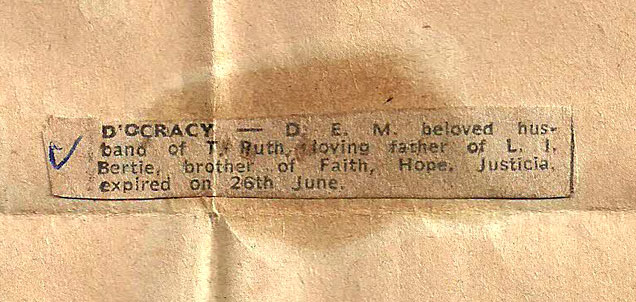
    I remembered an item available for publication in Reader’s Digest—I was then this magazine’s deputy editor, based in Mumbai— about the “death” of democracy. It had originally appeared in a Sri Lankan paper when an emergency had been declared in that country. The ingenious item dealt with the demise of “D.E.M. O’Cracy,” who left behind several relatives, including a son named L.I. Bertie. Why not put this item in the obituary column of the Times of India? I copied it down and made my way to the office of the Times nearby. The clerk in the classified advertisements department there told me he couldn’t accept it because it was too long. I began arguing with him; then, fearful that he might suddenly realise what I was up to, I shortened it. “Are you Bertie?” the clerk asked me. It took few moments to understand what he’d meant. “Oh, yes,” I bluffed. The obituary advertisement was accepted. I paid the small fee and left. Would the item appear? I spent an anxious night, and made sure I was the first in the family to grab the Times the next morning. And there it was! O’Cracy, D.E.M., beloved husband of T. Ruth, loving father of L.I. Bertie, brother of Faith, Hope and Justicia, died on June 26. I was overjoyed. But for it to have any impact, a lot of people—and not just those who read the obituary columns regularly—had to see the item. So I called up a friend in the Times and, disguising my voice, asked him if he’d read the day’s obituary column. “Who’s this?” he asked suspiciously. “Never mind,” I said. “Take a look at it.” He began grumbling, but obeyed, and I heard his voice rising in excitement as he read the ad aloud. “Make sure you tell everyone about it,” I said, hanging up. Word about my ad spread fast. Those who were against the Emergency loved it. Many people sent clips of it to everyone they knew. Among them, I later learnt, was the advertising director of the Times of India! (After the Emergency, he told me so himself.) The ad was even reproduced in foreign newspapers.


    Were you scared of a backlash from the government following its publication? Is that why you withheld your identity and changed your physical appearance?

    The police were called in to find out who had placed the ad. But they got nowhere. This may have been partly because I took some precautions. Shortly after the ad appeared, my wife Jessica and I were scheduled to appear in a Doordarshan programme featuring couples. Since there was a chance that the Times clerk would watch the show— Doordarshan was the only TV channel in those days—I shaved off my beard to look less like “Bertie.” (Several people grew beards to protest the Emergency; I was the only one to have removed his!) Naturally, there were all kinds of rumours about who’d placed the ad. In fact, one Digest reader who dropped into our office even told me a lurid story about how the perpetrator had been caught and tortured by the police! Of course, for all the publicity the ad received, it did not have the slightest effect on the Emergency. That was lifted only 19 months later when Mrs Gandhi, for reasons scholars still speculate about, announced that Parliament was to be dissolved and elections held. To everyone’s astonishment, her party was routed—she even lost her own seat—and the Janata Party formed India’s first non-Congress central government in mid-1977.


    The gutsy obituary drew attention to the situation in India even in the foreign media. What was the reaction when you finally revealed yourself as the person who published it?

    Apart from my friends who congratulated me for publishing the ad–I outed myself in the magazine Debonair, then edited by the late Vinod Mehta–the Times of India clerk who’d accepted the ad called me to say that he’d been punished by the Times for accepting it. Since I knew Mr Thirumalai, the then ad director of the TOI, I complained to him about penalising the clerk. Thirumalai angrily denied that any action had been taken against the clerk and revealed that that he’d been personally delighted by the ad (see article) etc. He then called the clerk and gave him a firing in my presence for lying to me!


    Do you think journalism today has evolved to an extent that we can be protected from such happenings in the future?

    I wish I could foretell the future and reassure you that journalism today has evolved enough to ensure that another Emergency is not possible. However, I think that, thanks to TV, and most importantly, the social media, I think there will be much more opposition to any attempt to impose dictatorship in India.


    In your opinion is the government today strong enough to prevent history from repeating itself?

    Power tends to corrupt, so the stronger a government, the more likely it is to rule dictatorially. All citizens, and especially journalists, should always be on guard against strong governments and fight dictatorial rule (non-violently) if it is imposed.


    Ashok Mahadevan photograph courtesy Reader’s Digest


  • Kalpana Sharma on Himmat’s defiance of press censorship in the Emergency

    Senior journalist Kalpana Sharma worked with Himmat magazine when the Emergency was declared. She took charge as Editor in the year 1976 until 1981 when the magazine ceased operations. Since then she has worked with The Indian Express, The Times of India and The Hindu and is currently Consulting Editor with Economic and Political Weekly. In an emailed interview with Dyanne Coelho, Sharma recalls the Dark Days and how when freedom of the press is denied, it is the poor who suffer the most 


    Q: Give us some insight about the plight of the press at the time. What was it like working under the pressure

    A:  On June 26, 1975, press censorship was imposed.  No one had a clear idea what that actually meant including those given the task.  In Mumbai, in Mantralaya, a room was set up for the Special Press Adviser (the official name for the Censor).  Around 15 people from the department of publicity of the Government of Maharashtra were assigned to assist him.  In the intial weeks, apart from daily newspapers that were compelled to follow the “guidelines” the government had issued, many smaller publications remained outside the net.  I worked with one such publication, Himmat, an English language weekly edited by Rajmohan Gandhi.  We read the guidelines and decided that we would not submit to pre-censorship.  If the government thought we had violated one of these guidelines, they could move against us.  Of course, this was risky, and we experienced the challenges right through the 20 months of the emergency.  But our defiance showed us that it was possible to challenge the censorship regime if you were prepared to take risks.  I might add that this was easier for smaller publications like ours than the big newspapers.  Even so, some like the Indian Express did resist, thanks to their owner Ramnath Goenka.


    Q: Would you share some incidents, memories, anecdotes during the period of Emergency, particularly in your capacity as a journalist.

    A:  There are too many to recount.  As I said, Himmat had decided not to submit to censorship.  But within a few weeks of the declaration of emergency, we were served a notice that we had printed “prejudicial” material and would have to submit to pre-censorship.  This was a report about a meeting on Gandhi Jayanti in Delhi at Raj Ghat where Acharya J. B. Kripalani spoke.  Those sitting on the stage with him were arrested by the police which disrupted the meeting.  For carrying that news, we had apparently violated the so-called “guidelines”.

    Many more such incidents took place, including a demand that we deposit Rs 20,000 with the Commissioner of Police or would be denied the right to continue printing.  Our printing press was also served a notice not to print Himmat.  We went through some really challenging times.  But we did not miss a single issue.  This was only possible because of the committed group of journalists working with the publication.

    What it taught me, and all of us, above all is that when freedom of the press is denied, it is the poor who suffer the most.  The government can then do what it likes, as it did during the emergency, and in the absence of the check that a free press provides, it can literally get away with murder. After the emergency, we heard about the terrible violations of human rights, the mass sterilisation campaign, the slum demolitions, the torture in jails, fake encounters etc.  Not a word of this could be reported during the emergency.


    Q: Do you think we’ve evolved since then, in terms of ensuring the freedom of the press is protected. Where do we stand now in your opinion?

    A:  Legally, it will be difficult to impose that kind of emergency and to bring in press censorship.  But I’m not sure we really value the freedom we have.  If we did, we would make sure that the untold and unrecorded stories, of the people who are marginalised, virtually invisible, find space.  But where do we see that?  We have another form of self-censorship in the media today where the nexus between big business and politics has ensured that certain stories never get told.  And is anyone really defying or resisting that?  Fortunately, the internet is providing some kind of democratic space for some of this information to come forth.  But for these stories to see the light of day, we need many more journalists committed to seek out the truth and report it.


    Q: In your opinion do we as a country have a strong enough leadership today to ensure history doesn’t repeat itself?

    A:  My short answer is No.  I don’t think any of our present lot of politicians, including those who suffered during the emergency, feel passionately enough about the real meaning of the freedoms guaranteed under a democracy.  These freedoms are not words on paper; they have to be seen in the actions and decisions made by those who govern.  Yet, no sooner than a group gets power, they are willing to resort to any measure to hold on to it.  How different is that from what Mrs Gandhi did 40 years ago?


  • Ranjona Banerji: Indian journalism exposed by ‘one year’ coverage


    By Ranjona Banerji


    The great gaps in Indian journalism have been exposed by the coverage of one year of the Narendra Modi government at the Centre. And also, the great divide within.


    The media, print, television and digital (if only we could add radio to this list), have embarked on a first anniversary analysis of the government’s performance. This includes report cards, which former prime minister Manmohan Singh used to do with his Cabinet.


    However, who do you find to both praise and critique the government’s performance and appear to be objective? Commentators and analysts have been very sharply divided between pro-Modi and anti-Modi since the nation kicked into election mode in 2014. The supporters are usually either BJP members or open admirers. The anti-brigade are the usual suspects and somewhat larger in number because they include academics and activists.


    The only recourse therefore to “balanced” coverage is to ask members of the BJP itself and BJP-appointed members of organisations or pro-BJP corporate to assess the government’s performance. Obviously there is no balance there at all but perhaps there is no option.


    So that’s as far as columnists and analysts go. What about bog-standard newspaper coverage? Here we see, more or less, straight outright hero worship. The Times of India’s Mumbai edition gives the Modi government over 77 per cent on May 26, the anniversary of the swearing-in or anointment as TV anchors preferred to gush. Oddly a survey for May 16, the first anniversary of the election results, in the same newspaper, showed many Indians, especially those living in Mumbai, not quite so happy with the government’s performance. Perhaps something dramatic happened in the last 10 days that the rest of us are unaware of?


    The Economic Times outdid its sibling paper with its 20 or more days of coverage and analysis of the first year. The paper on May 26 led with the headline “Lage Raho Narendrabhai”, a salute to the successful Lage Raho Munnabhai movies about the life and times of a lovable petty gangster. Not sure if the editors saw the irony there or had not seen the movies… Judging by the gush and mush, I would reckon they thought they were just being super-clever.


    The Hindustan Times, Hindu, Telegraph, Indian Express and so on follow the model but with comparatively less hero worship… but am not sure that that’s saying a lot… TV is so idiotically breathlessly ra-ra that analysis is sometimes not possible. The websites have managed to be better sources of opinion than newspapers but is that because they depend not as much on advertising revenue?


    **


    Rather than speaking to so many “experts”, how would it have worked if newspaper reporters or maybe editors themselves, actually ventured out to the streets to speak to the general public. After all, they are the ones who vote and who wanted “achche din” after four years of stagnation. Had these people understood that the promises made were dismissed as “jumla” or that the promised good days were not supposed to arrive for the next 60 years?


    It might have been interesting to know how editors would spin the word on the street. Surveys are so much easier and so what if they’re not always right? You can always increase the margin of error to plus-minus 15 per cent, no?


    The foreign media, perhaps most interested in India because of Modi, has been more balanced in their assessment. This is actually a scathing indictment of the Indian media as a whole because it means that too many managements and editors put business interests ahead of truth… Hmm, what’s new, eh?


    **


    Meanwhile, some Hindi newspapers reported that chairs were broken by crowds angry with Modi’s one-year celebration speech in Mathura on Sunday. Did any English newspaper or TV channel report this?


    Ranjona Banerji is a senior journalist and commentator. She is also Consulting Editor, MxMIndia. The views expressed here are her own. She can be reached via Twitter at @ranjona


  • Times of India bags INMA Global Innovation regional award

    By A Correspondent


    The Times of India group was among the seven companies rewarded for excellence in innovation by the International News Media Association (INMA), with social media curation company Storyful taking home worldwide first place in the Global Innovation Awards.


    The awards were presented on May 11 at the 85th Annual INMA World Congress held in New York City with nearly 300 media executives in attendance. The second annual INMA Global Innovation Award competition rewards media company programmes that encourage ideation and incubation, change the corporate culture, attract young talent, and incentivises innovation mindsets.


    “This year’s winners exemplify the breathtaking pace at which media companies are investing in innovation as a process that leads to more new products, more revenue, more efficiencies, a modern workforce, and better business outcomes,” said Earl J. Wilkinson, executive director and CEO of INMA. “That Storyful took home the global prize as a non-print, non-legacy media company shows that the ‘news media tent’ is expanding.”


    The seven regional winners are:

    Best in Africa: Independent News & Media, South Africa, for “Inspired by Change.”

    Best in Asia/Pacific: Fairfax Media, Australia, for “Brand Discover.”

    Best in Europe: Sanoma, Finland, for “Get Started.”

    Best in Latin America: El Colombiano, Colombia, for “ECOlab.”

    Best in North America: The New York Times, United States, for “Digital Innovation 2.0.”

    Best in South Asia: Times of India for “Rewarding Excellence in Media Company Innovation.”

    Global/At-Large: Storyful, Ireland/international, for “Innovation Is a Culture.”


    From the seven regional winners, the three-judge panel of innovation experts selected Storyful as the worldwide winner.


    Founded in 2010, Storyful is a social media news agency that curates relevant tweets, posts, and video from people in the center of news events worldwide. Storyful also provides social media dashboards, real-time discovery tools, feeds and analytics to customers. The company’s headquarters are in Dublin, with offices in New York and Hong Kong.With innovation already a part of its young culture, Storyful faced the challenge of scaling its efforts when acquired by News Corp. in late 2013. Integrating scale with culture, Storyful created a manifesto:


    Full-stack teams, no silos.

    Clear focus with teams focused on News, Video, and Discovery.

    Fail-fast mentality with two-week sprints and an adherence to the Agile methodology.

    Create time to collaborate: planning, research, UX design, and user engagement.

    Diversification of workforce to provide a more rounded approach to problem-solving and speed innovation.

    Be data-driven across all tools – from user loyalty to feature development, and more.

    Breed culture: maintain it and help new employees to assimilate through team activities and onboarding.


    With those principles, Storyful set out to build three new teams, re-build its core product, overhaul internal tools, and launch a new product into the market.


    Ultimately, judges focused on the processes behind Storyful’s objectives. They described Storyful as a company with a “super interesting innovation culture” integrated throughout the organisation, led by data-driven insights and full-stack teams. They lauded Storyful as a “strong start-up on its own” that has “leveraged new corporate ownership’s resources without bogging down.”


    Regional Winners

    Colombiano, Colombia: With creativity as its strategic weapon, El Colombiano created ECOlab, an internal media lab to launch and maintain business units, research and implement new business models, develop new activities to grow the business, diversify its portfolio, transform creativity into corporate culture, and be systematic agents of change. ECOlab has led to a Web site redesign, a redesign of neighbourhood newspapers, and created new magazines and projects while providing employees borrowed from departments new skill sets.


    Fairfax Media, Australia: Brand Discover is Fairfax’s response to bring incremental revenue and to create new product streams that leverage its content. Since launch, the programme has achieved more than A$2 million in revenue. The Digital Innovation Services team is tasked with developing new advertising products around rich media and content marketing.


    Independent News & Media, South Africa: Embracing change on many fronts, the company shifted from a regional to a national structure, created an editors’ forum, rewarded staff ideas through pitch sessions, digitally trained teams, sought new talent to bring Digital Natives into the storytelling process, making editorial and sales departments compatible, and pushed 360—degree custom content solutions.


    The New York Times, United States: Reaching 910,000 paid digital subscribers was spurred by the development of new editorial and advertiser solutions. A wide array of new products with refined features aims to elevate the reader experience and provide a deeper emotional connection to the Times, which aims to consistently drive its most engaging content to grow audiences and deepen advertiser relationships through exclusive paid posts. Products to emerge include NYT Now, a cooking app, Paid Posts, and Times Premier.


    Sanoma, Finland: SanomaLab is an accelerator designed to develop new internal ventures, create open innovation programmes, accelerate cultural change to reach business goals, and identify “superstar” talent. More than 1,700 employees have been trained to use the lean methodology. The slogan for all its product activities is: “Can we find a repeatable and scalable business model?”


    The Times of India: Its systematic innovation approach has implemented 85+ breakthrough performances in the past three years. The Times’ innovation-focused strategy aims at execution speed, interactive innovations with young readers in mind, culture and revenue as key drivers in the process. It involves teams across all levels, leading to an ongoing process of ideation and incubation. Its reviewing system tests reader ideas before being scaled.
     

  • Noteworthy campaigns bring India laurel at ADFEST 2014

    By A Correspondent


    India put up a decent show at the just concluded ADFEST 2014 that was held in Ljubljana, Slovenia. 14 CUPs were given out at this year’s Intercontinental Advertising CUP Awards.


    Dentsu Inc. won a total of five CUPs this year, with three CUPs awarded to Dentsu Inc. Nagoya for Mother Book, and two awarded to Dentsu Inc. Tokyo for Sound of Honda/Ayrton Senna 1989.


    Taproot India won four CUPs for the Times of India’s ‘Farmer Suicide’ campaign.


    Hakuhodo Inc., Tokyo won two CUPs for Rice-Code, while JWT India, Mumbai, Ace Saatchi & Saatchi, Manila and BBDO Singapore one CUP apiece.


    “ADFEST would like to extend its congratulations to this year’s winners,” shared Jimmy Lam, ADFEST President. “THE CUP is an incredibly unique festival thanks to its singular focus on local culture, so it is wonderful to see such a strong performance from Asia Pacific agencies again this year.”


    The Intercontinental Advertising Cup was established in 2007 by organisers of the world’s three biggest regional advertising festivals: Asia Pacific’s ADFEST, Ibero-American FIAP and New European Golden Drum. From the first year onwards the ADC*E, Art Director’s Club of Europe, is also a member.


    The mission of THE CUP is the affirmation of locally inspired creativity. It is a very new international concept that makes it possible for local creativity to be judged on a global scale by its local merit.


    This year’s CUP jury awarded 36 CUPs and one Grand CUP in total. ADFEST won the highest number of CUPs this year with 14 winners, followed by FIAP with 11 CUPs and ADC*E with 11 CUPs. The Grand CUP went to Heimat, Berlin for The Hornbach Hammer.


  • Veteran journalist BG Verghese passes away

    By A Correspondent


    BG Verghese, veteran journalist and former editor of The Times of India, Hindustan Times and The Indian Express passed away in New Delhi on Tuesday.


    Mr Verghese (June 21, 1927 – December 30, 2014) was with the Centre for Policy Research since 1986. He started his career in journalism with the Times of India and was later Editor of the Hindustan Times (1969-75) and Indian Express (1982-86).


    He was Information Adviser to the Prime Minister (1966-69), a Gandhi Peace Foundation Fellow for some years after the Emergency and Information Consultant to the Defence Minister for a short period during 2001.


    He was a recipient of the Magsaysay Award in 1975, Assam’s Sankaradeva Award for 2005, and the Upendra Nath Brahma Soldier of Humanity Award in July 2013. Verghese has served on a number of official and unofficial boards and committees and continues to be associated with a number of NGOs in the fields of media, education, the environment and community relations. He is chairman of the Commonwealth Human Rights Initiative, Delhi, and a distinguished fellow of the Administrative Staff College of India, Hyderabad.


    Mr Verghese was a member of the Kargil Review Committee and co-author of the Kargil Review Committee Report tabled in Parliament chronicling the sequence of events leading up to the India-Pakistan confrontation and recommendations for the future. He was also a member of the Editors Guild of India Fact Finding Mission to Gujarat in April 2002.


    With a keen and enduring interest in developmental reporting and the social transformation it can help bring about, Verghese has authored several books including the seminal Design For Tomorrow early in his career following an extensive tour of the country and its infrastructure projects, Waters of Hope, Harnessing the Eastern Himalayan Rivers, Winning the Future, India’s Northeast Resurgent, and Reorienting India. Rage, Reconciliation and Security (Penguin 2008) deals with managing India’s diversities. His personal memoir and “worm’s eye” view of India, First Draft: Witness to the Making of Modern India, was released by Tranquebar in October 2010. Post Haste – Quintessential India, (Tranquebar), followed in April 2014 with an official launch in May, chronicling the diversity and history of India as portrayed through its postage stamps and ‘dak’ runners who still traverse jungles and remote Himalayan valleys to get the mail through. Reviews and launch comments in Jansatta, Indian Express, and The Hindu.


    Schooled at Doon School, Dehra Dun, India, Mr Verghese went on to read Economics at St Stephen’s College, Delhi University and Trinity College, Cambridge. Verghese was born in 1927. He resided in New Delhi.


    Mr Verghese passed away on December 30 having lived a life “without regrets”, fearlessly and tirelessly championing the cause of the underprivileged and less fortunate in his crusade for justice, social equality and freedom..


    Information source: http://www.bgverghese.com


  • Times of India Editor Kingshuk Nag clarifies: As Editor at TOI one is far more autonomous than can be imagined

    We chose to publish what was essentially a letter for internal discussion and consumption essentially to start a discussion on the issues plaguing not just The Times of India but a large part of the Indian news media.
     

    We know there’s widescale owner-/management-interference in editorial affairs. The Times of India suits do it in the open, many don’t. Paid content rules. Politicians strike deals with news media owners for plugs.


    Private Treaties (or ads against equity) is no longer a preserve of TOI owners BCCL. Many others are doing the same. Even those publications that once wrote loads damning the TOI’s Medianet policy, decided to introduce similar schemes for brands/lifestyle events/parties.


    And it’s not that all journalists come with a squeaky clean reputation. Vested interests play a huge role here too.


    As Kingshuk Nag, suggests in this clarification, The Times of India is one of the better places to be in for quality journalism. There’s a great deal of functional autonomy for editors of the main paper.


    Indeed, we are aware that at the time of the Gujarat law-and-order mess in 2002 that led to then Chief Minister Narendra Modi being denied a visa to the US, the newspaper’s Ahmedabad edition adopted a neutral stance and did not buckle under extreme political pressure at that time.


    Here’s Kingshuk’s Nag letter, published as is:


    The Editor,

    MxM India


    Dear Editor:


    This is regarding my letter to senior colleagues at TOI. While the letter you have reproduced is the one that I had written it was only meant for internal discussion.


    Though as a journalist I cannot question your rights as a journalist to reproduce information that you have accessed, your note that precedes the letter says that we at TOI (as journalists) face a dilemma on how to deal with a powerful marketing department. Unfortunately this has placed a somewhat misleading emphasis to the letter.


    Further down in the letter I have explained how I have never faced pressure internally from management about the stories in the paper. In fact, in my position I have really never had the occasion to interact (much less receive diktats) from the top management. As Editor at TOI one is far more autonomous than can be imagined. Two incidents come to my mind –although two decades old. I am citing these old incidents and not present examples only to maintain confidentiality in many matters (that have nothing to do with Deepika and BT).


    In my days, as Chief of Business News in New Delhi in the mid -1990s, I was approached by a top industrialist who was very upset about a report carried by us about his company. “I will complain to your vice chairman Sameer Jain, who is my childhood friend,’ he threatened and slammed the phone. A week later the guy was at my door. “What happened,” I asked. “Yaar that Sameer does not even take my calls. You only solve my problems”, he confessed.


    In the second incident, we (at Business Times, New Delhi) were summoned for a meeting to his room by our then chairman (now deceased Ashok Jain) a year or two after liberalization. The meeting went on for three hours but at the end it we were non plussed about what he was trying to communicate. After talking amongst ourselves we realized that our chairman was implying the following: “hey you young journalists you are going gung ho about liberalization and opening up the economy. But think of old industry also and what will happen to them. Write about them also.” He was very conscious about this and therefore beating around the bush. He would not even say anything directly


    If the owners keep a hands off approach in TOI, that may not be true everywhere else. A decade ago the owner of a leading newspaper invited me and told me that he wanted to appoint me as his publications National Political Editor in Delhi. He thrust an appointment letter which had the salary details unfilled and said: ‘you put your own figure.’ I was a little non plussed and before I could react he added: “To make your job easy, I have already hired the guys who will work with you and even decided their beats.” Needless to add, I terminated the conversation immediately.


    To reiterate, in my present job assignment the top management of TOI has no clue about what how I go about my work and neither do I intend to tell them!


    Thanks,


    Kingshuk Nag

    29 September 2014


  • SOS! Editor Kingshuk Nag laments decay in values at The Times of India

    This eloquent appeal to Times of India journalists and editors to reclaim their dharma found its way into the MxMIndia mailbox over the weekend. Written by Kingshuk Nag, Resident Editor of The Times of India in Hyderabad, it is a reaction to the whole fiasco between the glamour sections of the newspaper and first film star Deepika Padukone and then the world at large. The Times of India’s blatant sexism has been attacked by the national and international media and the open letter written by Priya Gupta, head of all Times’ supplements, only made matters worse.


    Mr Nag was earlier RE of The Times of India’s Ahmedabad edition where he and the newspaper took a resolute stand for justice during the Gujarat riots of 2002. He has also written a biography of Narendra Modi, now Prime Minister of India, plus books about the rise of the BJP, the Telangana crisis and the fall of Satyam.


    Mr Nag’s letter to his colleagues points to the dilemma faced by all journalists when they have to deal with a powerful marketing department and with impossible diktats that run counter to the ethics they have nurtured for years. It raises questions that we have all had to deal with at some point and underlines the fact that we cannot and must not give in. There is more at stake than individual careers.


    We publish the letter as is. MxMIndia has verified that the letter was indeed written (and mailed) by Mr Nag. Although this letter is published without Mr Nag’s permission, given its content and the fact that MxMIndia is read essentially by the media fraternity, we think it merits wider discussion in the news media ecosystem. – Ed


    Here goes the letter:


    Dear Editorial colleagues and co- pilgrims:


    Subject: Reclaiming Journalism

    The Navaratris having begun and Vijaya Dashami will follow in a few days. Traditionally this is considered to a very auspicious time and legends have it that this was when Lord Rama had invoked goddess Durga before launching all-out war against Ravana. Vijaya Dashami is the day when Ravana was vanquished the occasion is celebrated as the victory of good over evil.


    Good and evil are however subjective words and evil could mean to denote not only our external enemies but also our internal obstacles. In fact most often than not we are inhibited by obstacles that we place before ourselves and victory is to surmount these impediments to go forward on our path and practice our dharma.


    Nightmare

    For the last few days I have been disturbed a lot. This followed the by now widely publicized row that Bombay Times has had with Deepika Padukone. Our ‘vagina and tits’ reference in a story carried in the supplement has lot a drawn of adverse reference in even international media. I feel shamed and humiliated by the comments being freely passed about us including in competing publications.


    For me the worst nightmare would be if someone went to the Supreme Court with a PIL seeking printing of a statutory warning on the masthead of the paper. The warning is that “some of the news carried in this paper is paid for.” This would be a statutory warning like that carried on cigarette packets: “Smoking cigarettes is injurious to your health.” Somebody could also file a PIL asking for a definition of what a newspaper is.


    This is not an implausible scenario considering that the supplements carried along with the TOI main paper have provisions for medianet. These supplements – though they have their own editors and imprint lines – are distributed along with the main paper. Of course, we carry on the masthead a line called advertorial, entertainment promotion feature, as a safeguard. But can a court not go beyond this?


    A few months ago- in February end- at our brand editorial meeting in Sri Lanka- the managing editor of Bombay Times (the same person with non-editorial background who has written the vagina and tits story) made a suggestion that on Sundays probably the Bombay Times could on top and the main paper could be wrapped within.  I recollect vividly that the suggestion was met with a hushed silence and disbelief, till the CEO dismissed it saying: ‘that’s just an idea (which I read as meaning the idea of the person suggesting).


    Journalism: a lifestyle

    Almost all of us came into the sacred profession of journalism by choice. At the beginning of our career many of us had other options but through affirmative action chose this path. By doing so we forsook many ordinary pleasures of life. For us, there is no Sunday, no Holi, no Diwali. For us there is no watching a movie in a hall in the evening 6-9 show. Thus journalism has become a lifestyle for us and this is something that we wear on our sleeves- very proudly. For us nothing gives us more kick than paper well brought out, a page well designed, a story well written and a picture well displayed. Nothing is more dampening to us that spotting errors and misses in our paper every morning. It spoils our mood. Yet we cannot be described as living in our own world. We are perpetually on the ball, and I reckon the fastest decision takers. This is not only regarding news but also designing strategies to take on competitors. We can cut through clutter and zero on problems and devise solutions, faster than the fastest ‘managers.’ This is not an empty boast.


    The only constant in life is change. Times change and so do realities but values that we imbibe remain. We are all aware that a paper that we sell to our readers for Rs 3 costs us upwards of Rs 20 to produce. The difference is paid by the advertiser. Considering this I can affirm and proudly so that the advertiser has almost no say in the content our paper. This is something that is amazing and unbelievable but so it is. Also over my long years in the TOI – I am now in my 22nd year -I have not been subject to any owner/ senior management pressure on what can be carried in the paper. I have worked in four different centers of TOI: New Delhi, Bangalore, Ahmedabad and Hyderabad. In some of my job profiles I have faced external intimidation but no internal company pressures. For over 14 of these 21 plus years I have been the editor of an independent edition.


    Yet a bias against journalists can be discerned. Though this may not be an institutional bias but it sometimes does percolate down the line and is not pleasant to encounter. As an example two years ago just before Diwali, I ran into the director in charge of the Management Assurance Services (MAS), a function which is akin to internal audit. The director who had come visiting Hyderabad told me (in words to that effect) that all journalists were corrupt. When I glared back at him, he said ‘at least in Delhi’ but withdrew because I started at him harder. I wanted to tell him that he had no idea and clue about the complexities of the job of an Editor but thought it a waste of time to educate him.


    There are many other ways too where these biases show up but they are too numerous to be listed. All of you must have discerned this as well.


    Once upon a time, TOI was infested with union politics. I remember my early days in Delhi in the first half of the 1990s when the editorial floor would be taken by union netas who would climb on the table making incendiary statements and create ghadar all around. I have also seen political netas (including one who became a minister soon thereafter) throw stones on the glass door on the ground floor of the TOI office. Thank god we have left those days long behind. Yet at the same time the pendulum has swung from one extreme to other.


    Change but is all for the good?

    The country has also changed a lot in these years and we have to adapt ourselves to the new changes. Yet some things do not change. One of them is that good journalism is all about reporting events around you -without biases and taking sides. It is not about the worship of Mammon. In fact the worship of Mammon leads nowhere and our recent national history proves this.


    Ever since 1991 when the economy was opened, profits have become a sexier word. But this has been to what effect? When Manmohan Singh became finance minister in 1991, the rupee was around 26 to a US dollar. As is write as on September 26 2014, the rupee is 61 to a dollar. Our currency has declined sharply. What was all this liberalization all about, I wonder. If you want to get a reality check and feel first- hand how you ‘disempowered’ you are, you have to go abroad. India is actually a nation that lives beyond it means, which is why imports are higher than exports and our currency is getting constantly devalued. We not only import oil and coal, but also gold and even fruits and vegetables. What a sorry state of affairs! Increased consumption and consumerism may not be bad but only as long as you can afford it.


    Of course it has to be admitted that liberalization also unleashed the creative urge amongst the entrepreneurially inclined and the importance of this cannot be underestimated. As a result our business landscape has changed and there are tremendous opportunities all round. Yet our manufacturing remains below par and most of the so called economic growth is only real estate boom and pure speculation. This is not growth, but just an illusion of growth. Creating a monoculture and façade of unappetizing concrete structures cannot be described as growth; it’s just a pretension of growth. A huge part of the money created by speculation has entered politics and led to huge corruption, fall in moral values and resulted in ‘contractorization’ of politics. All these are valid concerns, which our journalism must aim to articulate.


    National Interests

    All of us have individual interests. Above them we have the interests of our family, friends and relatives. Above all this is the societal and national interests. What our societal interests are and what our national interests should be – could be a matter of debate. But we cannot forget that there has to be national interest. When a soldier goes to war we expect him to fight for the country and even die in national interest. We will not pardon a soldier who draws his salary but runs away from the battlefield. As journalists we cannot be say that we can run away from the national interest, whatever the compulsion is.


    Friends, I took the liberty of writing to you because you are my co travelers and co pilgrims on this path of progress of this great nation. I write to you because I am extremely troubled and nowhere to turn to. I hope we will be able to work together and reclaim journalism and give back to society what we take for it. This is what we owe to our great nation. This is our dharma.


    With Best Wishes foryou and your nears and dears for Vijaya Dashami

    Thank You,

    Kingshuk Nag

    27 September 2014


  • Ranjona Banerji: Long way to go for ToI’s Doon edition

    By Ranjona Banerji


    Dehradun, the capital of Uttarakhand, where I now live, has been privileged to receive a Times of India edition all of its own – or so we were informed in a series of advertisements and announcements in the paper and in the local compact daily, Garwhal Post.


    But in the week or so since this has happened, what has The Times of India told us about the city in which we live? There is no edition office in Dehradun and the resident editor sits in Delhi. The edition carries no imprint line at all (or I should amend that to any more) so the reader – even one inspired to decipher 2 point print – does not know who owns, prints or edits the paper. The newspaper is not printed in Dehradun either. I understand from sources within the paper that the resident editor is Anand Soondas.


    Usually, at least one Page 1 story carries a Doon dateline. This provides the “local flavour”. Most of the rest is either the previous day’s news or of the day before, as befits a mofussil or dak edition.


    On Tuesday, August 12, 2014, TOI’s front page led with former judge Markandey Katju’s allegations about corruption in the judiciary, with Nitish and Lalu’s new friendship, TRS MP and Telangana CM’s daughter booked for a remark on Kashmir and Mohan Bhagwat’s remarks on all Indians being Hindus above the fold.


    Below the fold, a body has been found at Congress leader Kumari Selja’s residence in Delhi, former PM AB Vajpayee’s relatives excited about a Bharat Ratna and tweets by a teenager in Gaza.


    The Garhwal Post (edited by Satish Sharma) led with a picture of mountaineering twins posing with the Uttarakhand (the short form is UK, hopeful migrants please check before you hitch a ride on the wrong plane) governor.  Next, the TRS MP, scrapping the collegium system to appoint judges and the DMK warning of action against Katju.


    What about local news? TOI’s first city page’s lead story was about students protesting against merit-based admissions at DAV college. The other stories on the city pages were about a decision over whether revenue officials (patwaris) should also be allowed to continue as policemen, an ancient ritual of stone-pelting and government doctors refusing to take remote postings.


    On their first city page, Garhwal Post took their story on the mountaineering twins further with the government funding a trip to Antartica. Plus, a strike by collectorate employees and the agitation at DAV college. Garhwal Post however is peppered with local stories, based on their pagination system with features and sport both getting good coverage.


    I would give TOI’s effort a 5 on 10. The first rule for a local edition is local coverage and a look through most newspapers will tell you that municipal issues and crime top the list. After that, local politics, local trends and people follow. Garhwal Post answers some – though not all – of those questions. But the TOI seems hard-pressed to get a grip on any. Of course, the first rule of starting a publication is to do it as badly as possible so that the only way forward is upwards. Most publications which broke that rule – and started too well – only collapsed under the weight of expectation.


    TOI right now seems to have stretched itself too thin over the entire state – Garhwal, Kumaon and the plains. A little more focus to start with might make for meatier stories. Scandal and corruption are the other obvious choices. Glamour is the other but it is amply covered by both papers being compared.


    Interestingly, landslides in the Himalayas – affecting the Char Dham yatra – have got very little coverage – especially after the disasters of 2013. The only guess is that access is difficult and the Rambo-like PM is no longer interested in a magical rescue.


    As of now, the Garhwal Post stands on firm ground because it is better rooted in the community. For the TOI to make gains, it has a long way to go.


  • TOI, Twitter partner to develop social news hub

    By a correspondent


    Timesofindia.com and Twitter have joined hands to delight users with a unique integration named ‘Tweet to remember’. The joint social initiative seeks to encourage users to exercise their core right as a citizen of world’s largest democracy, India: to remember to vote.


    When a user tweets “@timesofindia [city name]” (like “@Timesofindia Delhi”, they will be guided through a process that easily enables them to add the date for their vote to their calendar on their phone or desktop.


    In addition, TimesofIndia.com has developed a Social News Hub, in partnership with Twitter & Frrole. It leverages trend analysis and sentiment analysis via algorithmically filtered tweets to display the latest trends and sentiments around candidates and parties, according to users, with real-time data and millions of data points. The data is beautifully presented with dynamic visualizations, sorted by day or week. The platform offers a new lens to understand the Lok Sabha elections, bringing community feedback as a source of news.


    Speaking on these partnerships, Satyan Gajwani, CEO, Times Internet, said, “The social conversation is a new component in today’s news cycle. As a news outlet, Timesofindia.com is always looking for ways to bring new information and new value to its users. With Social Hub, we’re bringing a new perspective that hasn’t been readily visible before, and with Tweet To Remember, we hope to better enable the thriving democracy that powers India.”


    Rishi Jaitly, India Market Director, , said, “Twitter is the world’s leading mobile, real-time information network where users follow, share and experience content that is live, public and conversational. During this election season, the Twitter platform has become a vital source of daily information, conversation and communication for citizens and political leaders alike. We applaud Times Internet for innovating on our platform with “Tweet to Remember” and ensuring its audience can use Twitter to add its polling date and additional details to their calendars.”


  • Filmfare, Femina ink deal for brand extensions

    By A Correspondent


    Mumbai-based brand management and licensing firm Dream Theatre Pvt Ltd has entered into a partnership with The Times of India Group to take its magazine brands Filmfare and Femina toward brand extensions after this unique arrangement.


    Jiggy George

    Commenting on this deal, Jiggy George, CEO and founder of Dream Theatre Pvt. Ltd. Said: “We are thrilled to partner with Times Group on their iconic brands of Femina and Filmfare. This ushers in a new era in licensing in India and opens up new and exciting prospects for partnering with and leveraging Femina and Filmfare in hitherto unexplored products and services.”


    The Indian licensing market is valued at $450 million at retail and now has a further fillip with the growth of publishing licensing, notes a communique, adding: “The avenues for brand extensions for both magazines are enormous and across sectors. The entertainment magazine Filmfare, having stood for the best of cinema and film personalities is a valuable proposition for forays such as restaurants, cafes, apparel, gifts and themed entertainment. On the other hand, Femina has been the voice of the changing, modern Indian woman and its brand extensions will be intriguing too. From the rapidly changing fashion and accessory market to women’s lifestyle and personal care products, there are a number of doors to open.”