
By Jehangir B Gai
 No matter how attractive or appealing something may look on paper, it is of no use whatsoever if it does not achieve its objective, and worse when it actually harms the very cause it is supposed to espouse. This is the case with the Consumer Protection Act 2019 which comes into effect from today, repealing the earlier enactment of 1986.
Let us look at the existing scenario. The District Consumer Forum which till now had a pecuniary limit of Rs 20 lakhs, are mostly located in premises which are too small, especially in urban areas where the filing of cases is more and there is a scarcity of adequate space. Consequently, files are spilling over even in corridors, and there is hardly any place for movement. The Forum is manned by just one or maximum two clerks, who find it difficult to cope with the existing work load of accepting complaints, scrutinising them, preparing and despatching notices, accepting of deposits and investing the money during the pendency of appeals, issuing certified copies of orders, etc.
Similarly, there is also a dearth of stenographers, and there is just one stenographer who has to sit on the dais during court hours to take dictation of daily proceedings of each case (known as the case roznama), and thereafter take dictation of judgments from the Presiding Officer as well as two members, Imagine the plight when there is just one steno between three persons. Consequently, judgments are invariably delayed, sometime by two to six months. Besides, when the steno proceeds on leave due to an illness or for some family occasion, the work of the forum comes to a grinding halt.
This has resulted in a huge backlog of over 5.5 lakh cases at the District level. Hence even though the Act stipulates for cases to be decided within three months, or within five months if laboratory testing is required, the reality is that it take anything between four to ten years, and sometimes even longer for a consumer complaint to be decided, especially in urban cities.
In this backdrop, imaging what will be the plight with a five-fold increase in the pecuniary jurisdiction. A case will now take anything from 15 to 25 years to get decided! Can a consumer who finds her/his fridge or television not working wait for such a long period for the case to get decided? Definitely not. The delays will lead to frustration, denial of justice, and consequently consumers will prefer to abandon their rights rather than fight for them. The new Act will thus be counter-productive and serve as a deterrent to the filing of consumer disputes, which in turn will be a boon to manufacturers, traders and service providers. Thus, under the garb of protecting the consumer, the Act will in fact subserve the interest of industrialists.
When the original Consumer Protection Act was legislated in 1986, the procedure for enforcement of orders was the same method of application to execution of decrees of civil courts. This required the filing of a separate application before the Civil Court for attachment of property by the bailiff, publishing of newspaper advertisement for auction of property, etc. making it a tedious as well as costly procedure, and often not worthwhile for realising a paltry sum of compensation. In view of this experience, the Act was amended in 2003 to make recovery proceeding simpler by adopting the procedure laid down for recovery of arrears of land revenue by the collector or other competent authority.
The new procedure was very convenient and working well without putting the consumer to any further expense. Surprisingly, this procedure has been given the go-by and the old costly, tedious and time-consumer procedure of having to approach the civil courts for enforcement of orders has once again been made applicable to the proceedings under the new Consumer Protection Act.
Since it was foreseeable that the new Consumer Protection Act would result in tremendous delays in securing justice, the Act provides for mediation. While mediation cannot be of much help in complaints pertaining to defective goods or services, it would be helpful in resolving cases where there are high claims for compensation such those dealing with medical negligence. Yet, extremely surprisingly, matters relating to proceedings in respect of medical negligence resulting in grievous injury or death cannot be referred to mediation as there is an express prohibition to do so.
Besides, a consumer normally knocks on the doors of the consumer disputes redressal agencies only when all attempts to resolve a grievance have failed, so attempting a mediation is not likely to be effective, but will cause a further delay in proceedings. In fact, even under the Act of 1986, the consumer disputes redressal agencies had attempted mediation and settlement of disputes through Lok Adalats, but this was abandoned when it was found to be an exercise in futility, especially when about 80 per cent of the cases were against insurance companies whose officials did not even bother to attend the Lok Adalat, possibly due to the apprehension that there would be a CBI inquiry against an official for settling a claim which had previously been rejected. So mediation is not likely to be of much help, and the consumer would not be compensated for the harassment meted out to him.
Conclusion:
Considering the practical aspects of the capability of the members sitting in adjudication, the space constraints, the lack of manpower and other limitations, the new Consumer Protection Act will spell the death knell of the consumer movement and result in consumers abdicating their rights rather than go through with litigation for years together for grievances relating to small claims in respect of consumer durables and services.
If the Act is to be implemented in its true letter and spirit, the government must set up more than one consumer disputes redressal tribunal in each district depending upon the workload so that cases get decided within the time-frame stipulated under the Act. Moreover, the government must also appoint competent persons for adjudicating consumer disputes, provide adequate space and accommodation, and sufficient staff and manpower to cope with the increased workload. Unless this is done, the consumer movement will be doomed to a disastrous failure.
The author is an awardwinning consumer activist and a columnist with various publications including The Times of India and Business Standard. He has received the Government of India’s National Youth Award for Consumer Protection. His views here are personal. He can be reached jehangir.gai.columnist@outlook.in

 Vineet Jain, managing director of Bennett, Coleman and Company, set off an interesting discussion on Twitter the other day. Bennett, Coleman is the owner of The Times of India and Times Now amongst a large array of newspapers and television channels. India’s largest media conglomerate is how the company is often described. Jain is the MD and part of the family which owns the group.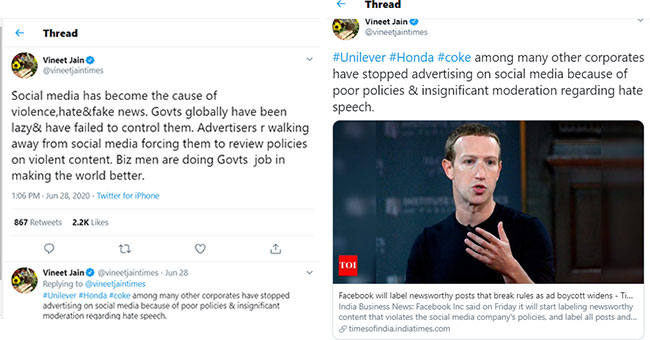
 The Times of India is doing a content series under ‘Unlocking Diaries’ that chronicles how different sectors are opening up post the lockdown.
 He’s moved from journalism to communications strategy, but writing and matters of national interest have always been dear to him. Ashraf Engineer, former journalist with Hindustan Times, Times of India, Mid-Day, Maharashtra Herald and also an author and currently Principal Consultant at Pitchfork Partners, has launched a digital platform for commentary, called Allindiansmatter.in, on issues that matter to India. It is a “home for conversations with and about the country,” he said.
 Added Engineer: “All Indians Matter is a citizen’s effort to engage – through commentary by a variety of writers on a wide range of issues – with everyone who cares about India, its Constitution, its liberal and secular values. It is a response to the political, social and economic situations we find ourselves in. Normally, it would be the domain of the news media, but it’s been found wanting in the past few years. As a result, many of the issues that should be highlighted are sidelined and the voices that should find a megaphone are muffled. Allindiansmatter.in is a simple, clutter-free website that shines the spotlight on the commentary, cutting out complex navigation, multiple sections and visual dazzle. The writing is what it’s all about, and that’s the way it’ll stay even if it evolves into something bigger.”


 It’s going viral. Each Q&A we hear is firing up the Whatsapp and mail circuit. People have been laughing, screaming out incorrigible reading a response… but there’s no denying that each question-and-answer is profound and funny. Presenting Das ka Dum with Dr Bhaskar Das. And do come back next week for another round of questions and answers.

 We launched this feature yesterday, and judging by the number of views it generated, we can say it’s a super-duper hit.