Tag: The Times of India

  • Ranjona Banerji: What the Whacky-dooky?!

    Ranjona Banerji

    By Ranjona Banerji


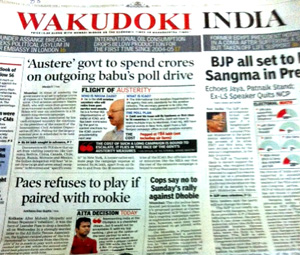
    I understand that advertising is vital to the well-being of a newspaper but just who invented these idiotic “half-jackets” which either split the front page of a newspaper or cover it with some meaningful and wholesome message about a bank or a soft drink?


    What I mean is, does one blame an advertising agency or the ad sales department of a newspaper?


    My problem however is not to do with the advertising message itself – although I was hard-pressed to understand today’s Wakudoki message on The Times of India masthead. Why this car company had to say Wakudoki to us, I don’t know. What Wakudoki is I don’t know. In some places Wakudoki was one word and in other places Wako-doki was hyphenated. Actually this made me happy in a schadenfruede kind of way – copy checkers in ad agencies are of the same calibre as sub-editors in newspapers.


    My primary objection is that they don’t allow you to fold the newspaper properly. This is particularly annoying as you reach the last pages of the paper as the half-jacket page with not enough hold flies off or falls off or slips out. This makes me want to shout something far more robust and potent that “Wakudoki” or even “Waku-doki”. Hyphen or not, the words I’m thinking of do not start with a ‘w’.


    Halfway through reading about Leander Paes’s current tantrum to compete with Mahesh Bhupathi’s original tantrum, I suddenly find the names have changed to Drogba and Rooney. These names are as mysterious to me as “Wakudoki” (and “Waku-doki”) and as I wonder if my coffee has some magic mushrooms in it, I realise that the last page of the newspaper has slipped off.


    I realise that The Times of India is not the only guilty newspaper here. Everyone does it. It’s just that I was whacked in the face today by this vastly annoying invention. It even beats the detergent bubbles and spouting soft drinks I had to deal with as a young sub-editor.


    In my view, I would rather the newspaper just sold its front page, self-respect and identity in one go rather than in half-measures. That way you can just turn the page, know that it will fold obediently and carry on with the latest Purno, Pranab, Nitish, Narendra fight.


    Instead of wanting to start the day by whacking whoever comes close because the newspaper begins with some cheapie corporate who only wants to pay for half a sheet of paper.


  • Stagnancy stages a comeback in IRS 2012Q1


    By A Correspondent


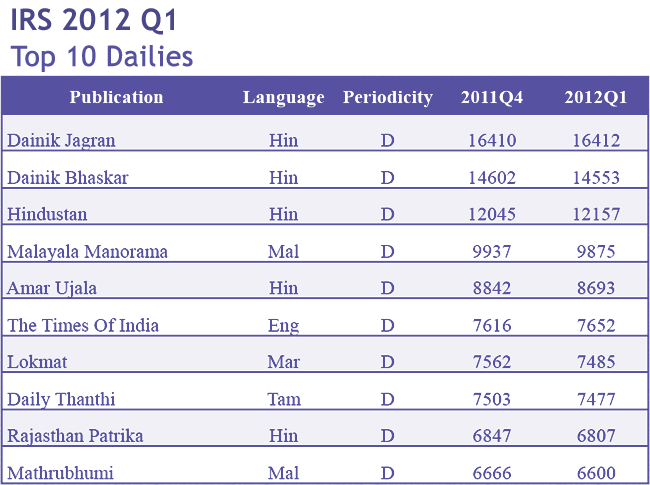
    The IRS 2012 Q1 readership results released by MRUC and Hansa has nothing new to tell but the obvious tale of the apparent rise in numbers of a few publications and the decline in readership of a majority of players. Going by the Average Issue Readership norm, in the Top 10 dailies there has been no change in the pecking order of the top performers but the readership of 7 out of 10 dailies has seen a marginal decline. Of the ten publications, five are Hindi in origin, two are in Malayalam, and one each in Tamil, English and Marathi.


    Emerging a frontrunner once again, Dainik Jagran manages to hold its forte showing slight readership growth with 16,412 in 2012Q1 as against 16,410 that it reported in 2011Q4. At No 2, Dainik Bhaskar has reported numbers totalling 14,553 a decline by 0.33 per cent from 2011Q4 figure of 14,602.Hindustansits comfortably at the third spot having reported a 1 per cent growth of 12,157 as against 12,045 reported in 2011Q4. Malayala Manorama is at the fourth spot with an AIR of 9,875 as against 9,937 in 2011Q4 – a drop of 0.6 per cent. Amar Ujala is next reporting an AIR of 8693 against an AIR of 8842 in 2011Q4 – a drop of 1.7 per cent. The Times of India English edition continues to see growth and comes in sixth with AIR of 7,652 as against 7,616 registered last quarter. Marathi daily Lokmat sees a marginal decline to end 2012Q1 at 7,485 compared to 2011Q4 AIR of 7,562. Tamil daily Daily Thanthi is next with AIR numbers of 7,477 as against 7,503 recorded in 2011Q4. Rajasthan Patrika with 6,807 and Mathrubhumi with 6,600 end the tally occupying the ninth and tenth spot respectively.


    Reacting to the overall trend, Dinesh Rathore, Vice President, MediaVest Worldwide said, “The study hasn’t thrown any new surprises. What is known is that the readership time spent on print is coming down these days, which is even lesser in case of magazines. Newspapers as a habit are not going to die soon but the time spent is surely on a decline. Also, if people were subscribing to more newspapers earlier, they are subscribing to one less now because of the options available on digital.”


    Highlighting her stance on the numbers, Anamika Mehta of Lodestar UM said: “What I infer is that the drop is very marginal. Print will continue to hold its ground in India. With literacy rates going up and the launch of several new products print will continue to drive growth in India . Also, what is seen is that there is a growth of consumption that is happening on the web and moreover, India is a very young country. Almost 60 per cent plus of the population are younger than 35 years. With these audiences the consumption is more on the web than on the physical newspaper. Also, we are seeing a lot of launches by players in the regional markets. So it’s not as bad as it seems.”


    Voicing a similar opinion as given by Mr Rathore, Priti Murthy, National Director – Insights, Maxus said, “I am not surprised by the overall trend that has been thrown up. Why do we read newspapers and magazines, for the sheer content that it provides and content is available faster in other mediums today – definitely digital and to a large extent even TV. I see this trend continuing in the next 3-4 years after which it will reach a saturation point. Also, how much ever tactical initiatives publications engage in to increase circulation, it clearly shows that readership is not going to increase. The time spent in reading newspapers and magazines will continue to see a decline. Also the new generation that is growing up may not grow up on a newspaper alone. They rely on mobile and other AV modes to receive their communication.”


    (AIR numbers; all figures in ‘000)


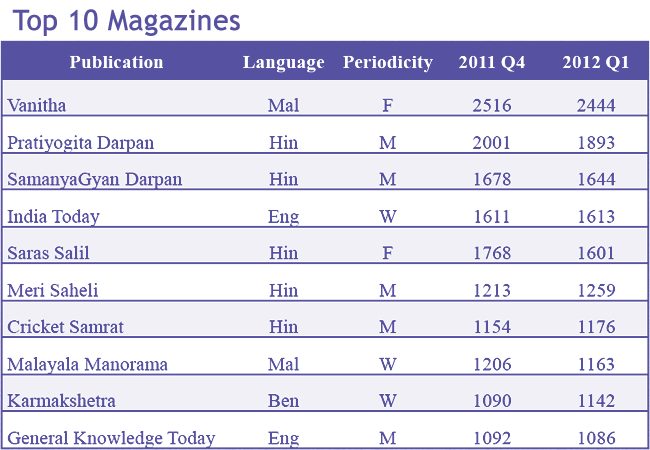
    The downfall story continues with magazines as well with leader Vanitha (Malayalam) reporting an AIR of 2,444 as against 2,516 in 2011Q4 – a decline by 3 per cent. Pratiyogita Darpan too sees a decline of 5.4 per cent having registered an AIR of 1,893 in 2012Q1 as against an AIR of 2001 in 2011Q4. SamanyaGyan Darpan sees a marginal decline with an AIR of 1,644 as against 1,678 reported last quarter. India Today is the topmost English magazine in this list and figures at the fourth spot with 1,613 as against an AIR of 1,611 reported last quarter. Saras Salil is next on the line-up and has reported a big drop of 9.5 per cent registering an AIR of 1601 as against an AIR of 1,768 reported in 2011Q4. Meri Saheli and Cricket Samrat have posted growth with an AIR of 1,259 and 1,176 respectively. Malayalam Manorama at 1,163 has seen a decline of 3.5 per cent while Bengali magazine Karmakshetra has seen a growth in its AIR at 1,142 as against 1,090 in 2011Q4. General Knowledge Today completes the list with an AIR of 1086.


    Throwing light on the trend spotted in magazines, Anamika Mehta said: “In the case of magazines, what we are seeing is that the time spent on magazines is going down but there are a lot of new and niche products being launched. A lot of international players too are coming into this market. So that should give it some scope for growth. But right now I think magazines are in a more worrying state than dailies in India but having said that I do not see the death of the medium coming here anytime soon.”


    (AIR numbers; all figures in ‘000)


  • Ranjona Banerji: Media double faults in Paes-Bhupathi match

    Ranjona Banerji

    By Ranjona Banerji


    After years of working with city reporters, I accepted the fact that many grappled to understand the concept of “presumption of innocence”: If the police made an accusation against someone, why then it had to be true. But, of course, every accused has the right to defence. And while reporting a story, journalists are supposed to be objective. If they cannot provide both sides of a dispute, they must explain to the reader why they have failed.


    But in the initial rounds of this rather unfortunate fight in Indian tennis, where Mahesh Bhupathi and Rohan Bopanna have refused to partner India’s top tennis player Leander Paes in the 2012 London Olympics, the media started out batting for Bhupathi alone. In what appears to be a well-thought-out campaign, the doubles pair of Bhupathi and Bopanna sent out a series of letters and emails signalling their refusal to play with Paes even before the All Indian Tennis Association decided on the Olympic team. Several newspapers and news channels did not even make a willy-nilly attempt to contact Paes.


    The exceptions are possibly DNA and Headlines Today, who got in touch with Paes’s father. But for the most part, it was about the terrible wrong that was about to be done to Bhupathi and Bopanna – being forced to play with Paes for the Olympics. Mail Today and The Times of India seemed like they had stakes in Bhupathi’s career.


    These pressure tactics appeared to have failed and the AITA decided to pair Bhupathi with Paes. This is where objectivity completely failed India’s sports journalists. Bhupathi came on air and was quoted in print making all kinds of allegations against Paes. The Times of India at last informed us that they could not contact Paes. Therefore, the story remained one-sided.


    Bhupathi and Bopanna meanwhile, perhaps emboldened by this out-and-out media support stated firmly that if either had to partner Paes, they were willing to forgo the Olympics. Despite the media’s usual pattern of extreme jingoism, even this display of lack of country love, did not deter the pro-Bhupathi-Bopanna journalists. One cannot state that sports journalists are less jingoistic than the rest – we see what they do to cricketers regularly. In fact I can guarantee that any top cricketer who refused to play for India because he did not like his team members would be hung, drawn and quartered by the media. By the way, cricket is not even an Olympic sport and technically, when Indian cricketers play, they represent the board. Not so for tennis, where professional players put aside career considerations to play Davis Cup and the Olympics.


    However, as the week of allegations by Bhupathi and Bopanna came to a close, the media slowly started to turn. Paes may have contributed to that by issuing a statement that he was willing to go by the AITA’s decision. The Indian Express and Mid-Day started to look at being fair to all concerned. The Hindustan Times later also presented a larger picture. The Times of India came to the party last – but more on its edit pages than its sports pages.


    Where a reader should have been given perspective on this battle and information to negotiate through this unseemly fight, he or she got a minefield of accusations from only one side. Now the villain of the piece is apparently the AITA as Bhupathi has approached the sports ministry to step in. Bhupathi has accused the selection committee of being a bunch of bureaucrats who know nothing about tennis. To me they appear to be former players – perhaps not of the stature of Bhupathi but tennis players nonetheless, a fact which needs to be pointed out in the media.


    Monday night saw Times Now’s Arnab Goswami ask Mahesh Bhupathi some tough questions – some of which he struggled to answer. This is the first time that Bhupathi’s accusations were questioned. Later, the fathers of Paes and Bhupathi were on Times Now, where Paes Senior pointed out that Bhupathi was not blameless in this battle, while Bhupathi Senior tried to shrug that off and say the Olympic riddle had to be solved not the mistakes made by the boys.


    Appalling as this ego battle between India’s top tennis players may be, the media’s partisan stand has been as appalling.


  • Ranjona Banerji: Is the media fickle, or just having fun

    Ranjona Banerji

    By Ranjona Banerji


    Television is, of course, very worried about the next President of India, but newspapers have given it the treatment it deserved – reporting on the news rather than trying to create it.


    Which means that Friday morning saw the straining of the ties between the UPA and Trinamool Congress get full play in the papers, although Mamata Banerjee’s mocking of the prime minister seems to have got a muted response.


    There has been a distinct movement to belittle Manmohan Singh and the media now appears to have been taken along for the ride. It seems a bit odd that rather take a non-partisan stand, the media has been party to this campaign. Or maybe it is not odd and I am not surprised.


    The downside for Team Anna is that Mamata Banerjee has stolen their limelight. Of particular interest is her declaration in today’s Times of India that she is a “simple man”. Indeed.


    * * *


    Mumbai’s newspapers have focused this week on the extraordinary behaviour of the Mumbai police, with its raids on bars and restaurants and treatment of customers. On Thursday, The Times of India, Mid-Day and Hindustan Times dedicated pages to the police’s highhanded methods and its reliance on archaic laws to harass people. Vasant Dhoble, the assistant commissioner of police who conducted most of the raids, was also targeted. Pritish Nandy has written an impassioned article on the destruction of civil liberties in Mumbai over the years in TOI.


    Some of this concerted media focus has prodded the minister of state for home to ask the police to exercise some restraint. There has also been some discussion to re-look at all these old and pointless laws.


    Friday’s Mid-Day has a story on how the protests against Dhoble and the police which started on cyber space are now entering real life as well. And, according to the paper the city’s “young leaders” like Milind Deora and Poonam Mahajan have also asked the police not to harass the innocent.


    * * *


    The unfortunate ego battle between Indian tennis stars Leander Paes and Mahesh Bhupathi has now got full media attention, especially as it affects India’s Olympic media chances. Here too, the media is divided between the two and as Bhupathi is better at building media relations, his case is being viewed with more sympathy. This is, in spite, of the fact that Bhupathi is the one putting up terms and conditions and refusing to play with Paes and also that Paes has bigger dibs on the Indian Olympic team because of his higher ranking.


    * * *


    The News Corp noose around British prime minister David Cameron gets closer and closer. Testifying in front of the Brian Leveson Inquiry into media ethics, Cameron tried to stand his ground that he had done no wrong but was hard-pressed to explain a text message from former News Corp CEP Rebekkah Brooks which said “we’re definitely in this together” just before the general election which the Conservative Party and Cameron won.


    The nexus between Britain’s political classes and the Murdoch organisation is no secret but its tentacles appear to have poisoned British polity, the establishment and the media itself.


    * * *


    Interesting to see after all the hoopla over former army chief VK Singh and all that bombastic media support, suddenly the media focus seems to have shifted to his detractors!


    Fickle or just having fun?


  • The Rise and Rise of Deepak Lamba

    By A Correspondent


    When MxMIndia broke the story of Deepak Lamba joining Bennett, Coleman and Company Limited as President, the news spread like wildfire (see link http://www.mxmindia.com/2012/06/first-on-mxm-deepak-lamba-joins-bccl-as-president/). As it spread amongst media circles, it was decidedly the most read story on MxMIndia over the weekend.


    Mr Lamba is one of the youngest professionals in Indian media to occupy the position of President of a large Indian media conglomerate like The Times of India group.


    Until end-April, Mr Lamba was with Bloomberg UTV as business head. He made a sudden exit with no indicator of his next port of call. Except that it was to be with a leading media corporation with diverse interests.


    Although Mr Lamba was not available for comment and nor was it officially announced at BCCL until Friday evening, MxMIndia learns that did join the company on June 1. There is no word on his portfolio except that he is likely to be heading a few new ventures that the group proposes to enter. MxMIndia also learns that the proposed venture may not be in television, the business he has been working with at Bloomberg UTV and MTV, though there may be some linkages.


    Mr Lamba’s rise and rise has been phenomenal and is in fact inspirational to those without any godfathers in the business and/or no Ivy League education. A student of Pune’s premier St Bishop’s School later the Wadia College, he did his MBA from the Pune University thereafter. He was business head of Bloomberg UTV from January 2010 to April 2012 and prior to that was Director – Viacom Brand Solutions and worked with MTV India for five years.


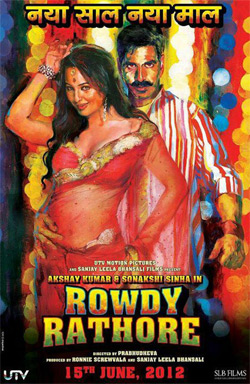
  • Reviewing the Reviews: Rowdy Rathore

    By Deepa Gahlot


    Producer: Ronnie Screwvala, Sanjay Leela Bhansali

    Director: Prabhudheva

    Music: Sajid-Wajid

    Cast: Akshay Kumar, Sonakshi Sinha, others


    These days, most critics have nothing against mainstream cinema. But Rowdy Rathore is the kind of film that has the mildest of then gnashing their teeth in frustration, because the success of such a bad and old-fashioned film is inevitable.


    The masses want mindless entertainment even today, they don’t care how loud, crass or silly the film is; does it give them their money’s worth?  For the non-massy types, such films are a kind of guilty pleasure.  What shocked most is that Sanjay Leela Bhansali is partly responsible for unleashing this on the public.


    Except for Taran Adarsh’s 4 and The Times of India’s now-standard 3 stars, everybody else tossed between 1 and 2. Writes Adarsh, with an eye firmly on the ticket windows of single screen cinemas. “On the whole, Rowdy Rathore, is designed to magnetize the masses in hordes. The accurate blend of action, emotions, drama and humor, besides a superlative performance by Akshay Kumar, makes this motion picture an immensely pleasurable and delightful movie watching experience. If you savour typical masaledaar fares, this one should be on your have-to-watch listing for certain. Dhamaal entertainer!”


    Srijana Mitra Das of the TOI gushes, “Indeed, Rowdy Rathore pays homage to iconic filmi characters – identical heroes, golden-hearted chors, brave Men in Brown beating evil people to pulp. However, it pays most homage to its own star, Akshay Kumar, who pulls off Shiva with style but Vikram less so, possibly because all that violence overwhelms acting itself. Not that the crowd seemed to mind. As Shiva exhorts a woman raped by Baapji’s son to beat him up, the girl next to me cried, “Why doesn’t she?” Her neighbour replied, “She will.” And she did – much to the crowd’s Rowdy delight.”


    Saibal Chatterjee of NDTV gave it 2 stars and commented, “Rowdy Rathore is a shrill action flick designed to help Akshay Kumar return to his hit-making ways. Accept that obvious intent and you might actually end up enjoying certain parts of the film against your own better counsel. Isn’t that the effect that many a Bollywood potboiler of the 1980s would have on us? Yes, Rowdy Rathore employs narrative elements that hark back to a bygone era of Bollywood potboilers: two men who look like each other without any apparent reason, a bunch of baddies that snarl and snap at the slightest provocation and indulge in rape and pillage with abandon, and the good old back-from-the-dead revenge seeker who goes back dispensing rough-and-ready justice.”


    Two stars from Raja Sen of rediff.com.”Inured to the kind of exploding-beedi violence promised by the trailer, the film instead starts stupid and stays silly. This is much more like an early Khiladi movie — where Kumar recklessly got away with anything, goofily stumbled towards the climax and then proceeded to kick bottom without mercy — than any of the recent films which have completely forsaken plot. As a result, it’s far less objectionable. Still moronically stupid and entirely pointless, but nowhere near as horrid as what the genre’s been reduced to in the last couple of years.”


    Shubhra Gupta goes with 2 stars as well, “We don’t have to be told that this is a remake of a Telugu film. It could have been in mainstream Tamil or Kannada. Because whether it is Priydarshan or Prabhudeva (who has directed this one), the film is bound to have South Indian actors trying to pass off as North Indian. Fictional towns which look as if they’ve been created on a set. Blinding colours. Songs at the drop of a hat. Dialogues which don’t go beyond a line. Or two. And a leading lady whose job description is, apart from possessing a swaying ‘kamariya’.. um, let me think about it.”


    Now come the one star rants. Anupama Chopra writes, “Don’t Angry Me! Akshay Kumar bellows this often in Rowdy Rathore. At one point, the command even plays out as background music. I think viewers need to co-opt the line. To all the directors, producers, actors who are inflicting eighties-style, low-IQ, deafeningly loud, unapologetically crass, mind-numbing movies on us, I just want to say: Don’t angry me! Don’t exhaust me! Don’t bludgeon me!”


    Rajeev Masand comments, “Rowdy Rathore is the kind of movie that’s made by people with a cash register in place of their brain. Because no legitimate reason, other than financial gain, can justify why this movie was made – it has no story or plot whatsoever, the characters are entirely forgettable, and it’s so long and loud and silly that the laughs dry up early on. That the film has such impressive pedigree – it’s produced by Sanjay Leela Bhansali, directed by Prabhudeva, and stars Akshay Kumar – is both baffling and shameful.”


  • Bandh a ‘partial success’, no effect on petrol prices

    Ranjona Banerji

    By Ranjona Banerji


    Tracking Thursday’s Bharat Bandh protesting against the petrol price hike on TV led to a bit of confusion – was it a success or not. As it turned out, the Opposition-led bandh was what is known as a “partial success” so if you’re a half-glass pessimist, that’s the same as a “partial failure”. For Mumbai, TV showed us a bus in Mulund being attacked by a man in a BJP T-shirt – who either did not have the good sense or was just to brazen to hide his face from the camera. But social networking sites seemed to suggest that people did go to work. The morning papers said 60 per cent turn out in private offices and slightly more in government offices (really!). The commercial loss, said The Times of India, was Rs1,000 crore while Mid-Day pegged it at a more conservative Rs300 crore. Of course maybe with current rupee-dollar rate, both figures mean the same thing?


    There is also the other question about the loss caused by damage to property by “bandh” enforcers which as every newspaper painstakingly informed us, we the people would have to pay for.


    Across the country, the bandh fared better in some parts than others and apparently had no effect in Kerala at all.


    Petrol prices, by the way, had not come down by Friday morning at least.


    * * *


    As the TV news day progressed however, the bandh was sidelined first by BJP veteran LK Advani who announced in his blog that the BJP had made too many bad decisions recently and used the party’s favourite word “introspection”. This kind of took the wind out of the BJP’s sails as the main “bandh” caller. Immediate speculation began about a rift in the party – something political commentators have long known about. http://blog.lkadvani.in/blog-in-english/bjp-a-hub-of-hope


    Arnab Goswami interviewed Ram Jethamalani who had said similar things in a letter to Nitin Gadkari and Jethamalani was a hoot as always, even as he lost his ear pieces for a while and Goswami watched precious air time and money dribbling away.


    Jethamalani told Goswami he was a clever man who was trying to get Jethmalani round to Goswami’s opinion. Goswami said he had no opinion.


    No comment from me either.


    * * *


    The other big bandh spoiler was the Indian economy and the fall in GDP growth to 5.3 per cent, the lowest in nine years. Our TV newswallahs who usually shy away from the economy – possibly because they know so little about it – were forced to sit up and take notice and so gave us some uninformed guff, interspersed with a lot of dramatic music and stuff.


    Since the economic recession in the West in 2008, international TV newswallahs have become experts at this economy stuff and our TV people could learn from them how to use jargon effectively and impressively. Or, they could hire some journalists with a background in business and the economy. This would be particularly useful for the Sensex channels.


    Amartya Sen on NDTV sort of turned the argument on its head by saying that this obsession with GDP was misplaced. He started talking about inclusive growth and stuff which usually makes business people and economists turn faint from boredom as they cannot understand what that means.


    * * *


    At prime time, Headlines Today was still worried about cricket and Rahul Kanwal was in “hot pursuit” of Gautam Gambhir. Arnab Goswami asked why we need such bandhs at all and then proceeded to have a quarrel with Ravi Shankar Prasad about the NDA’s petrol policies.


    Mohandas Pai formerly of Infosys came up with a novel solution to bandhs – he said all bandh-callers should sit around statues of Mahatma Gandhi and hold hunger strikes. BJP people looked bewildered having never heard of this man nor seen statues of him anywhere in India.


    * * *


    Chief Election Commissioner SY Quraishi in Thursday’s Indian Express said, “Serious thought needs to be given to the ‘paid news’ that is threatening to erode the value and pride of the press and is starting to shake the foundations of democracy. A voluntary code would be the effective answer”.


    He was speaking at the annual convocation of the Express Institute of Media Studies.


  • [MJR] Wanted: sponsors to cover the Olympics!

    Ranjona Banerji

    By Ranjona Banerji


    The biggest sporting event in the world (no, not the FIFA World Cup) is due to begin in a couple of months. So how many Indian newspapers are going to send someone to cover the Olympic Games in London? This is where Indian sportspersons are hoping to make a breakthrough after Abhinav Bindra won the first individual gold medal by an Indian in Beijing. The Indian hockey team did very well in the qualifiers, leading to expectations that they will shine again in a sport which has won us eight gold medals but no one in India really watches.


    So what’s the grouse? The reluctance of Indian newspaper managements to spend money on newsgathering. The Olympics are not just any old event. They represent an ideal – of human endeavour, of a global spirit and a desire to push back boundaries of achievements. Editorials will declaim with thundering authority about the significance of “citius, altius, fortius” but when it comes to actually reporting on the efforts to get there, everything depends on a “sponsor”.


    That is, a newspaper or journal will often only cover an event like this if the marketing department can get someone to cover its expenses. One can understand the reluctance in the days when foreign travel was prohibitive and foreign currency limited by the government (yes, I know it almost seems like we’re back in those times!) but in today’s world, depending on agency feed is nothing short of laziness and taking your reader for a ride.


    Yet strangely, in the olden days (that is, when I was young), the idea of “junkets” was anathema and people I know lost their jobs for accepting favours. Over the years, managements realised, “why pay for something when someone else can be convinced to do it”. This is why so many sports pages – like The Times of India’s for instance – are so full of “sponsored columns” that there is hardly any place left for actual news.

    One doesn’t know yet of course how many newspapers are going to go for the easy route to the Olympics, but one hears rumours…


    Meanwhile, the entire film journalism community appears to be in Cannes for the film festival, where given the quality of our cinema, almost nothing makes it even within shouting distance of a tin palm, let alone a golden one. But visits to Cannes are now de rigueur on the junket circuit, so no dip in the newspaper’s bank balance there. And credibility? Well, we stopped worrying about that a long time ago.


  • [MJR] Media has to protect freedom of expression and thought

    Ranjona Banerji

    By Ranjona Banerji


    The knee-jerk government response to the Ambedkar cartoon controversy – banning cartoons from text books – got a very strong response from Sunday’s newspapers. The need to protect freedom of speech, why cartoons frighten those in power, the personal attacks faced by cartoonists were covered by The Times of India, Indian Express and Hindustan Times in special features and detailed stories.


    Many also carried cartoons which have caused trouble in the past and tried to examine just why cartoons are seen as dangerous.


    Indian Express had a comprehensive interview with historian Mushir-ul-Hasan who has just written a book on Parsee Punch, a cartoon magazine brought out by Parsis in colonial India. The British in India at the time either had a good sense of humour or the good sense to realise that going after cartoons was hardly likely to end subversive thinking.


    The media has to come out and protect freedom of expression and thought – because in any battle against it, it will be the first casualty. The threat does not come just from those in power but also from pressure groups in civil society. Unfortunately in India, the first response by the government is to cave in to the demands of those whose “sentiments are hurt” rather than stand up for the Constitution.


    * * *


    After running through the IPL as the scourge of human civilisation, TV channels found something else to amuse themselves. Not, of course, the Indian economy, which seems perilously close to bad times ahead – there is after all little scope for a melodramatic studio-based jatra based on a falling rupee and rising inflation. Much better instead to concentrate on parties (not political ones, but the others where people gather to eat, drink and make merry and thus promote unconscionable evils), why the BCCI has insulted Kapil Dev by not giving him lots of money (and then providing the answer – because Dev hooked off to the rebel league ICL) and for all I know whether the sun will rise tomorrow or not.


    * * *


    It is always interesting to see journalists take the moral high ground when it comes to other people eating and drinking. Everyone knows that there are journalists who will do anything for a free meal and many attend press conferences only for the free drinks at the end. Even those who are not quite so greedy enjoy a drink or two at the end (or the middle) of a long and stressful working day. So why this moralistic posturing when it comes to others? Just to appeal to a puritanical audience or has alcohol dimmed their memories of their own excesses?


    In fine contrast, of course, the glamour sections of newspapers and glamour segments on news channels only serve to glorify the “having fun” lifestyle and employ almost no critical faculties at all.


    Just because the general public doesn’t know what you get up to in your spare time does not mean that you have to give in quite so much to hypocrisy.


    * * *


    Now that the Lokpal Bill has been put off till the next session, one can predict an all out publicity campaign by the Anna Hazare brigade – that’s easy. However, it is also possible to predict that while the movement may not fizzle out, the media coverage will.

  • Loss of plurality is worrying: Paranjoy Guha Thakurta

    Paranjoy Guha Thakurta

    By Paranjoy Guha Thakurta


    This sort of an acquisition is part of a growing trend of ‘corporatization’ of the media where big business houses such as the Aditya Birla Group and the Reliance Industries group are investing into existing media groups. Through this process of consolidation, they are also bailing out these groups.


    The Raghav Behl-led Network 18 and Ramoji Rao-led Eenadu are now part of one big conglomerate because Reliance Industries Ltd (RIL) has bailed out both by pumping in a huge amount of money. On paper, it appears as if they are still separate corporate entities, which they are, as per the laws of the land. But the kind of associations they have struck gives an impression that they are now going to work like a conglomerate. Now this is exactly what has happened in the case of Mr Aroon Pourie who heads the India Today group which is also going to be one major conglomerate. So what we are seeing, in that sense, is the ‘cartelization’ of the media. There are cartels being formed, there are oligopolies being formed.


    The recession in the west has led to shrinking of advertising expenditures for the media in India and across the world especially after 2008, and this has had a direct impact on the fortunes of media organizations. So this process of consolidation has got expedited. What this means is that the media in India is going to become less plural, it’s going to be dominated by relatively fewer groups. What you are really seeing is, large corporate groups exercising greater dominance on the media. Now there are two implications.


    Also read:

    AV Birla group buys 27.5% in India Today group


    Birla may use personal money for buy, Mail Today may now launch editions in Mumbai, other metros


    Why media purists needn’t worry about Kumar Mangalam Birla’s 27.5 % in Living Media

    One is, of course, you are finding telecom companies (Mr Aditya Birla also happens to be the head of Idea and Mr Mukesh Ambani’s RIL is a major player in the broadband wireless access space), which are providing you communications, are also now playing an important role in companies that produce content. So the content providers and content distributors are coming together. This, in my opinion, is going to result in a loss of heterogeneity, resulting in a loss of plurality. In a sense, the oligopolies that are going to be formed will also impact the listeners of content, the viewers of content, or the readers of content. The content they get will be less heterogeneous.


    The other part of the story is that these companies are also big advertisers. Therefore, the clout of the advertiser will go up. As I said, the telecom service providers are now becoming important stakeholders in companies that are producing content. So the distributors of content are becoming stakeholders in the producers of content. Similarly what you also see at another level, the companies which are big advertisers are also now becoming the owners of the media. So in my opinion, these trends towards ‘cartelization’, or the formation of these giant corporate conglomerates is not going to lead to greater plurality as far as the consumers of content are concerned.


    The numbers of TV channels and newspapers and websites often give you a very deceptive kind of a picture and the capital is a classic example of that.Delhiis the only city in the world with 16 English language daily newspapers. This gives you a misleading picture, that readers of English dailies inDelhihave a huge choice. But the fact of the matter is that two newspapers, The Times of India and Hindustan Times would account for well over three-fourths of the total market of all English daily newspapers. And if you add to that Economic Times, then these three publications put together would account for more than 80 per cent of the total circulation of all English newspapers in India. So, in terms of numbers it looks good, but if you look at the structure of the market, you see few dominant players.


    In India, unlike in other countries of the world, like US, UK or Australia, there are no cross-media restrictions. In other countries, there are both vertical as well as horizontal restrictions. Vertical restrictions mean that the content producer and the content distributor are different companies/groups. In India, the same guys who are producing content are also distributing the content. You have the DMK controlling the distribution channel and also producing the television channel; you have Zee News producing news and also controlling Dish TV. There are clear conflicts of interest that arise if your distributor and the provider are the same. That’s only one part of the story.


    The other is what is called horizontal cross media restrictions. That means, the same company dominates all forms of the media, like print, radio, TV, in the same geographical area. In our country we don’t have any legal restrictions on cross media holdings. As far as the media is concerned, the group concept or the conglomerate concept does not operate in our country. So you have Bennett Coleman Ltd which brings out various print publications, and then you have Times Global Broadcasting which brings out the television content. These two companies happen to be controlled by the same set of people. But because the legal restrictions that exist in India apply to individual entities and not to conglomerates, effectively you have no cross-media restriction.


    Speaking of editorial content, editors will not publish or broadcast anything that would go against the interest of the corporate that controls; these would become subtle forms of censorship and control. For instance, Living Media which includes, Aaj Tak, India Today, Headlines Today and Mail Today, these publications or these broadcasters are unlikely to publish anything negative that could affect the business interests of the Aditya Birla Group. So that could be an eminent danger, that degrees of freedom that editors and content providers would enjoy, would get curtailed not just because of the pattern of ownership but also because the owners of major conglomerates are also major advertisers.


    Even if on paper, the editors have the autonomy and independence to publish what they like, there could be subtle forms of censorship wherein editors would feel constrained or would think twice before publishing any story that could in any way go against the interest of the promoters of the company that control these media conglomerates.


    I am optimistic about the future of media in India but I am also concerned about the fact there is loss of heterogeneity, loss of choices to the consumer.


    (As told to Shruti Pushkarna)


    Paranjoy Guha Thakurta is a senior journalist, editor and broadcaster based in New Delhi.

     

  • [MJR] Holier than thou Hindu takes on the Times


    Ranjona Banerji

    By Ranjona Banerji


    The Hindu has published a massive “expose” on paid news in The Times of India. According to painstaking research done by veteran journalist P Sainath, the Nagpur edition in 2008 carried a special feature about how farmers in Vidarbha had benefited from using Bt cotton seeds. This went against all other evidence that it was the use of Bt cotton which had led to falling yield, depleting the land, increasing debt burden and consequently the large number of suicides in the region.


    The TOI team spoke to farmers who said they were making much more money than they thought and were very happy. The villagers spoken to said no one had committed suicide. The trip was sponsored by the manufacturers of the Bt cotton seed – Mahyco Monsanto Biotech. The newspaper added this as a disclaimer, maintaining however that the journalists had done their own research.


    According to Sainath, in 2011, the same feature was dredged up and re-printed, this time as an advertising feature – paid for by Mahyco Monsanto Biotech – and published in all editions of The Times of India except the Nagpur edition.


    Yet, the same villagers, when they spoke to a Parliamentary Standing Committee in March this year, Sainath points out, said that 14 people had committed suicide since Bt cotton had been introduced and that their financial plight was pitiable. The enormous amounts of money being made – as claimed in the TOI report – were untenable and were also contradicted by figures provided by Union agriculture minister Sharad Pawar.

    So what do we have here? A cynical manipulation of events to help a giant corporation out of a PR disaster? Or exploitation of journalists to further the commercial interests of the newspaper? Or complete contempt for the reader and disregard for the newspaper’s credibility?


    I would say the worst sin is number 3. The first two lead to the third. The fact that Bt cotton has aggravated rather than alleviated farmers’ problems ought to be a fact universally acknowledged. It is also well-known that Monsanto has an extremely aggressive public relations department. Further, the government has also pushed farmers to opt for Bt cotton and thereby helped Mahyco Monsanto Biotech.


    However, it has to be pointed out that The Times of India is not the only practitioner of paid news. This menace is prevalent through the media, both print and television. The ways in which it is done can be subtle or brazen – here TOI seems to have opted for the latter. It is also not clear if this deal with Monsanto was limited to the Nagpur marketing department which then shared it with headquarters or whether the entire editorial team was aware of what was going on.


    Either way, though, both the initial report and the use of that report as an ad are highly questionable. Cynicism on the part of journalists will only make life worse for them more than anyone else.


    There is one more question here as well. Holding the media up for scrutiny is necessary and important. But The Hindu’s tendency to take this holier than thou line is bound to boomerang at some time. It now has to keep its house cleaner than everyone else’s.


    The link to Sainath’s column in The Hindu: http://www.thehindu.com/opinion/columns/sainath/article3401466.ece?homepage=true#.T6tjbKDv3XQ.email


  • [MJR] Jingoist of the year award to Times Now

    By Ranjona Banerji


    For some reason best known only to Times Now, the channel decided to huff and puff over a Barack Obama campaign ad, which said that not only did Republican presidential candidate hopeful Mitt Romney outsource jobs to Mexico and China as a CEO, but as governor he also outsourced a task to a call centre in India.


    My god, the insult – Obama has spent, said Times Now, a million dollars to “trash India”. This news played over and over again on the channel all evening, even as it had to compete with the other “big story which we are tracking” – the release of Sukma district collector Alex Paul Menon by the Maoists (that’s another example of a TV extravaganza).


    On the Newshour last night, there was Goswami, filled with nationalistic pride, surrounded by Chidananda Rajghatta of The Times of India looking a bit embarrassed, Pramit Pal Chaudhuri of Hindustan Times looking smug and embarrassed, Mohandas Pai, once of Infosys, looking amused and not sure if he could tap sufficiently into his inner jingoist and a few other guests.


    Goswami launched full steam into his heartfelt anguish at this perfidy by Obama – when the facts said that Indian companies contributed millions of jobs and billions of dollars to the US economy (a few gazillions and who knows, India might solve all the US’s economic problems). But guest after guest pointed out that all this was election rhetoric and that anger with outsourcing was now normal campaign guff and that whoever won would do little to change US policy.


    Goswami, as he watched his argument crumble, smiled wryly and changed tack. He was not, he said, talking about the inner workings of the US election process. He was bothered about perception and stereotyping. Luckily he found one guest who weakly agreed, sorta kinda.


    After 15 minutes of sound and fury signifying nothing, and guaranteeing a good laugh for all viewers, the debate petered out as everyone just repeated the same thing. Goswami ended by asking why the Indian government could not spend some money to issue a counter ad. Indian pride, one can only hope, was restored amongst those viewers who spend their time picking up stones and weeds everywhere, hoping to find an insult to India and then demand reparation.


    On Friday morning, interestingly, only The Times of India was interested in this story.

    (An aside: the other fight for Indian pride was on the internet over Hollywood star Ashton Kutcher and some chips ad where he mimics an Indian. The Indians won because on the internet, power operates differently!)


    * * *


    Stewart by the way, took on the sex scandals in the US secret service, hardly guffaw-inducing stuff compared to Goswami.


    * * *


    Meanwhile, the collector: all day TV told us that the kidnapped by Maoists collector Alex Paul Menon was about to be released. We were treated to some pictures of some bush and scrub with very bad communication lines and no collector. Then in the evening an exhausted man appeared, only to be mobbed by eager reporters. This is one of the fault lines of modern journalism and you have to feel for both parties. The media needs the story and the collector needed some rest. He looked as he himself said, “shattered”.


    Since Zee had most of the pictures, everyone had to credit it. Headlines Today and NDTV, instead of showing the bush and scrub, showed us Menon’s father-in-law. The CNN-IBN website told us that the collector was freed hours before he appeared out of the wilderness.

    No explained whether that was inside information or a false start to the race.


    Jai Hind!