Tag: The Times of India

  • Ranjona Banerji: Why HT scores in Mumbai

    By Ranjona Banerji


    For Mumbai, The Times of India has to be the primary English newspaper. But seven years ago, a very serious challenge was mounted by the Hindustan Times and DNA. For at least five of those seven years, DNA was well ahead of Hindustan Times in circulation and readership and for a while, even had the Old Lady of Boribunder worried. But since then, Hindustan Times has overtaken DNA and left it behind as a third contender. The difference between the two papers is not much in terms of numbers – a few thousand copies, not hundred thousands – but it represents how much DNA has lost, its recent rise in IRS calculations notwithstanding. I’m not counting Mumbai Mirror in this race since it is not a standalone newspaper.


    So far it has seemed that DNA’s loss was HT’s gain – through no major effort of its own. But lately, HT’s efforts to make a niche for itself seem to be paying off. Unable to compete with the TOI for blanket coverage of city news – and severely hampered by the no-poaching pact between their managements – HT had specialised in packaging and focused campaigns. Now it seems to be taking a surer route – re-introducing the city to its readers.


    Monday’s newspaper has an excellent exploration of changing trends in the Girgaum area by senior journalist Smruti Koppikar. It’s good to see Ayaz Memon’s insightful and incisive column on “So Bo” (how I hate that phrase!) back in HT, shifted to Monday’s city pages from its earlier Sunday slot. HT Cafe is clearly trying to be less PR-driven than its competitors and ruffling a few feathers with its stories. And HT sports section – although this has little to do with Mumbai – is one of the better ones.


    That leaves HT’s edit page, which for my money is too skewed towards India’s TV stars and has far too little analysis or informed opinion – in my humble opinion!


    There are many ways for a newspaper to gain ground and many of those have to do with circulation, branding and management. But for editors, you have to grab the hearts and minds and HT Mumbai seems to be working that out for itself after seven years.


    **


    Mohd Junaid Ansari asks in what passes for the humour column on The Times of India’s edit page: “Aren’t we all a little bit in love with Hina Rabbani”. This takes off from the gossip that Pakistan foreign minister is involved in a love affair with the Pakistan president’s son and putative heir, Bilawal Bhutto Zardari.


    Attractive as Rabbani is, I would contend that only men and lesbians are likely to be in love with Rabanni. Even accounting for female foeticide, dowry deaths and accounting for same-sex selections, roughly half the human race might prefer to not to be in love with a woman. Some might even pick Bilawal over Rabani. We do count you know, even in a male-dominated world!


    **


    Arvind Kejriwal and Prashant Bhushan and other members of the new un-named political party and what’s left of India Against Corruption are bound to be disappointed with the media’s reaction to their allegations against Congress president Sonia Gandhi’s son-in-law Robert Vadra.


    Although TV has given the story playtime, newspapers have been tepid. The main reason is the allegations are unsubstantiated and it requires some work to find out just how the connections between Vadra and DLF work. It looks as if Kejriwal and friends just threw a pebble into the pond to see how many ripples it would create.


    Now instead of taking it further, the anti-corruption crusader and politician is encouraging people in Delhi to break the law.


    Ranjona Banerji is a senior journalist and commentator based in Mumbai. She is also Contributing Editor, MxMIndia


  • Ranjona Banerji: Economy on the front seat

    By Ranjona Banerji


    After months of political turmoil taking centre stage, the economy is back to dominating headlines. Ever since government went ahead with raising diesel prices and allowing foreign investment in multi-brand retail, we’re back to reading about various economic proposals, which are either going to change our lives or at any rate postpone complete devastation.


    This means that the usual political high rollers will have to be off the headlines for a bit unless they can stage some new theatrics. Mamata Banerjee may be the first to feel the pinch. In a story which talked about Banerjee wanting to make sure she is not consigned to oblivion, the Times of India chose not to use the TMC’s beloved leader’s photograph and went instead with US ambassador to India, Nancy Powell. Irony? Self-fulfilling prophecy? One can predict though that Banerjee is likely to see more of that happening.


    **


    The Economic Times, in somewhat unfortunate phrasing, headlines the next possible tranche of economic reforms, “PMO’s bucket list”. We understand that the prime minister is going to turn 80 this week but to link reforms to his dying wishes seems as yet a bit premature. Or does the newspaper refer to the prime minister’s office alone, an entity much hated by the residents of twitter?


    **


    The Times of India’s Mumbai edition has for a while now taken on Maharashtra’s deputy chief minister Ajit Pawar of the NCP, for his role in the irrigation scam that has been uncovered in the state. Pawar (nephew) when he was irrigation minister had apparently involved himself in practically every single deal and where subsequently, costs escalated. Another NCP minister Sunil Tatkare is already under the scanner for his tenure as irrigation minister.


    **


    The Indian Express has once more outlined for us the frivolous reasons used by police investigators to detain people under tough laws like the Unlawful Activities (Prevention) Act. These include children’s magazines and books of poetry – especially if they are written in Urdu. The Maharashtra police have the dubious distinction of considering ownership of Joseph Stalin’s biography a dangerous crime. This is in a country where Adolf Hitler’s Mein Kampf never gets off best-seller lists.


    Perhaps we need a more sustained campaign for better education of the police as well as greater use of forensic science in investigations.


    **


    On television, Rajdeep Sardesai on CNNIBN discussed with Arun Shourie why the diesel price hike was necessary and why FDI in multi-brand retail was not the end of the world. Karan Thapar on the Last Word also on CNNIBN discussed freedom of speech in the context of the contentious film on Islam and the needlessly violent protests against it. Arnab Goswami on Times Now took on the killings of sarpanches in Jammu and Kashmir, presumably by miltants. Goswami is very fond of the idea of Kashmir and works very hard to solve its problems – more than any other journalist in the country. One suspects however his rather black and white approach may not help in what is a very complicated situation.


    **


    If you want to look for TV news viewing from the main news channels that is minus the hysteria of prime time, the afternoons often pay dividends. Shiv Aroor of Headlines Today and Bhupendra Chaubey of CNNIBN both conduct well-behaved discussions – as was evident on the day Mamata Banerjee pulled the plug on her national role in Indian politics.


    **


    I apologise for the delay in posting this link from pointer.org. It discusses why “patchwriting” which is what both Fareed Zakaria and Samar Harlarnkar can be accused of, id as dishonest as plagiarism. Adds more depth to the argument but not more malice. http://www.poynter.org/latest-news/everyday-ethics/188789/patchwriting-is-more-common-than-plagiarism-just-as-dishonest/


  • Ranjona Banerji: The shame of the PR influence on the media

    By Ranjona Banerji


    It is interesting indeed to see that newspapers have chosen to report on the Maharashtra government’s decision to ban the sale of Mahyco’s Bt cotton seeds in the state but has not gone very far beyond that. In another story on Friday morning, a Parliamentary panel has sought a probe into the current stand-off over the introduction of Bt brinjal in to India.


    Criticism of Bt cotton in the media started off by being as expected but soon buckled under the tremendous pressure brought upon it by Mahyco Monsanto Biotech. Earlier in this column we have discussed the “expose” on The Times of India done by P Sainath in the Hindu. The marketing department of the TOI used articles done after a Mahyco Monsanto junket to promote the company, years after they were originally written.


    Although there have long been allegations that the forced or over-encouraged use of genetically-engineered cotton seeds have been detrimental to farmers as yields have fallen and land has to be fallow for too long. The initial success of Bt cotton, coupled with the promises made, led to high expectations from farmers and a corresponding high debt burden. This in turn led to most of the suicides by farmers is what most activists and social workers have alleged.


    While many such stories appeared initially, the enormous pressure brought upon the media by the company and by the government saw the stories petering out. Monsanto, the American company and Mahyco, the government venture, both employed very persuasive PR to push their case. The Sainath column in Hindu, in fact, went through all the mistakes and misrepresentations in the Times of India Bt cotton junket, point by point. A Parliamentary committee which went to the same areas of Maharashtra a few months later found an area rife with debt and suicides – sometimes quoting the same people who claimed to be happy in the TOI report.


    In Friday’s papers, TOI has a single column story while Hindustan Times has a more detailed report.


    The shame of the PR influence on the media is not just about glamour or lifestyle stuff, although that is rampant and in some cases institutionalised. But when it comes to corporate pressure, especially from aggressive companies who are willing to use the law and every other avenue to protect themselves from criticism, the media comes up against a formidable opponent. In the case of Monsanto and Mahyco, having initially put up a fight, most of the media seems to have capitulated. Friday’s stories have been carried only because the Maharashtra government has finally accepted that the shift to genetically modified cotton has not been the universal success initially claimed.


    Time perhaps for the media to find its teeth again?


  • @INMA: Thriving in a digital world

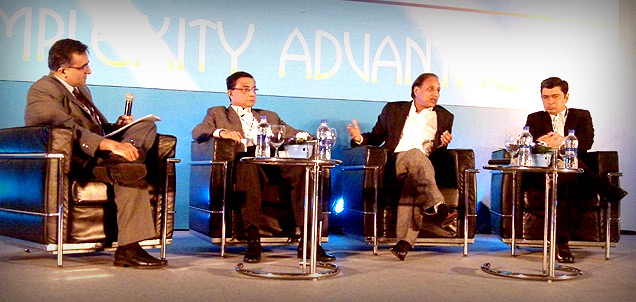
    L to R: Jehil Thakkar (KPMG), DD Purkayastha (ABP), Ravi Dhariwal (BCCL, INMA) and Santosh Desai (Future Brands)


    By A Correspondent


    The second day of the International Newspapers Marketers Association (INMA) South Asia 2012 conference in Delhi threw light on the complexities and challenges of the print newspaper media. The first session of the day was ‘Media 2020: A future backward kaleidoscope’. The session focussed on how the newspaper industry is readying itself to face the challenge from digital media usage.


    Mr Jehil Thakkar, Partner, Head-Media & Entertainment, KPMG India made some interesting observations about the levers that are changing the Indian newspaper industry. He pointed out how empirical studies prove that there exists a positive relationship between the wealth of a nation and newspaper readership: “There also exists positive correlation between growth of economies and technology adoption, which has significant potential to disrupt media consumption.”


    “The rapid proliferation of new-age devices and growth of alternate media has reduced newspaper consumption by 40 per cent with audiences preferring to access paper via their mobile phones,” added Mr Thakkar. According to him, technology would alter the workings of newspaper industry as coverage would become electronic, delivery would become faster; collaboration would become the key; cloud-based service would become a norm; interactivity through QR and barcodes would see an upsurge.


    DD Purkayastha
    If you are having trouble in viewing this video, see link

    Talking of how things will shape up in 2020, DD Purkayastha, MD & CEO, ABP Pvt Ltd said that the future belongs to newspapers who become hyperlocal as cities reach the saturation point. He said: “Regional publications will grow. And consolidation will happen at a much faster pace.”


    Mr Ravi Dhariwal, President, INMA Worldwide and CEO, The Times of India, noted how newspaper of 2020 will undergo a dramatic change. He noted: “Three critical things will emerge in 2020: what brand you own will become important as there will be many more brands on the digital media; curation of the product will become more important as the role of a journalist will shrink and need for analytical news pieces will arise; and business model will change as ad revenue will become a critical source of revenue. As technology improves, and people get more comfortable with using technology, the ad rates would only increase.”


    Mr Santosh Desai, MD & CEO, Future Brands India, remarked: “The larger issue that would emerge would be the tension between decentralisation of news media and fragmentation.” The panel, however, coherently agreed that despite the changes and challenges that the newspaper would undergo, it would still exist with the digital media.


    The session on ‘Increased circulation; dwindling readership: Is it time to measure ‘access’?’ saw panellists discuss the much-debated measurement metrics available. ‘Newspaper distribution channel: How best to nurture it for the future’ and threw light on the vendors and agents who distribute the newspapers. Moderating the session, Mr Sanjeev Vohra, Executive Vice-President – Audiences, BCCL, said: “The vendor currently exists as an independent businessman and as an investor in newspaper business.” His view was supported by Mr PS Venkat, Vice-President, Circulation, The Hindu, who said that changes are needed in distribution model to enable the vendors to become partners in progress.


    Mateen Khan
    If you are having trouble in viewing this video, see link

    Mr Mateen Khan, Product Head of Lokmat Samachar pointed out how the distribution channel in rural areas is still a problem, while it may not seem so in a metro. Taking the discussion ahead, Mr Rakesh Sharma, CEO, Aaj Samaj & ITV Group said: “There should be distribution points every three kilometres, and more distribution points.” He, however, noted that the vendors will remain the key to distribute newspapers in India beyond 2020. Mr OP Rajgharia, Chairman & MD, Overnite Express Ltd appreciated the effort put in by newspaper vendors to ensure the timeliness of delivery.


    ‘Needed to be sector-neutral’


    If you are having trouble in viewing this video, see link


    Bhaskar Das, President & Principal Secretary to MD, The Times of India Group, talks to MxMIndia on curating the INMA South Asia 2012 conference

    When I was talking to the organisers, and was given the task of preparing the content architecture of INMA, I told them very clearly that it is not about newspaper industry -it is about business. So, we have to be sector-neutral since principles of business are same. Newspaper is a sub-set of business. This was the first consideration.


    Secondly, in my case, the delegates were my guiding point. Why should people attend the conference? Are we going to be just another conference? How do I make it distinctive?


    The distinctiveness of the conference is that it creates fluid knowledge; knowledge that one can import when they go back. So, I had to ensure that they learn from each session. That led to the subject. In most of the conferences, people state the obvious. I thought why we don’t address the fact that there are complexities, there are challenges. Being an incumbent player, I realised that if we talk about problems, it is not solved. We should then talk about how we can leverage that problem or challenge. This led me to look for various industries. I scouted the internet, books, academic journals, about what happens when an industry goes through huge challenges, air pockets. There are initial signs of a problem, which I came to know of while researching, such as ‘butterfly effect’ that led to complexity science. This became the theme. The theme has to be intriguing to people rather than being a newspaper conference. The theme was then decided as ‘complexity advantage’. Now that complexity is a given, why not leverage it.


    On the audience mix:

    This time it has been a record attendance. I am not very happy but you to also have to market it that way. If one can maintain this level of content architecture, attendance will grow. For an event that happens once a year, I will have to sustain noise throughout the year. The community needs to talk about it, so that you can have user-generated content architecture next time. Then, there are regional peculiarities that may not be only one; there are eastern and western peculiarities.


    We also have to be industry- or sector-neutral in our audience mix. Why should they be from newspaper industry? Why not from television industry or from client side to discuss business? When people know what you are delivering, I am sure diversity will happen in the audience.


    The session was followed by speakers from Pakistan and Bangladesh who spoke on ‘Managing complexity in South-Asian markets – A Pakistan and Bangladesh Experience.’ The session saw interesting insights about newspaper industry in the two neighbouring countries.


    Industries across the globe are increasingly learning from other industries to improve their operating efficiencies and innovation capabilities across various spectrum of businesses. ‘Media learning from other industries’ saw three specialists from sectors such as retail, telecom and finance discuss the wisdom that newspaper industry could imbibe, given the onslaught of digital media. The panel discussed how the evolution could gain from the exploration of the new path.


    Mr Jaideep Ghosh, Partner, Management Consulting, KPMG pointed out that print media continues to remain the second largest medium in the Indian media and entertainment industry. He also pointed out the key challenges of talent, operational cost, monetizing digital media and fragmentation that the industry faces currently. He said: “Media can leverage data analytics to strengthen the understanding of its customers and build brand loyalty, much like the way telecom, retail and finance sector have done.”


    Drawing from the e-retail experience, Mr Rajiv Prakash, ex-CEO, FutureBazaar.com, said, “The audience is increasingly turning Clomosol, which is an aggregation of Cloud+Mobile+Social+Local. Thus, the digital consumer is a channel omnivore, and should be serviced at every touch-point.”


    Mr Jairam Sridharan, Head, Retail Banking, Axis Bank said that the newspaper organisations should focus on getting their product on mobile, rather than internet as, “the consumer is leapfrogging the internet and becoming increasingly mobile-savvy.”


    The closing session of the two-day INMA conference saw Prof Rishikesha T Krishnan., Chairperson, Corporate Strategy and Policy Area, IIM Bangalore talking about sustainable and thriving media business model that can successfully withstand the vicissitudes of business environment.


    He said, “The internet tends to dampen bargaining power of newspaper channels by providing direct avenues of access to customers. But the other hand, it will help the industry to create new substitutes, and new geographical markets will emerge.” He further noted, “The internet has and would result in targeted advertisements, disappearing role of editor as decision maker; fall in advertising revenues and young people moving away from printed newspaper.” The key decision variables, according to him, were how to embrace internet, and change strategy. Giving the example of Schibsted, Norway, he said that the paper now brings readers to its webpage through the front page and even Google was denied the permission to crawl its pages. “This helped them to monetise the banner ad on its front page,” Mr Krishnan said, adding, “Huffington Post has enaged in user-generated content, and its ad revenues are growing. Axel Springer/Bild has extended its brand to other media.”


    As Indian newspaper industry struggles with low cover price, growth of paid news, entry of non-traditional players, investment to establish presence in non-metros, the panel at INMA South Asia conference tried to address issues as closely as possible. Whether the industry would learn, and implement the learning remains to be seen.


  • Our battle is to out-think TOI: Meenal Baghel


    Meenal Baghel is the founder and Editor-in-Chief of Mirror, the nation’s most sprightly newspaper. Mumbai Mirror was launched seven years ago, and today the paper has editions in Pune, Bangalore and Ahmedabad. A part of the Times group, Mumbai Mirror boasts of a fantastic circulation of nearly 600,000 copies, and it’s become the city’s favourite compact paper.


    Meenal relives the journey with us, and speaks candidly about the many challenges she’s faced along the way. We also discuss her first book, ‘Death in Mumbai’, which received wide critical acclaim.


    I did a stint with Mumbai Mirror some years ago, and this gave me a chance to watch her in action. Meenal can be a demanding editor, she can be impatient, she can be tough. While these qualities don’t endear her to some, they have played a huge part in her success. I have to say she’s the most passionate editor I have worked with.


    By Anil Thakraney


    It’s been seven years editing Mirror. How’s the journey been? Tell me the highs and the lows.

    The high obviously has been to see the paper become an important part of Bombay. We have been successful in forging an emotional connect with the readers, which is very important. We get an enormous number of people calling in with stories. And we’ve routinely broken a lot of stories, so those are the big highs. The low is that the paper is still a bit inconsistent. You know, when we started the paper, it used to be called Mumbai Error. I wish we had a cleaner start in terms of the paper being more finished. But it’s been a sort of work in progress. We have learnt a number of journalistic lessons along the way because the market has changed, the reader has changed. For instance, when we were at Mid-Day, you could get away with a lot of things. But in this day and age, you can’t.


    Give me an example

    Like sometimes when, just to break the monotony, you put an entertainment story on the front page, there is a backlash. People now expect a more serious newspaper, it’s something different from what I had envisaged. But that’s also because there’s so much of entertainment everywhere that people don’t want more of it.


    One story you regret

    We ran the FIR of the TISS girl who was raped. That was a mistake. Because the details in the FIR were very graphic on what had transpired. And you realize that you may have ended up titillating. I regret that story, we got terrible feedback for it and we apologized for it.
     

    “I don’t think journalism offers enough challenges to the really bright people any longer.”

    I still see a number of typos in Mirror. Is this an un-lickable problem?

    I think there is a very real problem with journalism today, and it’s not only limited to Mirror. The problem is that the deskies is a disappearing breed. And it’s going to be a big challenge over the next few years. Also, there are very real problems we are facing, and these are going to change the profession drastically. It’s so rare to find people who want to come into journalism because they want to be journalists. For example, when you ask people, ‘Who edited this copy?’. Invariably the response will be: ‘I looked at it/I glanced at it/I skimmed through it.’ Another thing is I don’t think journalism offers enough challenges to the really bright people any longer. There is an attrition problem across aboard. People want to try out various things. When you and I were growing up, it was about sticking to a profession, a career path, and that no longer holds true. People now have the advantage of taking breaks, taking gap years, studying, etc. The journalism hours don’t allow too much of a personal life. And I think HR, owners, publishers, editors need to take all these things into account.


    Is the passion for journalism diminishing in young India?

    I think the important thing now is personal growth and personal life. That has taken precedence over wanting to change the country.


    What was Vineet Jain’s brief to you when you signed up for Mirror?

    His brief was very clear. He said it should be a smart paper and that it should be different from the Times of India. And because it’s a compact size, there are elements of a tabloid that you can incorporate. In fact, when we started the paper, there were a lot of conflicting opinions, so I was a little tentative in the beginning. And then one day he called me and asked why was I so tentative. He said, “I have given you this brief, just stick to it. And don’t be apologetic about it.” So that was wonderful.


    You think this country is ready for a Brit style tabloid?

    No. Though it’s very interesting because everybody is trying to incorporate the tabloid elements, but you can’t be openly unabashed about it. We are not ready for it. For instance, look at the responses Dr Vatsa’s column gets.


    Guess it’s a tightrope walk. You want to be tabloidy, and still have to be aware the nation isn’t ready

    Yes. Sometimes in the newsroom we think we can do a story, but when we see the backlash the next day, we start being more careful by censoring ourselves.


    And the problem is if you play safe and cut down on controversy, you get dangerously close to the TOI

    Yes. So what we try and do is this: I always say our competition is the Times of India. Because we go with the TOI. Now the TOI has massive width, they do like sixty stories at an average. So our battle is to out-think the TOI, in the sense that ‘this is what they will do, so let’s do something different’. We can get away with some naughty things that they can’t.


    Lots of court cases?

    Actually they’ve come down, ever since we’ve become safer. (Smiles.) But there’s also a lot of frivolous litigation, which is easily dealt with.


    More editions in the offing?

    At the moment, no.


    And for Mumbai Mirror, are you still as hands-on as ever?

    See, I am out for lunch with you! (Laughs) But yes, I like being hands-on. There are times when I can breathe down people’s necks. But I am trying to back off a little now that we have a very competent senior team. I also realize that people should be given more space, but it’s difficult. (Laughs.)

     

    “The TOI has lots of products that come with it, but everyone doesn’t necessarily read all of them, right?”

    Meenal, the perception is that Mirror benefits a lot from being the TOI’s free paper. Without that advantage, your circulation would be nowhere close.

    I am lucky and I won’t question my luck. We have a great readership, thanks to the TOI. But then you have to capitalize on that luck, you still have to deliver a good product. The TOI has lots of products that come with it, but everyone doesn’t necessarily read all of them, right?


    If you were a standalone paper, how much circulation do you think you’d lose?

    I guess we’d retain 60%. Because Mirror has become a genuine commuter’s paper. You have to travel in the train to see how many people carry it. It started off as a guilty pleasure, which people didn’t want to acknowledge they were reading, but they were all reading. But over time it has also become a lively paper. And that can’t be said about too many other papers in town. And people like that.


    Would you say Mid-Day was your training ground?

    Absolutely. I had always worked with broadsheets before that – Pioneer, Asian Age and The Indian Express. So when I joined Mid-Day, for a while it was like, where the hell have I landed? This is not how journalism is done. For the first six months I had no idea what I was doing. But I was in a senior job and I was getting paid an X amount, and I must tell you I HATE giving up. And then one day I went for a walk and said to myself the paper won’t change because of me, there was a reason why this paper was so beloved in Bombay. And that was the Eureka moment for me. I decided to try and understand it rather than look down upon it. And that changed things. I must say I learnt a lot from Aakar Patel (the then editor of Mid-Day). I learnt a lot from what the paper did on Page 1 and on headlining.


    One Indian print editor you most admire.

    I owe everything I learnt in journalism to MJ Akbar. About writing, about making pages, about what not to do, etc.


    It’s been seven years at Mirror. Don’t you feel the itch? Isn’t it tiring to do the same thing day in and day out?

    I keep wondering why nobody else offers me a job! I am joking, of course. Which is why doing the book was wonderful for me. It gave me a chance to step back and follow a story that had been fascinating me. And it was extended journalism. I have always felt when the number of days you feel bad about what you do exceeds the number of days you feel good, you should quit. I haven’t reached there. And there’s always something exciting happening.


    Being a hard-edged journalist, how do you reconcile with something like Medianet?

    That’s easy, because we don’t have Medianet in Mirror.


    But it’s there in your group.

    It doesn’t affect my life, so I don’t care about it.


    You aren’t asked to carry plugs?

    No. And it’s one of the things that has pleasantly surprised me. They have maintained the Chinese wall from the start.


    They have left you alone?

    Yes. And there’s another reason. Mirror is a small paper in the group, so it’s not necessarily the focus. We are a small cog in comparison.


    Have you ever been asked to drop a story?

    (Pauses) Not drop a story. I think what one learns over a period of time is that you have to pick your battles. I’ll give you an example: If there’s an entertainment story which is coming right ahead of the Filmfare awards, where somebody is going to be performing, and I have a damaging story on that person, would I delay it by a few days? Yes, I would.


    There used to be intense rivalry between the Independent and the TOI. Is it the same with you?

    Not rivalry, but there is great competition. When the TOI does something, and we’ve missed it, I give my reporters hell. And I am sure JoJo (Jaideep Bose) does the same when we get something.


    “Mid-Day killed itself. And I feel really bad. I feel bad that what was such a robust paper is no longer that.”

    You’ve pretty much killed Mid-Day. Feels good?

    The paper killed itself. And I feel really bad. I feel bad that what was such a robust paper is no longer that. We all worked very hard out there. We worked our asses off at Mid-Day and we used to take great pride in the paper being so robust, that it was second only to the TOI.


    What would you do if you were editing Mid-Day today?

    I’ll bring in more energy. What’s going for Mirror despite the inconsistency is that it’s never dull. And dullness in journalism is a cardinal error. Especially if you are a tabloid.


    Let’s shift to your book, ‘Death in Mumbai’. Does Meenal think Maria Susairaj got away lightly?

    I must tell you I ended up liking her quite a bit. I feel that she is a manipulative woman and that she may be a tease. But that’s not a crime, there are a lot of women like that out there. Did she kill or abet the killing? I don’t think so. She was in love with Emile Jerome, she really wanted to marry him. But he wasn’t committing to her. When he killed this guy, it was, in her mind, like his commitment to her.


    When you started writing, was there something you had decided you won’t do in the book?

    The only thing I told myself is to not be judgmental. Because someone else’s idea of morality could be different from mine. Like, I started out with a certain view of Maria but it became something else.


    In fact, that was the only criticism I read about the book. As a journalist, readers expected you give us your own view. Perhaps as the epilogue.

    There were genuine difficulties. Something happened in a room where there were only three people. One guy is dead and two are in jail. There is only so much information I had. And I genuinely did not want to play judge.


    You have always kept a very low profile. Marketing the book must have been tough.

    (Laughs.) It was! It was terrible. The only time you would see me on television was on things that were related to the book. Otherwise I wouldn’t be caught dead going on TV.


    Any more books coming up?

    I would like to write more books, but I love this job too much. Ideally I’d like to do both. But I haven’t thought of another subject so far. Might be interesting to write fiction.


    Would you like to edit the TOI?

    No. I think it would be fun to edit a broadsheet, but I don’t think I am ready to edit the Times. It’s the biggest paper in the country, it requires a greater understanding of business, politics… and I don’t think I am ready for it. Also, it requires certain people skills which I perhaps don’t have.


    Don’t rate yourself high on people skills?

    I think I am very good. But I need to be more patient. I can be impatient and that’s a serious shortcoming.


    You are 43. Don’t want to marry?

    It’s too late now (Laughs).


    Is it important to be single to edit a high pressure daily? Is it a price one pays?

    Sure. It’s a price a lot of women, more than men, have to pay for any high pressure job. It’s unfortunate, but it’s a fact. I may have been married, but it would have been very difficult with children.


    Photographs: Fotocorp

     

  • Ranjona Banerji: TV news viewing can be injurious to the lower jaw

    By Ranjona Banerji


    Since president-elect Pranab Mukherjee spoke to almost everyone on Tuesday, it was hard to see why news channels rushed to qualify their interviews as “first” or “better” or whatever. Exclusive, in TV parlance, is apparently when you do the same thing as everyone else, except five minutes before.


    Anyway, Mukherjee did not say very much about anything he was going to do as President although he talked about his childhood and his early political career. The silliest question I reckon came from Sagorika Ghose of CNN-IBN who asked whether Mukherjee’s ascension to Rashtrapati Bhavan was a “return of Bengal to the mainstream”. At this point my jaw dropped so low that it fell off and I was so busy retrieving it that I couldn’t pay attention to the rest of the interview.


    The best I could get from Arnab Goswami’s interview with Mukherjee on Times Now was that first Mukherjee walked round his garden 40 times, then 33 times and now 30 times and he did not know how many times he was going to walk around the Mughal Gardens. He said he heard the gardens were very large. Anyway, as President he will have ample time to work out stuff like that. Or if he asks someone they might tell him how big the Mughal Gardens are.


    * * *


    Sunday was all about the presidential election as well as everyone gave us live coverage. Of course, after some time they ran out of things to say because there was very little to say about a presidential election in India, at least not enough that can last a whole day even given TV’s marvellous propensity for waffling on about nothing. The highlight of the day was losing candidate PA Sangma’s losing speech. He started by congratulating Mukherjee and then went into a whine about how the Congress had used bribery, extortion and threats to ensure Mukherjee’s victory and how the North East and betrayed not just him but all tribals and themselves as well. (They didn’t vote for him.) Sangma’s entire campaign was based on pettiness, so nothing surprising here. What was surprising was Navika Kumar of Times Now stating emphatically that this was the best, most gracious and most sportsmanlike speech she has ever heard from a loser. Her guests Krishna Prasad of Outlook and commentator NN Satchidanand tried to point out otherwise, but she would have none of it. Jaw-retrieval is a common affliction for those who watch too much TV news, as I should know by now.


    * * *


    Rupert Murdoch has stepped down from several boards which control News Corp’s titles in the US, UK and India. The pressure to do so apparently came from investors, after the phone-hacking scandal led to the closing of The News of the World and all the arrests of News Corp staff, current and former. Murdoch’s rise saw a lot of bile but in his fall are some abject lessons for media bosses and for those journalists who decide that principles are nothing when faced with corporate pressure to perform in a particular manner or to do anything to get results. The Nuremberg trials ought to be required reading for young aspiring journalists: the fact that you got an order is not defence enough.


    * * *


    I was appalled yesterday and continue to be appalled today about Monday’s front page anchor in The Times of India about a group of Indian athletes that went to the 1936 Berlin Games under a saffron flag singing Vande Mataram and impressed Adolf Hitler enough to give the group a medal. The story behaved as if getting a medal from the 20th century’s most frightening dictator was a great honour. There was not a squeak in the story about Nazism and what the organiser of the group thought of that. The glorification of Nazism in India is restricted to those influenced by the religious nationalism that comes of out of Nagpur. The story, therefore, should have mentioned or questioned the RSS connections of the group. Saffron flags and Vande Mataram were clear giveaways but why not come out openly and say so? And for a journalist – and a newspaper – to ignore the Nazi angle to such a story is criminal.


    * * *


    Vikram Doctor’s article in The Economic Times on food and the Olympics was extremely readable and well-researched. Try it: http://blogs.economictimes.indiatimes.com/onmyplate/entry/thanks-to-french-humour-here-s-best-of-british-food


  • ‘If you’re not ready for digital, your company is’: Media Rhythm 4


    By A Correspondent


    Stratagem Media Pvt. Ltd, an independent media services company, held its fourth training program called ‘ReveNEW Concepts – The Media Rhythm series and Ideas’ on July 21 in Mumbai. The workshop saw participants from The Times of India, The Hindu, Malayala Manorama, Eenadu, Amar Ujala, MY FM and other media companies.


    Among the speakers were Mr Sundeep Nagpal, Founder Director at Stratagem Media Pvt. Ltd; Mr Suresh Balakrishna, CEO, Brand Programming Network; Mr Bharat Kapadia, Chairman, Whatuwant Solutions and Mr Madan Sanglikar, a digital media expert and CEO, AD2C.


    About bending backwards with ease:

    Mr Nagpal, the first speaker of the day, delved on ‘Bending back with ease’ wherein he asked the participants to first know what they are selling. He said that instead of selling many things at one time, there has to be some clarity and certainty of what is being sold and only then the expectations of the clients can be met. Mr Nagpal also spoke about the importance of reminding the consumers about the brand even after awareness is created: “A consumer needs to see the ad frequently. Time and again we have been able to convince clients that in a crowded market, playing one advertisement is not enough. Therefore a reminder is very important.”


    He also said that even though there is awareness, reminder and high impact, the brand may not sell as the problem could be because the competition is making more noise. “At times when everything is good, there is no recall because competition is making more noise. Response measurement is very tricky and must be done in a scientific way. Low response could be because of the lack of good features, price and distribution issues,” he said.


    Mr Nagpal also pointed out that it is very important to know the client’s business or product: “If you are managing client expectations, you must also know the client’s needs. When you do consultative selling, you can reduce the discount selling.”


    He also spoke about the two ways a brand can grow. First, get new consumers and second get the same old consumers to consume the brand more frequently. Some other ‘home truths’ Mr Nagpal shared were: remove discount, adopt differential and value based pricing.


    He said it is important to know the competition as is important to calculate, permute and innovate and that you can always refuse a business instead of selling lower than what you deserve.


    Customising media usage for brand communication:

    Mr Suresh Balakrishna kick-started his session by playing a one minute trailer of the film ‘Rocket Singh, Salesman of the Year’ as an example of how one should and can sell his brand to the consumer. He spoke about going beyond media objectives and looking at communication objectives, quickly pointing out that the media objective is only a channel; the client however wants a communication objective. “You need to create a connect between communication objective and media solution. It is important to understand the communication objective of the client, his needs and aspirations as well. You must, therefore, involve your clients and listen more to what your client wants.”


    Mr Balakrishan presented three case studies – Union Bank of India, Vodafone, and Cadbury Dairy Milk Shubh Arambh. He split the participants in different groups and asked them to do various exercises on the case studies presented. He gave the participants various challenges and asked them to come up with solutions to those challenges: how they would have connected with the consumers; how they would have amplified a particular campaign in the media or solved a certain problem in a different way.


    On Motivation and Innovision:

    Mr Bharat Kapadia spoke about the importance of motivation in an individual and the need for ‘innovision’- a combination of innovation and vision. “Everyone cannot have wrong card, what is important is how you play your cards. Unless ‘You’ believe that nothing is impossible, nobody will be able to help you out. Whenever you are given a tough task, don’t see it as impossible, but instead attempt it to raise the bar for yourself.”


    On the need for innovation, Mr Kapadia stated that even innovation needs to have a vision. He said that one needs to innovate, to not only stay ahead of the competition, but also to create a new experience or even to solve a problem which at first looked quite challenging.


    Mr Kapadia shared four crucial points for innovation: Uniqueness, Impact, Achieving the goal and Sustainability. He was quick to state that ideas and creations are nobody’s monopoly as each one is capable of generating ideas. Therefore, one needs to start thinking without any baggage.


    He also stressed that an idea needs nurturing, which could be achieved with the help of family, friends and colleagues. He asked the participants to mentor the ideas of their juniors, so that they would come up with better ideas. But he was also quick to stress that the real test lies in the execution of the idea. One must always think of the end objective of their idea, and the hurdles they might have to cross.


    Mr Kapadia also warned the participants about the dangers of an idea: “Be careful that your idea is not gimmicky and irrelevant, the idea must fit into the objective of the brand. A good idea becomes a great idea if it is implemented well.”


    He also told the participants not to be afraid of mistakes and failures, but to learn from them. Mr Kapadia shared his experience about how he managed to successfully execute the Bru Coffee aroma campaign on The Hindu and the challenges he have to overcome to execute the campaign successfully.


    Mr Kapadia also gave participants some practical or exercise work during his session. He asked them to come up with an innovation for any media vehicle for any brand, whether existing one or a fictitious one. He asked them to exploit the strength of that medium. The teams were split into five groups.


    While concluding his session, Mr Kapadia reiterated that an idea is no one’s monopoly. It must however be relevant, feasible and beneficial to the client. He concluded: “There is no dearth of money in the market because it is all about a good idea. If you come up with a good idea, then the client will also shell out the money required for that idea. A good idea can even bring new advertisers.”


    Teleporting to 2015:

    Mr Madan Sanglikar shared nine concepts on digital, emphasising the growth of digital and the implication of that growth to other medium and the brands. He spoke about the future of print, television, gaming, mobile, social media, e-commerce, data visualization and eco-system transition, pointing out the need to think digital, that innovations are also happening on digital, and the fact that digital media is the fastest growing medium in the country.


    He said that the growth of digital will see more advertising categories increasing their spends on digital. He also said that digital will reduce the urban- rural gap. On the future of print media: “Print will be the biggest beneficial from the digital growth among the media categories. Dailies and magazines will get a new lease of life and static and AV (Audio Visual) formats of content and ads will co-exist.”


    On the future of television, Mr Sanglikar said that television experience will get better, a lot of which will be gesture controlled. Online video format will merge with television; it will create an explosion of online and on-demand videos.


    Talking about the gaming market, he stated that it is expected to grow to Rs3,100 crore by 2015 and there is a shift of gaming from bedroom to living room, wherein it becomes a family entertainment medium.


    Mr Sanglikar gave the example of a bakery in London who used Twitter to attract customers to his bakery as an example of how social media can be used for enhancing the business. He said that very soon there will be no emails as corporate social network will see huge growth.


    On the e-commerce front, Mr Sanglikar stated: “E-commerce market is also growing tremendously. Online shopping is getting more interactive with more pay options available and newer shopping categories soon catching up.”


    Mr Sanglikar also explained the difference between paid media, owned media and earned media and how today we are witnessing owned media and earned media share growing. He concluded: “Digital is like another medium and not imbibing the medium will not work. If you are not thinking about digital, your companies are certainly thinking about it.”


    What the participants say:

    At the sidelines of Media Rhythm 4, MxMIndia spoke to some of the participants for their views on the daylong event. According to Mr Subin Thomas from MY FM: “It was very interesting and fun too. Mr Suresh Balakrishna’s session was especially very good. There has been lot of learning, especially about innovation and communication objective.


    Ms Zeenat from Eenadu said: “The workshop was definitely helpful for us as it helps us with new ideas. After being in the industry for a long time, you tend to get a rigid mindset but, when we attend such forums where so many different issues are discussed, it refreshes our thoughts and allows us to think differently. The session on digital will probably help us in our work in digital.”


    A Times of India participant said: “It was a good way of looking at certain things and even on media selling. All in all it was a good and interactive sessions. There have been some good learning and takeaways too. I would also be taking some of the takeaways from these sessions to my clients.”


    Mr Soham Khimani from Malayala Manorama said: “The sessions were really wonderful and the speakers too were good. There was lot of creativity in the session which is very important in media sales today.”


  • Paritosh Joshi: _____________ Maketh A Man

    By Paritosh Joshi


    Surely, you are wondering why I chose to leave that first word blank when everyone knows the word that completes the aphorism?


    A Methuselah of our Media & Communications business came by a few years ago, when I was still gainfully employed and not a lily of the field, to talk about the media and their place in our lives. The conversation made an impression on me, abiding enough that I am compelled to develop it in today’s essay.


    Let me rewind to my early memories circa 1968.Kanpurhad no local English newspaper. The Times of India would ship theDelhi‘Dak’ Edition to our mofussil outpost. By the time the (now only of distant memory) Toofan Mail with her imposing steam locomotive growled intoKanpurstation with the precious newspaper, it would already be a day late. The news wasn’t yet stale, mind. After all, the only other source of news and current affairs we had, was the nightly bulletin on All India Radio delivered in the richly textured baritones of Jasdev Singh, Ashok Bajpai and their ilk. I must add that the scratchy Short Wave signals that our prized Murphy radio managed to extract from the ether made listening challenging at the best of times. Barring the most momentous of events and emergencies, the world beyond the nearest 10 kilometers was at least two days away. And it didn’t matter. Life, as we led it then, had little or nothing to do with the world beyond.


    Fast forward to 1977, nearly a whole decade later. We lived inNasikjust 175 kilometers fromBombay. Yes, in those days it was stillBombay.  Here was a city that offered not just one but TWO local (also local language) newspapers, Gavkari and Deshdoot. Times ofIndia,Bombay’s Dak edition would reach us the same day except it probably carried the previous day’s stories. There was still no television inNasik, so we still were served only by the stale newspaper and the highly expurgated radio. Not a lot had changed. Our lives continued to be led in the isolation and serenity of small townIndiaand, quite frankly, we didn’t think we were missing anything.


    Things began to change with the move toBombayin 1980. Suddenly, a television arrived at home. Black & White it may have been and only for a few hours of low fidelity transmission every day. And featuring exciting content such as missing people’s reports and Krishi Darshan, the farmers’ show, only occasionally spiced up with Chitrahar and Chhayageet. From consuming less than an hour’s worth of assorted media (perhaps half an hour each of radio and newspaper), our days now had at least another hour dedicated to TV.


    Television continued to grow. Print began to proliferate, not just in the form of a growing range of magazines, but also as a daily in the form of the afternoon or evening tabloid. Soon there was a Mid-Day fan and an Afternoon aficionado; an India Today enthusiast and a Week loyalist; a Stardust addict and a Filmfare feeder. Between all the diversity now available to them, many consumers were spending several hours a day just consuming all the options they were fond of.


    Cut to 2012. From perhaps 2 or 3 hours of exposure to various media a day, the modern urban Indian probably spends 4 or more hours a day consuming or in some way interacting with one medium or another. And it is no longer just urbanIndiaeither. DTH is available all over the country and a subscriber in the most remote hamlet has to just train its little antenna toward the sky to receive the latest content from around the world, a lot of it for free, in full digital video and Dolby Stereophonic Audio.


    People are defining themselves by the mix of content they consume.


    Can there be a segmentation approach that is based on shared commonalities AND uniquenesses in the way people consume the media?


    Which is why I left that heading blank.


    It really ought to read:


    Media maketh the man!


    Paritosh Joshi was until recently CEO, Star CJ. He has been a marketer, a mediaperson and a key officebearer on industry bodies. He is Strategic Advisor, Ormax Media. He can reached via his Twitter handle @paritoshZero


  • The Best of Print Ads – 2011


    By A Correspondent


    You may have seen only a few of them and probably even forgotten the underlying message that the campaigns had to tell. But now you could make a dash to have a hard copy of MOSAIC, a compilation of the Best in Print (campaigns) to have hit India n shores in 2011. The compilation has been put together by 23 creative agencies who have submitted their best pieces of work for the category in 2011. Conceptualised by Sanjeev Kotnala and team from the Dainik Bhaskar Group, the initiative has been made special through the “insights” and “personal favourite” sections that have been provided by Media agency bosses. These include Lynn de Souza of Lintas Media Group, Mallikarjun CR, CEO, Starcom MediaVest Group, PM Balakrishna, Chief Operating Ofiicer, Allied Media and Punitha Arumugam, Director – Agency Business, Google India.


    Lynn de Souza, Chairman and CEO, Lintas Media Group, Chairman, Aaren Initiative and Director, Karishma Initiative

    “An excellent idea to recreate interest and remind all about the power and impact of the print medium. My only reservation is that there were too many submissions of ‘pretty pictures-pithy headlines’ work that may or may not have been published and did not appear to fully grasp how the medium must be used effectively.”


    TOP 5 Choices:


    Click on the picture for larger view

    1) DNA – ISKCON (Scarecrow India)

    Reasons for choosing: The intelligent use of the cigarette-turned-food visual immediately targets the smoker and invites him/her to contribute in a very simple way to a cause that benefits both beneficiary and the giver – something not easy to achieve. I like the simple, clean look of the ad and the directness of the headline and copy.


    Click on the picture for larger view

    2) Flying machine “What an Ass” (Lowe)

    Reasons for choosing: This is my idea of perfect ad! One that has used all the elements of the print medium – headline, visual, copy to present a bold, modern attitude through a perfectly harmonised contribution of all three. It’s an unmissable ad whether you are a guy or a gal.


    Click on the picture for larger view

    3) Parker – Ramnath Goenka Excellence in Journalism Awards (Lowe)

    Reasons for choosing: A stark headline supported by the simple bottle of ink that says it all. An attention grabbing reminder of the power of the pen to influence the world. Perfect synergy for the subject – Journalism awards and the ‘always memorable’ image of a gold Parker fountain pen.


    Click on the picture for larger view

    4) The Times of India – A day in the Life of India (Taproot India)

    Reasons for choosing: Fantastic art direction – great visual appeal that hooks you into reading the whole ad. The contemporary feel, using India n kitsch, with attention to detail, is riveting. (Check out the dog lifting his leg to pee on the bed of nails!) Bright, colourful, crowded yet not messy. I could read it again and again!


    Click on the picture for larger view

    5) Vaseline ‘Dear Mr. Vaughan’ (BBH India)

    Reasons for choosing: The kind of ad that every Creative Director who woke up to it that morning would have said: “I wish I had written this”. There are some things you can do impactfully in a topical yet ‘permanent’ medium like print that you can’t do anywhere else, and this ad fits the bill. Nose-thumbingly outstanding!


    Mallikarjun CR, CEO, Starcom MediaVest Group

    “This is a fantastic initiative. As media agency professionals, our lenses to view the world are different. However, what comes across is that great creative work is universal. Really enjoyed it.”


    TOP 5 Choices:


    Click on the picture for larger view

    1) Audi – World Cup (Creativeland Asia)

    Reasons for choosing: Great connect with the Champion’s Trophy ’85 win. Most of the target audience that can buy an Audi will connect immediately with that moment. For a lot of us India ns, that was the first moment of connect with Audi.


    Click on the picture for larger view

    2) DNA ISKCON Food Relief Foundation (Scarecrow)

    Reasons for choosing: A nice calculus linking smoking to food relief. Very innovative, eye catching visuals.


    Click on the picture for larger view

    3) Indigo Campaign (Weiden+Kennedy)

    Reasons for choosing: Stark, consistent visuals. The colours, space everything reflects the qualities of the airlines. Nice word play that grabs your attention and makes you read the copy. The reference to price is as value and not cheap.


    Click on the picture for larger view

    4) Nissan Micra (TBWA\ India)

    Reasons for choosing: Simple stark visuals. Driving home the relevance of a small car without talking price, affordability etc. Great, understated use of a celebrity.


    Click on the picture for larger view

    Reasons for choosing: Great expedient use of Michael Vaughan’s comment. Superb cut through and great visuals.


    PM Balakrishna, Chief Operating Ofiicer, Allied Media

    “I think this is a wonderful initiative and exposes the fantastic creativity. It is a very different platform as it is more an appreciation of great work rather than a competition as I believe each creative is great on its own.”


    TOP 5 Choices:


    Click on the picture for larger view

    1) Bajaj Fans (Leo Burnett)

    Reasons for choosing: The best part of this creative is the way it has integrated everyday common issues and weaved them into the core communication of the product. The creative is also very well crafted visually using the very cause of the product making it very effective.


    Click on the picture for larger view

    2) Birla Cellulose (Salt Brand Solutions)

    Reasons for choosing: The sheer aesthetic treatment to the communication draws you and I like the beautiful and colourful way the creative has used nature and the human body (woman). It brings out the environmental friendly nature of the product in a very soft and appealing manner.


    Click on the picture for larger view

    3)Fuji(Grey)

    Reasons for choosing: Colour and background are intrinsic material for any great creative and nothing better than drawing inspiration from Mother Nature and wildlife. The beautiful use of the animals brings the message home effectively and creatively and connects with any photographer or photo enthusiast.


    Click on the picture for larger view

    4)NipponPaints (JWT)

    Reasons for choosing: They say a great picture is worth a thousand words and the effect is breathtaking when it is beautifully woven into the message making the communication very compelling and effective. In this case the product USP, a central factor in the category has been brought home very beautifully for correct impact.


    Click on the picture for larger view

    5) Zee 24 Taas (Draftfcb Ulka)

    Reasons for choosing: Ganpati Bappa has a significant connect with the India n diaspora and especially with Maharashtrians who revere the elephant God. I like the way the creative has beautifully engaged the viewers in an innovative and personal manner and makes it unique and different.


    Punitha Arumugam, Director – Agency Business, Google India


    “This initiative continues the long tradition of Dainik Bhaskar – breaking boundaries and setting new trends in the industry.”


    TOP 5 Choices:


    Click on the picture for larger view

    1) DNA Mumbai Marathon (Scarecrow)

    Reasons for choosing: The power of long copy. It brings back memories of the old era, which was marked by a great headline and the power of long copy. It inspires and bonds with its audience.


    Click on the picture for larger view

    2) Murphy Richards epilators (Contract)

    Reasons for choosing: The power of a picture. The visual intrigues, makes you pause, demonstrates the benefit and brings a smile – all this without a single word.


    Click on the picture for larger view

    3) MTR Spicy Pickle (Ogilvy)

    Reasons for choosing: The power of insight. A true South India n like me will see this ad and can only say “How true!” Equating spicy with ‘tears’, the way the ad captures the cultural nuances – awesome!


    Click on the picture for larger view

    4) Parker – Ramnath Goenka Excellence in Journalism Awards (Lowe)

    Reasons for choosing: The power of words. While most entries used the power of the picture, this ad stands out because it uses print for what it does best – leverage the power of words and intriguing headlines.


    Click on the picture for larger view

    5) Saffola Healthy Heart (McCann)

    Reasons for choosing: The power of an innovation. A great collaboration between the creative agency, the brand team, the media agency and the publication to convey the brand message interestingly and inclusively so as to trigger an action from the reader.

    Best of Print in Dainik Bhaskar Group’s MOSAIC
     

    Some may see India’s performance of bagging just four Press Lions at Cannes out of the 30 that were shortlisted as a drab effort, but then there are some who would like to think of it as being otherwise. After all, Press Lions as a category managed to get India its largest tally of four metals versus any other category at the awards – a valiant effort considering that India finished 2012 with just 14 metals in its kitty.


    While the category may have received its fair share of fame at the pinnacle of creative awards, many would agree that Indian adland has failed to laud the finesse that stems out from Print creatives over the years. While such is not the case in some large international markets where creative works across categories gets noticed and rewarded that gesture seems to be missing when it comes to India. Luckily for the creative frat in India, an opportunity to showcase their best works – besides the awards shows – were given a fillip by the Dainik Bhaskar Group that released the first of its kind creative compilation of the finest works produced in Print in the form of MOSAIC 2011.


    Elaborating on the initiative, Sanjeev Kotnala, VP & National Head, Dainik Bhaskar Group said, “This has been a first year for MOSAIC, which is a rich collection of 150 creative units part of 77 campaigns that have been submitted by 23 agencies.” The creative showcase has been made special through some individual comments and insights that have been posted by creative leaders of individual agencies.


    Elaborating on the thought process behind the compilation, Mr Kotnala said: “As a group, we believe that the Indian creative across mediums and media is of international standards, in its thinking, relevance and in its execution. Unfortunately there has been no single reference point for the same. MOSAIC bridges this gap and we would want it to be referred by the creative, clients, media and trade.”


    As for the method that was adopted in getting the agencies to submit their campaigns, Mr Kotnala said that it began with Dainik Bhaskar requesting the creative heads at the agency to send their best Print work. “They know better than us – as by placing it in MOSAIC affirms it to be their best work. Though we did have constraints on the number of campaigns we could place in Mosaic from a single agency. This has all been a by-invitation. On the other side, there were few agencies that sent lesser number of creative units as they felt others were not up to the standard to feature in such a compilation. So it was created and evaluated by the creative teams themselves.”


    On how print has evolved over the years as a medium, Mr Kotnala said: “Today print ads are working on all fronts of communication. They are not just for the purpose of awareness building or as a source of providing tactical information; they engage and involve the readers and are very result-oriented in their approach. We always held that the idea is more important than the medium. And it will automatically find its right medium for better efficiencies and effectively delivery of the message.”


    In fact, the compilation has been made special with the involvement of four media agency heads who’ve provided their assessment of the campaigns. They include Lynn De Souza, Chairman and CEO, Lintas Media Group, Chairman, Aaaren Inititative and Director, Karshma Initiative; Mallikarjun CR, CEO, Starcom Mediavest Group; PM Balkrishna, Chief Operating Officer, Allied Media and Punitha Arumugam, Director- Agency Business, Google India.


    With the first edition already finding appreciation within the industry, the Dainik Bhaskar group have their task cut out for the next year too. On his plans for a sequel, Mr Kotnala said, “We would want to see more regional and language work in the collection – and they still should meet the standards set. We would and could try getting clients and media owners also picking their favourites and definitely may wish to incorporate a section on media innovations. Though we have taken the task and brought out the book, in our mind it is an industry level initiative and we would want to keep it that way.”


    Mosaic 2011 can be accessed and downloaded at http://i10.dainikbhaskar.com /dainikbhaskar2010/books/ Final_Book.PDF


  • Ranjona Banerji: Media forgets more than it remembers

    Ranjona Banerji

    By Ranjona Banerji


    Most Indian newspapers stayed up late to bring readers the results of the Euro semi-final between Germany and Italy. The Times of India also managed to check up the Wimbledon scores and had a front page snippet on Rafael Nadal’s shocker of a second round exit. This is unusual because TOI usually does much less for tennis than other newspapers.


    (But CNN tennis reporter, I have a question for you: Is Rafael Nadal’s second round exit bigger than Pete Sampras’s fourth round exit in 2001, since you said that Nadal’s upset was the biggest in tennis history and no one could remember another? Nadal has two Wimbledon titles, Sampras at the time had seven Wimbledon titles – a record he holds with William Renshaw – and would never win another. The man Sampras lost to: Roger Federer. It was only 11 years ago, a little history is not a bad thing for a sports reporter. Or even, a good memory!)


    * * *


    The Houston Chronicle has fired a reporter for working as an exotic dancer (sometimes known as stripper) as a second job. The woman was exposed by a rival publication. Snitching on your competitors is a trend in Western journalism which is yet to reach India and one wonders whether that is not a good thing. The Guardian’s exposes of phone-hacking and other dubious practices by rival newspapers, especially those owned by Rupert Murdoch, perhaps fall in the realm of both public service and dogged investigative journalism. (The Hindu comes the closest in India, as it occasionally pulls up lesser media houses for journalistic and marketing transgressions.) But “investigating” fellow journalists of media houses and their personal lives to inform readers? Am not sure what category of journalism this falls into.


    * * *


    A minor storm in Indian journalism has been over the death of a photographer who worked with Tehelka, was sent into the hinterland to do a story on Naxals, got malaria there and died. The newspaper is at fault for apparently not factoring malaria into the threat element of this assignment.


    Newspapers in India are notorious for not being bothered about the dangers of newsgathering – mainly because most newspapers have dispensed with most kinds of dangerous reporting. (I could I suppose say the same thing about TV, in that they hardly started.) Gone are the days when even gossip columnists – like Devyani Chaubal being slapped by Dharmendra – faced physical dangers while working. I am being facetious I know but bullet-proof vests are hardly part of a reporter’s must-haves in India. There should be no room for callousness. But I am still unconvinced what Tehelka could have done about a mosquito. If they did not help the photographer or his family later, then there is cause for criticism.


    Still, it would not hurt media houses to take a closer look at employee welfare (this does not mean a box of mithai at Diwali) and on-the-job dangers.


    * * *

    Interesting that the anniversary of the Emergency came and went with little media attention. Are we moving on or did we just, like, forget?


    * * *


    The case of Abu Jundal or Jindal or Zaby or whatever his name is – the Lashkar handler of the 26/11 attacks sent to India by Saudi Arabia – is exciting but it is still in its early stages. Rather than focus their hysterics only on Pakistan, the Indian television media might like to look at it as a story first and probe all angles rather than jump into jingoistic propaganda.


    * * *


    The Indian media – particularly TV – got itself into a bit of a bind over Pakistan’s flip-flop over the release of Sarabjit Singh. Sarabjit is a celebrity prisoner whose family has ceaselessly campaigned for his release. Pakistan announced Sarabjit’s name and then changed it the next day to Surjeet Singh. Now the dilemma: should the media show happiness for Surjeet, rage against the machine for Sarabjit, damn Pakistan or blame Pakistan? Is one Indian equal to another or are famous Indians more equal? It is not known how hard Surjeet Singh’s family worked the media to get him released, so perhaps there’s an answer. Also Surjeet Singh walked across the Wagah border and claimed he was a RAW agent, a tag Sarabjit and his family have consistently denied!


    * * *


    Congratulations to Mid-Day on its 33rd anniversary and a whopping anniversary issue of 200 pages which I haven’t had the time to read yet. Might take me all week!.


  • Ranjona Banerji: TV does right by Baby Mahi!

    Ranjona Banerji

    By Ranjona Banerji


    Let’s cut TV news a little flak. What! Did I really just say that? The story of “baby Mahi” who fell into an abandoned borewell on her birthday last week but could not be rescued for almost five days is a made-for-TV story. Most newspapers would have reduced the story to a brief, if they carried it at all. Human life or in this unfortunate case death means very little in Indian newspapers unless it concerns high net worth individuals or happens in large numbers. Here also the concern is relative: for a Mumbai newspaper a bus that falls into a ravine and kills 50 of a marriage party in Bihar means less than an accident on the Mumbai-Pune expressway which kills 15. Geography and proximity carry more weight than the idea of death itself.


    TV news, however, challenges these assumptions made by the print media. While some may find TV’s attention to baby Mahi excessive or indeed point out that people fall into wells all the time, they are missing the point. Newspapers belong to the old, fatalistic India, where you took everything in your stride because life taught you that horrible things happen to everyone and especially to poor people. TV belongs to New India and as we learn every night, India always wants to know.


    And some questions, we must admit, need to be answered. There is no reason why people should regularly die because they accidentally fall into wells. There is no reason why we should not insist that safety protocols be put in place to prevent such accidents. There is no reason why local officials are not pulled up for being callous.


    Even if the hyperbole and hysteria generated by TV reporters and anchors can be vastly annoying, it does not mean that the reason they are having fits is not genuine. It took every bit of fortitude I could muster at midnight to listen to Arnab Goswami’s impassioned outburst against apathy and indifference (Wimbledon means I cannot get to TV news before midnight, yes I have no life and thank god I don’t watch football!) but behind all the bluster – there was a point.


    The trick for TV now is not to let this baby Mahi case turn into a real-life version of Peepli Live. They have to continue with the campaign they have begun so that they do not become as cynical as print journalists. It may be a tall order, but they started it.


    * * *


    I greatly admire Pakistanis who appear on Indian TV news discussions about terrorism. It takes great courage to withstand all that solid evidence against them and continue selling their government’s line. And they seem to be quite happy to do it. I do not get to watch Pak TV any more so I do not know if Indians appear on panel discussions to get pilloried. Does anyone know?


    * * *


    Football has taken over our newspapers. It is now emerging as cricket’s biggest competitor. We all know that Indian football does not generate any interest at all (somewhat like Indian hockey) but every FIFA tournament brings the lives of others to a standstill.


    The test I suppose is when cricket (with India playing) and football tournaments happen at the same time. Who do you think will win? Or will we then know whether sports pages are just lazy or have some top class brains involved in the planning?


    * * *


    The Times of India in its little debate section on the edit page has gone for and against on the use of the term “Bollywood”. It’s an old argument and an amusing one. We all know that the term is derogatory and was coined in the 1970s with that in mind. We also know that as long as the Hindi film industry continues to make song and dance potboilers, the term will continue to stick. No one calls Shyam Benegal or his oeuvre “Bollywood” so we all know the difference. TOI could have suggested options like “Goregaon”, since that’s where so many films are made and that’s how Hollywood got its name. Any takers?


  • Ranjona Banerji: TV lacks training to cover live events

    Ranjona Banerji

    By Ranjona Banerji


    The fire which engulfed and destroyed large portions of Maharashtra’s most important government building on Thursday afternoon dominated news broadcasts and the newspapers on Friday – hardly surprisingly. TV channels switched from whatever they were covering – mainly the unseemly drama over India’s tennis stars and the Olympics to concentrate on the fire in Mumbai.


    It’s self-evident that TV is the best medium to cover live events. However, this is where lack of training – both anchors and reporters – gets exposed. Having shown viewers the fire over and over again – which really points to the camerapersons being able to locate the targets – TV reporters then appear to be at a loss. Instead of hundred several of them “standing by” at various locations around an incident, news channels might be better served if they trained some reporters to collect information while others dealt with on-camera duties. This way, viewers would get some news instead of having to hear: “The fire is still raging and as you can see people are waiting anxiously and if my cameraperson could show you…” over and over again.


    This is an aside: Instead of concentrating on emulating some fancy foreign accent, reporters who appear on English channels might spend more time on their grammar. A young girl on Times Now kept talking about the “backside of the building.” Backside however refers to the derriere, posterior, bottom, buttocks, bum – that is, the rear end of humans. She could have just said “back of the building”. This would not have been so jarring – or amusing – if she had not acquired an ambivalent pseudo-foreign accent.


    * * *


    Incidentally, local channels usually win at times like this and Times Now, being the only major English news channel located in Mumbai had the clear upper hand.


    * * *


    And the same can be said of The Times of India. For the past four years now, Mumbai’s largest English newspaper has been flexing its muscle when it comes to local coverage. With the Mantralaya fire, they covered just about every angle. Since they have employed a large proportion of the city’s reporters, they also benefited from the expertise their staff has picked up in other papers!


    In order, Mid-Day comes next and the tabloid newspaper has done a comprehensive and detailed job, then the Indian Express and finally, Hindustan Times. It is at moments like this that Hindustan Times seems to pay the price for concentrating more on packaging than substance. The Times of India has dispensed with packaging to provide material and this seems to be a winning strategy. Undoubtedly, a commendable achievement for a “product” from a group which is also responsible for some of the worst practices in the media today?


    “Sabotage” asked the Economic Times in a boxed item on their front page, thus emphasising the suspicions that almost everyone has about this fire.


    * * *


    Eminent heart specialist Ramakant Panda’s defence of the medical fraternity (obviously still feeling hurt by Aamir Khan’s Satyamev Jayate) on Times of India’s edit page was not just weak, it was quite funny. Imagine using the incredible service provided by Prakash and Mandakini Amte to the tribals as an example of how great doctors are. If other doctors bothered to even do half of what the Amtes have managed for years, our healthcare to the poor would not be so despicable. Most doctors in Maharashtra however refuse to do their rural stint since it severely cuts into the ka-ching of big city cash registers. Please.


    * * *


    This is just a personal note. My rage against biased coverage of the tennis fiasco led one young (am assuming young from the way it was written and the handle Poopsonurface) person to call me a “Calcutta partisan presswalla”. Amused as I am, I must humbly declare that I have never worked in Calcutta or Kolkata in my career which spans almost 30 years. Other than Mumbai, the only other place I have worked in is Ahmedabad. As to his or her’s other suggestion that I “get a life”, I have taken that under advisement!