
Tag: TAM

  • In Week 50, Colors is No 2 Hindi GEC

    By our Research Associate


    It’s a game of yo-yo at the top.


    So, last week, Zee was No 2 and Colors has marched ahead in Week 50 of the calendar year.


    Star Plus is still the numero uno Hindi GEC. All of this is as per TAM ratings revealed to us, not directly by TAM which has been restrained by the powers that be to give the media get a first-hand update on weekly ratings. Instead we have to get it from our friends who share the info. It’s reliable but, then, we haven’t got it from TAM.


    The following are the numbers:

    Star Plus              579 {561} (548)

    Colors                   449 {456} (479)

    Zee TV                  439 {480} (449)

    Life OK                 313 {325} (334)

    SAB                        291 {260} (269)

    Sony                       267 {241} (239)


    Figures in brace brackets indicate viewership numbers for last week {Week 49} and in regular brackets for the previous week (Week 48).


  • In Week 49, Zee is at #2

    By our Research Associate


    While Star Plus continues to be numero uno, Zee gets ahead of Colors for the #2 slot in Week 49 amongst Hindi GECs.


    The following are the numbers:

    Star Plus            561197 (548331)

    Zee TV               479878 (448553)

    Colors                456302 (478534)

    Life OK               325066 (334327)

    SAB                     260862 (269269)

    Sony                   241395 (238987)


    Figures in brackets indicate viewership numbers for the previous week. Note these numbers have not been sourced from TAM but they are sourced from a TAM subscriber which is very reliable.


  • Sony’s slide unabated. Now Colors at #2 is twice gross viewership of SET

    By A Correspondent


    It’s a story that saddens our heart. Sony Entertainment Television, the Hindi general entertainment channel with spunk, the channel that’s got in some really top programming like CID, Indian Idol, Crime Patrol and even Kaun Banega Crorepati (though not this season), continues to have awful ratings.


    Its gross viewership ratings in Week 48 of this calendar year, as per TAM, is at a lowly 239 million. To be precise 238987. Colors is at 479 (or precisely 478534). And Star Plus way ahead at 548 (548331).


    This is how the ratings numbers stood (in million)

    Star Plus              548         (560)

    Colors                479         (513)

    Zee TV                 449         (433)

    Life OK                 334         (335)

    SAB                       269         (308)

    Sony TV                239         (269)


    The figures in brackets are those for last week (Week 47). It may be noted that TAM does not (or is not allowed to) share viewership numbers with the media. So we rely on what is dished out to us by some subscribers. Consequently, we can’t vouch for the authenticity for these numbers with a ‘sar pe haath rakh kar’, but we trust the source reasonably.


  • Mediametrie… who, why, how?


    By A Correspondent


    If the question in our headline is what a lot of broadcast industry stakeholders have been asking this weekend, there’s reason. The US- and UK-exposed Indian media fraternity do not know much about Mediametrie, the French joint industry body for TV measurement that’s been chosen as the primary technology vendor by the Broadcast Audience Research Council (BARC).


    The BARC Board met on Saturday, November 30 and is reported to have given an in-principle clearance for awarding the measurement contract to the French measurement body. However, that’s as per the information leaked. Officially, the BARC communiqué issued doesn’t name any vendor.


    On Saturday, the BARC Board met to decide on the technology and the path ahead. “There was unanimity in deciding on a leap in technology to be used in television measurement. The Board approved the management and the technical and commercial committees to go ahead and finalize with a couple of international companies for this. The team will be completing the pilots and will start deployments soon. The Board also decided on the funding mechanism and is encouraged by the response received from banks for funding the project,” the release noted.


    As per reports earlier this year that were later denied by a BARC official, there were five vendors shortlisted for the key function of installation of set-top boxes and generate measurement viewership numbers. These included Kantar and Nielsen. Sources say Nielsen was in the final shortlist of three and was close to being selected, but the solution it offered was far more expensive than that of Mediametrie. TAM, a joint venture of Nielsen and WPP-owned Kantar, was not involved with the bid process at this stage.


    The vendor selected will not be involved with the analyzing of data, and that contract will be awarded separately by BARC. TAM is a likely contender for this, subject to the cross-ownership not being a stumbling block in its participation in the bidding process.


    So what is it that got Mediametrie to win the race? And who and what is Mediametrie?

    The reasons, in brief:

    First, the technology.

    Second, the low cost.

    Third: Mediametrie is not married to any set-top box provider

    And fourth, Mediametrie is structured like BARC and is not a solely-for-profit body


    The technology Mediametrie is likely to deploy is called ‘watermarking’ which entails inserting into programmes a ‘mark’ that is inaudible to the human ear. This ‘mark’ contains the identification of the channel which airs the content and the regular broadcast time markers. The audimeters installed in panellists’ homes can then recognise this information. According to sources, BARC officials have discussed the viability of inserting these markers with private channels as well as with Doordarshan. The technology allows for measurement of TV content on mobile phones as well as sedentary computers.


    The watermarking technology is being licensed from a Netherlands-headquartered vendor Civolution.


    The cost is indeed low for the technology and the set-top boxes and that’s the reason why BARC is bullish about achieving a 50,000 panel base in a year-and-a-half (See: http://www.mxmindia.com/2013/10/barc-eyes-50k-panel-in-1-5-years/) .


    A key irritant in the increase of the panel base of TAM was the cost of set-top boxes deployed. While TAM was willing to buy more, the costs were high and the taxes made them even more pricey. With the Mediametrie deal, the measurement technology is the key and not the set-top boxes. In fact, the boxes will need to be procured by BARC separately through one or more vendors. As per a source, Nielsen almost won contract due to this clause, as it was a tried-and-tested offering. However, buoyed by the confidence reposed by various stakeholders, the BARC technical committee is understood to have taken the decision to get into a separate contract with one or two hardware providers who can bring in the mandatory 20,000 set-top boxes required within six months of the government guidelines for TV measurement coming into force. Cisco was also rumoured to be in the running for this contract, but sources say that it may not among the chosen ones.


    As per info on its website (hence not verified by this correspondent), Médiamétrie was founded in 1985 in response to the changing demands in the French audiovisual sector. The government encouraged the creation of an independent company to ensure that audiences of the principal audiovisual media could be measured scientifically. This independence for Mediametrie is guaranteed by the presence of all professional parties, in all its decision-making processes and in its stakeholding, including the media, advertisers and agencies without any of them having a majority holding to take a decision alone. The ownership and structure of Mediametrie is hence quite like BARC and it isn’t a solely-for-profit set-up.


    Médiamétrie is now developing its range of services and extending its scope by working on new media, telephony, new multimedia practices, crossmedia, etc. It offers original products designed for specific users and launches offers on the international market that have become essential due to changes in consumers’ listening and viewing habits. Mediametrie has also created Eurodata TV Worldwide for analyzing and distributing info on over 5500 channels across over 100 countries.


    Civolution was  formed in October 2008 as a spin-off of Royal Philips Electronics.  In August 2008, Philips Content Identification, a business unit of Philips Electronics, assumed full ownership of its joint venture Teletrax. The combined entity was spun out of Philips in October giving birth to Civolution. In July 2009, Civolution took over the Software and Technology Solution from Thomson (Thomson STS), formerly NextAmp. Mediatmetrie’s technology is aided by that of Thomson (and hence Civolution).


    So, a source close to the developments, told MxMIndia that while Mediametrie is the primary tech vendor, Civolution and the set-top box vendor(s) will also play a key role in the implementation.


    When will the new BARC measurement come into force?

    BARC as we know is a Joint Industry Body (JIB) set up in 2012 with the specific purpose of designing, commissioning, supervising and owning India’s Television Audience Measurement System. IT is a joint venture bringing together the three key stakeholders – broadcasters, advertisers and advertising and media agencies. Their respective apex bodies, the Indian Broadcasting Foundation (IBF), the Indian Society of Advertisers (ISA) and the Advertising Agencies Association of India (AAAI), represent the three sectors.


    Although the public position for BARC may be that the new measurement regime will be up and about by the end of Q2 of 2014 (that’s by June 30, 2014), MxMIndia estimates as per discussions with various stakeholders in the industry, given the criticality of the data, subscribers will switch off the tap only after they are a hundred thousand percent convinced about the data.


    “Remember Q3 and Q4 are the all-important adspend seasons and we can’t afford to risk any mess-up due to the non-availability of data that has a buy-in of all parties. So even though we want the new BARC system to be a success, we need to be realistic,” said one industryperson. A broadcast sales head was more pragmatic. “Although it appears that the market will improve and we will be done with the elections, over the last few years there have been too many extraneous factors impacting broadcast sales. We can’t have one more variable in the system,” he said, indicating that the transition to the new measurement regime from TAM could well be done in a phased manner. So the new BARC data will start coming in from August 2014, as per scheduled, but subscribers may dispense with the current system only later.


    In the meantime, BARC needs to also contend with the government and a zealous Minister of Information and Broadcasting who is keen on effecting the new measurement regime in his tenure. “Minister Tewari’s intent is well-placed,” said a key BARC stakeholder, adding: “In reality, the system just can’t be executed in the UPA-2 tenure. Also, we do not a half-baked system to get operational.”


    The minister (and the ministry) is keenly keeping tabs on the progress being made on this front and it is learnt that key BARC officials are likely to meet them in Delhi this week.

     

  • Sachin’s farewell Test is highest rated in 8 years

    By A Correspondent


    Master Blaster Sachin Tendulkar’s farewell Test match has emerged as the highest rated Test on television in India in the past eight years. The match garnered 1739 average TVTs which remains unmatched since 2005.  According to a communiqué, the Star Sports network channels together had the maximum channel share across all genres during the six playing days of the series. (Overall TVTs generated during the day). Also, starsports.com attracted 3.5 million unique visitors during the two matches of the India-West Indies Test series.


    Star India put out all stops for the series. It had secured the title sponsorship rights for the Test series and launched its seven-vehicle network on Day 1 of the first Test. There was a 360-degree initiative involving programming, production, marketing to add buzz around Sachin Tendulkar’s farewell series. The broadcaster also launched three shows programs to engage with the sports fan. Then there was a  ‘Cheer for Sachin’ campaign along with a slew of on-ground activities. Star India CEO Uday Shankar presented Sachin Tendulkar with the first STAR Sports ‘Believe’ Trophy during the post-presentation ceremony in Mumbai.


    Speaking on the occasion, Nitin Kukreja, Head of Sports Business, Star India, said, “We are delighted with the ratings. Our strategic investment in the Hindi language feed over the past year or so is now paying us huge dividends. We will continue in our endeavor to promote sports culture in the country,” added Nitin.


    Important: The TAM numbers quoted above (Average TVTs; TG: C&S 15+, M, SEC ABC ) are sourced from a communiqué sent by Star Sports. These have not been verified with TAM.


  • KBC takes Sony ahead of SAB in Week 36

    By A Correspondent


    With TVTs of 8950 and 8460 on the Saturday and Sunday of Week 36 of the TAM ratings, Sony Entertainment Television scored 346122 GVT versus that of SAB being 322392. Last week it was 291074 (Sony) and 319158 (SAB).


    Meanwhile, TAM has expaned its universe from 205396 to 205749.


    The rest of the GVT roster hasn’t changed very much for Week 36 of 2013. The figures in brackets indicate numbers for Week 35.


    Star Plus 494732 (495509)

    Colors 452851 (452921)

    Zee TV 410774 (395024)

    Sony   346122 (291074)

    SAB 322392(319158)

    Life OK 276290 (269927)

    Star Utsav 100093 (109333)

    Sahara One 28742(29645)


    We haven’t received the GVT score for Zee Anmol in this week.


    Important: It may be noted that TAM does not share GVT and TVT numbers with the media. What you see here is info shared by one of the subscribers. Though not authenticated by TAM, so we would urge our readers to base their decisions on authenticated data only.


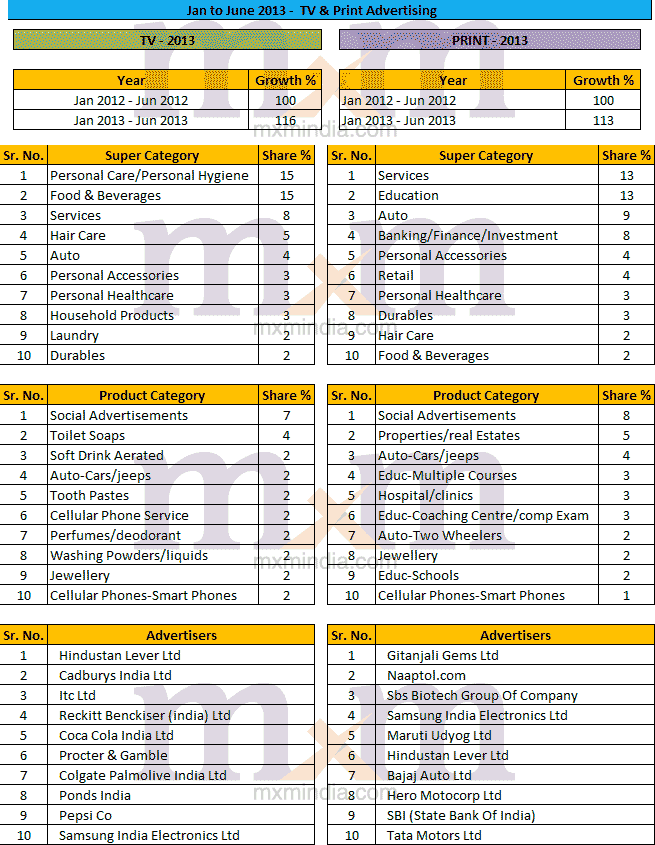
  • Special to MxM: TV volumes grow 16%, print up 13%


    By A Correspondent


    The skies may be overcast for the Indian media, but here’s room for some cheer on this last Friday of August 2013. Television spends grew 16 percent and Print spends grew 13 percent – from January to June 2013, over the half-year of 2012.


    The numbers are from TAM Media Research whose AdEx India division painstakingly computes data for ad volumes for the television and print sectors, amongst others.


    Note: the analysis is based on ad duration in seconds for television and CCMs for print.


    The tables are fairly explanatory, so we’ll restrict the prose.


  • IBF, AAAI, ISA and TAM reach a consensus. Finally

    By A Correspondent


    Representatives of advertisers, media agencies, broadcasters and TAM have finally been able to iron out their differences and agreed to agree on an agreement.
    The media and public will now get to know television viewership in thousands, colloquially referred to as TVT. TVT captures and reflects growth in TV audiences in the country in terms of absolute numbers. TVT will be the sole currency in the public domain.

    In addition four-week TVT rolling average will be provided every week. The rolling average is statistically more stable data on viewership, especially for smaller audiences in niche channels, regional languages, English language programs and news.

    For internal evaluation including planning and buying, %TVR weekly will be available to advertisers and advertising agencies.

    The three constituents have also agreed that TAM will make all future audience measurement changes based on inputs from the joint-industry BARC Technical Committee.

    Commenting on the changes IBF President Man Jit Singh said: “We are delighted to have reached this agreement. We believe it is important for the industry, and from the perspective of our social responsibility, we must reflect both the growing television audience and the data in a more stable and useful manner. We want to thank AAAI and ISA in collaborating and working out a solution acceptable to all constituents”.

    “As three concerned constituents, who believe in working together, we have decided to refer all future currency related changes to the BARC technical committee. I’m glad that now we will have an effective guide and monitor for ratings in the country,” said Hemant Bakshi, Chairman of Media Committee and Managing Committee of the Indian Society of Advertiser.

    “Getting weekly TVR% is important for media planners and buyers to effectively plan and buy TV  and do mid- plan course corrections and post analysis. We are glad that we have been able to agree that the agencies and advertisers will have access to this data as in the past. From tomorrow, we look forward to being able to focus back on our clients businesses and effective planning and buying for their brands,” said Arvind Sharma, President of the Advertising Agencies Association of India.

    A TAM spokesperson has also issued a statement saying: “TAM is happy to receive a common brief from the three Industry Stakeholders (IBF, ISA and AAAI) and will work very closely with them to ensure its smooth roll out.”

  • IBF, AAAI, ISA and TAM reach a consensus. Finally!


    By A Correspondent

    Representatives of advertisers, media agencies, broadcasters and TAM have finally been able to iron out their differences and agreed to agree on an agreement.

    The media and public will now get to know television viewership in thousands, colloquially referred to as TVT. TVT captures and reflects growth in TV audiences in the country in terms of absolute numbers. TVT will be the sole currency in the public domain.

    In addition four-week TVT rolling average will be provided every week. The rolling average is statistically more stable data on viewership, especially for smaller audiences in niche channels, regional languages, English language programs and news.

    For internal evaluation including planning and buying, %TVR weekly will be available to advertisers and advertising agencies.

    The three constituents have also agreed that TAM will make all future audience measurement changes based on inputs from the joint-industry BARC Technical Committee.

    Commenting on the changes IBF President Man Jit Singh said: “We are delighted to have reached this agreement. We believe it is important for the industry, and from the perspective of our social responsibility, we must reflect both the growing television audience and the data in a more stable and useful manner. We want to thank AAAI and ISA in collaborating and working out a solution acceptable to all constituents”.

    “As three concerned constituents, who believe in working together, we have decided to refer all future currency related changes to the BARC technical committee. I’m glad that now we will have an effective guide and monitor for ratings in the country,” said Hemant Bakshi, Chairman of Media Committee and Managing Committee of the Indian Society of Advertiser.

    “Getting weekly TVR% is important for media planners and buyers to effectively plan and buy TV and do mid- plan course corrections and post analysis. We are glad that we have been able to agree that the agencies and advertisers will have access to this data as in the past. From tomorrow, we look forward to being able to focus back on our clients businesses and effective planning and buying for their brands,” said Arvind Sharma, President of the Advertising Agencies Association of India.

    A TAM spokesperson has also issued a statement saying: “TAM is happy to receive a common brief from the three Industry Stakeholders (IBF, ISA and AAAI) and will work very closely with them to ensure its smooth roll out.”

  • No method in this TAMasha!


    By A Correspondent


    The sales folks at some channels are staying put in the office because there are no calls to make. If the ads are on air, they don’t know if the money will come in at all.


    In media agencies, there is growing anxiety that if the stalemate continues endlessly, bottomlines will suffer. And if the ratings indeed go weekly, there could be lay-offs.


    While a few advertisers are happy that the ad suspension will help save valuable monies in a lean season, not all are happy with the decision.


    So if everyone is unhappy with the state of being, why the, well, sugar, aren’t they sitting across the table and smoking the peace pipe?


    Why can’t they come to a settlement when they all know what they need:

    1. CPT

    2. Weekly ratings now, eventually daily for GECs

    3. Stable ratings for smaller channels, if weekly is not possible, fortnightly or even monthly. Smaller is defined as below a certain viewership sample threshold


    What’s happening now is a loss or revenue and opportunity to explore other areas.


    In India, the television and print sector is fortunate that there aren’t enough takers for digital. Or even if there are people who advertise on digital, the monies aren’t big.


    A media planner told MxMIndia that the current faceoff could even impact print, because once advertisers sample the fruits of digital, while they’ll need to revert to television in the season for numbers, a few could switch from English print to digital. We think it’s not going to happen in a hurry, but our planner friend insists it’s a possibility.


    There is reportedly an IBF meeting today (Friday, July 19). AAAI and ISA officebearers are in constant touch. There was some jubilation a few days back when Discovery Networks wrote to TAM asking for a revert to weekly numbers, but the next day we had NGC and Fox asking for a switchover to monthly.


    What we do know is that the industry can’t do without measurement. For instance, despite the face-off, ESPN Star quoted TAM numbers in ads to highlight how it scored over some news channels for its non-live content.


    Programming, marketing and sales folk are also very keen to the ratings so that they can tweak their content, if needed. Until then it’s time for some R&R (rest and recuperation/relaxation) though everyone’s worried about the other R&R (ratings and revenues). Sigh.


  • Measurement mayhem as TAM goes weekly for some


    By A Correspondent


    Interviews by Johnson Napier


    If you thought that broadcasters would be on their knees to keep advertisers and media agencies happy, perish the thought. This is India in the year 2013 and relations between those who put money on media vehicles and the vehicle-owners have hit the bottom.


    Over recent times, there have been issues between advertisers, media agencies and broadcasters. It started with the constitution of the BARC, and moved to the Net billing issue and eventually moved to the status of the TAM-administered television audience measurement system. Along with the controversy on the measurement system has also been the issue of CPT versus CPRP being the currency for adspends.


    The unsubscription of TAM’s services by leading networks post an advisory of broadcaster body IBF last month was the last straw. While broadcasters had their reasons, the AAAI and ISA felt that it was harsh a decision and should’ve been settled by way of discussions, especially since there is a BARC-administered measurement system that’s just around a year away.


    On Thursday (July 11), after many days of the stalemate between the IBF, AAAI and the ISA and of course TAM, it was decided by the Nielsen-Kantar jv to fulfil its contractual obligations and publish monthly ratings for all those desirous of it. Although in terms of numbers, the entities are few – Star, Zee, TV18+Viacom 18, MSM, NDTV, Times TV, Sri Adhikari Brothers, BAG Films and India TV, they control a sizeable pie of ad revenues across all their channels.


    Noted a statement issued by a TAM spokesperson: “TAM, purely as an act of professionalism, is fulfilling and respecting its contractual duties and obligations that it is bound by, with the individual Broadcaster clients. This decision is basis individual client letter requests received by TAM from only specific few  TV Channels.  Data for all other TV Channels will be reported as earlier.”


    Srinivasan Swamy

    Said Srinivasan K Swamy, Chairman and Managing Director, RK Swamy BBDO:  “This move by TAM to agree to a monthly reporting for the said channels  is bowing to the pressure of these broadcasters and is a desperate reaction to the issue. Fundamental changes in a measurement system followed for years cannot be undone for a few select parties without accounting for the consensus amongst the other stakeholders , particularly the advertisers. ” Mr Swamy was critical of TAM too on the decision: “Having succumbed to such pressure tactics can lead to a further question mark on TAM’s  credibility,”


    According to Sam Balsara, CMD, Madison World and one the seniormost representing media agency professionals in the country, advertisers are “unwilling to take this unilateral decision of broadcasters lying down”.


    Sam Balsara

    Added Mr Swamy: “This is a retrograde step for a medium known to be extremely dynamic. In fact the argument can be that the move to measure TV should be available on a daily basis rather than weekly and here we are moving to a monthly. While both CPT and CPRP have their advantages and disadvantages, the bigger issue is of data stability and integrity. While the move to CPT is the way to go in the future and its advantages are known, but in absence of a new robust measurement metrics, such actions do not reflect a mature industry functioning. Where is the advertiser and the media agency in this decision?  It is time the three industry bodies ISA, IBF, AAAI arrive at a long-term solution to such fundamental issues and put a roadmap in place to prevent such knee=jerk changes in an important area of measurement.”


    Ashish Bhasin

    Echoing a similar view is Ashish Bhasin, Chairman, India and CEO, South East Asia of Aegis Media: “I think we should let it be the way it is and rather have a joint industry body like BARC or people who are qualified to handle such issues from a technical standpoint. Obviously there are some issues with TAM. We cannot take decisions on an ad hoc basis where TAM moves from weekly to monthly for some and gives out weekly data to the others. It will just add to the confusion; we need to get in experts like the BARC technical committee because they have all the constituents concerning the welfare of the industry including broadcasters and advertisers. So they will have to take a relook at the whole issue and put forth recommendations that are best for the industry.”


    Meanwhile, advertisers are not too amused by the decision. A senior marketing professional with a multinational said that the willingness to discuss issues shouldn’t be construed as a weakness on the part of those putting in monies. Another advertiser who we spoke to said that while decisions to advertise do not change on a week-on-week basis in the case of general entertainment channels, for some channels like news a more instant measurement mechanism is vital. “It’s my money so I want to know if I am spending it well. It’s not that I will stop spending If I don’t know how my money is being spent, Said Mr Bhasin: “According to me, these ad hoc steps are really retrograde. The world is moving to real-time data on a daily basis and to move to a monthly system is not acceptable. For all you know, clients might actually rethink their association with the medium of television and may channelize their energies on other mediums. Clients may lose confidence on the medium of television as if you release data after a long gap they won’t be able to analyse the immediate impact that will be created. If clients start reducing or pulling back the monies, we agencies and broadcasters will be on the losing end. So net-net, a joint industry body needs to look at it from a holistic standpoint and put forth their recommendations – what should happen in the short-term till BARC comes in.”


    The last is not heard on the television audience measurement controversy. The stakes are high and so are the bucks. For many, it also means a threat to the very existence.


    Please stand by for more as the drama unfolds.


  • Measurement impasse to end with stakeholders set for a compromise

    By A Correspondent


    There appears to be a solution emerging to the prevailing imbroglio on television viewership measurement. With many broadcasters choosing to unsubscribe to TAM ratings and some even asking the research body to not report its numbers, the pressure was on to reach a settlement that would satisfy all stakeholders.


    While the key constituents of advertisers and media agencies who require the ratings to base their decisions, have not turned off the tap, the problem is that around 80 percent of TAM’s revenues come from broadcasters, and eventually the measurement process could have suffered if the Nielsen-Kantar Media jv was compelled to cut corners.


    According to information received, four of the five key stakeholders of the Indian Broadcasting Federation, Indian Society of Advertisers, the Advertising Agencies Association of India and TAM have been in dialogue – formally and informally – to work out a consensus. It is not known whether the government – Doordarshan and Prasar Bharati specifically – is participating in the discussions.


    Although there’s no clear formula arrived at the time of writing, the discussions are veering around a changed periodicity of release of numbers, a switch from cost per rating point (CPRP) for media buying and a relook at how niche channel numbers would be published.


    While broadcasters have been adamant and have aired their grievances in the media, it is learnt that the representatives of the advertisers and media agencies too have adopted a tough stand on the issue. And even as there is agreement that broadcasters have been facing tough business conditions, there is unanimity that an independent, credible measurement system is imperative. Also, since BARC is in the process of finding vendors for measurement by early next year, it is prudent to continue with what’s around with tweaks, if necessary.


    Broadcast industry observers also alert that whatever settlement is reached now will have far-reaching implications on the new measurement process that BARC introduces next year.