|
Sustained efforts required
The news that an EY employee may have died in July this year due to excessive workload surfaced earlier this week, when her mother put up a social media post. While a probe is expected to throw more light on the specific case, the incident has sparked off conversations on the corporate work culture in India. The topic has intrigued me for years. In the first decade of my career, I worked at five different organizations, all in the Indian media industry. While each varied significantly from the others, a certain inherent chaos, an idea that’s very uniquely Indian, was a common factor across, though in varying degrees. This chaotic energy is often seen as a virtue in Indian workplaces. It fuels a flurry of activity, not all of which translates into effective action. You might be called into unscheduled meetings long after they’ve begun, because someone decided you should be there. You might be assigned a task and asked to prioritize it over everything else, leading to schedule disruptions, not just for you, but for your entire team. This often results in a false sense of urgency. In our research work, we find that many Indian companies provide the same brief for all research projects: ‘It’s critical, and we needed it yesterday’. Which means that they should have briefed us four weeks ago. But that wouldn’t pass the chaos test! In stark contrast, we were once briefed by an international client about a research project in India. At the end of the briefing, she hesitantly mentioned that the project is somewhat urgent, as it was tied to a multi-nation report, and they would need the report in eight weeks. I nearly burst out laughing at this new definition of urgency. The false sense of urgency was on display for years, when the ratings data (in the TAM era) was released at unearthly hours, often past midnight. Why it couldn’t wait till the next morning remains a mystery to me to this day. Several executives would stay back in the office (laptops weren’t as common then), doing the “runs” and sending text messages to various people, who would receive them in the middle of the night and respond with follow-up questions, forcing the executives to stay until the early hours of the morning. Thankfully, BARC India discontinued this bizarre tradition. But it’s just one example in an industry replete with them. Interestingly, this chaotic trait also affects the Indian offices of many foreign companies, while others manage to operate their Indian branches just like their parent offices. So, is it the people or the organization that determines how an office is run? It would depend on the reporting structures. Workplaces where a significant number of Indian employees report to foreign managers in other countries tend to have less chaotic work cultures. They don’t appear to be in a constant state of urgency. In the operating paradigm of chaos and false urgency, more hours may be spent working, but more work doesn’t necessarily get done. It’s as if the entire corporate culture of the country, with some honorable exceptions, not too many of which are in the media industry, has decided to work in a way that’s evidently inefficient and unhealthy. Singling out specific companies would be akin to looking for scapegoats. The problem runs deeper, and addressing it will require sustained efforts from multiple organisations over several months, if not years. |
Work-life Balance?!
A young woman died of a heart attack because of work pressure, says her family. Her employer says that the pressure on her was no different than the pressure on all other employees. The insensitivity of the employer aside, the subject of work pressure and the need for work-life balance has been part of our conversation for a while. A few months ago, Infosys founder Narayana Murthy proclaimed that young people needed to work 70 hours a week for the good of the nation. This amounts to 14 hours a day, in a five-day week and over 11 and half hours in a six-day week. Either way, there’s not much time to sleep, eat, commute, spend time with family, friends and so on. Invariably, the conversation comes round to the media, and the work pressures that are put on us and that we put on ourselves. I will be honest, when I started working 40 years ago, we had never heard of work-life balance. Because of yuppies, we did discuss work “stress” and good stress and bad stress. The upshot was a certain amount of stress made work exciting; too much made it painful. Where did the two meet? It varied from person to person. Unfortunately, in those days, anyone who did not work at the same rate as the norm was seen as lazy or unproductive. They were often given work which did not upset the flow, which meant that they were out of the fun as well as the pressure. A newsroom can be fun especially when there’s a newsbreak. But how much fun is too much fun? I worked hard, or I think I did. Do I regret it? No. Would I have changed much? I don’t think so. But I have learnt over the years to not be judgmental about other people’s needs. I remember an intern asking me about days off in the job. I was truly shocked. I had never asked the question myself. And was clearly told that days off were rarities. And so they were. But there’s a funny shift here. When I started working, these rules which applied to the media did not apply to many other companies. My father worked in a large multinational. Work stopped at the dot of 5.27 pm (don’t ask, something to do with unions). Weekends were off. Government followed its own rules. Banks seemed shut more often than open. There was no “service” sector to speak of. Shops shut early and were half-day a couple of times a week. So there was a balance of sorts, bar a few professions. Junior doctors in hospitals for instance, suffered then and suffer now. Someone apparently decided that the best way to treat patients is when you are sleep-deprived and inexperienced. The shift came post-economic liberalisation when American companies set down the rules: work work work, bully bully bully, get ahead faster than everyone else. Or so you dreamed. The ways to get ahead remain largely the same in the old system and the new: pretend to work pretend to work pretend to work take credit for other people’s work take credit for other people’s work take credit for other people’s work suck up suck up, suck up… unless you are lucky. Within the media, we forget easily. The toxic newsroom conversation vanished, even though two colleagues died after being bullying relentlessly. The pressure of work is not new; but we pay lip service and move on. There’s a lot of misogyny as well here, with masculinity scoffing that women need time for children and households so are not good workers. The same men who want their chappatis hot and fresh, when they get home, by the way. Where we are blind to the need for work-life balance is when it comes to the working classes. Women complain ceaselessly about domestic staff who take days off, do not come to work on time and so on. Domestic workers have no right to life, luxury, rest, recovery time and so on. Drudgery for other people is their purpose. Many women bristle when I mention this, but it is true. Daily wage labourers must use their strength and stamina for a little money and less food to feed their families. Family-run business like shops use the same theory on themselves and customers also expect on-tap friendliness in exchange for their money. There is a reason why cabin crew walk off a plane when their time is up, although passengers – who want their own work-life balanced – are inconvenienced. Funnily there are fairly easy solutions, minus heartache. In shift systems, in realistic goals, in a monitoring of toxic bosses, in a reassessment of methods – and this works in newsrooms as much as anywhere else. The onus is on employers, not to squeeze every last drop out of their staff. The onus is on HR departments to check employee satisfaction from the bottom up, rather than top down. (To be honest, though in my experience life was better before HR was invented.) Some European countries have figured this out, much to the bemusement of Americans. Perhaps a revisit to Bertrand Russell’s In Praise of Idleness is needed: “When I suggest that working hours should be reduced to four, I am not meaning to imply that all the remaining time should necessarily be spent in pure frivolity. I mean that four hours work a day should entitle a man to the necessities and elementary comforts of life, and that the rest of his time should be his to use as he might see fit.” These essays were first published in 1935. Go figure. Ranjona Banerji is a senior journalist and commentator. She writes on MxMIndia on Tuesdays and Fridays. Her views here are personal |
Tag: TAM
-

What ails corporate work culture in India?
-
If the pandemic does not cause any more disturbance, print will reach the 2019 level much before 2025, writes Indrani Sen The Push & Pull of Print

By Indrani Sen
 Print media in India was the worst affected by the coronavirus pandemic last year. As per the FICCI EY Report on M&E industry 2021, the revenue of print shrunk by 41% from INR 206 billion in 2019 to INR 122 billion in 2020. The report estimated that while TV will recover its 2019 level of revenue by 2022 and the combined revenue of traditional media will recover the 2019 level by 2023, it will take print at least till 2025, if not more to recover the 2019 level of revenue.
I commented on print media in an earlier article in www.mxmindia.com “However, the industry seemed to be recovering well during the first quarter of 2021 as TAM AdEx data for Jan-Mar 21 showed that 1350 new brands advertised on print during that period. When compared with Jan-Mar 20, the quarter also showed 9% increase in ad space mostly from Hindi and other language newspapers. Similarly, April-May 2021 recorded better results compared to April-May 2020.”
Now, it appears from the latest TAM AdEx report that the print media has begun the first month of the July-September quarter with an upward swing. At the end of July 2021, ad space per publication on an average has grown by 35% when compared to July, 2020. Multiple educational courses, cars, hospitals/ clinics, two wheelers and real estate have topped the list of categories who advertised in print media during last month. Media planners are hopeful that the next months of August and September will see further increase in print advertising with many regional festivals, Onam, Independence Day, Raksha Bandhan and Ganesh Chaturthi dotting the calendar. The dhamaka of 15% discount has already begun in newspapers, the tempo will surely build up further before August 15, 2021, the 75th Independence Day. This year, Onam in Kerala begins on August 12 and ends on August 23, overlapping Independence Day and Raksha Bandhan on August 22. Ganesh Chaturthi will be celebrated next month on September 10. Together these festivals will be the precursors of the main festive season of Dussehra (Durga Puja) and Diwali.
Why print media still works in India, particularly during festivals? It is convenient to execute sales and other promotional campaigns in newspapers at short notice. The entry cost or the cost of creating static creative content for print media is less expensive than creating video creative content for TV, OTT and other digital formats. The local advertisers with comparatively small budgets rely on print media for advertising throughout the year. By definition all traditional media are push media delivering content to the users with little interactions between the media and the users. Pull media by definition is the opposite of push media where the users seek out information from media. During festive season, print media plays a dual role of both pull and push media as brands step up their advertising activity and consumers seek out information on various offers and discounts available in different stores and retail outlets. This interplay of push and pull of the print media will definitely continue for the next two or three years enabling the print media to recover its lost revenues.
In the last month, we saw many full-page and jacket advertisements in newspapers, a trend which is likely to continue well into the main festival season. Ads placed below the mastheads as well as some other formats which were considered as innovations when first introduced by newspapers, have now become part of the regular options like half page, quarter page, etc. offered by regularly by newspapers. As per market reports the deal sizes in the print media has started going up, demand for inventory for advertising space in newspapers is also on the rise. It can be safely assumed that if the pandemic does not cause any other disturbance, print media will recover a substantial portion of their lost revenue during 2021 and will reach the 2019 level much before 2025.
-
After circulation & ad revenue going south in 2020, newspapers seems set on the path of recovery, writes Indrani Sen Newspaper Industry in India after the Second Wave of the Pandemic

By Indrani Sen
The Indian newspaper industry faced an unprecedented crisis last year after the National Lockdown was declared at a very short notice. Circulation fell drastically when many subscribers, particularly housing societies, shut their doors for the newspaper delivery persons for the fear of the contagious virus being carried by the newspapers or the delivery folk, leading to change is consumption pattern of newspapers. Lack of local transport also prevented the distributors and hawkers from reporting for work. This was followed by withdrawal of commercial advertising as advertisers were worried about a fall in circulation and readership and were themselves affected by choking of distribution pipelines and economic slowdown leading to loss in their sales. The FICCI EY Report on Indian M&E industry 2021 showed that ad revenue of Print came down from INR 206 billion in 2019 to INR 122 billion in 2020.After the National Lockdown was lifted in 2020, the newspaper industry tried its best to recover their lost grounds. As per the same FICCI EY report, it will take Print four to five years to regain the pre-Covid ad revenues level. However, the industry seemed to be recovering well during the first quarter of 2021 as TAM AdEx data for Jan-Mar 21 showed that 1350 new brands advertised on print during that period. When compared with Jan-Mar 20, the quarter also showed 9% increase in ad space mostly from Hindi and other language newspapers. Similarly, April-May 2021 recorded better results compared to April-May 2020.
As per TAM AdEx analysis in May 2021, when the second wave of the Covid-19 was at his peak, there was an average 58% growth in ad space per publication as compared to May 2020. However, all was not well as compared to February 2021 and March 2021, the ad space in Print saw a drop of 42% and 29% in April 2021 and May 2021 respectively. As the phased process of unlocking has begun, the newspaper publishers expect that both the ad volume and value would pick up by August 2021 and grow further during the festive season of 2021.
It appears that newspapers were better prepared to handle the second wave of the pandemic in 2021 and the lockdowns imposed by various state governments across the country. Along with the process of gradual unlocking, the newspapers now are looking forward to recovering their lost grounds. The credibility of the printed word, the vaccination drive, revival of the corporate sector and good rain forecasts are the other factors which are expected to contribute to the overall growth of the newspaper industry in 2021. The Print industry has appealed to the government for a stimulus package and an increase in FDI in 2021. The government has not responded so far, but the industry is still hopeful of getting, some positive response though no relief was announced in terms of waiving the import duties on newsprint by the finance minister in her 2021 Union Budget.
The newsprint prices, which saw a decline in the international market (below $300/metric tonne) in 2020, have started going up from the beginning of the calendar year 2021. The price was $670/tonne-$700/ tonne in April-May. The industry expects it to go up further. It appears that quite a few paper mills which used to export newsprint to India and other countries, either shut down their business or migrated to the businesses of producing brown papers and craft papers during last year when their business was hit due to the global pandemic.
As India is far from being self-reliant in newsprint production, our newspaper industry, struggling to recover from the effects of the pandemic, has been hit further by this demand supply imbalance of newsprints in the international market. Many newspapers are increasing the use of indigenous newsprints to balance out their cost of productions. However, most newspaper owners feel that this crisis of newsprint prices is not going to last for a long term and expect the international market to stabilise before our festive season in the third quarter of 2021.
To sum up, the newspaper industry in India seems to be set on the path of recovery after a severe decline of both circulation revenue and advertising revenue in 2020. In recent times, during the second wave of the pandemic, the industry was not much affected and would have been in a better financial position if they were not hit by the crisis of newsprint prices. It is expected that by end of the calendar year 2021, their overall performance may be better than predicted earlier by media analysts.
-
Bhuvi Gupta evaluates the options for the old and new traditional media companies Legacy Media Must Leap Ahead

By Bhuvi Gupta

The media industry the world over is in a state of flux. The internet has made us all both publishers and reviewers and the odd part of that is that it has made the world both biased and unbiased in equal measure. It has never been easier to publish and publicise your opinion and it has never been easier to polarise either. But leaving propaganda aside, the fact that we all have access to multiple media in function and form means that media models are themselves obsolete. While the pandemic has accelerate the print medium’s deceleration, aural media has had a comeback with podcasts going mainstream. But noteworthy in this comeback is the role played by the individual creator.
This comeback will define what media will come to represent as a whole across the world. Individual creators will define media because:
Traditional Media Measurement is Broken
In India, media as a whole has been slowly losing its credibility. In the earlier part of the last decade both, which I consider a load shed decade for media measurement, both IRS and TAM/BARC overhauled their entire systems to keep up with the times and both ended up getting boycotted or sued – IRS in 2013, and the TAM by NDTV in 2012, which eventually resulted in the formation of BARC (LINK – https://timesofindia.indiatimes.com/business/india-business/ndtv-sues-nielsen-for-fraud-negligence/articleshow/15302393.cms). The latest alleged BARC TRP-manipulatiom investigation highlights the flaws of a system based on extrapolation of a relatively small sample data set, especially in a country the size of India. This is not to point fingers at a case currently sub-judice but to make a case for system which is not so advertising-dependent, that such misdeeds become commonplace. (https://economictimes.indiatimes.com/industry/media/entertainment/media/indian-newspaper-society-rejects-irs-2013-findings/articleshow/29871308.cms?from=mdr)
Monetisation Models are Fragmented
The media’s monetisation in itself has gone through many changes. Once almost entirely run on ads (and later on advertorials as well), media houses realised that their strength lay in the deep networks and complementary relationships they had built with the elite and powerful, which was monetised via events. Then came the digital era when media houses put all their content on the web only for brand visibility with advertising as an afterthought (hence, letting the Google-Facebook duopoly control digital advertising which is now coming to bite them) and now finally the era of subscriptions and donations because survival for media companies has become harder. What will work going forward is a system based on subscriptions with a content aggregator probably charging the consumer on the basis of the quantity of content consumed
Media Biases are Clearer than Ever
While I believe that all individuals have deep-seated biases which are hard to displace even when they try their best, media today seems to align strongly to either the Right or Left. This can become inexcusable when defending a political party in the face of visible wrongdoing. Once biases become visible by the viewer, especially on major mainstream media, viewers/readers start deserting them.
For entertainment, a lot of TV content seems to be scripted for audiences in the 90s – the quality of script, actors and direction especially when compared to international content easily accessible on OTT platforms. That has had an impact on TV viewership.
So, Is there a Way Ahead for Legacy Media?
Yes, of course, there is. I feel as platforms like Substack and the OTTs move towards the maturation phase in their product lifecycle, there will be further fragmentation in media consumption and clear market leaders will cease to exist. While consumers who are early adopters might have already given up their legacy media subscriptions in favour of Substack, The Ken et al, the majority of the market is yet to catch up. It is here that traditional media outlets must evolve to remain relevant enough. They have the advantage of knowing what the audience wants, and robust role models like New York Times (NYT) which in November 2020 generated more digital revenue than print with 7 million digital subscriptions. There’s also pay-as-you like journalism which has been implemented in part by Newslaundry.
Early signs of traditional media evolving are there. Today, most traditional media outlets whether Print, TV or Radio have robust video and print teams and soon-to-be-announced podcast teams as well.
But as they all put their fingers in more and more pies, I hope they don’t lose the entire plot by spreading themselves thin too soon.
Bhuvi Gupta is a marketer with over 10 years across industries, of which the last six have been in Media & Entertainment. She has been a part of many launch marketing campaigns – specifically at the Times of India group, Republic TV and the latest in marketing a Bollywood film. She will write on A&M (mostly marketing, but often on advertising too) every other Tuesday. Her views here are personal. She tweets at @bhuvigupta3
-
To commemorate the new stadium at Motera TAM Sports turns Pink
By Our Staff
TAM Sports will turn pink starting today (Feb 24) afternoon, commemorating the Pink Ball Test Match between India and England in Ahmedabad.
Said a spokesperson for TAM Media Research: “TAM Sports will be turning pink once again, for the third India-England Pink Test match. This is in reverence to the spirit of cricket as a sport, Indian sponsors and cricket fans. If you recall, TAM Sports had turned Pink for the very first Pink Ball Test in India, Year 2019. To further demonstrate TAM Sports’ commitment to keep serving Sports fraternity, we announce Complimentary Brand Evaluation Report (Brand Exposure on TV) for the 1st Test Match (On-ground/In-Stadia sponsor brands) in the World’s Largest Cricket Arena. TAM Sports has been in India for more than a decade, serving a number of Brands present on Sports arena and gracing several of the Sporting occasions. This is our way of showing gratitude to the Brands supporting the game, our Players, the sporting bodies as well as infrastructure creators of the brand new stadium at Motera, which are a part of our awe-inspiring ambassadors for the Country”.
-
HUL topped among the GEC advertisers followed by RB as runner-up in 2020 as per TAM AdEx GEC AdEx in 2020: Commercial ads: 55% share, Promos 45%

By Our Staff
TAM AdEx has released the second of its reports on 2020 for television advertising. This time it focuses on advertising on general entertainment channels.
Here are some highlights
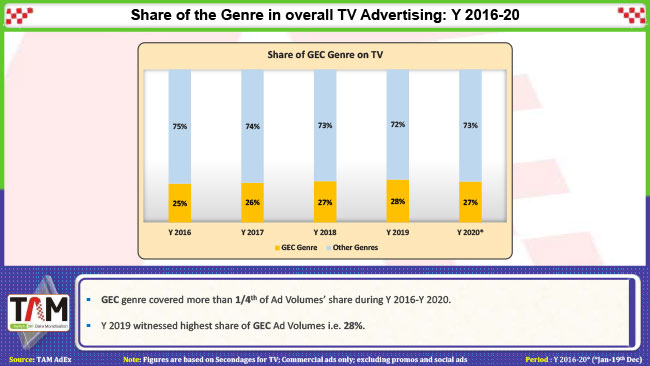
GEC genre covered more than 1/4th of Ad Volumes’ share during Y 2016-20.
True Shield Hand Sanitizer was the top brand during Apr’20 to Jun’20 & Aug’20 in GEC Genre.
Toilet Soaps leads among the Top 10 categories of GEC Genre with 9% ad volume share in Y 2020.
Ecom-Media/Entertainment/Social Media saw highest increase in ad secondages during Y 2020 compared to Y 2019 in GEC Genre.
In GEC genre, HUL topped among the GEC advertisers followed by Reckitt Benckiser on 2nd position during Y 2020.
6 out of Top 10 brands on GECs were from HUL and 3 were from Reckitt Benckiser.
1.3K+ advertisers & 2.7K+ brands exclusively advertised during Y 2020 on GECs compared to Y 2019.
Primetime is the most preferred time-band on GEC genre followed by Afternoon and Morning time-bands.
20-40 second ad commercials were most preferred for advertising on GECs during both Y 2019-20.
Commercial advertising added 55% share of Ad Volumes on GECs whereas Promos had 45% share in Y 2020.
Highlights of the report are Advertising Trend during Lockdown versus Unlockdown, Covid Prevention categories, Celebrity Endorsement, Social Ads by Govt. etc.
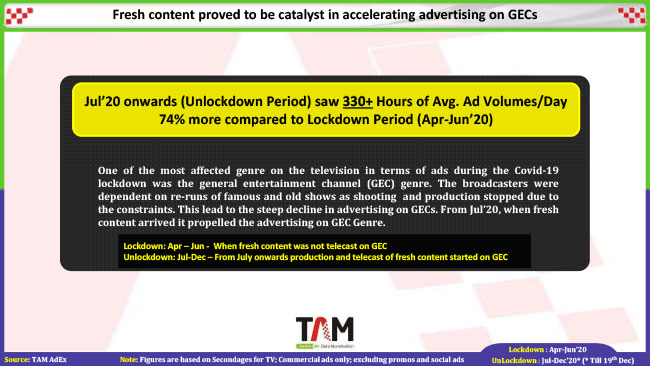
According to the report, advertising volumes in 2020 saw a marginal rise versus what it was the previous year (2019). Average ad volumes in the all-important fourth quarter of the year rose 39% over the average ad volumes in the first three quarters of the year. There was 90% growth in Average Ad Volumes/Day witnessed during Post Lockdown period.
FMCG players ruled the list of Top 10 advertisers with HUL leading the list. Four of the Top 10 brands advertised were from Hindustan Unilever and three were from RB. Personal Care/Personal Hygiene sector had 20% share of Ad Volumes followed by F&B with 18% share.
Please click on this link for the report:
TAM AdEx – Mirroring Y 2020 for GEC Genre






-
The networking app promised to let people connect to other like-minded couples with mutual interests Former measurement professional launches networking app for couples
By A Correspondent
Audience measurement professional Amit Nevrekar has moved on to set up CouPals, a networking site for couples. The rationale: While there are apps available in the social networking world, there is none that caters to couples and provides them a platform to connect with other like-minded couples.

Amit Nevrekar Said Amit Nevrekar: “Only love isn’t enough! It is equally important to keep the Fun, Adventure, Mystery and Spark alive in the relationship. And there was really a need for such app as the market didn’t have any that focused only on couples, Apart from serving the relevant profiles, it would also recommend the options for dining, weekend getaways, tailor-made travel itinerary and more based on interests selection as well as couple tips & therapy through partnerships.”
CouPals will be launched in phased manner starting with Mumbai, Bengaluru and Delhi in January 2021. Nevrekar is co-author of the book ‘The Advertising Mess’ in 2012 and worked with industry bodies BARC, TAM and MRUC. He has also worked with Kantar, GroupM and Zapr Media.
-
The study is on All Live matches only during IPL Season 13 and 12 TAM Sports: Tally of Advertisers & Brands grew by 7% and 3% in IPL13 Live matches. Avg ad vol stays same
By A Correspondent
Before we give you the headlines, the Advertising Volumes we refer to are for advertising across 24 Star Network channels for both IPL 13 and IPL 12. The study is on All Live matches only during IPL Season 13 and 12. It excludes pre-, mid- and post-match shows. The analysis is based on Pure Advertising [i.e. Excluding Franchisees, Promos, Filler, Film Trailer and Official Broadcaster (Star Network)]
So here are the headlines:
> Average Ad Volumes during all matches of IPL 13 remained almost same compared to IPL 12.
> Tally of Advertisers & Brands grew by 7% and 3% respectively in IPL 13 compared to IPL 12
> Oppo India made it to the top during IPL 13 compared to 4th place in IPL 12
> During IPL 13 (53 days), Ad Volumes of Sports genre spiked by more than 3 Times compared to 53 days prior to IPL 13
Here’s what you can get by clicking on the PDFed presentation here:
> Overview of IPL 13
> Toppers – Categories, Advertisers and Brand
> New Advertisers and Brands in IPL 13 vs. IPL 12.
> Advertisers under Top 5 Genres – IPL 13
> Ad Length Usage (10, 20, 30 Seconds) – IPL 13
> Advertising Trend in Channel Genres
And more…
IPL 13 Commercial Advertising Report
-
Hope some common sense prevails, and trigger-happy authorities stay away from shooting at will, writes Shailesh Kapoor Shailesh Kapoor: Whose Ratings Are They, Anyway?

By Shailesh Kapoor
 The last few weeks have seen eruption of a fresh debate around television ratings. Before the formation of BARC India, ratings-related controversies in the TAM era were frequent, and different broadcasters, at different times, expressed their discontentment privately and publically, with some like NDTV even taking the legal route. When the currency shifted to BARC India in 2015, these debates expectedly became less frequent. The key difference, of course, was that BARC India is an industry body, and not a private organisation like TAM.
For the last five years, despite stray voices and uncalled-for government interference, there has been an overall sense of calm around TV ratings in India. But trust 2020 to challenge the status quo. One concern after the other, the ratings system has come under the scanner again in recent weeks.
It started with BARC India’s decision to use an algorithm to remove the impact of landing pages on viewership. This evidently-controversial decision has not gone down well with several news broadcasters. Even as we await the unfolding of this contentious piece, the Peoplemeter-tampering controversy came to the fore, wherein the Mumbai police charged certain news channels, most noticeably the Republic TV network, of breach.
In a large, pan-India panel that’s being managed manually at the last mile, some Peoplemeter homes being compromised is not such a surprising development. It’s bound to happen once in a while, and a swift and decisive response it all that such incidents needs, on behalf of BARC India.
But such incidents bring the topic up in the media, and we know that questioning voices don’t worry much about facts and details anymore. By suspending channel-level ratings for the news genre, BARC India has, in effect, admitted there’s a need to get things in order. And that can, arguably, be called a constructive decision.
t the events of the last two months have worked as a perfect trigger for the ever-eager I&B ministry and TRAI to step in. Last week, the ministry constituted a four-member committee to review the existing guidelines on television ratings agencies in India.
The government’s interference in the television industry can be exasperating for any sane mind that has the industry’s best interest at heart. Under the excuse of protecting consumer interest, TRAI has interfered repeatedly by setting the price points and guidelines regarding pay TV subscription. Why TV industry even comes under TRAI is a larger question in the first place. But even if one ignores that by seeing TRAI and the I&B ministry or any other such body as a generic entity called the Government of India, the interference is a blatant violation of the principles on which a free market operates. Why are cinema and live event ticket prices not regulated? I hope I’m not giving them more ideas to widen their interference net, but the Government could have done well to stay away from areas it has no business of being a part of. But that ain’t happening anytime soon. In fact, the latest development, that online news portals and the OTT category will come under the I&B ministry, is a new cause of concern.
The ratings committee has two months to put up its recommendations. Irrespective of how good a job they do of it, the direction in which this discourse is going is deeply problematic. It’s been a tough year for all industries, and television broadcasting is no exception. Hope some common sense prevails, and trigger-happy authorities stay away from shooting at will. Else, 2021 could spell some more trouble for the business. Trouble that, unlike the pandemic, is eminently avoidable.
-
The report predicts that the IPL buzz volume of the digital track will grow from 37 mn in 2019 to 60 mn+ in 2020, writes Indrani Sen IPL 13 Rules. And how!

By Indrani Sen
Ever since IPL 13 began on September 19, 2020 with a massive 20 crore viewers on Star India Network and Disney + Hotstar, the tournament has been delivering high ratings on TV and OTT platforms.On the digital media front, IPL 13 is generating huge tractions over and above its coverage through Star India’s OTT platform Disney + Hotstar. On October 30, 2020 Wavemaker published a press release on their mid-season report of “IPL Mesh 2020” covering matches from September 19 to October 24. Mesh is Wavemaker’s Realtime Data Intelligence tool which has integrated data from “multiple consumer touchpoints across Digital ecosystem ranging from Social Listening, Google Searches, Website visits, BARC, Video analytics in partnership with VIDOOLY, Interaction data points collected from Facebook, Twitter, Instagram and YouTube” to arrive at the observations and predictions shared in the report.
The press release by Wavemaker contains a few charts and whets the appetite for the total report. The report predicts that the IPL buzz volume of the digital track will grow from 37 Mn in 2019 to 60 Mn + in 2020. During the first 36 days of the tournament, CSK was the driving force behind the interactions on social media. Now that CSK has failed to secure a place in the playoff matches, it will be interesting to watch if the buzz volume of the track gets affected. Similarly, it would be interesting to see who takes the place of M S Dhoni as wicketkeeper in the Leading Player Index Leader Board.
In the Leaderboard ranking of most loved ads, Dream 11, Oppo and Tata Motors took the first three positions in desending order. IPL 13 has also seen a never before engagement in gamification of Cricket Fantasy League with the top five Fantasy League in September 2020 generating 30 million google searches and 90 Million web traffic. Based on historical data, the report claims that there will be huge surge both in TVP and social buzz during the next two weeks which will counter the drop in the social media buzz over during the last few weeks as shown in the chart above.
While the Wavemaker’s report reconfirms the accelerated growth of the digital media intractions in India, in traditional TV media also IPL 13 continues to deliver high ratings to the satisfaction of the advertisers who have invested their advertising rupee in cricket. A fortnight back on October 15, TAM released “IPL 13 Advertising Report 1” based on their ADEX data covering the period from September 19 to October 10 (25 natches). The report has shown an 8% growth registered in average ad volumes from IPL 12 to IPL 13 during the same time span/ number of matches. 5 out of the top 10 categories have been from E-commerce with 35% share of IPL 13 advertising volume and Oppo India’s commercial made it to the top position quite fast during IPL 13 compared to 2nd position in IPL 12.
The most interesting fact which has emerged from this Advertising Report is the participation of new categories and brands in IPL 13. According to the TAM Adex report 30+ new categories and 150+ new brands advertised during IPL 13 compared to IPL 12. It remains to be seen how the advertising frenzy builds up further during the last two weeks of IPL 13, strategically scheduled during the pre-Diwali season in this pandemic hit year.
-
TAM has partnered with Revuze, a global product experience management specialist TAM launches CRISP to track consumer reviews & influencer sentiments for brands
By A Correspondent
 TAM Media Research has announced the launch of CRISP, an analytics tool to help decode consumer sentiments in the Indian marketplace. CRISP is short for Consumer Reviews & Influencer Sentiments for Brand Performance. The product is specially crafted for marketers to gauge and understand the actual consumer reviews/ sentiments and augment the consumer product connect, notes a communique. TAM has partnered with Revuze, a global product experience management specialist.
Speaking on the launch, L V.Krishnan, CEO, TAM Media Research: “Today’s evolved Indian consumer is not just pragmatic about the products they purchase but extremely vocal and quick to give reviews. For a Marketer, these customer feedbacks can help realign product and communication strategy effectively. Hence, it is crucial for Marketers to constantly keep track, understand and re-connect while managing consumer sentiments towards Brands. TAM has partnered with Revuze to bring a new age, robust, data analytics tool – CRISP, for Marketers to decode the realms of unstructured feedback data from consumers and retrace it back into defining sharper rrand strategies. In a fast-paced evolving environment, it can be a crucial weapon for marketers to win additional brand sales and market shares. CRISP will help build the much-needed superior analytical prowess within the marketers business and help analyse product usage, identify areas of product/service improvement based on feedbacks so as to take quick footed decisions.”
Added Shai Etzion, CRO, Revuze: After showing significant success in the USA, Revuze is entering the Indian market partnering with TAM Media, a natural choice being our mutual Nielsen family relationship and their 20+ years’ experience in deep understanding of the Indian media landscape. It will be a compelling product and a gamechanger for India to understand consumer sentiments and reviews.
 By Shailesh Kapoor
 By Ranjona Banerji