Tag: TAM

  • Colors back at #2 as Life OK biggest gainer in Week 4

    By A Correspondent


    Week 4 of 2014 saw Colors revert to the #2 slot with Life OK numbers increasingly dramatically on the back of the Life OK Screen awards aired last Saturday.


    Star Plus was at 606 (previous week 626), Colors at 449 (467), Zee at 441 (471), Life OK 375 (347), Sab 323 (318) and Sony at 254 (258).


    As always, this info is based on what a TAM subscriber told us. Nothing official about it. But it’s reliable.


    We expect Sony’s ratings to leapfrog next week given the numbers of the Filmfare Awards.


  • Decision on TV ratings guidelines pushed to Feb 11

    By A Correspondent


    As per reports that have just come in, the Delhi High Court which was to have announced its decision on the Kantar Media petition on the government guidelines on television audience measure will now happen on February 11.


    It may be remembered that the 30-day period after the government guidelines were issued this month on January 16 is due to end on February 14.


    *Please await a detailed report by 7.30pm today (Jan 29)


  • Ready for a ratings-dark year?

    By Shailesh Kapoor


    The threat, and I use the word carefully, that we may end up being in the middle of a fairly long ratings-dark period in 2014, is now a real one. Kantar has taken the Indian government to court over the cabinet guidelines for TV ratings agencies. The guidelines have a shareholding pattern clause that would make TAM (in which Kantar, a WPP company, has a 50% stake) an ‘illegal’ ratings provider less than a month from now.
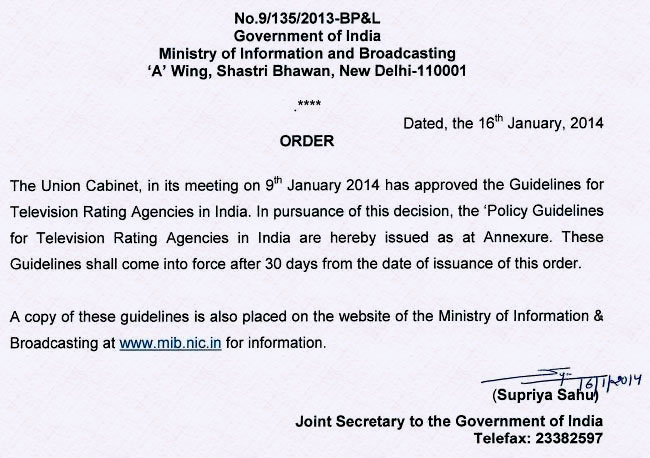


     

    I wrote two weeks ago on why I’m no fan of TRAI or I&B ministry interfering in the broadcasting ecosystem on the topic of ratings. But now that they have, if Kantar’s case is dismissed, we may have a situation unlike anything seen before – a running, sprawling industry will have no viewership measurement. In effect, it will have no currency to sell in.


    This is chaos of a magnitude far higher than what happened in 2012, where ratings were held back for nine weeks, but were still being recorded, and hence, eventually released. Here, we are staring at a no-measurement situation, not just a no-reporting one!


    We are in that part of the year when a lot of annual deals are signed. Typically, data from April 2013 till date can be used to arrive at cost benchmarks for these deals. The real challenge will be post-evaluation of actual deliveries. There could be nothing to evaluate at all.


    But the big element of chaos will come via specials and new launches. Sporting events like the IPL, the T20 World Cup and the FIFA World Cup are scheduled between March and July this year. We are also likely to have a General Election without measurement. How’s that as an idea to call a ceasefire in the news channels war? I’m not even getting into the innumerable fiction and non-fiction show launches that happen every month across 100+ channels.


    How will the broadcasters respond if this reality of no-ratings dawns upon them? I’d like to assume that most would want to keep a close eye on their performance through alternative methods, with the understanding that no magic is going to happen overnight when the BARC ratings start later this year.


    Putting monitoring mechanisms is not very difficult. Tracking day-after recall is a good indicator of directional movement of consumption of any channel or show. Many broadcasters used it effectively even during the nine-week ratings hiatus in 2012. For example, Madhubala’s recall doubled from 5% to 10% over that period. The rating averaged 2.5 TVR before the blackout, and 4.3 TVR in the week after the blackout. Hence, an accurate sense of significant positive movement was captured during the blackout.


    So, I believe the content and marketing teams can still survive this period, albeit with a dash of trepidation. The real issue is on the buying side. Media planning solutions are more complex than just programme and channel sampling measurement. And a currency research can be replaced only by a currency research. This is where I fear all hell may break loose. Though, it may also mean that we have the classical buyer-seller market, where negotiation skills and enterprise become the deciding factors.


    I’m still hoping a solution is worked out, either in the court or outside court. I&B has been making some fairly strong comments on why they needed to do what they did, without having to wait any longer. The question they should also ask is: At what cost?


    Whatever happens, be assured that there will never be a dull moment over the next 12 months. Fasten your seatbelts!


    TV Trails is a weekly column written by Shailesh Kapoor, founder and CEO of media insights firm Ormax Media. He spent nine years in the television industry before turning entrepreneur. The views expressed here are his own. He can be reached at his Twitter handle @shaileshkapoor


  • Sorry, but Kantar’s spokesperson knows nothing about the petition against the Govt of India

    By A Correspondent [updated]

    It’s possibly our ignorance that we didn’t figure that the ‘Like to know more?’ contact in the Kantar ad on Monday was none other than that of IMRB International’s Group Communications Manager – Shweta Ratnaparkhi.

    We had published the news on Monday that TAM was likely to go to Court against the Government of India on the issue of the guidelines towards television audience measurement.

    We’ve often backed TAM in the war that many have been waging against the measurement body. We believe that the government’s policy on crossholding is flawed. And that if there’s a problem with crossholding on measurement than so must it be for a newspaper or newsmagazine owners also running news channels or radio stations.

    We believe the various stakeholders paying for TAM’s services and representatives of the three key stakeholders ought to have been sitting together periodically from the last 15 years so that there was no gap in the expectations.

    We also have a strong view about the government’s FDI policy in the news media. So even as the I&B ministry believes that a majority or 100 percent stake in news and current affairs media  — print and television – cannot be permitted, it has allowed fully foreign-owned media buying and planning agencies knowing fully well that media agencies can significantly impact the financials of newspapers or news channels and hence potentially influence them.

    The esteemed spokesperson did not respond to a direct question on whether her company has taken her country’s government to court.  Hey, there’s nothing illegal in giving out a piece of information. Last evening, IndianTelevision.com had scooped the story on the government being taken to court. The story’s first version named TAM, but that was later corrected to Kantar.

    The Economic Times today reports that the “writ petition filed by Kantar on January 20 said the new guidelines have put the existence of TAM at risk even though the ratings agency has operated in the country for over 15 years”. ”The petition argues,” the reports adds, “that with the new guidelines restricting cross-holding in TV rating agencies, TAM would have to shut shop in the country”.

    While the hearing has been adjourned to next week (Jan 29), Kantar has been asked to submit documents relating to its shareholding by then.

    We too received the information from a reasonably reliable source – that Kantar had taken our government to Court. We tweeted about it.

    But in order to give more info, we needed a copy of the petition or an official confirmation. When we spoke to Ms Ratnaparkhi, she refused to disclose any information on the legal procedure her company has initiated.

    The lady must realise that by doing so she’s only forcing journalists to wonder whether she’s trying to hide something.  And even look beyond TAM.

    Like do the government guidelines also impact Kantar’s tie-up with Tata Sky on the return path data audience research service ? In April last year, Kantar Media Partners had announcement the commencement of this service that measures the behaviour and viewing habits of Tata Sky’s rapidly increasing number of pay TV subscribers. Since the guidelines pertain to all television audience measurement, the Tata Sky tie-up can also be affected.

    But, of course, Madame Spokesperson won’t answer this question. Or possibly any other. Sigh.

  • Ahead of litigation, TAM part-owner Kantar takes on govt + A possible solution to the mess

    By A Correspondent


    So now that it’s formal that TAM or either of its joint owners were not selected for the critical technology vendor, what’s the path ahead for the measurement body?


    Will it shut shop on February 14 or 15, after the completion of 30 days post the  guidelines were issued? Unlikely. In fact, in all likelihood TAM will take the government to Court (see our report: http://www.mxmindia.com/2014/01/as-time-ticks-on-measurement-guidelines-will-tam-take-mib-to-court/). However, according to information received by MxMIndia, the objective is first to put the pressure on the government and stakeholders through media that’s not unfriendly and some heavyduty lobbying.


    Text of the ‘advertorial’ ad inserted in some newspapers:


    The Fact about Television Audience measurement

    1. The government has issued guidelines regulating television rating agencies in India. These guidelines specify that no legal entity can have 10% or more equity in both rating agencies and advertising agencies. Moreover these guidelines impose a requirement on existing rating agencies to comply within 30 days and lays down penalties for non-compliance.


    2. ‘Television Audience Measurement’ is a service used by professionals in the broadcasting and advertising agency industry to measure the size of the audience for television channel or campaign.


    3. TAM Media Research (TAM) was created 15 years ago at the request of the Indian advertisers, advertising agencies and broadcasters. They suggested that Kantar and Nielsen – the two global leaders in television audience measurement – come together to form a joint research company to provide measurement data, using their global expertise and technology. The identity of the partner companies are displayed prominently on the TAM website. Together Kantar and Nielsen provide TAM services in about 70 countries across the world.


    4. TAM data is common ‘currency’ for television rating in India. Data is uniform and provided via TAM’s website: data is not customized for any individual customer.


    5. It is a myth that TAM is a monopoly. Over the last two decades, several companies provided TV measurement data and alternatives exist. However the fact that the data is a “currency” means that customers typically prefer to have one supplier. It is expensive to set up there are no legal or other factors preventing competition.


    6. The involvement of international parent company in TAM was demanded by Indian advertising industry: their expertise provides the latest technology, investment and expertise in television measurement. Over the 15 years of its existence, TAM and its shareholders have invested over Rs 150 crore in increasing the panel base, and improving the technology and infrastructure. This investment continues even today.


    7. Currently TAM covers a panel of 35, 000 individuals in 225 cities through 9,600 people meters, making India one of the 5 largest TAM panels globally. TAM, in consultation with the industry, is on course to achieve its target of 20,000+ meters.


    8. TAM’s methodology has been audited by independent academics from the University of Michigan. The general panel operations are audited by independent external consultants.


    9. TAM has also instituted the TAM Transparency Panel: this is constituted by five globally acclaimed independent media specialists who rigorously apply global best practices to verity TAM’s commitment to data quality, panel home security and resolution of customer grievances.


    10. No other market in which cross ownership exists, such as the UK, France and Spain, has imposed restrictions on cross ownership between market research agencies like TAM, and advertising agencies. Restricting Kantar and their associates from ownership of meaningful stake in a rating agency will deprive India of one of the leading global players in this area. It is and would be impossible with the ownership structure and the oversight of all stakeholders – broadcasters, agencies and advertisers – for any one stakeholder to influence the TAM rating that are produced by the system, nor would there be an incentive to do so.


    11. Implementing the guidelines on crossownership would leave the entire industry without ratings for most of 2014, a situation that no one who really cares about the media industry in India could possibly tolerate.


    Sample this from an interview of Eric Salama, chairman and chief executive of Kantar, to Shuchi Bansal of Mint: “In no other market in the world where the provider has an equity stake from broadcasters and agencies-such as UK, France, Spain-has this been raised as an issue. Even Mediametrie which is rumoured to be in conversation with Barc (Broadcast Audience Research Council) is partly owned by broadcasters and agencies. Will that be an issue for the government or Barc? They (Mediametrie) have no meaningful experience of operating outside France. And I understand they are about to lose the one minor contract they have outside France, that of Morocco. With all that, does it strike you as the choice for the future?” (see link: http://www.livemint.com/Consumer/pTUcSWMPOR5k TjDuHSk86I/
    New-guidelines-will-disqualify-TAM-Kantar-CEO.html).  Mr Salama acknowledges that TAM will be disqualified if the guidelines go through.


    In an interview with Anant Rangaswami for CNBC-TV18, Mr Salama was more direct:

    It’s not a good idea because it’s not something that is an issue in India, and it’s not an issue for us anywhere in the world. It’s a red-herring that has been introduced. Even one of the companies that BARC wants to work with, called Mediametrie, has got an ownership stake from Publicis and Omnicom. Now, I don’t think that Publicis and Omnicom’s ownership stake in Mediametrie affects what Mediametrie does from a professional point of view. And what TAM does is not affected by the ownership stake either. There is no country in the world which has got this kind of cross ownership. It’s going to limit competition; it’s going to mean the number of companies that are able to do it is much less. And it means that India isn’t getting the best in terms of what’s available from around the world. (See link: http://www.firstpost.com/brands/kantars-eric-salama-wouldnt-be-good-for-tv-ratings -collapse-in-india-1348739.html?utm_source=ref_article)


    A quick look at Mediametrie’s shareholding did indicate a stake that Publicis has in it, but it’s below 10 percent, that’s permissible by the Government of India guidelines (see link: http://www.mediametrie.com/mediametrie/pages
    /capital-and-shareholders.php?p=10,88,86&page=26).


    What’s the way out of the mess: A senior industryperson who spoke to MxMIndia insisting anonymity indicated that the guidelines concern only the vendor entrusted with the measurement responsibility. In the proposed scenario, BARC is the measurement body which will subcontract the measurement task to multiple bodies. Hence, BARC can even entrust the task of measurement in the interim to TAM which can undertake the task in its guidance.


    That way, the guidelines will be followed to the T, and the industry will have no blackout zone.  This will allow ease of entry to the new measurement regime.  Since the proposed audience measurement system is not plug-and-play as in there is no integrated solution and BARC will need to deal with multiple vendors and put the jigsaw together, a TAM-administered system allows for some respite and a no-blackout period.


  • As time ticks on measurement guidelines, will TAM take MIB to court?

    By A Correspondent


    With the government guidelines notified on January 16, the time’s literally ticking for TAM and the entire prevailing broadcast ecosystem.


    Thanks to the persistent demands of broadcasters – especially those representing news channels – to police TAM, the Ministry of Information and Broadcasting has been on an overdrive on the issue of measurement guidelines. The perception created is that news channels are required to sensationalise to score high ratings and the government, in its effort to to keep newswallahs happy and in check in an election year, is on an overdrive. How the ratings scenario will change in the new BARC-administered regime beats us, but what we do learn is that existing player TAM is contemplating taking the Ministry of Information and Broadcasting to court.


    The plea will most likely be that it cannot comply with the requirements on ownership within 30 days so it needs to be given time. The advertisers, media agencies and select advertisers too believe that a measurement-free regime will be counter-productive. Some advertisers in fact believe a measurement blackout will force them to review their spends on television.


    According to the grapevine, TAM’s co-owners had some concerns on taking the Court route. Nielsen, we were told, was averse to litigation, while Kantar wanted it. Both Nielsen and WPP, the owners of Kantar, have steady businesses in India and there’s a concern on how taking on the government could impact its relations with the government. Industry veterans though site several instances when relations with government hasn’t been impacted by legal tangles.


    Meanwhile, even as you read this, BARC has convened a press conference in Mumbai to make some significant announcements – possibly the name of the vendor – Mediametrie or Nielsen.


  • The clock is ticking… Guidelines on TV audience measurement issued. 30 days wef Jan 16

    By A Correspondent


    Valentine’s Day this year is when the broadcast system may need to kiss the current audience measurement system goodbye. That is, if the government, the Courts or some divine power do not intervene. Or of course if TAM, the sole operator of the current audience measurement system, is unable to take some urgent measures to comply with the guidelines.


    There was a meeting with the Minister of Information & Broadcasting and officials of the ministry and key BARC functionaries in Delhi on Thursday (Jan 16) and even though Advertising Agencies Association of India President Arvind Sharma underscored the need to extend the deadline for the guidelines by five to six months, the Minister said there was not much he could do since the guidelines were being uploaded on the website and since the Cabinet had approved them, there’s little he could do in the matter.


    The order on the guidelines uploaded on the ministry website is dated January 16 and it clearly states that the guidelines will come into force 30 days from the date of issuance. The 30th day would be either February 14 or 15 given when the 30-day notice comes into force – from Jan 16 or 17.


    Meanwhile, the industry is bracing for a measurement-free era. While some of those who got the government to intervene have reason to wonder if they have scored a self-goal, the real worry is for broadcasters who could now face the heat from advertisers.


    The pressure is also on the stakeholder-led BARC to ensure timely delivery of its measurement system. It may be recalled that BARC spokespersons have promised the commencement of a new television audience measurement regime by the second quarter of 2014.


  • We can’t be without a measurement system: Hemant Bakshi, ISA Chair & ED, HUL


    What appeared to be a quiet start of the year emerged as an action-packed one as the ghost of the TV measurement scare emerged yet again with the Union Cabinet approving guidelines on television audience measurement issued by the TRAI.  Hemant Bakshi, Executive Director – Home & Personal Care of Hindustan Unilever (HUL) and Chairman, Indian Society of Advertisers (ISA) spoke with Shobhana Nair on how no measurement system is no good for the ecosystem, and the television sector in particular. The ISA, it may be remembered, had opposed the stand of several broadcasters who had unsubscribed from TAM last year. Excerpts from an interview with Mr Bakshi


    The danger of no measurement system hangs on the industry again though the reason is different this time around. How have you thought of handling it as the ISA Chairman?

    Firstly, it has just been announced and we need to get clarification on exactly how it is going to be amended. We are trying to figure that out right now. Meanwhile, ISA’s position on this remains the same that we do need a robust measurement system and I think the guidelines will help us get that. In the short term, we can’t be without a measurement system because ratings are the currency with which we buy television and the absence of the currency will affect the industry. We want to avoid that scenario at any cost.


    Have you discussed the situation with other members of ISA and what is a possible solution that has come out?

    I think we will come to conclusions but, as I said, right now we need to understand the details of the guidelines on how things will pan out, etc. And we are working on it.


    What are your thoughts on the guidelines by TRAI for TV Rating Agencies? Do you think it is a good attempt to create a manipulation-free environment?

    I haven’t seen the guidelines fully, so I don’t want to comment on it.


    BARC has many months before it becomes operational, what is on your agenda to speed up things there?

    BARC has already been working quite well and the progress has been outstanding. We need to keep in mind that to create something of this nature takes time and can’t be done overnight. Having said that, the work on BARC is at a good pace.


    After everyone came to an agreement last year on the need for a television audience measurement, we still have many  sections in the industry against TAM…

    I think we should look ahead and not look back. Going forward, the three bodies (IBF, ISA & AAAI) are working together through BARC to create a ratings system which will be acceptable to everyone. I think we should put all our energies in that.


  • What next for TAM?


    By Pradyuman Maheshwari [updated]


    Is it a cul de sac for TAM? Was the cabinet approval for the TRAI guidelines the final nail on TAM’s 15-year-plus existence?


    Created by a decision of the Joint Industry Body way back in 1998 with stakeholders Indian Society of Advertisers (ISA), Indian Broadcasting Foundation (IBF) and the Advertising Agencies Association of India (AAAI) agreeing to back the body. For a while, there was an alternative in the form of aMap, but that fizzled out thanks to a lack of patronage.


    Had aMap existed today, one wouldn’t be sure of its future because it always quoted a consortium of unnamed investors as its primary owner.


    Policy Guidelines for Television Rating Agencies in India


    The Union Cabinet today approved the proposal of the Ministry of Information and Broadcasting for bringing out a comprehensive regulatory framework in the form of guidelines for Television Rating Agencies in India. These guidelines cover detailed procedures for registration of rating agencies, eligibility norms, terms and conditions of registration, cross-holdings, methodology for audience measurement, a complaint redressal mechanism, sale and use of ratings, audit, disclosure, reporting requirements and action on non-compliance of guidelines etc. The proposal is based on recommendations made by the Telecom Regulatory Authority of India (TRAI) on “Guidelines for Television Rating Agencies” dated 11th September, 2013.


    Based on the recommendations of TRAI, comprehensive policy guidelines for television rating agencies have been formulated.


    Salient features of these guidelines are as follows:

    • All rating agencies including the existing rating agencies shall obtain registration from the Ministry of Information and Broadcasting.


    • Detailed registration procedure, eligibility norms, terms and conditions, cross-holding norms, period of registration, security conditions and other obligations have been delineated.


    • No single company / legal entity either directly or through its associates or interconnect undertakings shall have substantial equity holding that is, 10 percent or more of paid up equity in both rating agencies and broadcasters/advertisers/advertising agencies.


    • Ratings ought to be technology neutral and shall capture data across multiple viewing platforms viz. cable TV, Direct-to- Home (DTH), Terrestrial TV etc.


    • Panel homes for audience measurement shall be drawn from the pool of households selected through an establishment survey. A minimum panel size of 20,000 to be implemented within six months of the guidelines coming into force. Thereafter the panel size shall be increased by 10,000 every year until it reaches the figure of 50,000.


    • Secrecy and privacy of the panel homes must be maintained. 25 percent of panel homes shall be rotated every year.


    • The rating agency shall submit the detailed methodology to the Government and also publish it on its website.


    • The rating agency shall set up an effective complaint redressal system with a toll free number.


    • The rating agency shall set up an internal audit mechanism to get its entire methodology/processes audited internally on quarterly basis and through an independent auditor annually. All audit reports to be put on the website of the rating agency. Government and TRAI reserve the right to audit the systems /procedures/mechanisms of the rating agency.


    • Non-compliance of guidelines on cross-holding, methodology, secrecy, privacy, audit, public disclosure and reporting requirements shall lead to forfeiture of two bank guarantees worth Rs. one crore furnished by the company in the first instance, and, in the second instance shall lead to cancellation of registration. For violation of other provisions of the guidelines, the action shall be forfeiture of bank guarantee of Rs. 25 lakh for the first instance of non-compliance, forfeiture of bank guarantee of Rs.75 lakh for the second instance of non compliance and for the third instance, cancellation of registration.


    • 30 days time would be given to the existing rating agency to comply with the guidelines.


    • The guidelines would come into effect immediately from the date of notification.


    The Guidelines for Television Rating Agencies in India are designed to address aberrations in the existing television rating system. These guidelines are aimed at making television ratings transparent, credible and accountable. The agencies operating in this field have to comply with directions relating to public disclosure, third party audit of their mechanisms and transparency in the methodologies adopted. This would help make rating agencies accountable to stakeholders such as the Government, broadcasters, advertisers, advertising agencies and above all the people.


    Background:

    Television Rating Points (TRPs) have been a much debated issue in India since the present system of TRPs is riddled with several maladies such as small sample size which is not representative, lack of transparency, lack of reliability and credibility of data etc. Shortcomings in the present rating system have been highlighted by key stakeholders that include individuals, consumer groups, government, broadcasters, advertisers, and advertising agencies etc. Members of Standing Committee on Information Technology had also expressed concern over the shortcomings.


    In 2008, the Ministry of Information & Broadcasting (MIB) had sought recommendations of TRAI on various issues relating to TRPs and policy guidelines to be adopted for rating agencies. TRAI, in its recommendations in August 2008, had amongst other things recommended the approach of self-regulation through the establishment of an industry-led body, that is the Broadcast Audience Research Council (BARC).


    The Ministry had constituted a Committee under the Chairmanship of Dr. Amit Mitra, the then Secretary General FICCI, in 2010 to review the existing TRP system In India. The committee also recommended that self-regulation of TRPs by the industry was the best way forward.


    Since, the BARC could not operationalise the TRP generating mechanism, the Ministry of Information & Broadcasting sought recommendations of TRAI in September 2013 on comprehensive guidelines/accreditation mechanism for television rating agencies in India to ensure fair competition, better standards and quality of services by television rating agencies. TRAI recommendations on Guideline for Television Rating Agencies were received in September 2013. While supporting self-regulation of television ratings through an industry-led body like BARC, TRAI recommended that television rating agencies shall be regulated through a framework in the form of guidelines to be notified by MIB. It also recommended that all rating agencies, including the existing rating agency, shall require registration with MIB in accordance with the terms and conditions prescribed under the guidelines.


    Source: Press Information Bureau website – pib.nic.in


    The problem with the TRAI guidelines for TAM is its ownership – TAM is a 50-50 jv between Nielsen and Kantar Media Research. The third point on the cabinet approved TRAI guidelines is very clear on the ownership issue. “No single company / legal entity either directly or through its associates or interconnect undertakings shall have substantial equity holding that is, 10 percent or more of paid up equity in both rating agencies and broadcasters/advertisers/advertising agencies,” it says.


    With Kantar being owned by WPP which in turns owns Group M, Ogilvy, JWT and a host of advertising and marketing services firms in India, there’s little that TAM can do.


    Perhaps not. For, as they say in India, for every law, there’s a mother-in-law, brother-in-law, and son-in-law. So Kantar can retain a 9.9 percent stake and the rest of the 40.1% can be bought by one or multiple entities, who can then have some longwinded alliance or consulting arrangement with one of the many WPP group entities.


    For instance, MxMIndia could own the 40.1 percent stake and then MxM can retain Ogilvy, or JWT or whatever for creative services. Or the 40.1 percent stake could be owned by a Trust… TAM could seek inspiration from the ownership of other similar moves made in the past.


    What’s happened though is unfortunate. By giving the government a handle to police it, the broadcast ecosystem has had it. The development also shows that the broadcasters may seem more powerful but can’t keep off the government from interfering in its affairs. It may be remembered that until last year, the print readership study was undertaken by Hansa, which is owned by the RK Swamy BBDO and Hansa group. This group also has interests in advertising and runs a media agency, but no one raised a question on the issue of ownership. Or even if people did, it wasn’t public and certainly didn’t call for a government intervention.


    Logically, the government ought to have no business to police the TV measurement business. An intervention should be necessary only if there’s a fraud and then the law enforcers – the courts and the cops can get into the picture.


    It will be interesting to see if an agency like Group M – which is owned by WPP – decides to say that it will have its own system of measuring TV audiences. It’s unlikely that it will do it as Hindustan Unilever, one of its main clients, is a key member of the ISA and a senior HUL executive is a member of the BARC technical committee for the new audience measurement system. Also, an HUL may not want to take on the government for its own business reasons.


    The clock may be ticking for TAM, but the next step in this drama is the notification of the guidelines. TAM could of course take the government to Court. In the event that the notification happens and TAM doesn’t take the government to court, it will need to do something about its ownership. And increase boxes from 9450 to 20,000 etc etc.


    There’s of course another all-important factor. From the reports we receive at MxMIndia, BARC has kind-of decided on awarding the critical tech contract to Mediametrie, the French industry body and a couple of other vendors. The deal may not have been signed, but it’s just a matter of tam, er, time. Nielsen had also made a fresh pitch at a lower cost, but the informal industry view was to think long-term and give the contract to Mediametrie.


    In that event, it may well be a cul de sac for the way TAM is today. Perhaps, like in the Hindi movies, it will need to be reborn as something else. Or wait for divine intervention.

    In the meantime, we hear of a pressure building within the industry of how the notification could impact broadcasting. The earliest the BARC-approved measurement system will come up is the second quarter of 2014. It will take a quarter or two for it to find stability and earn the confidence of the fraternity. Advertisers and broadcasters (and media agencies) can ill-afford a period of no measurement.

    That perhaps would do more harm to the industry than any other move to shore up the media ecosystem.


  • Star Plus starts year with 647 mn viewers. Colors, Zee at #2 and #3

    The figures in the table below tell the story. These are for Week 1 of 2014 and Week 52 of 2013 as per measurement agency TAM. However, the information we have received is not from TAM, but from a friendly subscriber. So, please do verify these numbers before making all-important decisions.


    Viewership in million  
    Channel Week 1 Week 52
    Star Plus

    647

    606

    Colors

    522

    527

    Zee TV

    449

    431

    Sab

    361

    330

    Life OK

    323

    324

    Sony (SET)

    266

    272


  • Star Plus closes 2013 with 606 mn viewers. Big gains for Colors as Sab is #4

    The figures in the table below tell the story. These are for Week 52 and 51 of the year 2013 as per measurement agency TAM. However, the information we have received is not from TAM, but from a friendly subscriber. So, please do verify these numbers before making all-important decisions.


    Viewership in million
    Channel Week 52 Week 51
    Star Plus

    606

    599

    Colors

    527

    488

    Zee TV

    431

    409

    Sab

    330

    309

    Life OK

    324

    326

    Sony (SET)

    272

    255

  • Colors continues run as No 2 Hindi GEC in Week 51

    By our Research Associate


    It’s a status quo of sorts. Colors stays on as the No 2 Hindi GEC. Star Plus is still the numero uno Hindi GEC.


    As always, the TAM ratings have not been revealed to us by TAM which has regrettably been restrained by the powers to give the media a first-hand update on weekly ratings. Instead we have to get it from our friends who share the info. It’s reliable but, then, we haven’t got it from TAM.


    The following are the numbers:

    Star Plus              599 [579] {561} (548)

    Colors                  488 [449] {456} (479)

    Zee TV                 409 [439] {480} (449)

    Life OK                 326 [313] {325} (334)

    SAB                      309 [291] {260} (269)

    Sony                     255 [267] {241} (239)


    Figures in square brackets indicate viewership numbers for last week [Week 50], in brace brackets for the previous week {Week 49} and in regular brackets for the week before that (Week 48).