Tag: TAM

  • Jaldi 5 with L V Krishnan: Core viewers of genres is up

    By Ananya Saha


    Digitization is having multiple ramifications for all stakeholders: MSOs, LCOs, broadcasters and advertisers. On the sidelines of the ‘Digitization Begins’ conference convened by afaqs.com, MxMIndia spoke to LV Krishnan, CEO, TAM India to get upclose to the real picture after mandatory digitization was implemented in the three metros.


    01. What can broadcasters learn post DAS, given that the two metros (Delhi and Mumbai) have shown differential changes towards genre preference?

    There are two aspects to it. One, distribution is bringing order in the chaos post-DAS, where channels are getting in two metros. In a way, order that you now see will be much more systemised order and consist of core audience wanting to watch that genre than the trespass audience. This will go the long way in Phase II. The learning of Phase I is good enough to say what the next step should be. Step one is marketing: tell the consumers what the channel has and come and watch it. The second step would be much stronger content of engagement.


    02. So, do we have any surprises post-DAS?

    Overall, the core viewers of the genres have gone up. However, the overall reach of mass channels has gone down. Engagement levels have marginally increased with the genre and strong properties that are marketed are getting the audience. The core audience is still sticking to the preferred genre; it is the trespassing audience that are no longer accessing it. The broadcasters can create strong properties and communicate those properties to the audience so that the audience becomes loyal.


    03. How do you see the audience trend of Delhi and Mumbai replicating in other cities?

    Rollout of digitization will exhibit same phenomena in other markets as well. But the difference will be those markets already have strong penetration of digitization, eg MP and Gujarat. In metro markets, we see 50 percent penetration so such cities will see much smoother rollout of digitization than a Delhi or Mumbai.


    04. Many channels are claiming a spike in viewership. Have things shaken up much with digitization?

    These are the initial stages of digitization. The channels have worked hard to get their communication across to the audiences and have created better content and engagement.


    05. What is in it for the advertiser in the post-DAS scenario?

    They are getting targeted with audiences getting skewed to genres. Therefore, they can target their advertising more efficiently unlike the pre-DAS scenario. Secondly, geography is becoming clearer, especially for niche genre. Communication will be much easier in the digital era.


  • Big CBS network at No 1 in English GECs post DAS

    By A Correspondent


    The successful implementation of DAS in the key metros has resulted in a strong upsurge in the viewership and market share for the Big CBS Network, Reliance Broadcast Network Limited’s joint venture with CBS Studios International, consolidating its position as the premier English Entertainment Network amongst viewers across metros. A release from the company said that according to the latest TAM reports of week 51 (Source: Dec  16-22 Dec, Digital 4+ AA Sec A, Top 7 metros), Big CBS channels – Prime and Love – have topped the charts, registering a cumulative relative share of 28 percent among all other competing English GECs.


    For the same week, Big CBS Love has surpassed Star World and AXN with 3.33 GRPs compared to 3.04 (Star World) and 2.58 (AXN). (Top 7 Metros, CS SEC A 4+). The channel also garnered all 3 Top Positions in the Top Rated Programmes Charts, with Sex & The City, Excused & Life Unexpected among CS Females SEC A 4+, 7 Metros.


    According to latest TAM reports, the data also highlights the huge increase in the Relative Share, Reach and TSV of the Big CBS channels post DAS (Digital Addressability System) ie during weeks 48-51 (Market: Mumbai, Delhi and Calcutta. TG: CS 4+ Sec A) compared to the pre-DAS figures. The Relative Share of Big CBS Prime and Love increased by 93 percent and 192 percent respectively while the channels’ Reach increased by 86 percent and 124 percent. The TSV of both channels also registered impressive jumps with Big CBS Prime and Love logging 33 percent and 78 percent growth respectively.


    Anand Chakravarthy

    Anand Chakravarthy, Business Head, Big CBS Networks said, “The post DAS environment has demonstrated the power and impact of the Big CBS Network. With digitization any existing distribution advantages, legacy competitive channels had, is now nullified with the Big CBS channels available across every headend in the DAS markets. This combined with exclusive and the latest seasons of leading shows from the US, has delivered proven performance.”


  • Big Magic grows to top in Hindi heartland

    By A Correspondent


    Big Magic, the regional general entertainment Channel for the Hindi heartland from the Reliance Broadcast Network stable, has emerged the numero uno channel in Central India with a growth of 22 percent as per the latest TAM results for the period – week 41-50.


    The channel features locally relevant entertainment, with focus on drama, crime, socio-mythologicals, game shows and talent shows.


    Key highlights:

    Show name Descriptor TG Week TVR

    Khulja Sim Sim – Emerges No. 1 Show of the Market

    A simple game format, which is the local adaptation of the international format – Let’s Make A Deal the show is a no brainer based on intuition and luck, making it an ideal opportunity for anyone to participate and win!

    CS 25+ SEC A-E MF

    Week 49 0.64
    BIG Memsaab – becomes No. 1 show among female audiences within 3 weeks of launch A show targeted at housewives, offering a platform to showcase their talent ranging song and dance to aerobics or even bargaining CS 4+ Females Week 49 0.67
    Police Files – No. 1 show of the market Show showcasing real crimes from the region CS 25+ SEC A-E MF Week 48 0.63


    Big Magic is distributed across all cable operators across the states of UP, MP and Bihar and spread across the likes of DEN, Digicable, WWIL, Hathway, Darsh and Maurya amongst others, reaching approximately 10 million households in the heartland. Big Magic is also supported with a high-decibel integration plan on 92.7 BIG FM, Outdoor, and Mall Activation, play-out seeding in malls, print and local cable, said a release from the company.


  • LookBack 2012: Tales with a tail – the packages

    At MxMIndia, our endeavour always is to take an in-depth look at happenings in the media and marketing space. Here are the key stories of 2012, which panned through a number of days and, in a few cases, months. While MxMIndia covered the issues extensively, only a few headlines from each them are listed here to give you the big picture.


    1. TRAI insistence on 12-minute ad regulation continues. Also the ads cannot be part screen or scrolls – they would need to be shown on the entire screen. Though many stakeholders are unhappy, TRAI is in no mood to give it a second thought.


    TRAI sticks to 12-minute ad regulation in fresh draft, seeks feedback

    http://www.mxmindia.com/2012/08/trai-sticks-to-12-minute-ad-regulation-in-fresh-draft-seeks-feedback/ (August 28)


    TRAI curtails ads to 12 mins per clock-hour, no part-screen ads allowed

    http://www.mxmindia.com/2012/05/trai-curtails-ads-to-12-mins-per-clock-hour-no-part-screen-ads-allowed/ (May 15)


    TRAI-ing time for TV with ad curbs

    http://www.mxmindia.com/2012/03/trai-ing-time-for-tv-with-ad-curbs/ (March 23)


    2. Digitization or digital access system (DAS) has been implemented in four metros with varying degrees of success – Mumbai and Delhi doing exceedingly well, Kolkata almost there and Chennai lagging behind. While rural areas largely have DAS, rest of the urban India is still analogue. March 31st 2013 being the deadline for it to go digital. A long running story this one – and still long way from getting concluded.


    Let the (ratings) games re-begin!

    http://www.mxmindia.com/2012/12/let-the-ratings-games-re-begin/ (Dec 18)


    Stakeholder view of one month of digitization

    http://www.mxmindia.com/2012/11/stakeholder-view-of-one-month-of-digitization/ (Nov 30)


    March 31, 2013. MIB kicks off Phase II countdown

    http://www.mxmindia.com/2012/11/march-31-2013-mib-kicks-off-phase-ii-countdown/ (Nov 7)


    The A-Z of Digitization

    http://www.mxmindia.com/2012/10/the-a-z-of-digitization/ (October 12)


    Can we achieve the October 31 deadline?

    http://www.mxmindia.com/2012/06/can-we-achieve-the-october-31-deadline/ (June 21)


    Mediaah! Why Ambika Soni is to blame for the delay in digitization

    http://www.mxmindia.com/2012/06/mediaah-why-ambika-soni-is-to-blame-for-the-delay-in-digitization/ (June 21)


    I&B pussyfoots on digitization. Decision on deadline to be announced this week

    http://www.mxmindia.com/2012/06/ib-pussyfoots-on-digitization-decision-on-deadline-to-be-announced-next-week/ (June 18)


    Ready, Steady, Go? Or Delay?

    http://www.mxmindia.com/2012/06/ready-steady-go-or-delay/ (June 7)


    60 Days to Digitization Day: Digitization in 4 metros will not happen by July 1: JS Kohli

    http://www.mxmindia.com/2012/05/60-days-to-d-day-digitization-in-4-metros-will-not-happen-by-july-1-js-kohli/ (May 2)


    MIB diktat: Digitize or get punished!

    http://www.mxmindia.com/2012/03/digitze-or-else/


     3. Cricket – IPL and beyond


    Cricket is a continuous story on media websites through the year – however, this year it too became a bit more intriguing with DHL going and Pepsi coming in as IPL title sponsor, not so good ratings of IPL 5 and the short but stressful conflict between BCCL and Sahara. What with India’s performance deteriorating even on home turf, 2013 might see advertisers’ interest waning in this particular genre.


    Pepsi bags IPL title sponsorship for 5 yrs @ Rs 396.8 crore

    http://www.mxmindia.com/2012/11/pepsi-bags-ipl-title-sponsorship-for-5-yrs-rs-396-8-crore/(November 22)


    India out, advertisers still in!

    http://www.mxmindia.com/2012/10/india-out-advertisers-still-in/ (October 8)


    DLF exits IPL lead sponsorship as BCCI ups rate

    http://www.mxmindia.com/?p=29678 (August 29)


    Loyalty factor is the key to consistency in season 5 IPL viewership

    http://www.mxmindia.com/2012/05/loyalty-factor-is-the-key-to-consistency-in-season-5-ipl-viewership/ (May 17)


    4 reasons why IPL ratings & revenue won’t be better this year: Ashish Bhasin

    http://www.mxmindia.com/?p=14860 (March 19)


    Halfway through, IPL 5 ratings stabilize

    http://www.mxmindia.com/2012/05/halfway-through-ipl-5-ratings-heading-towards-stabilization/(May 10)


    Will IPL 5 ratings match those of earlier seasons?

    http://www.mxmindia.com/2012/04/will-ipl-5-ratings-match-those-of-earlier-seasons/ (April 4)


    Brand IPL needs to play innings of its life: MSL Group report

    http://www.mxmindia.com/2012/04/brands-focussed-on-men-now-wooing-women-customers/ (April 4)


    All’s well as BCCI gets back its Sahara

    http://www.mxmindia.com/2012/02/alls-well-as-bcci-gets-back-its-sahara/ (Feb 17)


    Is cricket overpriced?

    http://www.mxmindia.com/2012/02/is-cricket-overpriced/ (Feb 7)


    Be-Sahara BCCI | What next for cricket? Laxminarayan, Bijoor comment. Also: the Sahara communique in full

    http://www.mxmindia.com/2012/02/be-sahara-bcci-mahesh-ranka-why-this-cricket-veri/ (Feb 6)


    4. Dentsu taps Taproot


    The Taproot acquisition was perhaps a piece of news that generated unprecedented interest from agency majors. The last time tie up between an Indian agency and a global one generated so much interest was in the ’90s, when Trikaya became Trikaya Grey. And no wonder, as Taproot has been connoisseur of many eyes with numbers of awards, account wins and its creative excellence.


    We will not mess with what’s working wonderfully: Rohit Ohri

    http://www.mxmindia.com/?p=29769 (August 30)


    Rahul Kansal: No shortcuts and stereotypes with TAPROOT!

    http://www.mxmindia.com/?p=29817 (August 30)


    Pops on the Rise & Rise of Aggie & Paddy

    http://www.mxmindia.com/?p=29738 (August 30)


    Anil Thakraney:Talent & values rewarded

    http://www.mxmindia.com/?p=29734 (August 30)


    The Complete Story: Win-win for Dentsu,Taproot; big loss for WPP

    http://www.mxmindia.com/2012/08/win-win-for-dentsu-aggie-paddy-big-loss-for-wpp/ (August 30)


    Global ad biggies like Omnicom, Publicis & Dentsu in hectic parleys to buy Taproot

    http://www.mxmindia.com/2012/06/global-ad-biggies-like-omnicom-publicis-dentsu-in-hectic-parleys-to-buy-taproot/ (June 7)


    5. Though questions have been raised on the accuracy on data collected by TAM due to the sample size quite in the past as well, it was a first for the measurement giant to get into a dragging legal battle with a media owner. NDTV filed the case against TAM in a US court, and it opened a Pandora’s box of accusations and counter accusations.


    WPP, Nielsen (proposed) dismissal motions to be heard on Dec 14

    http://www.mxmindia.com/2012/09/wpp-nielsen-proposed-dismissal-motions-to-be-heard-on-dec-14/(11 Sep)


    WPP moves New York Supreme Court for dismissal of NDTV lawsuit

    http://www.mxmindia.com/?p=29737 (August 30)


    NDTV, WPP trade statements yet again

    http://www.mxmindia.com/2012/08/ndtv-wpp-trade-statements-yet-again/ (August 28)


    MxM Comment: Enough of trading charges. Industry needs to bring warring partners to the table

    http://www.mxmindia.com/2012/08/mxm-comment-enough-of-trading-charges-industry-needs-to-bring-warring-partners-to-the-table/ (August 27)


    NDTV v/s WPP: War of words over the Weekend

    http://www.mxmindia.com/2012/08/ndtv-vs-wpp-war-of-words-over-the-weekend/ (August 27)


    Battle of courts spills to media statements, as NDTV rubbishes WPP claims

    http://www.mxmindia.com/2012/08/battle-of-courts-spills-to-media-statements-as-ndtv-rubbishes-wpp-claims/ (August 24)


    NBA urges Soni to suspend TAM data reporting until system probed, made robust

    http://www.mxmindia.com/2012/08/nba-urges-soni-to-suspend-tam-data-reporting-until-system-probed-made-robust/ (August 24)


    WPP takes on NDTV, mulls defamation suit. Says NY courts have no jurisdiction on claims against it

    http://www.mxmindia.com/?p=29130 (August 23)


    Mediaah! | Ratings controversy: Too little too late

    http://www.mxmindia.com/?p=28862 (August 21)


    AAAI, ISA to meet TAM on Aug 16 as MIB, Prasar Bharti mull probe

    http://www.mxmindia.com/?p=27887 (August 8)


    Government mulls probe against TAM after complaints

    http://www.mxmindia.com/2012/08/government-mulls-probe-against-tam-after-complaints/ (August 2)


    By Invitation | Atul Phadnis: Industry must not duck core issues on measurement

    http://www.mxmindia.com/2012/08/by-invitation-atul-phadnis-industry-must-not-duck-core-issues/ (August 2)


    Trade shocked as NDTV sues Nielsen, Kantar, TAM & others

    http://www.mxmindia.com/2012/08/trade-shocked-as-ndtv-sues-nielsen-kantar-tam-others/ (August 2)


    6. The Aamir Khan – Satyamev Jayate phenomenon


    There are shows and there are shows. TRPs, of course, are always at the back of broadcasters’ minds. Satyamev Jayate, nonetheless was a show that tried to make a difference – and did manage to capture people’s attention due to the credibility of its host. Whether it made a difference or no might be argued – but what is indubitable is that the attempt was honest.


    Exclusive: Satyamev Jayate isn’t over yet, special show planned for Independence Day

    http://www.mxmindia.com/2012/08/satyamev-jayate-isnt-over-yet-special-show-planned-for-i-day/ (August 8 )


    End of Season 1 of Satyamev Jayate: The good, the bad and the ugly truths of life

    http://www.mxmindia.com/2012/07/satyamev-jayate-the-good-the-bad-and-the-ugly-truths-of-life/ (July 31)


    Planners happy with Satyamev’s 4.9 TVR

    http://www.mxmindia.com/2012/05/planners-happy-with-satyamevs-4-9-tvr/ (May 17)


    By Invitation: Sundeep Nagpal | Will Satyamev Jayate work for advertisers?

    http://www.mxmindia.com/2012/05/by-invitation-sundeep-nagpal-will-satyamev-jayate-work-for-advertisers/ (May 12)


    MxM Exclusive: Satyamev Jayate impacts govt. Women & Child Dev Minister Krishna Tirath promises action, commends Aamir

    http://www.mxmindia.com/2012/05/mxm-exclusive-satyamev-jayate-impacts-govt-women-child-dev-minister-krishna-tirath-promises-action-commends-aamir/ (May 10)


    Dream start for Satyamev Jayate

    http://www.mxmindia.com/2012/05/dream-start-for-satyamev-jayate/ (May 7)


    7. Starbucks comes to India


    It might appear to be an out-of-place article here – but then it was a much awaited move. And indeed it demonstrates what a power brand is all about. It is the most crowded destination in the malls where it has a presence. And Starbucks surely doesn’t need to worry about future – as word of mouth is great and sampling would definitely turn to conversions!


    Mumbai, Delhi malls relocate brands to welcome Starbucks

    http://www.mxmindia.com/2012/11/mumbai-delhi-malls-relocate-brands-to-welcome-starbucks/ (November 7)


    Anil Thakraney: Starbucks: Power of a brand

    http://www.mxmindia.com/?p=34057my (Oct 23)


    Make mine a Mocha Frappuccino!

    http://www.mxmindia.com/?p=34008 (Oct 19)


    Starbucks set for festive season flag-off in Mumbai

    http://www.mxmindia.com/2012/06/starbucks-set-for-festive-season-flag-off-from-mumbai/ (June 26)


    8. At 20, Zee is young as ever


    It has been 20 years since Zee changed the TV viewing habits of the Indian consumer – even the earliest shows and soaps on the channel are remembered by many with immense fondness. The journey has not been without the bumps – but Zee rocks even today with its own kind of programming and signature shows.


    Anil Thakraney: Zee showed the way

    http://www.mxmindia.com/2012/10/anil-thakraney-zee-showed-the-way/ (October 3)


    What makes Zee such a force to reckon with

    http://www.mxmindia.com/2012/10/what-makes-zee-such-a-force-to-reckon-with/ (October 1)


    Jaldi 5 with Ashok Kurien: Zee changed the Indian consumer forever!

    http://www.mxmindia.com/2012/10/jaldi-5-with-ashok-kurien-zee-changed-the-indian-consumer-forever/


    From ‘Okara Dukaan’ to Zee… the complete story

    http://www.mxmindia.com/2012/10/from-okara-dukaan-to-zee-the-complete-story/


    Uday Shankar: ‘Zee is a treasured peer’

    http://www.mxmindia.com/2012/10/uday-shankar-zee-is-a-treasured-peer/


    Zee@20 | Rajdeep Sardesai: In 1992, no one believed a 24-hr channel was possible

    http://www.mxmindia.com/2012/10/zee20-rajdeep-sardesai-in-1992-no-one-believed-a-24-hr-channel-was-possible/


    Zee@20: At the helm of the vision

    http://www.mxmindia.com/2012/10/zee20-at-the-helm-of-the-vision/


    Zee@20 | Sundeep Nagpal: What a score!!!

    http://www.mxmindia.com/2012/10/zee20-sundeep-nagpal-what-a-score/


    Zee@20: Producers raise a toast to team spirit

    http://www.mxmindia.com/2012/10/zee20-producers-raise-a-toast-to-team-spirit/


    The Anchor: 10 all-time favourite ‘faces’ of Zee TV

    http://www.mxmindia.com/2012/10/the-anchor-10-all-time-favourite-faces-of-zee-tv/


    9. Verghese Kurien’s legacy continues


    It rarely happens that a man becomes a movement. And that too of the nonpolitical variety. A story that has inspired many – and would continue to do so. MXM India salutes the man and the brand that lives on in style yet once again.


    Verghese Kurien: Great vision, Dream client

    http://www.mxmindia.com/2012/09/verghese-kurien-great-vision-dream-client/ (October 11)


    V Kurien was visionary par excellence: B M Vyas

    http://www.mxmindia.com/2012/09/v-kurien-was-visionary-par-excellence-b-m-vyas/


    How Amul honours its contract with consumers: V Kurien

    http://www.mxmindia.com/2012/09/how-amul-honours-its-contract-with-consumers-verghese-kurien/



  • Santa TAM has come to town today!


    By A Correspondent


    Oh! You better watch out,

    You better get set,

    You better not pout,

    I’m telling you that:

    Santa TAM is coming to town!


    He’s making the list,

    Checking it twice,

    Gonna tell us who’s popular or nice.

    Santa TAM is coming to town!


    He sees you when people are sleeping,

    He knows when people are watching.

    He knows if your shows are bad or good,

    So be good for goodness sake!


    Oh! You better watch out,

    You better not cry,

    You better not pout,

    I’m telling you why:

    Santa TAM is coming to town!


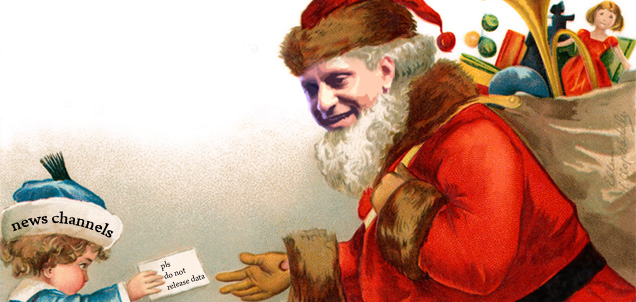
    With apologies to all for mauling the famed Christmas carol.  And we hope TAM CEO LV Krishnan and his team also take the doctoring of a Microsoft Clipart in the right spirit.


    For, it’s Christmas eve and the day when the ratings for the last week and that of the last two-odd months will be released.


    A settlement was reached in the first half of Saturday (Dec 23) where it was decided that the ratings of all channels save those news channels who produce a letter asking TAM not to share their individual channel’s numbers. These numbers which will not be disclosed are to be clubbed together in under an ‘others’ category.


    Before we bring you the numbers of the all-important Hindi GEC category, here’s a disclaimer: It may be noted that from around mid-May 2012, TAM Media has not been giving out the ratings numbers proactively to the media. While the ratings we bring you are hence unverified by TAM, we assure readers that the source is reliable and the information is not incorrect. However, we would urge readers to make their own enquiries before being influenced by the numbers.


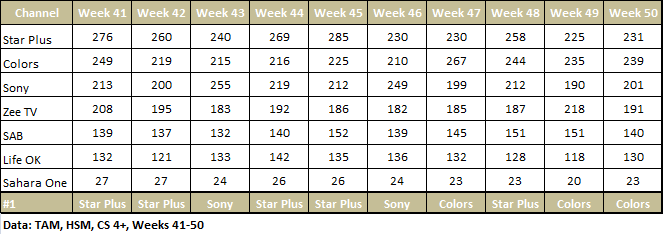
    General entertainment channel Colors has been #1 in Weeks 49 and 50. It also generated the highest in ratings in Week 47 as well. While Colors is #1 in three weeks, #2 in 4 weeks & #3 in three weeks, Star Plus has been a close #2 except in Week 47.  Sony was #1 twice while the highest rank Zee could attain was #2. Yes, there’s a neck-and-neck fight between #1 and #2.


    On Star Plus, the ‘Yeh Rishta’ leap on Dec 3 generated 5.4 TVR and the ‘Dabangg 2’ integration in ‘Diya Bati’ on Dec 12-13 got it 5.1 and 5.3 TVR respectively.

    On Colors, reality show Bigg Boss season 6 opened with 4.1 TVRs and has averaged 2.5 Monday to Friday in Week 41-50. The premiere of OMG generated 3.5 and 3.4 TVR delivering 39 GRPs.

    On Zee, Qubool Hai  opened with 2.5 TVR (Mon-Fri 9:30pm),  with latest week average  being 2.7.


    For Sony, the premiere of ‘Rowdy Rathore’ on Sunday Oct 21 garnered 5.1 TVR at the 12noon slot and 5.6 TVR at the  8:30pm slot  delivering 68 GRPs in all, whereas the premiere of ‘Ek Tha Tiger’ on November 11 fetched 3.3 TVR at the noon slot and 4.6 TVR at the 8.30pm slot delivering 55 GRPs. Kaun Banega Crorepati has been averaging 3.3 TVR.


    Earlier, the music genre numbers reached us, courtesy of 9XM. The flagship music channel has done remarkably well outwitting competition on most weeks.


    Meanwhile, you better not cry, you better get set… for Week 51 ratings are going to be out a day after Boxing Day. Yup, December 27! Week 52 data will be out on Jan 3 and the news channels on Jan 9.


    Imaging: Rafiq


  • Is our TV measurement future-ready?


    By Bipin Mundhwa and Amit Nevrekar


    TV audience measurement through the ‘peoplemeter’ is accepted as the most appropriate technique among others for measuring TV audiences. However, the capability of the peoplemeter (an electronic device) is completely dependent upon external factors such as continuous human intervention (Manual Inputs). Viewers need to press their respective button on the peoplemeter remote (as assigned to them) to let the system capture the data on who is viewing what. Which means it is safe to say that it does not automatically capture the viewers and their viewing patterns. It requires the viewer to keep in mind that they have to press the respective button every time they leave the room and enter the room.


    In an age, where people forget to turn off the switches while not occupying the room or even turn off the water taps after use, do you think people will remember religiously to switch on and off their respective people-meter remote button every time they enter and leave the room?


    There are high chances that the viewer may get interrupted by something and leave the TV room or for a while take an exit to do some other household activities without pressing the exit button. In such situations, the people-meter does not stop capturing the viewership of the audience, even though he/she is no longer viewing. What could be more erroneous than this?


    Jaldi 5 with Bipin Mundhwa & Amit Nevrekar: No one influenced us to write book
    Bipin Mundhwa

    01. It’s interesting that your book is published around the time when TAM is being needled by many stakeholders. In fact it’s also being sued. Is it just a coincidence or planned… given that you’ve highlighted the T, A and M in your book title ‘The Advertising Mess’?

    Frankly speaking, we had planned the date for our book launch much before the announcement of non-reporting of viewership data by TAM. The main objective of our book was to provide the necessary practical literature on The Audience Measurement systems in India. Over the years, we have seen different methodologies for the same medium in the same period resulting in different findings and thereby creating a Mess in media buying and planning.


    Amit Nevrekar

    02. Having worked with TAM as also with other media organizations, why is it that you didn’t raise some of the issues earlier?

    Working with TAM was always a pleasure. And we constantly discussed many improvements as part of our professional duty.


    There may be people who may say that you have written this at the behest of someone wanting to take on TAM?

    Firstly, we have not condemned a particular organization or criticized upfront. The book is about ‘bridging the gap for accountable MarCom’, where we have presented the ‘Bridge’ model which provides a unified B-Score across mediums in a single metric based on engagement levels, rather than inflated exposures. No one can influence us for taking such a mammoth effort whilst working, especially in a media agency, media house with hectic working hours. It’s only our self-inspiration and passion for our industry.


    03. Given that there will always be television channels who feel aggrieved by any ratings, there will be people who will raise objections against any measurement system?

    Every media professional subscribing to the respective measurement system’s data has the right to raise questions to understand and utilize the data in most logical and appropriate manner.


    04. You’ve touched upon corruption. And you say that with digitization, it could only increase?

    Yes, we have identified some loopholes in the system which can simplify corruption post digitization and needs to be addressed for robust data representation.


    05. One of the primary motives of the book is to talk about the ‘Bridge’ model that both you have developed. Have you had any discussions with BARC about it?

    The bridge model is purely developed by us. We haven’t had any discussions with BARC as an organization but we certainly had series of discussions with members of BARC, MRUC and other media veterans of the industry.


    In the current peoplemeter, if the TV is ON but none of the panel members have logged in the system (that is, pressed the peoplemeter button), then the peoplemeter would prompt for an input to register the viewing occasion for the respective panel member.


    But what if the panel member has logged in the system and is not present in the room. Is there any kind of validation thought about?


    However, today’s technological advancement allows us to make every impossible thing ‘possible’. There are Pyroelectric (“Passive”) InfraRed sensors that can detect whether a human has moved in or out of the sensors range. And undoubtedly, these are very inexpensive chips.


    Another such technology is used by Microsoft in their Xbox 360 game console, ‘Kinect”, which is a motion sensing input device capable of facial recognition along with full-body 3D motion capture. Which means if incorporated in the peoplemeter, will not only sense the individuals present in the room, but also identify if they are viewing the TV along with their engagement through facial expressions.


    Also, a very interesting point crops up, which ideally should have been raised by MarCom professionals. Bear with us as we elaborate.


    With the new Digital Video Recorder now commonly available along with most of the DTH providers, individuals have now got into the habit of not watching programmes live, but recording their programmes of choice and watching at their convenience.


    For example, if a working individual chooses to record a programme which was telecast from 4 – 5 pm, reaches home at 8 pm, and watches this recorded programme from 9 – 10 pm.


    ANOTHER PROGRAMME BEING TELECAST FROM 9 – 10 PM ON SOME OTHER CHANNEL IS ALSO RECORDED BY HIM AT THE SAME TIME TO VIEW AT A FUTURE TIME OF HIS CONVENIENCE.


    The critical point we are making is, most people with DVR facility have now got into the habit of recording almost all programmes they wish to view, and while viewing the recorded programmes, most of them would forward and skip all the ads.


    The question is, at 9 pm in the case of the above example, what will the peoplemeter capture as viewership?


    Will it capture the 4 – 5 pm show which is being watched between 9 – 10 pm or will it capture the 9 – 10 pm show which is being recorded for future viewing at the same time?


    And will the peoplemeter be able to gauge whether the ads have been skipped by the viewer while watching the recorded programme, which is bound to happen in most cases?


    BECAUSE THE 10-MIN AD BREAK CAN BE FORWARDED AND SKIPPED IN A MATTER OF FEW SECONDS..


    Thus this DVR facility has the potential of making the peoplemeter defunct and useless.


    Definitely, the currencies such as TAM should be keeping up with these advances in technology. We are very sure they have an answer for the questions we have raised above.


    BUT, we are also sure the industry and MarCom professionals would love to see a practical demonstration, if they claim that the people-meter can take care of these issues. Speaking is so much easier than doing.


    According to research paper published by Andrew Green (2010), the people-meter is only capable of capturing what is being displayed on the TV screen and not the actual behaviour of viewers.


    Very interestingly, TV broadcasting would be going digital in coming days. It has already gone digital in the four metro cities of India as on November 2012.


    In future, there could be options of pay v/s free channels, where the pay channel will have only programme content and no advertisements, similar to the current HD channels.


    DVR (Digital Video Recording) technology is also expected to dominate in the near future, which means there would be more flexible and enhanced TV viewership. This would also include storing of favourite TV programmes by viewers who would watch them at their convenience while skipping the commercial breaks.


    There is also an increasing trend of VOD (Video on Demand) in direct-to-home households. Would this mean lower viewership for repeat telecast of TV content? Because as the name suggests, VOD is TV content that can be viewed at anytime as per the convenience of the individual viewer. More sob stories for MarCom due to digitization.


    The new-age television viewership will include CAS (set top box), as well as others like DTH, DVR, IPTV/VOD, internet TV, TV programmes via YouTube and mobile TV. Conventional wisdom says that subscribers of these technologies will have vastly differing lifestyle habits. As we say, “necessity is the mother of all invention”. For the first time, the audience will be in the driver’s seat for choosing their option of technology of reception. So is the case with TV channels that they wish to subscribe to.


    Now, looking at the traditional TV measurement system, the viewership base will be determined by subscription packages, as now the option of choosing a specific channel is available to the viewer. In the recently phased-out analogue system in 4 metros, for a fixed monthly subscription fee, subscribers got access to ALL TV channels.


    This means the sampling frame for estimating TV viewership is based on the audience pool that recently had access to all the channels for a fixed subscription fee.


    Whereas, the new technology of digitalized reception will make the subscriber’s pool asymmetric for sampling. There are bright chances that the universe (the channels which an individual subscribes to), will fluctuate depending on basis of favourite channel/popular programmes/sports seasons or a new series, as people may change their channel subscription from time to time.


    For example, let’s consider a household which has recently switched to the DTH system from the old analogue system. Now this particular household has not subscribed to a particular GEC channel because they felt it was not worth paying an extra fee as they were casual viewers of only one programme on this channel, as against other GEC channels where they watched multiple programmes.


    Now after a couple of months, this household again decides to subscribe to that GEC channel they had abandoned because of a new programme of interest to them, along with a sports-pack for the upcoming IPL cricket season. Post the IPL season, they again unsubscribe the sports-pack.


    This means the channel’s universe has now changed beyond recognition. This will keep happening as now it will be directly related to pay for what you watch.


    In such situation of switching subscription plan from analogue to digital, peoplemeter may capture the audience movement from analogue to digital. However, within digital, the viewership for channels may fluctuate significantly (as these are sample surveys, where 1 panel member’s viewership is extrapolated to around 20,000 audience or more). This could result into vague and half-hearted understanding of channel viewership as practitioners would not know the reason for volatility in channel viewership i.e. Subscribed but NOT viewing OR Channel NOT subscribed.


    Until now in analogue mode, the same set of channels that a household with a people-meter had was also the same set of channels that all other households had, so the household with the people-meter was representative of all other households in the universe, at least as far as availability and access to channels went.


    But now, with households free to choose and reject individual channels, it is not necessary that a household which has a peoplemeter will have similar channels as other households in the universe.


    In fact there could be thousands of permutations and combinations of households with different sets of channels. So how would one judge whether the peoplemeters households are truly representative of the universe.


    Now with due respect to the existing people-meter technology for capturing TV viewership data, can we ask ourselves how geared up are we to take on the future challenges of capturing TV viewership data in light of the above mentioned technological advancement.


    The story does not end here. The real challenge is still to be explained by us. TV as a medium was largely an ‘at-home’ medium. However, TV as a medium is now becoming highly portable. How are we going to measure the audience on portable TV?


    For example, most of the working population may watch IPL out-of-home such as at office, at a common friend’s place, on their laptop, etc. On weekends they would also go to restaurants and pubs to watch the game in a social gathering and cheer for their favourite team. Their receptivity to the programme may be higher but it does not get covered as the people-meter is not capturing out-of-home viewership.


    This may influence viewership of popular sports seasons and they may get under-reported as compared to actual viewing figures.


    According to Horrell (2008), IPTV (Internet Protocol Television) could offer some encouraging answers to audience measurement such as real-time audience measurement through return-path-data technology from TV owning households itself. Moreover, it allows broadcasters to divide audiences based on socio-economic class, geographies and basic demographics. This would enable advertisers and media planners to showcase lifestyle, socio-economic class and geographic location based Ad streaming. One can avail the technology now as this is reality.


    One of the sophisticated devices according to Pellegrini, Pasquale and Purdye, Ken (2004), for measuring out-of-home TV viewership is Arbitron’s Portable People-Meter for capturing passive viewership data based on encoded audio signals, embedded in the TV programmes being watched. This pager-like device would have to be carried by selected individuals to enable this device to capture the encoded audio signals. However, it could prove to be misleading if the audio signals are being captured in the vicinity but the individual is actually not watching it. For example, in a coffee shop, the PPM may record TV viewership for an individual but the selected individual is engrossed elsewhere.


    What does all this mean for advertisers? How will they optimize their media investment?


    In totality, TV as a medium which even today is highly fragmented with 700+ channels will have very tough and challenging days ahead as far as measurement goes.


    ‘The Future is now, but Measurement is Yesterday’


    Extracted with permission from

    The Advertising Mess

    By Bipin Mundhwa and Amit Nevrekar

    Published by Sci-MO

    Price Rs 249, 139 pages

    www.theadvertisingmess.com


  • MIB bows to news TV pressure, pushes TAM to delay ratings data release

    By A Correspondent


    In what is clearly a case of government interference in the broadcast business, measurement agency TAM Media has been compelled by the Minister Manish Tewari-led Information and Broadcasting Ministry to not release the data for ratings for the last week as well as for around the last two months which it had agreed to not release. The other stakeholders – the IBF, ISA and AAAI – have been mute witness to the decision and chose not to take the government head-on.


    While TAM spokespersons were unavailable for comment, sources tell us that news broadcasters had petitioned TAM to not release data for a while. When TAM sought the advise of other industry stakeholders, they (the other bodies) trashed the plea and chose to go ahead with the release.


    However, it appears the news broadcasters were able to convince the government which used its power to push ahead with the late evening knock.


    Late last night, TAM issued the following statement: “At the request of the I&B Ministry, the Government of India, and in concurrence with IBF, AAAI & ISA, we are delaying the data release to Thursday/Friday.The reason for doing so is that  the Government of India has requested us to withhold release of news channels data by two or three days.  The industry is meeting with the ministry to take a decision. Thank you for your cooperation.”


    While TAM and the other industry bodies are not required to toe the government line, they chose to do so, fearing retribution in the future, an industry observer told MxMIndia.


    News channels are reportedly desirous of a longer ratings-free window. They believe the current processes followed by TAM do not effectively track their viewership. However, advertisers and media agencies want the presence of a measurement currency so that they can effectively spend monies.


  • No TAM data release today as MIB ask withholding news channel numbers for 2-3 days

    By A Correspondent


    There will be no release of data from TAM Media research today, as the Minister Manish Tewari-led information and broadcasting ministry has urged TAM to withhold release of data of news channels by two or three days.

    Late last night, TAM issued the following statement: “At the request of the I&B Ministry, the Government of India, and in concurrence with IBF, AAAI & ISA, we are delaying the data release to Thursday/Friday.The reason for doing so is that  the Government of India has requested us to withhold release of News channels data by two or three days.  The industry is meeting with the ministry to take a decision. Thank you for your cooperation.”


  • Let the (ratings) games re-begin!


    By A Correspondent


    After a brief two-month hiatus, the broadcast industry will be waiting with bated breath to lay their hands on the viewership data that will be released by TAM tomorrow – that is, December 19 2012. The day will be of utmost importance in the broadcasting fraternity as it marks the release of data post the digitization drive that transpired across four major metros and also for the fact that the industry expects new trends to emerge, something that was amiss when the analog world was largely in operation until October 31, 2012.


    Just to recap, TAM had stopped issuing ratings to the industry citing deferment. In wake of the phase-wise DAS implementation that was scheduled to take place across the four metros, the custodians of TAM Media Research – Advertisers (ISA), Media Agencies (AAAI) and TV Broadcasters (IBF) – had arrived at a joint consensus on the need to temporarily defer TAM TV Viewing data release for the All India market for a period of 9 Weeks starting Week 41 (October 7, 2012, Sunday) and ending Week 49 (December 8, 2012). This deferred data will now be released on December 19, 2012 along with data for Week 50 (December 9-15, 2012).


    LV Krishnan

    At a press conference last week, LV Krishnan, CEO, TAM Media, highlighted the progress that had been made so far post the switch to digitization by the four metros and what were the immediate trends that were showing up in the new universe. What was heartening to note was that most analog homes in Mumbai and Delhi had made the imperative switch to digital with Mumbai recording a 93 per cent conversion rate compared to Delhi that recorded an impressive 97 per cent. On the other hand, Kolkata witnessed only 70 per cent conversion from C&S homes to digital while Chennai recorded more abysmal figure of just 26 per cent homes that had moved on to digital.


    Emphasising on the new rating mechanism, Krishnan said that as per the advice of the CIC committee, TAM will not report homes in the DAS area that are not digital. This will lead to the universe also shrinking correspondingly. Thus while analogue data from Mumbai, Delhi and Kolkata will not be released, an exception will be made for Chennai where it will continue to report analogue data given the low conversion rate observed there. Krishnan added here that the Urban Agglomeration or non-municipal corporation areas in Mumbai that consist of Navi Mumbai, Thane, Dombivli, Kalyan etc will continue to release analog data as they would be liable for conversion when the second phase kicks in. Thus, going forward, the data that would be released will be reported at breaks of C&S 4+, NCS (Terrestrial), C&S Digital 4+ and C&S Analogue 4+ (for non-DAS areas).


    Among the few trends that were observed as a result of the digitization drive, Krishnan pointed out the move had been a boon for niche genres like English and kids entertainment that witnessed a spike in viewership (time spent) during this phase. He noted that about 60 percent of channels with a pre-DAS share between 0 and 0.5% gain in share had witnessed a 4 percent net share gain post digitization. This was not the case for larger market share channels that witnessed a slight reduction in the net share gain.


    In order to facilitate the ever-expanding universe size, TAM has said that it would be increasing its sample size by about 400 peoplemeter boxes in the Mumbai and Delhi markets starting from the first quarter of 2013. It has also decided to add another 250 peoplemeter boxes to centres such as Chennai, Hyderabad, Bangalore and Kolkata.


    While all systems are set for the December 19, 2012 release Krishnan stated that with digitization having set in it was important to be cautious when analysing data in this phase like for example taking averages, looking at trends, not cutting data too fine such as a particular half hour on a particular day, ensuring that sample sizes are sufficient etc. Asserting his gameplan for the future, Krishnan said that for Phase 2, TAM seeks to carry-forward the learnings and continue working with the committee to make it conducive and resourceful for the broadcast environment.


    MxMIndia spoke to a few members from the broadcast fraternity to see if not having data for two months made any difference to their survival and what would be their expectations from the new ratings that get released from December 19, 2012.


    Ajay Bhalwankar, Head- Content – Hindi GECs, ZEE

    “There is a myth about every Wednesday morning being a scary one….You won’t find us running helter-skelter every Wednesday. Ratings tell you what has been liked and what has not been liked but not what has to be done! So they are just a reference point. We have an internal meter which we follow to check whether our shows are creating magic or not. Initiatives on digital and social media brought us closer to our audiences. This internal judgement is important. I started my career in the ’90s and we had no ratings then for nearly eight years. So, ratings do not bother me.”


    Anand Chakravarthy, Business Head, BIG CBS Networks

    “Our issue with TAM has always been that the English entertainment genre has never been well represented. The fact is that the English entertainment speaking audiences are never fairly represented in the sample, due to which the data released is not quite comprehensive. As a network, we have never depended on numbers to sell; we’ve always talked about the quality of content and the quality of our offering which has been our strength. In fact we have always maintained that TAM data is not a yardstick for niche channels like the English entertainment channels because the sample size of TAM does not represent this audience well.


    Even with digitization happening, the question, is how well will the new sample represent households that watch English entertainment channels? There could be some amount of movement of market shares between genres as we know that some parts of metros are still not disconnected completely. Therefore the universe size may reduce in some markets that will lead to change in ratings from the larger genres to possibly the smaller genres. But the fundamental issue, does the TAM ratings represent the English entertainment genre well enough and does it have the right sample size and profile of people, the answer to that is no. It will continue to be a problem unless it is addressed very clearly and head-on. That’s an issue that needs to be addressed very quickly. We are working with TAM to see how we can better evolve the system so that the English entertainment space is represented well enough.”


    Nina Elavia Jaipuria, EVP & Biz Head – Sonic & Nickelodeon India

    “What happened was for the good of the industry because it was required that everybody come to a consensus and see that the data is sanitised thanks to the changing environment and that it would give us a better understanding of phase 2. So while life was disrupted for about 8 weeks, it was all for a good cause. But having said that, I also believe that TAM is the only currency that exists in this industry and therefore we did miss its release to some extent. But it was a minor hurdle and nothing major so as to change our lives drastically.


    As for the release of data once again from tomorrow, we have to see what the new TAM has in store for the industry. They must be having their hands full as of now but then there is a committee which is looking to sanitize data that gets released. With the digitization numbers already pouring in, we are eager to see the kind of trends that the kids entertainment genre has managed to throw up. I see content and marketing playing important roles as they will drive viewership to the genre. So I would wait to see what TAM has to offer and take that lesson to phase 2 of digitization. I am sure that TAM will keep themselves abreast of the sample size and formation based on the manner in which digitization gains acceptance. So the universe will also move accordingly and I am sure that TAM would have taken into account that factor. Whether it is SEC fragmentation or it is the universe movement, TAM surely would have taken all these things into account. Also, digitization will only help the industry in terms of it becoming more transparent and more measurable and the fact that the niche genres will have a better chance to survive.


    Also, it will become an environment where the reliance on ad-sales will witness a drop. It will not vanish completely but we will see more reliance on subscription, which will be a good thing. All this won’t happen overnight as only 4 metros have been included in phase 1, which will move to 38 other cities in phase 2 that will take another 4-6 months. But in the end the country will be digitized for good.


    From a qualitative perspective, we would like to see different slicing of data especially from a demographic and psychographic perspective in the kids’ genre. Traditionally we have been doing 4-14 yrs which is sliced 4-9 and 10-14 yrs and the more we look at kids today and the fact that they are becoming more dynamic today, there is a need to relook at the slicing by TAM.


    Ajay Trigunayat, CEO, English Entertainment Channels, Times Television Network

    We are of the view that it’s difficult to capture rapid macro-transitional changes:


    1. Analog >> Digital migration

    2. Panel Updation

    3. Change in SEC definition


    We certainly understand it’s a challenge to condense this transitional period but we are hopeful TAM will accurately reflect these changes soon.


  • The Anchor: 4 reasons why it’s the last Wednesday many of us can have fun

    By A N Chorrea


    Chill, next Wednesday is December 19 and all those theories about the world plunging into darkness etc can be reserved for the 21st.


    So why is this the last Wednesday for fun?


    #1 Note the date next Wednesday: December 19. That’s when TAM ratings will come alive once again.


    #2 This article ought to have appeared yesterday. Folks, last night was your last Tuesday night of fun… don’t expect similar luxuries to happen again


    #3 Not just Wednesday, you may as well tell the family that the weekend of Dec 22-23 will be spent crunching numbers, and analyzing data for the last two-odd months


    #4 It’s not the last Wednesday of fun for broadcasters, media agencies and the folk at TAM, but also the entire ecosystem. Beat journalists who have to interpret stories. PR agencies who will need to figure new talking points for their TV clients. Advertising agencies who may be required to work overtime to capture mailers and magazine ads. Even IT and admin departments as they’ll need to ensure the machines are working fine and the printer toners are refilled. Accounts department to reimburse the late night food and taxi bills… phew!


    Surely, there’s someone out there at the Mumbai headquarters of TAM Media Research laughing out loud: Yeh TAM TAM ki baat hai! Meanwhile, enjoy the next six days!


    A N Chorrea is a senior industryperson writing under a pseudonym


  • Digitization: The media agency view


    By Ananya Saha


    Phase I of digitization has been a challenged ride. Even as MIB believes that as on November 5, 2012, 22.4 lakh Set Top Boxes (STBs) were installed in Mumbai, 25.15 lakh in Delhi, and 17.74 lakh STBs in Kolkata; analogue signals still continue to beam in the four cities. The Chennai matter is sub-judice in the Madras High Court. To top it all off, the sunset date for the second phase has already been announced. It is no doubt that 100 percent digitisation of the four metros is still a huge task.


    Anita Nayyar

    Anita Nayyar, CEO, Havas Media, India & South Asia said, “The current state will carry on over the next eight weeks until stabilization sets in and state government and consumers realize it’s here to stay. The change to digital, now or later is eminent in waves if not crests and troughs. Hundred percent digitization across India will certainly take much longer and there will be many more extension dates.” Raj Datta, Senior GM, MPG-Kolkata also opined that reaching 100 percent digitization in Kolkata will take close to three months.


    Raj Datta

    While the broadcasters are happy with the numbers, since it will give them additional revenues and save them the carriage fee, the advertisers are still apprehensive. The cost of set-top box (STB) and infrastructure are the primary concerns of the industry. The suspension of TAM data, simultaneous beaming of analogue and digital signals is only adding to the confusion during the festive season. Mona Jain, CEO, Vivaki Exchange opined that the advertisers are wary of the fact that visibility will drop due to the transition. She said, “For the advertising fraternity, the festive season is the key period for them. Due to transition to STBs and digital signals, there are going to be shortfall and shifting in terms of visibility. This is a big concern for them. They are not able to predict the shifts in their current plan and that is an issue.”


    Mona Jain

    Kolkata has been grappling with low transition numbers. While Mr Datta predicts that digitisation might shoot up due to the impeding cricket season, he is quick to point out, “We do not know what the numbers will show because TAM data has been suspended and will be available only after December 15. Anything and everything is an estimate. It remains to be seen how channel scenario will change. I am guessing that the viewership of niche channels such as History, Nat Geo might shoot up. Post digitization, illegal connections will also drastically drop, also because they will have to shell out money and take a connection. Thus, I feel that the whole scenario will change towards what SEC A likes.” He also said that the sampling of SEC A, B has also increased and this might result in shift of advertisers’ money.


    “Advertisers as rule will have to adopt a more segmented and targeted approach sub-slicing their segments. With access to more channels, viewership by TG, will get spread, people will experiment and consume more even if it is not focused consumption and this will happen across genres. Marketers and advertisers if they want immediate results will be looking at incremental spend than earlier budgeted as they will have the option to follow the spread,” opined Ms Nayyar, adding, “Underreporting of C&S households has been an issue and resulted in loss to the exchequer. Further there is the deferring of the TAM data which clients are used to even though digitization will allow more refined information, but while this is already being done it will take a while to become a norm.”


    She also said that advertising will increasingly get localised and spill over to local print and radio in the long run.


    According to Mr Datta, advertisers are apprehensive about believing the historical data and the current situation. “As a media agency, we have to depend on historical TAM data that we have till October 7, but we do not know if it is giving the correct picture. But we do feel that overall viewership might drop because of digitisation. These issues are coming up repeatedly since we work with cost effective measure called CPRP, and broadcasters are a little apprehensive. It is a complete wait-and-watch kind of scenario. Something definite is quite difficult to predict,” he said.


    While the planners and buyers feel the broadcasters are co-operating, it remains to be seen who emerges unscathed in the digitization fracas.


  • Only 59% (&not 87%) digitization achieved!


    By Pradyuman Maheshwari


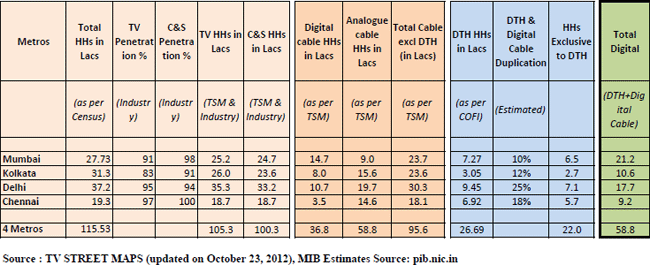
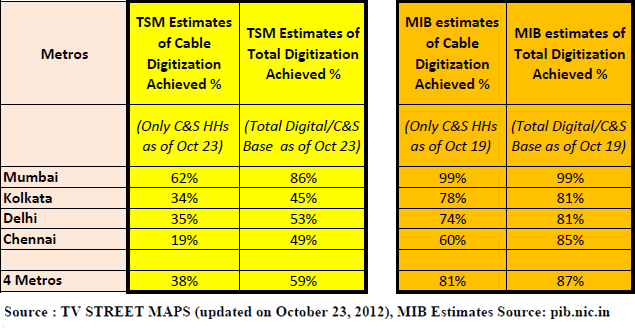
    Only 59 per cent of digitization has been achieved in the four metro as per the first ever independent survey of the extent of digitization in the four metros was conducted by Television Street Maps for MxMIndia. This number is in sharp variance to the claim made by the Ministry of Information and Broadcasting that 87% of the four metro was digitized.


    The figures for the four metros tell the story:


    For Cable & DTH:

    Mumbai: 86% (Govt: 99%)

    Delhi: 45% (81%)

    Kolkata: 53% (81%)

    Chennai: 49% (85%)

    The gap grows when you look at the achievement of digitization only in cable homes.


    Mumbai: 62% (Govt: 99%)

    Delhi: 34% (78%)

    Kolkata: 35% (74%)

    Chennai: 19% (60%)


    On Tuesday, we made a clarion call to the mandarins of the Ministry of Information and Broadcasting urging them to put an end of this charade of make-believe numbers of digitization.


    MxMIndia strongly believes that digitization is THE ONLY way in which the broadcast business can survive and thrive. For too long there has been much confusion amongst stakeholders. With half-baked regulations and guidelines, certain sections of the ecosystem were getting away with unethical practices.


    India has been among the most happening markets in the global broadcast business. Most of the world’s media superpowers are here. What was needed was some order in the business. Which digitization was going to bring in this, as it happened internationally. Unfortunately, the government has appeared to have missed  a trick in its attempt to execute this.


    The Sunset Date for the switch from analogue to digital transmission in the four metros was first fixed as June 30, 2012.  Then it was shifted at the last-minute to October 31.  When this writer mentioned that even that date looks tough to achieve, there were many in the industry who said that the momentum will build eventually.


    Although MxMIndia had been running a series starting 100 days to the June 30 deadline, we didn’t look at digitization in a big way until there 50 days left for November 1. But soon after interacting with all stakeholders, we figured that none of the numbers on the extent of digitization achieved that were being dished out could be believed.


    Jaldi 5 with Joydip Kapadia: Data based on ground-level info + professional & expert assumptions
     

    The government claimed an 87% achievement of digitization while the study conducted for MxMIndia by Television Street Maps showed this achievement to be only 59%. While this figure is for cable and DTH homes, that in cable homes alone is a low 38% as against the I&B ministry claim of 81%. MxMIndia spoke to Joydip Kapadia, Business Head, Television Street Maps on the issue:01. There is a huge variance between the TSM study figures of 59 per cent total digitization as against 87 per cent which the government is quoting. Why do you think do we have this huge difference between the two figures?

    I wouldn’t be in a position to comment on the numbers quoted in other studies. After all, whether its the authorities or TSM or other third parties releasing info about the ground, we all have to resort to diverse methodologies and assumptions. Sometimes the estimates of individual studies could vary due to the underlying assumptions considered. These assumptions work at multiple levels – each or all of these assumptions levels could influence the end result. For instance, differences in defining the areas within the city, definition of Digital TV (including or excluding DTH), total cable homes in a city extrapolated from census and other sources – are just some of the places where assumptions taken upstream within the analysis could produce variations in numbers coming out downstream – at the end of the analysis. All I can say is that our data is based on information obtained from the ground overlaid with our professional and expert assumptions.


    02. By your estimates how much do you see the 59 per cent grow to by October 31?

    It’s difficult to predict given the scale of the initiative and the number of players and variable involved. I wouldn’t like to hazard a guess.


    03. Would you see broadcasters lose out because of the delay (given more carriage fees, the delay in transparency, but then assured reach)

    We have actually not looked at these aspects so I wouldn’t like to say anything on that.


    04. Is there any one thing that you would like to see being done right if there’s a delay in the date and/or for the digitization for the rest of the country?

    We are not direct stakeholders in this and cannot offer any advice in this regard.


    05. 05. Do you think it would be prudent for the government to push the digitization date in the four metros by another three months?

    The math for all stakeholders comes down to what is the overall target to achieve vis-a-vis the seeding pace of the industry to reach that target. If that Math adds up then great, else the verdict would be to budget for greater time.


    It is then that we commissioned Television Street Maps (TSM),  India’s largest and widest channel distribution monitoring service covering over 1500 headends across  675+ cities/towns, to conduct this study. TSM placement monitoring data is provided on a weekly basis to its clients who include names such as Indiacast, One Alliance, Viacom18, MSM, Star, UTV, etc. Besides providing distribution monitoring for analogue and digital for Class-1 towns, TSM has recently started providing distribution monitoring for LC1 towns as well as Digital Track, a system to analyse Digital offerings of MSOs and DTH companies.


    Over the last two years, TSM has been tracking cable headends on a daily basis and reporting on a weekly level in almost a cable census style – covering every headend for the geographies it represents. While the data provided here are just the toplines we intend to provide detailed insights to our client on DAS. (see box: Jaldi 5 interview with TSM Business Head Joydip Kapadia: Data based on ground-level info + professional & expert assumptions ).


    Methodology of Data Capture:

    Over the last two years, TSM has been capturing TV channel distribution on a daily basis – the expanse of which is now a staggering 1500 headends across 675+ towns. This daily activity has been augmented since August 2012 for the four metros to capture the movement from analogue to digital at a more granular level. This augmentation/ expansion has been done using extensive ground intelligence and multiple verifications due to the criticality of the data. To ensure correctness of the data, more frequent scans were done in the last few days. The current release is for the ground situation as on October 23, 2012.


    The ground info on Analogue versus Digital has been layered with metro universes data collated from census and other third party sources to ultimately validate and put together the digital penetration data for the 4 metros.


    The sharp variance in the numbers as per the TSM survey and those put out by the government is reason for worry. But this is precisely what led MxMIndia to commissioning this study. No one really believes the numbers that are being put out by the government though MxMIndia, like other media, has been publishing these.


    MxM View

    MxMIndia recommends that the government act in a mature way on the issue. While a delay will mean a loss of face, it’s better to schedule for a time when 100 percent digitization is truly achieved. At the time of writing, we’ve heard of rumours that the government may well announce a delay by two months. We would urge the government to not look at December 31 as the Sunset Date. There is a fair amount of special programming on television planned on that day and the government would be well advised to look at a date like January 31.


    However, while doing so, it must get assurances from the governments in West Bengal and Tamil Nadu on compliance. The government must also meet all stakeholders to ensure that everyone is on the same page and is working towards the greater common good. It may be a good idea for it to appoint a full-time Officer on Special Duty for digitization. Either someone from its ranks, or pulled from the industry.


    A note of caution: there is a general election coming up in 2014, possibly earlier. Elections have been lost due to grave national issues and teary ones like onion prices. If there’s any mess-up with digitization, the government can ill-afford a crisis where the masses won’t get to watch their favourite shows on telly. Then, the cry will surely be: alag chahiye!