Tag: Shailesh Kapoor

  • Talent Travails on Telly


    By Shailesh Kapoor


    It’s about 25 years since the start of the satellite television industry in India. While 25 years is a long time, the industry would still qualify as being fairly young when benchmarked against more traditional sectors like FMCG.


    One of the most interesting facets of a new or young industry is how it builds its talent pool in its early years. This aspect has been of particular interest to me for the television, film (even younger) and digital content (newborn) industries in India.


    In the ’90s, in the first decade of the TV industry, talent pool creation was largely organic. While some senior hands from other sectors were hired at the top levels by most networks, especially the foreign ones, the bulk of the talent pool was created by hiring young people in the creative field, erstwhile working with ad films or features, often at assistant levels, or by hiring media planners and buyers to staff up the sales function in TV channels.


    If one had to describe the overall feel of the talent pool in that first decade, they were a bunch of young and semi-maverick people passionate about working on something that was new and growing.


    It’s difficult to say when exactly that phase ended and the next one started. It would have been somewhere in the 2001-2004 period. The next phase, which lasted for about seven to eight years, that is, till the turn of the decade, involved two key shifts. By now, media was becoming a lucrative option for senior resources in FMCGs, consumer durables and other such marketing-savvy sectors to consider. The top layers of several broadcasters witnessed entry of such “outsiders”.


    The impact of the “outsiders” was evident in the processes and the marketing focus they brought in. The content creation side of the business, however, didn’t change much, and continues to operate much the same way even today. The failure of the “outsiders” to impact the way the production side works (not what they create, but how they work to create what they create) is probably the missed opportunity of this phase.


    The second key shift in this phase was related to the geometric (not exponential) increase in the number of channels and hence the demand for talent. While senior hires in big networks happened from outside, the middle level witnessed a lot of demand and not even quality supply. Dangerously then, we saw promotions before they were due. Executives with less than a decade of experience, and not necessarily a glorious career backing them, were put in roles that they were just not ready for. Not that they knew it then, or for that matter, realise it even today.


    As a result, there was a huge loss from the idea to execution stage, i.e., from the top levels to what goes out to the consumer.  Many network heads carried this frustration with them, of just not being able to get the next level to see where they are coming from.


    This problem, if we can call it that, began to ease off around 2010, as the young lot that was promoted too early learned the ropes and grew with experience.


    Now in the third decade, there are two talent challenges the industry is facing. One of them is the reverse of the demand problem from the last decade. With the number of new channels drying up, there are not that many jobs being created within the sector anymore. We see a lot of shifts between networks, but for someone to grow up the ladder is becoming increasingly difficult. There’s just not enough demand for senior level broadcasting jobs today.


    The second challenge is one that digital poses. Many on the creative and the marketing side of the broadcasting business are being lured by opportunities that digital content could offer in the coming few years. There is also a sense of frustration with the status quo on GEC content, triggering the shift to digital faster than it would have happened otherwise. The next year will be a defining one for digital content in India. And how many make the transition from TV to digital content will be interesting to track.

     

  • Shailesh Kapoor: Cutting us to Size: India’s Censorship Woes

    By Shailesh Kapoor


    I can say ‘I told you so’. Last week, in this column, I had said: Udta Punjab is coming up, but a messy mix of certification board, courts, state governments and religious-cum-political ‘activists’ will thwart its flight.


    Though the writing was on the wall, the authorities have managed to add a dash of dark humour to this episode, by becoming a laughing stock in no small measure. But one that gets a laugh of exasperation out of you.


    One can vaguely sense that there are some reforms on the anvil. But the truth is, the entertainment business, be it films or television, has never been on the priority list of governments over the years. They are only used strategically to achieve political objectives when convenient.


    The idea of censorship goes beyond certification. The latter recognises the freedom the former is designed to curb. They are near opposites in ideology. Yet, we are still struggling to pick one over the other. The ‘certification’ board actually censors, because it has managed to generate a long list of taboo things that won’t even get the toughest of the certificates – the Adults only (A) one. This taboo list can keep getting shorter or longer with every successive board chief (and the powers backing him/ her). But the problem shall remain till the idea of this list is dropped in the first place.


    “Self-regulation” has often been suggested as a solution. I find that phrase a bit of a misnomer in the Indian context. Self-regulation should imply that the owners of the content, e.g. TV channels or ad makers, responsibly regulate what they put on-air, on their free will, in the interest of their audiences and the society at large.


    Yet, self-regulation operates in our TV industry more out of fear than responsibility. There have been instances of English channels being taken off-air by the courts for not censoring adult language or visuals. That has made all channels airing foreign content treat every show or movie with kid-gloves. Footage is cut out, words are muted, subtitles are asterisk-ridden, and so on.


    If you want to watch international content uncensored in India, you are literally forced to take the piracy route, because nothing in the theatres or on TV airs without mutilation. Only the degree varies. This is all self-regulation, of course, the powers will tell you. But you create fear and you get this. It’s self-regulation by coercion, not by free will.


    The problem is not limited to foreign content. Indian television stays clear of any potential controversies too. The language is sanitised, even the most hardened criminals don’t smoke, and the idea of showcasing sexuality is entirely irrelevant. It’s another matter altogether that superstitions, potentially a lot more threatening than many things on the TV taboo list, are casually endorsed across serials.


    But make no mistake. Our television is censored too. The self-regulation garb is only a sham. After all, it is humanly impossible to censor television, given the volume of daily content. If it were, it would fall under CBFC in no time, like films on TV do.


    The ones laughing through all this would be the content creators in the internet business. Censoring films and television will only make the internet a more viable option for mainstream content consumption. But don’t be surprised if someone decides to censor that too. The tool there is probably the easiest to execute – Send sarkaari instructions to all ISPs to block the site. No revising committee, no FCAT. Fight a battle in the courts if you will.


    North Korea? Not yet, but quite close.

  • Shailesh Kapoor: Highly Non-troversial: When Snapchat Videos Become News

    By Shailesh Kapoor


    Pointless controversies have kept our media buzzing for about a decade now. When Indian celebrities started taking to Twitter a few years ago, using social media as a source of news collection and reporting became an acceptable proposition. Slowly but surely, such news made its way into the primetime and on the first page. Then, it became a topic of news debates.


    But nothing beats the silliness of the ‘non-troversy’ of this week. The Tanmay Bhatt Snapchat video spoofing Lata Mangeshkar and Sachin Tendulkar offended many Indians. Being allowed to take offence is a sign of a thriving democracy. But calling for arrests and giving primetime importance to something that shouldn’t have made it to television in the first place is a sign of our times.


    It’s a sign of how news-starved our channels are, and how publicity-hungry several celebrities, starlets and politicians are. What’s there to even debate on the said video? It’s a piece of humour with no social or national security ramifications. And this is not the first time we have seen celebrities been spoofed. Why should the idea of a whether a spoof is acceptable or not depend on who’s being spoofed? The constant use of ‘Bharat Ratna’ in the argument made us non-Bharat Ratna-winners seem like worthless algae.


    In a mature society that respects its art, the response of an artist who felt disgusted at the video would have been to put up a piece of work (a Snapchat repartee or an open letter, perhaps) to counter the one that offended him or her. But we have no such luck, do we? Our model is simple enough. Our ‘celebrities’ will tweet their disgust against something like the video in question. News channels, forever on a Twitter prowl, will handpick the most interesting tweets, and a taskforce will be put to get them to appear on the primetime show. Not that it’s a challenge. The other side is ever eager anyway.


    Yet, there are some appearances that can perplex you. How would Rakesh Bedi, an actor who’s largely inactive now and hasn’t tweeted for two months, make it to a primetime debate? Who would even come up with the idea? Answers to questions like these can make for fascinating reading in a book called “How TV Channels Run”.


    If you thought this was a controversy big enough, brace yourself for what’s to follow over the next three weeks. Udta Punjab is coming up, but a messy mix of certification board, courts, state governments and religious-cum-political ‘activists’ will thwart its flight. And Udta Punjab’s battle to get a fair release will only be a trailer to what is likely to happen to Dangal later this year.


    Enjoy the chaos. For it is a reflection of what we have become.


  • Shailesh Kapoor: GECs in a Promotional Traffic Jam Post-IPL

    By Shailesh Kapoor


    We are just two games away. This Sunday night, the ninth edition of the IPL will be out of the way. Out of the way for the rest of the mainstream media, especially GECs and big-budget Hindi films, who stay away from taking panga with the league. Since 2008, when the IPL started, this has been the tradition, barring a few exceptions.


    The Friday after the IPL final has become a key week for Bollywood releases. Only five new Hindi GEC shows have gone on-air since the IPL started, two of them in non-match hours (before 8pm). A typical month over the last five years sees six launches. At that rate, we should have seen at least 11 launches in the IPL period.


    Clearly, IPL is the thing to avoid. After all, most shows do not come with an expiry date, and shifting a launch by a few weeks only means extending a long-running show by the same period. Piece of cake!


    The thought process of avoiding IPL is based on sound marketing logic. When there is disruption and distraction around, you can get lost in the noise. IPL certainly impacts the viewing patterns in a predominantly single-TV India, shifting the control over the remote, with complex negotiations that families have worked out for themselves over the years. In such a scenario, a new launch could be easily given a skip.


    But is it as simple as that? Nine to-be-launched Hindi GEC shows are being promoted aggressively by various channels currently, all slated to go on-air from this Monday (May 30) till the end of June. At least three others may announce their June presence soon. So we have two months’ quota being delivered in one month. Add to that the various events and movie premieres, and you realise the problem is back!


    Part 2 of the problem is equally important to state. Many existing shows will plan a major plot point in the month of June, leading to promotional focus. IPL is out of the way for them too. We may see a couple of leaps, some new characters and a few maha-episodes and maha-sangams.


    The very disruption and clutter that led to the IPL being ducked is going to be on full display in June. The viewer’s appetite to handling new shows is fairly limited. Even the most seasoned viewers cannot recall more than two upcoming shows unaided. In such a scenario, the more high-profile launches on bigger channels like Colors and Star Plus will still make the cut, but the problem multiplies significantly for the next set of channels, who do not have that kind of daily reach or equity currently.


    The GECs will be caught in a promotional traffic jam this June. Time for one of them to come up with a fresh, almost lateral, approach to manage the IPL in 2017?


  • Two reviews of Results Day 2016


    Election Results Coverage: A Mix Of Hits & Misses 

    By Shailesh Kapoor


    There are very few tentpole days in television news these days. The debate format has homogenised the genre, bringing it down to personalities rather than the news or its coverage itself. And if you are a regular news viewer, you would get the feeling that something of utmost national or global importance is happening everyday. There are no slow news days anymore.


    The only real tentpole days left are those of election results coverage, which is just about one day every year. 2016’s election results day just passed by, this Thursday. Four states and the Union Territory of Puducherry went to polls over a couple of months, and it all came down to May 19, the day of the counting and the results.


    The results themselves did not have the edge-of-the-seat element or kahaani mein twist. Tamil Nadu was not as close as some had predicted. West Bengal, Kerala and Assam went on expected lines. Early trends held on till the end, and no Bihar-like moment happened, where several channels, including NDTV, wrongly predicted the outcome in favour of BJP, much too early, based on very thin and almost irrelevant data.


    The English news coverage itself was a case of hits and misses. Over years, election results coverage has started testing the multitasking skills of viewers, which is never a great idea. At one point of time, you may have to pay attention to five things – the ticker with the state-level seat leads, a second ticker with seat-level details, the graphic on the screen trying to analyse a key trend, the anchor talking you through all of this, and a voice, often of a panelist (one of many waiting patiently to get themselves heard), trying to add value to it all.


    When there is no major excitement in the results, like this time, this format exposes its weaknesses. It puts the onus of comprehension on the viewer, instead of the channel taking the responsibility of simplifying things for its viewer, in a way that’s easy to comprehend yet not dumbed down.


    Times Now used some new graphics, under the fancy branding of ‘Data Journalism’. There was too much branding and build-up to it all, but the actual content of these innovations ranged from mildly interesting to banal. While these new properties, with names borrowed from a math class, were a bit of a miss, the channel relied on Arnab Goswami’s unrelenting energy and enthusiasm to have another good day. His gentle rebuking of his panel members, when they entered side conversations, was particularly endearing.


    NDTV was the only English news channel that did not expect you to multitask. They typically had (like always) limited data on the screen, and spoke at a pace (like always, again) that needs to be fast-forwarded 4X to match Goswami. Much as this idea of de-cluttering has merit, there is something soporific, Doordarshan-like about the NDTV coverage over the last few elections. That roundtable set and the casual style just doesn’t bring purpose to the proceedings. In contrast, their analysis shows in the evening have a lot more going, with the best talking heads and some interesting, often lateral, questions.


    One of the more interesting segments of the day featured Arjun Jaitley and Shashi Tharoor debating the results on India Today in the evening. While Tharoor had the tougher job to do (defending Rahul Gandhi is never easy), the debate had depth and civility that’s a scarce commodity these days. Perhaps because the more eloquent talking heads have stopped appearing on television debates barring an odd day like this. Can you really blame them?


    We have a few key states lined up for elections in 2017-18, led by UP, Punjab and Gujarat. Hope we see more hits and less misses in that coverage.


    Why waste monies on Exit Polls 

    By Ranjona Banerji


    Most exit polls showed Mamata Banerjee winning a second term in Bengal. And indeed, the Trinamool Congress and Banerjee did win. But there’s the thing. On May 16, at around 7 pm, the ABP-Ananda poll said she would win 163 seats, C-Voter said 167, India Today said 243, Chanakya said 210, News Nation said 153. As everyone knows by now, Banerjee won 211 seats, higher than her majority of 184 in 2011, when she had formed a government in alliance with the Congress.


    In Tamil Nadu, on May 16 at 8 pm, here were the exit poll predictions: India Today DMK 132, News Nation DMK 116, C Voter DMK 78, NewsX DMK 140, ABP Nielson 132. That is, incumbent chief minister J Jayalalithaa of ADMK was losing, except according to C-Voter who said she would win 139 seats. J Jayalalithaa won 134 seats.


    In Bengal, we see confusion over the number of seats with only Chanakya coming close to reality. In Tamil Nadu, other than C-Voter, we see the exit polls getting it completely wrong. I am using only two examples but they should be enough to bring up once more the point of this exercise. Newsrooms spend a lot of money on exit polls, now almost essential it seems in the hysterical run to be first with breaking news. The range of seats for the Trinamool and the absolute distance from reality in Tamil Nadu are only two examples of how either the process or the presentation is faulty.


    This is not a critique on polling agencies. But it is an indictment of newsrooms which tend to rely so much on them, especially since so many of these exit polls go so wrong. More reporters on the ground may perhaps be a better way of balancing these surveys. The Bihar assembly elections of 2015 and the general elections of 2014 both quite drastically showed that exit polls cannot be fully reliable.


    As far as television coverage of the election results themselves are concerned, we were back to nothing different. You could argue that there is no other way of doing it. But it is still much of a muchness. TV is what most people depend on at times like this and yet there is a limit to how much of the same old stuff the viewer can handle.


    Is it necessary for instance for anchors and experts to start jabbering at a TV studio from 7 am? As usual I opened the Election Commission website at 8 am and tracked the results there. As usual, the EC was at variance with news channels since it showed nothing till around 8.30 am. TV channels by this time were running ahead with all kinds of numbers all different from each other. However, after the Bihar assembly debacle of last year where exit polls, TV pundits and trends on screen had no connection with reality, all our experts and commentators were far more circumspect this year.


    There is a tendency amongst some loyal TV viewers to stick with NDTV and Dr Prannoy Roy for election results and budget coverage. And since NDTV got it so wrong in early in the day for Bihar, this time they ran a script saying that early trends included postal ballets which are not always reliable. A sensible move at some damage control.


    If TV is about the way the way things look and sound – if not necessarily whether it makes any sense – then CNN-News18 was the most sober. Not hundreds of numbers and talking heads vying for attention. Times Now wins that battle hands down as usual — sound, fury and symbols clashing ceaselessly. NewsX remained copycat, as it must. India Today TV was in the middle.


    By the end of the day, they all looked really tired but I must admire the way guests and anchors talked and talked all day though I have no idea what they said. I watched Masterchef, I cannot tell a lie.

  • Shailesh Kapoor: True Stories: Will TV Take A Cue From Bollywood?

    By Shailesh Kapoor


    Bollywood has discovered a new genre. An experiment that started with one-offs like The Dirty Picture, Paan Singh Tomar and Bhaag Milkha Bhaag has now gathered some real steam. Films based on true stories (biopics and true events) are now thriving, finding audiences in plenty. After the Milkha Singh movie, we had Mary Kom in 2014. Last year saw smaller films like Talvar and Maanjhi, inspired from true events. But the real boost came early this year, with the resounding success of Airlift and Neerja.


    Azhar, based on events in the life of the former Indian captain, releases today. Sarabjiti’ss lined up for release next week, and a Ramgopal Varma film on Veerappan the week after. The biopic on MS Dhoni releases later this year.


    Several other scripts based on true stories are in various stages of pre-production and production. With the theatrical business stagnating over the last two years, this genre diversion could be that injection of growth Bollywood needs. This year will tell us its true potential.


    India is not the easiest country to make biopics or films based on true events. Politics is a touch-me-not category anyway. Even outside the realm of politics, making such films is like treading on thin ice. You never know who will get offended by what, and when.


    Bollywood has found a practical solution. If the person is alive, involve him or her in the film-making process, down to the last promotions. If the person is no more, involve the family. It may be the sanitised way of making films that depict reality, but at least it has put the genre out there for us to watch.


    A true story will always find more traction than its fictional counterpart. Imagine watching Airlift as a fictional story. The idea of the story gets instantly diluted. It becomes more fantasy than inspirational. And that’s where the magic of real stories lies. They can create a sense of amazement and inspiration that fiction can struggle to match, unless it’s big budget fiction like superheroes and adventure fantasy, which Hollywood is using to great effect.


    In mainstream Indian television, all the attempts to make true stories have been largely limited to the historical genre. Some of these shows (eg Jodha Akbar) have used a historical context to tell a largely fictionalised story, while others like Prithviraj Chauhan or Ashoka are somewhat closer to documented events.


    But that’s been about it. There have been virtually no stories explored from the more recent past. A commonly stated concern is that real stories may suit a film, but they don’t have enough meat to keep a daily fiction show running for two years. Even historical shows tend to fizzle out after a year or so.


    While that may be true, it is much less of a limitation today, with finite series and weekend fiction being considered more seriously than ever before. If that doesn’t initiate experimentation with the true story genre, it will be an opportunity lost.


    The staple television diet for a mass Indian viewer is escapist in nature, providing relief from the drudgery of day-to-day life, or adding value to it by highlighting what it could have but doesn’t. Yet, the appetite for true stories is a universal phenomenon. And now, Bollywood has proven this appetite exists in India too.


    The big plus of the true story genre is that it comes pre-sold in many ways. The marketing task becomes a lot more sharp and focused. In a scenario when new shows have stopped opening well, this could be that marketing distraction that the mainline GECs, especially Hindi, can look up to. But will they?


  • Shailesh Kapoor: Web-series: Television outside the Television Set?

    By Shailesh Kapoor


    2000 and 2008 were watershed years for Indian television. 2000 gave us KBC and the ‘K-serials’, changing the scale at which the industry would thereafter operate. It also brought in dailies for good. 2008 brought in new stories and ideas to break away from the K-serial overdose by then, and the launch of Colors was the primary driver of this change. Going further back in the past, 1992 was the year when it all started, with the start of Zee TV and thus mass Hindi satellite television in India.


    1992, 2000, 2008… If this was one of those guess-the-next-number-in-the-sequence questions, it would be a sitter. 2016 is the answer, and wait, we are in it already. Is there a next big change round the corner? There are no major signs of it as of now, but we have eight months to go, and one hopes there’s something cooking somewhere to keep the sequence going.


    Even as the Indian television industry waits for its next content revolution, there is a parallel opportunity that many players are flirting with, and some very seriously too. And that’s the world of web-series. The launch of Permanent Roommates and then Pitchers by TVF gave this category a boost last year, and with some of the major film studios announcing their digital plans, the category is certain to gain momentum in 2016-17.


    But things can often look more exciting than they actually are. Like most new categories, web-series in India is a category that’s still trying to find its feet. There is active investor interest in the category, given the ‘progressive’ nature of the content, and the general cynicism of the corporate world with mass television. But active interest does not make a business model.


    In a country where television comes dirt cheap, expecting a large mass of audience to pay for content over the Internet would be a challenge. And if web-series have to rely only on ad revenue, they will struggle to find any real scale whatsoever.


    Some argue audiences who spend on movie tickets would gladly pay for breakthrough content on the Internet too. That argument, though, is flawed on two counts.


    For one, in the phrase ‘movie-going’ experience, the word ‘movie’ holds only as much value as the word ‘going’. That may not make much sense to a movie buff, but visiting a theatre for most audiences is as much about having a good time, as it is about watching a good film. The two may be correlated, but they are fundamentally different. Part of the value of the ticket price (and a sizeable part too) can be attributed to this ‘going’ element, something that the web-series medium can fundamentally not deliver.


    The second flaw is around the notion of ‘breakthrough content’. Just by being a web-series, a content piece does not become breakthrough or cutting-edge. There is no such entitlement on offer, though many web-series producers tend to exercise it nevertheless. If you look at the collective quality of more than a dozen web-series already out, you will hesitate to use the word ‘breakthrough’ for the category as a whole. A series or two maybe, but not the category.


    As more investment flows in and high-speed Internet penetrates India, we are bound to see more web-series in action. But to challenge conventional television, this category will need to set some rules of its own. Currently, it’s defined by what’s not on TV. Either because it’s too niche or too bold. We even have a web-series titled ‘I Don’t Watch TV’ that launched earlier this month!


    Hence, in many ways, web-series is television outside the television set. As technology permeates further, the distinction between these two media will blur. And at some stage, the advertiser may look at buying them as a unit, at least in an ideal scenario when equitable measurement is available. That will be the proverbial proof-of-the-pudding time for the web-series category.


    The web-series category has its task cut out, though the path may not be evident yet. Can it be the next content watershed that TV is searching hard, and unsuccessfully, for. Only time will tell.


  • Shailesh Kapoor: Clash It Up: Bajirao Mastani v/s The Kapil Sharma Show

    By Shailesh Kapoor


    The prevailing humdrum in the Hindi GEC category has been the pet peeve of this column, especially since mid-2014. But this weekend, specifically this Saturday, that complaint will be forgotten. In a rather interesting clash, The Kapil Sharma Show (TKSS) will be launched on Saturday, April 23 at 9pm on Sony, at exactly the same time as the television premiere of blockbuster film Bajirao Mastani on Colors.


    There isn’t much strategic value to this clash. The two channels are not locked in a close battle for a category rank. The fortunes of either channel won’t be dictated by who wins this little contest. Neither will the fortunes of TKSS depend on its first episode alone. Yet, the clash has excitement written all over it.


    The primary reason for this excitement is that the clash is evidently orchestrated. TKSS announced its arrival details well in advance, and Bajirao Mastani was slotted against it a couple of weeks later. We know that all didn’t go well between Sharma and Colors, and his parting wasn’t exactly smooth. Colors’ decision to slot Bajirao Mastani against TKSS can be seen as inspired mischief. And why not! Who minds a little harmless fun, after all?


    It’s a clash of an apple and an orange though. A single-event like Bajirao Mastani will always aggregate audiences better than an episode of a show. Bajirao Mastani is one of the most decorated films in recent years, and in more ways than one too, and its premiere has recorded excellent buzz and has been tracking at par with the biggest movie premieres over the last decade. PK, Bajrangi Bhaijaan, Bahubali and Prem Ratan Dhan Payo have set high rating benchmarks, and Bajirao Mastani would like to enter that bracket, though its last hour (post 11pm) may be its undoing. An 8pm slotting would have helped end the film early, but 8pm vs. 9pm is not half as much fun as 9pm v/s 9pm.


    In its first hour, Bajirao Mastani will be against the most popular comedian Indian television has ever seen, in a launch event of sorts. For many viewers, the first 15 minutes of this show could decide which way they swing for the rest of the hour. TKSS has its task cut out. Bajirao Mastani has a solid first hour, after all.


    All the usual tactics of audience aggregation will come into play. I will be surprised if either of the two properties takes an adbreak while the other is on. That could mean at least one hour of breakless viewing for audiences. Let’s see if that actually happens tomorrow night.


    They both will have IPL to contend with as well, though the Punjab vs. Hyderabad game is not the threat a Mumbai or Delhi game would have been. Even though Sharma hails from Punjab, King’s XI has not been a viewership-generating team over the last decade.


    A 3+ rating for TKSS and a 5+ rating for Bajirao Mastani will be a win-win scenario. To know if that happens, we will have to wait for 12 long days, till May 5. Where are daily ratings when you need them?


    When content innovation is tough to find, it’s clashes like these than can generate interest in what is a huge but creatively stagnant genre. Let’s hope we have more such inspired mischief on our way in the coming weeks.


  • BCCI – Bhogle’s Cricket Career Interrupted


    By Shailesh Kapoor


    Controversies have been defining elements in the Indian Premier League (IPL) over its previous eight seasons. In a way, they have also given the league its personality, that of a flamboyant rich bloke who’s constantly up to some or the other mischief. And a sharply defined grey personality is better than no personality at all.


    But the controversies related to the IPL this year (and we are only a week into the long league) have been unlike those in the previous seasons. The Maharashtra drought controversy reflects tokenism of the silliest level. IPL has become a soft target in a case of misplaced priorities and incompetent governance.


    In general, constant judicial intervention in the IPL over the last few years is not a healthy sign. BCCI has struggled with its public image ever since the sport got commercialised back in the ’90s. Far from being perceived as a professional organisation (which, in many ways, it actually is), BCCI is seen as a rogue body by the common cricket fan.


    While most controversies have had little to do with actual cricket itself, the one that broke last weekend upset diehard fans and followers of the sport the most – Harsha Bhogle’s last-minute exclusion from the IPL 9 commentary team.


    Compared to Australia, England and South Africa (and even New Zealand and West Indies, some will hasten to add), India has probably the weakest set of commentators in the English language. Sunil Gavaskar has mastered the art of sitting on the fence and Ravi Shastri is the king of the clichés. Sanjay Manjrekar has improved considerably over the years, but remains uninteresting, to use a mild expression. Sourav Ganguly showed great promise, but cricket administration has kept him busy of late. In the world of mediocrity that Indian commentators have created over the years, Harsha Bhogle has stood out as the best.


    Speculation is rife about what led to Bhogle’s ouster. He claims he just doesn’t know, and the BCCI response has been, like most other times, reluctant and reticent. But whatever the trigger incident may have been, it is certain that Bhogle did not enjoy an easy equation with the BCCI (unlike his other employer Star Sports) over the years. Which doesn’t come as a surprise, given his simplicity and humility, traits that BCCI would never put on its wall as its values.


    There has also been this rather bizarre controversy about an Amitabh Bachchan tweet, where he suggested Indian commentators would do better by focusing on Indian players. While that suggestion may reflect a misplaced understanding of the commentator’s role, it was just a suggestion after all. By endorsing it, MS Dhoni expressed his displeasure too. I re-watched the recording of the India-Bangladesh game and its post-match show to see what could have led to such a strong reaction by the captain. Barring the strange commentary by Gavaskar in the last over (his “glamour shot” theory has stayed since the 2011 World Cup), nothing else stood out as discomforting. But then, what’s a controversy if it’s a puzzle can be solved in a jiffy!


    Harsha Bhogle remains a popular face in Indian cricket, one that signifies the inclusive nature of the sport in this vast country. Thankfully, there’s at least some cricket beyond what BCCI controls, and we will hear Bhogle on-air again.


    As for BCCI, brace yourself for the next controversy. It must be round the corner.


  • Shailesh Kapoor: T20 World Cup: Learning For Reality Television

    By Shailesh Kapoor


    It’s been a thrilling fortnight for Indian cricket fans. Starting with the India-Pakistan game two Saturdays ago at Kolkata, they have been treated to three steroid-like doses of entertainment. Beating Pakistan is always a high for any Indian cricket viewer, but the electrifying end to the Bangladesh game matched some of the most exciting moments Indian cricket has witnessed over the years.


    As if that was not exhilarating enough, the team backed it up with another adrenaline-packed performance this Sunday, beating Australia. Taking the chase deep into the last three overs, the team relied on the genius of a young star, who announced himself yet again at the world stage that night, this time in a way that was tough for even the most cynical to ignore.


    By the time you read this, the ratings for the first two of these three games will be out. It is certain that the India-Pakistan game will set a new BARC record, beating the India-Pakistan Asia Cup game earlier this year. And if India reach the final, the India-England final this Sunday is highly likely to beat that record, even if the India-Australia game doesn’t manage to.


    T20 Cricket, thus, has turned out to be reality television of the purest form. It’s unscripted (though some may debate this fact) and it’s edge-of-the-seat. This World Cup, in particular, may have brought many new and lapsed viewers to cricket, what with all the entertainment surrounding these three (and potentially two more) India games.


    This fortnight of cricket’s mega success has a lesson or two for reality television. The games that won our hearts have been characterised by elements most reality shows should aspire to have, if they have to acquire cult status and blockbuster viewership.


    There are four such things, in particular: Unscripted entertainment, fast-paced action that keeps you glued to the TV, a robust format and fan following.


    Most Indian reality shows today are either overtly scripted, or are unscripted but engineered or programmed to unfold in a certain way. For example, by giving a particular task or creating a particular situation, you force the participants or jury or host to react in a certain way. About a decade ago, this worked, because reality television was new to India and most viewers didn’t really have much of an understanding of formats. As time has passed, they have become educated reality television viewers, perfectly capable of sniffing out the fixes. There may be not such thing as “it’s scripted but will appear unscripted to the viewers” anymore.


    The pace of action in the recent India games, especially the last six overs in the Australia game, will put even the best of reality television to shame. The idea of time is redefined every decade, I guess. What was one hour a decade ago may seem like 75 minutes now. Hence, you need to give more in less time, to avoid falling into the boredom trap. Yet, reality formats have, if anything, slowed down in their execution pace over these years, often with the temptation of getting more episodes on-air.


    The importance of a robust format cannot be overstated. A format was created for a reason, and it has elements that make it work. “Adapting to India” may be prudent, but chipping and chopping it endlessly can take away from the essence of it.


    And finally, reality shows that have survived, or will survive in the future, are the ones that can manage to create fan bases for its cast, be it jury, host or participants. Early seasons of Dance India Dance are perhaps the best example of this. As is MTV Roadies. But these are rare exceptions in a long list of fan-less reality shows.


    The T20 World Cup will be over this Sunday. The next one is a long four years away. It is highly unlikely that the success of this World Cup will boost viewership of other cricket formats in India. But there is enough to learn from it nevertheless, especially for reality television producers.


  • Naagin: The Myths & The Truth

    ­­


    By Shailesh Kapoor


    On November 1, 2015, Colors launched Naagin as a bi-weekly weekend series. It was an experimental move, albeit a judicious one, not involving the budgets of some big-ticket reality shows that guzzle up the dollars and give little in return (18 new reality shows launched on Hindi GECs since 2012 never saw a second season, because they failed at the first instance).


    Now 19 weeks old, Naagin is an unqualified television blockbuster. It rates more than 30 per cent higher than the No 2 programme in most weeks, and has touched ratings that were believed to be impossible in today’s fragmented viewing environment. It is also a gender-unifier, age-unifier and market-unifier, rolled into one, a critical factor for the success of a weekend property.


    Evidently, Naagin has been the talk of the media industry as well, generating a mix of emotions, ranging from surprise, amazement and awe, in that chronological order. There has been considerable stereotyping as well. Not too many media executives (non-GEC broadcasters, planners, buyers and brand heads) have watched much of the show. Every now and then, I have heard remarks like: “If Naagin is the No 1 show, there is no hope for any change in Indian television” or “the Indian audience are getting the trash they deserve.”


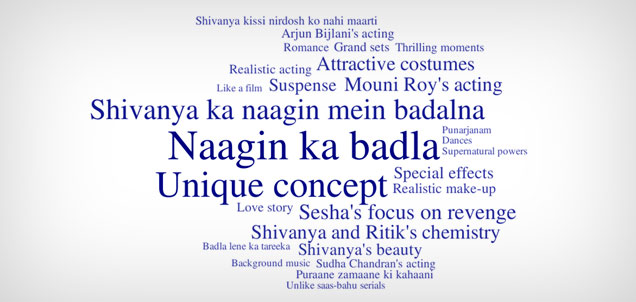
    This misplaced elitism amuses me. Truth be told, Naagin, in fact, captures a very significant “change” in Indian television. And that point is probably being missed across the board, even by many GECs. A first step to understanding this “change” is to understand why Naagin is doing so well. The thought cloud above captures the reasons why viewers love Naagin.


    The pace, treatment and presentation of Naagin is a cut above even the most successful fiction shows on Hindi GECs today. Designed as a finite series brings a sense of purpose to the show, and the story actually moves every episode, unlike many other serials where nothing really happens even over four long weeks.


    Its exciting pace creates the intrigue and suspense that a thriller needs, but often lacks. The visual presentation is top-notch. A quick glance at the cloud above and you will know that costumes, casting, make-up, sets and visual effects form an important element of Naagin’s success. These elements are considered merely hygiene in weekday fiction, never the differentiators.


    Importantly, the nature of the entertainment provided by Naagin is unequivocally escapist. It does not carry any burden of inspiring the Indian women audience and giving them the confidence or resilience to fight challenges in their own life. It is just pure entertainment, free of messaging of any sort.


    There have been other finite series in the recent past, none of which have delivered even 25 per cent of Naagin’s ratings. Many were questioning the merits of finite series after the high-budget experiments misfired. But Naagin has proven that if the concept selection is right, finite series, handled with a sense of pace and purpose, can be lucrative business.


    Since 2000, Hindi television has been largely reduced to daily fiction content, airing 5-7 days a week, where the pace is languid, the production at best serviceable, the treatment is very “afternoon soap-ish”. Naagin is unlike all of that, and in that, it fills the need gap that exists – of fast-paced, finite fiction content.


    Many have asked me if Naagin would have worked on weekdays too. I believe that if it was the exact same show that it is today, broken into four half-hours every week, it would have worked equally well. But if it were a daily, it may not have been this exact show after all. The tendency could have been to apply the daily-soap rules, slow down the pace, save on production budgets after the launch period, and go into assembly line mode sooner than later. And that’s why it would not have worked equally well.


    Far from being regressive, Naagin could be the start of some significant progress Hindi television could make, if it chooses to see Naagin beyond being a “snake show”. The real reasons of its success are a lot more interesting than that.


  • Shailesh Kapoor: Time For Cricket To Take Over… By Default

    By Shailesh Kapoor


    On all counts, 2016 has been a predictable year for Indian television so far. News coverage remained as shrill as ever, half a dozen channels claimed they were the most-watched on the Union Budget day, GECs continued to respect the idea of status quo and the awards season played out its annual routine.


    The only odd element disrupting this feeling of déjà vu has been T20 Cricket. India’s performance this year has been consistently strong, winning 10 of the 11 games played since the start of the year. India enters the T20 World Cup on home soil as firm favorites (not always a good thing).


    Within a week of the World Cup final on April 3, the IPL will kick-off. We are, by now, used to a long, never-ending season that becomes a part of the background noise for some, snack-in television for many others, and addicted viewing for a handful few. This year will be no different. IPL ends on May 29. By the time that happens, we will be five months down in 2016.


    Ratings from the India games in the Asia Cup have been very encouraging, setting new records in the short BARC India history. India’s strong performance and TV-friendly match schedules help. But cricket ratings have been, and will be, equally helped by lack of action and excitement in the rest of the television space.


    With the exception of Naagin, no Hindi programme launched since January 2015 has been a runaway success. There have been a few flash-in-the-pan performances, but nothing has sustained beyond 3-4 months. In such a scenario, viewers are left looking for ‘television events’, such as a big awards show, a big movie premiere or an India cricket match of some importance. This lack of excitement in mainstream television is also bound to help this year’s IPL, especially if it comes on the back of an India win in the T20 World Cup.


    Even as cricket prospers, news coverage of cricket suffers from the same shrillness and status quo as the rest of the news genre. Witty and entertaining cricket programming would be much in demand, but instead, all we get are talking heads, mostly cricketers from the days when cricketers were not paid enough to not need a day job, debating it out before and after every game.


    One’s earliest, and strongest, memories of television are from one’s teen days. I sometimes wonder what television memories those born in India in the new millennium will grow up with. And if they shun television for online content as they grow up, technology alone won’t explain why they did so.


    But that’s a thing of the future. For now, let the cricket take over from the sameness of things. For the next three weeks at least.