Tag: Shailesh Kapoor

  • Shailesh Kapoor: General Entertainment: A Sloppy Term We Have To Live With

    By Shailesh Kapoor

    The term ‘General Entertainment Channel’ (GEC) is unique to India. I don’t know who came up with it originally (could have been one of the ratings agencies in the ’90s), but the term has bad English written all over it. This article is a linguistic critique of this term (GEC). The viewer doesn’t even know this word and couldn’t care less. Hence, whatever you read here on has no business value. But if you care about the English language, read on.


    Let’s start with the first of the two contentious words: General. What kind of entertainment is “General”? For some reason, the word “General” was preferred over the word “Mass”, as is evident by a counterpart category being called “Niche Entertainment”, an equally odd articulation.


    If we go with “Mass Entertainment” as the meaning behind the term “General Entertainment”, we come to the next contentious word. What is “Entertainment” to the masses? Channels in the category would like to say it’s a mix of all that the mass audience want, and hence, the word “General” may have a meaning after all.


    But are the GECs delivering “a mix of everything”? If you go by a broad definition of the word “Entertainment”, it would include music, documentaries, Bollywood gossip, kids content (including animation), and some would say, even news. But the homogeneity of GEC content today is evident to all of us. They are offering only two types of content that covers more than 90% of their primetime: Serials and reality shows. Even films, earlier a GEC mainstay, have slowly moved to the movie channels.


    The other definition of the word “Entertainment” is a consumer definition. The chart below is a ‘thought cloud’ made from the words that were spontaneously associated with the word “Entertainment” by a large group of consumers across the country (data collected end 2015).
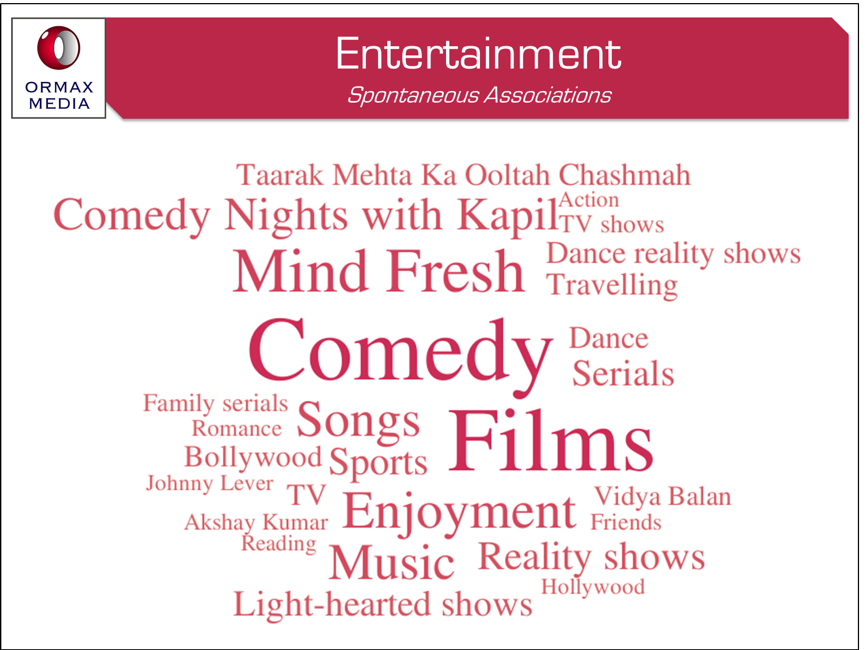
    This is how India sees “Entertainment”. A large part of this thought cloud is not delivered by the GEC category (Hindi or regional). Is this consumer definition also a linguistic faux pas? Not really.


    The dictionary definition of “Entertainment” range from “the action of providing or being provided with amusement and enjoyment” to “something diverting or engaging, such as a public performance or a usually light comic or adventure novel.”


    Associations of “Entertainment” with de-stress, amusement and comedy are unmistakable across these and many other definitions available on the Internet. The thought cloud above mirrors these definitions in most part, though with an Indian contextualisation.


    Does it mean that the consumer understands English language better than those coined the term “GEC”? That would be tough to believe in a country where grammatically incorrect terms like “Mind Fresh” (also seen in the chart above; an Indian English term for relaxation and mood refresh) are rampant in their usage.


    In my understanding, when the term “GEC” was coined, it was coined with the right intention. There were no movie channels, kids’ channels or music channels then. Through the ’90s till the early 2000s, GECs used to air fiction programmes across genres, lots of films, had trailer and music slots during the day, and even animation bands in partnership with companies like Disney and Turner. Some even had news content.


    But as more and more channels launched, this “Entertainment” saw fragmentation. Each new category started getting its share of content. Film channels fought for the first right to air a big film, because ‘Why should a GEC air a film?’. Therein started the change in definition of what a GEC stands for.


    Today, almost all GECs, barring an odd exception like SAB TV, are more Drama Channels and less Entertainment Channels. Even the non-fiction content on these channels would fall under the generic definition of “Drama”: “An exciting, emotional, or unexpected event or circumstance.”


    BARC India had the opportunity to change some of this faulty nomenclature in 2015. I suspect this would have been too low on their priority list. But we have learnt to live with this mess of a term (GEC) anyway over two-and-a-half decades. Who needs a change only because the English language must be respected.
     

  • An ‘Uncommon’ Bigg Boss Season


    By Shailesh Kapoor


    For a decade, now, Bigg Boss has been the standout reality show in the Indian TV space, especially for its differentiation. Almost every other non-fiction show we have seen in India is about “talent” of some kind or the other, dominated by singing, dancing and comedy. Also, all such shows are aired on the weekend. Bigg Boss, when on air (about 15-16 weeks every year), has at least seven hours of original content every week, twice more than any other non-fiction show and more than any fiction show too.


    The Bigg Boss brand has huge traction in the online community and among the advertisers. It provides for product placements and integrations in a way that’s natural to the format. It also has immense talk value, fueling organic press coverage around it.


    Yet, the ratings have not been easy to come by. Colors, who have aired nine of the 10 seasons, have tried every possible slot. But there’s an evident upper limit to how much a show that is essentially metro-skewed and not exactly family-inclusive can deliver. The format has seen its own share of innovations over the years in the attempt to boost the ratings. While some of these have helped, the larger picture is that Bigg Boss has acquired the status of a “cult niche show” over time, with a relatively small but diehard fan base.


    This season, which culminates on Sunday, January 29, saw a bold attempt by the channel and the producers (Endemol Shine) to disrupt the format more significantly than ever before. The season featured commoners (called ‘Indiawaale’) along with celebrities. This well-thought decision (call-for-entries promos broke a year ago at the end of Season 9) was a brave gamble to play. If they lost even a part of a niche loyal audience base, it would have meant an abrupt spiral downwards.


    But that didn’t happen. The season started weak, and hovered around the rating levels of Season 9, which itself was not a high scorer, in the same 10.30pm slot, which faces a challenge given the abrupt drop in TV viewership in India 11pm onwards.


    But somewhere in the middle of this season, the numbers began to look up. The one week when host Salman Khan said he will not blame the audiences if they changed the channel during the show, because the way a particular housemate (one Priyanka Jagga) was conducting herself was repulsive, was ironically the start of the minor but significant upswing. Over the last month, the show has settled at a rating level that’s about 20% higher than Season 9.


    The presence of commoners did not provide the pull factor initially. But as the season progressed, some of them emerged stronger and more watchable than the celebrities in the house. The raw passion to give it their all seemed to be the point of difference. Over the last three-four seasons, celebrities in the show have played the guessing game, trying to out-think the producers on their next move. There has been too much “this will show on the cameras” talk, which can confuse, even disillusion, viewers.


    But most commoners did not bring any of that baggage, of maintain or nurturing an image, with them. Over the first six weeks of the show, Bani Judge (popular as VJ Bani) was the most popular housemate on the show on Ormax Characters India Loves. In the second half of the show, Manu Punjabi took that position from her briefly, before it passed on to another commoner, ManveerGurjar.


    This shift in popularity balance coincided with the increase in ratings. There is high chance that Gurjar could win this season, though Bani and he are close contenders for the title. But irrespective of whether he wins or finishes second best, he, along with Punjabi, have set the template for the show for the coming years. They have given the makers the confidence that it can be a show driven by the commoners. Some celebrities may be needed, at least for the next few years, but over time, it can even be a commoners-only show.


    This helps the production cost significantly. It also makes running the show easier, with celebrities, some of them merely so, bringing their own share of problems with them. And if these benefits come with additional ratings, it’s a masterstroke.


    Will Season 11 push the envelope even further? We will know in due course of time.


  • Shailesh Kapoor: Award Shows: Moneybag for Bollywood, Ratings for TV

    By Shailesh Kapoor


    The “reality” of Bollywood award shows has been a subject of much discussion and ridicule over the last decade. Till the ’90s, there was a certain aura around these events, primarily Filmfare and Screen at that time. A new generation of stars started establishing its foothold in the industry from the mid ’90s, and therein started some straight talk on the topic.


    Aamir Khan shunned the awards show circuit after Rangeela. Salman Khan, Akshay Kumar and a few others followed suit over the years, attending award shows only as paid hosts or performers. Many stars openly discuss the “fakeness” of the winner selection process at award shows in their media interviews. Even an industry-insider show like KoffeeWith Karan has several references to it.


    It’s not as if awards don’t matter to Bollywood stars at all. The younger actors still see awards as aspirational, more like a certification that they have arrived. But with time, the charm fades away. The charm of winning the award, not the charm of the award show itself. Because there’s a crucial difference.


    The award show is a moneybag. It’s a TV event packaged with a sponsor who’s willing to pay the top dollar to be associated with the property. The organisers can afford to pay the stars handsomely to get them to host, perform or simply attend. Even a 10-minute appearance is enough, as it will take care of all the expressions required to be plastered across the three-hour length of the TV show.


    All the pretense around film awards being “genuine” was officially abandoned this season, when the Star Screen Awards ground event was held even before the release of Dangal, and the nominations and awards were still given out for the entire calendar year of 2016. It was an opportunity to get a strong TV property on New Year’s Eve. And since Aamir Khan doesn’t believe in awards anyway, why let Dangal come in the way of this opportunity!


    If you have watched the two awards aired so far this year (Screen and Stardust), you will notice that the TV event does not give more than 20-25% of its time to the actual awards part. The rest is for TRP generation – banter between the host and the co-host, banter between the host and the stars, dance performances, spoof acts, etc. Most technical awards are pushed out as a separate programming, mostly aired as a short capsule after the main event is over.


    And the ratings are coming. Since 2015-16, award shows have been outperforming some of the biggest films on TV. Award shows and events could be the new “world TV premieres” very soon, going by the way most films are underperforming on satellite television (more on that some other week).


    So, a prized Bollywood creation from years ago is now a TV property that Bollywood too earns off.


    Let the irony not be lost!


  • Shailesh Kapoor: Get Ready For A Deluge Of Singing Reality Shows

    By Shailesh Kapoor


    It’s an interesting new year for Hindi GECs. In an extended period when new fiction shows are failing to make a mark, the focus, temporarily at least, has shifted to non-fiction content. An immensely successful first season of Super Dancer ended on Sony last month. The Kapil Sharma Show (‘non-fiction’ that’s somewhere between non-scripted and scripted) is doing very well for the channel too, establishing Sony as a clear No 3 over the last few weeks.


    Season 10 of Colors’ Bigg Boss may not be a ratings blockbuster, but it has managed to sustain well over the last few weeks. In a bold and experimental move, commoners were used as a differentiating element this season. And the move has worked alright. The commoners are headlining the show, and this could set the template for Bigg Boss over the new few seasons. After all, it’s an option that’s a lot more commercially lucrative than a celebs-only show.


    But the big non-fiction highlight of the new year is going to be the sudden influx of shows in the singing reality genre. There are as many as five such shows around, at various stages, from promotions to post-launch.


    The second season of The Voice India launched on &TV early December. Indian Idol made a solid comeback on December 24, with the original jury helming the show this time. The show has opened to very encouraging ratings. The presence of SonuNiigam adds significantly to the franchise’s credibility. While a drop in ratings post the audition episodes is par for the course, the show is set to have a good run over the next quarter.


    This weekend, Star Plus will launch Dil Hai Hindustani, a singing reality show featuring NRI and foreign participants singing Bollywood songs. It’s an interesting differentiator, though it’s difficult to say how engaging the content can be, if centered only around this promotional premise. This weekend should tell us more.


    Colors is promoting the International format Rising Star, based on live audience voting, heavily. Zee TV will be banking on its pedigree show Sa Re Ga Ma Pa as a trump card to win back the No. 3 position. The show is currently in its auditions phase.


    That leaves only Sab TV and Life OK out as Hindi GECs that are currently not engaged in singing reality content. Sab TV doesn’t dwell much into non-fiction anyway, and Life OK is in a reboot phase with fiction being the focus currently.


    So, five singing reality shows will be on-air at the same time, a few weeks from now. All on the weekends, some head-on against each other in the same slot too. Even though they come with their individual strengths and differentiators, it wouldn’t take much to guess that some of these will outshine the others.


    Singing reality has been a genre that has gone through its fair share of fatigue in the 2000-2010 period. Multiple seasons of Sa Re Ga Ma Pa and Indian Idol were punctuated by several other attempts, many of which never even entered a second season. Unlike dance reality, which is a visual genre, singing reality tends to get technical and low on entertainment. The average viewer cannot distinguish good singing from average or bad singing, especially when these shows reach their gala stages. The inspirational backstories and the jury banter then take over as key hooks.


    Indian Idol’s strong opening suggests that the fatigue factor has eased out a bit. By March, we will know who the winners and the losers of this unique five-way battle are.


  • Top 5 “Gamechangers” on Hindi GECs in 2016


    By Shailesh Kapoor


    This Top 5 yearender piece has been a regular feature on this column since 2013. (Links to previous articles: 2015, 2014, 2013). However, there has been one important change since 2015. The word “gamechanger” seemed too liberal to use for the 2015 list, and needed the quotation marks around it to qualify the liberal usage. I had secretly hoped at that time that this qualifier won’t be required at the end of 2016. But no such luck.


    It has been a fairly uninspiring year on the content front, and hence game-changers continues to be a liberal word to use. That being qualified, here’s the list of the five Hindi GEC shows that stood out this year, for the impact they managed to have on the category:

    5.  Diya Aur Baati Hum

    The Star Plus show features in this list for one specific reason – Star Plus’ bold move to end the show this year. Diya Aur Baati Hum wrapped up on September 10, after a five-year run that saw a glorious period of at least three years. Like many other shows, the channel could have dragged this one for another 2-3 years, even more. It would have understandably been a tough call to take. But wisdom prevailed. Colors’ Balika Vadhu also ended this year, after an eight-year run. Hope there’s a trend being set here, slowly but surely.


    4.  Kumkum Bhagya

    Kumkum Bhagya finished two years in April (though it seems like it has been on-air for ages). Through the year, the show single-handedly kept Zee TV afloat, even as the channel struggled to retain its No. 3 spot in the second half of the year. There’s a certain storytelling style that Balaji Telefilms has mastered, and Kumkum Bhagya’s consistent performance is yet another outcome of that.


    3. Naagin & Naagin 2

    Naagin had topped this list at the end of 2015. The first season ended on a high in June, and the second season has worked equally well since its October launch. Treated like a true sequel, with characters and story being taken forward 25 years from where the first season ended, Naagin 2 continued to rely upon the tropes that worked for the first season – dramatic storytelling, glamorous cast, deft special effects (at least by Indian television standards) and most importantly, a sense of urgency and pace that’s unmatched in the category by far.


    2. Shakti

    This post-IPL launch on Colors had one of the more intriguing campaigns in recent times, playing on a “sach” that would eventually be revealed several weeks later. With a eunuch (kinnar) as its lead protagonist, Shakti managed to create differentiation with social relevance. That, combined with smart storytelling that made the most of every dramatic moment, ensured that Shakti quickly rose to the top of the GEC fiction charts, in turn helping Colors usurp Star Plus at the No. 1 position, especially with Naagin also on-air.


    Will Shakti have an extended run over 2017-18? Only time will tell. But in a year of lacklustre weekday fiction launches, Shakti stood out as a genuine exception.

    1. The Kapil Sharma Show

    He had ruled the weekends for more than two years before parting ways with Colors. Yet, when he made a comeback with The Kapil Sharma Show on Sony in April this year, there was much scepticism about how the show would fare. There would be format fatigue after all, and Comedy Nights With Kapil didn’t exactly end on a high on Colors.


    But those fears, as it turned out, were unfounded. The Kapil Sharma Show grew from strength to strength during the year, acquiring the same cult status, if not even higher, that the predecessor show on Colors enjoyed. That Kapil Sharma did not have a feature film distraction during this year helped. As did the superbly conceived and performed character of Dr Mashoor Gulati.


    The Kapil Sharma Show took Sony to the No. 3 spot by the last quarter of the year. And unless Sharma messes it up with another feature film roadblock, 2017 is set to be a big year for this show.


  • 2016: Television’s Tough Year


    By Shailesh Kapoor


    We are nearing the end of 2016. It’s been one of the more, if not the most, lacklustre years for the television business since the start of satellite television more than 25 years ago.


    The defining television highlight of the year would be that it was the year when the transition from the old ratings method run by TAM, to the new one run by BARC India, was completed. BARC India launched in mid-2015, but it took some time for the dust to settle and the new numbers to acquire normative status. That has happened, despite stray voices that still compare the old system to the new.


    Leave aside this big industry-level change, and some others on the regulatory front, 2016 did not have anything substantive to offer on the content side. There were no big channel launches headlining the year. And by and large, the hit shows from 2008-2014 continued to rule the roost in most GEC genres, Hindi or regional.


    Earlier this year, I wrote about us being in the Dark Age of Indian Television. Six months later, the argument only gets stronger. In an era when media proliferation is so high that it has acquired nuisance value in many ways, not moving forward with the times can be a catastrophe of no small proportion. Because if you won’t, the world around will anyway.


    The year marked good activity on the digital content front. Netflix and Amazon Prime launches bookended the year, and brought more scale and corporatisation to the digital content universe, which so far had seen only flashes of creative brilliance in the middle of a lot of mediocrity. Can SVOD be the next big thing in a market like India, where you get 200+ channels at a total price of less than Rs 10 a day? The jury is out on that one.


    In the absence of entertainment content breaking new grounds, it ended up being a year where two heavily male-dominated genres found traction, namely Sports and News.


    It’s been a very good year for the Indian cricket team, and a particularly good year for Virat Kohli, and that helped cricket viewership. The Rio Olympics got good coverage, especially with two medals for India in the last week, after a frustrating first two weeks.


    The news front had many stories to tell, right from Arnab Goswami’s exit from Times Now to the demonetisation saga that started on November 8. The latter is still a story in development. It may not move out of the headlines in a hurry, especially because it will drive the election agenda in key states in early 2017.


    Even as news prospered, the two biggest entertainment businesses in India – Hindi television and Hindi films – are in a tough phase they would love to get out of. The stagnation that started in 2014-15 is now clear and apparent for even the ostrich to see.


    All eyes on 2017 to fix what’s definitely broken.


  • Shailesh Kapoor: Death Of The Obituary

    By Shailesh Kapoor


    It’s been another busy week for the news industry. The demise of Tamil Nadu Chief Minister J Jayalalithaa earlier in the week was news big enough to dwarf everything else that was happening around us, including the hot topic for November – demonetisation.

    The Chief Minister has been maintaining ill-health for a while now, but it all began late night on Sunday, when she apparently suffered a cardiac arrest at the Apollo Hospital, where she was being treated. She passed away Monday late night.

    In that relatively short period of less than 24 hours, we saw frenzied news activity. That included an evening rumour that she was no more. Some Tamil news channels flashed the news, and sections of the media picked it up. This included Jaya TV, a network owned by the Chief Minister herself! It required a hurried press release from the hospital to set the record straight.

    That drama was only a precursor to what was to follow. By 10pm, it seemed apparent that the official announcement of the Chief Minister’s demise is not far away. The story was given a distinctive thriller feel. ‘What will happen now’ was the operating question.

    When the AIIMS doctors team left the venue and vehicle movement between the hospital and the Chief Minister’s residence started, a young India Today (channel) journalist, reporting from outside the hospital, said: “It seems something much bigger, much better is going to be announced soon.”

    Now that may have been just a slip of tongue. Most field journalists have poor English (wrong choice of words is not uncommon in routine stories). But there’s a meaning to the “bigger and better” here. It meant bigger news, better news.

    Channels, especially their field staff in Chennai, had been reporting on the events of the day for almost 20 hours without a break. They were starting to suffer from news fatigue. The viewer may have only tuned in an hour ago, but for the channels, what happened earlier in the day was already stale news. Their patience was being tested. They wanted to move on. Report the inevitable death, secretly hoping it gets announced in the prime time and not late night.

    But there was no waiting beyond a point anyway. Obituaries had started during the day itself. Jayalalithaa was being referred to in the past tense. The succession plan of AIADMK was being discussed. Life had moved on, even as death waited.

    The next morning, though, was even more striking. By 7am, channels were in official “obituary” mode. Except that the meaning of the word has changed significantly, one realised. The new definition may as well be: “Hurriedly-put together footage with Wikipedia information to go with it”.

    The mood of the morning was not somber, by any stretch of imagination. In the age of T20 news, there is no time to take an introspective position on a story today, it seems. The obituary is dead. It’s made way for news drama. Long live the obituary.

    One wondered if the lack of poise and grace in the coverage was a function of the person in question. The more one thought of it, one concluded that even if the most revered politician passed away today, the discourse will be very similar in tone and tenor. A combination of the news paradigm of the day and lack of respect for the political class as a whole will ensure this.

    At the end of it all, if you wanted to know more about Jayalalithaa, you had a destination that would beat all news channels hollow. It’s called the internet.


  • Life after Arnab


    By Shailesh Kapoor


    It’s been about two weeks since Arnab Goswami went off-air, and it may be a while before we see him a hosting primetime news show again. Over a decade, and especially since 26/11/2008, Goswami had built a cult following that does not have any parallel in India’s news economy. You either loved him or hated him. There were no in-betweens. And even his harshest critics, including those running competition channels, could not ignore him.


    Clones of the Newshour show mushroomed across English, Hindi and regional news channels over the last five years. Journalists with more years on their CV than Goswami’s were forced to adapt to a new style of reporting and debating, where taking a stand and pushing it through was not only seen as legitimate, it became the only valid style of journalism.


    It’s fair to say that Arnab Goswami has transformed the Indian news landscape. The jury will be out for a long time on whether this transformation is a positive one. But it’s a transformation alright.


    I’ve been a fairly ardent viewer of the Newshour show over years, though there was always the need to take occasional detox breaks from the show. If you have been an ardent follower of the man yourself, you would know that there are many around us who would judge us for watching and liking him. “How can you watch these meaningless shouting matches every night!”


    To confess, sometimes, I even questioned if I had bad taste in news. But I couldn’t really get off the show. And today, I know why. Because there are simply no viable alternatives. Over the last two weeks, in search of a primetime news show I can gravitate towards, now that Goswami is off-air, I tried all the English news channel options available, right from 8 to 11pm. What you get is not very encouraging.


    Many of these shows are clones of the Arnab format, and in a very ‘wannabe’ way too. And the others are simply deathly boring, with no personality to keep you interested.


    News is available online through the day. Hence, primetime telecast cannot possibly be about headlines, especially in the English category, where a majority of audiences are well connected digitally. It has to take the agenda forward and provide something more than just telling us what happened. When Goswami decided to use debating as the format of his primetime show a few years ago, was it a conscious way of differentiating against the omnipresence of news online, I wonder!


    The search on the English news genre being futile, I moved to the Hindi news category. In Ravish Kumar, I found the closest option. There are two things Kumar and Goswami share. Both have strong, well-defined personalities, be it their style of talking or taking a dig or just commenting on the state of affairs. These personalities, while distinct from each other, have a strong sense of wit and bravado, almost nonchalance, woven into them. They are anything but boring.


    The second connecting element between the two is their confidence to take a stand on a topic and see it through with commentary that’s decisive. In this, I like Kumar even more, because his articulation is more colourful and vivid.


    But Ravish Kumar does not do multi-window debates. And hence, much as he’s a good replacement, he has not been able to fill the Arnab Goswami vacuum for me.


    But irrespective of whether you watched Goswami or not, or what your replacement anchor is, a vacuum has certainly been left behind. Will we see an Indian news journalist as powerful and influential as him again in our lifetime? I won’t bet on that. So, I would rather wait for him to make an on-air comeback soon.


    Now that’s a good 2017 wish to have.


  • Shailesh Kapoor: Perspective: Entertainment Can Wait When It Needs To

    By Shailesh Kapoor


    Perspective is a powerful word. It is also an underrated one, and “losing perspective” is not an uncommon thing to do. The entertainment industry, in particular, is notorious for having perspective problems. And nothing highlights this more than the events of the last week. It may not be the most obvious linkage, but it’s one worth diving into.


    With the cash economy coming under increasing pressure over the last 10 days, the focus of the country has been on keeping their lives running. Everything else comes second to that. Now that’s pretty obvious, you would say. But this dead-duck-obvious piece of fact actually challenges how the entertainment industry, especially the film industry and the ad industry, has been thinking for years.


    The perception that the entire country, if not the world, is waiting with bated breath for their new film, trailer, ad, channel or show launch is something you would strongly sense in the corridors of a media house. It is natural to feel involved with one’s work, and passionately so too. But the perspective that this industry’s work after all is not essential to running people’s lives is often not understood in so many words.


    It is routine to hear sweeping statements like “People have simply loved the show, we are getting so much positive feedback, we can’t even read all of it” or “I’m surprised its recall is so low. Everyone I meet is talking only about it”. In a country as big as ours, words like everyone, people, so much, etc. can mean previous little, especially when spoken without perspective. The social media has made it worse. It has increased the interaction of celebrities, creative talent and media executives with their audience manifold, creating more and more illusion about how substantive their work is.


    Let’s look at some numbers for perspective. Only 36.6 million (3.66 crore) Indians contribute to 87% of Bollywood’s theatrical business. More than 65% television sets are switched off at 9pm, which is the peak of primetime. An episode of the biggest show on TV gets about 12 million (1.2 crore) impressions only. These numbers may look sizeable, when you compare them to random data points, like the population of a mid-sized state in the USA. But when seen in the Indian context, they are certainly not national unifiers.


    Entertainment is a powerful industry in influencing public opinion, shaping popular culture and creating social change. There is no debate on that. But it is, to begin with, primarily a medium of relaxation and enjoyment. No shame in that. Relaxation and enjoyment are not easy to come by. But ascribing undue importance to the role of the entertainment business is where perspective is lost.

    Theatres have been largely empty over the last week and a half. In a research conducted by Ormax Media earlier this week, 28% of regular theatre-goers said they will not be able to watch a film in theatres at least for the next week, till their cash situation improves. This number is likely to be significantly higher among irregular theatre goers.

    The “non-essential” nature of the entertainment business is evident. People don’t talk TV shows and films all the time. They have a life to run, which can at times include standing in long bank and ATM queues for hours. That’s their perspective. What’s yours?


  • Shailesh Kapoor: Notes & Votes: When News Becomes Too Hot To Handle

    By Shailesh Kapoor


    Two big news events, separated by less than 24 hours, marked an exciting week. The Prime Minister’s address on Tuesday night, to announce the demonetisation of old, high-denomination currency notes caught the media off-guard. Not surprising, given that subsequent reports suggest that even Cabinet members, barring a couple, were not aware of the decision.


    What followed was coverage on the go. Between making sense of what has happened, trying to give more information and getting a sense from the ground, Indian news channels and online sites had their task cut out. The sentiment nationwide was extremely positive and pro-Modi, with polls suggesting more than 80% believing it was a positive step.


    Now, an average Indian, or even a well-informed one, such as a reader of this column, will know little about the technicalities of the move and the impact it could have on curbing black money circulation in India, in the short run and the long run. Public opinion was driven, hence, not by facts and analysis, but by a feeling of “Wow! How cool is that!”. That it could be done in a “surgical” (can we retire that word, please?) manner with no media leaks, a near impossible task in today’s day and age, made the move come across as a masterstroke.


    Subsequent expert opinions have suggested that the move may be limiting in its impact, especially in the long run. Yet, there is not much to fault per se, as it does not have any major pitfalls, except a couple of days of inconvenience, which has not snowballed into anything significant as I write this on Friday morning.


    But on Tuesday night, news media was not bothered about financial technicalities anyway. They wanted to play on the sentiment, and build a sense of euphoria. It was as if India had won something major, like a Cricket World Cup or something. The sentiment was infectious. Nowadays, you can use Whatsapp jokes to gauge that. Jokes are jokes, but if you read between the lines, the sentiment – positive (optimistic) or negative (cynical) – is apparent from their sub-text. In this case, it was clearly the former. A few politicians who criticised the move just came across as having a bad sense of timing.


    This Tuesday night story stole the thunder from the US Presidential Elections, which had happened the previous day, and whose results were going to come out Wednesday morning India time. An average Indian could not care less about who becomes the US President, if they are worrying about having enough hundred rupee notes to survive the next three days, or about how and when they will exchange their high-denomination currency.


    But a substantial section of India is not the “average Indian”. There has been considerable interest in India in the US elections this time, with Donald Trump ensuring that dull moments are far and few in between.


    All opinion polls in the US, barring just one, projected that Hillary Clinton will be the next US President. The US media, centered in big cities where Clinton won handsomely, started their coverage assuming she will win. Around 8:30 AM IST, they were sensing they could be wrong. Within an hour of that, they knew it was going to be one Mr Trump, and not one Ms Clinton. After weeks of lead-up analysis on why Clinton will win, they found themselves analysing why Trump won. As seasoned journalist Shekhar Gupta tweeted: “Lessons for US journalists is the oldest one in our biz: Never let your voting preferences color your professional judgment.”


    Journalism can be dizzy and exciting on days like these. As can be news consumption. Bring some more!


  • Shailesh Kapoor: Arnab Goswami: Newsperson turned Newsmaker

    By Shailesh Kapoor


    The speculation had been rife for almost a year. That sometime in the future, Arnab Goswami will do the inevitable – part ways with Times Now. But it was a simmering speculation that never really materialised. Till early this week.


    We have no “official” statement from the man himself or his organisation. Accounts of an editorial meeting is the foundation of all reporting on this topic. Some social media posts and video clips from the said meeting have gone online, such as this one. But further information is hard to come by.


    It was said, when the “news” first broke on Tuesday, that the show that night will be his last Newshour show. He has hosted that one and two more, as if it’s business as usual. Clearly, the news media hasn’t made much headway in investigating this case.


    But that hasn’t stopped them from covering it. The coverage, despite little information available to build a running story, has been relentless. Digital news sites and apps, who ask for funding from venture capitalists using the argument that traditional news is dying, have left no stone unturned to make a TV news editor their poster boy. The irony is hard to miss.


    Equally fascinating is the nature of the coverage itself. Humour is a recurring theme in how Goswami’s exit has been covered, both in social media and in online news. And why not? If you watch some of Goswami’s recent speeches at seminars and conventions, he has started talking of himself in caricature terms, often playing along, even fueling, the ArGo humor mill that has been running on top speed on social media for a few years now.


    Interestingly though, there is little coverage of Goswami’s impact on the news media in India. The man may go off our TV screens for a while, but it’s certainly not an obituary that we are writing. So one can understand the absence of “contribution” pieces. The few that exist talk about the commercial contribution – of taking Times Now to a position of long and undisputed leadership.


    Goswami’s real contribution lies in changing the news format on Indian television, across channels and languages. Even his harshest critics come from channels that have adopted the popular news debate format as their prime time set-piece. He has also had a considerable impact on the political and public discourse in the country, with “statements” from his debate being used in the Parliament, among other places, more than once.


    Times Now does not have a strong second line of anchors. Days when Goswami is off-air, The Newshour is an insufferable watch, because it seems everyone who replaces him is out there to become another Arnab Goswami.


    But there cannot be another Arnab Goswami. You may hold him in awe, be indifferent to him, or detest him. But you cannot deny that he is not substitutable. You cannot deny that we may not see another one like him in our lifetimes.


    Where will he go, everyone’s asking. As long as he gets a primetime debate show, the platform won’t matter. The man will outshine the scenery. Which is not necessarily a good thing for a media company, even if it’s his own. But it comes as a part of the ArGo baggage.


    As we wait for more official information to come in, it will be nice to go on an Arnab Goswami detox for a while. One just hopes it’s not a very long break.


  • Shailesh Kapoor: ADHM: When Audiences Rejected Patriotic Blackmailing

    By Shailesh Kapoor


    Four weeks ago, the news coverage of the Uri attacks and its aftermath were the subject of this column. I had written that it is a pleasant surprise that the news coverage has been restrained in most part. I may have spoken too early.


    That column also mentions a “silly side story”, that related to the demand of banning Pakistani talent from working in India. As it turned out, that silly side story became the headline story for much of October, sidelining, in turn, the main story itself.


    The “surgical strikes” provided a climax to the main story that the news media found hard to surpass. In search of a hot topic, they found a low-hanging fruit in MNS’ opposition of Fawad Khan’s (cameo) presence in Karan Johar’s Ae Dil Hai Mushkil (ADHM). And since then, the theatre of the absurd has played out.


    The logical fallacy in this controversy is like an open-and-shut case. The film was shot a year ago, under entirely different circumstances. Yet, a political outfit used it as an opportunity to get noticed. And the state’s political leadership actually legitimised it by brokering some kind of a settlement.


    While much of this has been written about and subsequently criticized, especially in the social media, one aspect of this ADHM drama has not got sufficient media attention. And that’s to do with the media’s ability to influence public opinion unfairly.


    A film like ADHM would have about 1.5-2 Crore (15-20 million) target audiences across India, who could potentially purchase a ticket and watch the film in a theatre. It’s safe to assume that almost all these people are consuming news in some form, and were aware of Uri and the subsequent developments, including the surgical strikes.


    A large section of this target audience (60-70%) would have seen the film’s trailer (or read about the film) and recognised that it stars Fawad Khan, a Pakistani actor. You would expect these grown-up adults to put the pieces together and make their opinion on whether they want to “boycott” the film based on the connection between the two pieces of information – news from the LOC and the ADHM campaign.


    And they found no evident connection. In early October, in our regular film work, we got no traces of any sentiment among the actual target audience to suggest they would stay away from the film for this reason. Many didn’t want to watch the film for various reasons, such as the trailer not appealing to them, but the anti-Pakistan sentiment was conspicuous by its absence.


    And then, over two weeks, the said “connection” was hammered into their heads via prime time news debates and the social media machinery that inevitably accompanies such debates. By last week, about 15% audiences were actually considering the boycott.


    Just 15%. Despite all the noise, there was no impact of a huge majority of the target audience. The film trade, especially single screens, were skeptical, fearing damage to their properties. But at the audience end, it was a fringe issue at best.


    But it’s this fringe issue that should bother us too. About 20-30 lac of the film’s target audience (and several times of that in the huge non-theatre-going universe) were “brainwashed” into making an opinion. It’s one thing to watch news and build your opinion. But here, we had patriotic blackmailing at play. If you do not boycott, you are not a good Indian. And we have seen this argument play out increasingly in the media over the last year or so.


    Should we worry? Yes and no. Yes, because our media is dangerously positioned to create these false binaries. And no because a vast majority of audiences have the ability to make their own judgment. And that’s a saving grace alright.2