| Election Results Coverage: A Mix Of Hits & Misses
There are very few tentpole days in television news these days. The debate format has homogenised the genre, bringing it down to personalities rather than the news or its coverage itself. And if you are a regular news viewer, you would get the feeling that something of utmost national or global importance is happening everyday. There are no slow news days anymore.
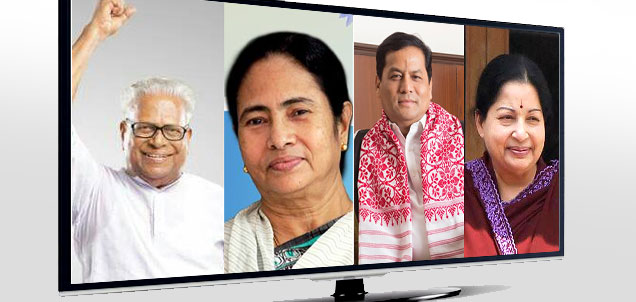
The only real tentpole days left are those of election results coverage, which is just about one day every year. 2016’s election results day just passed by, this Thursday. Four states and the Union Territory of Puducherry went to polls over a couple of months, and it all came down to May 19, the day of the counting and the results.
The results themselves did not have the edge-of-the-seat element or kahaani mein twist. Tamil Nadu was not as close as some had predicted. West Bengal, Kerala and Assam went on expected lines. Early trends held on till the end, and no Bihar-like moment happened, where several channels, including NDTV, wrongly predicted the outcome in favour of BJP, much too early, based on very thin and almost irrelevant data.
The English news coverage itself was a case of hits and misses. Over years, election results coverage has started testing the multitasking skills of viewers, which is never a great idea. At one point of time, you may have to pay attention to five things – the ticker with the state-level seat leads, a second ticker with seat-level details, the graphic on the screen trying to analyse a key trend, the anchor talking you through all of this, and a voice, often of a panelist (one of many waiting patiently to get themselves heard), trying to add value to it all.
When there is no major excitement in the results, like this time, this format exposes its weaknesses. It puts the onus of comprehension on the viewer, instead of the channel taking the responsibility of simplifying things for its viewer, in a way that’s easy to comprehend yet not dumbed down.
Times Now used some new graphics, under the fancy branding of ‘Data Journalism’. There was too much branding and build-up to it all, but the actual content of these innovations ranged from mildly interesting to banal. While these new properties, with names borrowed from a math class, were a bit of a miss, the channel relied on Arnab Goswami’s unrelenting energy and enthusiasm to have another good day. His gentle rebuking of his panel members, when they entered side conversations, was particularly endearing.
NDTV was the only English news channel that did not expect you to multitask. They typically had (like always) limited data on the screen, and spoke at a pace (like always, again) that needs to be fast-forwarded 4X to match Goswami. Much as this idea of de-cluttering has merit, there is something soporific, Doordarshan-like about the NDTV coverage over the last few elections. That roundtable set and the casual style just doesn’t bring purpose to the proceedings. In contrast, their analysis shows in the evening have a lot more going, with the best talking heads and some interesting, often lateral, questions.
One of the more interesting segments of the day featured Arjun Jaitley and Shashi Tharoor debating the results on India Today in the evening. While Tharoor had the tougher job to do (defending Rahul Gandhi is never easy), the debate had depth and civility that’s a scarce commodity these days. Perhaps because the more eloquent talking heads have stopped appearing on television debates barring an odd day like this. Can you really blame them?
We have a few key states lined up for elections in 2017-18, led by UP, Punjab and Gujarat. Hope we see more hits and less misses in that coverage.
|
Why waste monies on Exit Polls
Most exit polls showed Mamata Banerjee winning a second term in Bengal. And indeed, the Trinamool Congress and Banerjee did win. But there’s the thing. On May 16, at around 7 pm, the ABP-Ananda poll said she would win 163 seats, C-Voter said 167, India Today said 243, Chanakya said 210, News Nation said 153. As everyone knows by now, Banerjee won 211 seats, higher than her majority of 184 in 2011, when she had formed a government in alliance with the Congress.
In Tamil Nadu, on May 16 at 8 pm, here were the exit poll predictions: India Today DMK 132, News Nation DMK 116, C Voter DMK 78, NewsX DMK 140, ABP Nielson 132. That is, incumbent chief minister J Jayalalithaa of ADMK was losing, except according to C-Voter who said she would win 139 seats. J Jayalalithaa won 134 seats.
In Bengal, we see confusion over the number of seats with only Chanakya coming close to reality. In Tamil Nadu, other than C-Voter, we see the exit polls getting it completely wrong. I am using only two examples but they should be enough to bring up once more the point of this exercise. Newsrooms spend a lot of money on exit polls, now almost essential it seems in the hysterical run to be first with breaking news. The range of seats for the Trinamool and the absolute distance from reality in Tamil Nadu are only two examples of how either the process or the presentation is faulty.
This is not a critique on polling agencies. But it is an indictment of newsrooms which tend to rely so much on them, especially since so many of these exit polls go so wrong. More reporters on the ground may perhaps be a better way of balancing these surveys. The Bihar assembly elections of 2015 and the general elections of 2014 both quite drastically showed that exit polls cannot be fully reliable.
As far as television coverage of the election results themselves are concerned, we were back to nothing different. You could argue that there is no other way of doing it. But it is still much of a muchness. TV is what most people depend on at times like this and yet there is a limit to how much of the same old stuff the viewer can handle.
Is it necessary for instance for anchors and experts to start jabbering at a TV studio from 7 am? As usual I opened the Election Commission website at 8 am and tracked the results there. As usual, the EC was at variance with news channels since it showed nothing till around 8.30 am. TV channels by this time were running ahead with all kinds of numbers all different from each other. However, after the Bihar assembly debacle of last year where exit polls, TV pundits and trends on screen had no connection with reality, all our experts and commentators were far more circumspect this year.
There is a tendency amongst some loyal TV viewers to stick with NDTV and Dr Prannoy Roy for election results and budget coverage. And since NDTV got it so wrong in early in the day for Bihar, this time they ran a script saying that early trends included postal ballets which are not always reliable. A sensible move at some damage control.
If TV is about the way the way things look and sound – if not necessarily whether it makes any sense – then CNN-News18 was the most sober. Not hundreds of numbers and talking heads vying for attention. Times Now wins that battle hands down as usual — sound, fury and symbols clashing ceaselessly. NewsX remained copycat, as it must. India Today TV was in the middle.
By the end of the day, they all looked really tired but I must admire the way guests and anchors talked and talked all day though I have no idea what they said. I watched Masterchef, I cannot tell a lie. |
 By Shailesh Kapoor
 By Ranjona Banerji