Tag: Shailesh Kapoor

  • Shailesh Kapoor: The TikTok India Story: Paused or Aborted?

    By Shailesh Kapoor


    Less than two years ago, sometime in mid-2018, if someone mentioned ‘TikTok’ to you, chances are you would have asked: “Sorry, what’s that?” The Bytedance-owned app, launched in late 2016, began to found traction in India from 2018, and skyrocketed in popularity in 2019. Estimates of downloads and active users suggest that India was TikTok’s biggest market in 2019, ahead of the native market China. Unlike other global apps like Facebook, Instagram and Twitter, TikTok did not have an organised marketing muscle behind it. It built its user base organically, suggesting deep product resonance in the India market.


    Data available with Ormax Media suggests that TikTok’s user profile is distinctive compared to other social media apps. The biggest distinction is the pop strata. A large section of TikTok users in India come from mini-metros and small towns, far more in proportion than even Facebook, which is the other wide-reaching social media platform in India. Instagram is heavily skewed on age, towards the sub-30 bracket, and Twitter is largely restricted to a niche English-speaking user base, a large chunk of which belongs to the top 10 cities in the country.


    Short user-generated videos are a powerful and inclusive format. They are easy to create and even easier to watch. That’s perhaps why a lot of TikTok stars that have emerged in India are a new bunch altogether, with no previous presence or awareness on YouTube, a platform that can come across as a lot more intimidating for a creator than TikTok.


    With growth comes its share of problems. TikTok has been embroiled in controversies over the last several months. Very recently, a TikTok post from one Faizal Siddiqui, glorifying acid attacks, create a furore. It can be argued that TikTok has been a bit lackadaisical in its approach towards handling such cases that violate community guidelines. In early 2019, the Madras High Court had imposed a ban on TikTok for not taking action against pornographic content. The ban was later lifted.


    In the Siddiqui case, TikTok responded by suspending his account, and issuing a statement too. But not before several prominent voices started advocating a ban on the app. In the current times of the ‘Chinese virus’ and now the escalation at the border, anything Chinese needs just a spark around it, and a raging fire is sure to be ignited. Politicians are suckers for opportunistic timing, and a handle from a Chinese app, putting up a video endorsing acid attacks in times of Covid, is political opportunity presenting itself on a platter.


    Given the context, the ban on TikTok, along with 58 other Chinese apps, has not come as a surprise to many. Evidently, these apps are soft targets in the current environment. It’s a populist move that does get a large section of the nation behind it.


    TikTok creators will have to find other platforms, and they may be spoilt for choices, with many high-profile launches round the corner. Instagram has Reels, YouTube has Shorts and Facebook had Lasso, till they announced just yesterday that it’s shutting down the app. Zee5 announced the launch of its platform HiPi within a couple of days of the TikTok ban announcement. The press release says HiPi is a platform “made for Aatmanirbhar Bharat”.


    TikTok has been one of the most unusual success stories in the Indian media space in recent years, and also an under-reported one. Will it return to India anytime soon? The odds are heavily stacked up against the app, and it may take a while for it to find its way through. And in the social media context, that time gap may be enough to kill it forever.

  • 2020: Halfway There… Halfway More To Go!


    By Shailesh Kapoor


    In case you have not realiSed, we are halfway through this terrible year already. Where do we go from here? That’s the question on everyone’s minds. The pandemic has brought with it an unprecedented level of uncertainty. A lot of discussions these days feature a line that goes: “It will take another X months”. The value of X, varies from 2 to 24, depending on the subject matter of the discussion and the optimism level of the speaker. Predictions in these times are tough, if not futile. But I’d hazard a few anyway.


    An oft-asked question is: When will theatres reopen nationally so that big Hindi films can be released? I’d say October 2020. Delhi (and not Mumbai) could be one of the last markets to open the theatres. Till both Mumbai AND Delhi are open, new films releasing seems out of question. Theatres will open with ample safety measures and restrictions, and the audience will take their time to make that visit. Sooryavanshi releasing on Christmas 2020, is my other forecast in this regard.


    Another commonly-asked question is: When will content production begin like before? This is a lot more complex one to predict, because “like before” will surely have to wait for the vaccine to be available globally. Till then, shoots will restart, but don’t be surprised to see dodgy make-up, empty frames with less characters, no foreign locations, and visually-disorienting content in general.


    Another popular one is: Will IPL happen this year? I’d predict that it indeed will, but without crowds and in a curtailed format. The T20 World Cup in Australia in Oct-Nov 2020 is likely to get moved to 2020 (there’s the next edition in India next year anyway), and that slot should pave way for IPL to happen. It could be an event restricted to two or three cities, but with no spectators and ticket sales, that wouldn’t matter much anyway. ThE business models will have to be reworked, but given what’s at stake, BCCI and Star will be extremely keen to hold the event in some capacity, than skip an edition altogether.


    Then there is the larger question about the recovery of the economy: Will the Diwali festive season see regular levels of adspends and consumption, perhaps (as some suggest) on a rebound? Here, I’d go with a sCeptical view. The general public is quite tentative, and expecting festivity levels anywhere close to normal in the bigger cities is certainly ruled out. The economic pressure adds to the fear of the pandemic, and while people may start going out a bit, the festive mood will take another year to be revived. I’d expect at least 60% drop in ad revenue in the traditional media (TV, print, radio, OOH, etc.) in the festive season this year vis-à-vis last year.


    The way it looks, the second half of the year will continue to be one of uncertainty and very slow recovery. Patience is a prized virtue to have in these times. Hold on to it!


  • Post-Covid Challenges: Hindi GECs will be Tested


    By Shailesh Kapoor


    The pandemic is still all around us. Fatigued from a long, early lockdown, and facing dire economic consequences, India has begun to open up slowly. But we are nowhere close to “normal”. Not even close to the “new normal”, an oft-bandied phrase that means different things to different people.


    The entertainment sector is preparing to take small steps towards normalcy. Shooting of TV serials has started in some markets, and others will follow in July perhaps. It will not be the usually bustling, chaotic shoots that we are so used to. With limited resources at hand, the frills and the overheads will be cut out. This may pave way for cost-saving ideas in the long run. But that’s another topic for another day.


    There’s a lot of talk of how post-Covid media consumption in India (and the world) will look like. I wrote about prevailing “lockdown myths” in May, expressing my view that fundamental change in habits is not as easy as many are suggesting. But much as habits won’t change, the lockdown has created a break in them, which allows for disruption, offering opportunities in particular for weaker TV channels to come back stronger than before, and challenge the leaders. Of course, that is easier said than done, especially in categories like Hindi GEC, which have their own share of problems.


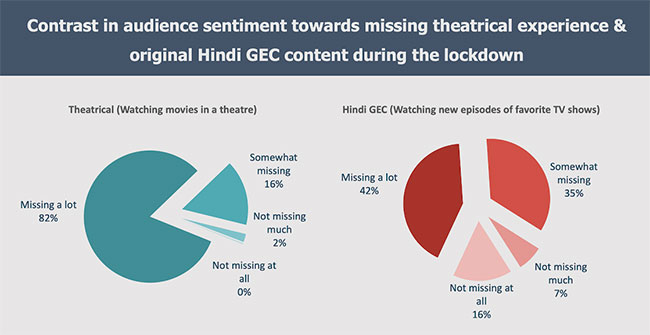
    When Ormax Media released the findings of its research (see chart above) stating that the Hindi GEC audience are missing original episodes of their favourite serials a lot less than they should, the reactions from those involved ranged from scepticism to outright denial. Unfortunately, one can’t even say the reactions were surprising.


    Using ratings to predict audience sentiment has been an age-old fallacy in the TV industry. We saw that back in 2006-2008, when the growing audience resentment towards the ‘K-serials’ was met with a standard “but they rate so well” response. It took the launch of Colors in 2008 to prove that a sentiment just needs a good catalyst to convert into behaviour.


    Even though news and movies have made inroads into primetime family viewing during the lockdown (as indeed over the last 3-4 years too), it is safe to say that GEC content will remain the staple primetime diet of a very large section of the universe. But what the chart above tells us is that a sizeable proportion of this large section is not giving the Hindi GEC category (the results will be different and significantly better for regional GEC categories) the love it should get. The relationship between Hindi GEC content and the viewer is now less emotional and more ephemeral in nature.


    Some say this could be simply a function of the times that we live in, where attention spans have gotten shorter, distractions have increased, and concepts like loyalty and appointment viewership are things of the past. But there are multiple reasons to disagree with that line of thinking. For one, the regional categories are faring much better. Secondly, if distraction and clutter was the driving force, it should have reflected in a geographic skew. But that’s not the case. The metros, the mini-metros and the small-towns all perform equally poorly on the question asked for the chart above.


    Will there be post-Covid viewership attrition for Hindi GECs? A drop of more than 5-10% compared to pre-Covid times is unlikely in the near future. But the ground cannot be more fertile for one of the top players to sow the seeds of long-pending category evolution.


    Streaming will not take away TV audience. But certain TV channels and genres have enough other competition on TV itself to contend with anyway.


  • Lockdown Stars: An Actor Who Acted, A Reporter Who Reported


    By Shailesh Kapoor


    Two-and-a-half months into the lockdown (or Unlock-something now, I have lost track of the nomenclature), the pandemic continues to loom large, especially here in the city of Mumbai. Yet, as if almost bored of having kept their hand on the pause button for far too long, the powers-that-be have decided that life must go on. The economy cannot afford any more damage, even though it can be argued that a large share of the damage already done was preventable in the first place.

    With no shootings, releases and promotions, celebrities across media have been locked up in their homes, waiting patiently (or impatiently) like all of us. Many of them have put up content on social media to engage with their fans. Karthik Aaryan has his own little talk show going, Salman Khan has released three music videos on last count. It’s difficult for film and TV stars to stay relevant in such times, and everyone is trying their best to not go out of sight and hence out of mind.

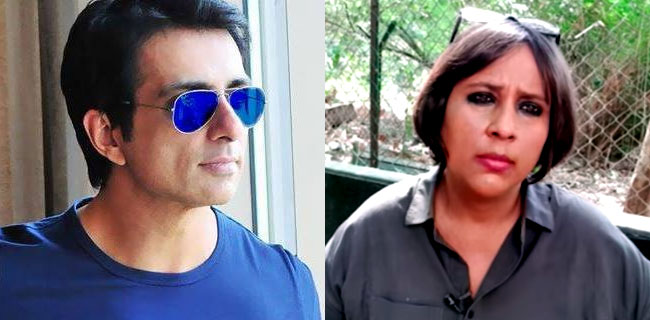
    But the real stars of the lockdown are not those on YouTube, Instagram or TikTok, but those on the ground. If I have to pick media personalities in India whose work from this period will be remembered much after the fun and the shot-from-home messages on social media are forgotten, there are just two names that stand out at a national level: Sonu Sood and Barkha Dutt.

    Sonu Sood, a reliable film actor seen playing supporting parts or the antagonist in big-budget Hindi and South films, took to contributing towards solving the migrants crisis. His method of solving, however, was not a donation or an awareness campaign. He actually got down to getting it done, hiring buses and even a flight, to transfer large number of migrants to their destination.

    It is well understood by now that the migrants crisis in India was grossly under-estimated when the lockdown was announced first in March. No one saw this problem coming up in the first place. But 75 days later, the migrants are still on the road, waiting for a bus or a train ride to take them back home. Ironically, it’s now time that we are “opening up”.

    Often, the administration’s failure requires citizens to step in. Sood’s efforts are a reassuring sign that some celebrities (however few) can go beyond thinking of their own self-image and its marketing. It is way too evident that Sood is not doing this for any publicity or perception building. His passion and honesty towards the mission to get numerous migrants back to their homes is palpable in his social media posts and his interviews. In an age of orchestrated media appearances and cultivated image building, Sood has shown a different way to think to many of his co-actors.

    Barkha Dutt has been on the ground, reporting on Covid-19, the migrants crisis and the healthcare infrastructure for more than 80 days now. It has been one relentless pursuit, one story after the other. Dutt’s penchant for field reporting has been well-known since her reports from the Kargil War in 1999. Even as ‘seasoned’ TV journalists (barring a couple) continue to report (and conduct inane debates) from the comfort of their studios, Dutt has shown them what true journalism in such times is. Many of them will hate to admit it publically, but even her harshest critics would have developed a newfound admiration for Dutt.

    Dutt has been slammed incessantly on social media for years for her liberal, anti-Right political leaning. Fighting that branding in an era of right-wing fueled nationalism, Dutt has done 80 days of strictly non-political reporting, each story more engaging the one before. This is some relentless, tireless pursuit of the truth. Dutt has shown her journalist counterparts the true power of their profession. Even if the old hats turn a blind eye, she would have inspired many young guns in the new crop of scribes coming up. After all, a much-maligned profession has found a new endorser.


  • Lockdown Myths: Will Entertainment Habits Change Permanently?


    By Shailesh Kapoor


    The last two months have seen fundamental shifts in entertainment consumption trends worldwide, including India. The Lockdown has created more demand in terms of viewing minutes, and the absence of original entertainment content on television has led to large-scale disruption. Audience mood and priorities are also different, leading to significant alterations in the genre profile of the content being consumed, e.g. news showing 200% growth in consumption. OTT has found new takers, and some films planned for theatrical release are beginning to release via the OTT route.

    These shifts in consumptions have triggered off notions that entertainment consumption in India may have fundamentally changed forever. This is nothing more than a recency bias, whereby too much importance is attached to what’s happened in the immediate past.

    The truth is: Habits formed over years, even decades, don’t break in three months. As we open up and life begins to limp back to normalcy, despite a Covid threat looming large, old habits, needs and tastes will return.

    Here are four ‘myths’ about the future of entertainment consumption in India, that one should be highly sceptical about believing:


    1. Mythology is the next big thing on TV

    Mythological content has managed to generate talk value because of the roaring success of Ramayan and Mahabharat on Doordarshan during the lockdown period. But mythology has been big on GECs for many years now. It is a genre with the best success rate, with more than 60% shows being hits (vis-à-vis an industry average of less than 20%). The issue with mythology is that there are only so many relevant stories and characters around which such content can be created. Shows over the last decade have covered this entire gamut. In fact, there have been two, even three, shows on some of them.

    Mythology is highly suited for family viewing, and hence, will be highly relevant for years to come. But the search for new ideas is getting progressively difficult. The success of Ramayan and other reruns tells us that the genre has holding power. It’s for content creators to find interesting story opportunities. But to say that mythology is now “in” is fallacious, because mythology was never “out” in the first place. Much like family viewing, which is, bizarrely, being described as a “new trend” on television!


    2. Newspaper readers will shift to digital news

    Print readership has not been on the ascendancy. But over the last few years of digital penetration going up, the good old newspaper has managed to hold on to its constituency. During the Lockdown, disruption of printing and delivery in the supply chain has led to a temporary break in the habit. But it’s not a happy break for readers who love the feel (and the smell) of newsprint in their hands every morning. This lot is older-skewed, and the habit has been formed over several years. You can expect them to value their newspaper even more now than before.

    The larger threat to the print category is the aging of its core reader base. But that’s a long-running concern and a few weeks of lockdown would have done very little to worsen it.


    3. Nostalgia will be a big trend in the years ahead

    While the above two predicted “trends” can still be debated, I find the one about nostalgia particularly silly. This talk has been fuelled by Doordarshan’s move to bring back its old shows, and even launch a full-fledged channel called DD Retro. Prime Video’s recent show Panchayat was appreciated for its leisurely view at rural life, and was compared to the old style of storytelling we saw on Doordarshan in the late 80s.

    But to believe that this will continue to an idea to cherish once we are back to the routines of our lives is outlandish. Pace of life is fundamentally altered right now. Over the last few years, audiences complain about they have progressively lesser time available at hand with each passing year. The Lockdown breaks that pattern, and with the slowing down has come the opportunity to savor the past. But it will take just one day (yes, just a day) of return to the regular life for this mode to switch off. Anything else you hear on this is just wishful.


    4. Audience would rather watch films on OTT than visit theatres

    This idea is being propagated over the last two weeks, once the announcement that films like Gulabo Sitabo and Shakuntala Devi will skip their theatrical run and release directly on OTT (both on Prime Video). Unprecedented times may call for unprecedented measures, but once better times come, cinema will make a solid comeback. The need to visit theatres is less of a content consumption need and more of a social need. Many film fans, who look at theatres as only a way to watch cinema, miss this point. Much like shopping and eating out, going to the movies serves a purpose that cannot be replicated at home.

    Going to the movies may evolve. What kind of movies people go to may change. But six months of theatre closure won’t kill the habit to consume a medium that provides a unique, larger-than-life experience.


  • The Content Crisis That Awaits Us


    By Shailesh Kapoor


    One blurry week after another, the wait for restoration of normalcy continues. Even as some sections of the economy open up in parts of India and the world, the wait for return to old routine, if there can be anything like that all in these times of Covid-19, is going to be a long one.


    Different sections of the media and entertainment industry have been impacted to different degrees. Television has seen viewership boost and redistribution of viewership share across genres and channels. But the advertising moneys are drying up, and for a business that relies on that as its primary revenue source, the next few months can be really tough. Theatres are closed and will be the last thing to open. The film business is hence at a virtual standstill. OTT has emerged strong in this period, with most platforms registering record new subscriptions and time-spent numbers.


    But there’s a bigger crisis that awaits us. That of content availability. Television ran out of original content in early April itself. Most OTT platforms have launched the originals they had completed shooting before the lockdown. A handful of films are ready for release, but many others are in various stages of production. Hence, as we limp back to normalcy, the big question that will begin to bother all three sectors is: When can we start shooting?


    The answer to this question is not a pleasant one. Shoots are inherently chaotic, and even more so in India. Social distancing while visiting a mall or even a theatre can still be ensured, but how do you ensure it on the sets of a film or a show using an elaborate crew to manage a multi-camera set-up? There is close physical contact involved, between actors in a scene, and between actors and their staff, especially those handling hair, makeup and styling. There are a lot of workers involved, and there is equipment and more equipment. Let it be said in no uncertain terms: You cannot socially distance on a set, especially in India, beyond a point.


    Producers have, of course, started thinking of measures they will need to put in place. But at whichever stage shooting restarts, being on a set will still involve its share of risk. While the South film industries may be less impacted (Kerala has already put out some guidelines related to start of shoots), but Mumbai and Delhi NCR, from where a large part of Hindi content is shot, are going to take a while to reach any level of feasibility to start shooting.


    Then there is the additional complexity of travel. Everything is not shot in a studio. How do you shoot abroad? How do you shoot in a small town, for which you have to make an extensive crew travel? How do you get actors residing in other parts of the country to Mumbai, even if you are shooting at the Film City here?


    Halting of production will create a deep-end content availability crisis that could last months. Can OTT survive only on library content? Netflix and Prime Video perhaps can, but what about the newer platforms, and those that get a large share of their daily users from catch-up television? What will GECs show for another three-four months, before they can start shooting? How much can one sustain on nostalgia and how many versions of Ramayan and Mahabharat can you run how many times? I’m surprised more shoot-from-home formats are not out on television already.


    Films is a peculiar case of its own. Theatres may reopen at some stage with social distancing measures, and some of the films that are ready will eventually be released too. But that can take care of only two-three months. If producers cannot shoot much, we will soon have no content available, leaving theatres open but empty.


    We are in for a long haul. And the content availability crisis is in for an even longer one.

  • Shailesh Kapoor: News Television in Covid-19: FAILED!

    By Shailesh Kapoor


    Covid-19 has been the predominant mental occupation for large number of Indians, especially those with the privilege of staying securely at their homes. It is also the only topic that makes it to the news these days, especially on television and print. While digital news always has some room for other types of news, the nature traditional media consumption doesn’t allow for much width of coverage.


    In such times, when news is the go-to category on television, with more than 200% growth in viewership compared to pre-COVID times, the much-maligned genre could have aimed at setting new editorial benchmarks for itself. Unfortunately, though not very surprisingly, the news television genre in India (barring a few exceptions) has let itself down spectacularly. It’s one thing to operate with mediocrity under normal circumstances, but quite another to let go of an evident potential ability to make a difference in the times of crisis, when everyone’s watching you all the time.


    There’s so much to question about how Indian news channels have handled Covid-19. To begin with, there’s been very little programming innovation. If anything, the studio portions have increased, and field reportage, has been marginalised. You can see WhatsApp videos being used as the primary field material on many news channels. Even as some of the digital journalists, such as Mojo’s Barkha Dutt, do extensive coverage from the ground, our top TV journalists are happy to sit in their studios and debate. Perhaps they have got too comfortable with this format over the last few years, and being on ground is not their idea of journalism at a senior level anymore.


    Even if one learns to live with the dominant absence of ground reportage, one cannot fathom why the in-studio content is what it is. Why are we seeing spiritual leaders like Jaggi Vasudev and Ravi Shankar on news channels in the times of a health crisis? Why is there is no specialised programming on the impact on the economy? Why are numbers and trends not being analysed with more depth? One has to invariably turn to the Internet for anything meaningful and insightful.


    Evidently, news channels are happy playing the populist game, relying on political rhetoric and nationalist sentiments to play to a larger audience base, than to a smaller section that’s looking for more heft in the news. The numbers come from the former, and a large part of the latter is online-friendly anyway.


    The argument above may apply to Hindi and regional news channels, but does not hold much ground for the English news genre. The real issue with the populist approach taken by news channels across languages, however, is that it comes with a political stance. The PM can’t say or do anything wrong. The Opposition can’t say or do anything right. These lines are drawn clearly. There’s not even a pretense anymore of trying to camouflage one’s political ideology.


    Along with that comes the urge to handle stories with a dangerously communal lens. This is the most damaging of the various types of incompetence news channels are guilty of. In times of 200%+ viewership growth, this narrative can shape the mindset of a country for years, if not decades.


    It’s said that times of crisis test and reveal your true character. This was a great opportunity, bigger than anything else before, for news channels in India to prove their detractors wrong and attach a higher purpose to their existence. They are “essential services” after all. But they have failed. And they will be judged for this failure for a long time to come.


  • Shailesh Kapoor: Lockdown TV: GECs Falling Short on Innovation?

    By Shailesh Kapoor


    The nationwide Covid-enforced lockdown is nearing its halfway mark. The lockdown has been accompanied by an expected surge in media consumption, especially for television and OTT content.


    In the weekly data released yesterday, BARC India reported a 42% growth in TV viewership over the first three days of the lockdown (Wed-Fri), resulting in an overall 37% increase in TV viewership over the entire week (Sat-Fri). Expectedly, the news genre saw the biggest surge, growing by a whopping 298%. Movies and Kids genres grew at high levels too, as did the niche Infotainment genre.


    But the biggest genre of them all, GECs, struggled to grow. While non-primetime showed a 32% surge, a drop of 15% in primetime viewership resulted in the total GEC viewership growing by a marginal 3% only. Hindi-speaking markets were worse, declining by 23% in primetime.


    The inability of GECs, especially Hindi GECs, to capture a significant portion of the additional viewership available to them in a near-captive form, is striking. While the surge in news ratings is understandable, there’s little reason why GECs, which stand for “General Entertainment” after all, should struggle to grow in a week when the total TV viewership has shown an unprecedented growth.


    Recording of new episodes is halted, and most GECs ran out of their episode banks in the week before, or in the earlier part of the lockdown week. It presented them with a unique opportunity to innovate on the FPC, offering the all-too-eager audience content that matches their taste and their mood. Based on the amount of data that is crunched at these channels and the amount of research they conduct, one would expect that the plan would have been a fairly straightforward one. Bring out successful comedies, if any, from your library. Next, move to mythology and see what you have there. And while you do that, consider the obvious option of running a film a day, if not two. Films are as “general” as entertainment can get, and even if your network has a movie channel (or two), the library is big enough to balance it across channels, especially because there’s more viewer demand currently.


    Bafflingly though, many channels have tried to take an original programming route. Somehow, they have led themselves into thinking that people would rather watch “new” content than reruns of hit shows or films that fit the mood. Zee TV put out three OTT shows bang in the middle of its prime time, and Star Plus has one (Hostages) lined up from the Hotstar library. To even think that such content can rate on mass television is wishful. The first ratings of the Zee TV shows are out, and in what should not have come as a surprise to anyone, OTT content has fared terribly on TV. Poor performance of shows like 24, POW, etc. in the recent past is enough evidence to be able to predict this outcome.


    Understandably, most channels except Sony SAB don’t have much to show by the way of a successful comedy library. Some of the old mythology shows are being re-run by a few GECs. But the evident reluctance to air movies as primary content in these unusual circumstances points to a certain rigidness that may have come into our television industry over the last decade or two. The almost-artificial segmentation of channels into genres has restricted channels from providing general entertainment in the truest sense.


    In a family viewing scenario, when the entire family is at home and watching TV a lot more than they ever do, providing a mix of all types of content (except news, which is legally not permissible) should be the driving thought of a general entertainment channel. Even animation content, if available in the library, could be used to create a strong kids band. And if a GEC has to take a “let’s become a movie channel for two weeks” position, the consumer will only appreciate it as relevant innovation, than see it as an inappropriate crossing of genre lines.


    Let’s see how the top channels respond, now that they one week’s ratings data in front of them. It’s the flexible and nimble-footed ones who will get the best share of the additional viewership volume available.


  • 2020: Already The Year To Not Remember


    By Shailesh Kapoor


    Even as we feel life has slowed down just a bit, so much is happening so fast. In times of continuous newsbreaks, one can simply lose a sense of time. Covid-19 numbers have surged in the last week across Europe and the US, and India remains on the edge, wondering what’s in store ahead.


    There couldn’t be more disruptive times for the media industry. And I don’t mean it in any good way. Every single category is taking a hit. And this is no short-term impact. The cascading effect may be visible over months, if not a year or even more.


    IPL was postponed last week, and we all realise by now that it’s very unlikely that it will happen anytime soon. This is true for sporting events worldwide, and the biggest of them all, Tokyo Olympics, faces a question mark as well.


    Film and TV shoots have stopped across many parts of the world. There’s no content in the theatres, most of which are shut anyway. As and when they reopen, the release schedules will be redrawn, and several big films are bound to shift to 2021. Hollywood has already started announcing that, while Indian studios wait and watch with caution. As a conservative estimate, we are staring at a minimum loss of 25-30% in India’s box-office revenue in 2020 vis-à-vis 2019.


    Staying at home could have led to TV viewership going up, but that’s unlikely to happen by much, given that no original content is under production, except live news. Even the news category will eventually struggle. Viewership share may go up significantly, but the category relies heavily on ad revenues, and those numbers will be hard to come by, for at least another few months.


    The only medium that seems unaffected is the SVOD OTT business. Surge in OTT viewership because of more time at home is a general expectation. I read this morning that there’s a suggestion from EU that Netflix and other streaming platforms should disable their HD streaming, to prevent the internet from crashing.


    While higher time spent on OTT is a likely outcome, growth in subscriber base will be muted, as economies around the world come under pressure. You can have existing subscribers streaming more, but also witness a major slowdown on new subscriber growth rate.


    There really cannot be any real silver lining here, except that the entire world is in it together. In times of hyper-nationalism, this irony tells us a story of its own.


    PS: If you are missing live sports, watch The Test on Amazon Prime Video. It’s the most exhilarating sports content you could see in a while.


  • Given Covid-19, must the IPL show still go on?


    An update: BCCI has announced the postponement of IPL 2020 to April 15, 2020. This column was written much before the announcement was made.

    By Shailesh Kapoor


    The twelfth edition of IPL is scheduled for kick off 10 days from today, i.e., on March 23, 2020. In the wake of the escalating Covid-19 situation across the world, ‘non-essential’ travel and community gatherings are being restricted, both by the administration and the private sector. Sporting events tick both these boxes. They are non-essential, and they involve community gatherings in stadia. And it’s only natural that they should be considered for postponement.


    While several sporting events have been canceled or postponed over the last two weeks, the big news came in yesterday with the suspension of NBA, after player Rudy Gobert tested positive. Gobert incidentally mocked the Covid-19 situation by touching the mikes at a presser, just two days before he was diagnosed.


    Should IPL go on, then? Till about a week ago, BCCI was cautious, but keen on going ahead with the league anyway. But much has changed since then. The ‘best-case’ scenario of BCCI today stands at an IPL played in empty stadia, to eliminate the community-gathering risk. Television and digital media are the revenue drivers for IPL, and while empty stadia may take some of the zing away, the economics of the big-ticket event will be impacted only marginally.


    However, one could question the desperation to go ahead with the tournament at any cost. IPL is clearly non-essential, and the marathon length of the event would mean that players and officials are exposed to multiple people during the course of the league. Over the last few days, high-profile cases ranging from heads of state to ministers to actors have emerged from across the globe. In no uncertain measure, it tells us that public life puts you to more risk than an average citizen. Sportspersons fall in this category, and there’s the additional complication of overseas players, who may have traveled to different countries in the lead up to IPL.


    But a lot of cricket is going on worldwide. Among that, India is playing South Africa at home, where the remaining two matches will be held to empty stadia. The Ranji Trophy final is being played too, even as I write this. The veterans’ tournament, promoting road safety, was called off yesterday after five days of cricket. But in general, cricket across the world seems somewhat immune to the hazard at hand. Then why should IPL take all the blame?


    But that’s how IPL’s imagery is. There’s an intrinsic association between IPL and greed, built as a public perception over the years. Because there’s so much money involved, all IPL-related decisions can come across as material and insensitive.


    The players, especially the young talent, would really want to play. They may not get this once-in-a-lifetime opportunity again. But this should not be a decision governed by advertisers, franchises or players. It should be based on larger considerations of a situation that’s evolving rapidly with each passing day.


    IPL can surely wait another year (it’s impossible to reschedule it later in the year given the cricket calendar). And BCCI could be fighting many perception battles, with the media and the administration, if they decide to stick to the schedule.


  • Shailesh Kapoor: Coronavirus Impact on the Indian M&E Sector

    By Shailesh Kapoor


    Coronavirus has taken over the world. That reads like the first half of the logline of a Hollywood film (remember Contagion?), except that it is for real this time. It’s been some time since the outbreak in China and the subsequent spread to select countries like South Korea, Iran and Italy. But it’s only over the last two-three weeks that the rest of the world has started feeling the impact. The medical community is on its toes, the economy on its feet, and WhatsApp on fire.

    It’s also in this time that the Indian media has started covering Coronavirus as mainstream news. When the initial cases came up in Kerala, there was minimal reportage in the national media. But with Delhi in the spotlight, the media has gone into overdrive. Coronavirus is on the front page of all newspapers every day this week. While several English news channels continue to debate meaningless politics and the relevance of Rahul Gandhi (still!), Hindi news channels have got Coronavirus updates and prevention tips on the top of their agenda. One can expect news viewership to show a significant spike in this week’s ratings. And judging by how the panic is building, this could even end up being the (unexpected) news event of the year.

    The television industry was already facing the brunt of an economic slowdown, with abysmal ad revenue numbers over the last six months. The global dip because of Coronavirus will only complicate matters further.

    The other significant impact will be felt on the theatrical business. MGM and Universal announced a seven-month postponement of their James Bond film No Time To Die. China is a huge theatrical market for Hollywood films, and this decision may spark off a chain of film postponements.

    Closer home, three big Hindi films are lined up for release in the next five weeks. Baaghi 3 releases today, Rohit Shetty’s Sooryavanshi later this month, and Kabir Khan’s 83 on Good Friday in April. Delhi is an important theatrical market, and if Baaghi 3’s collections are impacted today because of the Coronavirus threat, you can expect panic and rescheduling of several other films too. This could potentially throw the entire release calendar off.

    Then, there is also the impact of several foreign shoots, for films and television, being stalled. And with the fear of being in a public place peaking, even local shoots may be hard to pull off. Streaming services are in the safest position, relying neither on ad sales nor on communal viewing.

    The silver lining here is the comforting thought that the entire world is together in it. It tells us that the world is eventually one place, even if some people speak of building walls or of Brexit. Now that could be a story idea for Contagion 2.


  • Trump in India: News Or Entertainment?

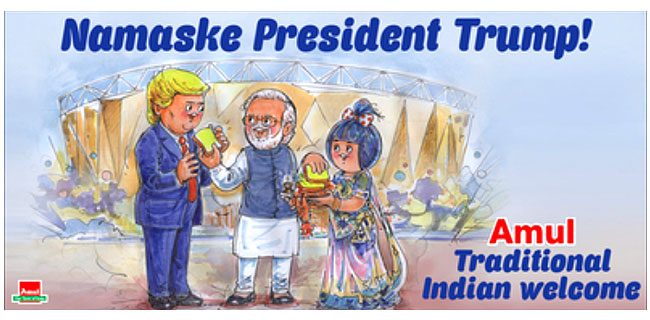
    Amul’s topical take on the Trump visit


    By Shailesh Kapoor


    US President Donald Trump visits India for the first time early next week. And it’s going to be two days of absolute media frenzy. The news media, especially of the television variety, is perpetually looking for big news events, and this is one news event they didn’t see coming till very recently.


    The media went ballistic when President Obama visited India in early 2015. But there was more statesmanship associated with that visit, given the stature and sophistication Obama brings with his persona. Trump is more unpredictable, in what he says and how he responds to situations, and that would definitely add more colour to this trip, no pun intended.


    The build-up has already started. I found two stories on Trump’s limousine ‘The Beast’ while casually surfing news channels last night. There is much speculation already on the food that will served to the US President over the two days. One news anchor, in all seriousness, as if he was breaking the most important news of the year, informed his audience last night that Trump loves Diet Coke, but doesn’t drink tea, coffee or alcohol.


    While the news media see these as opportunity to flex its reportage muscles, and get a good boost in their ratings, for the home-viewing audience, this is just another type of entertainment. An average Indian couldn’t care less about the supposed trade deal that India and US may sign in the near future. Instead, it will be the photo-ops, the food, the inevitable line or two Trump will utter in Hindi, and such nuggets that will excite the TV audience. You don’t trade your favorite soap or reality show with news for nothing. You do it for entertainment.


    This normalisation of news content is a sign of the times we live in. Expect memes and more memes in your WhatsApp and on your social media feed, targeting all the protagonists involved: Trump, Modi and the media itself. Expect to be amused and irritated in equal measure.


    I also have a theory that such events work as antidotes to the constantly-raging news anchors, who need that odd break from shrillness and outrage every now and then, purely for medical reasons, if not anything else. And they secretly know this too.


    So, we are in for a fun ride. Let the entertainment begin!