Tag: Shailesh Kapoor

  • Divergence over Convergence: The Uniquely Indian Story


    By Shailesh Kapoor


    Shailesh Kapoor

    The week that was saw India win a Test series in Australia, despite all possible odds stacked up against them. In India’s 89-year Test cricket history, this has to count as the most memorable and cherished win.


    Will this huge cricketing achievement reflect in viewership numbers when they come in next week? Almost certainly not. If the peak viewing of the Gabba test touches even 50% level of the weakest IPL 2020 match, it will be a surprise. While the non-prime timings contribute to limiting the viewership, the wider ‘issue’ with Test cricket, of being able to engage large sections of the audience, especially the youth, remains.


    As a result, while T20s and even ODIs are profitable formats, Test cricket is a struggle to monetise. The upcoming India-England series in India has five T20s lined up. The money they will take will be enough to fund the four Test matches. A new format (T10) has come up in recent times, and there’s a well-promoted T10 tournament in Abu Dhabi scheduled from January 28. The duration of the ‘perfect’ cricket match for the masses will continue to shrink with time, till it reaches the soccer level of 120 minutes from start to end, including the breaks.


    Which brings us to the larger question: Where does content like Test cricket, which has a niche but very loyal following, sit in the scheme of things? Cricket may find its way through, because even the ‘niche’ numbers are in millions, but what about niche content in other genres such as GEC, movies or news? It virtually has no chance to survive in a viewership system that is designed around the lowest common denominator (LCD). And because our television models continue to be ad-dependent in major part, the subscription-only route is not viable too.


    Here’s where digital comes in. It may be time to reconcile that unlike the West, where “TV” has two branches, linear and on-demand, India will see two very distinct and divergent categories emerging more clearly over the next five years. Linear television will continue to become more and more aligned to the LCD, while SVOD services will get more and more specific in the niches they will target.


    The abbreviation “OTT” has emerged as a uniquely Indian one. But there’s a good reason why that’s happened. Because unlike the West, we cannot use “TV” for a medium that does not look or behave like classic television at all.


    All this while, convergence has dominated discussions around the growth of different content distribution options in India. Catch-up television and sports are good examples of convergence, as are reality shows like Bigg Boss and KBC. But a lot of that, except sports, is AVOD. AVOD is essentially like YouTube, which ends up being LCD-aligned more often than not. But it’s the SVOD end where convergence with other distribution platforms, especially linear, family-viewing-based television will be impossible to believe.


    A relevant question then is: Which is a bigger opportunity – a huge LCD monolith of millions of people, or the sum of several smaller, niche offerings to a divergent set of taste segments? The answer would vary for the content creator, the distributor and the advertiser. But this divergence, rather than convergence, is inevitable. And that’s an exciting story to look forward to.
  • Ormax Characters India Loves goes regional

    By Our Staff


    Media insights and consulting firm Ormax Media has announced its focus on regional language markets in India. As a first step in this direction, it has announced the launch of its syndicated monthly GEC character popularity tracking tool Ormax Characters India Loves (OCIL) in four regional markets – Tamil, Telugu, Bangla and Marathi. OCIL has been tracking character popularity in the Hindi GEC category since 2010 and is used widely by all channels in the category.


    Commenting on Ormax Media’s regional focus, Shailesh Kapoor, Founder & CEO – Ormax Media said: “In recent years, India’s regional story has been a compelling one. Be it television, theatrical or now streaming, regional content has been attracting the audience’s and the advertiser’s attention alike. 2021 will see Ormax Media launch several offerings targeted at key regional markets. The launch of OCIL in four languages is only a first step in this direction.”


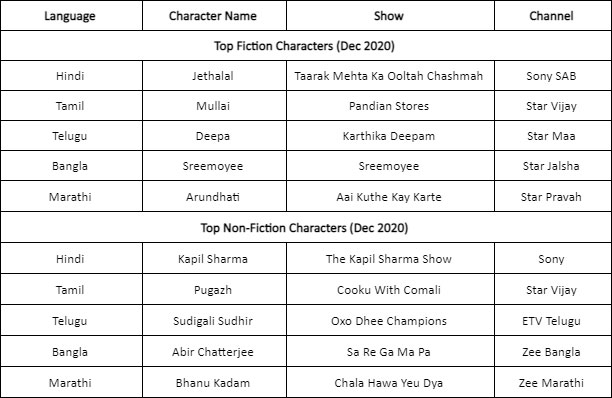
    The top fiction & non-fiction characters in December 2020 across the five languages are:


    Added Keerat Grewal, Partner – Ormax Media: “Characters are the cornerstone of storytelling. Character affinity ensures program loyalty, in turn helping shows to have long runs on television. Since 2010, Ormax Characters India Loves has helped leading Hindi GECs build a deep understanding of what makes Hindi GEC characters work. With the expansion into four regional languages, we hope that many other channels will now be able to benefit from similar understanding”.


  • Ratings Row: It may Finally be the Time for ‘Less is More’


    By Shailesh Kapoor


    Early in the new year, there’s a potential storm building up in the television business. Mumbai police has filed its chargesheet in what is now being called the ‘TRP Scam’. This is no ordinary case. It can have far-reaching implications for the television business in 2021, 2022 and even beyond.


    Ratings, as we all know, is the primary currency on which ad inventory trading is done in the television industry. Any question mark on the credibility of the ratings system puts a question mark on the currency. It doesn’t matter how many people are involved in the case, or data for how many channels was allegedly manipulated. What matters is that allegations of data distortion are in the public domain.


    The Central Government has been largely silent about these developments, perhaps because the case is under the purview of a government from the Opposition. But in parallel, the Central Government has been issuing advisories related to measurement transparency, sample size robustness, etc. This twain shall meet. It’s inevitable. And when that happens, we may be in for some dramatic developments. Dare I say, a larger ratings blackout is not ruled out. If that happens, it may be a treacherous road ahead for the television business, especially given the healthy growth digital advertising is witnessing currently.


    The television industry should take part of the blame for the soup it finds itself in. The obsession with ratings has been a constant feature of the sector over the last 25 years. While mass channels like entertainment and movies looking at ratings keenly is understandable, the obsession with ratings for niche genres, where the weekly time-spent by an average viewer (TSV) is in single-digit minutes, is amusing to say the least. At times, weekly changes that translate into 2-3 Peoplemeter homes are analysed in so much detail that you wonder if everyone actually understands the math behind it all in the first place.


    Then there is the obsession about slicing the data to segments and sub-segments, e.g., 15-21 yrs. NCCS A in Mumbai. This is where the ratings agencies, current and those in the past, have faulted. By allowing liberal data cuts in the software, they have encouraged a culture of slicing and over-analysis. BARC India has been better on this front compared to its predecessor, limiting the geographical cuts within a state only for the bigger states. But it’s not enough.


    Irrespective of how the ‘scam’ unfolds, some structural changes may be in order. All these years, the Indian TV ratings system has been constructed on the ‘more the better’ (and ‘faster the better’) premise. There was even a time when a lot of channels were keen on daily ratings. And who has forgotten the torture of pre-sunrise ratings updates till a decade ago?


    From ‘more the better’, we need to shift the mindset to ‘less is more’. By less, one obviously doesn’t mean lesser sample size. One means lesser TG cuts, lesser parameters perhaps, lesser frequency of reporting for some genres, etc.


    This shift requires a fundamental change of perspective. It will be unsettling for those who have built their entire careers on the ‘more the better’ premise. But in the long run, ‘less is more’ is the only sustainable solution for the industry. Let’s hope there are enough minds in the industry who are willing to endorse this idea.

  • 2021: The Year of Restoration & Regional Duality


    By Shailesh Kapoor


    We are out of the dreadful 2020 and into a new year. A date change doesn’t mean much in the present. But history is segmented by years and decades. And 2021 will stand out in history as an unusual year. If 2020 was the year of disruption and setback, all hopes are pinned on 2021 being the year of restoration and comeback. The next few weeks will be fascinating, to see how the recovery story actually unfolds.


    The Indian media and entertainment sector is on its comeback trail too. Revenue challenges apart, the television industry is running like 2019. Once again, off-screen news is dominating on-air magic. This time, the off-screen news is centered around the ongoing Mumbai police investigation into peoplemeter tampering. That’s a story that could have long-term ramifications, or turn out to be a case of much ado about nothing, depending on how the investigation progresses.


    The year of the pandemic was a big shot in the arm for the digital entertainment sector, especially streaming and gaming. Paid subscriptions have seen unprecedented jumps, and the streaming content landscape is looking healthier than ever before.


    But it’s the theatrical business that’s still trying to stand back on its feet. Theatres opened in October 2020, but the road has been a difficult one so far, with only about 15% regular theatre audience having revisited a theatre. While the fear of the pandemic is a factor, a bigger factor is the absence of mainline content itself. Producers, especially Hindi, have been reluctant to release their films, playing a cautious wait-and-watch game. It’s a strategy that’s arguably too conservative for its own good.


    But things are going to look up soon. The South film industry has been more forthcoming, with a huge Tamil release (Master) lined up for release next week. The teaser for one of the biggest pan-India films of the year (KGF Chapter 2) dropped yesterday. We are set for some real, big-ticket action at the box office in the regional markets in early 2021.


    But it’s not just the regional markets that will see audience flocking the theatres for these entertainers. KGF Chapter 2 and RRR are huge films for the Hindi market too. It will be an irony of sorts if the post-pandemic revival of Hindi cinema comes via dubbed version of South Indian films. And that’s a very distinct possibility as of now.


    Which brings me to a trend that’s likely to become even bigger in 2021: Breaking of regional boundaries in the content marketplace. This trend is manifesting itself in different ways across sectors. In television, remakes and adaptations of regional shows into Hindi and other regional languages are on the rise, and it seems like Star Plus’ new content mantra in particular. In streaming, it’s the idea of making originals available in multiple language feeds, and most platforms, especially Disney+ Hotstar and Amazon Prime Video, are taking this up on priority. And in theatrical, the doors that Bahubali opened will be broken altogether by the next line of big regional films releasing in 2021.


    The interesting facet of this trend is that it is shaping up in a era of growing regionalism. Pride around one’s culture, history and language continues to be on the rise at a pan-India level. It’s a more localised interpretation of the idea of nationalism, which is on the upswing globally, not just in India. The successful of 2019’s only Hindi blockbuster, Tanhaji: The Unsung Warrior, finds its roots in this trend.


    On the face of it, the two (acceptance of regional content and burgeoning regional pride) may seem contradictory. But that they are developing in parallel as growing trends is a statement about the fascinating reality that India is. The next year or two will see this duality unfold in full force, and it’s an exciting journey to witness.

  • Shailesh Kapoor | Scam 2020: Streamers or Pirates?

    By Shailesh Kapoor


    Three weeks ago, I wrote about the path ahead of the streaming category in India here. While that piece focused on content quality, there’s another important area that’s crucial to the growth of the SVOD category in India: Piracy.


    Piracy has plagued the Indian entertainment business for long. It was VCR-enabled piracy in the 80s and the 90s that impacted the theatrical business severely. As satellite television business mushroomed in India, piracy of cable connections as well as under-reporting on subscriber base by the last-mile operator led to huge leakage of subscription revenues, till the time digitization was brought in (one of the areas where TRAI’s involvement has been a definite plus) a few years ago.


    While all entertainment businesses will continue to face some form of piracy at any time, the latest story on the horizon here is about the new kid on the block: SVOD. Let’s understand this through an example.


    In our estimate, Scam 1992 (Sony Liv) has been watched (at least one episode) by 23 million people in India already. In a recent official statement in a promotional TOI supplement created around the success of the show, it was confirmed that Sony Liv is at the 2 mn paid subscribers mark now. Even if one assumes that all these 2 mn are in India and that all of them have watched Scam 1992, that’s still 21 mn unaccounted-for viewers. One can argue that Scam 1992 is fairly family-inclusive (compared to other web-series anyway), and would have been watched by 3-4 members of a family, either individually or together, on the same subscription. At an average of 3.5, it comes to 7 mn viewers through paid accounts. That still leaves 16 mn, i.e., 70% of the total viewer base, unexplained. Yes, there could be some free trials contributing to this 16 mn too, but that’s unlikely to be sizeable.


    The explanation is not too complex. There are three sources through which such ‘pirated’ viewing happens. The first is perhaps legally valid: Password sharing. In India, password sharing for OTT apps is fairly rampant, especially among teenagers and youth, as they try and extract the maximum value from their limited pocket moneys. But this aspect creates inconvenience, because many subscription packs do not allow for simultaneous viewing on multiple screens.


    This is where the other two modus operandi come in, both of which are blatantly illegal: Pirated downloads and file sharing. Both these are connected, in that the starting point of both these methods is a ripped copy of content making its way into the public domain. This is not very different from how we understand torrents. But now, it happens through apps that are often downloaded for this specific reason. There are many, and one of them is a fairly established messenger app too (Telegram). A simple search for your favorite show/ film on such apps will tell you how easy it is to find a good-quality pirated copy.


    It seems that the streaming industry is now becoming aware of the scale of this issue. But so far, there has been very little action that one has seen. The most obvious starting point is viewer awareness and persuasion. Remember those ads at the start of movie screenings and video cassettes, where film stars appealed audience not to watch pirated films?


    In our reading, 3 out of 5 people who download or view pirated content through such sites and apps do not know it is illegal! And those who know have no understanding of its impact on the industry that feeds them their entertainment. And of course, there’s no fear of getting caught in an illegal act anyway. So, there’s a long way to go on viewer awareness itself.


    One cannot bring such things down to nil. But there can definitely be a reduction in scale. If the SVOD category is making only 30% of what it deserves based on the Scam 1992 example above, imagine what the boost can be if it goes up to just 50%. That’s 67% growth from an inorganic factor!


    One hopes that the I&B ministry, under whom the industry now comes, takes this up as a top agenda item. For that, leading platforms will do well to pitch in with their share of lobbying.


  • Once Upon a Time… In a Pandemic


    By Shailesh Kapoor


    Shailesh Kapoor

    2020 been an unusual year, if ever there was one. Amid the pandemic and the socio-economic disruption it has brought in, there have been shifts in tastes and preferences too, some more enduring than others. The rise of digital consumption is perhaps the most enduring of these shifts. It may take some more time to accurately ascertain on how many new users were initiated into the world of e-commerce and online consumption of content, ranging from social media to long-format content, as a result of the pandemic. But all early estimates suggest the numbers in India are very sizeable, with some categories seeing upward of 40% growth in their active user base.


    A less dominant, but more nuanced, trend that has emerged is the apparent rise in the importance attached to the idea of nostalgia, especially in the realm of entertainment. The success of Ramayan on Doordarshan was the first strong indicator, but certainly not the only one. Television in 2020 has seen immense success via old content, including more recent shows like Saath Nibhaana Saathiya (S1) reruns rating higher than most popular new shows.


    In the streaming space too, Panchayat’s old-world charm fascinated the audience, and the more-recent Scam 1992 has been appreciated for, among other things, its authentic recreation of the 90s. Appreciation of the latter kind is not new, being a factor in films like Special 26 and Once Upon A Time In Mumbaai. But it’s more persuasive and dominant in Scam 1992, perhaps because the importance attached to nostalgia is peaking in 2020.


    Ludo King has emerged as the most popular online game of 2019-20, with its nostalgic value driving its success in no small measure. Even as modern-era games like PUB G (till its ban in India) and its variants fascinate the teenagers and the youth, the older (30+) population is enamored by the idea of being able to play Ludo online with friends and family members across the globe.


    Nostalgia has the potential of being a strong hot button in films too, though it can be argued that so far, it has been a bit of a wasted opportunity. Many old songs have been recreated over the last decade. But more than evoking nostalgia, these remixes have made many question if remixing old songs is a way of legitimizing creative bankruptcy in the music world, where original creations are taking a backseat. But there have been some smart ones too, like the recent use of the Albela (1951) song O Beta Ji in Anurag Basu’s Netflix film Ludo.


    The signs are clear. Yes, nostalgia is in. But nostalgia does not equal recreations. Remaking a film from the 90s (e.g. Coolie No. 1) is arguably ‘anti-nostalgia’ as an idea, because the underlying message here is that the old-world charm should make way for a modern interpretation. Audience are beginning to question if they need modern interpretations at all, or would they rather visit the old world as it was, without any gloss and packaging added to make it “relevant”. Referring back to television, one of Sony’s more compelling fiction shows in recent times (Yeh Unn Dino Ki Baat Hai) was one such authentic tribute to the old world, without any adulteration to cater to the smartphone mindset.


    This is a complex trend, and a very new one too. How does one revisit the old and keep it relevant to the 2020s? How does one balance the authenticity with relatability? It may be easier for true stories like Scam 1992, but when it comes to more fictional work like Panchayat and Yeh Unn Dino Ki Baat Hai, the execution needs to be pitch perfect to resonate.


    The added complication is the doubt whether this trending is enduring or ephemeral. Will the love for nostalgia fade away in the post-vaccine world? A short answer to that is: No. After all, the term’s definition itself is so emotionally rich and textured. Nostalgia is defined as a feeling of pleasure, mixed with sadness, when you think of happy times in the past. Nostalgia has emerged as one of the most compelling content lenses in recent years, and it is unlikely to lose its footing anytime soon.


    How the entertainment (and the advertising) industry uses it to their advantage will be a story one is very keen to follow, in 2021 and beyond.


  • Indian Streaming Content: Boom or Bubble?


    By Shailesh Kapoor


    Shailesh Kapoor

    In a tough year for businesses in general, the growth of the streaming business in India has stood out as the big story of 2020. Last week, Disney+ reported that out of its 73.7 million paid subscribers worldwide, 18.3 million are from their Indian service Disney+ Hotstar. Even if one assumes that a fraction of this number will unsubscribe now that IPL is over, this is a staggering number, nonetheless. India is a market known for its reluctance to pay for content.

    The current SVOD (Subscription Video on Demand) consumer base is India is estimated at about 30-35 million people, and the average number of services subscribed to at about two, leading to an estimate of 60-70 million active paid subscriptions. Considering that every subscription is used by about three people on an average, that’s about 200 million (20 crore) SVOD consumers in India, a healthy number by any yardstick.

    An equally big growth story is emerging on the AVOD (Advertising Video on Demand) front. Catch-up television has been at the forefront of AVOD consumption in India for a few years now. But this year has seen original content springing up too, with MX Player, the leading AVOD platform, clocking huge numbers for its shows, especially Aashram, two seasons of which were released within a short period of time.

    And then, there’s film content too, which has got a major surge because of an extended period of theatres being closed and no major new releases announced even after they have re-opened. If we just consider national content (Hindi and Made-in-India English shows or films), the number of shows and films launched in 2020 have been upward of 200 already. The year may end at a number close to 250. If production had not been halted because of the lockdown, we may have seen a triple century being hit. And this does not include many low-profile YouTube shows that form a secondary content ecosystem online. In the streaming category, International content gets sizeable traction too. Add to that the activity at the regional front (Bangla platform Hoichoi and Telugu platform Aha have done very well), and it’s a buzzing category indeed.

    Now that’s a lot of content! In comparison, the Hindi GEC category launches about 80-100 new shows every year, and about a similar number of Hindi films release theatrically with at least some marketing push behind them.

    But how many of these 200 shows and films have actually done well? India does not have organised viewership measurement on the streaming category yet, and it may take some time before that happens. Platforms, understandably, are reluctant to share figures. We, at Ormax, are working on statistical estimate models to estimate viewership of shows (and a Top 5 list is released every week on Film Companion since September). But while we wait for that data to be built over a year, another yardstick for which more data is available is the likeability of the content itself. Of those who watched the show or the film, how many liked it enough to recommend it to someone they know?

    This data has been built at Ormax since the start of the streaming originals in 2015. Measured on a percentage (0-100) scale, Advocacy (likeability) of 60% of more suggests a positive response, while that of 70% or more indicates that the content has truly broken out. Only 27% of shows or films launched in 2020 met the 60+ benchmark. And only 12% crossed 70. These numbers are at par with TV and films content in India over the last 2-3 years.

    But the difference is when you can calculate the absolute number of shows or films that were “not liked” (below 60). That’s 150! Yes, let that sink in. 150 Indian streaming originals and films launched in 2020, in Hindi or English, received response that ranged to lukewarm acceptance to outright rejection.

    Production houses are enjoying this phase, when there is a lot of demand for content from the streaming platforms, and a lot of work is being commissioned. But the question that should be asked sooner than later is: Are the streaming platforms becoming a dumping ground for mediocre content? Content that would not have found its way in any other medium, such as television or theatrical?

    For every Scam 1992 or Mirzapur, there are half a dozen other shows that just don’t get any traction. All streaming platforms, without exception, take pride in the data that they own, and guard it jealously too. Why, then, should the success rate be a paltry 27% only?

    It is certain that 2021 will see a further surge in content production for the streaming category, especially because more films will be made with the intent of releasing directly on OTT. One hopes the strike rate improves too. Because content quality is as much a measure of success as anything else, especially if one has an eye on the long-term sustainable growth, which is needed to ensure 2020 doesn’t become just a bubble year.


  • 86mn IPL franchise fans in India: Ormax Media’s study

    By A Correspondent


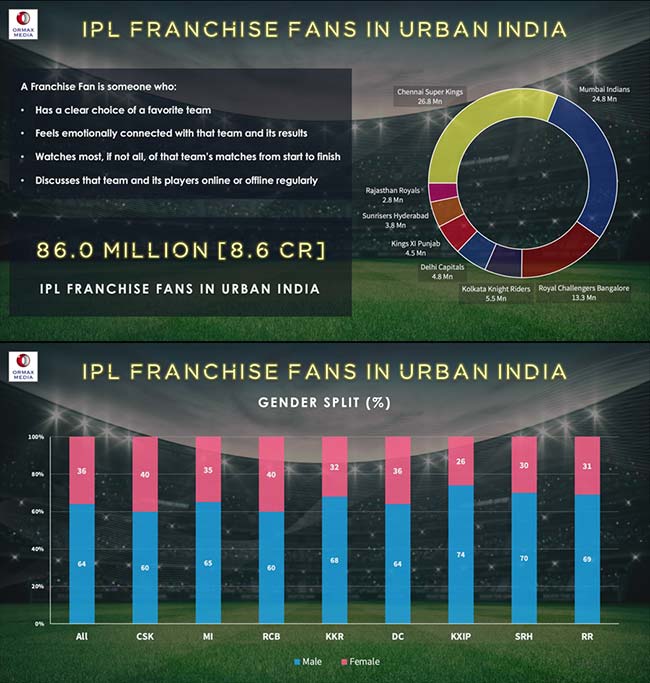
    Media consulting firm Ormax Media has released the findings of its study on ‘IPL Franchise Fans’, based on a research conducted among 3,200 urban respondents across 23 states in India. The data was collected through the course of the eight weeks of IPL 2020. The study pegs the number of fans across the eight IPL franchises at 86 million (8.6 cr).


    Chennai Super Kings (CSK) emerges as the strongest franchise, with 26.8 million fans, closely followed by season winners Mumbai Indians (MI) at 24.8 million fans. Royal Challengers Bangalore (RCB) ranks third, with 13.3 million fans. Between them, these three franchises account for 75% of the total fan base, while the remaining five contribute to the balance 25%.


    As many as 64% (55 million) of the total franchise fans are men, while the balance 36% (31 million) are women. CSK and RCB have the most gender-balanced fan base, with the proportion of female fans being the highest at 40% each. Nationwide popularity of their star players (MS Dhoni and Virat Kohli respectively) contributes to their stronger female fan base. Mumbai Indians leads Chennai Super Kings by a slender margin when it comes to the male fan base, but the latter takes the overall #1 position because of its stronger female following.


    Shailesh Kapoor

    Commenting on the findings, Shailesh Kapoor, Founder & CEO – Ormax Media said: “Apart from viewership, a definitive measure of the success of a sports league is whether the teams playing in it manage to build a sizeable fan base over the years. A strong fan base is eventually the key for a profitable franchise, because it offers higher monetisation opportunities through sponsorships, ticket sales, merchandizing, licensing and other such avenues. Over the last 13 years, IPL has done very well, and the fan base estimates of the Top 2 franchises suggest that they are now two of the strongest sports teams across the world. It’s for the other franchises to learn from the success story of CSK and MI and develop a strategy to widen their fan base in the coming years”.


  • At a Theatre near you… A Film will Eventually Release!


    By Shailesh Kapoor


    As we enter the ninth month since the start of the Covid-induced lockdown and the various unlocks that have followed, most sectors, including those in the entertainment business, have started their journey back to recovery. But there’s one sector whose journey is still waiting to kickstart: The theatrical business.


    It’s been over a month since theatres started opening in the country. Being a state subject, it was left to the discretion of the various state governments to allow theatres to open or not, within the broad guidelines set by the Centre. Eventually, most states have given the nod, and multiplexes have started to open.


    But there is no audience yet. Except a couple of festive weeks in West Bengal and a few footfalls in the South where some niche films have started to release, the audience have not gone back yet. It could be easy to see this as a measure of audience’s sentiment regarding the perceived Covid threat in a theatre visit. But that’s not a valid argument. Not for now, at least.


    Audience in large parts of the country have not gone back simply because there’s no new content to go to. The first 3-4 weeks saw reruns of old Hindi films. It was understandable that with Maharashtra theatres still closed, no new Hindi films will release. But now, that’s not the case, and all major states have allowed theatres to re-open. A lot of single screens have chosen not to open yet, because unless they get new content, the running operational cost would far exceed the ticket sales from rerun content.


    It’s the classic Catch-22. ‘What comes first: The audience or the content?’ The Hindi film industry is hoping the answer is ‘the audience’. But that’s wishful thinking. We saw that this week with the first proper Hindi release since March. It was brave to see Zee taking the plunge and releasing its film Suraj Pe Mangal Bhari on November 15. The film didn’t get much traction, but it may have struggled even during normal times. The film simply lacks the scale that’s needed to get the audience back.


    The only practical answer to the question above is “the content”. And some content needs to announce its arrival soon. We are entering the sixth week of theatre re-opening, and there’s no announcement on the release date of Sooryavanshi or 83 (both Reliance films that were ready for release pre-Covid). Christopher Nolan’s Tenet has released in all the major countries worldwide, but awaits a specific date for its India release. It may end up being the first major release of a Hindi or Hollywood film since March. Wonder Woman 1984 is scheduled for a Christmas release, but given the escalating Covid situation in the US, that date may not be met.


    In this tentativeness-laden scenario, single screens and smaller multiplex chains in India wait eagerly for some announcement. When theatres were closed, announcements regarding films releasing on OTT platforms came in thick and fast. But the same level of urgency is evidently absent when it comes to theatrical announcements. Tamil and Telugu industries have been more proactive in putting out some teasers and dates, but there’s been complete silence from their Hindi counterparts.


    While one can understand the scepticism regarding the potential loss of business a big film can suffer if it releases “too early”, someone has to simply take the plunge for the larger good of the industry. Otherwise, the case for smaller theatres to permanently shut down will become stronger by the week. And that damage may last years, not months.


    There’s enough research to indicate that the audience is willing to come back, but also to indicate that they will not all come back on Day 1. It will be a slow process over a few weeks, over three-four major national releases, flanked by key regional ones. But we need a brave soul to set the ball rolling by locking a date and put it out in the public. Or at least announce clearly what their plans are, and the rationale behind those choices.


    Inaction can be worse than imperfect action. I hope the Hindi film industry doesn’t have to pay a huge price for its current state of indecisiveness.


  • Shailesh Kapoor: Whose Ratings Are They, Anyway?


    By Shailesh Kapoor


    The last few weeks have seen eruption of a fresh debate around television ratings. Before the formation of BARC India, ratings-related controversies in the TAM era were frequent, and different broadcasters, at different times, expressed their discontentment privately and publically, with some like NDTV even taking the legal route. When the currency shifted to BARC India in 2015, these debates expectedly became less frequent. The key difference, of course, was that BARC India is an industry body, and not a private organisation like TAM.


    For the last five years, despite stray voices and uncalled-for government interference, there has been an overall sense of calm around TV ratings in India. But trust 2020 to challenge the status quo. One concern after the other, the ratings system has come under the scanner again in recent weeks.


    It started with BARC India’s decision to use an algorithm to remove the impact of landing pages on viewership. This evidently-controversial decision has not gone down well with several news broadcasters. Even as we await the unfolding of this contentious piece, the Peoplemeter-tampering controversy came to the fore, wherein the Mumbai police charged certain news channels, most noticeably the Republic TV network, of breach.


    In a large, pan-India panel that’s being managed manually at the last mile, some Peoplemeter homes being compromised is not such a surprising development. It’s bound to happen once in a while, and a swift and decisive response it all that such incidents needs, on behalf of BARC India.


    But such incidents bring the topic up in the media, and we know that questioning voices don’t worry much about facts and details anymore. By suspending channel-level ratings for the news genre, BARC India has, in effect, admitted there’s a need to get things in order. And that can, arguably, be called a constructive decision.


    t the events of the last two months have worked as a perfect trigger for the ever-eager I&B ministry and TRAI to step in. Last week, the ministry constituted a four-member committee to review the existing guidelines on television ratings agencies in India.


    The government’s interference in the television industry can be exasperating for any sane mind that has the industry’s best interest at heart. Under the excuse of protecting consumer interest, TRAI has interfered repeatedly by setting the price points and guidelines regarding pay TV subscription. Why TV industry even comes under TRAI is a larger question in the first place. But even if one ignores that by seeing TRAI and the I&B ministry or any other such body as a generic entity called the Government of India, the interference is a blatant violation of the principles on which a free market operates. Why are cinema and live event ticket prices not regulated? I hope I’m not giving them more ideas to widen their interference net, but the Government could have done well to stay away from areas it has no business of being a part of. But that ain’t happening anytime soon. In fact, the latest development, that online news portals and the OTT category will come under the I&B ministry, is a new cause of concern.


    The ratings committee has two months to put up its recommendations. Irrespective of how good a job they do of it, the direction in which this discourse is going is deeply problematic. It’s been a tough year for all industries, and television broadcasting is no exception. Hope some common sense prevails, and trigger-happy authorities stay away from shooting at will. Else, 2021 could spell some more trouble for the business. Trouble that, unlike the pandemic, is eminently avoidable.


  • Shailesh Kapoor: A Poll Here, A Poll There

    By Shailesh Kapoor


    It’s an elections week after long, and one that offers a double bill too. Polling in the Bihar elections ends this Saturday, and Tuesday is the big counting day, even though exit polls will be out Saturday evening itself. But the election that has kept many of us engaged this week is the Presidential election in the US, where three days after polling, the counting is still on, and though Joe Biden is almost certain to be the next US President, the election has still not been officially called by any major news network at the time of writing this column.


    The contrast between Indian and US elections and elections coverage cannot be more striking. On the process itself, the paper ballot counting method in the US makes you realise once again how India has evolved so much in this area over the last two-three decades. Watching the US elections results reminded me of the 1984 Lok Sabha election results, where it took three days for all the leads and results to come in. On Tuesday in Bihar, it will take less than three hours.


    But an important reason for the long wait in the US is Covid-specific. Voters were given the option to post in their ballots, than physically queue up on the election day. This evidently sensible option was used by a massive number of urban voters, leading to the counting process being more cumbersome than usual. Implementing an equivalent in India is unthinkable for about a dozen reasons.


    The other contrast is the coverage on television itself. India elections coverage on TV is hyperbolic, even when the outcome is a foregone conclusion. Watching some of the American news channels over the last three days, I was impressed by the calm demeanour maintained by most anchors and reporters, despite the close contest in a highly-polarised political environment.


    One Indian news network, though, is ignoring the US elections, and may even ignore the Bihar elections. Republic Network’s promoter and star anchor Arnab Goswami was arrested by Maharashtra police on Wednesday, and the two channels run by the network are running that as the singular news story since then. Even over the last two-three weeks, after the controversy around some Peoplemeters being allegedly compromised in the favour of their channel broke out, the network has been incessantly doing stories on itself.


    Goswami’s arrest is evidently a politically timed move, much like demolition of Kangana Ranaut’s office earlier this year. He will eventually be out on bail, and you know he will be ready to play martyr on primetime television for at least a few weeks after that.


    As an aside, Tuesday, the day of Bihar election results, is also the day of the IPL final. For the first time in IPL’s 13-year history, the final is not being held on a weekend. This unusual scheduling choice notwithstanding, it has been an immensely successful IPL, especially given all the challenges involved. The next edition, planned within five months, will do very well to just match up.


  • Shailesh Kapoor: October Diaries

    By Shailesh Kapoor


    It’s been a month of many things. As October comes to an end, here’s a round-up of some highlights from the media & entertainment sector this month:


    The Big Cricket Bash

    After all the speculation and tentativeness, IPL 2020 is up and running in the UAE, and doing well for itself. With an approximate growth of 10% in viewership over the previous edition, IPL this year has benefited from cricket starvation enforced upon the home viewers for the last eight months. The season has lived upto its billing too, with several evenly-contested games.


    The Road To Recovery

    With the arrival of the festive season, however muted the festivities may be this year, advertising revenues have got an impetus too. The presence of IPL and big ticket reality shows like Bigg Boss and KBC helps too, and in no small measure. It’s not a year to compare to any previous one, but compared to how things stood in July, there is a definitive sense of recovery now.


    Theatres: Now Open

    The theatres are finally open, though most of them (with the exclusion of those in West Bengal) still await the arrival of fresh content to generate any meaningful footfalls. The response to new Puja releases in the West Bengal market has been heartening and is the first quantitative sign that we can expect a sizeable audience back once the big Hindi, Hollywood and South films make their way to the cinemas, hopefully in 2020 itself.


    A Rare Weak KBC Season

    KBC has not performed this year, and that’s a rarity for a show that has been a family favourite for a decade now. It’s only the second weak season of the show since it moved to Sony from Season 4. Earlier, Season 7, if my memory serves me right, had struggled to engage audience, especially because of the extreme visual disruption it attempted, including a change in set design. This time, the absence of studio audience can be seen as a key factor that may have reduced the magic of the show.


    The Big Bull of the Web-Series World

    Mirzapur 2 was the much-awaited web-series this October. But it’s Sony LIV’s Scam 1992: The Harshad Mehta Story that has stood out as a real winner this month. The deftly executed book adaptation is meticulous in its detailing and authenticity, and elegantly simplifies a scam that was too “technical” for most of us to comprehend thus far. It also ushers in a new genre in the streaming space: Corporate drama. And that’s a welcome change from the overdose of thrillers and crime sagas!


    Another Star Plus Era Ushering In?

    For the first time in many years, the top Hindi GEC enjoys a 40%+ lead over its nearest competitor. Star Plus has managed its content portfolio very well on either side of the lockdown, and has even managed something that was unthinkable a year ago: A new show (Anupamaa) averaging 3+ TVR. The competition must catch up soon, because Star Plus has got its house in order alright.


    From Sushant To Drugs To Elections… News Moves On

    The Bihar elections have finally shifted focused away from four months of a stretched news narrative around Sushant Singh Rajput, Rhea Chakraborty, consumption of drugs in Bollywood, and all the associated gossip primetime news was busy delivering, even as India struggled with Covid. An election in the times of Covid is a first. But even if that’s not the story being chased, the focus is finally back to politics, and we can expect some real news on TV in the next few weeks.