Tag: Shailesh Kapoor

  • Men Rule OTT in India. 66% males dominate viewership


    By A Correspondent


    The audience size of regular OTT (online video content) audience in India stands at 76.5 Million (7.65 Cr), according to the findings of The Ormax OTT Audience Report: 2019. Mumbai and Delhi lead the top markets, with 3 million regular OTT audience each, followed by Bengaluru, Hyderabad, Kolkata, Ahmedabad, Surat, Chennai, Pune & Jaipur.


    The study, conducted among 15+ age group, also profiles the OTT Universe. 66% regular OTT audience are men, while 34% are women. 25% belong to the 15-21 yrs. age group, 34% in the 22-30 yrs. age group, 21% in 31-40 yrs. and 20% in the 41+ age group.


    The research report covered a sample size of 10,000 audience over the period of May to September 2019, whereby audience were sized and profiled based on their OTT consumption behaviour, usage of various OTT platforms/ apps, and their content choices. The study defined ‘regular OTT audience’ as someone who watched two or more hours of OTT content every week, and uses at least one website/ app besides YouTube and social media to watch video content online.

     

    Speaking about The Ormax OTT Audience Report: 2019, Shailesh Kapoor, CEO – Ormax Media, said: “OTT is an emerging and fast-growing category in India. While individual platforms have a lot of a data on their own audience, there is little industry-wide understanding available on who the OTT audience in India exactly is, how many are they in number, where do they exist, how do they watch, which genres do they prefer, what are their subscription triggers, and many other such questions that are extremely relevant to any OTT business. This report, which will be an annual feature, answers many such questions in a manner that’s highly actionable, with direct implications in decision-making in the areas of content selection, target audience choice, media planning, market research and brand communication”.


    Among the OTT platforms, YouTube emerges as the most-preferred OTT brand, followed by Netflix, Amazon Prime Video and Hotstar closely vying for the second position. ALT Balaji’s Gandii Baat emerged as the most male-skewed show, while Amazon Prime Video’s Mind The Malhotras emerged as the most female-skewed show.


    The report also highlights how solo consumption is still the dominant viewing behaviour seen in the OTT category, with 82% audience typically watching online videos alone. Hindi emerges as the most-preferred language of online video consumption at 62%, followed by English at 22%, while regional languages, led by Telugu and Tamil, control the balance 16% share.


    The Ormax OTT Audience Report: 2019 is a syndicated report that’s now available for subscription.


  • Sawaal 120 Crore Ka


    By Shailesh Kapoor


    Last weekend, Union minister Ravi Shankar Prasad gave a press statement, where he cited the combined first-day collections of War, Sye Raa Narsimha Reddy and Joker (Rs. 120 cr) to “prove” that there is no slowdown in the Indian economy. This comment, which can form a case study in a Logic 101 class on how not to construct an argument, has been the subject of many jokes and memes on social media over the last week.


    For most people in traditional businesses, the slowdown this year is a harsh reality. If we speak specifically of the media sector, most TV channels and print publications have started reporting declining sales this year, forcing them to rationalise expenses, while they wait and hope for a better 2020-21. The digital and online businesses have managed to hold on somewhat better, with the growth in data consumption countering the slowdown in some measure.


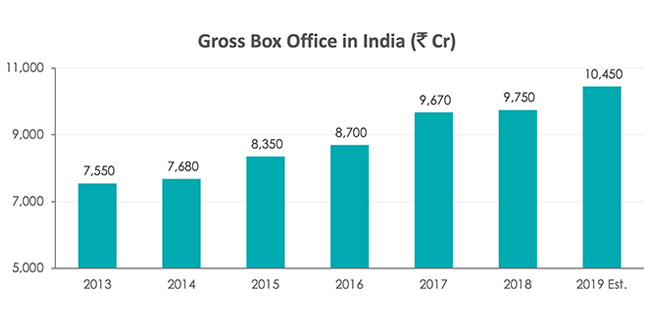
    I’m not an economist, and any further comment on the slowdown is out of syllabus for me. But the specific 120 Cr comment is definitely in my territory. The chart above and below captures the movement of the total box-office in India from 2013 to 2019. These are box-office collections across all Indian languages put together. Gross (pre-tax) numbers have been considered, as tax burden on film tickets has changed because of the arrival of GST, and then the change in the GST slab earlier this year. The numbers for 2019 are estimates for the entire year, based on the collections so far.


    A first look at the chart itself should tell us that there hasn’t been much of a steady growth in the box-office business in India over the last few years. The CAGR over the period 2013-2019 stands at a mere 5.6%, and even the best growth years have struggled to go much beyond 10% growth. Importantly, some of this growth is seller-led, coming only because of the continuous growth in ticket prices. Footfalls have remained largely stagnant, and even fallen in specific years.


    The other story in the chart is about how small the number Rs 10,450 cr is in itself. If you are aware of even the ballpark in which television revenues operate, you would know that the box-office collections from across the entire country can’t match up to the revenues of some of the big TV networks in India. Not that television is a very big industry to begin with.


    Hence, to even quote box-office as any indication of the health of the economy is fallacious and contentious. But if entertainment can provide fodder for more entertainment, however unintentionally, who’s complaining?


  • Have we entered a ‘Slow News’ era?


    By Shailesh Kapoor


    It’s a bit contrarian, almost ironical, as an idea. But since the re-election of the Modi Government with a thumping majority earlier this year, India may have, arguably, entered its first ‘Slow News’ era since the media boom arrived in the early 90s. In an age where digital news provides an anytime, anyplace option to the traditional news media of television and print, this could seem almost impossible. But the signs are around us.

    Over the last two decades, “news” has typically been dominated by politics. Elections have always been the tentpole news events, but there are other political, or at least quasi-political, happenings at national and state levels, which have often dominated headlines. For example, the last 3-4 years of the second UPA term was headlined by a series of scams, which kept the newsrooms busy for months at a stretch.

    Then, there is the socio-political type of marquee news, such as the Anna Hazare movement in 2011. And events that can rattle the nation at large, such as the 26/11 terrorist attacks in 2008 or the Nirbhaya gangrape case in 2012. These news events had both relevance and consequences, leading to them being not just elaborate news affairs, but also those with very high recall much after they have passed their peak-news phase.

    In contrast, if we look at the first few months, there’s very little of any of the above. The first term of the Modi Government had the big demonetisation tentpole, which stretched for almost a year. Then, there were the surgical strikes post-Uri, and they were received with avid interest by the news audience. Round 2 of that came earlier this year, just before the elections, in Balakot.

    Additionally, there was the aggressive political headlining across the country, as BJP began to take control of power in one state after the other over the last few years. The campaigning has been aggressive, and political attacks and counterattacks have been commonplace since 2011-12 at least.

    In its second phase, the Modi Government seems more assured and front-footed. While political jibes and attacks will continue, especially around State elections, there isn’t much of an Opposition, definitely not nationally, to create any major sense of conflict or thrill. There haven’t been any major scams since 2014, except the Opposition’s unsuccessful attempt to project the Rafale deal as one. And thankfully, there haven’t been any major terrorist attacks (not outside J&K at least) for some time now.

    The striking-down of Article 370 provided good fodder for news, as did the Chandrayaan 2 landing on the moon. Both these events worked for their nationalistic sentiment, with the latter in particular evoking pop patriotism, about which I wrote here a few weeks ago. The recent Howdy Modi event is one more addition to this growing list of pop patriotism news events.

    But the more technical news, such as the economic slowdown, or the continuing restrictions in Kashmir, does not make for interesting headlines. For one, these topics lack the packaging and the relevance new events like demonetisation may have. To add to that, a large part of the mainline media today is highly compliant to the government’s political, economic and social agenda anyway, leading to the growing marginalisation of the anti-establishment media.

    If you see primetime news over the last few weeks, you would largely see what can be called tactical news stories. These are stories, like a random comment made by a politician being analysed ad nauseum, which wouldn’t have any significance even one week later.

    Of course, the absence of scams and terrorist attacks leading to slow news weeks is a good thing. But the homogenisation of the rest of the news, in favour of a particular ideology (nationalistic, if not right wing) is arguably not.

    Some state elections are coming up, and we can expect news consumption to rise. But that apart, we are in a slow news area, where variety and relevance of news will be increasingly at a premium.


  • Shailesh Kapoor: Not Releasing At A Theatre Near You

    By Shailesh Kapoor


    Even as the online shows category, or “web-series” as they are popularly called in India, continues to gain momentum with the launch of big ticket launches The Family Man (Amazon Prime Video) and Bard Of Blood (Netflix) in September, there’s another significant online trend emerging in the background: That of releasing mainline Hindi films direct-to-OTT, than releasing them theatrically first.

    On November 1, Dharma Productions’ Drive will be available on Netflix. The film was conceived and shot for a theatrical release, and has some face value attached to it too, with the cast being headlined by Sushant Singh Rajput and Jacqueline Fernandez. But the theatrical release has been delayed by more than a year, and the makers have now chosen to skip that route altogether.

    Earlier this week, Fox Star Studios decided to release their film Lootcase, a comic caper, online directly, canceling its theatrical release after launching the trailer with a specific theatrical release date. The decision makes a lot of sound business sense. Lootcase has a good trailer, but evidently lacks the face value to get people to buy a ticket for a theatre seat. It would take more money to market the film for a theatrical release, than what its likely box office recovery could be.

    Even as smaller films find a life online, the bigger ones continue to set the box-office ablaze. Hrithik Roshan and Tiger Shroff’s War opened to record-breaking numbers on October 2. Earlier this year, we saw Avengers: Endgame record set new benchmarks for Hollywood theatrical business in India.

    So, while a certain type of content becomes less lucrative theatrically, and is beginning to rely on the OTT world, the big ticket motion picture continues to thrive. And then, there is the middle-of-the-line cinema too, like Chhichhore and Dream Girl. These films may not be big ticket, but have enough entertainment value to attract a sizeable section of the young audience, ensuring lucrative theatrical returns.

    But increasingly, we will see films on the fringes of this middle-of-the-line category tipping over to the direct-to-OTT category. The chasm between big ticket and the rest will only grow wider, as theatrical ticket prices will continue to go up, data costs continue to fall, and the OTT audience base continue to increase with each passing year.

    There are many films in 2019 alone, which had known faces attached to them, but were theatrical disasters, not getting an initial audience sizeable enough to build on. The more noteworthy of these are Why Cheat India (Emraan Hashmi), Sonchiriya (Sushant Singh Rajput, Manoj Bajpai and Bhumi Pednekar), Photograph (Nawazuddin Siddiqui), India’s Most Wanted (Arjun Kapoor), Arjun Patiala (Diljit Dosanjh and Kriti Sanon), Khandaani Shafakhana (Sonakshi Sinha), The Zoya Factor (Sonam Kapoor) and Prassthanam (Sanjay Dutt).

    The lure of a theatrical release, however, is still an important motivation for many writers, directors and actors. In the Indian film industry, a direct-to-OTT release is still seen as a compromise option, than as a legitimate business decision. This mindset would mean that such films, which should ideally be released online directly, will continue to have a loss-making theatrical release before they go online and hope to recover some costs from there.

    But with every passing year, better sense would prevail. Because the writing on the wall is inevitable. If you don’t have  the minimum threshold level of face value and packaging, the theatre is going to be increasingly out of reach.


  • The Big OTT Growth Story: Chapter 2


    This is the second in a series of columns by Shailesh Kapoor on the OTT Growth Story in India. Click here for Chapter 1.


    By Shailesh Kapoor


    It’s raining OTT show launches. Over the last few weeks, about two-three major and another five-six minor OTT shows have been launching every week. At this rate, the number of OTT shows that launch in 2019 will be higher than the Hindi GEC shows launched over a five-year period (2015-19). And you may not be wrong in believing that this is just the start, and things can only get more exciting from here.

    While the launch rate has accelerated significantly in 2019, it has been accompanied by a parallel improvement in the quality of content too. Till last year, among the many OTT shows that launched, only a couple would pass muster on quality. Most of the shows that won audience appreciation were from the TVF stable. ‘Quantity over quality’ seemed to be the OTT mantra.

    While that mantra continues to hold true for the second line of OTT players in 2019, there has been a significant jump in the quality of the top shows in 2019. If we look at the Ormax Advocacy Score (a measure out of 100 on how well-appreciated a show was among the audience who watched it), 2019 has some strong candidates in the reckoning.

    November 2018’s launch Mirzapur (Amazon Prime Video) continued to get audience appreciation early this year. Then came the deliciously compelling Delhi Crime (Netflix), which continues to grow its audience base till date, six months since it launched in March.

    The big success of the year, however, is a somewhat low-profile show Kota Factory (TVF). Presented in Black & White, this funny and insightful series on the student life in the education hub Kota has received widespread acclaim from young audiences, become the third-most liked Indian OTT show till date on the Ormax Advocacy scale, after Sacred Games (Season 1) and TVF Pitchers.

    Another potential top-end show dropped last night: Amazon Prime Video’s The Family Man. The unusually-textured spy thriller cum family drama stands apart from the dark and gritty world that shows like Sacred Games and Mirzapur espouse.

    However, all good things come with a word of caution. Almost 80% of OTT shows that have launched still have an Advocacy Score below 50, symptomatic of active audience dislike, even rejection. Many of these have been actively promoted by the respective platforms, indicating that the platform sensed good potential in them. So, even though the top-end has become stronger, the success rate may still be a mere 15-20%, or even lesser. Quantity may still be prevailing over quality after all.

    The Top 10 Hindi films of 2019 based on audience advocacy (word-of-mouth) average at a staggering Advocacy Score of 73. The equivalent number for the OTT category in 2019 is only 60, which is only a notch higher than the Hindi GEC category average of the year. And the Hindi GEC category has not exactly been in the pink of its health in recent times.

    A long tail of flop shows will continue to be churned out in a category where everyone wants a share of the pie. 2019 has been good so far in providing a strong top layer of quality content. This layer now needs to expand from three to four shows to 10-15 shows a year. And 2020 may just be the year to achieve that.


  • Chandrayaan 2: Pop Patriotism Is Here


    By Shailesh Kapoor


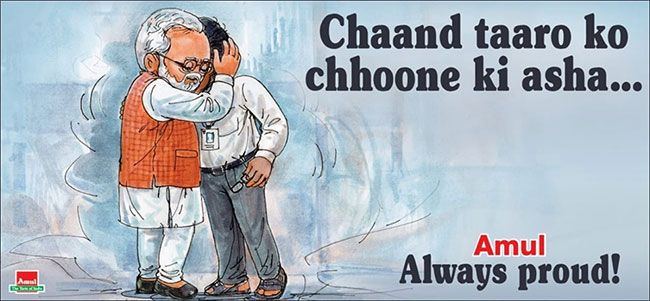
    Late night last Friday, the nation was hooked to watching the Chandrayaan 2 landing on the South pole of the moon. In the wee hours of Saturday morning, when it became evident that the lander Vikram has deviated from its trajectory and gone incommunicado, the nation gasped together. The next day, the now-famous image of the Prime Minister consoling the ISO chief Kailasavadivoo Sivan was the subject of many front pages, social media posts and memes.


    Outside sport and war, there has been no event in recent memory that has managed to generate a collective interest from across the country to this extent. Live telecast from ISRO across news channels and GECs took the mission to the masses, fueling discussions in real time that night, rather than the next morning. This, perhaps, was the most important difference in this case, vis-à-vis several other space and nuclear missions India has undertaken in the past. ‘Seeing is believing’, it is said. And the live images from ISRO, including the presence of the Prime Minister there, made the entire mission come across as a lot more ‘real’ and palpable than it would have been otherwise.


    The events of Friday and Saturday were intriguing, to say the least. The disappointment was soon overtaken by a sense of pride at having attempted the mission the first place. There was widespread support, cutting across the political and ideology spectrum, and in general, there seemed to be a sense that India has achieved something significant, despite the lander missing its course in the final phase. There were the jokes too, all in good taste.


    Does a country of so many people care about its space programme? How does it affect their lives in any way? Last weekend, most Indians were not thinking on those lines. What we saw can be termed as ‘pop patriotism’, whereby a nation comes together through an event that becomes a popular symbol of its strength, and through poster boys (the ISRO chief and the Prime Minister in this case) who are helming the event.


    In the day and age of social media, this could be the new normal. Patriotism and national pride may be easier to evoke through audio-visual stimulus, such as the live telecast and the follow-up conversations here, than through well-researched essays on history, science or humanities. It is almost certain that a vast proportion of those who watched the telecast live Friday night wouldn’t know anything about Chandrayaan (except the obvious reference to the moon in its name) before the day. It is highly doubtful that they would know much after the day either. But when there’s a collective, social energy at work, knowledge can, and perhaps should, take a backseat.


    There has been aggressive nationalism on display, especially in the electronic media, in the recent years via the surgical strikes and the air strikes that followed the Uri and the Pulwama attacks respectively. Finally, with Chandrayaan 2, the media found a non-Pakistan topic to celebrate the pride of our nation.


    Pop patriotism may sound like a bad word, but it’s in, nevertheless. And it will be the new kind of patriotism that the old school has to get used to.


  • Shailesh Kapoor: Test Cricket Championship: Survival Tactics?

    By Shailesh Kapoor


    In August 2019, the long-attempted ICC initiative of holding a World Test Cricket Championship finally took off. The two-year-long event, to be played over 27 bilateral Test series over a period of 19 months, will culminate in a finale Test at Lord’s on June 10-14, 2021, leading to crowning of the first-ever Test cricket champions.


    ICC’s attempts to hold a similar championship in the past were unsuccessful. The underlying complexities related to format and scheduling were too many to handle. But with some planning this time, ICC has managed to come up with a format that’s both feasible to execute and logically sound. One could quibble over elements of the format and how it falls short of symmetry, giving some teams an advantage over others. But in an elaborate tournament of this nature, this aspect is likely to be balanced out, and one should see the best two Test-playing nations compete in June 2021.


    The Test Championship is a purposeful attempt to bring some interest back into a highly-revered but increasingly-niche variant of the sport. The Test format, in which a match extends over a potential 30 hours of play spread over five days, is not aligned to evident media consumption trends across the world, whereby shorter attention spans and instant gratification have emerged as key expectations. Test cricket is laborious to watch for even the most diehard T20 viewers, and has virtually no traction in the sub-30 audience.


    Yet, there’s a connoisseur segment that exists, filling up the stadia for the more coveted games, like those in the Ashes, and enjoying the format for its sheer charm, and for the ebbs and flows that an ODI or a T20 game can rarely match. But the connoisseur segment is miniscule in size, and TV ratings worldwide don’t deal with connoisseurs of anything, let alone Test cricket.


    Yes, there’s a Test match once in a while that ignites the excitement in a wider audience, such as the enthralling third Test in the current Ashes series, which Ben Stokes won for the English team through a heroic batting effort on the fourth day, chasing down an unlikely total in the fourth innings.


    But most Test matches do not offer that level of excitement to extend the format’s appeal beyond its core connoisseur base. By introducing a Championship, ICC may have excited the connoisseurs even more, and probably brought in some fence-sitters. But it’s too early to analyse if the idea will increase ticket sales and ratings. The points system is not the easiest to crack either, unless you are a connoisseur, and that can act as an additional barrier in the first edition in particular. But at any rate, the championship cannot worsen ticket sales and ratings, and hence, is a good initiative nevertheless.


    What Test cricket needs is a business model that does not depend much on TV ratings. It is evident that the format will have to survive in the long run without TV ratings supporting it. Constant efforts to boost viewership can only be frustrating. If, instead, the focus shifted to finding more innovative revenue streams (and this could vary for different host countries), the debate around the imminent danger to the format may end after all.


  • Sony Sab: An Unusual Success Story


    By Shailesh Kapoor


    Even as the Hindi GEC category struggles to recover its lost glory inch by inch over the last year-and-a-half, there’s a special little story unfolding on the side. Sab TV (or Sony Sab, as it’s officially called) has grown almost 40 per cent in the last one year, to now emerge as the No. 2 Hindi GEC in the Pay TV segment in Urban HSM in the pre-KBC period. The channel has seen an upward surge in the months of July and August this year, overtaking more seasoned players like Zee TV and Colors, and competing well with the network flagship Sony Entertainment Television, which has big-ticket material like KBC on its side for 13 weeks now.


    The channel is by far the No. 1 channel on TSV (time spent by viewer), being about 30 per cent ahead of the category leader Star Plus on this engagement measure week-on-week. Star Plus is the leader on viewership, because of its significant Reach advantage over Sab, symptomatic of the former’s wider appeal vis-à-vis the latter.


    A deeper look at Sab’s viewership numbers can be fascinating. The channel’s Gujarat viewership is almost five times its UP viewership. The Mumbai to Delhi ratio is almost 2. Evidently, the channel manages to do much better in the Western markets, which have a higher proportion of Gujarati population in their viewer universe.


    This, of course, is attributable to the flagship show Taarak Mehta Ka Ooltah Chashmah (TMKOC). Now on air for more than 11 years, TMKOC contributes a staggering 83 per cent to the channel’s viewership. 58 per cent of the channel’s programming time is allotted to the show, across various original, repeat and rerun airings.


    The show has wallpaper-level presence on the channel. Sab benefits hugely from the non-prime time performance of TMKOC. Compared to Star Plus, which gets 51% of its viewership from the 7-11pm prime time, Sab gets only 30% of its viewership from it, thus relying heavily on the afternoon time band, where repeats of TMKOC do ratings that some of the big Hindi GEC shows will be happy to achieve in their original telecast in the prime time.


    Yes, Sab is a one-show channel. It has struggled to find a second big hit anywhere close to TMKOC’s stature. And it’s been 11 years now. There is a reasonably-robust second line of shows, led by Aladdin currently. But the stature of TMKOC dwarfs everything else Sab puts out.


    Breaking down the success of TMKOC is a matter of another detailed piece. But it can be briefly mentioned that the show goes well beyond being just another comedy show, and manages to integrate culture, values and family, eventually delivering a wholesome family entertainer, a genre which very few Hindi GEC shows can claim to have a foot in.


    How long can TMKOC remain at its peak? A conservative answer would be ‘at least another 10 years’. Its protagonist Jethalal, played by Dilip Joshi, has been the most-popular Hindi GEC character in India for years now, as per Ormax Characters India Loves. Character bonding ensures longevity, and TMKOC has very strong legs on that count.


    Sab went through an elaborate brand refresh (Hindi GEC’s category when-in-doubt activity) recently. The new proposition ‘Khushiyon Wali Feeling’ strikes the right chord, relying to SAB’s positivity and light-hearted charm as its differentiators in a melodramatic category.


    But currently, all the branding is just scenery for a channel that runs on the towering presence of a giant. If there was a second TMKOC, and that’s easier said than done, Sab will be the biggest Hindi pay channel by some distance. If that happens, it will be some success story to tell!


  • Ageless Wonder


    By Shailesh Kapoor


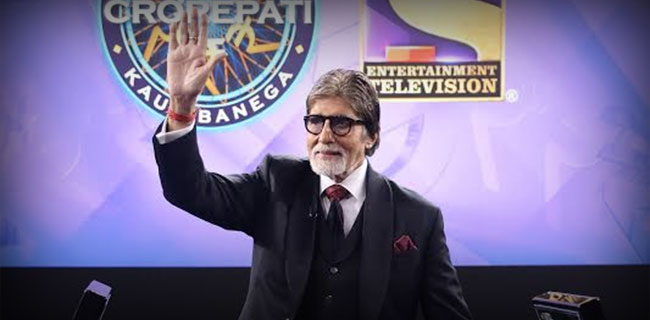
    It’s that time of the year again. India’s most iconic television show Kaun Banega Crorepati (KBC) is back again, this time with its 11th season. The first four episodes have set the tone for a 13-week entertaining and engaging ride. The story has been no different, after all, over the last few seasons.

    Ninety minutes a day for five days a week is quite some commitment to content. Yet, a sizeable section of the Indian audience makes this commitment year-on-year. Not to mention the various regional versions that have done immensely well over the last decade.

    ‘What keeps KBC going’ is not such a difficult question to answer. Its exemplary host Amitabh Bachchan, and its family-engaging format, one that’s full of positivity and interactivity, are the two cornerstones on which this 19-year old property rests. But over the years, KBC has acquired more value than just what its content is. And that’s the more interesting aspect to explore here.

    We live in times when it’s a matter of days that something that seemed so fresh until very recently, begins to look stale and jaded. This is happening with brands, ads, films, TV shows, cricket, everything. Product lifecycles of media products have reduced in general, as a distracted consumer moves from one to the other in a tearing hurry. In this context, KBC provides a certain comfort in the familiar. It’s that one show you don’t need to wrap your head around and figure out.

    Comfort in the familiar is quite an under-rated media thought. Very few shows on Hindi television today can offer this value, because it takes a lot of time and effort for a show to acquire this status. Of the Hindi GEC shows currently on air, only KBC, Taarak Mehta Ka Ooltah Chashmah and Yeh Rishta Kya Kehlata Hai benefit from this idea. And all three have gone to be enduring successes, bucking the growing consumer demand for short-term programming.

    In all three, there’s a sense of togetherness and family-inclusiveness. They are ensemble shows, despite very strong lead protagonists helming them. It’s the collective nature of the three, where multiple characters (host and contestants in the case of KBC) keep the flame burning.

    But KBC has two advantages over the other two shows in this coveted list. One, it is on air for only about 13 weeks every year, making it much sought-after when it hits the telly. Two, its interactivity is organic and central to its premise. Knowing an answer, when a family of 4-8 members is sitting and watching together, can lead to a moment of pride. Therefore, KBC also fuels family conversations like no other show can.

    Would KBC have acquired these values with another host? Almost certainly not. The fit between Bachchan and KBC’s values can only be a freak once-in-many-years kind of happy accident. And that’s why, he keeps getting better with each season, fitting the show even more, by giving a part of himself to it.

    Ratings will tell us how well this season does, but KBC may have transcended that test in the last 2-3 seasons. May the legacy live on!


  • Shailesh Kapoor: Man Vs. No Wild: Great Marketing, Bizarre Content

    By Shailesh Kapoor


    Calling it a coup will not be an overstatement. The Discovery Channel, known widely in India for its flagship adventure show Man vs. Wild, managed to put together a special episode with PM Narendra Modi. The episode, telecast Monday (Aug 12) in India, had the show’s anchor, the inimitable Bear Grylls, taking Modi on a walk-and-raft trip through the Jim Corbett National Park.

    It is easy to guess that the marketing-savvy Modi would have seen this as an unusual method to connect with the country, and would have seen the opportunity of getting a platform to express his thoughts on environment and its conservation. That Barack Obama, among other fancied celebrities, has featured on the show, would have given Modi enough reassurance to take the plunge.

    The show was heavily promoted by Discovery. And by the weekend leading up to its telecast, the episode had got a life of its own, driving social media conversations and responses.

    The actual episode itself, though, was a damp squib. I wasn’t expecting Modi to go the Grylls way by experimenting with food, given the former’s vegetarian food choices. But the 40-minutes long journey through the Himalayan forests (Grylls repeatedly reminded us how dangerous they could be) was an exercise in inertness. Walking through the wilds, with your “secret service” shadowing you, may be mildly adventurous, but it certainly doesn’t pass the Man vs. Wild quality test.

    A large chunk of the show was about Modi’s ‘Mann Ki Baat’ with Grylls, where the Prime Minister was quizzed on his childhood, his tryst with the Himalayas, his love for the nature, his parents and other such personal topics. We have heard some of this before, and some was new. But this is no Rendezvous With Simi Garewal, and the lengthy chat-ups seemed like fillers, covering up for the evident lack of actual adventure.

    But what really irked me no ends was the language in which these chat-ups happened. Modi spoke 80% Hindi, and Grylls, evidently not familiar at all with the language, had little to contribute by the way of an actual conversation. He put up a brave act, smiling and nodding in generic but appropriate ways, ensuring that the audience felt he was comprehending the incomprehensible. I was looking for a translator lurking in the background, but no, there was none. On a couple of occasions, Grylls could actually pick up some English words or hand gestures used by Modi, to respond in slightly more specific terms.

    I can’t get over the ridiculousness of the linguistic dysfunctionality of the episode. It’s like watching an interview show where the host cannot understand what the guest is saying. And yet, the host has to pull the show through, based on his common sense and experience. If Modi was reluctant to speak at length in English, an off-camera translator should have surely been a possible way to fix this bizarre communication method.

    The raft journey towards the end was arguably the most adventurous part of the show, more because Grylls had to wade his way through the water, and could use the word “balls” in front of Modi, and even get the PM to laugh at it. But it was a case of too-little, too-late.

    What will this special episode do to The Discovery Channel? It may get the brand strong recognition, leading to acquisition of some new viewers. We would get a sense of that through the ratings over the next few weeks. The episode, by all means, can be termed as a huge marketing success, even though the content was a letdown from the get go.

    PS: I think I should soon write about five Indian TV shows that Modi should feature as a guest on.


  • Shailesh Kapoor: HAHK: 25 Years… And A Legacy That Will Last Forever

    By Shailesh Kapoor


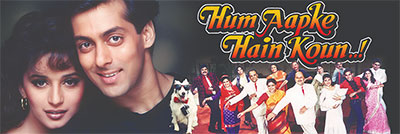
    Earlier this week, one of Hindi cinema’s most iconic films, Hum Aapke Hain Koun..! (HAHK), completed 25 years. In times when anniversaries of eminently forgettable films are celebrated on social media with great fanfare, this one deserves a genuine shout out.

    Rajshri’s 1994 film was a remake of their very own Nadiya Ke Paar (1982), which in turn was an interpretation of Keshav Prasad Mishra’s Hindi novel Kohbar Ki Shart, though the novel has a wider story than the two films. Remaking Nadiya Ke Paar in the 90s would need some courage. The idea of the original film is grounded in Indian culture and family values, which were not in vogue in the cinema of the early 90s, though Sooraj Barjatya, the director of HAHK, himself had brought Indian values to the fore in his debut film Maine Pyar Kiya (1989).
    But more than that, the humble rural setting of Nadiya Ke Paar was too un-cinematic for the 90s, when overseas business was a crucial component of box office, and even the Indian audience was looking for escape and aspiration through their cinema. How Barjatya visualised the adaptation is a story that’s still not been told much, perhaps because the original film is not very well known (though interestingly, it rates higher on IMDb than HAHK). But what he managed can only be called the work of a true genius.

    Much of HAHK’s imagery is about its 14 songs and the wedding functions. I remember The Times Of India review at the time of the film’s release being headlined something like ‘A bag of frills’. The film, of course, is a lot more than that. At the heart of it, it has one of the most well-etched, though somewhat simplistic, love story. But more than anything else, it’s a textbook chapter on the perfect modern Indian joint family, a mythical idea that many would want to be a part of, but is too good to be true, and largely out of reach.

    When one speaks about classics, one typically has 5-6 big scenes that stand out. That’s not the case with HAHK. It’s a seamless 220-minutes (in its original form before some songs were edited) line-up of sequences that are individually compelling, but not shouting for attention outside the context of the film. In the end, the whole is much bigger than the sum of the parts here, and it’s a fairly wholesome one too.

    Boxofficeindia.com projects the inflation-adjusted domestic nett revenue of HAHK at Rs. 711 Cr. That would make it bigger than everything Hindi cinema has churned out, including the dubbed Hindi version of Bahubali 2. But HAHK’s memories are not about the numbers. They are about the impact it had in the mid-90s. It was a time when theatres were shutting down and theatre-going was going out of vogue. The film, which the makers audaciously released in only 35 screens in its first week, “found” its audience, not over a week or a month, but over more than a year.

    I remember how only two theatres in Delhi (Sapna and Satyam, if memory serves me right) ran the film in the initial 2-3 weeks. In days of no Internet, getting a ticket did not come easy. It meant making a trip a few days earlier to stand in the advance booking queue. I did it more than a few times, as there was enough in the film to demand a second viewing, and then one more, and then some more.

    By the time it was Diwali, the film had found audiences in the most unlikely sections of the society. Families that had never visited a theatre were going in big groups of 15-20, all decked up for an experience of their life.

    The film then had a long and immensely successful television run, which is still going strong. Many believe the film has not aged as well as DDLJ, which came a year later. But for me, HAHK doesn’t need to go through the ageing test. It’s rooted in 1994, and that’s from where it should be seen.

    May its legacy live on!


  • The Big OTT Growth Story – Chapter 1


    By Shailesh Kapoor


    The rise of OTT/ digital consumption in India is a narrative that has dominated media discourse over the last year or two. The sheer volume of launches from the top players is reason enough for it to be a hot topic of discussion. The creative muscle backing many of these shows, especially those from Amazon Prime Video, Netflix and Hotstar, makes the OTT story even more persuasive.


    There’s an element of scepticism about how, and to what extent, is the OTT content delivering, both in terms of eyeballs and revenues. Absence of a unified currency means that there are no numbers in the public domain. Individual platforms may release specific data, such as Hotstar talking about the growth of IPL on the digital platform year-on-year. But the larger picture is incomplete, because a central data source is missing.


    This has been a topic of great interest for us at Ormax, and a lot of work has been happening in the background over the last year in this area. Over the next few weeks, you can expect to read more on this aspect here, in this column.


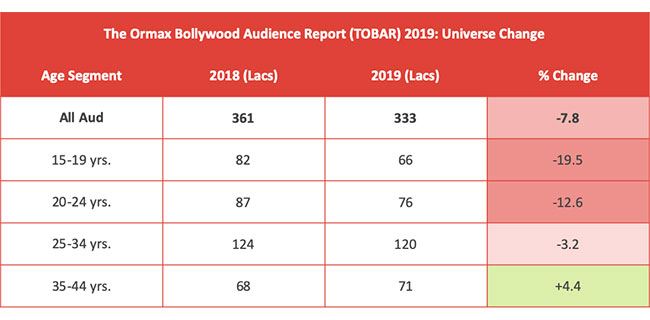
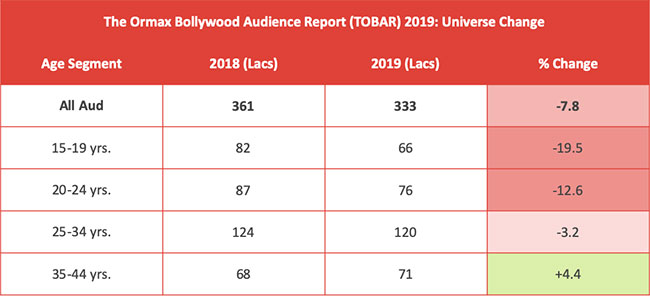
    A few weeks ago, we got one of the first definitive evidences on the OTT impact on media consumption in India. In the 2019 update of The Ormax Bollywood Audience Report (TOBAR), which sizes and profiles the Hindi moviegoers’ universe, the market size of regular theatregoers (defined as those who watched three or more Hindi films in a theatre in the previous calendar year) fell by 8%, from 3.61 Cr to 3.33 Cr. This itself is not much of a story, especially because this drop coincided with a higher incidence rate, i.e., while less people may have gone to theatres, they went more often, leading to higher box office in 2018 than in 2017.


    However, if we see the age break-up of the Hindi moviegoers’ universe over these two years, there’s a striking pattern. The table below shows this break-up:


    The drop in the universe size shows a clear negative correlation to age. From a 20% drop in the teenage segment to a 13% drop in the college youth, it becomes a mere 3% in 25-34 yrs. And then, there is actually an increase in the 35+ segment. In effect, the 15-24 yrs. segment lost 27 lac audiences within a year, but the 25-44 yrs. segment lost only 1 lac audiences.


    It is not very difficult to attribute this trend to the ascendancy of digital content in India over the corresponding period of time. The youth have been the early adopters of original OTT content, and a section of them have moved away from theatrical consumption of Hindi film content as a result. A parallel rise in Hollywood’s popularity in India adds a layer of complexity to this argument, but that’s another story for another day.


    While this may be a compelling concern for the theatrical business, it is also a validation of the OTT growth story. And the OTT growth story may have only just begun. The 25-34 yrs. age group could be next on the line.


    What’s the likely impact on TV in the coming years? Watch this space!