Tag: Shailesh Kapoor

  • Shailesh Kapoor: Paparazzi: TV News’ New Normal?

    By Shailesh Kapoor


    Television news continues to get more bizarre with each passing week. This week saw a new low, when television channels flaunted their paparazzi skills, trying to chase downs various film stars summoned by the NCB. At airports, at apartment complexes, at farmhouses… the paparazzi was omnipresent.


    Now, that itself is not new. The culture of chasing stars for a byte or a picture has come in over the last decade. Pre-Covid, some online and print tabloids apparently had their photographers permanently stationed at the Mumbai airport terminals, to click stars who arrive in the city. But all this was done on the sly. There was a sense of moral trepidation to it. The said photographer or journalist won’t brag about this “job” of theirs.


    But the visuals on TV over the last three days have been celebratory in nature. Channels have reporters chasing cars with such sincerity and sense of purpose in their voice that you will think they are on a mission to solve the nation’s economic problem out of their grave concern for it. Such “chases” are being branded as “exclusive”. Prime-time anchors are lauding the reporters who are stationed outside the airport for the last 24-48 hours, projecting their work as some kind of a benchmark in brave, ground-breaking journalism.


    When the news of Princess Diana’s tragic death in a car crash in 1997 first broke, it was reported that her car was being chased by the paparazzi, and that could have effectively triggered the crash. Investigation later disproved that theory, but nevertheless, the idea that someone could get killed because they are being chased by someone sounded all wrong, more like a form of lynching.


    But now, we have news channel gloating about their paparazzi skills. The mask has come off this summer, and entirely so. There’s no pretense left anymore about the lowbrow nature of television news. And we are not talking here about some weekend show or an entertainment magazine show. This is in the heart of the primetime, at 9pm.


    Credibility issues with television news are well understood and even quantified. But it seems that news channels can’t seem to care less. Even as print media and select digital platforms maintain their sanity, TV news channels have embraced idiocy with arms open wider than Shah Rukh Khan.


    And we may not have seen the worst of it yet. Covid has shown news channels that the expensive OB vans are replaceable by video conferencing apps in many scenarios. The cost of news gathering will go down substantially here on. While that would seem like a huge positive coming out of Covid, one suspects this change will be used to peddle more paparazzi news than that of substance.


    So be prepared for more lows. Because one thing TV news channels have not lost is their ability to surprise you with how innovative they can get when it comes to beating their own cringe levels.



  • IPL: The 2020 Showstopper Is Here


    By Shailesh Kapoor


    The show must go on, it’s said. That famous phrase, which has its origin in the circus in the 1800s, has been used more than ever before during this pandemic period, not just by the entertainment industry but by people in all walks of life. You cannot put nations or cities on pause mode for months at end. And hence, the show must, indeed, go on, even if it looks and feels a little different from what it was meant to be.


    IPL 2020 is one such show. When the event was indefinitely postponed in what seems like many months ago, many would have doubted if there would be an IPL season in 2020 at all. But the IPL brand is way too big to skip a season, unless there’s absolutely no choice. And here it is, starting tomorrow, on foreign land, without stadia audience, in a bio bubble.


    IPL has been a runaway success since its start in 2008, and only continues to get stronger with each passing year. The last couple of years have seen an increase in viewership. While its digital viewership has zoomed to new levels altogether, even the traditional media (television) continues to get stronger for IPL every year.


    Viewership increase in this year’s IPL is a given outcome. A cricket-starved nation will lap it up instantly. Time spent watching TV is anyway higher than usual levels because of lesser incidence of going out, especially on the weekends. The festival season, with its share of holidays, is setting in too. There are no headwinds at all as far as IPL viewership is concerned. Absence of spectators may impact the viewing experience a bit, but that wouldn’t take much time getting used to. And in any case, IPL is way too big for such factors to become sizeable viewing barriers.


    There may be no headwinds for viewership, but the headwinds come in the area of revenues. Despite its huge equity, IPL cannot possibly offset the impact of a struggling economy, and both BCCI and Star India have taken this in their stride, as they work towards making the most of the power event.


    While much is different about this year’s IPL, the one thing that makes it stand apart from previous seasons is that in 2020, its mere occurrence is a celebration. While eventually, the discussions around which team is doing well, who’s likely to win, etc. will pick up, those discussions will still be ‘secondary’ in nature this time. For many viewers, even those who follow IPL only casually, just the presence of IPL in prime-time everyday for seven weeks is a blessing. A pleasant distraction from what has been a tough and fairly deflating year for many.


    This status that the IPL acquires in 2020 can potentially take the brand to another level altogether, where its meaning in Indian lives goes beyond routine entertainment, and acquires elements that are more intrinsic, such as feel-good and happiness. I was a bit surprised to see that the brand ads released so far do not bring out insights around this transcendental opportunity this season offers. Perhaps they have been put together in a hurry, given how things have unfolded.


    So, get ready for the biggest IPL season ever. Even if the cricket is strictly average (never really the case with IPL), it will be a national feast like no other.


  • 44% of TV news consumers don’t find TV news credible


    By A Correspondent


    Leading media consulting firm Ormax Media has announced the launch of a its report titled ‘Fact or Fake?’, which is based on a survey of news consumers and measures their credibility of various news media as well as their overall perception of ‘fake news’. The survey was conducted among 2,400 urban news consumers (15+ yrs.) from across 17 States and Union Territories in India.


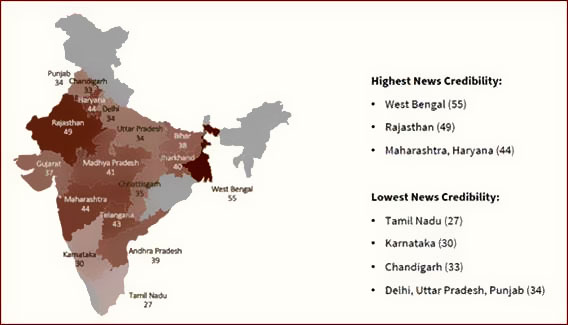
    As per the findings of the report, News Credibility Index in Urban India is only 39%, i.e., 61% news consumer see fake news as a major concern.


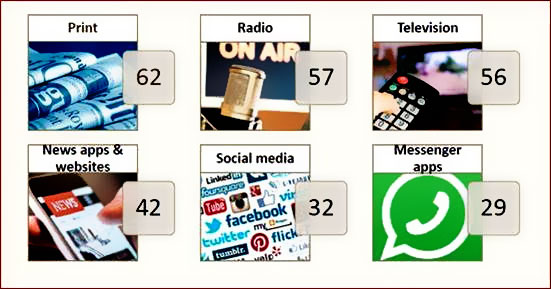
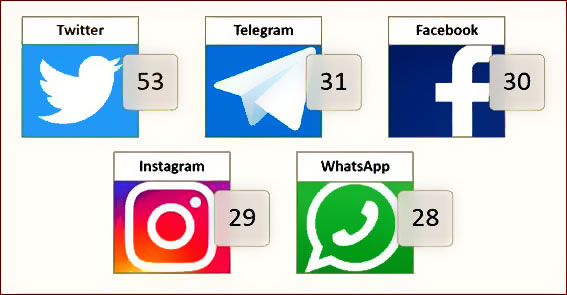
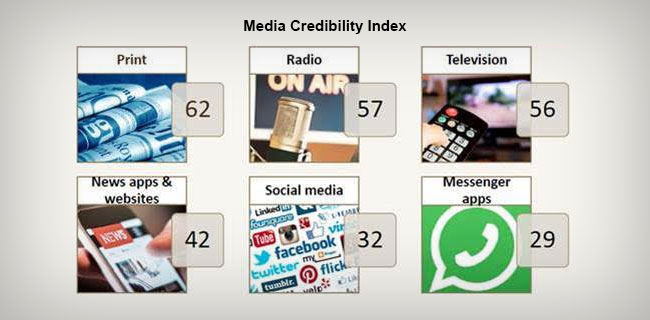
    Print media leads the Media Credibility Index at 62%, followed by Radio and then Television. Traditional media have higher credibility than digital media. Among social media, Twitter at 53% is by far the most credible social media platform for news.


    Shailesh Kapoor

    Commenting on the report and its findings, Shailesh Kapoor, Founder & CEO – Ormax Media said: “Concerns related to fake news have been a topic of discussion globally as well as in India, and the problem of fake news seems to be getting larger with every passing month. This survey was conducted to quantify the extent of this concern in India, and to understand if some media fare better than others. We plan to track these measures every six months, which will allow us to compare how perception of news consumers regarding fake news is changing with time”.


    According to the Ormax Media communique, News Credibility Index and Media Credibility Index are a percentage of news consumers who don’t see fake news as a major concern and news consumers who find the news in a particular medium generally credible, respectively.


    News Credibility Index by State/UT


    Media Credibility Index


    Media Credibility Index: Social Media & Messenger Apps


  • Anupamaa: The Big Hindi GEC Breakthrough?

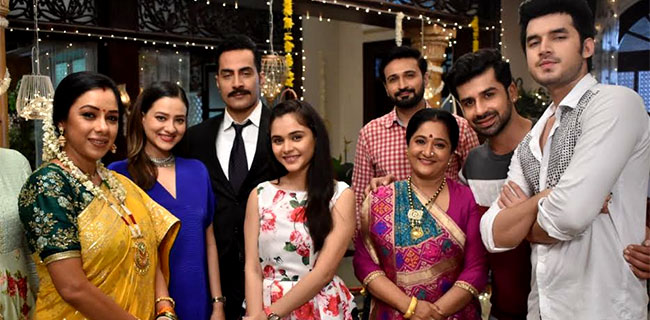
    A still from Anupamaa, the Star Plus show


    By Shailesh Kapoor


    Shailesh Kapoor

    While this weekly column has extensively covered the Hindi GEC category over the last eight years, pieces dedicated to a single show have been rare. If at all, they have been about a non-fiction show like KBC, or about a long-running fiction show like Balika Vadhu or Taarak Mehta Ka Ooltah Chashmah. Nothing launched since the start of this column in 2012 has been worthy enough for 500 words of its own. And those who follow this column regularly will know that the general sense of mediocrity that plagues Hindi GEC fiction content has been my pet peeve over the last 5-6 years.


    But here it is, a piece on a newly-launched fiction show that breaks through the mediocrity the category has learnt to unapologetically espouse over time. It’s the 10pm daily on Star Plus, and it goes by the name Anupamaa. An adaptation of a hit Star Jalsha show, Anupamaa was originally slated to launch in early 2020, but had to be deferred because of the lockdown. It was one of the first new shows to launch as things began to open up and shoots resumed July onwards. Less than three months into its tenure, Anupamaa is the top-rated show on Star Plus, more than 40% ahead of the next original show on the channel.


    Now that has happened before with some other shows too. But something a lot rarer happened this week. In the August report of Ormax Characters India Loves, a monthly character-popularity track for the Hindi GEC category, the protagonist Anupamaa has taken the second rank on the fiction list. Character popularity is the Holy Grail of GEC content. It takes months, sometimes years, for characters to build an emotional affinity with the audience. Entering the Top 5 within six months of launch is a huge achievement, and entering Top 2 within two months an unprecedented one.


    When I watched the show in its first week, my first reaction was: Wow, this looks so different from the rest of the genre. It was, in many ways, a reaction very similar to what I felt watching Balika Vadhu for the first time in 2008. Then, and even now, the Hindi GEC category has been guilty of a certain visual and thematic sameness that is omnipresent across shows, across channels. Some shows look ‘richer’ than others. But by and large, the protagonists are all in their early 20s, the costumes are fairly stock, the music largely similar too, the conflicts way too familiar, and the acting and the dialogue consistently mediocre.


    In that first viewing itself, Anupamaa seemed to belong to another space. Top performances grabbed my attention first. In particular, Rupali Ganguly as the female lead here is arguably one of the Top 3 stand-out Hindi GEC fiction performances in the last 20 years. The other distinctive feature, of course, was the age of the protagonist. In her mid-40s, Anupamaa is a mother of three grown-up children. That’s a life-stage a Hindi GEC female protagonist usually reaches five years into a show’s lifetime, after at least two leaps. Instantly, this separates the show from the rest of the lot, which are essentially romantic dramas played out in a family context. The writing seemed two notches higher than the category’s accepted level too, especially the dialogue.


    But as I started watching the show regularly, it seemed evident that this is that rare show that has a saga-like feel to it. After Balika Vadhu and Yeh Rishta Kya Kehlata Hai, no other show has a premise or a protagonist so fascinating that you know that you can do a long-running show around her, without losing the point and dragging the show meaninglessly. Already in the two months, the show has covered several social themes like patriarchy, parenting and class difference. It’s like the old days of reading a novel. The story can keep evolving, chapter by chapter, and enter different spaces. But the audience loves the protagonist(s) so much that they are always invested.


    Will Anupamaa manage that? Will it be one of the top shows in 2025 too? It’s, of course, too early to say that. But if there’s one show in the last decade that seems to have a strong foundation that longevity needs, this is it. The show’s name translates to “incomparable” in English. And unless the makers mess this one up, it holds the potential to live up to that translation over time.


    It could be a matter of introspection why such success came from a show from a regional market. Much like one can wonder why Bollywood can’t make its own Bahubali. But that’s another topic for another day.


  • 2020: News Channels’ Year of Shame?


    By Shailesh Kapoor


    2020 has been a year to forget on many counts. But oddball years such as this are usually the best years for the news business. There is little news value in the routine and the familiar. But in times of disruption and chaos, news acquires much higher significance.


    Let this be said: 2020 has been the year of a colossal letdown of a performance by television news channels in India. Let’s just take the last month in specific. There is so much going on in the country. We are still wondering when our Covid peak will eventually arrive, as daily cases cross 80K now. There’s the struggle of the health-workers to fight a pandemic incessantly for six months now. There is still a lot of misinformation floating around regarding C Covid and many myths that need to be busted. The economy is in terrible shape, and it’s not going a short-term impact. There’s an escalating situation on the border with China. Millions of students face uncertainty regarding their career and their future.


    In all this, what have our news channel found as their top story? That one Rhea Chakraborty could be involved in Sushant Singh Rajput’s death! Depending on the channel (and barring a couple of exceptions), 50-80% primetime is dedicated to this topic, which is made out to be some kind of a national interest thing, with “new India” being attached to the narrative in a way that’s bizarre and ridiculous in equal measure. That news channels have managed to politicize an inherently-apolitical event is a thought that’s more dangerous than funny.


    Surely no one can argue that there is nothing wrong in what’s going on. News is not a medium like films, GECs or cartoons. Its primary social function is to inform, before it entertains, if at all. The idea of “informing” presumes that right choices will be made on what is important information for those consuming news on a particular media. Of course, news channels have this understanding. But they knowingly side-step it. They may be incompetent, but that’s not their bigger failing. There’s moral corruption at the core of what’s happening, and that’s the central issue.


    The obvious argument in support of the news channels would go: But this is what gets ratings. Firstly, that’s not entirely tested as a fact in these unusual times. And even if one assumes that argument to be valid, does it really absolve the news genre of all social responsibility? Or have primetime news channels become electronic tabloids officially now? And how does the ratings argument apply to the English news genre, which sells primarily on perception? Can’t these channels see how they may be turning away some advertisers altogether because of the nature of abrasiveness in the content may dissuade some brands from associating with this medium?


    In a country where the government is forever busy regulating the price and packaging of TV channels, and censorship of fictional entertainment content is always in discussion, why is news content being given an absolute free hand?


    On social media, a section of the urban, educated population suggests that if all this bothers you too much, not watching news could be the solution. Even if it works as a sub-optimal but effective workaround at an individual level, it is an ineffective suggestion from a social perspective in a country where television enjoys a massive reach.


    I fear that the current degeneration of news suits the politics of this country. And if that’s the case, then we must prepare ourself for at least a few more years of despicable news coverage on television.

  • Time to Unlock the Cinemas?


    By Shailesh Kapoor


    We have officially entered the sixth month of the Covid-induced lockdown. Like life in general, the media sector is limping back to normalcy too, to whatever limited extent the situation permits. Streaming and digital sectors have boomed through this period. Television, despite seeing higher viewership, has a long battle ahead because of its high dependence on advertising revenues. But it’s the third segment, i.e., theatrical business of films, that continues to face the maximum brunt.


    Various states have reopened public places, including public transport and malls, with reasonable restrictions to ensure social distancing. Yet, there is no talk of reopening cinema halls at all. It’s a topic that’s doesn’t even seem to be in the purview of discussions. The decision to keep theatres shut, like many other decisions in the five months gone by, is just ad hoc.


    If theatres are allowed to open with clearly-defined social distancing and safety guidelines, it’s not as if audience are going to throng the theatres to watch films within the first week. As much as regular theatre-goers are starved of their theatre diet, two important considerations will come into play. The foremost is about the content itself. Films have to release for audience to visit. Audiences won’t go back to theatres for re-runs. And no big film is going to release within a week or two of theatres reopening, as they would want to build adequate interest via their marketing, while theatre chains do the same via their marketing efforts to communicate the precautions they are taking.


    In such a scenario, it will take at least about two months from theatres opening to any substantial footfalls actually materialising. In any case, all states won’t open on the same day, and some theatres, especially single screens, may choose to stay closed for some more time voluntarily. Which brings us to the second point: Individual choice. Audiences will make their own assessment regarding their comfort with the idea of visiting a theatre, like they will do for any other public place. With the right regulations in place, theatres, especially the organised chains, seem like a safer option than small retail outlets, where social distancing is being implemented only loosely, and seeing people without masks is not uncommon.


    The film industry does tend to become a soft target at times, and this is one more example. I may not visit a theatre myself in the first few weeks of them re-opening, but that doesn’t mean those who want to shouldn’t be allowed to, within the norms laid out, especially because other public places have been opened up gradually.


    Earlier this week, it was announced that a theatrical-worthy film (Coolie No. 1 remake starring Varun Dhawan) will release on streaming. Of all the announcements of this nature since April, this was the most desperate one. Coolie No. 1 had the potential of grossing Rs 150-200 cr at the domestic box-office. It is the kind of entertainment that a wider, pan-India audience connect to but don’t get in good measure. But one can understand the makers’ decision to move on. Where there is no clarity on the way ahead, how long can one really wait!


    Over the last two months, the film industry has been in the news for all the wrong reasons. There isn’t much to show by the way of content, and controversies have taken the spotlight instead. It will take a reopening of theatres to change the discourse over a few months. But even the start of that change doesn’t seem in sight as of now.


  • Post-Lockdown Blues for Hindi GECs

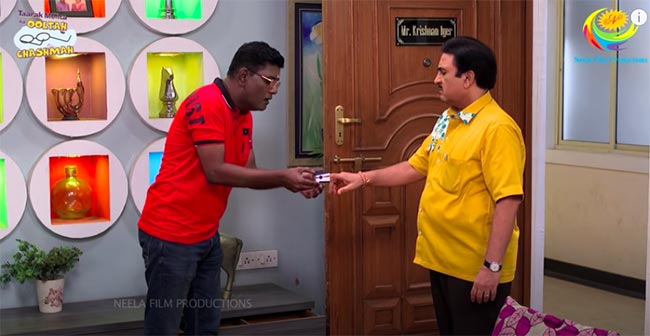
    Oximeter Check: Screengrab from a recent episode of Taarak Mehta…


    By Shailesh Kapoor


    It’s been a month since original episodes of Hindi GEC shows started airing again. The genre that survived primarily on mythology during the lockdown is now moving back to its old staple fare.


    The results of the first four weeks have not been very encouraging. Given that there are Covid-related restrictions still in place in large parts of India, and the overall TV viewing time is higher than pre-Covid, the Hindi GEC category (pay channels) has lost about 10% of its pre-Covid viewership levels despite the return of original episodes. Drop in the ratings of the top shows is particularly striking. Except Taarak Mehta Ka Ooltah Chashmah (TMKOC), which opened at pre-Covid levels upon its return, most other top shows have struggled, with some being less than 60% of their pre-Covid numbers. Long-running shows like Kundali Bhagya, Kumkum Bhagya and Yeh Rishta Kya Kehlata Hai have not got a section of their audience back, who were probably continuing only because of habit. Star Plus’ recent launch Anupamaa has emerged as the joint category leader in Urban HSM, along with TMKOC.


    The signs were ominous. During the lockdown, Ormax Media’s data suggested that only 42% of regular Hindi GEC audience are missing their favourite shows “a lot”. The category will soon face severe headwinds with IPL in the next quarter, and will have to look upto reality shows like KBC and Bigg Boss to uplift it from the precarious position it finds itself in.


    Having said that, the early success of Anupamaa is a positive development. It shows that the category discontent is not so high that a well-crafted new show that’s relevant and authentic will not find an audience. But we need more Anupamaas, and some of the upcoming launches look promising too. But the category urgently needs to shed its flab. Channels’ obsession with long-running family dramas that have long outlived their purpose is still a major villain in the 2020 Hindi GEC story.


    The other element of curiosity was to see how fiction shows integrate (or ignore) Covid in their plots. It’s been a mixed bag so far. While some shows have stayed completely clear of it, others have used token references, and a few have integrated Covid into the running plot, though not always in a way that’s sensible. To give an example (and there are a few), earlier this week, a plot point in Star Plus’ Yeh Hai Chaahatein involved the female antagonists plotting to get the protagonist out of the housing society by proving that she’s high-risk for a Covid infection. The society’s management committee comes to the protagonist’s house to insist she’s taken to a hospital or a quarantine centre. In this highly charged Covid discussion with half a dozen people, not one is wearing a face mask, making a potentially topical scene come across as fake, if not bizarre. It is this half-hearted attempt at depicting reality that creates emotional disconnect with many Hindi GEC shows.


    In sharp contrast, TMKOC has integrated Covid masterfully. For a show rooted in topicality and social reality, not recognising the Covid reality would have been a definite compromise. But it’s easier said than done. If they would have based the entire show in a Covid world, there would be limitations, related to society gatherings, functions, festivals, shop scenes, etc.


    What the makers have achieved is a fine balance, through a tried and tested device: Protagonist Jethalal’s dreams. In the three weeks on air so far, he has had two dreams (cumulative play-out of about five episodes) which tell a free-from-Covid story, while the rest of the episodes consciously recognise Covid and create genuine entertainment around it. This is how it should be done!


    With all its problems and a few silver linings, the Hindi GEC category is at a crucial phase. Something tells me the next six months may shape its future decisively.


  • Death by On-Air Investigation

    Image taken from advertising mailer sent out by Republic TV


    By Shailesh Kapoor


    I have started watching Republic TV over the last week or two, after a gap of a few years. The bizarre on-air investigation being carried out by the channel and its owner-editor, who is also its only primetime anchor, Arnab Goswami, under the title ‘Sushant Singh Rajput death probe’ has befuddled me. There have been many cases of irresponsible media coverage of celebrity news over the year, but here, the issue is larger, and the moral standing murkier.

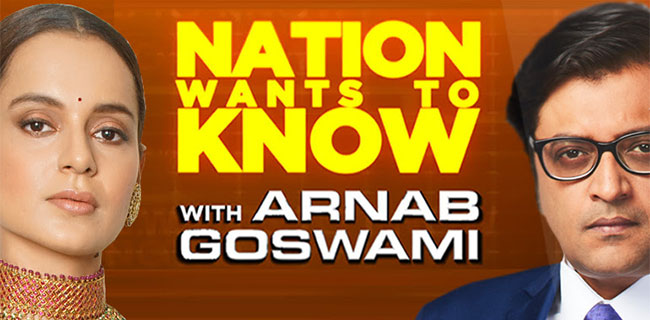
    The “investigation” started fine about three weeks ago. Kangana Ranaut chose to give an interview to Goswami, and he’s a fine interviewer on most days. She was shooting from the hip and he played along. But since then, the channel’s coverage of the topic has progressively degenerated. It’s as if the Ranaut interview gave Goswami the idea that there’s a big story in this, and you can run the entire channel on it for at least 4-6 weeks.

    The week after the interview featured persistent attacks by Goswami on senior producers and directors of the Hindi film industry. Using the edgy material Ranaut had armed him with, Goswami went about questioning the people she mentioned, with little headway, during that week. There was also an interview with Shatrughan Sinha, where the seasoned actor-cum-politician didn’t say much despite Goswami’s persistence, rightly pointing out that he doesn’t have the details.

    It’s over the last two weeks that Goswami’s investigation has become increasingly brazen. He’s sidelined his earlier nepotism narrative and has now taken up a “murder, not suicide” theory that he’s relentlessly pushing, two hours every night for two weeks and counting. Last night, he even said that if people thought this is a media trial, he’s like to inform them that he wanted to be a lawyer but couldn’t, but he may as well appear in a black robe one day on his show. Yes, he said that!

    It’s amusing at one level but dangerously immoral at another. If I make a list of people he has “accused” in some form or the other over the last three weeks, it will probably be a number around 15. In the middle of a pandemic, mental health is a serious concern as it is, and if any of those “accused” are affected because of how they are being projected (many other channels are simply trying to ape Goswami’s investigation, making it a wider concern), who will be held responsible?

    The other danger is of influencing the opinion of the lawmakers. Can a narrative being fed to the general population day in, day out not influence the police, the government and the judiciary at all? That’s a utopian situation, but we have seen before that reality is different.

    If the general audience builds an opinion of their own, however specious it is, and finds an organic way of channeling it to others, it’s within the democratic framework and hence should be accepted, even if one disagrees with the discourse and its general intellectual level. But Goswami is using mainstream media to peddle a narrative that has no legal standing right now. He keeps saying “I am only asking questions”, but he goes on to provide answers to them too, invariably every time he asks one.

    There’s also clear political polarisation at play here. How an entertainment industry news item became fodder for politics is beyond my comprehension, but it has happened, and unmistakably so. When political ideology enters other fields of public discourse and begins to influence the opinions there, we certainly have a reason to worry.

    Over the next few weeks, Goswami and his clones would have milked this topic dry and moved on. They will then find another story. And with each such on-air inquest, they will keep making the moral compass more and more irrelevant, under one broad defense: That the nation wants to know.


    Shailesh Kapoor is Founder and CEO, Ormax Media. He writes on MxMIndia on most Fridays. His views here are personal


  • Dil Bechara: Success of Serendipitous Proportions


    By Shailesh Kapoor


    Over the last seven weeks, following Sushant Singh Rajput’s death, allegedly by suicide, a murky Bollywood story has been playing out in the media. It started with a nepotism narrative, and has eventually snowballed into a larger controversy that’s an incoherent concoction of various sub-narratives, including nepotism, clique culture, allegations of a botched-up police investigation, celebrities using Rajput’s death to make their presence felt, and journalists using his death to get some primetime traction. There’s neither class nor grace in any of this, and one only wishes that chapter is resolved and closed soon within the legal framework.


    In the midst of all the mess, Rajput’s last film Dil Bechara dropped on Disney+ Hotstar last Friday. The film was originally scheduled for a theatrical release, but with theatres closed indefinitely, it has made its way to the audience via streaming, like many other Hindi films have, and will, in the next few weeks.


    Under normal circumstances, the film would have been a usual streaming release, getting its share of viewership based on its content and its credentials. But the events of the six weeks leading up to the film’s release are anything but “normal circumstances”. Disney+ Hotstar wisely decided to not put the film behind the paywall, hence opening it up to a wider AVOD audience base. While streaming platforms do not share numbers publically, our estimates suggest the film would easily be the most-sampled streaming content piece in India ever, with upwards of 50 million streamers accessing it. This number could be higher, closer to 75-80 million, and even more over the lifetime of the film. How much duration of the film they eventually sampled is another data point for which no estimates are currently available.


    In the Ormax OTT Audience Report: 2019, a research conducted in the second half of 2019, the estimated regular OTT Audience in India stood at 76.5 Million. This number would have increased significantly over the last year, especially because of the surge in OTT consumption during the long-running lockdown. And then, there is a wider audience base that are irregular OTT audience, who may come to watch that occasional ‘event’. And Dil Bechara is as ‘eventful’ as it can get on streaming.


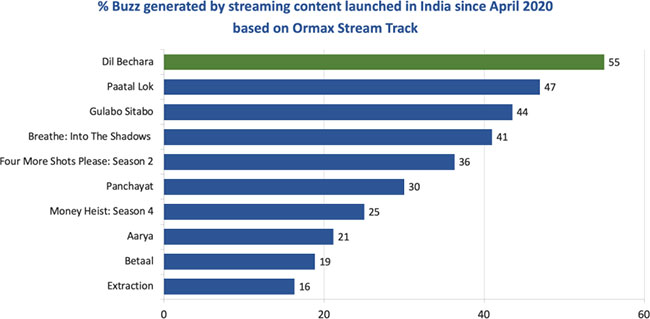
    Dil Bechara is not a usual romantic film either. ‘Death’ is a central element in the film’s story, and the emotions it generates in the last half hour get amplified several notches because of the context one is watching the film in. That has ensured that the film has generated both pre and post-viewing conversations. The chart below lists the Top 10 shows/ direct-to-OTT films launched in India since April 2020, based on the ‘buzz’ they generated in the week of their release. Dil Bechara’s takes the top position by some distance.


    There have been some silly media stories trying to convert the film’s estimated sampling into theatrical box =0office, by multiplying it with an average ticket price number. This cross-media mumbo-jumbo is so silly that inspires me to mathematically prove that if the Hindi GEC show Kundali Bhagya released in theatres in a movie spin-off, it will beat the collections of Bahubali 2, Avengers: Endgame and Dangal put together. There is no vaccine yet for media illiteracy, and journalists in some of the biggest publications in India can desperately do with some immunity.


    Like Ramayan earlier this year, Dil Bechara’s streaming performance is a serendipitous event in which the timing, more than anything else, contributed to an immensely successful outcome. Disney+ Hotstar would know, better than anyone else, that this cannot be replicated.


  • Shailesh Kapoor: Now Showing to Now Streaming… But where’s the Measurement?

    By Shailesh Kapoor


    Cinema theatres are indefinitely closed, and their re-opening is nowhere in sight either. Even as the country ‘unlocks’ while trying to manage a new Covid peak every week, enclosed public places like malls and cinema theatres are at the bottom of the reopen list for state governments. And unlike malls, which can open in different cities and states in a staggered manner and return to business at some stage, cinemas need to open in large parts of India for good content to release and the box office to start buzzing again. Even one city like Delhi or Mumbai not opening the cinemas is a bottleneck sizeable enough for studios to not release a big film.


    What earlier seemed July or August is now October in the best case, with a definite possibility of further delay. Announcements of films releasing directly on streaming platforms have grabbed everyone’s attention. It started with Amazon Prime Video’s May announcement regarding Gulabo Sitabo and Shakuntala Devi. Earlier this month, Disney+ Hotstar announced its impressive movie slate, and this week, Netflix has added a few more names to the list.


    There won’t be much else on offer, because besides the couple of big films that will wait for theatres to open, there is no other film content that’s fully shot already. Hence, the production bottleneck will now come into play. Hence, this week’s Netflix announcement may be the last major one on this topic.


    It’s obviously a delightful position for the viewer to be in, getting to watch films (as also streaming shows) in a period when outdoor entertainment options are practically out-of-reach. This four-month period has increased the user base of the streaming category, and also aided more comfort with the use of technology among the more traditional audience. Many not even aware of streaming platforms till earlier this year and now using them like seasoned viewers.


    The question, however, is: Can streaming platforms use this to their strategic advantage once things are back to normal in a few months? Which platforms are in the pole position to best reap long-term benefits from the acquisition of new audience?


    This is where the lacuna in data comes in. Each platform knows its own numbers, and in far more detail than any TV broadcaster can ever hope to know theirs. But in the absence of any third-party viewership measurement, it becomes challenging to build a wider category view. A lot of attempts, most notably from BARC India (they announced the launch of their digital measurement system Ekam in 2017), have been made in this area. But it seems that more than the technology challenges, SVOD’s platforms low-perceived need for such a service is a major barrier. YouTube is anyway well-measured, and for a larger streaming measurement system to find its footing in India, it needs backing from all stakeholders, not just advertisers looking at the AVOD category outside YouTube and social media.


    We will never fully know at a consolidated industry level how each of these several films performed. There have been issues regarding transparency of box-office data for years now. But the opaqueness of streaming viewership of films makes box-office data look a lot better than it ever did.


    If a long-term ecosystem of direct-to-streaming films has to emerge in India, a parallel measurement system must find its way into the ecosystem too. But 2020 is definitely not the year when that’s happening.


  • All Eyes on IPL as Cricket Restarts


    By Shailesh Kapoor


    This Thursday saw the resumption of international cricket, with the start of the England-West Indies Test at Southampton. The match is being played without any spectators allowed into the stadium. But even with that restriction, it’s quite incredible that they could actually get down to playing it. It helps that UK is well past its Covid peak, having managed the month of April far better than most major countries, and that the various countries in the West Indies are not impacted by Covid as such. Seeing the slip fielders standing next to each other without a face mask was disorienting for the first few overs. But as the game got along, it seemed like good old cricket after all. At least for me, good commentary more than made up for the atmosphere deficit because of the absence of spectators.


    Cricket in the subcontinent is at least a few months away, with “India’s Covid peak” still being an idea in the waiting. The Asia Cup, scheduled in Sri Lanka, was formally postponed this week to 2021. But the rest of the cricketing world seems more ready. New Zealand is holding very well at less than 25 total active cases currently, and Australia is managing fine with what can be called its second peak. But the latter in particular is quite stringent on its travel policy during this pandemic. We will know in the coming few weeks how things unfold around the 2020-21 International cricketing calendar.


    But all eyes are indeed on the IPL. Not holding the IPL is a worst-case scenario, and BCCI will do all it can to avoid that. A foreign venue, such as UK or New Zealand, seems more practical at this stage than India itself. And the original T20 World Cup window in Oct-Nov may suit the IPL well. It could be the first IPL around the Diwali season!


    In any other year, the Diwali + IPL combo would have been an absolute money-spinner. But we are not in any other year. The advertiser appetite to fund a league of IPL’s stature will be a big factor. Even if a curtailed version of the league is conducted, with say 50-60% of the usual number of games, the corresponding drop in inventory will still not be enough to compensate for the fall in advertising demand. Significantly lower ad rates will be an inevitable outcome of the negotiations involved. Hope BCCI is flexible in understanding Star India’s predicament here. None of the old rules apply, and if BCCI takes an inflexible position, there could be long-term damage.


    Watching IPL at a neutral venue without spectators may not be the best IPL viewing experience, but if that’s the only way the show can go on, then that’s the way it must. The other option, of course, will be to write off this year altogether, as many already have. But young cricketers will be raring to play, and TV viewership for IPL could see an all-time high this year given the starvation lack of cricket has caused. The temptation to not write off will be quite high.


    But this is not a year to predict things. It’s a year to take things a month at a time, at best. The coming month or two should tell us if IPL 2020 will be recorded in history as an actual event or a canceled one.

  • Ormax Media launches continuous poll to track approval rating of PM & CMs

    By A Correspondent


    Media consulting firm Ormax Media has announced the launch of The Ormax Prime Minister & Chief Minister Approval Rating. Based on continuous nationwide tracking across 22 states and one Union Territory, the polling tool covers 275+ cities and towns in India, with a monthly sample size of 12,000+. The Ormax Approval Rating, notes a communique, will be a through-the-year poll to track the public perception of the nation’s leadership and underscores that the tracking is being done independently by Ormax Media, with no affiliations to any media organisations or political parties.


    Shailesh Kapoor

    Speaking on the launch of the Ormax Approval Ratings, Shailesh Kapoor, CEO, Ormax Media, said: “Approval Ratings are a norm in many democracies in the West, including the US. Hence, it is surprising to note that there has been no continuous tracking on the public perception of the political leadership in India all these years. After piloting this project for many months since mid-2018, we are now ready to roll out these ratings in the public domain. In a country with many political opinions and biases, including in the media, credibility and political neutrality are the cornerstones on which this poll has been conceptualised. We will not be sharing any ratings by religion, caste or any other such variable that can take the discourse around these ratings away from actual governance.”


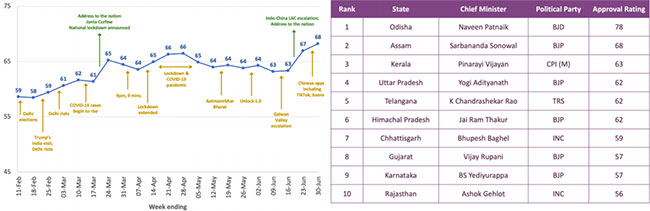
    Approval Rating is a measure out of 100 (%) of the proportion of eligible voters who approve of the governance of the Prime Minister or the Chief Minister of their state.. As per the first Ormax PM Approval Rating report released, Prime Minister Narendra Modi’s Approval Rating jumped from 59 in early February 2020 to 68 at the end of June 2020. The sharpest growth was seen in the week when the PM addresses the nation twice on either side of the Janta Curfew, announcing the three-week lockdown on March 24 in the second address. The Approval Rating saw a further jump in the second half of June in the aftermath of the escalation at the Galwan Valley. His popularity is the highest in Chhattisgarh, Jharkhand, Rajasthan, Himachal Pradesh, Bihar, Gujarat, Odisha and Goa, where he enjoys 71+ Approval Rating in June 2020.


    As per the track, Odisha Chief Minister Naveen Patnaik is by far the most popular Chief Minister across the 22 states covered currently with an Approval Rating of 78 in June 2020. Assam’s Sarbananda Sonowal and Kerala’s Pinarayi Vijayan rank second and third respectively.