Tag: Shailesh Kapoor

  • Covid Impact: A Fast-Drying Content Pipeline

    By Shailesh Kapoor


    The devastating second wave of Covid-19 in India has brought with it various lockdowns, being managed by the various state governments individually. A direct impact of lockdown-like restrictions is the inability to produce video content, such as TV shows and films. In any case, the fear of the second wave is real and palpable, and many actors and technicians are wary of being on sets. The much-touted IPL bio-bubble bursting last week does not inspire confidence either.


    We are hence staring into an inevitable situation of a hugely-constricted content pipeline. This time, the problem is worse than 2020, because the reluctance to venture out is not just law-enforced but a result of caution being exercised at an individual level too. Since one cannot shoot in Maharashtra, many TV shows have shifted their base to other states, e.g., Gujarat, where the lockdown is partial in nature. But the caution is evident when you notice that despite IPL season being indefinitely suspended, launch promos of not a single new Hindi GEC programme have gone on air. Channels are just about managing their existing line-ups, and would rather not have more on their plates right now.


    The situation gets a lot more complex when it comes to films and OTT content. Outdoor shoots are a given in most projects in these categories, and that involves extensive travel, even if one limits the crew size to the minimum possible number. As a result, there is hardly any film or OTT content being shot currently, in Hindi at least, as a result.


    Even when the second wave subsides over the next month or two, complications related to vaccine shortfall and the inevitable third wave will continue to disrupt life. One cannot expect things to return to even late 2020 levels till a sizeable population in India is vaccinated. And that’s some time away.


    We can, hence, expect a huge content shortfall, especially in theatrical and OTT genres. The signs are already evident. Over the last two months, there have hardly been any big-ticket OTT properties that have gone online, despite a large section of the core OTT audience being locked down at their homes. What is coming out is largely the second line of content. A lot of big-ticket content is semi-produced, and will need at least a few more weeks of work before it’s out for public consumption.


    2020 was OTT’s breakout year in India, with a huge surge in subscriber bases and watch-time across platforms. 2021 looks far less so. The theatrical business was just about beginning to get back on its feet, before the second, more debilitating blow came its way.


    Good old linear TV may end up being the saviour after all. But even that will take some doing. It may be time to go retro with your content consumption once again, but this time out of no choice.
  • 2 out of 3 news consumers see fake news as a major concern


    By Our Staff


    Media consulting firm Ormax Media has unveiled the results of the second edition of its report titled ‘Fact or Fake?’, which is based on a survey of news consumers, and measures their credibility of various news media, as well as their overall perception towards ‘fake news’.


    This is the second edition of the report, based on data collected in April 2021. The first edition was released on September 2020. The survey covers urban news consumers (15+ yrs.) from 17 states and Union Territories in India.


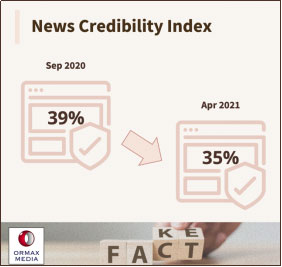
    According to the report, only 35% news consumers feel that the news category in India doesn’t have any major fake news concerns. This number has dropped 4 percentage points, from an already-low level of 39% last year (Sep 2020). This implies that 65% news consumers, i.e., almost 2 out of 3, see fake news as a major concern.


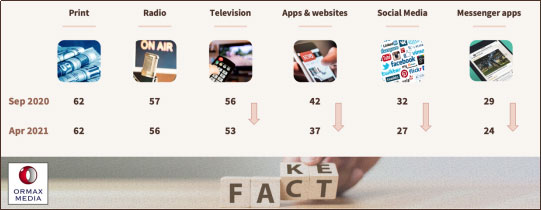
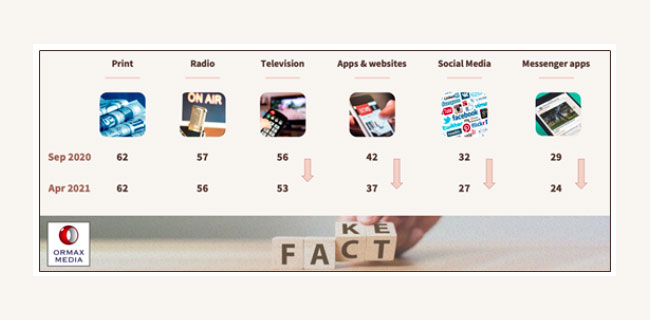
    Print media continues to lead on credibility, with a score of 62%, the same as the last track. Radio holds on to its no. 2 position (56% now, vs. 57% in 2020). However, all other media have shown minor or major drops, i.e., Television (56% to 53%), Digital news apps & websites (42% to 37%), Social media (32% to 27%) and Messenger apps (29% to 24%).


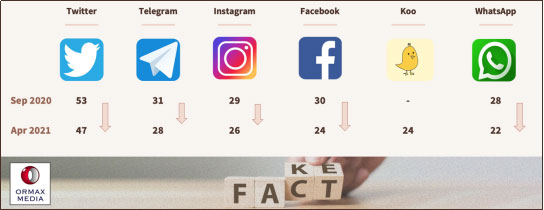
    Within social media, despite a drop since the last track, Twitter continues to rank on top with a News Credibility Index of 47%. No other social media or messenger app platform manages to touch even the 30% mark. Newly-launched Koo scores only 24% on credibility.


    Commenting on the report and its findings, Shailesh Kapoor, Founder & CEO – Ormax Media said: “Concerns around fake news have been escalating worldwide over the last few years. But a drop from an already-low score of 39% to 35% within just seven months, does not augur well for the Indian news industry. In the midst of a pandemic, credibility of news becomes even more important. We hope to see television news and digital platforms address this concern more proactively, before it becomes a brand safety issue for advertisers using these media, and a cause for rejection for subscribers of paid news services”.


    News Credibility Index and Media Credibility Index are a % of news consumers who don’t see fake news as a major concern and news consumers who find the news in a particular medium generally credible, respectively. All credibility scores are among consumers of that particular medium or platform.


    News Credibility Index (Apr 2021 vs. Sep 2020)


    Media Credibility Index


    Media Credibility Index: Social Media & Messenger Apps

  • Shailesh Kapoor: Nothing Heroic About It!

    By Shailesh Kapoor


    Shailesh KapoorFebruary 2, 2021: When singer Rihanna tweeted in support of the farmer protests in India, all hell broke loose. Her tweet, and the one that followed from activist Greta Thunberg, were provocation enough for the Government of India to issue an official statement. Within hours, a battery of Indian celebrities, the who’s who of Indian sports and film industries, were parroting the Government view. The hashtags #IndiaTogether and #IndiaAgainstPropaganda were trending on February 3, as a part of an evidently orchestrated campaign.

     

    April 2021: As the devastating second Covid-19 wave takes its toll in India, the foreign media has picked the story up, ironically even more than the mainstream media in India. By now, we know that the current Government at the Centre does not like such coverage, which goes against years of image building efforts it has undertaken. There was an official response to a particular piece in The Australian. But you cannot keep taking on BBC, CNN, New York Times and a few dozen more. Unlike young female celebrities, global news corporations are not soft targets for an image-conscious Government to flex its muscles.


    The farmer protests had its share of complications. For an ordinary citizen not connected to the issue directly, it was difficult to say who’s in the wrong. That grey area led to a campaign that found its takers. The current Covid crisis, however, has no such ambiguity. Unlike the farmer protests, it has impacted millions of Indians directly. The pain, the anger, the despair is real.


    Over the last two weeks, we have seen how good souls on social media have taken it in their own hands to help fellow citizens, even as the “system” crumbles around them. But where are those with the widest social media reach? The celebrities. Those whose tweeted #IndiaTogether less than three months ago. Isn’t this the time for India to be together, more than ever before? Why, then, are they silent? Why are foreign cricketers the ones making donations while the top Indian stars play the IPL as if they are in a mental bubble too, not just a bio one?


    We know the reasons, don’t we? This is not a topic on which you can possibly tweet in favour of the Government. And tweeting anything to offer help will be to acknowledge that there’s a problem to begin with. And that doesn’t go down too well with our Governments, including those in many states.


    So, is it fear or is it greed? Fear here could be of both professional (disruption of releases) and personal (IT raids, property disputes, etc.) in nature. Greed would be the temptation to prolong their careers, and make it more commercially lucrative, by being pro-establishment. It’s difficult to say, and the answer may be different for different celebrities too. But even if fear is the dominant operating thought, one should question if it is justified, or if it is a mere euphemism for lack of spine?


    How do some other celebrities manage to speak up in the same atmosphere of fear? They may be very few in number, but the likes of Sonu Sood and Taapsee Pannu do exist. Sunil Chhetri, a sports personality who wouldn’t even be called out if he remained silent, is handing over his Twitter account to experts and frontline workers, so that they can use his reach to spread awareness on resources. All this while the stars of the Indian national cricket team don’t even acknowledge the problem. And the big names in Bollywood are silently seeing this period through, even as some of the young aspirants post videos from Maldives, taking tone-deafness to new levels.


    We live in a heavily political world today. And this is true not just for India, but for almost all major countries. Celebrities, especially those in the mainstream, do not have an option to be apolitical anymore. Because being apolitical is to be insensitive. Sure enough, our celebrities are not apolitical either. They have a clear political leaning. The problem is that it’s making them look rather poor right now.


    Inspiration is a word that has often been associated with celebrities. We certainly need to question that. After the Rihanna issue erupted, I wrote on this website that if celebrities let go of their social currency, they also let go of the notion that they can shape the country’s future. Less than three months later, I’m wondering what I was thinking while writing that. Do celebrities even care about shaping the nation’s future? Hell, no.


    We are nowhere past this second wave crisis. The peak is still a week or two away, if not more. At some stage, one or two of the big names would dig into their conscience to find a way to overcome the fear and the greed, and emerge as a real hero. We live in hope. Always.


  • Television News: An Acid Test Awaits


    By Shailesh Kapoor


    Shailesh KapoorLast one week has seen deepening of the Covid crisis in India, with a virtual collapse of the health infrastructure under the weight of escalating cases, and enabled in no small measure by the absence of a coherent strategy to fight the pandemic and its inevitable second wave.


    I was too young at the time of the Emergency in the 70s to have any memories of it whatsoever. And I gather, from what a generation older than me has narrated, that there was no major impact of the Emergency on the daily life of a large section of India’s working class. The Emergency remains one of the most problematic events in India’s post-Independence history because of it is rooted in constitutional subversion, and the resultant impact, for example on the freedom of the press, does not sit well in history at all.


    In my 45 years of living, I do not remember any public-centric issue in India that’s as serious as the current crisis the country face. Unlike wars, elections, political assassinations and other types of challenges India has faced, this one is impacting ordinary citizens in large numbers, which by now we know are much larger than those being officially reported.


    The next fortnight will be a crucial one. By all estimates, we are still two weeks (if not more) away from the national peak of the second wave. Which means that the healthcare crisis may escalate further, even take a new shape and form as it develops. We are on the edge, and we don’t know what’s in store next.


    It will also be the period of an acid test for our news channels. Over the last few years, most news channels have notoriously towed political lines, and it has been left to digital news platforms to ask the real, hard questions. But in a moment of extreme crisis, existing ‘rules’ of political engagement may not apply anymore. For something as close-to-home as this, the lens the viewer uses to look at news is bound to be different.


    As recently as last night, some news channels continue to peddle India-Pakistan stories in the primetime, an unimaginable thing to do in the current situation. Come May 2, you can expect many to shift all attention to the West Bengal elections. None of that surprises us anymore, because we are now immune, no pun intended, to seeing our news channels shirk their social responsibility for way too long.


    But times of extreme crisis are also opportunities to change the discourse. Can some of these channels rise above political lines and report, what is essentially, a human crisis the way it should be reported? It will not be easy, because the political pressure will act like headwinds (for example, there is talk of editors being told to go easy on crematorium visuals).


    The ethic of media owners and editors will be tested. The question is: Do they have it in them? A couple of weeks from now, we will know the answer.


  • Shailesh Kapoor: Woes of the ‘Second Wave’

    Shailesh KapoorBy Shailesh Kapoor

    There’s been an alarming rise in Covid-19 cases across India in March, with the state of Maharashtra and the city of Mumbai being the epicenters. With lockdowns not an affordable option anymore, life seems as ‘normal’ as it was end of 2020, with some restrictions like night curfews in some cities.

    A media sector that is being hit the most by this ‘second wave’ is the theatrical films business. After a long wait of a year, the film industry was finally getting into release mode. But with Maharashtra’s escalating numbers and the accompanying restrictions (capacity capped at 50%, night shows not allowed in many cities), Hindi films may have to wait a little longer.

    It is now safe to say that the Hindi film industry missed a good release window between December 2020 and February 2021. This was a period of low restrictions, and the Covid count in the key box-office states, including Maharashtra, was largely in control, being a fraction of what it is today. But films like Sooryavanshi waited for the situation to get even more ‘normal’, and that’s backfired a bit, going by how things stand today.

    The South film industry is largely unaffected at this point of time. Most states have their Covid numbers in control, and big films have released and done great business, in 80-90% range of what their pre-Covid box-office would have been.

    It’s an evolving situation, and one hopes that we are at the peak of the so-called second wave, and that April will bring in some relief for films scheduled for end-April (Sooryavanshi) and Eid (Radhe and Satyameva Jayate 2) release. But it’s a wait-and-watch scenario for now.

    This extended period of theatrical lull should have bolstered the streaming platforms further, but that’s not happening either. The content pipeline seems to have dried up, and while new shows have been launching at the usual rate of four-six a week, the big-ticket ones are missing in action. Pre-lockdown tentpole shows are all out, and those that started filming post-lockdown are still in production. One may have to wait for the summer, post IPL, to see the next slate of big shows go online.

    The direct-to-OTT strategy adopted by films was a much-talked-about topic in 2020, especially with the big announcement by Disney+ Hotstar, around its ‘Multiplex’ sub-brand. But that strategy has not sustained too well, and the pipeline of upcoming theatrical-worthy Hindi films on streaming has dried up too.

    General entertainment television has done well for itself over the last few months, but the focus for the next two months will be on IPL and the state elections, which means that sports and news will be dominant media content categories in April and May 2021. Let those games begin, then!

  • The Art of the Interview


    By Shailesh Kapoor


    Shailesh KapoorThe interview that has been the talk of the week was well worth a watch, especially since I have recently binge-watched The Crown across the four seasons, and British royalty has been a topic of interest since then. We have known Oprah Winfrey as a fine interviewer for years now, and this one was no different. She didn’t seem even a bit over-awed by her ‘royal’ guests. There was no oh-this-is-so-huge vibe to her demeanor, or to the show itself.

    Oprah started off with a clarification to the viewers, when she told Meghan Markle: “There has not been an agreement (between us). You don’t know what I’m going to ask. And there’s no subject that’s off limits. And you are not getting paid for this interview”. Meghan replied: “All of that is correct”. That, to me, set the tone for what would be a candid and unscripted conversation that will not always go on predicted lines.

    Hours after watching the show, I was left thinking why we have so few good TV interviewers in India. If we keep aside Kapil Sharma, who does a fine job of his comic interviews, and some good film interviewers in Hindi and South cinema, we will struggle to come up with great ‘general interviewers’, i.e., those who can interview people from any domain. In any case, no one will even come close to Oprah’s caliber, forget stature.

    News interviewers like Rajat Sharma and Prabhu Chawla started off well, but have become routine and predictable over time. Some other names spring up when you think more, like the old NDTV line-up, including Dr. Prannoy Roy himself. But none of them have been consistent at it, either in terms of regularity or quality. And the one from that lot who has been consistent doesn’t ‘interview’. He runs his own little show with a guest as supporting cast. Now on three channels.

    Simi Garewal, then, is the only name that comes to my mind. I often revisit her shows, and they have aged quite well with time. But that’s pretty much the only name on my list.

    My view is that interviewing is not in sync with our culture and social fabric, and that’s why, it’s a genre of content that has never taken off in this country in its truest form, except in niche media. The first issue is to do with listening. A good interviewer needs to listen well. Though I didn’t come across any data to validate it, I have a strong hypothesis that if there was a ranking of nations on the average listening skills of its population, we will rank quite low.

    The second factor has to do with low curiosity levels itself. Societies facing existential challenges generally do not value knowledge and learning as much as developed societies, that are in the upper half of the Maslow needs pyramid for an average citizen. Hence, watching an interview is not interesting per se for many Indians. About a decade ago, in a consumer focus group, when we asked a young Delhi boy why he didn’t watch Bollywood interview shows on TV, he quipped at lightning speed: “Kisi aur ka interview hum kyon dekhein?”

    That almost-oxymoron-ish reply has stayed with me. Unless the interviewer makes the conversation entertaining, voyeuristic and juicy, there isn’t any direct consumer benefit of watching an interview, at a mass, pan-India level at least. Because knowledge is not in high demand, and certainly not in this format. So, most cricket fans in India would rather watch MS Dhoni: The Untold Story, than watch Dhoni tell the same story himself, even though the latter is more authentic.

    With liberalization and opening up of the world, one would have expected a stronger interviewing culture to develop in India over the last three decades. But if at all, it seems to have gone south. And Oprah’s latest show is a reminder of how wide the gap is!

  • State of the Trade Media: Pre-Crisis Alert


    By Shailesh Kapoor


    Shailesh KapoorNews about government guidelines on content regulation and ‘censorship’ in the digital space, including social media and the OTT platforms, has been dominating the trade media over the last week. This topic has been in the discussion for a while, and continues to get written about extensively in business newspapers and online trade websites.

    But it is not as if the trade media covers digital content only when there are regulatory developments. There has been extensive reporting on content itself, including show launches, slate launches, content analysis, the works. For years, the trade media was largely focused on linear television as its primary industry of analysis, and print got its share of coverage as a secondary medium. But now, digital media is right up there, ahead of television, in terms of its visibility on top media websites in India.

    From an advertising perspective, free platforms like social media, YouTube and AVOD offerings of OTT players form an important domain to report on. Digital advertising is growing, and is shaping the future of how advertising may look like in a future. But SVOD platforms do not interest advertisers as such. And yet, they are being covered extensively. A platform like Netflix India gets more trade coverage than big TV channels whose daily viewership is 20 times Netflix’s India subscriber base.

    Evidently, it seems the digital story is an exciting one, especially because it’s evolving, and everyone, including the platforms, are learning on the go. Consumer tastes are still shaping up, and data is not easily accessible, which opens up the topic for explorations in various directions.

    While the extensive coverage given to digital media makes a lot of sense, the contrast between how digital media is being covered far more meaningfully in the trade than traditional media has been a pet peeve for me for a couple of years now. Search the internet for pieces on Indian television or print industry, and you will largely get press releases, or interviews that look more like plugs than actual interviews. As a student of media, if you looked towards the internet for some knowledge, you will get ample to read on the digital front, but very little insights coming your way on television or print. There is hardly any content analysis or marketing stories on TV or print brands, for example.

    The situation has been worse for the other traditional industry, i.e., films. Reporting on theatrical content has been limited to a few box-office and film trade sites. The latter are more promotional platforms than knowledge hubs. For the longest time, I thought this was the case because the theatrical medium is not ad-driven, and hence doesn’t interest the trade media. But with so much coverage on SVOD content, that argument is not valid either.

    Even at an overall level, trade websites have generally been reduced to being information disseminators than thought drivers. Very few like MxMIndia have regular guest columns from industry experts. Views, and not news, shape up the thinking of a human being. Young executives entering the industry can definitely do with more of them.

    Because of my work, I often get to speak to media trade journalists. If I were to make a list of those who truly understand the medium, the audience and the business, the list will come to less than a dozen.

    We may not realise it yet, but the Indian media industry is running into a crisis of poor reporting around it. This problem may even be linked to the larger issue of falling levels of journalism across domains. But B2B journalism doesn’t even have the excuse that it needs to cater to the lowest common denominator!

    Let’s hope that this growing industry gets a more nuanced B2B media ecosystem in the coming years. It surely deserves better.

  • Leagues Over Legacy: The Future of Cricket


    By Shailesh Kapoor


    Shailesh KapoorIt’s been a bizarre cricket week. A Test match that didn’t last even two full days. The shortest Test match ever since World War II. Test cricket needs exciting games like tone at Gabba. It needs higher batting run rates to attract more audience. It needs innovations like pink-ball, day-night Tests. But a Test that gets done in about 10 hours is no advertisement for a format that’s meant to last four days, if not five. After that spectacular Australia series, this one runs the risk of becoming a tad farcical, though India’s qualification to the World Test Championship finals will mask that conversation fairly quickly.

    The much-hyped Narendra Modi Stadium was inaugurated less than two days ago. Its first-ever Test may have seen India on the right side of the result, but it hasn’t flattered the cricketing media. The venue, however, has its hands full. There’s another Test and then five T20s, all at the same stadium.

    Which brings me to the itinerary of this England tour. When the T20 format was first introduced about 15 years ago, a solitary match on a tour was all it merited. Over time, that one match became two matches, but Tests and ODIs remained the primary competitive formats for nation vs. nation cricket.

    But times have changed. IPL is a huge hit, finding new benchmarks of success with each passing season. Attention spans have dropped anyway. A three-hour format is well-suited to the times, and highly inclusive compared to the other two formats.

    But this co-existence of cricketing formats also reflects upon the crossroads cricket administrators, including ICC, find themselves at. It seems they want to keep all three formats alive, and nurture them with nearly-equal priority. For a sport that’s primarily restricted to a dozen nation, a strategy that doesn’t make a conscious choice cannot be a growth strategy.

    In my opinion, ICC and its national affiliates are trying to avoid the unavoidable. They are only buying time by keeping all three formats alive. Of the three, the Test format is fairly secure. It’s the niche, connoisseur-endorsed format that can doesn’t need to make much money, as long as it can broadly earn for itself. But it’s the 50-overs format that could have been retired a while ago. It’s an in-between thing that achieves nothing in particular, except keeping a legacy going.

    From a broadcast perspective, one would expect the leagues to get stronger with each passing year. Australia’s Big Bash League (BBL) can do well with some Indian players, as its quality of play and telecast makes it one of the most watchable cricket tournaments across the world. The match timings are not India-friendly, but weekends double-headers can take care of that, if India (read BCCI) decides to play a more active role in BBL, say from a talent pool perspective.

    Other leagues, like those from Pakistan, Bangladesh, West Indies, England and Sri Lanka, are in initials stages of building some traction among the T20 audience base. But it’s almost certain that this is the direction the viewership will move to, over the next decade.

    All that is still a thing of the future, though. The next season of IPL is fast approaching, and one can sense that a blockbuster is in the offing again. So, brace yourself for the most popular cricketing gala, even as a rather bizarre International series plays out before it.


  • News: A Growing But Decaying Genre


    Shailesh Kapoor

    By Shailesh Kapoor


    2020 was a big year for news, not just in India but worldwide. Covid-19 singlehandedly ensured that news became more relevant than ever before. Other political events, especially those in the US, further added to growing interest in news. India also had a busy news year, with the central government being fairly visible through the year, via announcements, addresses to the nation, the works.

    On television itself, news gained three percentage points in viewership share in the primetime. The news genre on TV contributed 11% to the total primetime viewership in urban India in 2020, up from 8% in 2019. The growth in nonprime time was even higher. Growth of digital and social media news consumption in this period may be as high as 70%, going by some estimates.

    We are in a new year, and Covid-19 has moved to the background, but there’s enough happening on the news front, nevertheless. The 2020 spike may not be a temporary one after all. We can expect news to continue to find more takers in an environment that’s more politically polarised than ever before.

    Yet, in all this, news television in India has had a troubled year. The genre has become a worthy candidate for spoofs and satires, having acquired entertainment connotations over time. In our Fact Or Fake survey in the second half of 2020, television ranked third to print and radio on credibility, amidst widespread concerns about news credibility across media in general. In the second round of that survey that’s due shortly, I suspect television news may have a tough time clinging on to its below-par credibility rating.

    One may have thought that the pressure of the TRPs, as TV ratings are popularly called, has led to this concern. But there have been no channel-level TV ratings for the news genre for about five months now. Yet, the tone and tenor of news presentation on television seems as problematic as earlier. It seems, then, that the problem is of the caliber and the mindset of editors and journalists, whose brains have been so hardwired to operate in a sensationalist manner in a ratings-driven environment over two decades. There has been too much attention around English news in the media. But the problem is equally big, if not bigger, with Hindi and regional news channels.

    Now, if this observation was about entertainment, one could (and should) ask: Who decides what’s in good taste? But for news, that question can be answered more objectively. News comes with its share of social responsibility, and it is difficult to turn a blind eye to that idea, even if no one in the business itself seems to care much about it.

    Many dissatisfied and lapsed consumers of TV news believe digital news will be the answer. That’s easier said than done. The Indian market thrives on video content, and WhatsApp videos remain one of the primary sources of digital video news dissemination in India. And as we all know by now, WhatsApp forwards and credibility don’t go hand-in-hand.

    Where do we go from here? I’m afraid, nowhere in particular. In a world of umpteen media options, the news consumers are now on their own, left to figure out what’s credible and what’s not. It’s ironical at one level, unnerving at another. And it may stay like that for a while.


  • Ormax Media’s Brand Trust Survey released

    By Our Staff

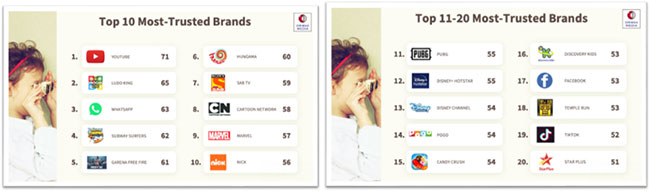
    Ormax Media has released its latest report titled Ormax Brand Trust Survey 2021 which ranks media brands based on the trust they enjoy among Indian kids. The survey was conducted during December 2020 and January 2021, among kids in the 6-14 yrs. age group across 10 cities in India, who scored 44 media brands, across television, digital, social media, gaming, streaming and film exhibition, on the trust factor that brand holds for them.

    YouTube has emerged as the No. 1 most-trusted brand among Indian kids, with a Brand Trust Score of 71%, followed by Ludo King (65%) and WhatsApp (63%). The top 5 ranks are all taken by digital brands, signifying the strong engagement digital media has built with kids in urban India.

    The top rank among TV channels belongs to the channel Hungama, which is followed by Hindi GEC Sab TV. Cartoon Network and Nick are the other two television brands in the Top 10 list.

    Shailesh Kapoor
    Shailesh Kapoor

    Said Shailesh Kapoor, Founder & CEO – Ormax Media: “This report is a decisive verdict on the growing resonance of digital media among urban Indian kids. A clean sweep of the top 5 positions by digital brands, ahead of legacy brands in the television space, would have been unthinkable even 2-3 years ago. Digital brands completely dominate the media landscape of older kids (10-14 yrs.) and boys, taking 8 and 7 of the top 10 positions respectively in these segments”.

    The top 20 most-trusted media brands among Indian kids are:


  • Shailesh Kapoor: Time to Redefine ‘Celebrity’?

    By Shailesh Kapoor


    The events of the last two days have been confounding for many of us. I’m referring to the chain reaction that started off with Rihanna’s and Greta Thunberg’s tweets. Whether the Ministry of External Affairs (MEA) needed to respond or not is a topic for those with an expertise in diplomacy to reflect upon. But the part that caught my interest, and saddened me too, is the orchestrated response from top-of-the-line Indian celebrities.

    Within hours of the MEA statement, the biggest cricketers and film stars in India were using their social media handles to share their views against ‘false propaganda’. The tweets read like each other (sometimes to the last punctuation mark), and came in a flurry, evidently suggesting the inorganic nature of this celebrity campaign. Ironically, these tweets against an alleged propaganda came across as a propaganda of its own making.

    Whether such ‘campaigns’ happen because some phone calls are made from powerful offices in Delhi, or if it is industry’s own way of being in the good books of those powers, I can’t say with certainty. But it is an open secret that almost none of these messages come from a genuine position of awareness or concern, and are merely a way of ensuring good optics.

    Celebrities hold an influential place in the society. It can be argued that the rise of social media has weakened both the inspirational and aspirational power of celebrities in India, though South India is less impacted than other parts of the nation. When celebrities take up an ‘issue’, it gets amplified by the media, and has the power of shaping public opinion, much like influencing consumers to buy brands they endorse.

    But selling chips and beauty products is one thing, and taking up social, economic and political issues quite another. The latter falls in the realm of public and national (not to be confused with nationalistic) importance, and hence, requires a much higher display of responsibility on the part of the celebrity.

    But when one sees the who’s-who of the celebrity world abandon that responsibility and toe a line that’s optically conducive, one is forced to wonder which of the two – opportunism or spinelessness – is the bigger malaise at work.

    It’s easy to give the standard argument that it’s a tough life as a celebrity, and you are damned if you do and damned if you don’t. But for people who enjoy the best of privileges, and have been generously showered with accolades for their great achievements, that argument comes across as spurious.

    When celebrities let go of their social currency, they also let go of the notion that they can shape the country’s future. Are we to understand, then, that celebrity culture in India is now only about Instagram posts, gossip articles and paparazzi invasions, and anything even slightly meaningful is too much to expect?

    Perhaps yes. Call me old school, but the notion that celebrities will only provide fodder for entertainment and not play a pivotal role in shaping India’s thinking is an unnerving thought.

    As it is, popular celebrity line-up in India is now largely homogenous, with film stars, sportspersons and a handful of TV stars dominating the popular list. Professions such as literature, journalism and arts have not built any mainstream traction, and there are no political heroes to look up to either. In such a scenario, film stars and cricketers, it can be argued, have even greater social responsibility. But going by the way things are, that’s a utopian idea in 2021.

    Maybe it’s time to reconcile with the new definition of a celebrity, that of a fashion & lifestyle influencer, than an inspirational figure who can shape impressionable minds, especially children and the youth. In times of half-truths and post-truths, that is the real truth about what the notion of a celebrity has come to, in India at least.

  • Shailesh Kapoor: Storm in a Chatroom

    Shailesh Kapoor

    By Shailesh Kapoor


    More than 1,000 pages. That’s how long the chat transcripts, which form a part of the supplementary chargesheet filed by Mumbai police in ratings manipulation case, are. The transcripts are from BARC India ex-CEO Partho Dasgupta’s WhatsApp records, and hence, features him in all the chats.

    One could question if it was right on the part of Mumbai police to release private conversations in the public domain. But they have, and the material is out there for us to see. The media focus, understandably, has been entirely on the chats with Arnab Goswami. But a large portion of the 1,000+ pages across the two volumes feature chats with other BARC India employees, the most prominent of which is BARC India’s ex-COO Romil Ramgarhia.

    If one focuses on the non-Arnab chats, there are three telling conclusions to draw:


    1. Launched in a hurry?

    There are enough indications in the transcripts that BARC India was not a settled, smoothly-running organisation. The processes, structure and people were being figured out on the go, even when the service had gone live and data was being reported. Perhaps there was a pressure to launch by a given date. But even till as late as 2019, four years after launch, there seems no sense of being settled.

    One can see this as the inevitably of a start-up. But even start-ups find their footing with each passing year. It seemed BARC India was in a hurry, announcing new initiatives (like the now-aborted Ekam) even when the main purpose of the organisation (TV ratings) was nowhere close to running in a stable manner. There are chats on “non-currency revenue streams”, which makes one wonder if revenue considerations took away from the single-minded focus on delivering credible and authentic TV ratings.


    2. Too many people to ‘manage’

    It seems like a classic case of too many cooks spoiling the broth. Way too many stakeholders, ranging from constituent bodies like IBF, AAAI & ISA, to government arms like MIB & TRAI, to the BARC India board and its technical committee, to individual channels ready to stir things up every Thursday, to individual personalities in powerful positions, were on Dasgupta’s, and his team’s, manage-with-kid-gloves list.

    It is difficult to say how much of this perception management approach to run the ratings agency is an inevitable nature of its construct, and how much of it was a result of a workstyle the CEO and  the COO decided to adopt. But almost all internal chats are about managing people and their perceptions. Someone or the other always seemed to be breathing down their necks. A body that should ideally maintain an arm’s length from interested parties, especially broadcasters, was doing anything but that. With the benefit of hindsight, one can say that this approach was doomed to fail.


    3. Lack of confidence in the product

    At many places in the chats, it’s evident that BARC India’s senior team members are tentative about their own panel design and data, and cannot decide whether to trust it or not. The entire outlier management exercise, which is a recurring theme in the chats, is projected as being necessary because of an inadequate panel size and/ or design, suggesting lack of confidence in the product.

    The outlier management process itself comes across as arbitrary and subjective, with decisions being taken at a manual level, despite multiple mentions of the need to “automate” it.

    In research, sample designs and reporting formats go hand-in-hand. If you do not have enough sample to report a data point with confidence, you may as well not report it. But it seems these decisions were not taken at the time of setting up BARC India, and there are multiple instances in the chats on how one or two peoplemeters in a particular market are resulting in ‘abnormal’ growth in a channel’s viewership in a particular week, to the extent of 200%+. Two weeks ago, I wrote here about why ‘less is more’ should be the new ratings doctrine. And these chats strengthen that argument a lot more.


    Where do we go from here? BARC India has a new leadership team, and hopefully, a fresh approach too. The next year or two may see some chaos, but in the long run, the only practical way of making a ratings system work over an extended period of time is to ensure that only highly robust data is reported, and that the agency is given a free hand without any influence from the various power centres. The former is achievable. It’s the latter that worries me.


    Shailesh Kapoor is Founder and CEO of Ormax Media. He writes on MxMIndia every Friday. His views here are personal.