The power ministry is tapping the imagination of advertising gurus to hammer home the message that India can save 25,000MW of energy every year by being prudent.
The Piyush Goyal-led ministry has roped in Ogilvy & Mather India executive chairman Piyush Pandey, Madison World chairman and MD Sam Balsara and Sunil Alagh, a marketing consultant, for a compelling campaign around saving and efficient use of electricity. “We are all helping the committee as individuals. We are now waiting for the brief,” Pandey said. “The idea is to bring awareness on saving power and ways of using power in the correct way.”
Despite having an installed power generation capacity of over 250,000 MW, about 5% of India’s close to 600,000 villages remain deprived of electricity, while power supply in most rural areas is erratic, mainly due to high consumption in urban areas.
Some experts say the government’s efforts to cut electricity wastage need to be supplement strategies to reach out to the industrial and agriculture sectors where energy conservation potential is estimated at over 23%.
As per the ministry’s estimates, close to 25,000 MW of energy can be saved annually.
The ministry, sources say, may rope in prominent faces as brand ambassadors to energise its “saving electricity” campaigns which, thus far, are perceived to have not achieved much. An efficient power sector tops the priority list of Narendra Modi, who as chief minister had turned around Gujarat’s utilities and showcased them as a development model.
In its election manifesto earlier this year, the BJP promised uninterrupted power supply for all. Government agencies like the Bureau of Energy Efficiency have taken several steps to improve energy efficiency and promote power saving.
Ogilvy’s sister agency, Soho Square and Madison, helped the BJP with its Lok Sabha poll campaign, which too was led by Union minister Piyush Goyal, Mr Pandey and Mr Balsara, and the trio continue to work on campaigns for state assembly elections. Asked if he is open to joining more committee’s within government, Pandey said, “I am open to helping out on any call. But I can’t spread myself too thin and then fail to deliver the work.”
Meanwhile, there are talks that Mr Modi wants Mr Pandey to lead communications for both the government and the party. Although Pandey denied having received any such offer, several top executives at WPP said the offer includes maintaining agency relations and supervising government projects like ‘Swachh Bharat Abhiyan’, ‘Clean Ganga’ and ‘Jan Dhan Yojana’, among others.
It’s a bond one thought would last forever. For many years, Ogilvy & Mather India has been known for Piyush Pandey. So strong is the association with Pandey that the agency’s name could well be prefixed with a Pandey.
But over the last five years, National Creative Directors Abhijit Avasthi and Rajiv Rao have come into their own and established themselves as creative gurus with their own standing, albeit a notch below Pandey.
The news of Ogilvy India National Creative Director Abhijit Avasthi parting ways with the agency after working there a decade-and-a-half sent shockwaves in the industry. Confirming this development, Avasthi said he was mulling his next steps. He said he was in discussions with Mr Pandey (coincidentally also his maternal uncle) for a few months.
Last evening, Piyush Pandey, Executive Chairman & Creative Director, Ogilvy South Asia sent a mail to Ogilvy & Mather employees announcing the development. Rajiv Rao, who also shares the creative charge of the agency as National Creative Director (NCD), will be the sole NCD with effect from December 1.
Mr Avasthi will be with the agency till November 30 and continue to be associated with small projects, Mr Pandey said in a mail. According to sources, Mr Avasthi is likely to set up his own creative agency, a move that he has been contemplating for a while. The outgoing NCD though is tightlipped about his plans and would talk about them when the time is right.
A metallurgist by formal education, Kinu, as Avasthi is known in the fraternity, got into advertising after working in a steel plant, manufacturing textile dyes, trading in saris and even exporting playing cards and match-boxes. He started as a copywriter with Enterprise Nexus in 1997 and joined Ogilvy in July 1999. Other than winning several awards and being on the jury of many award shows, Avasthi has been several acclaimed advertising campaigns to his credit. These being for: Fevicol, Cadbury, Asian Paints, Google, Tata Sky, Bajaj, Centerfresh, Mentos and Unilever amongst others.
Friends in Ogilvy, say that while he is a creative, Kinu has a sharp business mind and in his quiet, affable way can win over clients and make decent monies for his agency.
Watch this space for more.
Image: Part of a Fevicol ad was doctored to show a hand (Abhijit Avasthi’s) getting unstuck from that of Ogilvy’s
Kinley, one of the country’s most trusted packaged drinking water brands, has rolled out its new communication campaign Boond Boond Mein Sachchai. Centred on the theme of honesty and highlighting the importance of trust and transparency in relationships, the campaign reiterates the adage ‘Honesty is the best policy’.
Over the years, Kinley has stood for purity, a trait that has led the brand to become a trusted household name in India. Launched on the heels of Kinley packaging getting a new visual identity in India, the campaign aims to take forward the legacy of purity & honesty. The campaign, by focusing on a few usual everyday events, aims to awaken the realization that you can truly be at peace by being honest.
Talking about the new campaign, Wasim Basir, Director – Integrated Marketing Communications, Coca-Cola India, said, “Water as a category stands on a key pillar of Trust. Kinley has epitomized this through its legacy in India. Moving forward, we wanted to take the conversation around purity to the next level – which is truth – which is what led us to the communication idea of Boond boond mein sacchai.â€
He further added, “When we looked inside our society, we found that people did have a tendency to lie a little to avoid an unpleasant situation in everyday life, this gave us a great meeting point of our intent and consumers life-Kitna chain hota hai na sachchai main, Kinley: Boond boond mein sachchai.â€
The TVC is created by team O&M led by Ajay Gahlaut with guidance from Piyush Pandey, and directed by Vivek Kakkad of Curious Films.
In-addition to mass media advertising, the integrated communication program will be extensively leveraged through social media and radio.
OgilvyOne Mumbai has been ranked the fifth smartest digital agency in the world by WARC100.
WARC100 recently announced its worldwide ranking of The Smartest Digital Agencies in 2014 and OgilvyOne Mumbai is the only Indian digital agency to feature in the top 5.
Vikram Menon, President, OgilvyOne Worldwide said, “We can’t help feeling a sense of immense pride at being ranked the 5th Smartest Digital Agency in the World among the WARC100. This is an extremely competitive space which is why this ranking is tantamount to an endorsement and recognition of OgilvyOne’s capabilities and talent in India; we are also grateful that our clients give us the opportunity to do quality work for their brands.â€
Piyush Pandey
Piyush Pandey, Executive Chairman & CD, Ogilvy South Asia said, “This ranking is an enormous credit to OgilvyOne’s digital team in India. I am happy and proud of this achievement. OgilvyOne India’s accolades in the past month have reinforced the Ogilvy India network’s brand building capabilities particularly in the digital domain. The WARC100 ranking is credit to our creative reputation not just in India but also around the world.â€
The WARC100 is a benchmark for commercial creativity, allowing agencies to compare their performance with their peers. It is an annual list of the world’s best campaigns, agencies and brands, based on their performance in effectiveness and strategy.
ABSOLUT has received a positive response to its call for entries to design the first ABSOLUT India Limited Edition Bottle. The company has received over 2,000 design entries from various artists and creative minds across the country.
The design entries will be judged by prominent creative personalities such as Piyush Pandey, Executive Chairman and Creative Director, South Asia – Ogilvy & Mather;Â Sujata Keshavan Chairman, Brand Union; Bharat Sikka, Filmmaker and Photographer and Arjun Bhasin, Celebrity Stylist.
ABSOLUT is going all out by involving their ardent consumers to vote for their favourite design that they would like to see as the ABSOLUT India Limited Edition bottle. The voting commenced on Tuesday, 19th August, 2014 and will end on Tuesday, 26th August, 2014.
It was celebration time for Piyush Pandey and team at the Kyoorius Advertising and Digital Awards last Friday. His agency Ogilvy & Mather took home three Black Elephants – for The Good Road campaign in the Technological Innovation, :{to:) CleftToSmile in the Use of Social Media category and Google Reunion in the Online Branded Innovation Category. Ogilvy was also the most awarded agency at Kyoorius. Shobhana Nair spoke to Executive chairman and creative director (south Asia) of Ogilvy & Mather soon after the presentation of the awards
Very impressed by scale, grandeur and elegance: Madhukar Kamath
DDB Mudra was awarded a Black Elephant for The Last Telegram in the Direct Response Category at Kyoorius Advertising and Digital Awards. Shobhana Nair caught up with Madhukar Kamath, Group Chief Executive Officer and Managing Director, DDB Mudra who was seen crediting his entire team behind this success.
Your thoughts on winning a Black Elephant?
Being recognised for the breakthrough work that we did on The Last Telegram is extremely satisfying. Â I wish the people who worked on The Last Telegram were here. I am going to thank Anil, Deepak, Andy, Mandeep, Sonal, Nitin. Very importantly, our client Ajay Kakar and his team were outstanding. We just went up with an idea to them and it was not an idea that was planned. It was an opportune moment. Andy and his team were totally outstanding in coming up with the idea and executing it. The entire execution strategy for The Last Telegram is phenomenal.
Your personal favourite from other agencies?
The Google reunion is completely outstanding. I particularly liked the work done by Grey on Duracell.
Content with winning just One Black Elephant?
It’s a good jury. I will accept whatever they have decided upon. Next time around we will make sure we have not just one piece of work getting recognized, but at least 3 or 4.
Your views on the award show by Kyoorius and team?
Let me be honest. I am very impressed with what we saw – in scale, grandeur and elegance. The entire award show has been exemplary. In fact, what they have done to this NSCI stadium is outstanding. I compliment Rajesh on not just putting this up but also putting up such an outstanding show.
won numerous awards in the past… how would you rate Kyoorius and why would winning here be important for you (and the others)?
Kyoorius is new but it’s fantastic. They have an association with D&AD that every creative person in the world respects. They’ve made an effort to understand what advertising in India is all about. They have matched world standards but giving a lot of importance to what matters to our audience. For me, that’s the most fantastic thing that has happened and I congratulate Kyoorius and D&AD for creating a level playing field in a very transparent fashion. I am very happy and I salute the organizers.
Obviously you are very proud of all the work that Ogilvy produces, but if you have to pick one favourite creative, which one would it be?
This is a very difficult question. All the work is the babies of my babies. I will not differentiate as they all are great pieces of work. I will not choose between them. I am proud of their work that youngsters are doing in the agency and I look forward to their work. But the rockstar work in my mind is Google Reunion.
And work from other agencies that you love?
I liked a lot of work from other agencies.  I missed Lowe. I don’t know whether they entered or not. But I have loved their work on Gundappa for Lifebuoy. I think it would have been a better place if some other good agencies were also a part of it.
Your thoughts on the show put up by team at Kyoorius and D&AD?
It’s amazing. They have done a stunning job. As a first-timer, they have created hope and if they continue doing this, they will probably be the best award show in Asia very soon. The Abby has done a good job in the past but has lost track and may be this award should wake ’em up.
Information & Broadcasting minister Prakash Javadekar told journalists that the new government had no agenda for regulating media. “I would say the media should have a mechanism of “self restraint”; I don’t even like the word ‘self regulation’, the minister said when speaking at a the Press Club Mumbai’s National RedInk Awards held on June 7, 2014.
The I&B minister said the increasing attacks on journalists was a matter of concern and indicated that the Union Government is considering bringing in a Central Act to punish attacks on media professionals. He said the government is studying the impact of state laws against media attacks. “We will then look at the possibility of a central law,” he said.
The NDA government, he said, was fully committed to ensure full freedom of the Press. But there is nothing like absolute freedom and the society expects the media to be accurate, balanced and fair in its approach. In this context, he said he favoured self restraint by the media, rather than the much talked about self regulation.
He allayed apprehensions that the print medium will dwindle as the electronic medium grows. “Print medium will also grow with the rising literacy in the country.” he added.
Maharashtra Governor K Sankaranarayanan, chief guest at the awards function, abandoned his prepared speech and had the audience in splits with his wit and sarcasm. Coming down heavily on NOTA (None of the Above) as a vote option, he said: “In a democracy, NOTA has no place. It is nonsense. The person who does not go to vote expresses his feeling of NOTA anyway,” he said and pointed out that “It is a sheer waste of time for him (to go to the polling booth) and vote for NOTA.”
“It is only four years since the RedInk Awards were instituted. The awards have already got national recognition. I congratulate the Press Club of Mumbai for setting very high standards of selection of the recipients of this award,” the Governor said.
Veteran Hindi journalist Mrinal Pande was felicitated with the “Lifetime Achievement Award” that honoured excellence in Indian Journalism.
The evening began with a sizzling and hard fought debate on:Â ‘Elections 2014: Were We Fair, Or Did We Stoke the NaMo Wave?’, moderated by Star India CEO Uday Shankar, and with veteran journalist Kumar Ketkar, Times Now Editor-In-Chief Arnab Goswami and CNN-IBN Editor-in-Chief Rajdeep Sardesai and Piyush Pandey, Executive Chairman & National Creative Director Ogilvy & Mather India on the panel.
Rajdeep regretted that a section of the media promoted “Supari Journalism” and some journalists acted as Cheer Leaders during the election campaign by refusing to see beyond Modi. “We have lost the capability to look beyond (sensational) headlines,” he said. He said the media by making it a contest between Modi, a gifted organizer and natural orator, and Rahul Gandhi, who had no capabilities as a politician, made the elections a ‘no-contest’ game.
Arnab Goswami, while concurring that Modi had no competition, said: “But a section of the Delhi media tends to get too close to politicians thus affecting their reporting,” he said. For instance, it was like a sin to criticize Manmohan Singh in Delhi even during the height of various scams.
Kumar Ketkar said media pampered Modi and they stoked the NaMo wave by not reporting other important events and happenings.
Piyush Pandey
Adman Piyush Pandey said media “didn’t create a wave, it just rode a wave”. “When the Indian cricket team wins, everyone talks about Dhoni.”
Mrinal Pande, acknowledging award, felt that Hindi Media continues to play second fiddle to English Media. Hindi journalists should stop behaving like “outhouse boys”, shed inhibitions and develop self confidence.
In other sections of the RedInk Awards, 10 panels of juries were constituted from among distinguished citizens, senior journalists and industry experts to judge over 800 entries in print, online and television entries. From this intense competition have emerged nearly 31 winners and runners-up who will receive cash prizes of Rs one lakh in each of the 14 competitive categories.
Fountain Ink was awarded the Best RedInk Start-Up award. The best start-up award has been instituted this year to recognize media initiatives that have performed well soon after launch. Fountain Ink – launched relatively recently in 2011 – has made a mark this year with your journalists winning a record four awards in the line-up today.
Star India was the Presenting Partner for The Press Club’s Redink Awards for Excellence in Journalism 2014. The awards partners were Yes Bank, Glenmark Pharmaceuticals, Aditya Birla Group, Zee Entertainment, BSE, Eros International and Adani Group.
It’s a campaign that’s sure to enter India’s advertising hall of fame. A blitzkrieg that marketing boys from across the country are drooling over. The advertising mania around Brand Modi began a few months ago in right earnest. The seeds had been sown by way of a belligerent presence on the social media ended on the counting day.
Piyush Pandey
While the victory of Prime Minister-designate Narendra Modi has been attributed to many factors, one can’t overlook the advertising muscle put behind promoting a great brand. As Piyush Pandey, Executive Chairman and Creative Director for Ogilvy & Mather India and South Asia says, “You can only position and market something which is good and based on what the product is all about. Nobody has ever been able to sell a bad product. Nobody can as people are not stupid. So a good product is presented with its attributes and the marketing of the brand which was done by Soho Square is only a presentation of what is good in its intrinsic value.” A team of 25-odd creatives, planners and account management were working round the clock for three months in Mumbai and Delhi on the job. Soho Square, a part WPP’s Ogilvy & Mather India, bagged the account after nine rounds of pitching. “The brief was to firstly, address the common man’s key issues through a comprehensive agenda and secondly, project Mr Modi as the next PM this country deserves,” shares Anuraag Khandelwal, Executive Creative Director and Creative Head, Soho Square, Mumbai.
Ad campaigns like Abki Baar Modi Sarkar, Janata Maaf Nahin Karegi and Achche Din Aane Waale Hain were able to convey both – the current sentiment of the country and the BJP mandate – powerfully and effectively.
Prasoon Joshi
There was also Prasoon Joshi and his team from McCann’s TAG too who were involved to articulate the philosophical aspect of the party. Desh Ki Pukaar, Modi Sarkaar and Desh Nahi Jhugne Doonga were some of the campaigns which Joshi was involved in. “It is very important to know what your product has to offer and what people need. Only then will it resonate with the people. One of my biggest learning is that you need to have a right product, the right ingredients and you can’t confuse people with 10 things.”
“Modi was portrayed as a single-minded person of the party with one single mandate. There has to be clarity of focus & product has to be superior. A great campaign in isolation will not work,” says Joshi.
Ask the brand gurus on why the campaigns worked in favour of Modi and here comes the reply. Jagdeep Kapoor, Brand Guru & CMD, Samsika Marketing feels that the communication and advertising was simply strategic. “It entered the minds and heart, but more important was the great performance of Brand Modi over the decade, which helped them communicate.”
Harish Bijoor
Well-known brand expert and CEO, Harish Bijoor Consults Inc gives a thumbs up to Modi’s marketing, “Modi is the ultimate political marketer. He had able support, and he was decisive in the way he managed his campaign. His campaign was a 360-degree campaign that had everyone else watching with awe. The best of product marketing gyaan was brought into this campaign. And it worked. Modi is a product. And this product promised what the people wanted. And in him people saw a strong and decisive leader, someone who was an anti-thesis of sorts to the persona India was used to in the past decade with Manmohan Singh at the helm of affairs.”
The media buying and planning was handled by Sam Balsara’s Madison World and he admits that a campaign as large as this came with its set of challenges. “Outdoor in UP posed huge challenges because of unfair play by the ruling party in granting permissions for putting up hoardings. The other challenge was negotiations with media, some of whom artificially inflated their rates for political campaigns! Random numbers floating around in the media of the budget of our campaign made our task more difficult.”
While it may appear to have been all hunky-dory as one looks back at the BJP’s advertising campaign, Piyush Pandey adds: “No brand is built in a few months; a brand is built over a period of time. What Narendra Modi has done in the last 10 years has been valuable to him.”
Pandey also hastens to add that good advertising wasn’t the only reason for the Modi’s success. “No election is ever won or lost because of advertising. Advertising is only an element. Advertising only presents it. With a great product, I can do great marketing.” Indeed.
Okay, so the chief host was missing. So deep is his commitment to projects he takes on, that R Balki, Chief Creative Officer and Chairman, Lowe Lintas and Partners stayed away from the starry Portfolio Night that his agency was hosting this year.
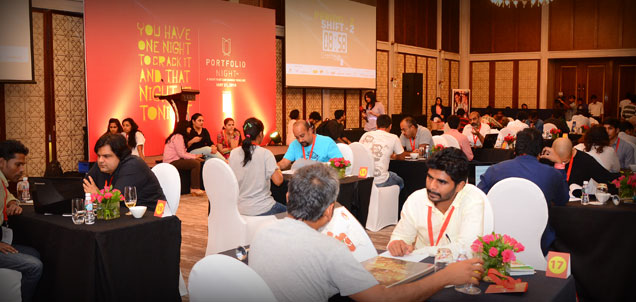
Portfolio Night is a global event where, as the event’s website notes, aspiring young advertising copywriters, art directors and designers meet with several renowned advertising creative directors in a fast-paced evening of advice, networking and recruitment. “While the evening has been jokingly called “speed-dating for creatives”, it’s really much more than that. In the eleven years since its inception, Portfolio Night has grown to a global event, reaching creative hubs in every continent in an evening where the best of the present meets the best of the years to come.”
In its 12th year, Portfolio Night brings together thousands of young minds on a single night at various top cities across the world. This year, Portfolio Night 12 was held in Mumbai’s Four Seasons Hotel, and Lowe Lintas was the host. Last year, Portfolio Night 11 was hosted in Mumbai and Delhi. While the Mumbai edition was hosted JWT, Leo Burnett got the act together in the capital. This year’s edition saw 13000 participants in what’s often also dubbed as one the world’s biggest “Job Mela”. The work is reviewed on the basis of geniality, creativity and execution.
Apart from the obvious nervous energy in the crowd, the host had put together a fun video on the star judges and their predictable reactions after hearing a creative idea which evoked a great amount of laughter from the audience. Bobby Pawar, Chief Creative Officer, Publicis reacted to the video on him by saying, “I loved it. It’s hilarious and they had a great material to play with.”
Talking about the quality of work expected at the Portfolio Night, advertising veteran and Executive Chairman and Creative Director South Asia, Ogilvy & Mather Piyush Pandey said, “It’s not about wrong. It’s about picking up little nuggets and encouraging them.” Amer Jaleel, National Creative Director, Lowe Lintas and Partners, who’s also the host, was seen in despair and wished he had this kind of platform when he had started out. “These 15 minutes are a big deal and it’s not about advertising but about an experience.”
K S Chakravarty (Chax), National Creative Director, FCB Ulka, known as Chax was however not very lucky as the participants who he met were clueless about advertising in the first place. He explains, “You meet all kinds of people. It’s always luck of draw. Out of this entire lot, the chances are that only 5 participants will be really good and not necessary that I meet the brighter lot.”
Arun Iyer, National Creative Director,Lowe Lintas and Partners shares that the team did miss R.Balki who was at that moment shooting for his movie but kept a close track on what’s happening. He further added, “It’s a fun evening. Of course, a responsibility but not a burden. Portfolio Night is a great platform for everyone and its getting evolved over the years.”
“I feel like a celebrity,” exclaimed Deepanjali Singh, after being announced as All Star Nominee. Deepanjali was among those 75 participants who got a lifetime’s opportunity to present their portfolio in front of the biggies of the business.
Bengaluru-based Mayank Bhayana was adjudged Portfolio Night – All Star from India. “I am still soaking in the news. It’s a terrific feeling indeed,” he said, adding: “And let’s not call it an award. It’s rather recognition that I can do a lot better than that.” The winner of Portfolio Night gets a chance to fly down to New York to take part in a week-long creative challenge on a specific brief.
Even as the final results were coming in, it was clear that one of the many factors why Narendra Modi and the NDA emerged victorious in the General Elections 2014 was the advertising and public relations campaign. Shobhana Nair spoke to Piyush Pandey, Executive Chairman and Creative Director for Ogilvy & Mather India and South Asia, Harish Bijoor, well-known brand expert and CEO, Harish Bijoor Consults Inc and Jagdeep Kapoor, Brand Guru & CMD, Samsika Marketing to discuss the rise and rise of Brand Modi
So what worked for Brand Modi since last year?
Piyush Pandey: No brand is built in a few months; a brand is built over a period of time. What Mr. Modi has done in the last 10 years has been valuable to him.
Harish Bijoor: Hard work. Very hard work. Add to it the fact that Brand Modi started off the block much before elections were announced. Brand Modi established itself first when it saw Narendra Modi as a hat-trick CM of Gujarat. This image was further boosted with development as a cue. And then came the announcement of Modi as a PM candidate of the BJP. This was decisive and focussed branding. And then kicked in the campaign.
The solus attention on Modi has helped the BJP immensely in this victory. If you remove Modi from the BJP, you will find a huge crevice in terms of the resultant imagery. To that extent, this is a pure Modi win. In many ways, this paves the way for an epochal shift in the way campaigns will be run in this country. The individual will become more important than the party. Parties that hide behind the cloak of group-think will need to think individual personas, American style, in the future.
Jagdeep Kapoor: Brand Modi has been persistent, has been insistent and has been consistent.
Do you think it was smart marketing that gave Mr Modi the comprehensive victory?
Harish Bijoor: Absolutely. Narendra Modi is the ultimate political marketer. He had able support, and he was decisive in the way he managed his campaign. His campaign was a 360-degree campaign that had everyone else watching with awe. The best of product marketing gyaan was brought into this campaign. And it worked. Modi is a product. And this product promised what the people wanted. And in him people saw a strong and decisive leader, someone who was an anti-thesis of sorts to the persona India was used to in the past decade with Manmohan Singh at the helm of affairs.
Jagdeep Kapoor: Yes. Very big. Because of 3 reasons:
1. He does not need anyone’s help now. Therefore he will only help the country.
2. Despite all the criticism for the last decade, he was clear in his strategy and ruthless in his implementation.
3. He genuinely wants to benefit all Indians, just like he did for all people in Gujarat.
Would you say the BJP’s ad agencies produce great advertising, or at least advertising that worked?
Piyush Pandey: You can only position and market something which is good and based on what the product is all about. Nobody has ever been able to sell a bad product. Nobody can as people are not stupid. So a good product is presented with its attributes and the marketing of the brand which was done by Soho Square is only a presentation of what is good in its intrinsic value.
Harish Bijoor: They did. I love the “Abki Baar Modi Sarkaar line”, as did I love the jingles that captured the need of the people in bundling hope: “Acchhe din aane waale hain…” And media organizations loved the amount of money that was spent in airing all of this for sure.
Jagdeep Kapoor: Their communication and advertising was simply strategic and entered the minds and heart, but more important was the great performance of Brand Modi over the decade, which helped them communicate.
And do you think the Congress loss was caused by bad advertising?
Piyush Pandey: No election is ever won or lost because of advertising. Advertising is only an element. Advertising only presents it. To say that Congress’ advertising was bad will be incorrect. What are you presenting is an issue and to say Soho Square’s advertising was great for Mr Modi will be incorrect too. Soho Square did a great job in interpreting the right side of Mr Modi strategically and creatively. But at the end of the day, advertising doesn’t make you win an election or any product for that matter. With a great product, I can do great marketing. A good product has to be presented properly for that I complement my partner Soho Square. I will conclude by adding “Acche din aane waale hai!”
Harish Bijoor: Not really. In the beginning, it is all about strategy. I do believe the gaps lie in the strategy rather than in the advertising executions. I do believe enough of emphasis on voter insight was not given. The campaign was top-down and ignored the bottom-up possibilities.
Jagdeep Kapoor: Advertising has a limited role. Performance has a major role. Good performance gives good results and vice versa. Brand Modi was able to set a high standard not only in Gujarat, not only in India, but also in the world.
How does Brand Modi not suffer from the same fate as various Opposition/non-Congress governments have in the past?
Harish Bijoor: Brand Modi is beyond it all for now. His assessment will start happening one year from now. And that will be the biggest challenge to tackle. Every single promise needs to be fulfilled. With care, tracking and passion.
Jagdeep Kapoor: In the case of Brand Modi, he’s positive. He focuses on growth proposition and not negative opposition.
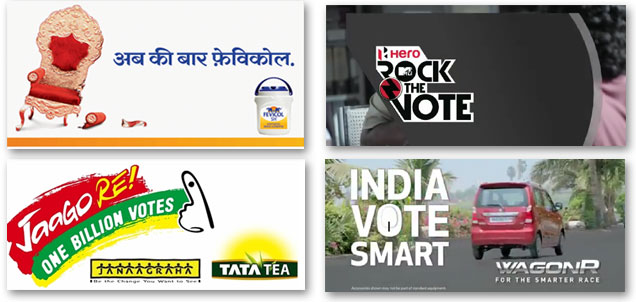
Last week, just off Peddar Road Bridge in South Mumbai, Bimmers, Bentleys and taxi cabs passed a giant billboard, standing in the shade of posh high-rises that are home to Mumbai’s wealthiest citizens. It featured a tub of Fevicol with these words in blue ‘Abki Baar, Fevicol’. Of course, ‘Abki Baar’ are the now famous (and extensively parodied on social media) opening words of the Bharatiya Janata Party’s general election campaign. So what does glue have to do with it? It’s a simple strategy deployed by brands time and again ride on the coattails of a topical event that has countless masses in its thrall.
Fevicol, a Pidilite brand and its agency Ogilvy also produced a commercial featuring a conversation between a chaiwalla and a slightly kooky carpenter about three peculiar chairs. A lotus shaped one, an adjustable chair shaped like a hand and the hotchpotch seat that’s the result of different sizes and shapes of kursis glued together. In other words, BJP, Congress and the Aam Admi Party.
The last time chairs were prominently featured in an ad it was for Facebook’s ‘Chairs’ commercial. However, while the social network’s ad was an ode to chairs, or Ikea perhaps (still a mystery that one); Fevicol’s all about seats of power in this cheeky spot. While most thought the campaign a refreshing and amusing commentary on the elections, it also put the cat among the conspiracy theorists who have suggested this is a surrogate campaign for Narendra Modi-led BJP.
They also point to the fact that Ogilvy’s chief Piyush Pandey was instrumental in the creation of the party’s campaign. On social media like Twitter some have fielded tweets such as, “Does the new Fevicol ad obliquely suggest that BJP is most likely to win?” which refers to the perceived bias in the commercial.
However, the point of the ad, according to Anil Jayaraj, chief marketing officer of Pidilite Industries, was simply to put a smile on people’s faces. He says, “Over the years, Fevicol’s advertising has striven to capture a slice of life while reinforcing our core proposition of strong bonds in a contextual situation. We didn’t think about the campaign from an election point of view.” But if you do, it’s highly advisable to exercise a fair amount of common sense when ad plots involve topics like elections, parties and politics. “But the ground rule is to make people smile with these humorous takes,” he says.
The 2014 Lok Sabha Elections has seen the most high-decibel campaigning in the history of India. It’s no surprise then, that the world’s biggest democratic exercise has prompted marketers to do the poll-ka too. Don’t be fooled, it’s a tricky dance. There’s the finest line between the good samaritan brand which encourages viewers to cast their ballot and the preachy bore which only provokes viewers to draw their mallets. And one could just as easily, consciously or not, colour a piece of communication in certain party hues.
Brands like Tata Tea have built and sustained the momentum of purpose-driven movements over many years. The Tata Group’s Jaago Re initiative is structured entirely on social causes and issues of citizen responsibility. Meanwhile others temporarily latch on to elections by broadcasting passive reminders.
Berger Paints did its bit to prompt viewers to be the change they want to see. The brand’s latest commercial has people trying to wash corruption off India’s walls, literally. So did innerwear brand Rupa, with its spot featuring Hero No1 in his white vest and gundas who keep voters away from poll booths; an ad that apparently inspired another similar commercial from innerwear brand Dollar.
Brands as diverse and tangential to polling as Wagon R and Finolex have thrown their khadi topis in the ring. Looking for a slightly more lasting association, sportswear maker Puma tied up with MTV for its ‘Rock The Vote’ initiative to help further the cause. Says Rajiv Mehta, MD, Puma South Asia, authenticity is key. “Besides we are not telling people who to vote for, we’re just saying vote.” And never spam people’s inboxes with messages and reminders to exercise their democratic right and do their duty for change and country, that’ll just piss people off, is Mehta’s advice.
For marketers, to join the clamour of election-themed brand campaigns is easy enough, to get viewers to vote is the hard part. Now, all they can do is hope that abki baar is in fact the right time to hitch their wagon to the poll. After all, it’s hard to be heard when noise from the parties’ party drowns out every other campaign online and off.
The seventh edition of India’s advertising festival, Goafest, will be happening minus some big names. Seven of the country’s top advertising agencies – Lowe Lintas, Ogilvy & Mather, Creativeland Asia, McCann Worldgroup, BBDO, Grey and Leo Burnett will not be participating in 2014.
Entries to the festival this year are down 50 percent – last year Goafest had received 4,800 entries across creative and media, but this year it has received around 2,500 so far. That’s despite the introduction of two new categories Promo-Activation and PR, and opening up the awards to entries from broadcasters and publishers.
Srinivasan Swamy
“I expected the numbers to be down this year,” says Srinivasan Swamy, chairman, Goafest 2014 and chairman & MD of RK Swamy BBDO. “But I believe 2,500 is also a good number to have. I agree that agencies like O&M and Leo Burnett send large number of entries and their absence would bring the numbers down. But we are not badly off,” he adds.
While some of the non-participating agencies have decided to send delegates to the festival, a senior Goafest committee member confirms that this year the number of delegates will be also down by at least 50per cent. While Swamy maintains, “Let’s celebrate people who are participating,” Piyush Pandey, executive chairman, Ogilvy & Mather says, “Even the winners won’t feel the joy of winning as half of the industry is not going to be there.”
Piyush Pandey
One factor that has played a role in the low participation rate is the timing of the festival. Says a source on the Goafest committee, “Agencies usually got at least two months between Goafest and Cannes Lions to work on their budgets, to decide which entries to send and to decide the team that would represent the agency. But this year since the festival is happening in the last week of May there is hardly any time for agencies to plan.”
All this has only resulted in more flak for the Abbys, the country’s oldest advertising awards which was integrated into Goafest a few years ago. “I think the Abbys was running beautifully till they combined it with Goafest,”says MrPandey. He says that the principle on which the award show was merged with festival was that Ad Club would run the awards and AAAI (Advertising Agencies Association of India) would organise the festival. “But it got muddled somewhere down the line,”he says.
K V Sridhar
KV Sridhar, the outgoing chief creative officer India subcontinent at Leo Burnett, agrees, saying, “While the festival may have become bigger, there is no doubt that Abbys has lost its credibility.” Mr Pandey in turn believes that Goafest should have taken a break for a year, restructured and reorganised itself and then returned with a bang in 2015. The deadline for entries has been extended to April 28 from April 25, so there doesn’t seem to be much chance that participation will ramp up. But Swamy says that the Goafest committee will be meeting with heads of the non-participating agencies immediately after the festival, to discuss and address their concerns and clear the way for next year’s event.


 DDB Mudra was awarded a Black Elephant for The Last Telegram in the Direct Response Category at Kyoorius Advertising and Digital Awards. Shobhana Nair caught up with Madhukar Kamath, Group Chief Executive Officer and Managing Director, DDB Mudra who was seen crediting his entire team behind this success.