Tag: Ormax Media

  • Post-Covid Challenges: Hindi GECs will be Tested


    By Shailesh Kapoor


    The pandemic is still all around us. Fatigued from a long, early lockdown, and facing dire economic consequences, India has begun to open up slowly. But we are nowhere close to “normal”. Not even close to the “new normal”, an oft-bandied phrase that means different things to different people.


    The entertainment sector is preparing to take small steps towards normalcy. Shooting of TV serials has started in some markets, and others will follow in July perhaps. It will not be the usually bustling, chaotic shoots that we are so used to. With limited resources at hand, the frills and the overheads will be cut out. This may pave way for cost-saving ideas in the long run. But that’s another topic for another day.


    There’s a lot of talk of how post-Covid media consumption in India (and the world) will look like. I wrote about prevailing “lockdown myths” in May, expressing my view that fundamental change in habits is not as easy as many are suggesting. But much as habits won’t change, the lockdown has created a break in them, which allows for disruption, offering opportunities in particular for weaker TV channels to come back stronger than before, and challenge the leaders. Of course, that is easier said than done, especially in categories like Hindi GEC, which have their own share of problems.


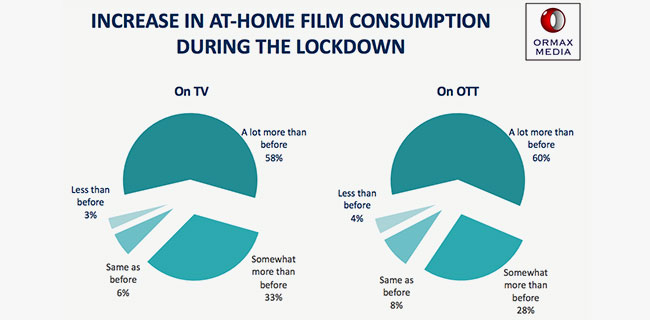
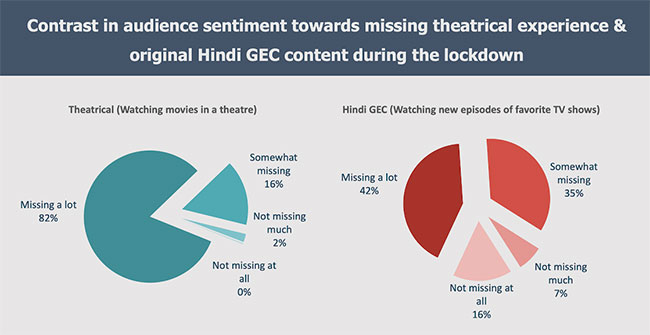
    When Ormax Media released the findings of its research (see chart above) stating that the Hindi GEC audience are missing original episodes of their favourite serials a lot less than they should, the reactions from those involved ranged from scepticism to outright denial. Unfortunately, one can’t even say the reactions were surprising.


    Using ratings to predict audience sentiment has been an age-old fallacy in the TV industry. We saw that back in 2006-2008, when the growing audience resentment towards the ‘K-serials’ was met with a standard “but they rate so well” response. It took the launch of Colors in 2008 to prove that a sentiment just needs a good catalyst to convert into behaviour.


    Even though news and movies have made inroads into primetime family viewing during the lockdown (as indeed over the last 3-4 years too), it is safe to say that GEC content will remain the staple primetime diet of a very large section of the universe. But what the chart above tells us is that a sizeable proportion of this large section is not giving the Hindi GEC category (the results will be different and significantly better for regional GEC categories) the love it should get. The relationship between Hindi GEC content and the viewer is now less emotional and more ephemeral in nature.


    Some say this could be simply a function of the times that we live in, where attention spans have gotten shorter, distractions have increased, and concepts like loyalty and appointment viewership are things of the past. But there are multiple reasons to disagree with that line of thinking. For one, the regional categories are faring much better. Secondly, if distraction and clutter was the driving force, it should have reflected in a geographic skew. But that’s not the case. The metros, the mini-metros and the small-towns all perform equally poorly on the question asked for the chart above.


    Will there be post-Covid viewership attrition for Hindi GECs? A drop of more than 5-10% compared to pre-Covid times is unlikely in the near future. But the ground cannot be more fertile for one of the top players to sow the seeds of long-pending category evolution.


    Streaming will not take away TV audience. But certain TV channels and genres have enough other competition on TV itself to contend with anyway.


  • OTT is great, but no Goodbyes to Theatres. Not yet


    By A Correspondent


    Ormax Media conducted a special study on theatre-going behaviour given the impact it has had by the Covid-19-led lockdown. The study measure audience sentiment about visiting theatres when they re-open, expectations and change in behaviour at the theatres, audience trust in various exhibitor brands in effectively implementing safety measures and the consumption of films on television and OTT platforms during the lockdown.


    Here is the Executive Summary of the findings:

    1.Audience have given whole-hearted endorsement to the theatrical experience, with 82% missing going to the theatres a lot during the lockdown

    2. A dominant section of audience believe that they will go back to the theatres within 2-3 weeks of them re-opening. However, social distancing and sanitization precautions taken by theatres will play a crucial role in their decision to visit

    3. Contrary to a perception being built in the trade and the media, high consumption of films on TV and OTT has not reduced the audience attraction for the theatrical experience

    4. 69% audience said they will visit theatres not just for big-scale films but for medium and small films too

    5. Economic considerations don’t emerge as a major factor in the decision to revisit theatres. Audience would rather have theatres keep the ticket price unchanged and spend money on implementing safety measures, than offer discounting to boost footfalls

    6. F&B consumption at the theatres is likely to be impacted by about 60% during the period of Covid-19

    7. The national chains score high on audience trust to effectively implement safety measures. However, chains with limited geographical presence, and single screens, are seen to lack this credibility

    8. Communication of safety measures undertaken by theatres will be a crucial factor to persuade audience to visit theatres when they reopen


    BackToTheTheatre-OrmaxMedia-May2020_compressed

  • Nationalism In A Theatre Near You…


    By Shailesh Kapoor


    Since the last year, the month of January has emerged as a month of usual blockbusters for Hindi cinema. In 2019, Uri – The Surgical Strike released in January, and went on to do exceptional business at the box office well into February, eventually doing net (post-tax) domestic ticket sales of almost Rs 250 crore. It was also the most-liked Hindi film of the decade (2010-19) with an Ormax WOM (Word-of-Mouth) score of 86, ahead of Bahubali 2’s Hindi dubbed version by one point.


    This year, Tanhaji – The Unsung Warrior, released in the second week of the month like Uri, has struck gold. The film marches on in its fourth week that starts today, and will comfortably cross the Rs 250 crore mark. Ajay Devgn is an established star over three decades, but this is by far his biggest success, overtaking Golmaal Again (2017) comfortably, despite the latter having the advantage of a franchise backing and a lucrative Diwali release.


    The second week of January may emerge as a hot date for new releases because of these back-to-back successes, but you don’t need to be a fancy analyst to decipher that there is a lot more in common between Uri and Tanhaji than just their release dates. Both the films evidently, and unabashedly, cash in on a nationalistic fervor that is an integral part of the political narrative of the country over the last few years. And both are inspired by true stories, though both take ample ‘creative liberties’ to mend the true story in question to suit the nationalistic sentiment they are trying to stir up.


    The films in question themselves are very watchable. Uri’s last hour is particularly gripping, and its handling of action sequences, especially in the sound department, broke new grounds in Hindi cinema. I found Tanhaji very cinematic, and in certain scenes, the Bahubali-inspired imagination of the makers was on good display. Both had to be good films to do the business they did.


    The question, however, is: How over-indexed is this business because of the political climate of the country? Would Uri have been an equal success in an earlier political regime, where Modi was not helming affairs? Would Tanhaji have gone on to do so well if national and regional pride were not on the top of the political agenda of BJP and Shiv Sena respectively?


    The films, especially Tanhaji, systematically incorporate the nationalist sentiment in their writing. I started counting the mentions of the word ‘bhagwa’ (saffron) in Tanhaji, and lost count somewhere around 12. The distortion of actual facts in the film’s story further propagates this agenda, along with building the lead character’s machismo.


    While quantifying the exact box-office surplus that these films gained from their political leaning may need more research than is currently available, the qualitative impact is there for everyone to see. And why only these two films? The Accidental Prime Minister, an unabashed mockery of Dr. Manmohan Singh’s tenure as a PM, opened at about Rs 3.5 crore last year, despite no star value to boot and a release clashing with Uri. The Tashkent Files, which implies, and in no uncertain terms, that the Congress was behind the ‘killing’ of Lal Bahadur Shastri, opened low but went on to do fairly good business last year.


    Cinema’s political coloring may be a worrying trend for many, but it may just be here to stay. After all, it’s the audience who are writing this narrative. One can make a dozen and more films on an agenda, but if there is no audience for the taking, it won’t work. Here, there’s a thriving audience who are looking towards the cinema halls for their monthly dose of nationalism.


    Patriotism has always been a strong selling point of our cinema, and the huge success of Gadar: Ek Prem Katha is the best example in this regard. But nationalism and patriotism are different. And that is why this story will continue to get more interesting in the years to come!


    Shailesh Kapoor is Founder and CEO, Ormax Media. He writes weekly on MxMIndia. His views here are personal


  • The Most Successful TV Channels of the Decade


    This is the fourth in a series of six decade-ender lists in this column. The previous lists:

    The most-defining Hindi TV shows of the decade

    The most-defining Hindi films of the decade

    The most successful OTT brands of the decade


    By Shailesh Kapoor


    The decade of 2010-19 was easily the most uneventful decade in the history of Indian television so far. Each of the previous three decades was dotted with events that unmistakably shaped television in India. The 80s was the golden age of television content, as Doordarshan started to provide primetime programming and engaged with some of the best writing, directing and acting talent in the country for the same. The 90s saw the emergence of satellite television, which widened the options available to the audience multi-fold. The 2000s saw the daily soap movement, led by Star Plus, and then, the rise of the alternative force in Colors, which brought a unique, real and rustic touch to mass entertainment. Each of these decades had a big highlight at the start. The Asian Games in the 80s saw the arrival of the colour TV. The Gulf War telecast in the 90s, albeit niche, introduced us to the fascinating power of satellite television. And Kaun Banega Crorepati ushered in a new era in 2000.

    In contrast, the last decade (2010-19) can only be remembered for what happened ‘off-screen’. The ratings controversies, leading to the birth of BARC India, in the midst of digitisation, headlined the first half of the decade. And TRAI’s New Tariff Order was the big talking point as the decade ended.

    Low content innovation and a general sense of inertia became even more apparent as digital and social media grew on the side, becoming a dominant force by the time the decade ended. Yet, some TV channels stood out, challenging the status quo and making a mark for themselves. Here’s my list of the top 5 most successful TV channels in India over the last 10 years, based on how they navigated through this tricky decade, making a mark for themselves, and their parent networks.


    5. Sony SAB

    SAB’s flagship show Taarak Mehta Ka Ooltah Chashmah (TMKOC) launched in 2008, and kept going strong through this decade. For large chunks of time over the last 10 years, SAB struggled to have a second hit show. But there were strong periods in between, when the channel managed to add fire power to TMKOC to emerge as a strong contender in the Hindi GEC category. 2019 was one such year, and the channel has been on the heels of Star Plus, Colors and Sony for the top spot, and often taken it too. SAB’s success is even more remarkable if you consider than it operates at significantly lower programming costs compared to other top Hindi GECs. TMKOC itself has gone from strength to strength, and SAB’s packaging and family-inclusive positioning are arguably the brightest and the sharpest respectively, in the genre.


    4. Nick

    In a category that’s essentially commoditised, and one flagship show is all you need to dominate the ratings charts, Nick managed to rule the roost for a large share of the decade, and often by a wide margin too. While its competition found it difficult to extend their portfolio beyond one show (e.g. Chhota Bheem on Pogo and Doraemon on Disney), Nick kept the animation mill running, launching several properties through the decade, with varying levels of success. While its 2012 launch Motu Patlu remains its biggest success story till date, the channel managed to sustain a strong second line, and showed nimble-footedness in experimenting with content shifts between the two sister channels Nick and Sonic.


    3. Star Plus

    The decade started with Colors emerging as a disruptive force in the Hindi GEC category, throwing Star Plus and Zee TV off their comfort zone with a new programming outlook. After a year or two of trying to figure out what had hit them, Star Plus found its feet back. Its ‘Rishta Wohi Soch Nayi’ campaign in 2010-11 is easily the most effective brand campaign any mass Hindi TV channel in India has ever launched. Unlike the umpteen ‘brand refreshes’ that GECs indulge in, this one was actually backed by content, ushering in a new line of shows like Diya Aur Baati Hum and Pratigya, which put strong women protagonists on the forefront, in relatable, small-town settings. In the second half of the decade, the Hindi GEC category went through a tough phase, losing ratings to regional, news and movie genres. Star Plus innovated here too, launching the ‘Rishta Wohi Baat Nayi’ campaign, signaling its focus on differentiated content that breaks the monotony of sameness. On the side, experiments like Satyamev Jayate continued, even as the channel managed to steer through many highs and lows over 10 long years.


    2. Zee Tamil

    For the first half of this decade, the Tamil GEC category was a one-horse race. Sun TV led its closest competitor Star Vijay by an embarrassingly-wide margin. The ratio of their viewership was often higher than 10:1. Zee Tamil was in a wooden spoon battle for the second spot with Star Vijay, with no hopes of catching up with the big force at the top. But somewhere in mid-2006, the channel started finding an alternative content space. It took a couple of years, but Zee Tamil became a strong contender, overtaking Sun TV in some prime-time slots, and bringing down the 10:1 ratio to 2:1, even less at times. Importantly, it altered the viewing behaviour of the category, as it made the audience realise there are options beyond Sun TV to consider. Even Star Vijay has gained because of this behaviour change. While Sun TV still ranks no. 1, it has lost about 20-25% of its viewership through the decade, even as Zee Tamil has grown by a whopping 500%+.


    1. Star Sports

    There’s so much to say about Star Sports’ dominance of the sports scene over the last 10 years that it may need a separate article some time. One can talk about the thought leadership shown in backing Kabaddi (and later soccer), or the front-footed approach towards IPL rights, or the digital strategy for sports with Hotstar, or the championing of Hindi commentary in the early part of the decade to the launch of regional channels in the latter. The long list of Star Sports’ innovations in the sports category provides a silver lining to a dull television decade. Star Sports’ much-underplayed tagline says ‘Believe’. It’s probably more a reflection of how Star looks at the future of sports and sports programming in India, than what they want Star Sports viewers to feel about the channel!


    Shailesh Kapoor is founder and CEO, Ormax Media. He writes on MxMIndia every Friday. His views here are personal


  • A Fortnight of News, A Decade of Everything


    By Shailesh Kapoor


    A lot has happened on the news front over the last two weeks. We first witnessed a political battle in Maharashtra that would put the biggest political thrillers in Hollywood to shame. It was a twist-a-minute saga, and you never quite knew if you have seen the end of it. In fact, we may not know that even now.


    Then, over the last week, the Hyderabad rape case has grabbed the headlines, and the story continues to develop, with the news of the four accused being shot dead in an encounter coming in even as I write this. There was also the historic Pink Ball test, which ended with another emphatic India win in under three days.


    On the entertainment front, another successful season of KBC came to a close, with a skillfully-crafted finale week. Even if you do not watch the show, you will do well to check out the finale episode featuring Sudha Murthy. It was inspiring and entertaining in equal measure.


    We are also nearing the end of the year, and also the end of the decade of 2010-2019. There’s been an unprecedented interest among journalists, especially those in the media & entertainment sector, to do decade lists and trend stories. I don’t remember any such interest ten years ago when the 2000-2009 decade ended. This interest may have been piqued by online channel Film Companion’s list of the best films and the best performances of the decade.


    The more one thinks of it, the idea of analyzing a decade is intriguing and challenging in equal measure. How do you ensure that recency does not bias your opinion? However sharp your memory may be, 2010 is way more distant than 2018-19. Much as I’m averse to lists, because they eventually becoming subjective opinion, a ten-year period is an irresistible temptation to take a shot at them.


    There’s another reason why I’m keen on them. For Ormax Media, which started in 2008, this is a decade for which we have comprehensive data over the entire ten-year period, which takes care of objectivity in good measure. Hence, from next week, over the next six weeks, this column will cover the following six lists for the 2010-2019 decade, not necessarily in this order. I’d stay away from box office and ratings-based lists, as that is easy to access in the public domain.


    1. The most defining TV shows of the decade

    2. The most successful TV channels of the decade

    3. The most iconic Hindi films of the decade

    4. The most successful digital brands of the decade

    5. The most important emerging trends of the decade

    6. The most significant trends expected from the new decade


    Let the lists begin!


  • Men Rule OTT in India. 66% males dominate viewership


    By A Correspondent


    The audience size of regular OTT (online video content) audience in India stands at 76.5 Million (7.65 Cr), according to the findings of The Ormax OTT Audience Report: 2019. Mumbai and Delhi lead the top markets, with 3 million regular OTT audience each, followed by Bengaluru, Hyderabad, Kolkata, Ahmedabad, Surat, Chennai, Pune & Jaipur.


    The study, conducted among 15+ age group, also profiles the OTT Universe. 66% regular OTT audience are men, while 34% are women. 25% belong to the 15-21 yrs. age group, 34% in the 22-30 yrs. age group, 21% in 31-40 yrs. and 20% in the 41+ age group.


    The research report covered a sample size of 10,000 audience over the period of May to September 2019, whereby audience were sized and profiled based on their OTT consumption behaviour, usage of various OTT platforms/ apps, and their content choices. The study defined ‘regular OTT audience’ as someone who watched two or more hours of OTT content every week, and uses at least one website/ app besides YouTube and social media to watch video content online.


    Speaking about The Ormax OTT Audience Report: 2019, Shailesh Kapoor, CEO – Ormax Media, said: “OTT is an emerging and fast-growing category in India. While individual platforms have a lot of a data on their own audience, there is little industry-wide understanding available on who the OTT audience in India exactly is, how many are they in number, where do they exist, how do they watch, which genres do they prefer, what are their subscription triggers, and many other such questions that are extremely relevant to any OTT business. This report, which will be an annual feature, answers many such questions in a manner that’s highly actionable, with direct implications in decision-making in the areas of content selection, target audience choice, media planning, market research and brand communication”.


    Among the OTT platforms, YouTube emerges as the most-preferred OTT brand, followed by Netflix, Amazon Prime Video and Hotstar closely vying for the second position. ALT Balaji’s Gandii Baat emerged as the most male-skewed show, while Amazon Prime Video’s Mind The Malhotras emerged as the most female-skewed show.


    The report also highlights how solo consumption is still the dominant viewing behaviour seen in the OTT category, with 82% audience typically watching online videos alone. Hindi emerges as the most-preferred language of online video consumption at 62%, followed by English at 22%, while regional languages, led by Telugu and Tamil, control the balance 16% share.


    The Ormax OTT Audience Report: 2019 is a syndicated report that’s now available for subscription.


  • Top 5 Category-Defining Hindi GEC Shows of 2018


    By Shailesh Kapoor


    Even if only in relative terms, 2018 has been a better year for Hindi GECs than the last 2-3 years. The category, on a share decline since 2015-16, did not see a further downward trend, and there was some recovery too by the end of the year.

    In a year when original content in the OTT space, led by Netflix and Amazon Prime Video, grabbed most headlines, the Hindi GEC category tried to find its footing back. And though the ‘success’ achieved can only be considered partial in nature, it sets a good base for 2019 to emerge as a revival year for the category.

    Here is my list of five Hindi GEC shows that drove the category and its perceptions this year, eventually leading to a respectable year.


    5. Kaun Banega Crorepati

    KBC had another successful season, both in terms of viewership and its revenue impact on the channel (Sony), with the latter benefitting considerably from the digital revenues that have become a strong force for the show since the last season in 2017. All the classical elements remained, and the show was virtually a replica of the successful one last year. KBC is emerging as India’s comfort family viewing in the prime-time year-on-year. And you don’t mend what’s not broken.


    4. Kumkum Bhagya-Kundali Bhagya

    The 9-10 PM block on Zee TV has emerged as a fortress of sorts, owing to the two Balaji Telefilms shows that continued to thrive in 2018. In times of content fatigue being a real concern among viewers, Kumkum Bhagya managed to stay fresh and relevant. Kundali Bhagya, the more recent of the duo, found its peak towards the end of 2017, and held on to it through this year. The combo delivered a solid package of traditional and the modern, covering wide-ranging and engaging characters and emotions between them. How long can Zee-Balaji milk this double bill remains to be seen. But in 2018, the combination was rock-solid.


    3. Radha Krishn

    Star Bharat’s RadhaKrishn launched at the start of the last quarter of the year, and immediately propelled the channel’s viewership. It is bizarre to think that Indian television has not had a TV series of Radha and Krishna’s love story till this show came in. The idea was a winner at the get go, and the visual execution, supported by top-level music, made the show a quick audience favorite. Mythological shows tend to have a shorter shelf-life than family dramas. But RadhaKrishn has just about taken off and should have a good early 2019 at least.


    2. Taarak Mehta Ka Ooltah Chashmah

    Taarak Mehta Ka Ooltah Chashmah (TMKOC) is the KBC of television comedy. Nothing else that happens in the category can seem to shake up the staunchly-loyal viewer base the show has built. The difference, of course, is that unlike KBC, TMKOC is on-air all year. Now, that should make it doubly hard for a show to stay fresh and relevant. But no such concerns with TMKOC. Aided in no small measure by its immensely-popular lead character Jethalal, TMKOC may be a fixture of the Indian viewers’ watchlist for another 2-3 years at least, if not more.


    1. Kullfi Kumarr Bajewala

    Star Plus adapted its very successful Bangla show Potol Kumar Gaanwala into Kullfi Kumarr Bajewala in an early-2018 launch. The show found its real footing after the IPL, finding levels of viewership that were out of reach of new shows for the last 2-3 years. The endearing Kullfi even usurped Jethalal briefly to become the No. 1 fiction character in the category (Ormax Characters India Loves). Differentiated stories, when rooted in viewer relevance, can be runaway successes. And with Kullfi Kumarr Bajewala, this combination was achieved by a mainstream (read non-mytho-historical) Hindi GEC fiction show after a long time.


    Shailesh Kapoor is Founder and CEO, Ormax Media. He reviews trends and insights on MxMIndia every week. The views here are personal


  • Shailesh Kapoor: The Mediocrity of Election Results Coverage

    By Shailesh Kapoor


    Earlier this week, on Tuesday, election results from five states were on the news agenda. The cliffhanger in Madhya Pradesh and the close contest in Rajasthan, combined with the story of Congress’ resurgence in the Hindi heartland, made for an irresistible news day by the end of it. But while the content proposition was delightful, the television coverage itself was terribly underwhelming.


    Election results have been event-like days for the news genre for decades now. With the advent of EVMs, the counting process got crashed from 1-2 days to 1-2 hours. Anything that’s in the T20 format works, and this format too is a television channel’s delight – it’s fast-paced, exciting, unscripted and unpredictable. The natural tendency, then, should be to hero the format and let it do all the heavy-lifting.


    But trust our news channels to complicate simple things. The Tuesday coverage across most Hindi and English news channels was like a T20 game where the cricket is good but the commentary and the graphics are terrible. You will still watch it for the cricket, even if the viewing experience s. It made me wonder what has made it come down to this. How has a collective community of topline channels forgotten how to cover election results over the last few years?


    There are many concerns with how such days have now started to pan out, but let’s focus on a few key ones. The first issue is the unnecessarily busy feel of the election shows, with multiple talking heads, both inside and outside the studio. As it is, the pace of results unfolding is breakneck. The various talking heads can be heard and seen jostling for attention, even as the anchor(s) attempt to balance the results with the commentary, which invariably is lost in the din anyway. Why do election results in their first hour have to be handled like a noisy primetime debate on a slow-news day?


    The second issue is about the graphics. In an attempt to outdo each other, channels have started investing in complicated, often non-intuitive, graphics that add little real value to the analysis. English news channels have been particularly guilty of it. Psephologists are one camera, jumping around big screens like energised bunnies, presenting data that is irrelevant, to use a mild word, when they should actually be behind the scenes, like a cricket statistician, arming the anchors with material that’s compelling and insightful.


    In my growing-up years, when the word “psephology” was first introduced into my vocabulary, I understood it as a fine balance between statistics and political insight, in context of election results. This balance has gone awry now. There is an overdose of statistics, but very little insight. In fact, the ‘insight’ part today seems to have an anything-goes approach. Comments are increasingly banal, often factually inaccurate.


    Seat-level leads, which were always a much sought-after aspect of election results coverage, especially in the General Elections, has been sidelined over the last decade. Even the 2014 elections had lesser emphasis on individual seats than 2004 and 2009. There is some token on-screen coverage, but very few channels have anchors and panelists who are actually aware of too many candidates by name and background. This robs the coverage of the classical personal touch. On Tuesday, it was rare to spot a local panelist across channels who knew the political faces in any of the five states.


    Then there is this confusing issue about multiple sources of results. Half an hour into counting, you will see at least five different results across various channels put together, some of which are in direct contradiction with each other. Till one hour after the results started trickling in, which way you thought Rajasthan is going was a function of which channel you were watching.


    Next Thursday, the ratings will be released and news channels will slice the data to do their share of emailers on how well they did on December 11. It will be an endorsement of mediocre coverage at a category level. And we shall see a repeat in the summer of 2019.


    Shailesh Kapoor is Founder and CEO, Ormax Media. The views here are personal


  • Ormax Media: Dus Saal Baad


    For an industry where crores are invested on content, marketing and business strategies, it was a no-brainer that there was a crying need for an organised third party research and insights analysis. A decade back, when it started operations, Ormax Media addressed that need and there is no looking back as it has moved on from research to strategising for business, from television to across media and with a very special focus on films. On the occasion of its tenth anniversary, MxMIndia convened a roundtable with Founder and CEO Shailesh Kapoor and his core team members and Partners of Ormax Media, Keerat Grewal and Gautam Jain. Read on…


    How would you say has Ormax Media’s decade-long journey been?

    Shailesh Kapoor (SK): I think we have two or three phases in these ten years. The first 3-4 years was when we launched.We knew there was a need gap. There was no company catering to media and entertainment as a category from the consumer knowledge perspective. So most of our work in that periodwas based on the research, whether there it was testing or tracking… various forms of qualitative and quantitative research.

    Today, we have moved on from being a research outfit to, what we would like to believe, is a more consulting space, where we use research only as an input. Even when we are doing research, there is a strong element of forecasting and looking at other data pieces and trying to make sense as a category beyond what a research company would do. Research,hence,becomes just a tool in solving the larger business problem.

    In this avatar, we are working on business plans of new channels or companies, evaluating whether one should invest in a certain business for example, acquiring a certain brand or certain company or partner with them.Such strategic questions have started coming to us. And that’s been a significant evolution.


    You’ve spoken about this before, but what got you to start Ormax Media 10 years back?

    SK: It was a fairly instinctive decision that time.There seemed to be a need gap because there was a lot ofnegative talk that research got from the media industry. Television was the only industry that time usingconsumer research. Films have started doing it over the recent years and there was no OTT at that time. There was a general disbeliefon whether research could tell that if a certain show will work or not. There was a near-rejection of the idea that you can go to consumers and get answers to very obvious, relevant questions, related to content.

    So, we started with that premise and within the first year itself, it was fairly clear that one way to standout is to create products which cater to common needs. For example, testing of television content is a widespread need across various channels. So we created the Ormax True Value for that. Many people can get consumers into a room and show them a film or play a script out to them and get their feedback, but the way we are doing it is a very product-centric approach, where there is a forecast given as an output, along with various research measures. That differentiates  us. There were many people testing content, but nobody was forecasting success, e.g. how much box office will this film do if made with so-and-so star.


    And how much time will you take from the germ of the idea to the setting up of the company?

    SK: Only one month. Once we started, we had to be in the market and start getting some work and see how it goes. The recession had set in that first year, soon after we started in July 2008. It was slow for the first 4-5 months but I think from December 2008, we had all the top GEC players on board, such as Star, Sony, Zee,Colorsand Imagine. So we knew this is working and can only grow from here.


    M:  How many employees then and how many employees now?

    SK:  Till March 2009, I was the only one. Of course, we are part of Ormax group, and in the initial days, there was strong inputs from the non-media team at Ormax, especially in the area of qualitative research. Khushroo (who heads Operations & Technology) and Keerat joined in March 2009, and Gautam joined in 2010. We are 19 of us now, not counting the agents at our CATI (Computer Assisted Telephonic Interviews) setup in Surat, from which a lot of our products are served. We have actually been able to scale upsignificantly without growing the team size in the past few years. We had more people two years ago when we were doing half the current volume of work, for example. I think this scaling up has been one of the big positives for me.


    Let’s speak to you, Keerat. So what made you join Ormax Media?

    KEERAT GREWAL (KG): It was an unchartered territory for me. I was on the marketing side – first in printand then into television. To be very honest, what made me join was Shailesh’s equity. I had worked with him for three-four years prior to that.

    We were in touch,so I had a sense of the kind of work that’s happening and the kind of clientele that was beingbuilt up within the first few months of Ormax Media. Researchwas almost like a necessary evil for most marketing and programming people in channels that time. I could sense that Shailesh wanted to change that, and that’s an idea that appealed to me.


    How would you say has the journey been, because you obviously interfaced with the clients, people who pay the money. People may be good to him as CEO but they will tell you the real thing.

    KG: Clients evaluate us on the work we do, and your entire equity has been built on the back of our work, because of excellence in the kind of output that we bring to the table. It’s been nine-and-a-half years here for me. I cannot recall a single meeting where the output has been fundamentally challenged.


    The output not been challenged is significant.

    KG: It is very significant. I don’t have a background of a research company, but we know that research numbers tend to be seen with a lot of cynicism. What we brought on the table was a kind of understanding of media & entertainment business that we knew for a factthat most research companies don’t have. Over the years, the whole approach was to be able to build insights and an understanding of content that nobody can really match us on.


    Gautam,the same question to you. What made you join Ormax and how has the journey been thus far?

    GAUTAM JAIN (GJ): When I met Shailesh, I had the thought that research in the films space is something that’s very interesting and has never been done. There was no one who could answer questionslike whether a film would work or not, which poster optionshould one go with, etc. These were very basic questions, but no one to answer than in a way that’s credible. One thing that I sensed when I first met him, was his huge passion for films. That passion resonated with me because films were my area of interest too. So I felt, okay let’s take that risk.No one has done this till date, but that doesn’t mean that it can’t be done.


    And how do you think that the journey has been for you as you look back?

    GJ: It has been amazing, extremely enriching. What we are doing had never been done before in the films business. To ask audiences what they think about a film or a trailer or a script was looked upon as ‘How can you do that…that’s a sin!’ From there to now, when we test films, scripts and trailers every week has been quite a journey.


    What according to you has been the high point, the turning point where you think things started moving very rapidly.

    GJ: I think the phase when we moved from pure-play consumer research to the forecasting of box office business.With that shift came a long-term association with most of our business partners. So what would earlier be a particular project or a two-month activity turned out to be an annual association. That’s the change the forecasting piece brought with me, both in the way we looked at ourselves and as well as the way everyone in the industry looked at us.


    Keerat, what about you? What do you think was a turning point and a high point according to you?

    KG: From being seen as a research company initially versus being seen as a media insights andconsulting firm over time has been the big shift. This shift defines us today and how our future is likely to be. There’s been a progressive and very stable shift in the kind of work that we are doing. We are moving to very complex briefs from our clients. It’s going beyond just content. It’s going beyond just saying how well would this show do or how’s it doing right now.Our work today is about understanding categories at a more deeper level. Changes are very rapid with digital coming in. So to be constantly updated on the trends and have the right data to address the right business problem is imperative in a consulting approach.


    Shailesh, you have heard them both and now,what according to you was the turning point, and what has been the high point?

    SK: I think one way to look at it is from a domain prospective. In the first two-and-a-half years, we were largely a TV-oriented company. 90% of our work was television. So when films work started in 2010, and then picked up momentum in 2011, that was the first important break.Today, many people in the media and entertainment industry, including those not in the film industry. know us for the work we do in films. Generally, Bollywood has that kind of aura that it gets people interested.

    To get the film industry to start using something which is not a part of their system, it is not something they havebudgeted for, was a challenge. In television, all channels have a research budget. But there was no such thing as a research budget in a film’s P&L. So, to get them to spend money out of something which is not even budgeted for, and make them actually believe that it is going to be of value was challenging. It has been a slow process from 2010-11 to now,but we started seeing results from 2015 onwards. When 20-25 studios are working with us regularly today, we feel we have been able to change the thought process over time. That was one important landmark. The next in continuation has been  digital space which is very recent, 2016-17 onwards.


    You mean OTT?

    SK: Yes. While the OTT category has existed in some form over the last five years, our work in this category has really gained momentum over the last two years. So form being a TV company, to TV plus films, to TV plus films plus OTT, plus all the radio, print and other work too.

    If I were to talk about another turning point, somewhere around 3-4 years ago, I felt very strongly that we have reached a point where we had built our own proprietary data using our tools &products. This data was built meticulously over the years since 2008. At some point, we started getting the feeling that if we are in a meeting and we are asked a question, invariably we have some data in your system that has at least an indicative answer.

    We still spend 15-20% of our direct cost on building our own understanding and our own data. It had nothing to do with marketability. So when the data started to come together, it gave us a great sense of confidence that we have invested in data and we are sitting on it and it gives us a huge ability to understand trends and trend movements over a decade.


    So what specifically would be the high points for you in these last 10 years? Any specific instances?

    SK: Instances for us in our work come down to specific meetings. Allthree of us will have specific meetings that we would remember and cherish. For example, I remember when we presented to Shah Rukh onRa.One.We had tested that film and the tests results were also not that encouraging, and we had to tell him that. We were just a three-year-old company then. He received it very well. It was a very important film for him, but he took the results with great maturity. Over the years, we have developed the ability to engage with creative people very well, to be able to talk their language without encroaching upon their creativity.


    So as you look back, is there anything that you,if you were given an opportunity to relive these last 10 years, that you would have possibly done differently?

    SK: I think one could do many things differently. For example, one of the approaches that we took was that in the first five years, we didn’t hire anybody from the research industry. That I think was a good move, but it also meant setting up all processes by ourselves. We believe we are very unconventional compared to the rest of the research industry in India in terms of our systems and processes. We set up processes on common sense and not by looking at what others are doing and saying, let’s do the same thing. But that’s something we are proud of and would not want to change if we went back in time.

    But something I would like to change if given a chance is about service orientation. We are in the service business, so we are a service provider like a restaurant or a hotel. We can’t run away from that. We are not selling a physical tangible product. We are selling a service. It may be knowledge-based, but it also has a strongexperience component to it.

    In the first two or three years, we were so pre-occupied creating our products and creating differentiation that we did not focus on the service experience. We probably did not understand the client side as well. One day, someone told us that you guys are very good but you are not service-oriented. It stuck in my head. I remember the exact moment when it happened. And the next day onwards, our approach to the business changed.


    Keerat, anything that you look back and would do differently?

    KG: I would concur with Shailesh’s point on service orientation. I think now, because we are so collaborative in our approach to projects, we have a great service orientation. But that’s somethingwe could have done differently in our early years. But I also understand that it comes from experience and it also comes with having a better understanding of one’s domain.


    Gautam, anything that you would look at?

    GJ: In the first 2-3years, we just kept doing things which we felt could be interesting. And it interested us and many of our products are, in a way,outputs of that work. I think we could have gone ahead and done more of those things in the middle period when we were scaling up. That kind of risk-taking and openness to innovation is something really worked for us and that’s what we want also to continue going forward.


    In the last decade, the industry has also grown considerably. Has the business got more complex now? And what would you attribute as reasons for the success of Ormax Media?

    SK: I think the business will always get more and more complex because the person consuming has more choices in terms of variety of media, and in terms of options within media. The decision-making process also keeps getting more complex. In TV, for example, the rejection rate of new shows is at an all-time high. People can just reject something by just seeing one promo. Earlier, they would watch it for probably2-3 weeks and then decide whether they want to go ahead or not. I think that is the sign of the times. Both television and film traditionally in India have operated on 15-20% success rate. Only 15% of the shows that launch or 15% of the films that are released make money. So, we have always questioned, can we help our clients take that 15% up to at least50-60%, if not even higher? That’s been the thought process. The investments that it takes are miniscule. If we have to test a new show idea extensively in 4-6 markets as a GEC, I will be spending, say, 15 lakh rupees ,which is less than the cost of two episodes. The show will run for thousands of episodes. There is no financial argument to not doing this. Because it is too small an investment from the perspective of what you are getting out of it, by actually avoiding potential failure. In today’s complex media world, this is more relevant than ever before.


    If you look ahead at say five or 10 years, and given that you have moved on from being a research firm to an insights and consulting firm, what are you next steps?

    SK: I feel there are two ways of looking at it. One is that in our estimate, we are doing only 15-20% of what we can do. For example, there are 200 scripts that studios are seriously considering in a year as far as Bollywood is concerned. We are probably testing only 40-50 of them. So that’s 20-25%. There are still 150-160 scripts that are not being tested. If you look at this from a scalability point of view, we are nowhere near saturation. That’s why, in the last 2-3 years, we have been growing fairly well.

    The second area which we tried 3-4 years ago and spent a lot of time and money on it was the Ormax Stories initiative.We said we understand content, we understand consumers, and we should be able to be involved in some way in active creation of content. We had some takers for that, but nothing really went on air. Our understanding from that exercise was that unless you have skin in the game, unless you have invested upfront, nobody wants to share your risk. So, if we say that these stories will work, the other side will still say: ‘But I am funding it. What if it doesn’t work?’ Also, the channel doesn’t want to go through the grind of attaching a production house to a story that Ormax believes in, because normally, the production house comes to them with a set-up including a director, writer and showrunner.

    We felt that if we have to me more involved or engaged in content creation, we may have to invest in it in some way. I think that’s the space. It’s right now very vague in our mind. Right now, some of it is happening through testing and some of it is through ideation, where we are involved in workshops at the client’s end. We help them structure some ideation processes with their creative team and come up with new ideas. But if we can partner with like-minded production companies or channels or studios and co-create stories or ideas, in a way that we have some stake involved in that, that could be a bigger play. The contours of it are not very clear in terms of the structuring as of now, but the idea has great merit.



  • Kids on TV: Criticism That GECs Can Live With


    By Shailesh Kapoor


    Three weeks ago, Sony launched a fiction show called PehredaarPiya Ki. The show’s promos received flak, especially in the social media, because of the show’s central theme: A grown-up girl marries a 10-something boy. This “romance” was termed regressive and even pervert.


    Recently, acclaimed film director ShoojitSircar tweeted about putting an end to kids’ talent shows on TV. With the respect he commands, he managed to initiate yet another debate on the topic.


    There’s something common to these two seemingly unrelated debates. Both are social commentaries on our television of the day, and both suggest that our TV is not exactly playing a positive role in building a progressive and positive society at large. And both have a kids angle in them.


    Much as a debate is healthy and should be encouraged, I find these opinionsmisplaced to a large extent. Let’s start with kids on talent shows. There has been considerable debate in the past on how kids who shoot for TV or films should have defined work hours, and shooting schedules should take into account their education requirements. That’s a fair point and needs more debate and industry guidelines.


    But kids’ talent shows cannot be seen only in context of the grueling schedules they could subject their participants to. Just because we haven’t fixed that problem doesn’t mean these shows don’t offer positives of their own.


    One of the biggest positives has been how such shows have encouraged parents to look at their kids’ personality development and talent beyond education. Such shows have led to parents allowing their kids to explore what earlier would be seen as wasteful activities. There are academies and courses for training kids in various skills and arts, which didn’t exist earlier. One of the enablers of this academy culture have been the reality shows on TV.


    There is always the danger of herd mentality operating in such cases, where parents force their kids to join one of such courses, because everyone else’s kid is also joining one. But we cannot throw the baby with the bathwater. And herd mentality exists with education as well, and to a much higher extent. But that doesn’t mean we call for an end to schooling.


    Sa Re Ga Ma Pa Li’l Champs is the top-rated show on Hindi GECs as of now. Ratings may not be social validation, but they definitely point towards acceptance of an idea. Kids-centric talent shows have consistently delivered, as they bring the family together and offer a combination of entertainment and positivity, which many adult shows fail to do.


    PehredaarPiya Ki was one of Sony’s best fiction openings in recent times, and has sustained well through its first two weeks. The story, and even the title, justifies the oddball marriage at the heart of the show. There is absolutely no sense of perversion in how the topic has been treated in what is a fairly tastefully-done show. There’s no social impact, negative or positive, this story can possibly have. It’s just entertainment, which some may like and some may not.


    Our TV industry, especially GECs, has enough concerns to deal with. And the ones discussed in this column should definitely not be on the top of their list.


    Shailesh Kapoor is a senior industryperson and CEO, Ormax Media. The views here are personal


  • Colosceum, Ormax unveil consumer-created fiction shows in India

    By A Correspondent


    In a pioneering venture, Colosceum Media and media insights firm Ormax Media and have come together to introduce consumer-created fiction shows for the Indian television industry.


    Consumer research was conducted over the last six months across more than 15 cities in India to generate original stories using proprietary techniques developed by Ormax. These stories were then tested using Ormax True Value, an industry standard that has been used on more than 250 television shows across more than 20 channels since 2008. Together, the two companies will approach leading broadcasters in India. Only shows that have tested exceptionally well, with more than 85 per cent probability of success, will be presented to broadcasters.


    Speaking about the initiative, Lalit Sharma, CEO – Colosceum Media said: “Ormax has used very advanced consumer research techniques to generate original stories for daily fiction shows for Hindi GECs. These concepts are stories that have been both created and validated with the consumers. A story may have originated in Indore, developed in Jalandhar and then fine-tuned by another set of consumers in Amravati. Currently, production houses make large investments in getting concept developed in-house. The broadcasters then make investments to judge their viability. By creating concepts that are sourced from consumers, we are creating a win-win situation for all stakeholders.”


    Shailesh Kapoor

    Shailesh Kapoor, Founder & CEO – Ormax Media said: “It’s been a long but fulfilling process of engaging with the actual consumers in story generation. Having produced shows like Roadies, Splitsvilla and MasterChef India, Colosceum are an established leader in the non-fiction space. We’re excited to partner them in their plans to establish a strong presence in the fiction space.”


  • 100 Episodes Young!


    Happy 100!

    So why did Show X do well on Television Channel A and Show Y flop on Channel B despite a huge marketing blitz?  As mediawatchers, we have always asked this question and often relied on our own personal views or that of people around us.

    However, there had got to be a scientific way of figuring why certain television works, and why some doesn’t. We needed to pick the trends and dig for the insights.

    A few months after we launched MxMIndia, we felt we weren’t servicing the needs of our readers well enough if we didn’t provide these insights. It wasn’t enough to carry plugs of what the channels want to say. It wasn’t enough to interview business/programming heads/CxOs and ask the predictable questions.  Or quiz a cross-section of media planners and marketers on what show worked

    We didn’t have to look around too much to know how we could bridge this gap. The answer was to get Shailesh Kapoor, Founder and CEO, Ormax Media to write for us. We had read his tweets and some very interesting posts on his blog.

    It took me longer to meet him than to convince him to write. The rest, as they say, is history.

    Today, Shailesh Kapoor’s weekly column hits a century of appearances. Yes, what you see here is the 100th edition of TV Trail and at MxMIndia we are proud to publish his column and have him associated with us.

    We are also delighted that all our readers have embraced his column right from Week #1 and the views he has expressed.

    For those of you have come in late, do dig into our archives. TV Trail by Shailesh Kapoor is Essential Reading for ALL stakeholders in the business and craft of the Indian media.

    Congratulations, Shailesh!

    – Pradyuman Maheshwari
    Editor-in-Chief, MxMIndia


    By Shailesh Kapoor


    TV Trail completes 100 episodes today! A century is always special, be it on the cricket field or here on the Internet. It’s easy to indulge myself in this hundredth edition of this weekly column and write about the experience of writing it. But that would be ironic, given that I have spent at least ten of these 100 columns criticizing some of the common indulgences in our TV industry.


    Instead then, here’s my pick of the seven pieces I enjoyed writing the most, in chronological order, with excerpts from each in italics. Click if you want to read any of them in full. To use TV language, I’m hoping this piece can convert some of the irregular readers into regulars. And for those who have been regulars already, thank you for reading.


    Films Stars on TV – Free For All (August 2012)

    Channels allowing filmmakers free access to their medium has always baffled me. Two years hence, not much has changed!


    Why should a producer, who pays upto Rs 3 million for a print ad, not pay a rupee for getting a wider, more contextual (audio-video and entertainment) medium to meet the same objectives better? Because TV has never asked for it! Because the pecking order is twisted enough for old-school film producers and stars to still believe that they, and not the channel, are the ones extending a favor by making an “appearance”.


    Trite Tributes To Film Legends (November 2012)

    How news channels cover the passing away of cinema legends embarrasses me. 2011-12 was a period when we lost a few stalwarts. This piece was written a few days after Yash Chopra passed away.


    The ‘programme’ names often border on being ludicrous. A channel covered Rajesh Khanna’s death live, under a program called ‘Oopar Aaka, Neeche Kaka’. Looking for alliterations and puns in tragedy is not exactly the most sensitive thing to do, but if you choose to do it, choose words that at least make some sense. The commentary is frantic, almost as if it’s a race against time. After-death is anything but that, both literally and metaphorically.


    It’s All About Hindi Vindi (December 2012)

    Why Hindi channels use English in their on-air and off-air communication that even Newton would have struggled to answer. Things have got a wee bit better since 2012. But only a wee bit.


    This obsession with English extends to channel packaging and taglines. There are two strong stereotypes at play here. One says: In the metros, English is now widely used, and hence, can be the main language of communication. This is classic mother-in-law research (or my-friends-circle research) at play. In cities where slow-paced songs are called ‘silent songs’ and horror movies are routinely referred to as ‘horrible movies’ (by the youth, no less), using English for brand communication of a Hindi channel is pure futility on display.


    Why Imam Siddiqui had to ‘lose’ Bigg Boss 6 (January 2013)

    I rarely write about specific programs, but Bigg Boss has been the subject of about four pieces. I enjoyed exploring India’s moral compass in this piece.


    Over years, the ambitious Air Hostess (Kitu Gidwani) and the beer-guzzling Tara were replaced by Tulsi, Akshara and Priya. These are strong characters in their own right, but outright positive ones, with no shades of grey at all. During this period, the villains became even more menacing and unidimensional, scheming and plotting all the time. Television, over the last 15 years, has separated the black from the white, the way our cinema did in the 70s and the 80s. This slotting today cuts across all television. Imam Siddiqui is “good to watch”, but that doesn’t make him the positive-type good. He was clearly the villain of Bigg Boss. A villain, who may display his soft side once in a while, but remained a villain nevertheless. Imam Siddiqui was “bad”. Probably 200% bad.


    Five Tips For Young TV Executives (May 2013)

    Easily the piece closest to my heart. There’s nothing more satisfying than nurturing talent, and how little nurture is happening in our TV industry always pains me.


    Be Curious: There is a world at work, beyond your assigned work, i.e., the show or the client or the campaign you are working on. Seek learning from that world. Talk to people in other departments, ask them questions, find your “intrigues” and then find answers to them. Learning never stops, but there is no real, sustained learning unless the mind is curious. And curiosity can be a deceptively under-rated concept. Make it your big idea.


    Are We A Noise-Loving TV Nation? (November 2013)

    I have written a few pieces around Arnab Goswami, but this one used him, Gauhar Khan (Bigg Boss) and Taarak Mehta Ka Ooltah Chashmah as examples to make a larger point about the desirability of ‘noise’ on Indian television.


    You would normally not associate positive emotions with the word ‘noise’. It’s generally assumed and accepted that noise is bad. In context of television too, the media has propagated this notion for a while now. But there is very little real evidence to accept this belief. In fact, there is telling evidence to the contrary.


    Reality Shows: Trendy No More? (May 2014)

    The decline of reality television (barring Bigg Boss) in the last two years has not been understood well or discussed enough. This was one of the two pieces I’ve written on this subject.


    Today, the reality shows genre is facing imminent decline. The audiences who grew up watching these formats would have recently got married or are likely to get married soon. The impact of marriage on TV content preferences can never be overstated. And no young generation likes to inherit what the “oldies” liked. They want to create their own trends, their own hits.