Tag: Ormax Media

  • Ormax launches online course in Indian Media Business

    Entering its 17th year of providing insights to the Indian media and entertainment industry, media consulting firm Ormax Media has announced its foray into the learning and education domain, with the launch of the ‘Certificate Program in Indian Media Business’, an online certification course, available separately for students and executives.

    The courses, available at ₹24,500 for students and ₹44,500 for executives, will be held over 10 online sessions of one hour each, and will be conducted by senior Ormax Media team members. The first batch is scheduled to begin on August 27.

    Speaking about the launch of its new education initiative, Shailesh Kapoor, Founder & CEO, Ormax Media, said: “Over the last decade, the interest in building a career in the Indian M&E industry has grown significantly. Media companies are now engaging actively with many business schools for placements and internships, and at the same time, we are seeing many young executives make lateral shifts from their marketing, finance or consulting industry jobs to M&E. Despite this growing interest, the amount of credible information on the Indian M&E industry available in the public domain is alarmingly low. This program is our effort to enable such aspirants take more informed decisions related to their career. At the same time, the program is equally relevant for those who have just entered the industry, as it can fast-track their industry knowledge considerably.”

  • Ormax Media forays into celebrity image consulting

    Media consulting firm Ormax Media announced the launch of its new consulting tool Ormax Star Image Pulse. The tool marks the company’s foray into celebrity image consulting to help actors in the film and streaming categories, as well as social media influencers, craft their market positioning based on audience intelligence provided by Ormax Media.

    Shailesh Kapoor
    Shailesh Kapoor

    Speaking about Ormax Star Image Pulse, Shailesh Kapoor, Founder and CEO, Ormax Media, said: “In a world where a celebrity is surrounded by people who are always putting them on a pedestal – fans, followers, media, employees, industry colleagues – objectivity invariably gets compromised. The distance between the celebrity and the audience increases as the celebrity gets more famous and successful. To hear independent, objective voices, from outside this echo chamber, is a pressing need, which Ormax Star Image Pulse has been designed to fulfil, by acting as a bridge between the celebrity and their real audience”.

  • Difficult times for Direct-to-OTT films

    Difficult times for Direct-to-OTT films

    Shailesh KapoorEarlier this week, Ormax Media released the mid-year streaming report, on the top original content on OTT in India, in the first half of the year (link). The report is on expected lines, with Panchayat S3 and Heeramandi being the two most-watched OTT originals in the first half of 2024 in India (Mirzapur S3 was released in July and is not covered in this report). However, the decline of the direct-to-OTT film format stands out as a key streaming trend in 2024 so far.

    Only four direct-to-OTT films across languages (though all four happen to be Hindi films) have crossed an estimated viewership of 10 Million in the first half of the year: Amar Singh Chamkila, Murder Mubarak, Ae Watan Mere Watan, and Maharaj. In contrast, nine fiction series (8 Hindi and The Boys S4 from Hollywood) and four unscripted shows (reality/documentary formats) have managed to achieve this mark.

    The direct-to-OTT film format gained immense traction in 2020-21, during the lockdowns, when theatrical films were forced to release directly on the medium. This led to many films being commissioned for OTT, and many films that were originally conceived for a theatrical release curtail their ambition, and opt for a safer, invariably profitable, OTT release.

    Last year’s viewership report had Prime Video’s Bawaal at more than 20 Million estimated viewers in India, despite the film getting mixed reactions from the audience and the critics. Those numbers seem like a distant dream now. No film has touched the 13 Million mark in the first half of this year, and from what it looks like, we may not have one in the second half either.

    Platforms are not keen on commissioning direct-to-OTT films anymore. These films must be marketed as standalone properties, compared to theatrical releases, which come pre-marketed. Theatrical films dwarf direct-to-OTT films on viewership, and carry much higher potency to generate new subscriptions too. Direct-to-OTT films don’t offer the scope for franchise building either, like a series would do. Franchise shows dominate the viewership charts for all platforms.

    This spells bad news for cinema that lacks a certain minimum scale needed to make it big-sreeen worthy. With big films continuing to get bigger (Kalki 2898 AD alone accounted for 15% of India box office in the first half of 2024), the smaller, more intimate films, that rely on realistic storytelling rather than larger-than-life portrayals, were beginning to find a good destination on OTT. But that’s no longer the case.

    Where do such films go? If they release theatrically, they carry the tag of a flop when they come on streaming. They invariably underperform, and this creates further doubts at the platform end, on whether such films are worth spending money on.

    We may well be entering a phase when such cinema, that cannot appeal to the theatrical audience’s post-pandemic taste, will phase itself out. The makers would try and tell the same stories through series instead. But it’s not as if the series business is flourishing in 2024 either.

    The streaming honeymoon in India is clearly over. And the decline of the direct-to-OTT film format in 2024 is a telltale sign.

  • All eyes on the franchise


    By Shailesh Kapoor


    Shailesh KapoorIn context of a report Ormax Media is publishing next week, a staggering data point was brought to my attention. Forty-five per cent of Hindi theatrical business in 2023 till the weekend of December 3 has come from franchise films, i.e., films that were already a part of a franchise or a franchise universe at the time of their release.


    With Animal and Dunki being non-franchise films, and Salaar: Part 1 being the first of its franchise, this proportion will drop to 35-40% by the end of the year. But the staggering-ness is not in the 45% itself. It’s in the year-on-year comparison.


    Proportion of Hindi box-office from franchise films was only 19% in 2019, and increased to 31% in 2022 (the interim years were pandemic-disrupted). Within two full years, the contribution of franchise films to the Hindi box-office has doubled.


    The equivalent number in Hollywood has been in the high 70s or 80s for a while now, depending on the year we look at. Clearly, Hindi cinema is moving in that direction. It could be a matter of another couple of years that we hit 60%, if not even higher.


    Even on OTT, franchises are beginning to dominate, now that the category is somewhat settled in India. Amazon Prime Video has done a particularly good job of building strong franchises, none less than The Family Man and Panchayat. The latter is produced by TVF, which is a franchise factory of sorts, with a long list of illustrious web original franchises, such as Kota Factory, Gullak, Aspirants, Permanent Roommates, Pitchers, Hostel Daze, etc.


    Linear television’s attempts with franchise creation have been less emphatic, but that’s only because the approach to having seasons does not exist, and it’s impossible to do a Season 2 if Season 1 is the ever-running season anyway. Yet, Zee TV has managed to create some sort of a quasi-franchise, which some young audiences even have a name for: The Bhagya Universe. It has three largely-unconnected shows in it: Kumkum Bhagya (2014), Kundali Bhagya (2017) and Bhagya Lakshmi (2021), all three produced by Balaji Telefilms.


    The rise of franchise content is an interesting phenomenon. At one end, audiences crave for new stories and characters, because fresh and imaginative ideas is generally a strong driver of content consumption. But at the other end is the comfort in watching something familiar. This continuum of original to familiar is a compelling one, because both ends of it are strong on intrinsic benefits related to why content is watched to begin with.


    There are franchise films and shows that manage to re-imagine their world, and provide freshness within the familiar. Some of the early Marvel films, leading up to Avengers: Endgame, managed to do this very well. But those are far and few in between, and in general, franchise content willingly lets go of new imagination, and focuses on the familiarity factor.


    So, if franchise content is becoming stronger than before, does it mean that audiences prefer comfort of the familiar to the excitement of something original and imaginative? That’s not an evident piece of truth. The real difference lies in the differing risk levels. Franchise properties are significantly safer than non-franchise ones. The latter must get the idea, however original it maybe, right. In the former, that’s already been tested.


    But we need a healthy mix, because if franchises begin to dominate to the extent of 70-80%, which is a real possibility soon, the originality will get sucked out of the content ecosystem, leading to a decline in business at some stage in the cycle.


    Be that as it may, in the short-term future, we can expect franchises to dominate Hindi cinema and OTT categories, in a way India may have never seen before.
     

  • Ormax Media launches campaign testing tool

    By Our Staff


    Media analytics firm Ormax Media has announced the launch of Ormax Campaign Express, its campaign testing tool for across theatrical, streaming and television categories. While Ormax Media has been testing campaigns for films and shows for 15 years now, Ormax Campaign Express, notes a communique, brings with it the capability to provide results within an express timeframe of just four days.


    Said Keerat Grewal, Head – Business Development (Streaming, TV & Brands), Ormax Media: “Despite the acknowledged need for it, campaign testing is sparingly used in the Indian entertainment industry due to a critical constraint – insufficient time for testing. Ormax Campaign Express acknowledges this challenge by providing our business partners with results and action points within a timeframe of just four days.”


    Added Sanket Kulkarni, Head – Business Development (Theatrical), Ormax Media, highlighting the tool’s potential impact on theatrical releases: “In times of content clutter, reduced attention spans and discerning audience behaviour, a good trailer is more important than ever before. The first reaction of the audience to the teaser or the trailer typically sets the level at which the film will open. All secondary assets can only have an incremental impact of not more than 10-15% at best. With Ormax Campaign Express, we can now deliver results of trailer testing, as well as evaluation of trailer options, in line with the industry’s requirement of quick decision-making”


  • ‘Cinema is Dead’. Really?


    By Shailesh Kapoor


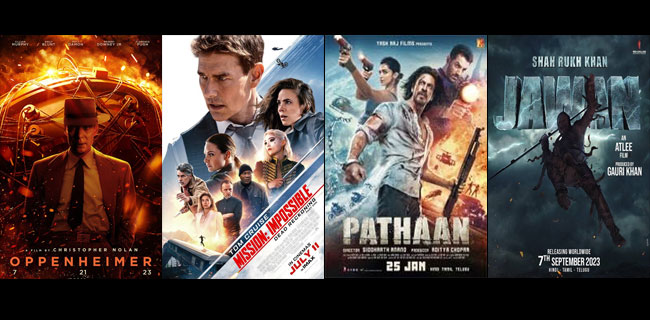
    Shailesh KapoorEven as I write this Friday morning, Christopher Nolan’s Oppenheimer, which released today, is running to packed houses in late night and early morning shows in India. Thus far, Hollywood box-office in India has with the action/ superhero genre. But here, we have a biographical period drama, which is likely to challenge the opening of last week’s Mission: Impossible film, singularly on the strength of its director’s equity among the urban youth in the big cities. The film, incidentally, releases along with Barbie, a ‘franchise’ film like no other. Unlike the West, Barbie will trail Oppenheimer at the India box-office, but is still expected to gross respectable numbers.


    And yet, there continues to be incessant talk about how the theatrical medium is in danger. This narrative, that started during the pandemic, when streaming took over as the only medium of premium video entertainment worldwide, continues to find traction in sections of the industry and the media, but is fast becoming facetious, with no facts supporting it.


    In May this year, I co-authored this report on the Ormax Media website, which explains how ‘big-ness’, whether it comes from the genre, or the franchise, or the director (as is the case with Oppenheimer), is the dominant expectation from the theatrical experience in India, which is why smaller films will struggle, even as the bigger ones continue to get bigger.


    The first half of 2023 grossed 15% less at the India box-office compared to the same period in 2022. But this is certain to be compensated to a large extent, if not entirely, by the second half, which has a stronger line-up of big-ticket releases. 2022 itself was the second-best year at the Indian box-office, being just a notch behind 2019. Yet, some people would like us to believe that cinema is in danger.


    I suspect this narrative is driven by Hindi cinema, or Bollywood as it’s called (and now pejoratively so), not being able to live up to the changing audience expectations from the medium. While Pathaan is by far the biggest Indian film of the year so far, and Jawan, another Shah Rukh Khan film, looks equally promising from a box-office perspective, the in-betweens are where the problem lies. Only five Hindi films have managed to cross the 100 Crore (nett box-office) mark this year in six-and-a-half months. 16 films managed that across the 12 months in 2019.


    That’s the real source of the faulty perception that cinema is struggling. The frequency of high-grossing films created a positive perception about Hindi cinema in the last decade. Post-pandemic, it’s been more about the tentpoles. The lull periods punctuating the tentpoles can make the theatres look woefully short of content.


    But as long as the tickets are being sold, there should be little cause of concern. One would even argue that a tentpole-driven category is less risk-prone, because even in the worst-case scenario, at least 50% of the tentpoles will emerge as blockbusters, something that cannot be said about mid-range cinema, where even 20% is a healthy hit rate.


    Tentpoles also go well with marketing-friendly concepts such as ‘event films’ and ‘theatrical experience’. They allow advertisers to plan a more concerted campaign, than spread themselves too thin across a long-list of films that are uncertain to deliver.


    As we approach the peak festive season in India, be prepared for a lot of buzz around the movies. But I’m not betting on the ‘cinema is dead’ debate dying down anytime soon. But it will begin to make even lesser sense with time.


  • Polls Apart: Election Results & a Partisan News Media

    Picture taken from https://telugu.oneindia.com/


    By Shailesh Kapoor


    Shailesh KapoorIt’s the day of election results tomorrow. The prestigious and hyped-up Karnataka elections were held earlier this week, and Saturday is the appointed day for counting the votes. Election result days have always been fascinating, even when the results are a foregone conclusion, simply because there’s a format to the coverage that’s inherently real-time and suspenseful.


    Of late, there’s an additional reason why I find news coverage of election results, especially in the electronic media, fascinating. And that is because, unlike all other news coverage, election results do not give the channels and the anchors much room to peddle their political agendas. Numbers don’t lie after all, and if the political party they bat for through the year is losing, anchors on news channels cannot spin a yarn of rhetoric like any other primetime show.


    It’s like a ‘Gotcha’ moment for those who can see through the evident politics of our news channels. It’s that rare day when they must keep a straight face, and be careful of those Freudian slips, like “Why did we lose?”


    Exit polls suggest that Congress holds the edge in Karnataka. If that turns out to be the case tomorrow, you can be assured that most of our news channels will delink these results with the 2024 General Elections. Using the Prime Minister’s mugshot as the party face being BJP is winning, but going with the local leader as the fall guy when BJP is losing, is now a well-known tactic.


    The parallel narrative will be ready too, if the results come in closer than what the exit polls suggest, whereby the Congress doesn’t get a clear majority. In this narrative, the Prime Minister will take centerstage, and 2024 will be discussed more than Karnataka itself.


    Election results are one area where social media feeds or internet articles cannot match the excitement that television can offer. But the predictable politics of our news channels have made election results coverage predictable too. How the TV industry has managed to make the few interesting TV formats they should have held on to less compelling with time is a mystery. Election results are high on that list, as are some reality shows, whose formats have been mutilated beyond recognition over the last few years.


    Meanwhile, an exciting and ever-so-close season of IPL is entering its business end. With just one week of league games to go, at least eight teams are in contention for a playoffs spot.


    It’s a weekend of two big contests, and for once, the sporting one looks like the one that will make for better TV.


    Shailesh Kapoor is Founder and CEO, Ormax Media. He writes on MxMIndia every Friday. His views here are personal. To access the archive of his columns, please visit: https://www.mxmindia.com/category/columns/tv-trail-media/

  • Ormax Media launches Ormax Cine Sense

    By Our Staff


    Media analytics firm Ormax Media has released its latest research report titled Ormax Cine Sense: 2023. Ormax Cine Sense is based on primary consumer research conducted among 9,500 audiences across Hindi, Tamil, Telugu, Kannada and Malayalam theatrical markets in India, to understand their viewing behaviour, content preferences and media habits in the post-pandemic era.


    Ormax Cine Sense is a follow-up to Sizing The Cinema: 2023 report, which Ormax Media released in February 2023, that pegged India’s total theatrical audience base at an estimated 12.2 Crore (122 Million). In Ormax Cine Sense, regular theatre goers in each language were interviewed, to understand their behaviour and perceptions on a wide range of topics related to their movie-going choices, ranging from their genre preferences, motivators and barriers to watch (or not watch) films, OTT consumption, marketing sources for new films, etc.


    Speaking about Ormax Cine Sense, Gautam Jain, Partner – Ormax Media, said: “Audience’s movie-going behaviour has changed significantly in the last two years, since theatres re-opened after being shut down for more than a year due to the pandemic. Our business partners expressed the need to understand audience behaviour in the post-pandemic scenario, and Ormax Cine Sense provides rich and layered audience data in five languages to this effect.”


  • Ormax Media releases study to size OTT audience

    By Our Staff


    Media consulting firm Ormax Media has released an audience research to size the OTT universe in India, titled The Ormax OTT Audience Sizing Report 2022. The research, based on a sample size of 13,500 across urban and rural India, was conducted from July to September 2022.


    Ormax Media released select findings of the report, which reveal that the Indian OTT audience universe is currently at 423.8 Million (or 42.38 Crore) people. This translated into a penetration of 30%, which means that 3 out of 10 Indians watched online videos at least once in the last one month. The report breaks this universe by gender, age, NCCS, pop strata, states and cities.


    Speaking about the need for the report, Shailesh Kapoor, Founder & CEO – Ormax Media, said: “India’s OTT audience universe has grown rapidly since 2018, with a boost during the pandemic years of 2020 and 2021. Now that we are in a more settled, post-pandemic period, this annual report is an important reckoner for the OTT industry to understand how their audience base is growing, and where this growth is coming from. Unlike other reports that rely on desk research, this report is based on primary audience research across India.”


    The report also reveals that there are currently 119 Million active paid OTT subscriptions in India, across 49 Million paying (SVOD) audiences, i.e., an average of 2.4 subscriptions per paying audience member. 65% of these paid subscriptions are with male audience. The top 6 metros contribute only 10% to India’s OTT universe but 33% to total paid subscriptions in India. Mumbai, Delhi and Bengaluru, Delhi and Mumbai are the top 3, with more than 8.5 Million active paid subscriptions each.


    Speaking about the findings, Kapoor said: “A large share of the 20% growth in audience base has come from rural India and small towns. The metro cities have reached saturation levels, with more than 79% OTT penetration. Platforms will have to rely on the smaller markets for the next phase of growth. From an SVOD perspective, the most significant finding has been that the average number of subscriptions have remained static at 2.4 per paying user. This data point holds immense strategic value, as it suggests that subscriptions growth will come from more people paying for subscriptions, than the same people paying for more subscriptions”.


  • Politics on the Sleeve


    By Shailesh Kapoor


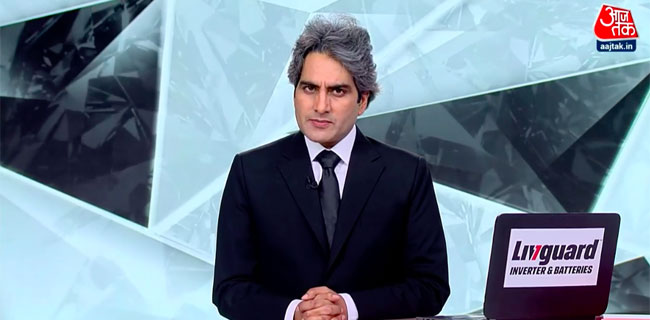
    Shailesh KapoorThe Hindi news television genre is buzzing this week. One of the biggest anchors in the category, Sudhir Chaudhary, has changed channels. His new weekdays 9pm show, Black & White, premiered on Aaj Tak this week. Chaudhary has spent over a decade at Zee News, which included a controversial extortion case back in 2012, for which he and a colleague had to face legal action, including judicial custody.


    I’m no fan of Chaudhary and his rabble-rousing style of anchoring, where Muslims are often the target. But over the last few years, Chaudhary has used this trademark style to become one of the most popular Hindi anchors in India, with a loyal fan following that’s only matched by a couple of other news anchors on television.


    In today’s polarised media environment, marquee anchors tend to define the political stance of the channels they are on. The role of the anchor, has, thus widened from only getting audiences to a particular time slot when they are anchoring. Anchors are now driving the brand narrative of news channels across languages. And this brand narrative is decisively political.


    That’s one of the reasons news that’s not political in nature hardly finds any presence on the primetime roster. And when it does, the story angle taken is primarily political. Most anchors feel under-leveraged if they do not use their political capital in their shows. They make it a point to wear their political disposition on their sleeves.


    But they also understand that the audience can’t be fed political news all the time. As a result, we have seen the emergence of news topics that are ‘pseudo-relevant’, i.e., the audience is made to believe the news being dished out is of high importance in their lives, while actually, it may have almost no relevance at all.


    One such sub-genre is ‘communal news’, where stories that are essentially ‘Hindus vs. Muslims’ in their construct are chosen, with an anchor position that’s invariably pre-decided. This trend started in 2014, and has since been on the rise. The Tablighi Jamaat coverage during the first Covid lockdown in 2020, and the Gyanvapi mosque controversy more recently, are evident examples.


    But you do not need a story to ignite communal sentiments among the audience. You could just do a random story, passing it off as research. Sudhir Chaudhary’s ‘Jihaad ka diagram’ story in 2020 is a notorious example.


    Not everyone watches television news anymore. But there is a strong correlation we observe in our work, between political awareness and consumption of TV news. To say it differently, those watching TV news are more likely to have defined political views, including whom they want to vote for in the next elections. In turn, they can shape the opinion of others (family and friends) around them who are often sitting on the fence till a week or two before an important election.


    Thus, to say that not watching TV news is a solution to fixing things that plague the genre is just being naïve. Sadly though, no strong alternative narrative has emerged, and not much may change anytime soon.


    But in hope, we live.


    Shailesh Kapoor is Founder and CEO of Ormax Media. He writes on MxMIndia every Friday. His views here are personal.


  • Smalltown India is the future for SVOD


    By Indrani Sen


    Indrani SenOrmax Media, a specialised Insights consultancy firm, was established in 2008. In its own words: “Over the last 13 years we have pioneered the usage of various testing, tracking and forecasting-based tools, designed to achieve higher profitability in films, television, streaming, print, radio and other categories in the Indian media industry… We are constantly innovating to introduce new tools and build knowledge that can help the Indian media & entertainment industry use consumer insights and data analytics to create businesses, brands, shows, films and campaigns that are both consumer-centric and profitable.”
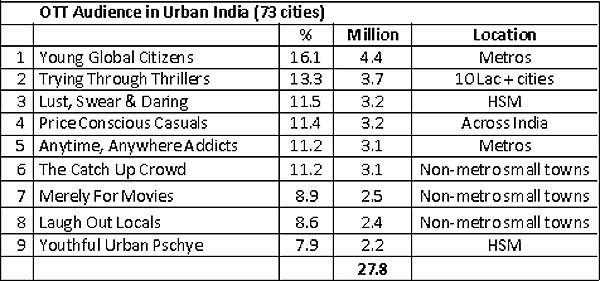
     

    Ormax Media launched the first edition of its Ormax OTT Audience Report 2019 with a promise to conduct similar reports year on year. In its first report, Ormax analysed the viewing behavior by preference of content watched and divided the urban OTT audience into interesting segments of nine different types.


    Source: OTT_AudienceSegments_OrmaxMedia__1_.pdf


    The onslaught of Covid-19 and the national lockdown forced them to miss the opportunity of conducting field research in 2020. But Ormax was back in 2021 with the 2021 report based on a 12,000 sample size across urban and rural India. As per that report, OTT audience universe in India in 2021 stood at 353.2 million (35.32 Crore) people. In other words, the penetration of OTT viewing was of 25.3% of the population, “which means that one in four Indians watched online videos at least once in the last one month”. The report was aligned to other syndicated media research and presented analysis of the universe by gender, age, NCCS, pop strata, states and cities.  This second report elevated OTT from a niche medium to a mass medium with huge prospect for further growth. It was possible to calculate reach of the OTT medium in different target audiences for the first time. The report also revealed that in 2021 there were 353 million OTT users in India of which 40.7 million were paying (SVOD) audiences accounting for 96 million active OTT subscriptions. In other words, each unduplicated paying audience member was subscribing to 2.4 OTT subscriptions on an average. This SOVD audience were dominated by male members who constituted 66% of 40.7 million.


    Last month, Ormax Media released The Ormax OTT Audience Report 2022, which has some interesting insights related to viewing habits of OTT audiences including content watched in different languages. The latest report is based on a sample size of 6,000 SVOD and AVOD audiences in urban India, and is probably India’s largest profiling study of the streaming /OTT audience.


    The report has revealed that Indian SVOD viewers use the dubbing and subtitling options on their OTT platforms and watch content in four to five languages on an average, while AVOD viewers watch in at least two languages, primarily due to less content options available to them. AVOD viewers watch a lot of content on YouTube where no dubbed content available.


    Content in the four South Indian languages have a large audience outside their home states, 88 per cent Malayalam SOVD content viewers and 82 per cent Tamil SOVD content viewers are respectively from outside Kerala and Tamil Nadu.


    This research also has highlighted the difference in preferences for content between SOVD and AOVD audiences.  The latter do not prefer to use web series instead they want more of shorter formats, like comedy scenes, songs, knowledge videos, including recipes, education and health, and films.


    The research has predicted that the next level of growth of SOVD viewers would come from small towns as 60-70 per cent of the top six metros’ population has already converted to SVOD audience, making the metros a near-saturated market. The male domination of the SOVD audience segment continues which may be due to other socio-cultural reasons and not just financial independence of women.


    On the whole, The Ormax OTT Audience Report 2022 has opened up a new vista of opportunities for content strategy and content creation for the Indian OTT platforms. It is interesting to note that Ormax media so far has not repeated any research on OTT audience in India, but has looked at a new concept for research every year to provide the users in the industry with either better estimates or in-depth insights.


  • Ormax Media & Film Companion announce 2nd edition of ‘O Womaniya!’

    By Our Staff


    Media consulting firm Ormax Media and entertainment platform Film Companion announced the launch of the second edition of their initiative on female representation in the Indian entertainment industry, titled O Womaniya! Releasing in June this year, other than the films released in the previous year,  the 2022 edition will also cover the streaming category extensively, analysing major digital-series and direct-to-OTT films, along with theatrical films, released in 2021, across Hindi, Tamil, Telugu, Kannada and Malayalam entertainment industries. Additionally, the current edition will also analyse female representation in the boardrooms of the top media and entertainment companies in India, and how the industry can work towards creating a nurturing environment that helps women grow into leadership roles.


    Speaking about the second edition of the report, Anupama Chopra, Founder & Editor, Film Companion, said: “I believe that cinema can shape the world. Which is why inclusivity and diversity is paramount.   O Womaniya! is our attempt to push the needle to move faster. We hope that data will trigger conversation, which will trigger change. We are happy to collaborate with industry bodies like the Producers Guild of India and Active Telugu Film Producers Guild, and streaming services like Amazon Prime Video, an important part of India’s rapidly evolving creative ecosystem, to take this conversation forward meaningfully. With multiple industry players joining hands with us for the second edition of O Womaniya! we believe we are moving the needle, slowly but significantly on this important subject.”


    Said Shailesh Kapoor, Founder & CEO, Ormax Media: “With every edition, we want to expand the ambition of this report, such as covering digital series this time. But the section of the 2022 report that I’m keenly looking forward to is on the representation of women in the senior management of Indian entertainment companies. These are the decision-makers who have the ability to shape the industry’s future, and hence, the analysis must start from the top.”


    To enable a deeper socio-cultural analysis of the findings, the O Womaniya! initiative has associated with leading gender expert, Sunitha Rangaswami, Independent Consultant – Gender and Women’s Economic Empowerment.