Media consulting firm Ormax Media has announced the launch of the third round of its report titled ‘Fact Or Fake?’. The report measures the credibility of various news media, as well as the perception around ‘fake news’, through a survey of 2,000 news consumers across 15 states in India. The first edition of the report was released in September 2020, followed by the second edition in April 2021.
According to the third edition, 64% Indian news consumers see fake news as a major concern. The News Credibility Index is unchanged since last track (65%), highlighting that fake news continues to be a huge concern amongst Indian news consumers.
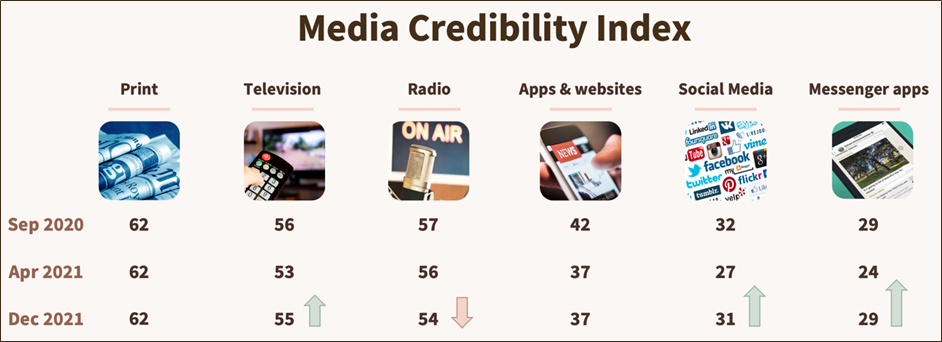
Print media continues to lead, with a Credibility Index of 62%, followed by Television (55%) and Radio (54%). Traditional media have higher news credibility than digital media, though most digital media have seen a marginal improvement in their credibility in this track.
Twitter continues to remain the most credible digital medium for news, albeit with a drop in its Credibility Index over time: 57% (Sep 2020) to 47% (Apr 2021) to 42% (Dec 2021).
Commenting on the findings of the report, Shailesh Kapoor, Founder & CEO – Ormax Media said: “Fake news, and lack of news credibility in general, continues to be a growing concern globally. Almost 2 out of 3 Indians see fake news as a problem, and that should be a major cause of worry for all news companies. We launched this report in 2020 to enable more informed conversations on this topic. In the subsequent editions, we plan to study these indices by languages, to understand if there’s a difference in news credibility between Hindi, English and other major Indian languages”.
Ormax Media has announced the launch of a new audience analytics tool Ormax Televate. The tool is designed to help TV channels identify a focused and consumer-centric strategy for viewership growth, based on data on parameters built through Ormax Media’s 13 years of work in the television industry.
Ormax Televate currently covers the Urban Indian market, and addresses 157 channels in the industry, in 36 genres across languages. The tool is available for GEC, movies, news, kids, music and infotainment genres across all major Indian language
Shailesh Kapoor
Speaking about the tool, Shailesh Kapoor, Founder & CEO – Ormax Media, said: “TV channels make various efforts in the areas of content, marketing, branding, distribution, acquisition, etc. to increase their viewership. However, these initiatives are often like hit-and-trial, and a lot of time and resources are spent on activities that may have incremental value at best. In Ormax Televate, using consumer data, advanced analytics and our deep expertise in the television domain, we will help channels identify the most critical aspects of their business they must fix from a viewership perspective. These are the only things that the leadership team should spend their time on”.
Added Keerat Grewal, Partner – Ormax Media: “TV channels conduct a lot of ongoing consumer research to build their consumer understanding, over and above the ratings data available to them. However, this often leads to data overload, where there’s too much information available, but very little clarity on how to process and action it. Ormax Televate is an audience analytics engine that cuts through this information clutter, and identifies three priority areas a TV channel must focus on to achieve sizeable viewership growth, and lays out a detailed strategic roadmap for each of them.”
Media consulting firm Ormax Media has launched its celebrity endorsement selection tool Ormax Celeble. The tool will help brand owners select a brand endorser whose profile and personality matches the desired brand personality the best.
With a database on personality traits of more than 500 celebrities, Ormax Celeble uses analytics to help brands identify the celebrities that fit their brand’s desired profile the best, enabling them to make smart brand endorser choices.
Speaking about Ormax Celeble, Shailesh Kapoor, Founder & CEO – Ormax Media said: “There is enough research available Internationally to prove that a good brand endorser can help a brand grow significantly because of the association between the brand and the celebrity, while a poor choice of brand endorser will not just be a waste of money, but also potentially dangerous for brand development. In India, brand endorser decisions are largely driven by gut and even personal taste of brand owners, with very little relevant data backing such choices. Ormax Celeble is a data-centric analytics tool that can help look at their endorsement options that their gut will often miss. We have a huge database of more than 500 national and regional celebrities across domains for brands to tap into”.
Ormax Celeble is Ormax Media’s second tool for brand marketers. Ormax Mpact, launched in 2013, helps brand managers and media agencies evaluate the effectiveness and ROI of a high-impact campaign, marketing innovation or sponsorship.
Media consulting firm Ormax Media has unveiled the results of the second edition of its report titled ‘Fact or Fake?’, which is based on a survey of news consumers, and measures their credibility of various news media, as well as their overall perception towards ‘fake news’.
This is the second edition of the report, based on data collected in April 2021. The first edition was released on September 2020. The survey covers urban news consumers (15+ yrs.) from 17 states and Union Territories in India.
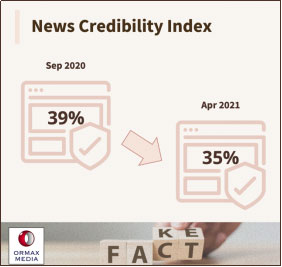
According to the report, only 35% news consumers feel that the news category in India doesn’t have any major fake news concerns. This number has dropped 4 percentage points, from an already-low level of 39% last year (Sep 2020). This implies that 65% news consumers, i.e., almost 2 out of 3, see fake news as a major concern.
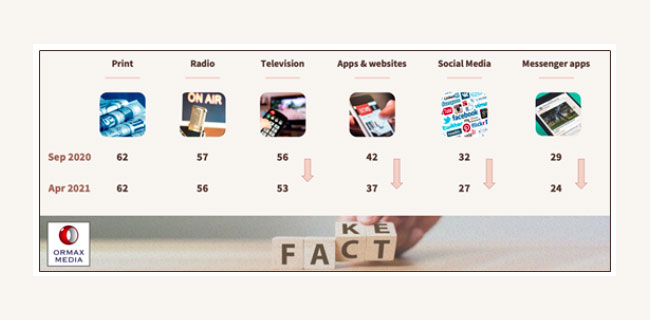
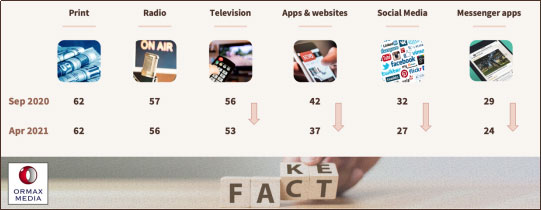
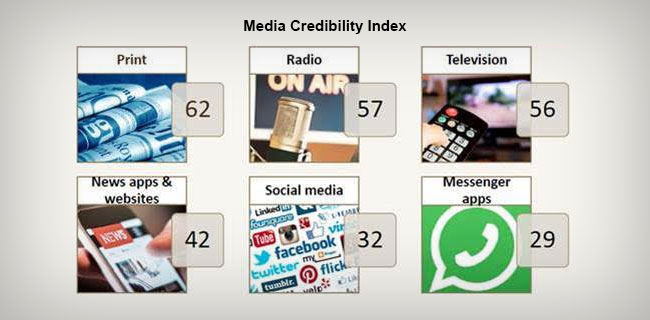
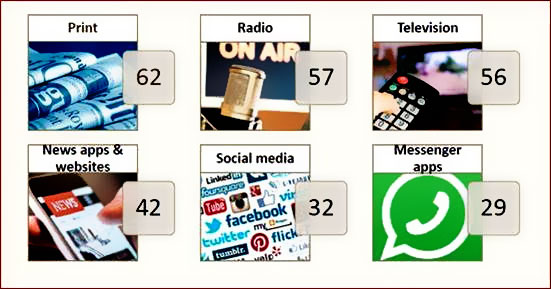
Print media continues to lead on credibility, with a score of 62%, the same as the last track. Radio holds on to its no. 2 position (56% now, vs. 57% in 2020). However, all other media have shown minor or major drops, i.e., Television (56% to 53%), Digital news apps & websites (42% to 37%), Social media (32% to 27%) and Messenger apps (29% to 24%).
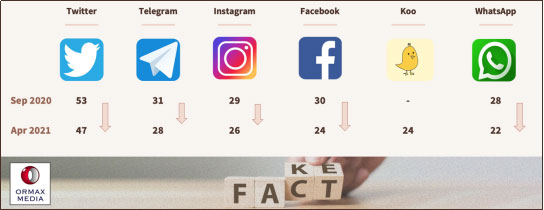
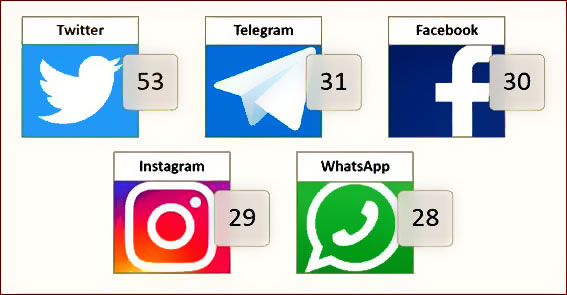
Within social media, despite a drop since the last track, Twitter continues to rank on top with a News Credibility Index of 47%. No other social media or messenger app platform manages to touch even the 30% mark. Newly-launched Koo scores only 24% on credibility.
Commenting on the report and its findings, Shailesh Kapoor, Founder & CEO – Ormax Media said: “Concerns around fake news have been escalating worldwide over the last few years. But a drop from an already-low score of 39% to 35% within just seven months, does not augur well for the Indian news industry. In the midst of a pandemic, credibility of news becomes even more important. We hope to see television news and digital platforms address this concern more proactively, before it becomes a brand safety issue for advertisers using these media, and a cause for rejection for subscribers of paid news services”.
News Credibility Index and Media Credibility Index are a % of news consumers who don’t see fake news as a major concern and news consumers who find the news in a particular medium generally credible, respectively. All credibility scores are among consumers of that particular medium or platform.
News Credibility Index (Apr 2021 vs. Sep 2020)
Media Credibility Index
Media Credibility Index: Social Media & Messenger Apps
Ormax Media has released its latest report titled Ormax Brand Trust Survey 2021 which ranks media brands based on the trust they enjoy among Indian kids. The survey was conducted during December 2020 and January 2021, among kids in the 6-14 yrs. age group across 10 cities in India, who scored 44 media brands, across television, digital, social media, gaming, streaming and film exhibition, on the trust factor that brand holds for them.
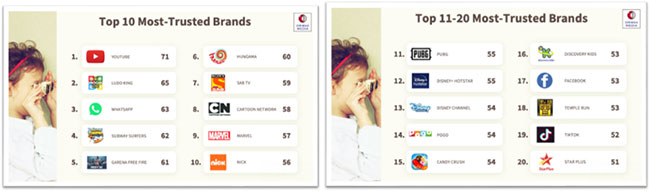
YouTube has emerged as the No. 1 most-trusted brand among Indian kids, with a Brand Trust Score of 71%, followed by Ludo King (65%) and WhatsApp (63%). The top 5 ranks are all taken by digital brands, signifying the strong engagement digital media has built with kids in urban India.
The top rank among TV channels belongs to the channel Hungama, which is followed by Hindi GEC Sab TV. Cartoon Network and Nick are the other two television brands in the Top 10 list.
Shailesh Kapoor
Said Shailesh Kapoor, Founder & CEO – Ormax Media: “This report is a decisive verdict on the growing resonance of digital media among urban Indian kids. A clean sweep of the top 5 positions by digital brands, ahead of legacy brands in the television space, would have been unthinkable even 2-3 years ago. Digital brands completely dominate the media landscape of older kids (10-14 yrs.) and boys, taking 8 and 7 of the top 10 positions respectively in these segments”.
The top 20 most-trusted media brands among Indian kids are:
Media insights and consulting firm Ormax Media has announced its focus on regional language markets in India. As a first step in this direction, it has announced the launch of its syndicated monthly GEC character popularity tracking tool Ormax Characters India Loves (OCIL) in four regional markets – Tamil, Telugu, Bangla and Marathi. OCIL has been tracking character popularity in the Hindi GEC category since 2010 and is used widely by all channels in the category.
Commenting on Ormax Media’s regional focus, Shailesh Kapoor, Founder & CEO – Ormax Media said: “In recent years, India’s regional story has been a compelling one. Be it television, theatrical or now streaming, regional content has been attracting the audience’s and the advertiser’s attention alike. 2021 will see Ormax Media launch several offerings targeted at key regional markets. The launch of OCIL in four languages is only a first step in this direction.”
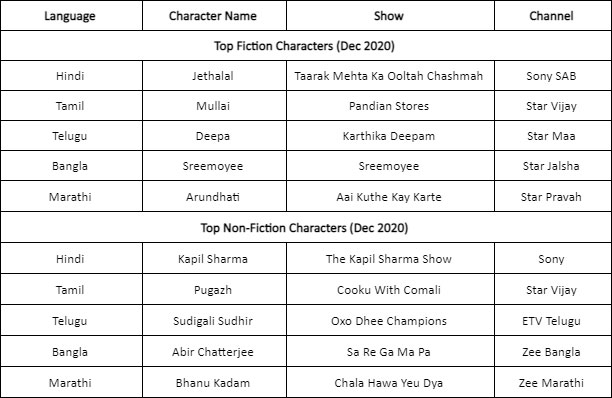
The top fiction & non-fiction characters in December 2020 across the five languages are:
Added Keerat Grewal, Partner – Ormax Media: “Characters are the cornerstone of storytelling. Character affinity ensures program loyalty, in turn helping shows to have long runs on television. Since 2010, Ormax Characters India Loves has helped leading Hindi GECs build a deep understanding of what makes Hindi GEC characters work. With the expansion into four regional languages, we hope that many other channels will now be able to benefit from similar understanding”.
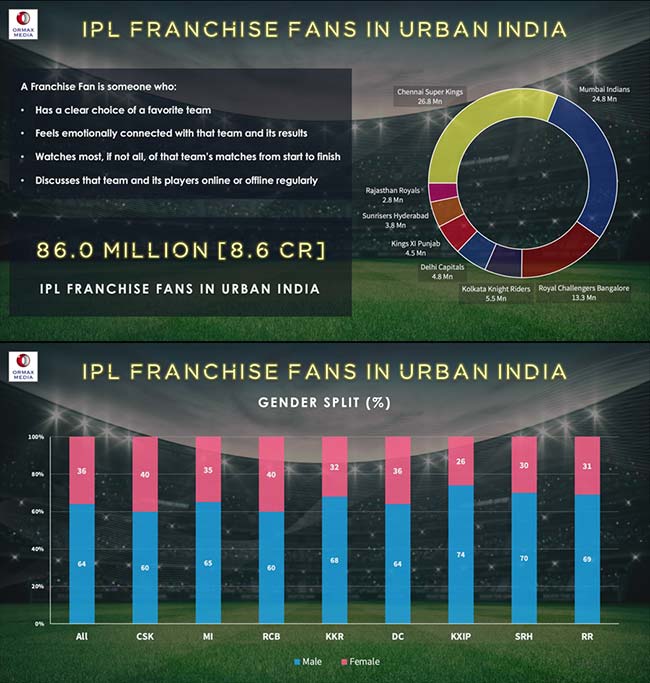
Media consulting firm Ormax Media has released the findings of its study on ‘IPL Franchise Fans’, based on a research conducted among 3,200 urban respondents across 23 states in India. The data was collected through the course of the eight weeks of IPL 2020. The study pegs the number of fans across the eight IPL franchises at 86 million (8.6 cr).
Chennai Super Kings (CSK) emerges as the strongest franchise, with 26.8 million fans, closely followed by season winners Mumbai Indians (MI) at 24.8 million fans. Royal Challengers Bangalore (RCB) ranks third, with 13.3 million fans. Between them, these three franchises account for 75% of the total fan base, while the remaining five contribute to the balance 25%.
As many as 64% (55 million) of the total franchise fans are men, while the balance 36% (31 million) are women. CSK and RCB have the most gender-balanced fan base, with the proportion of female fans being the highest at 40% each. Nationwide popularity of their star players (MS Dhoni and Virat Kohli respectively) contributes to their stronger female fan base. Mumbai Indians leads Chennai Super Kings by a slender margin when it comes to the male fan base, but the latter takes the overall #1 position because of its stronger female following.
Shailesh Kapoor
Commenting on the findings, Shailesh Kapoor, Founder & CEO – Ormax Media said: “Apart from viewership, a definitive measure of the success of a sports league is whether the teams playing in it manage to build a sizeable fan base over the years. A strong fan base is eventually the key for a profitable franchise, because it offers higher monetisation opportunities through sponsorships, ticket sales, merchandizing, licensing and other such avenues. Over the last 13 years, IPL has done very well, and the fan base estimates of the Top 2 franchises suggest that they are now two of the strongest sports teams across the world. It’s for the other franchises to learn from the success story of CSK and MI and develop a strategy to widen their fan base in the coming years”.
Leading media consulting firm Ormax Media has announced the launch of a its report titled ‘Fact or Fake?’, which is based on a survey of news consumers and measures their credibility of various news media as well as their overall perception of ‘fake news’. The survey was conducted among 2,400 urban news consumers (15+ yrs.) from across 17 States and Union Territories in India.
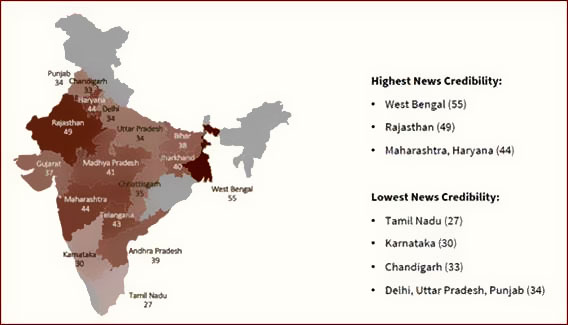
As per the findings of the report, News Credibility Index in Urban India is only 39%, i.e., 61% news consumer see fake news as a major concern.
Print media leads the Media Credibility Index at 62%, followed by Radio and then Television. Traditional media have higher credibility than digital media. Among social media, Twitter at 53% is by far the most credible social media platform for news.
Shailesh Kapoor
Commenting on the report and its findings, Shailesh Kapoor, Founder & CEO – Ormax Media said: “Concerns related to fake news have been a topic of discussion globally as well as in India, and the problem of fake news seems to be getting larger with every passing month. This survey was conducted to quantify the extent of this concern in India, and to understand if some media fare better than others. We plan to track these measures every six months, which will allow us to compare how perception of news consumers regarding fake news is changing with time”.
According to the Ormax Media communique, News Credibility Index and Media Credibility Index are a percentage of news consumers who don’t see fake news as a major concern and news consumers who find the news in a particular medium generally credible, respectively.
News Credibility Index by State/UT
Media Credibility Index
Media Credibility Index: Social Media & Messenger Apps
While this weekly column has extensively covered the Hindi GEC category over the last eight years, pieces dedicated to a single show have been rare. If at all, they have been about a non-fiction show like KBC, or about a long-running fiction show like Balika Vadhu or Taarak Mehta Ka Ooltah Chashmah. Nothing launched since the start of this column in 2012 has been worthy enough for 500 words of its own. And those who follow this column regularly will know that the general sense of mediocrity that plagues Hindi GEC fiction content has been my pet peeve over the last 5-6 years.
But here it is, a piece on a newly-launched fiction show that breaks through the mediocrity the category has learnt to unapologetically espouse over time. It’s the 10pm daily on Star Plus, and it goes by the name Anupamaa. An adaptation of a hit Star Jalsha show, Anupamaa was originally slated to launch in early 2020, but had to be deferred because of the lockdown. It was one of the first new shows to launch as things began to open up and shoots resumed July onwards. Less than three months into its tenure, Anupamaa is the top-rated show on Star Plus, more than 40% ahead of the next original show on the channel.
Now that has happened before with some other shows too. But something a lot rarer happened this week. In the August report of Ormax Characters India Loves, a monthly character-popularity track for the Hindi GEC category, the protagonist Anupamaa has taken the second rank on the fiction list. Character popularity is the Holy Grail of GEC content. It takes months, sometimes years, for characters to build an emotional affinity with the audience. Entering the Top 5 within six months of launch is a huge achievement, and entering Top 2 within two months an unprecedented one.
When I watched the show in its first week, my first reaction was: Wow, this looks so different from the rest of the genre. It was, in many ways, a reaction very similar to what I felt watching Balika Vadhu for the first time in 2008. Then, and even now, the Hindi GEC category has been guilty of a certain visual and thematic sameness that is omnipresent across shows, across channels. Some shows look ‘richer’ than others. But by and large, the protagonists are all in their early 20s, the costumes are fairly stock, the music largely similar too, the conflicts way too familiar, and the acting and the dialogue consistently mediocre.
In that first viewing itself, Anupamaa seemed to belong to another space. Top performances grabbed my attention first. In particular, Rupali Ganguly as the female lead here is arguably one of the Top 3 stand-out Hindi GEC fiction performances in the last 20 years. The other distinctive feature, of course, was the age of the protagonist. In her mid-40s, Anupamaa is a mother of three grown-up children. That’s a life-stage a Hindi GEC female protagonist usually reaches five years into a show’s lifetime, after at least two leaps. Instantly, this separates the show from the rest of the lot, which are essentially romantic dramas played out in a family context. The writing seemed two notches higher than the category’s accepted level too, especially the dialogue.
But as I started watching the show regularly, it seemed evident that this is that rare show that has a saga-like feel to it. After Balika Vadhu and Yeh Rishta Kya Kehlata Hai, no other show has a premise or a protagonist so fascinating that you know that you can do a long-running show around her, without losing the point and dragging the show meaninglessly. Already in the two months, the show has covered several social themes like patriarchy, parenting and class difference. It’s like the old days of reading a novel. The story can keep evolving, chapter by chapter, and enter different spaces. But the audience loves the protagonist(s) so much that they are always invested.
Will Anupamaa manage that? Will it be one of the top shows in 2025 too? It’s, of course, too early to say that. But if there’s one show in the last decade that seems to have a strong foundation that longevity needs, this is it. The show’s name translates to “incomparable” in English. And unless the makers mess this one up, it holds the potential to live up to that translation over time.
It could be a matter of introspection why such success came from a show from a regional market. Much like one can wonder why Bollywood can’t make its own Bahubali. But that’s another topic for another day.
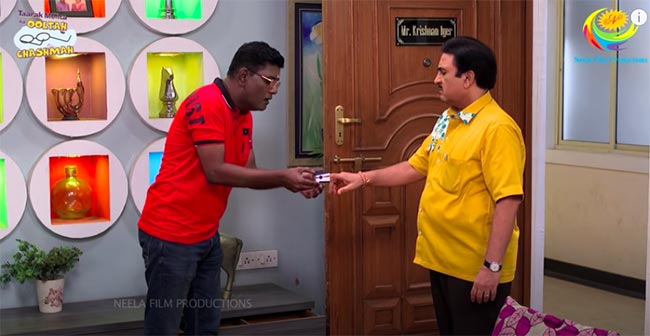
Oximeter Check: Screengrab from a recent episode of Taarak Mehta…
By Shailesh Kapoor
It’s been a month since original episodes of Hindi GEC shows started airing again. The genre that survived primarily on mythology during the lockdown is now moving back to its old staple fare.
The results of the first four weeks have not been very encouraging. Given that there are Covid-related restrictions still in place in large parts of India, and the overall TV viewing time is higher than pre-Covid, the Hindi GEC category (pay channels) has lost about 10% of its pre-Covid viewership levels despite the return of original episodes. Drop in the ratings of the top shows is particularly striking. Except Taarak Mehta Ka Ooltah Chashmah (TMKOC), which opened at pre-Covid levels upon its return, most other top shows have struggled, with some being less than 60% of their pre-Covid numbers. Long-running shows like Kundali Bhagya, Kumkum Bhagya and Yeh Rishta Kya Kehlata Hai have not got a section of their audience back, who were probably continuing only because of habit. Star Plus’ recent launch Anupamaa has emerged as the joint category leader in Urban HSM, along with TMKOC.
The signs were ominous. During the lockdown, Ormax Media’s data suggested that only 42% of regular Hindi GEC audience are missing their favourite shows “a lot”. The category will soon face severe headwinds with IPL in the next quarter, and will have to look upto reality shows like KBC and Bigg Boss to uplift it from the precarious position it finds itself in.
Having said that, the early success of Anupamaa is a positive development. It shows that the category discontent is not so high that a well-crafted new show that’s relevant and authentic will not find an audience. But we need more Anupamaas, and some of the upcoming launches look promising too. But the category urgently needs to shed its flab. Channels’ obsession with long-running family dramas that have long outlived their purpose is still a major villain in the 2020 Hindi GEC story.
The other element of curiosity was to see how fiction shows integrate (or ignore) Covid in their plots. It’s been a mixed bag so far. While some shows have stayed completely clear of it, others have used token references, and a few have integrated Covid into the running plot, though not always in a way that’s sensible. To give an example (and there are a few), earlier this week, a plot point in Star Plus’ Yeh Hai Chaahatein involved the female antagonists plotting to get the protagonist out of the housing society by proving that she’s high-risk for a Covid infection. The society’s management committee comes to the protagonist’s house to insist she’s taken to a hospital or a quarantine centre. In this highly charged Covid discussion with half a dozen people, not one is wearing a face mask, making a potentially topical scene come across as fake, if not bizarre. It is this half-hearted attempt at depicting reality that creates emotional disconnect with many Hindi GEC shows.
In sharp contrast, TMKOC has integrated Covid masterfully. For a show rooted in topicality and social reality, not recognising the Covid reality would have been a definite compromise. But it’s easier said than done. If they would have based the entire show in a Covid world, there would be limitations, related to society gatherings, functions, festivals, shop scenes, etc.
What the makers have achieved is a fine balance, through a tried and tested device: Protagonist Jethalal’s dreams. In the three weeks on air so far, he has had two dreams (cumulative play-out of about five episodes) which tell a free-from-Covid story, while the rest of the episodes consciously recognise Covid and create genuine entertainment around it. This is how it should be done!
With all its problems and a few silver linings, the Hindi GEC category is at a crucial phase. Something tells me the next six months may shape its future decisively.
Image taken from advertising mailer sent out by Republic TV
By Shailesh Kapoor
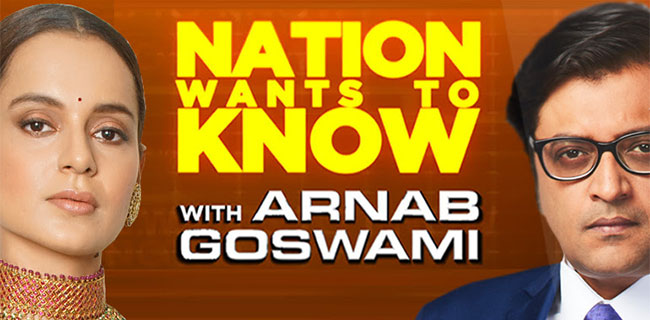
I have started watching Republic TV over the last week or two, after a gap of a few years. The bizarre on-air investigation being carried out by the channel and its owner-editor, who is also its only primetime anchor, Arnab Goswami, under the title ‘Sushant Singh Rajput death probe’ has befuddled me. There have been many cases of irresponsible media coverage of celebrity news over the year, but here, the issue is larger, and the moral standing murkier.
The “investigation” started fine about three weeks ago. Kangana Ranaut chose to give an interview to Goswami, and he’s a fine interviewer on most days. She was shooting from the hip and he played along. But since then, the channel’s coverage of the topic has progressively degenerated. It’s as if the Ranaut interview gave Goswami the idea that there’s a big story in this, and you can run the entire channel on it for at least 4-6 weeks.
The week after the interview featured persistent attacks by Goswami on senior producers and directors of the Hindi film industry. Using the edgy material Ranaut had armed him with, Goswami went about questioning the people she mentioned, with little headway, during that week. There was also an interview with Shatrughan Sinha, where the seasoned actor-cum-politician didn’t say much despite Goswami’s persistence, rightly pointing out that he doesn’t have the details.
It’s over the last two weeks that Goswami’s investigation has become increasingly brazen. He’s sidelined his earlier nepotism narrative and has now taken up a “murder, not suicide” theory that he’s relentlessly pushing, two hours every night for two weeks and counting. Last night, he even said that if people thought this is a media trial, he’s like to inform them that he wanted to be a lawyer but couldn’t, but he may as well appear in a black robe one day on his show. Yes, he said that!
It’s amusing at one level but dangerously immoral at another. If I make a list of people he has “accused” in some form or the other over the last three weeks, it will probably be a number around 15. In the middle of a pandemic, mental health is a serious concern as it is, and if any of those “accused” are affected because of how they are being projected (many other channels are simply trying to ape Goswami’s investigation, making it a wider concern), who will be held responsible?
The other danger is of influencing the opinion of the lawmakers. Can a narrative being fed to the general population day in, day out not influence the police, the government and the judiciary at all? That’s a utopian situation, but we have seen before that reality is different.
If the general audience builds an opinion of their own, however specious it is, and finds an organic way of channeling it to others, it’s within the democratic framework and hence should be accepted, even if one disagrees with the discourse and its general intellectual level. But Goswami is using mainstream media to peddle a narrative that has no legal standing right now. He keeps saying “I am only asking questions”, but he goes on to provide answers to them too, invariably every time he asks one.
There’s also clear political polarisation at play here. How an entertainment industry news item became fodder for politics is beyond my comprehension, but it has happened, and unmistakably so. When political ideology enters other fields of public discourse and begins to influence the opinions there, we certainly have a reason to worry.
Over the next few weeks, Goswami and his clones would have milked this topic dry and moved on. They will then find another story. And with each such on-air inquest, they will keep making the moral compass more and more irrelevant, under one broad defense: That the nation wants to know.
Shailesh Kapoor is Founder and CEO, Ormax Media. He writes on MxMIndia on most Fridays. His views here are personal
Media consulting firm Ormax Media has announced the launch of The Ormax Prime Minister & Chief Minister Approval Rating. Based on continuous nationwide tracking across 22 states and one Union Territory, the polling tool covers 275+ cities and towns in India, with a monthly sample size of 12,000+. The Ormax Approval Rating, notes a communique, will be a through-the-year poll to track the public perception of the nation’s leadership and underscores that the tracking is being done independently by Ormax Media, with no affiliations to any media organisations or political parties.
Shailesh Kapoor
Speaking on the launch of the Ormax Approval Ratings, Shailesh Kapoor, CEO, Ormax Media, said: “Approval Ratings are a norm in many democracies in the West, including the US. Hence, it is surprising to note that there has been no continuous tracking on the public perception of the political leadership in India all these years. After piloting this project for many months since mid-2018, we are now ready to roll out these ratings in the public domain. In a country with many political opinions and biases, including in the media, credibility and political neutrality are the cornerstones on which this poll has been conceptualised. We will not be sharing any ratings by religion, caste or any other such variable that can take the discourse around these ratings away from actual governance.”
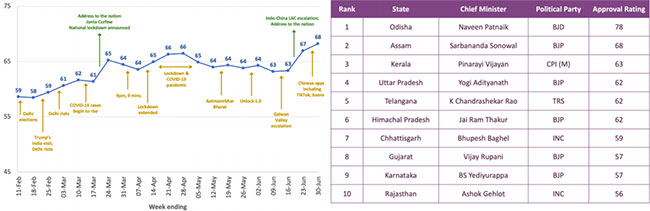
Approval Rating is a measure out of 100 (%) of the proportion of eligible voters who approve of the governance of the Prime Minister or the Chief Minister of their state.. As per the first Ormax PM Approval Rating report released, Prime Minister Narendra Modi’s Approval Rating jumped from 59 in early February 2020 to 68 at the end of June 2020. The sharpest growth was seen in the week when the PM addresses the nation twice on either side of the Janta Curfew, announcing the three-week lockdown on March 24 in the second address. The Approval Rating saw a further jump in the second half of June in the aftermath of the escalation at the Galwan Valley. His popularity is the highest in Chhattisgarh, Jharkhand, Rajasthan, Himachal Pradesh, Bihar, Gujarat, Odisha and Goa, where he enjoys 71+ Approval Rating in June 2020.
As per the track, Odisha Chief Minister Naveen Patnaik is by far the most popular Chief Minister across the 22 states covered currently with an Approval Rating of 78 in June 2020. Assam’s Sarbananda Sonowal and Kerala’s Pinarayi Vijayan rank second and third respectively.
 Commenting on the findings of the report, Shailesh Kapoor, Founder & CEO – Ormax Media said: “Fake news, and lack of news credibility in general, continues to be a growing concern globally. Almost 2 out of 3 Indians see fake news as a problem, and that should be a major cause of worry for all news companies. We launched this report in 2020 to enable more informed conversations on this topic. In the subsequent editions, we plan to study these indices by languages, to understand if there’s a difference in news credibility between Hindi, English and other major Indian languages”.