Tag: Nielsen

  • India leads in Global Confidence Index, notes Nielsen study

    By A Correspondent


    Consumer confidence findings from Nielsen, a leading global provider of information and insights into what consumers watch and buy has found that India continues to lead the global confidence index for the quarter with a three point increase from last quarter followed by Indonesia and Philippines. The Consumer confidence in urban India rose to a score of 129 in Q4 2014 – a three point increase from last quarter (126 in Q3 2014), and a 14 point increase from the last year’s index, same quarter (115 in Q4 2013). India is followed by Indonesia and Philippines with a score of 120 each.


    In the latest online survey, conducted Nov. 10-28, 2014, over four in five (82 per cent) urban Indian respondents indicated the highest level of optimism globally on job prospects in the next 12 months, followed by Indonesia (73 per cent) and Philippines (73 per cent). In the same quarter last year 70 percent (Q4 2013) were optimistic about their job prospects.


    “The urban online consumer in India ended the year far more optimistically as compared to last year, and even last quarter and ends on an encouraging note. The increased consumer sentiment is also aided by lower inflation rates and the positive economic environment and development initiatives led by the new government that have been instrumental in driving the India growth story,” said Piyush Mathur, president, Nielsen India Region. “This uptick in confidence is echoed across sectors – the fast moving consumer goods is industry is looking to grow by double digits in CY 2015, credit card penetration is rising, home loan disbursement in higher than in the third quarter, auto sales are also improving”.


    The Nielsen Global Survey of Consumer Confidence and Spending Intentions, established in 2005, measures perceptions of local job prospects, personal finances and immediate spending intentions among more than 30,000 respondents with Internet access[1] in 60 countries. Consumer confidence levels above and below a baseline of 100 indicate degrees of optimism and pessimism, respectively. The latest results reflect an outlook of cautious optimism, as every region’s consumer confidence score improved compared to the previous quarter.


    Discretionary Spending & Savings

    Over three in five (61 per cent) online respondents polled indicated this is a good time to buy things they want and need, two percent rise from last quarter (59 per cent in Q3 2014). From the same time last year good time to buy things they want and need has gone up by 12 percent (49 per cent in Q42013).


    When it comes to investing spare cash, 62 percent indicated it is a good time to put spare cash into savings. Half of respondents polled purchasing new technology products, up 11 percent from Q4 2013.


    “There is a stark increase in the sentiment amongst urban affluent consumers from last quarter last year, to the same time period this year. If we focus on 2014 – we notice a steady uptick in discretionary spending buoyed by the lower inflation. The consumer however continues to be cautious and is looking to close the year on a balanced note”, said Mathur


    Personal Finances, Concerns

    Seventy-eight percent urban Indian respondents indicated that the state of personal finances was good or excellent in the fourth quarter of 2014, six percentage points up from the same time last year (71 per cent in Q4 2013). The top concerns are job security (21 per cent), sustaining a work-life balance (12 per cent), followed by state of the economy (10 per cent).

     

  • Happy New Year awaits FMCG companies

    By Sagar Malviya


    The FMCG industry in India is set to return to double-digit growth rate next year after a gap of two years on the back of improved consumer sentiment and lower inflation rates, according to leading market tracker Nielsen. Nielsen expects the fast-moving consumer goods market to grow 7 per cent in 2014, 10 per cent in 2015 and about 12 per cent in 2016.


    “While India’s GDP might not revive drastically and could stay below 6 per cent, we still don’t see it weighing down the overall FCMG growth due to better sentiment and lower inflation,” said Ranjeet Laungani, vice president at Nielsen India. “Nearly half this growth will be volume-led, indicating favourable real consumption growth,” he said.


    India’s FMCG market has normally been immune to macro-economic pressures, but sales have fallen to single-digit growth since 2013. Worse, volume consumption remained flat and nominal growths came from price increases driven by inflationary pressure. However, the quarter ended September saw a bit of a revival at 7.2 per cent growth compared to 5.2 per cent in the previous quarter. Marketers say things have started looking up since the last two months.


    Source:The Economic Times

    Copyright © 2014, Bennett, Coleman & Co. Ltd. All Rights Reserved

    Licensed to republish


  • Achche din aagaye hain, Consumer confidence rises in India: Nielsen study


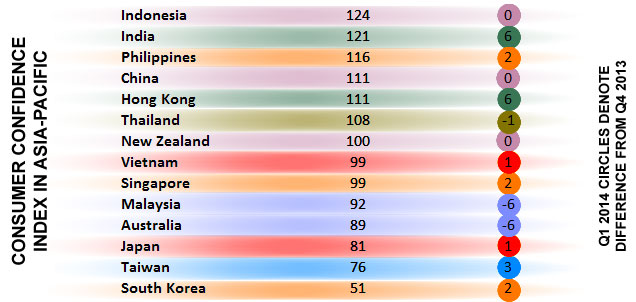
    It appears the ‘achche din’ have already arrived in India. Consumer confidence in Asia-Pacific increased in eight of 14 markets in the first quarter even as it was flat in three and declined in three markets. The region’s biggest quarterly index increase was six points, in both India (121) and Hong Kong (111). India’s index rise returns the score to a fourth-quarter 2012 level after several quarters of declining performance.


    Consumer confidence in the Philippines (116) and Thailand (108), as well as Indonesia (124) and China (111), were among the highest index scores of the 60 countries measured.


    “In India, the overall perception about the economy has achieved a steady state as many believe that things cannot get worse and that investments will pick up as the Indian fiscal year-ends and most households expect the positive impact of year-end bonuses,” said Piyush Mathur, president, Nielsen India. “However, inflation continues to be a challenge, and there is a sense of cautious anticipation about the outcomes of the world’s largest democratic election. Despite these factors, discretionary spending intentions are slightly more buoyant than previous quarters, as is typical at the end of the financial year, and in good time for the summer holiday season.”


    “In China, we see stronger confidence among respondents in Tier 2 and Tier 3 cities, compared with those in Tier 1,” said Yan Xuan, president of Nielsen Greater China. “In these lower tier locations, consumers have higher average salaries than their counterparts in lower tier locations, and they have less work and life pressures than those living in Tier 1 cities. Consumers in the middle tier cities also demonstrate a greater willingness to purchase more premium products. The continued rise of the Chinese middle-class throughout the country bodes very well for China’s goal to grow its GDP through more domestic consumption, rather than solely rely on infrastructure investment and export.”


    Discretionary saving and spending intentions in the Asia-Pacific region increased across all categories measured. The region boasted the most prolific savers, with 67 percent putting spare cash into savings accounts-an increase of 7 percentage points compared to fourth-quarter 2013. Investing in shares of stocks and mutual funds (38%) was also up 7 percentage points in the first quarter. Spending intentions increased for new clothes (+6 percentage points), home improvement projects (+6pp), holidays/vacations (+4pp), out-of-home entertainment (+3pp) and new technology (+3pp), compared to fourth-quarter 2013.


    Meanwhile, global consumer confidence returned to a pre-recession level with an index score of 96 in the first quarter-the highest score since first-quarter 2007, according to consumer confidence findings from Nielsen, a leading global provider of information and insights into what consumers watch and buy.


    The global index score represents a two-point increase from fourth-quarter 2013 and a three-point increase from a year ago (Q1 2013). The Nielsen consumer confidence index measures perceptions of local job prospects, personal finances and immediate spending intentions. Consumer confidence levels above and below a baseline of 100 indicate degrees of optimism and pessimism, respectively.


    Regional consumer confidence was highest in Asia-Pacific with an index score of 106, a one-point increase from the previous quarter (Q4 2013) and a three-point increase from a year ago (Q1 2013). North America posted the largest quarterly increase of five points to reach the optimism baseline of 100-the highest level since 2007. The Middle East/Africa region increased four points to 94, and Europe rose two points to 75, compared to fourth-quarter 2013. Latin America reported the only quarterly regional consumer confidence decline, falling one point to 93.


    In the world’s biggest economies, consumer confidence increased six points in the U.S. (100), remained flat in China (111), increased one point in Japan (81), increased four points in Germany (99), increased eight points in France (59) and increased three points in the U.K. (87).


    “With global consumer confidence at a seven-year high, it marks a significant milestone for the longest recession since the Great Depression,” said Dr. Venkatesh Bala, chief economist at The Cambridge Group, a part of Nielsen. “A global sentiment moves to one of cautious stability. As recovery continues, signs of optimism are increasing.”


    The Nielsen Global Survey of Consumer Confidence and Spending Intentions, established in 2005, measures consumer confidence, major concerns and spending intentions among more than 30,000 respondents with Internet access, in 60 countries.


    In the latest round of the survey, conducted Feb. 17 – March 7, 2014, consumer confidence increased in 60 percent of markets measured by Nielsen-up from 43 percent the previous quarter (Q4 2013). Indonesia (124) reported the highest consumer confidence index score for the fifth consecutive quarter, which was flat compared to fourth-quarter 2013. Croatia and Italy each reported the lowest consumer confidence scores (45), an increase of one point each compared to the previous quarter. Egypt (87) and Switzerland (104) reported the largest quarter-on-quarter increases of 11 and 10 points, respectively. Ukraine (56) reported the biggest quarterly decline of seven points.


    Text of the report is based largely on the Nielsen Global Consumer Confidence report  that MxMIndia sourced from Nielsen India


  • IRS 2013 Update: DNA sends legal notice to MRUC, Nielsen. Bhaskar gets stay order on IRS

    By A Correspondent


    The six-edition English news daily dna has sent a legal notice to the Media Research Users Council (MRUC) and Nielsen India as it “believes its readership figures are grossly misrepresented”.


    Announcing this in an announcement next to the masthead on the front page of the daily, dna communicated this move.


    Meanwhile, MRUC has pulled out the topline numbers of the IRS 2013 possibly in deference to a stay order of the District Court of Gwalior. Subscribers though can reportedly still access the data.


    According to the information received, the next hearing is on February 28 where an appearance has been sought of the MRUC representatives. The case by Bhaskar Publications and Allied Industries was filed on January 31, three days after the release of the data. The first hearing was on February 7.


  • IRS update: INS to decide future course today * Many papers withdraw * Legal action mulled to stop ongoing field research

    By A Correspondent


    The Indian Newspaper Society, the apex body of newspaper publishers in the country, had a specially convened meeting of its Executive Committee yesterday (Feb 5). According to sources, some members were incensed with the tough stand that the Media Research Users Council (MRUC) had adopted in its Governing Council meeting the previous day. “They can’t armtwist us. We are compelled to harden our stand, ” an INS member told MxMIndia.


    While discussing next steps, including legal action against the IRS, a smaller group is likely to meet in New Delhi today. The INS execom is reportedly piqued about a senior advertising honcho’s assertion that those opposing the new IRS should be banned.


    Meanwhile, many leading newspapers have written to the MRUC, RSCI and Nielsen, asking for their mastheads to not be included in the survey.


    On the legal recourse, according to one school of thought, since the IRS study is ongoing, the field work is on even as the controversy is raging. “The only way to stop the RSCI and Nielsen is by getting a stay,” an INS member told this correspondent.


    As reported earlier, adding to MRUC’s woes is the Association of Indian Magazines communiqué asking for the IRS to be withdrawn. “The current round of IRS has many glaring glitches when it comes to magazine readership,” AIM general secretary R Rajmohan wrote in a letter, adding: “We urge MRUC to immediately withdraw IRS 2013, as such faulty reporting of readership numbers can have extremely damaging impact on business, apart from misleading media planners and advertisers. ”


  • Don’t reject new IRS, correct it: Amit Ray


    By A Correspondent


    Sometime in the afternoon today (Feb 3), the Indian Newspaper Society is meeting the top brass of the Media Research Users Council for a discussion on the new Indian Readers Suvey findings . On Friday, 18-odd publishers issued a joint statement. The basic message: “We, the leading newspapers of the country, condemn the newly published Indian Readership Survey (IRS 2013) in the strongest possible terms.  The survey is riddled with shocking anomalies, which defy logic and common sense. They also grossly contradict audited circulation figures (ABC), of long standing. We also strongly ask RSCI and MRUC, the conductors of the Indian Readership Survey, to withdraw the results of IRS Q4 2013 immediately and  as well as put a stop to all future editions of this survey, as their continued publication will cause irreparable injury to the reputation of established publications like ours.”


    According to the information available to MxMIndia, a senior INS officebearer wrote to the MRUC saying that members of the apex body of newspaper publishers will pull their subscriptions if the new IRS findings weren’t disbanded.”


    The print media ecosystem is divided on what should be done with the new IRS. While many publishers have damned the findings and pushing for it to be dumped in the scrapyard, there are a fair number of media agency professionals and advertisers who believe that the media research findings must be honoured.


    MxMIndia Comment: Post IRS, worries for broadcasters * When publishers hailed IRS * Likely outcome of INS-MRUC meeting

    By A Correspondent


    Guess who should be most worried after the IRS 2013 survey findings that were out last week? The entire broadcast ecosystem of course, especially the folks at BARC. While the monsieurs at tech vendor Mediametrie and the yet-unappointed panel manager may mouth a few ouis, nons or whatever, the knives and suparis will surely be out if there’s any dramatic changes from the present.


    Let’s look at a few hypothetical scenarios.

    Scenario 1: Sony is Hindi GEC #1, ratings of the #1 GECs drops 100 GRPs

    Scenario 2: India News turns #1. The current leaders fall by the wayside

    Scenario 3: In Tamil, Pudhu Yugam becomes GEC #1


    These are of course just scenarios, but if the results of the IRS 2013 out last week are an indicator, they aren’t impossible to happen. It’s going to be a change of methodology, a change of vendor (possibly not fully if TAM is selected as panel manager), a change of philosophy and an all-new Technical Committee ensuring the processes are followed and the system is robust. And above all: BARC with a chairman from the industry, a CEO and his secretariat and a techcom that has reps of a broadcaster, media agency and advertiser.


    The problem, as many industrypersons told us, is not the process, but in the final numbers. These are after all IRS survey. As in the case of BARC, even the IRS saw representatives of all stakeholders actively participating in the processes.


    In fact on the day the IRS was launched in Mumbai in March 2013, Peter Suresh, the much respect research head (Head-Strategy) at the Dainik Bhaskar told MxMIndia:  “The entire process is automated, and that is incredible. Attempt to report individually on a far larger number of geographical units is also very heartening. District cut too has increased - hence the data can be analyzed at a far more granular level. Bulk of action of late has been in rest of India, beyond six metros and hence granular cut is extremely important. Data slicing at a deeper level, and multiple ways of presenting it, make far more sense. Readership numbers are the cornerstones of most media marketing and sales strategies - and the finer they can be cut, the more robust they are. And, of course, these will help in delivering better stories to the marketers.”


    Dainik Bhaskar is one of the signatories of the statement issued on Friday against the IRS. Interestingly, a day after the IRS was released - on January 29, to be precise -several newspapers front-paged their successful showing in the readership study. These include some of the signatories to the statement.


    The meeting between the Indian Newspaper Society (INS) and the Media Research Users Council (MRUC) at 2/2.30pm today is most likely going to end in a stalemate. It may be remembered the RSCI was formed by the MRUC and INS-sponsored National Readership Studies Council to govern  the new IRS. So the buck is clearly in the RSCI court. For the INS to damn the IRS is tough because its members had endorsed the process.


    The MRUC is being represented by Chairman Ravi Rao, TechCom chaiman Paritosh Joshi and Director General Shaswati Saradar. At the time of writing, one is not aware of who will represent the INS. But Hormasji Cama, a former head of the INS and MRUC and now chairperson of the RSCI, is travelling, the decision will need to be finally taken by him.


    According to the grapevine, the MRUC/RSCI has already written to Nielsen, asking the research agency to clear a few doubts. It’s possible that the new IRS findings will be put under suspension for a few weeks until the clarifications come in and Mr Cama is back.


    MxMIndia spoke with veteran media professional and former chairman of the MRUC Technical Committee Amit Ray for his views and to suggest the way forward of the mess.


    1. Is there really any anomaly as it is being made out to be? And if yes, why has it happened?


    a. There appears to be a lack of experience in the current dispensation vis-à-vis readership research. Instead of letting go of the previous experienced professionals, MRUC and RSCI should have engaged them more significantly given that the task was assigned to the same research agency that had failed earlier. If you remember, AC Nielsen was the agency which did the NRS in the past.


    b. The questions that are now rightly being asked are: Was Nielsen the right agency? Does it have the requisite experience for newspaper readership study in India? Did we forget that NRS had failed thanks to the same agency?


    c. I strongly believe that publishers ought to have got their own experts to validate Nielsen’s methods and later the results. How can the publishers let a body like new MRUC decide about their future knowing fully well that the real pillar of the earlier IRS was the research agency and the techcom together?


    d. One of the reasons why the print media rejected the NRS and opted for MRUC’s IRS was the concept of ‘continuous research’. So why was this junked overnight? It is very likely that the current people will defend this by asking for more time. This time the publisher would do well to have their own team of experts with experience and not just blindly trust the experience (or the lack of it) of the current technical committee and the research agency.


    e. Everyone inside MRUC would’ve known about what has happened historically. Even MRUC had a problem in the past when circumstances forced MRUC to choose a new agency NFO. This was the around 2000/2001. If my memory serves me right the new Agency took almost 3 years to complete the research. May be the current office bearers were not aware of this


    2. What are the next steps? Scrap IRS?

    a. Rejecting the new IRS will be a regressive decision. Instead of rejecting it, we should look at correcting it. If we reject it, we will be starved of another 15-18 months of data which will be counter-productive to publishers.


    b. Call the people from the earlier MRUC technical committee especially those who took it to another level because of which the INS agreed to team up with the MRUC. May be a good idea to urge the veteran Roda Mehta who set up the IRS to intervene and suggest changes. I will be happy to help too and possibly pull in a few others.


    c. Ask AC Nielsen to allow a detailed audit of their actual work. Invite some of the senior folks at Hansa Research Group to come in as professionals – and not representing Hansa – to offer their advice. They are clearly best suited to find the soft spots where mistakes are committed so that we don’t repeat them


    3. Both RSCI and MRUC are part-sponsored by print publishers. The officebearers of both bodies have publisher representatives. So is it right for the INS to now play Big Brother to decisions taken by its own members?

    For the sake of the industry and the entire print media sector, it’s important that IRS 2013 is salvaged. As I stated earlier, publishers will suffer the most if it’s scrapped. Media studies like that of KPMG, PwC etc make sectoral assumptions and projections based on these. I believe the entire sector shouldn’t suffer because of the mistakes of some.


  • As time ticks on measurement guidelines, will TAM take MIB to court?

    By A Correspondent


    With the government guidelines notified on January 16, the time’s literally ticking for TAM and the entire prevailing broadcast ecosystem.


    Thanks to the persistent demands of broadcasters – especially those representing news channels – to police TAM, the Ministry of Information and Broadcasting has been on an overdrive on the issue of measurement guidelines. The perception created is that news channels are required to sensationalise to score high ratings and the government, in its effort to to keep newswallahs happy and in check in an election year, is on an overdrive. How the ratings scenario will change in the new BARC-administered regime beats us, but what we do learn is that existing player TAM is contemplating taking the Ministry of Information and Broadcasting to court.


    The plea will most likely be that it cannot comply with the requirements on ownership within 30 days so it needs to be given time. The advertisers, media agencies and select advertisers too believe that a measurement-free regime will be counter-productive. Some advertisers in fact believe a measurement blackout will force them to review their spends on television.


    According to the grapevine, TAM’s co-owners had some concerns on taking the Court route. Nielsen, we were told, was averse to litigation, while Kantar wanted it. Both Nielsen and WPP, the owners of Kantar, have steady businesses in India and there’s a concern on how taking on the government could impact its relations with the government. Industry veterans though site several instances when relations with government hasn’t been impacted by legal tangles.


    Meanwhile, even as you read this, BARC has convened a press conference in Mumbai to make some significant announcements – possibly the name of the vendor – Mediametrie or Nielsen.


  • Kahaani Mein Twist: Nielsen cuts costs 20%+ for BARC TV measurement contract


    By A Correspondent


    In entertainment television, it’s called ‘kahaani mein twist’. In cricket commentary, you hear of ‘glorious uncertainties until the last bowl is bowled’. But in the course of business deals too, we often see twists in the tale. Or is it case of people getting real? Or is it too little, too late?

    For, the Broadcast Audience Research Council (or BARC) bosses are seeing a real-life soap opera playing out for them.

    Readers of MxMIndia would recall the reports that the BARC board had selected French joint industry body Mediametrie (along with watermarking tech provider Civolution and one or more set-top box providers) as the vendor for television measurement.

    It was a done deal. We even carried a ‘Big Story’ on Mediametrie. BARC representatives had visited France and the Frenchmen were in turn in India. The papers were getting readied, with a back-and-forth between the legal eagles.

    But after the news on Mediametrie was published, at least one other contender for the coveted contract got into action. As we know, TV measurement is currently managed by TAM, a joint venture of the research specialists Nielsen and Kantar. The latter is owned by WPP, which also runs GroupM, Ogilvy, JWT and several other media entities.

    The proposed government regulations are clear on cross-ownership – that the measurement company can’t be owned/co-owned by anyone with stakes in some media businesses. Sound logic, but then given ownership patterns of research companies, it rules out some firms. Also, cross-ownership rules have still not been administered in other media sectors.

    Given this although Kantar had made a bid for the all-important hardware tech partner phase of the BARC-ruled measurement business, there was a cloud on whether it would get the contract given the TRAI guidelines which are set to be notified soon.

    But cross-ownership wasn’t the reason why BARC ruled out Nielsen. It was dosh. Nielsen was charging the moon. Or so we were told.

    Pardon us for the looong backgrounder. But, this is television, and like the various soaps and sitcoms, some foreplay is a must. Okay, so let’s get to the point.

    Nielsen has now written to BARC saying it’s cutting price.

    Yes, you read it right. Nielsen has shaved off over 20 percent of the annual cost. President – India Piyush Mathur has reportedly written a letter bringing down the cost by Rs 13.1 crore per annum. This is thanks to the research major striking a deal with a large business conglomerate (rumoured to be the Tatas) to produce set-top box/meters and a few other components locally. The move saves Nielsen vital monies on custom duties and affords them another shot at the multi-million dollar contract.

    The rest of the scope of the project stays: 20,000 households, 25,000 meters, data, metering and collection systems and software. The all-important technology factor is a non-issue since Nielsen too is employing audio watermark knowhow. Nielsen Watermarks using audio signatures will ensure non-stop daily ratings. Given infrastructure issues in India, the crediting approach becomes critical which Nielsen has ensured it will administer very strictly.

    What Nielsen has also assured BARC is that the service ownership will be BARC’s.  Also, at the end of five years, the ownership of the meters will be transferred to BARC.

    So what does all of this mean? BARC has another Board meeting coming up next week and before that some of the technical/ commercial committee members may meet.

    What’s important to note is that the Nielsen pricing is in the region of what will have to be paid for the Mediametrie++ alternative. An industry observer told us this could only have happened with the Mediametrie number leaking out from someone in the BARC Board.

    While MxMIndia couldn’t reach BARC officials to confirm or deny these developments, according to the information available, there is a view that Nielsen may be excellent option in the short run and is a more tried-and-tested vendor, but there are many concern over costs escalating over time. The worry is that even though Nielsen has assured that the service ownership is that of BARC, in actual terms this may not be the case and BARC may have to fork out more. A lot of what Nielsen offers is proprietary, for which it could charge a royalty.

    Will TAM co-owner Nielsen be the new hardware/technology/data collection vendor for television measurement? It’s not going to be an easy decision for BARC. Like the soap opera on the GECs, we have already seen many twists and turns with television measurement. Watch this space for what happens next.


  • NDTV plans to appeal on jurisdiction

    By A Correspondent


    The lower court in New York has been hearing procedural arguments on jurisdiction, particularly whether the US or India is the appropriate forum for the case that NDTV has filed against Nielsen and Kantar.


    The lower court in NY felt that India would be a more convenient forum than the US. NDTV disagrees and will appeal against this decision. NDTV believes that this lower court’s decision is based on several misconceptions, legal and factual errors, and this will be outlined in the appeal.


    A release from NDTV said that the New York lower court did not go into the merits of the case on corruption in the Nielsen Process as used by Nielsen and Kantar through TAM, (Nielsen and Kantar are the owners of TAM). The court merely looked at where the location of the case should be heard. NDTV believes it must be heard in New York, and will pursue this on appeal in New York.


  • Saavn launches new ad platform

    By A Correspondent


    Indian music service Saavn has announced the launch of its new advertisement platform, Impact. This platform enables brands to identify, connect and engage with its 10.5 million users in India and across the globe.


    Impact is an innovative approach to digital and mobile advertising that gives brands 100 percent share-of-voice. Using Impact, brands get complete and exclusive access to all advertisement units on the Saavn web site and mobile apps for a set time period. These include Custom Skin, Web Display, Web Audio, Mobile Spotlight, Mobile Display, and Mobile Audio. Impact is a powerful model that allows brands to build positive associations with their products and services through music. The model has proven to create strong brand awareness, shape brand preferences and increase purchase consideration through undivided mindshare of listeners of Saavn across platforms.


    “In India, we all know that music plays an integral and meaningful part in every individual’s life. Impact is a powerful solution that enables the advertisers to build an emotional connection with their target audience during a passionate, social and engaging musical experience,” Vinodh Bhat, co-founder and CEO of Saavn, said. “The Saavn Impact model is based around engagement, curation and social sharing rather than the archaic click-through. Brands are able to measure ROI in meaningful ways, such as increases in perception, awareness, recall and purchase intent. The byproduct of our strong focus on the consumer experience is helping brands grow their businesses.”


    Some of the major brands utilizing Saavn to reach million of engaged users in India include: Samsung, Lay’s, Pantene, Pepsi, Nokia, Vodafone, Airtel, Hyundai, Domino’s Pizza, 7Up, Nielsen, MakeMyTrip, Max NewYork Life, Google Plus, Nokia, Vanish, Groupon, Intel and several others.


    Saavn delivers a comprehensive catalogue of Bollywood, Indian and regional South Asian music, licensed from more than 200 content providers. Saavn users can search, browse, and play a catalog of more than 1 million tracks; create and save their own playlists; and share their music tastes seamlessly via Facebook.


  • FMCG brand extensions 5 times more successful than new launches: Nielsen study

    By A Correspondent


    Arthur C Nielsen

    Extensions of existing fast moving consumer goods (FMCG) brands are five times more successful than launching a new brand in India, according to a new study released today by research major Nielsen.


    Nielsen’s study of top brands in 46 FMCG categories and 82 brand extensions in food and non-food categories shows that in addition to promoting brand equity, brand extensions can grow incremental sales up to 38 percent and contribute as much as 30 percent to parent brand sales.


    “Innovations are driving FMCG growth in India,” said Arun Chogle, client business partner, Nielsen India. “Brand extensions, or stretching your existing brand, increase your chances of innovation success. Not only do brand extensions leverage the equity of the parent brand, but they also lead to faster adoption and deliver higher marketing efficiency.”


    Nielsen identifies five ways brand extensions are successful in India:

    1. Brand stretches gain share and build distribution faster than new launches. One example from Nielsen’s review of brands launched in the past two years shows that while eight new, national body lotion brands reached a share of 0.3 percent, seven national brand extensions increased that figure almost four-fold, delivering a four percent market share.

    2. Brand stretches are two times more likely to succeed in a highly fragmented category.

    Nielsen’s findings show that developing categories with fragmented shares, or developing categories with lower penetrations, were more successful than established category sizes of greater than Rs 3000 crore.

    3. Sixty-five percent of successful brand stretches have a premium index lower than the parent brand. Keeping under the price premium index of parent brands is likely to increase the chance of success. Nielsen’s results show that brand leaders that priced below the parent premium at the entry stage were more successful than those priced above the parent brand.

    4. Strong parents beget strong children. Nielsen’s study shows that when the parent brand was a leader in the category, 59 percent of brand extensions were also successful. When the parent brand was not among the top five players, 35 percent of brand extensions were successful. “Building the core is important, but advertising support is critical for both the parent and the child,” said Mr Chogle.

    5. Successful stretches leverage four factors: Advantage-delivers new, or distinct, benefits to the category. Recognition-ensures strong parent-brand awareness levels in terms of functionality, imagery and personality. Relevance-makes certain parent attributes relevant in the new category and Credibility-delivers on brand promises.


    “To successfully unleash the power of your brand stretch potential, determine your brand’s leverage power by reviewing its advantage, recognition, relevance and credibility,” said Mr Chogle. “Understand the market structure of the new chosen category to determine both its fragmentation and penetration among consumers and most importantly, establish your company’s executional competence to create the right product offering, deliver distribution muscle to reach consumers and stay invested in ad spending and support levels.”


  • WPP, Nielsen dismissal motions to be heard on Dec 14

    By A Correspondent


    The return date for the dismissal motions will now be December 14 and not September 13. As per the proposed order posted by the New York Supreme Court, on August 30, the Court granted NDTV’s application for a conference to set forth a schedule by which the three key parties (NDTV revising its complaint), WPP’s existing motion to dismiss and Nielsen’s proposed motion to dismiss the motion. (See proposed order at: https://iapps.courts.state.ny.us/fbem/DocumentDisplayServlet?documentId=H5fLtBSiJltQWmamdxHfhQ==&system=prod)


    On August 31, 2012, the Court conducted a conference, via telephone, with counsel for NDTV, counsel for the Moving Defendants (WPP) and counsel for the Nielsen Defendants. On the Conference Call, counsel for NDTV indicated, inter alia, that NDTV will conduct an investigation as to whether or not Kantar, IMRB and JWT were properly named in the Complaint, and, if not, NDTV will make the necessary changes in the Amended Complaint.


    Having considered all of the papers and arguments regarding the scheduling
    disputes, the Court ordered: that:


    1. NDTV file and serve its Amended Complaint on or before October 5,
    2012, via electronic filing;

    2. The Moving Defendants (WPP) file and serve their supplemental motion papers
    responding to the Amended Complaint, if any, on or before October 19,
    2012, via electronic filing;

    3. The Nielsen Defendants file and serve the Nielsen Motions to Dismiss on
    or before October 19, 2012, via electronic filing;

    4. NDTV file and serve its opposition papers to the Motions to Dismiss and
    the Nielsen Motions to Dismiss on or before November 16, 2012, via
    electronic filing;

    5. The Moving Defendants file and serve their reply papers regarding the
    Motions to Dismiss on or before December 7, 2012, via electronic filing;

    6. The Nielsen Defendants file and serve their reply papers regarding the
    Nielsen Motions to Dismiss on or before December 7, 2012, via electronic
    filing;

    7. The return date for the Motions to Dismiss is adjourned until December
    14, 2012; and

    8. The return date for the Nielsen Motions to Dismiss shall be December 14,
    2012.