Tag: Nielsen

  • Dolly Jha moves from Nielsen to BARC

    By Our Staff


    There is more reason to be delighted to publish this bit of info. It’s possibly the first communique we’ve received from BARC India in over a year. Phew!


    Yes, you read it right: in over a year.


    But the news is of greater interest because the general buzz around the industry is that all is not too well at the audience measurement firm. In fact there are some very strong rumours of a certain section of broadcasters considering a rival measurement body. But of course running a measurement body needs loads of money and must have the blessings of the entire ecosystem, including advertisers and advertising agencies.


    Dolly Jha
    Dolly Jha

    Without further digression, here’s the news of the day: Broadcast Audience Research Council India (BARC), the world’s largest television audience measurement body (the communique claims… we would also add: possibly the world’s most controversy-ridden measurement body), has announced the appointment of Dolly Jha as its Chief of Product & Research. Jha has experience of close to three decades across Kantar, ITC Foods and Nielsen, where she spent the last 13-odd years.


    On her appointment, Jha said: “I am excited to join BARC India as the Chief of Product & Research. BARC today runs the largest Audience Measurement system in the world. With all the experience behind me, I am looking forward to contributing to BARC by evolving the measurement further to meet the growing needs of stakeholders.”


    Nakul Chopra
    Nakul Chopra

    Welcoming Jha, Nakul Chopra, CEO, BARC India said in the communique, “It is indeed wonderful that Dolly will join the BARC Leadership Team. As the Chief of Product & Research – she will expectedly bring immense value to our eco-system, both from the perspective of working back from our output, to improve input quality and, over time in helping build value added services that will benefit all our subscribers. Both these vital functions are new capabilities that we seek to add to BARC – given her vast experience, I cannot think of a leader more suited to this role. In her stint at Nielsen, Dolly has already deep exposure and understanding of what BARC does – I am confident that this will augur for an extremely fulfilling partnership. I warmly welcome her and look forward to working closely with her.”


  • Nielsen reports underspending in 50% of media plans

    By Our Staff


    Nielsen has released its first-ever ROI Report, which identified gaps in marketers’ budgets, channels and media strategies that are compromising returns on investment (ROI) on media plans. The global report reveals data and delivers insights on what drives returns on ad spends, how to measure the returns, and how to improve on the metrics brands already have, with content unique to advertiser, agency, and publisher audiences.


    According to the report, about half of marketers are not spending enough in a channel to get maximum ROI. While a poor ROI might cause brands to pull back on spending, Nielsen found that spend often needs to be higher to break through and drive returns. Nielsen’s “50-50-50 Gap” states that while 50% of media plans are underinvested by a median of 50%, ROI can be improved 50% with the ideal budget.


    Beyond budgeting, the ROI Report delivers key insights and recommendations to deliver higher ROI across multiple marketing areas including:


    :: Full funnel marketing: It’s rare for channels to deliver above average returns for both brand and sales outcomes, with 36% of media channels faring above average on both revenue and brand metrics. To grow ROI, brands should pursue a balanced strategy for both upper and lower funnel initiatives. Nielsen found that adding upper funnel marketing to existing lower and mid funnel marketing can grow overall ROI by 13-70%.

    :: Emerging media: It’s difficult for brands to spend big amounts without proof that the new media works, but spending small amounts can make it hard to see if the media is working. Nielsen found that podcast ads, influencer marketing and branded content can deliver over 70% in aided brand recall, and that influencer marketing ROI is comparable to ROI from mainstream media.

    :: Ad sales growth strategy: Ultimately, ROI will inform publisher pricing power. Publishers are not just competing against others in their channel, but also against other channels, so comparing channel ROIs can help set pricing strategy. The ROI Report uncovered that social media delivers 1.7x the ROI of TV, yet social gets less than one-third of TV ad budgets.

    :: Audience measurement: Campaigns with strong on-target reach deliver better sales outcomes. However, only 63% of ads across desktop and mobile are on-target for age and gender in the U.S., meaning that on the channels with the most exhaustive data coverage and quality, over one third of ad spend is off-target. To capitalize on opportunity and drive impact, advertisers should prioritize measurement solutions that coverall platforms and devices, with near-real-time insights. “Nielsen’s 2022 ROI Report serves as a guide for brands, agencies and publishers. In a time when there are more channels than ever to reach desired audiences, it’s critical that insights on ROI are attainable and easy to understand,” said Imran Hirani, Vice President, Media & Advertiser Analytics, Nielsen.“Brands can’t afford to waste valuable ads on the wrong audiences. By investing wisely and having a balanced strategy of both upper-funnel and lower-funnel initiatives, brands can reach the right audiences and maximize their ROI.”


  • Nielsen releases 2022 Annual Marketing Report

    By Our Staff


    Nielsen released its 2022 Annual Marketing Report and, for the first time, expanded it to a global audience, uncovering marketers have key priorities for the year ahead, but also where marketers have struggled over the past two years due to consumers’ changing media habits. Titled ‘Era of Alignment’ the report illustrates how marketers must gain confidence in their data to focus equally on brand building and customer acquisition, doing so through both upper-funnel and lower-funnel planning and execution.


    The report, which surveyed nearly 2,000 global marketers between December 2021 and January 2022, both revealed a digital dominance in how dollars are being spent and exposed marketers’ lack of confidence in the data behind those decisions. With continued digital fragmentation, marketers report data accuracy, measurement, and ROI are paramount. While 69% of marketers believe first-party data is essential for their strategies and campaigns, and 72% of marketers believe they have access to quality data, only 26% of global marketers are fully confident in their audience data.


    The Era of Alignment found marketers around the world are experiencing similar areas of success and challenges, as shown by:


    Brand awareness is marketers’ top objective. To reach this goal, brands need to leverage an array of channels to reach the widest audience. Nearly two-thirds (64%) of respondents stated that social media is the most effective paid channel with TikTok and Instagram dominating spend. Comparatively, TV and radio spend is significantly less with an aggregate increase of 53% across global marketers. Customer acquisition is their second objective, showing that marketers must focus efforts on the entire customer journey.


    Increased media fragmentation amplifies the need for holistic measurement. Marketers’ confidence in measuring ROI of the full-funnel is only 54%. Remove online and mobile video and confidence in measuring ROI across all other channels is under 50% globally, and while nearly half of marketers plan to increase their spending on podcasts, their confidence in measuring the ROI of that investment is 44%.


    It’s vital for marketers to use data to champion personalized marketing strategies. The increasing proliferation of channels produces an abundance of unique data sets. However, 36% of marketers still claim that data access, identity resolution, and deriving actionable insights from data is either extremely or very difficult. With the rise of connected TV (CTV) this presents new challenges to traditional targeting solutions. CTV is a growing focus for global marketers, with 51% planning to increase their over-the-top/CTV spending in the coming year. To wit, Americans streamed almost 15 million years’ worth of content across subscription- and ad-supported platforms.


    By placing a greater emphasis on purpose-driven initiatives, marketers can better connect with consumers. Nielsen Research shows over half of U.S. consumers (52%) purchase from brands that support causes they care about; similarly, more than 36% expect the brands they buy to support social causes. While global marketers say their brands are emphasizing purpose, Nielsen data shows that 55% of consumers aren’t convinced that brands are fostering true progress.


    Said Jamie Moldafsky, Chief Marketing and Communications Officer, Nielsen: “Our work at Nielsen is to provide the most complete view of consumer behaviour regardless of industry, and our long-time experience in measurement and comprehensive view of the media universe gives brands a 360-degree view that can’t be found anywhere else. This research showcased that marketers want to put money into channels to deliver immediate ROI, however we also see that they must be agile in the year ahead and work across the entire marketing funnel to reinforce brand awareness and acquire more customers. With the upcoming elimination of third-party cookies, it’s understandable to see marketers prioritizing personalisation and aligning their brand with causes their customers care about. Through our solutions – and this report – we’re continuing to help brands and marketers get actionable insights to make more informed, and quicker decisions.”


  • Nielsen enhances Identity System for Digital Ad Ratings in India

    By Our Staff


    On April 1, Nielsen enhanced its open web methodology in India for Digital Ad Ratings through the Nielsen Identity System, alongside seven other markets: Germany, Australia, Japan, Spain, Indonesia, Canada and Brazil.


    Said Dolly Jha, Nielsen India Managing Director: “We’re leading the way in tackling digital consumer behaviour fragmentation. From granularity, to large-scale measurement, we’re delivering actionable insights to help advertisers measure, manage and optimise their campaign budgets and results.”


    According to a communique, the Nielsen Identity System powering Digital Ad Ratings advertisers and publishers can measure reach and frequency of their audiences with confidence knowing that when a digital ad is viewed, demographics are deduplicated across mobile and PC platforms to get to true people-based metrics.


    Added Sarah Miller, SVP, Product Management at Nielsen: “With this enhancement to our Identity System we are taking another step to assure the continuity of ad measurement amidst the rapidly evolving digital ecosystem. Because of Nielsen’s unique data assets, we are not only able to adjust and correct licensed third party demographic data using panels, we have also developed sophisticated machine learning algorithms to cluster digital identifiers into people and correct for any possible imbalances from the market’s universe of users. It is this advanced data science methodology fueled by the sheer volume of Nielsen Identities that will empower the digital ad measurement into the future.”


  • Nielsen and The Trade Desk team up

    By Our Staff


    Nielsen and The Trade Desk have announced a strategic partnership to power identity resolution for open internet measurement in key international markets around the world. The Trade Desk will help fuel Nielsen’s demographic data starting with France, Italy and the United Kingdom. Japan, Australia and Germany will launch on April 1, with plans to launch in other Asian and European markets, in addition to Canada and Mexico, on a regular cadence following the initial releases in 2022.


    Nielsen will integrate demographic data provided by The Trade Desk into the Nielsen ID System to provide more scope and accuracy in Nielsen’s digital ad measurement for the open internet, connecting digital impressions to demographics across millions of devices. Advertisers and publishers can use Nielsen Digital Ad Ratings with more confidence knowing that the solution is aimed towards appropriately assigning and deduplicating audience demographics across mobile and PC platforms when a digital ad is viewed. With this initiative, Nielsen becomes a preferred measurement provider of The Trade Desk and builds on the two companies’ longstanding relationship.


    Said Karthik Rao, Chief Operating Officer, Nielsen: “This strategic partnership with The Trade Desk immediately scales Nielsen’s Identity System globally, and showcases our commitment to independent measurement and marketplace interoperability, facilitating an open ecosystem for the media industry, with audiences de-duplicated across multiple platforms,” “We continue to evolve our technologies and methodologies as we move toward Nielsen ONE and this is a very important milestone for that vision of true cross-platform measurement across all screens, underpinned by a strong digital measurement capability.”


    Added Michelle Hulst, Chief Data Officer, The Trade Desk: “As the world’s largest independent demand-side platform, The Trade Desk is in a prime position to provide the open internet with a standard of measurement that improves data-driven decisioning, advertising performance and transparency. We have long believed that it takes all of us to support the digital media ecosystem, especially in the world of measurement, and look forward to advancing the open internet together with Nielsen internationally.”


    The communique issued doesn’t specifically mention if the roll-out will happen in India.


  • Online chatting surpasses audio & video calling


    By Our Staff


    Almost seven in 10 respondents say that their chatting activity has increased in the last six months and 67% of those say that it shall remain the same or increase further in the next six months. These and more findings were revealed in the a study conducted by research major Nielsen for Bobble AI, the Conversation Media Marketing (CMM) platform.


    The study involved smartphone users both males and females, divided in two categories: 18-30 and 31-40 years conducted over a fortnight: March 2 to 16, 2021. 


    Key highlights of the ‘Conversation media’ focused survey report:

    1. Chatting is a daily activity which most of the people (94%) engage in EVERYDAY! Chatting has surpassed audio calling and video calling as the most common way of communication (by a significant margin – 13 percentage points over audio calling). Almost 7 in 10 respondents say that their chatting activity has increased in the last 6 months and 67% of those say that itshall remain the same or increase further in the next 6 months, establishing that chatting is here to stay as the most heavily used communication medium.


    2. The awareness and adoption of conversation media formats including emojis, stickers, GIFs across different demographies is very high– 95% users are aware of emojis in NCCS A and 93% in NCCS B and 91% users are using emojis in NCCS A and 84% in NCCS B. Similar pattern is observed for stickers – 92% users are aware of stickers in NCCS A and 85% in NCCS B and 81% users are showing preference for usage of stickers in NCCS A and 71% in NCCS B.


    3. Primary reasons for increasing popularity of chatting formats are that ‘its fun to use’ and ‘It helps in expressing oneself better’. The older age group score significantly higher for ‘makes messages easier to understand’.


    4. Awareness of re-sharing is similar across different chatting formats, however, the likelihood of re-sharing Emojis are significantly higher than stickers and GIFs.


    5. Emojis, Stickers & GIFs make the conversations real and personal as it allows people to express accurately and in a fun way. 80% of users believe that chatting formats make their message easier to understand.


    6. Emojis were ranked first as the most preferred chatting format, followed by stickers and GIFs.Moreover, Emojis are more likely to be used for ‘expressing an emotion’ and talk about various daily activities, whereas people prefer to use stickers to send best wishes on birthdays and festivals.

    a. 96% of users claim to use emojis, stickers, gifs to express an emotion (happiness, anger, or sadness to name a few)

    b. 85% of users claim to use these formats to wish on birthdays, anniversaries, festivals, etc.

    c. 81% of users claim to use chatting formats to express or tell something about an activity (eating, running, cooking, etc.)

    d. 70% of users claim to use these chatting formats to talk about trending topics, situations IPL, etc.


    7. When given a choice between a branded sticker & an unbranded sticker for specific situations, around 3 in 4 among the surveyed respondents claimed that they are likely to use a branded sticker vis-a-vis an unbranded sticker. Given that chatting is one of the main sources of communication these days and majority of respondents prefer branded stickers, it gives a powerful platform to the brands to advertise themselves and be a part of everyday conversations.


    Millennials and Gen-Z chats across platforms are evolving from just plain text to stickers, GIFs and emojis. Various keyboard and messaging platforms now understand what youngsters want and are investing to expand their content offerings in these areas. This, in turn, provides opportunity to brands to explore these unique chatting formats and connect with the intended audience most effectively.


    Commenting on the findings of the survey, Ankit Prasad, Founder and CEO, Bobble AI said, “The key findings validate the growing relevance of Conversation Media among GenZies and Millennials in the country and the rising inclination for chatting over any other means of communication. With more and more people working and living remotely and being compelled to multi-task, they are looking for new and innovative ways to express themselves better. Conversation Media like emojis, stickers, GIFs are a fun, engaging way for brands to break the clutter and connect with their audiences.  COVID-19 pandemic has caused gloom and Conversation Media Marketing serves as an opportunity for brands to drive positive impact and influence in the minds of consumers.


    The respondents for this survey are spread across 5 Metros across Zones (62%) including Mumbai, Delhi, Kolkata, Bangalore and Hyderabad and non-metro cities (38%) including Patna, Lucknow, Indore, Ahmedabad, and Jaipur. The fieldwork was done in an unbiased manner without intervention from Bobble AI and the quality control procedures were also followed very strictly.


  • Nielsen rolls out ID resolution system

    By Our Staff

    Nielsen has announced a new approach that moves away from third-party cookies to privacy-centric, people-based identifiers for attribution. This new technique will attempt to ensure that advertisers and publishers are able to understand the entire consumer journey across platforms, better optimise their spend and prove the impact of advertising.


    Said Matt Krepsik, GM of Planning & Outcomes Products at Nielsen: “At Nielsen, we’re committed to helping our clients navigate the cookieless world and unlock the next generation of metrics that enable them to drive outcomes, maximize reach, and optimize their budgets. With our transformed approach to Attribution, we’re turning data into actionable insights so advertisers can understand the impact of their marketing efforts and publishers can continue to prove the impact of advertising on their platforms.”


  • India: E-commerce sees a sectoral comeback: Nielsen

    By A Correspondent


    Products that cater to the consumer need for convenience while adapting to the homebody economy dominated the festive sale period in India (Oct. 15 – Nov. 13, 2020), according to measurement giant Nielsen.


    With the need for communication and increased media consumption, mobile phones and accessories (e.g. earphones, headsets, case covers, etc.) continued to account for over half of e-commerce sales during the festive period. While notably, electronics (e.g. laptops, printers, peripherals) increased its share by 10% compared to 7% during the festive season last year (Sept. 28 – Oct. 25, 2019) given the increase in remote working and schooling.  See chart below.


    Nielsen India’s E-commerce Consumer Panel (E-Analytics Solution) helps measure consumer behaviour across more than 30 E-Commerce platforms, finds double digit increase in average spend of online shoppers for electronics and accessories (39%), mobile and accessories (12%), and fashion, including apparel, footwear, and accessories (10%). Appliances (e.g.TV, WM, refrigerators, etc.) also saw notable shopper spending increase at 9%.


    Said Kunal Gupta, Head, Consumer Intelligence, Nielsen, South Asia: “Consistent with the trends that we are seeing globally, consumers in India are fitting into the homebound behaviour. Triggered by the desire to make life and work easier and more convenient at home, we see a significant increase in shopper spend in categories that are perceived to cater to homebody needs on account of the pandemic.”


    Geographically, the growth of e-commerce during the festive period is led by Bharat (<10 lakh population towns). Nielsen reports a 16% increase in orders from smaller cities (<1 lakh population towns) and a 14% rise in shopper spends from >1 lakh+ population cities. This clearly shows the evolution of the shopper spend journey through urban classes.


    Added Vaughan Ryan, Nielsen’s Consumer Intelligence managing director in Asia: “Manufacturers and retailers in multiple markets such as China, the Koreas and South East Asia have long recognised the affinity of consumers to online shopping during popular festivals. The behavior of waiting and saving up for the big festival online sales have clearly turned into a consumer habit. It doesn’t come as a surprise that manufacturers and traditional retailers have online sales promotions on their own or have partnered with online platforms to get products faster to more consumers.”


    FMCG continues to record the highest orders during festive sales with 35% unit share. Looking at FMCG sales over the last 14 months, FMCG sales are higher during the festive period this year versus the pre-COVID period and matches the same level during Republic Day sale in January this year.  New FMCG shoppers have been enticed to shop online for the first time during the festive period in 2020, and with shopper penetration remaining high at almost 20% in the festive period for the year. An uptick from 14% in 2019, indicates that more consumers were persuaded to shop online for FMCG.


    “We see the gradual recovery of FMCG online from April when consumers were mostly buying essentials online and there were supply and delivery issues. The Big Day Events which usually happen during festive sales in August and October helped accelerate the recovery of FMCG,” added Gupta.


  • So 8 out of 10 people trust advertising: ASCI-ISA report

    By A Correspondent


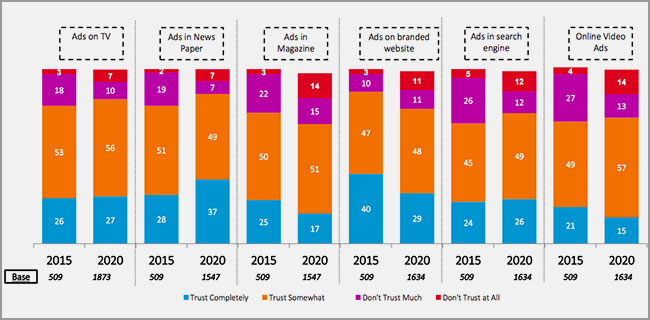
    Eight out of 10 people trust advertising. That’s the basic standout from a study commissioned by the Advertising Standards Council of India (ASCI) and the Indian Society of Advertisers (ISA), and conducted by Nielsen.


    The Trust in Advertising study was conducted with people across age groups in 20 centres in India, including metros, smaller towns and rural areas. The study found that eight out of 10 people trusted advertising messages across media.


    TV (94%) was the most common medium for consumption of advertising, followed by digital (82%), print (77%) and radio (29%). Viewership of TV ads is driven by non-metro markets.  Interestingly, viewership of ads on digital is the same in rural (82%) as it is in metros (83%).


    Prasun Basu
    Prasun Basu

    According to Prasun Basu, Global Head, Strategic Alliances and New Verticals Nielsen, this demonstrates the growing importance and centrality of this medium in the hinterland. ASCI spotted early that the growing consumption of digital content and advertising pointed to a permanent change in consumer behaviour and marketing. Accordingly, it set up robust monitoring mechanisms for digital platforms alongside its monitoring of print and TV advertising. It now scans more than 3,000 digital platforms for misleading messages.


    Advertising seen on traditional media continues to enjoy high trust amongst consumers. Advertising in newspapers (86%) emerged as the most trusted, closely followed by that on TV (83%) and Radio (83%). Text/SMS ads were the least trusted at 52%.


    In terms of shifts, consumers put greater trust in advertisements consumed on TV, print, radio, social media, outdoor and search engines as compared to what they did in a similar survey conducted by Nielsen in 2015, but there is a fall in the percentage of consumers trusting text messages over this period (58% vs. 52%)


    Among sectors, audiences displayed a very high level of trust for advertisements of educational institutions at 82%. This is possibly because culturally, Indians have a strong belief in education as a means to secure their future. Ironically, ASCI finds that a significant portion of misleading ads come from the education sector. ASCI therefore has a high focus on education sector advertising.


    Manisha Kapoor
    Manisha Kapoor

    Said Manisha Kapoor, Secretary General, ASCI: “ASCI’s job of monitoring the education sector is even more crucial, given these findings. In India, the poorest of people prioritize education spends over other necessities. Most educational institutions promise job guarantees or make false claims of being the No 1 or guaranteeing 100% placement without any objective data or evidence. We are doing our best to make sure that such false advertising is removed from the market,”.


    Sunil Kataria
    Sunil Kataria

    Added Sunil Kataria, Chairman of ISA: “Brands are built on the back of long term communication with consumers and audiences. It is in the advertisers’ own self-interest to make sure that all communication is honest and truthful, so consumers can trust advertising messages, and thereby, brands. This study helps advertisers, agencies, media owners and planners understand what works well and introspect on what needs improvement”


    The detailed findings of the study can be accessesd by clicking here


  • Peace or Perish!


    [updated with India Today Group quote & Republic TV statement]

    By Pradyuman Maheshwari


    Ask present and past TV audience measurement professionals who or what is pulling down the reputation of their business, the response would be an emphatic: news channels.


    TAM, a joint venture of Nielsen and Kantar (then owned by WPP and now majority owned by Bain), lost its measurement contracts from broadcasters, advertisers and agencies thanks essentially to news channels warring against it. Premier news network NDTV took TAM to court over allegations of faulty data, and this hastened the effort to set up the joint industry owned body Broadcast Audience Research Council (BARC). Eventually TAM sold its measurement business to BARC.


    Like TAM in the past, the BARC team faced turbulent times from the news channels, and in a letter to the BARC chairman Punit Goenka, the News Broadcasters Association (NBA) is said to have expressed its reservations about the BARC leadership of the past.


    There are murmurs that BARC CEO Sunil Lulla too has experienced some angst from news channels.


    The problem is always with ratings. That some of the channels have deep political connections makes matters worse. So every time there is a peeve, news channels flock to the I&B minister for intervention. In the past, matters have also gone to Parliament and there have been committees set up to examine nuances of the business. And if it’s not the law-makers who assert themselves, it’s regulator Telecom Regulatory Authority of India (TRAI) which intervenes.


    Frankly, the government ought not to have role in the business of news television. Except for running its own Doordarshan news channels, its publicity department DAVP which doles out advertising and monitoring objectionable content and addressing the media on issues and make announcements.


    But by running to the government often, channel owners have invited the ministers and bureaucracy to step into a territory which they shouldn’t be treading on.


    For instance, BARC’s weekly viewership data ensures that advertisers and the agencies make wise media buying decisions. It also helps broadcasters and content-makers better their content, sales and marketing act.


    But the ecosystem dominated by broadcasters inflicted on itself the government’s intervention (or interference?) and got BARC to be governed by a set of rules and regulations.


    There’s nothing new with what happened on Thursday. It occurred when TAM was around and it’s taken place under the BARC regime. There has been pilferage of information on the placement of set-top boxes, but the machinery is well-oiled to issue alerts when necessary.


    That’s what happened when Hansa Research, one of BARC’s vendors on engagement with panel homes, alerted the police about a mess up.


    Was Republic named in any written complaint? We don’t know. An FIR shared with MxM has a mention made of the India Today channel. Both Republic and India Today (by way of a report on the site) have presented their points of view.


    What we did find last night was various channels shaming Republic TV and founder, editor-in-chief and managing director Arnab Goswami. Newspaper reports today – owned by media companies which also run news channels as well as a few others – have also named Republic and Goswami prominently. The reference to other channels and India Today has been understated or is missing.


    So when did it all start? The war of words and ratings began even when Goswami was with Times Now. The channel was doing exceedingly well, on the back of the heated debates that it would air.


    But when Goswami quit the Times Network to start Republic, the daggers were pulled out from all directions. All sides are to blame. Times Now had its issues with Goswami for quitting, hiring some ex-staffers and making no bones of the fact that he was taking on his former employer. The others got on to the act the moment Republic shot to #1 in the ratings roster. ‘News without Noise’, became India Today’s credo.


    Various attempts were made to isolate Republic, including the rest of the news channels pulling out their watermarks so as to boycott BARC. On its part, Republic too countered the others – and compared its ratings with that of the others. Nothing wrong with it, except that the comparison was accompanied by much bombast. Surefire formula to rile others.


    But the war took on a new turn when Goswami launched Republic Bharat. While English news channels are influential and earn fair monies, the real bucks is in Hindi news. Aaj Tak, ABP News, Zee News have been raking in the moolah over the years. While Bharat made its presence felt, it didn’t create much of a dent until the Covid-19 pandemic-led lockdown happened and the Arnab Goswami brand of hyper-aggressive, right of centre journalism took over.


    And then came the controversy around actor Sushant Singh Rajput’s death. The line that Republic Bharat took on the controversy ensured it was numero uno. And not just for one week, but for now many weeks.


    Advertisement buying decisions are not taken in a hurry, but buoyed by its success, Republic Bharat has hiked its ad rates.


    On Thursday evening, the Mumbai police commissioner named Republic TV based on what appear to be unverified complaints and allegations. Later, on its primetime bulletin, Republic TV showed scans of the FIR naming India Today. The joint commissioner of police is reported on the India Today website stating that while India Today was named in the FIR, neither the accused nor the witnesses supported the claim. “On the contrary, the accused and witnesses are specifically mentioning the names of Republic TV…”


    The India Today Group issued a statement late on Friday: “There is a malicious campaign on right now by a few vested interests to drag the name of the India Today Group into the TRP scandal that broke out on October 8, 2020,” adding: “We welcome any probe the police may wish to conduct and are fully confident that we will come out unscathed as we have not acted in any inappropriate manner. What we have right now is nothing but malicious, unsubstantiated allegations by a vested party.”


    Republic TV has taken on the Maharashtra government and Police Commssioner Param Bir Singh over the last few months in Sushant Singh Rajput case. Meanwhile, Goswami has threatened to sue Singh.


    So what next on this? The news channels business in India is a divided house. There is the News Broadcasters Association (NBA) which comprises most of the big players operating nationally and there’s News Broadcasters Federation (NBF) which is spearheaded by Goswami and Republic. Recently TV9 pulled out of the NBA with the association lodging a complaint with BARC saying that the network had used unfair means to forge ahead on the ratings roster. The network is now back as its member.


    Singh was quoted on a channel saying that advertisers may also be called for interrogation. So will Amul managing director R S Sodhi have to make the rounds of the commissioner’s office? Perhaps he will be. Will media agency network bosses Prasanth Kumar of GroupM and Shashi Sinha of IPG Mediabrands also be questioned by the cops? If Sodhi is, surely Kumar and Sinha will be called in.


    It suits the government perfectly well to have channels warring each other. But if the police summons advertisers and agency bosses for questioning, there could be trouble. Large, pedigreed advertisers would prefer to stay away from the murky world of news television. Channel owners would do well to smoke the piece pipe.


    If warring countries and corporates can get together, surely Arnab Goswami and Rajdeep Sardesai can.


    Updates:


    Media agency bosses Sam Balsara, Shashi Sinha and Prasanth Kumar have been called to the police station for seeking information. So these may not be summons, but a request from the cops is never for a chat about the weather. There are rumours that names of certain advertisers have also been handed over to the police.


    The Republic Media Network has issued a press release: https://www.republicworld.com/india-news/general-news/full-news-release-from-republic-media-network.html. “The Republic Media Network has approached the Honourable Supreme Court of India. We have served notices of our legal action to the Maharashtra Government as well. While we will follow the law, we are determined to seek a legal remedy against this atrocious witchhunt,” the release says.


    Although Pradyuman Maheshwari is Editor-in-Chief and CEO of MxMIndia, the views here are personal and are not necessarily that of MxMIndia. He can be reached via Twitter at @pmahesh. A version of this has also appeared on The Wire at The ‘TRP Scam’ Could Open the Doors for the Government to Enter the Picture




  • Has the Lockdown diverted audio streaming to video?


    By Indrani Sen


    During this decade, the listening habits of consumers have been steadily moving to online platforms. The demand for vernacular content consumption helped popular music streaming giants to establish their apps in India and benefitted the homegrown apps. At present, the main players in the Indian market are Times Internet-owned Gaana, JioSaavn, Apple Music, YouTube Music, Amazon Prime Music, Spotify, Google Play Music and Airtel Wynk.
     

    The consumption of digital audio has been growing steadily from music streaming to podcasts. One would have thought that the coronavirus pandemic would further increase digital audio streaming, but it reality it has turned out to be different.


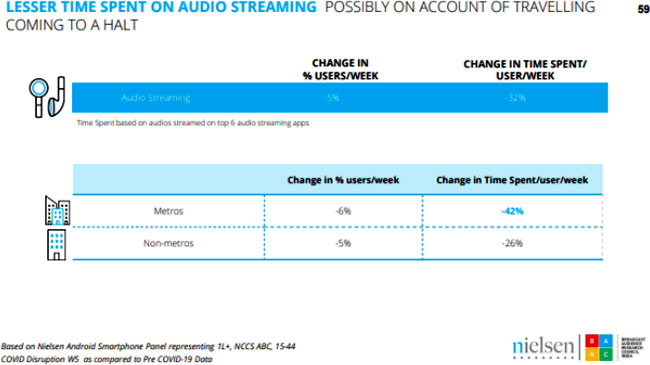
    In one of the earlier reports released jointly by BARC and Nielsen, it was reported that both users per week and time spent by users per week for audio streaming have been going down across metros and non-metros. While the research agency attributed the decline to travelling coming to a halt, informal research showed that people staying at home preferred to see music videos than listen to audio tracks of music.


    Source: Deep Dive into content and advertising consumption during COVID 19, 23rd April, 2020


    This trend has been seen across the world with www.emarketers.com  reporting on audio streaming getting diverted to video streaming in UK and US during Coronavirus lockdown resulting in decline of average time spent with digital audio in 2020.


    In UK, where steady gains were made till recently in digital audio consumption, www.emarketer.com has predicted a zero growth among the adult population in 2020. The picture in the US is broadly similar, though with time spent among adults declining only by a single percentage point. (https://www.emarketer.com/content/in-the-us-and-uk-audio-streaming-has-diverted-to-video-during-coronavirus-lockdown). April 2020 data from Nielsen Music as reported in the article, found that compared to an eight-week pre-Coronavirus baseline, audio music streaming volumes in the US were down by 6.2% in the week ending March 19 and by 9.2% in the week ending March 26. Music video streaming on the other hand increased by 9.3% and by 13.4%, respectively during the same two weeks. It is likely that a similar analysis in India will show similar trends during Covid-19.


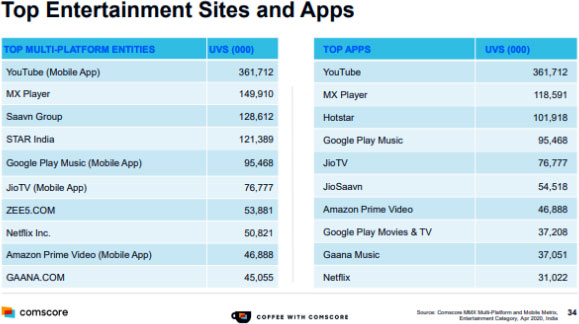
    Source: Coffee-With-Comscore-India-JUN2020


    The Comscore Report of June 2020 estimated  the number of Unique Visitors (UVS) for top entertainment sites and apps in India. Among the music steaming apps, Jio Saavan had highest number of Unique Visitors followed  by Gaana Music. Hotstar has almost double the number of UVS of  Jio Saavan. An informal check with the audio streaming companies further revealed that both their Daily Active Users (DAU) and Monthly Active Users (MAU) have been going down staedily. They are now shifting their focus to increasing their subscription revenue, which currently has a miniscule share of their revenue.


    The question which is currently haunting the audio streaming industry is if this shift to video streaming from audio steaming is a temporary phenomenon which will disappear with the pandemic or is it going to be a lasting effect which will adversely affect their future business plans? As education, trade and commerce grapple with the manifestation of the ‘new normal’ status, it can be safely guessed that the current trend is not a short-term affair. Unlocking of the economy will probably slow down the rate of diversion from audio streaming to video streaming, but it would not bounce back to the pre-Covid-19 scenario.


  • Scenarios beyond Covid-19: Rebound, Reboot, Reinvent


    This article courtesy Nielsen

    Governments around the world are edging toward plans to exit mass population lockdowns, albeit at different speeds and in different ways, but the persistent questions for business are around what the future holds and how it should be navigated.


    In response, Nielsen has identified three distinct time horizons for global market regeneration beyond the novel coronavirus (COVID-19) global health emergency and attached likely scenarios to each. The three-tiered framework identifies the conditions for businesses to Rebound, Reboot or Reinvent as they confront expected unprecedented recessionary conditions.


    With trillions being pumped into economic stimulus packages, yet thousands still dying of COVID-19 and some countries confronted by the prospect of ongoing population lockdowns, the question of how to reconfigure economies is significantly dependent on the behavioural changes taking place among the world’s consumers.


    Nielsen’s global intelligence team has undertaken an initiative that takes into account global macro conditions such as unemployment, bailout packages, and interest rates and ties them to ongoing FMCG sales and attitudinal inputs from consumers around the world. From there, the team examined common threads of consumer behaviour that tied to how the disease was being managed and the response of governments to support citizens through health and financial care.


    The findings led to three horizons being established that reveal significant new and adjusted consumer behaviours that will lead to different types of demand in terms of what, where and how consumers make purchases. They also point to a series of common characteristics likely to be exhibited by consumers over time. All of these are based on the conditions currently in play to manage the virus on a global basis.


    “Much has been made of comparisons to the 2008 global financial crisis, but this situation doesn’t make for accurate comparisons. The circumstances back then were fundamentally different,” said Scott McKenzie, Nielsen Global Intelligence Leader. “Thousands weren’t dying each day, millions weren’t locked in their homes indefinitely, businesses weren’t ordered to close their doors, kids were still in school. The impact of this will be profound and more far reaching than anything we’ve seen in our lifetimes. The pace of change is also extraordinary.”


    The new Nielsen framework extends a set of six consumer behaviour threshold levels that provided early signals of spending patterns during the first three months of the health crisis. It lays out three possible timelines for each of the scenarios:

    :: Rebound: An early return to normal living conditions (schools, workplaces, stores, restaurants etc re-open) at some point in the third quarter of 2020.

    :: Reboot: A medium-term scenario that is positioned in the fourth quarter of the year.

    :: Reinvent: A longer-term view that places the world in a general return to normal living conditions at some point in the first half of 2021.

    COVID Exit Scenarios

    “The world is fundamentally recalibrating right now. Consumer habits are changing at pace and understanding those changes, in the context of these scenarios, will be critical as businesses prioritise how they too recalibrate to meet the changed circumstances driven by COVID-19,” said McKenzie.


    The framework points to a series of behaviours and habits that will be accelerated in each of the scenarios. In some cases, changes that may have taken years to evolve could be in place in a matter of months.


    Already, this year, Nielsen has tracked significant changes to the ways people shop and the ways they think they’ll behave after the Covid-19 crisis comes to an end, particularly with regard to technology and the use of digital platforms.


    Taking advantage of Nielsen’s global footprint, the intelligence team was able to shape the new framework by also taking into account consumer sentiment, such as that measured in Europe, where many expect the impact of Covid-19 to be long lasting. And to test hypotheses using data out of markets such as China and South Korea that are further along in dealing with the disease and its impact.

    Regeneration Srategies

    In each horizon identified by Nielsen, a different set of factors and respective consumer behaviours can be identified.


    In horizon No. 1, “Rebound,” a series of health indicators, actions by governments and business, and market conditions point to a rebased “normal” that has some of the following as a societal response:

    Horizon 1: Rebound


    In horizon No. 2, “Reboot,” the societal response has a different set of focal points and positions the economy for meaningful regeneration toward the end of the year.


    Horizon 2: Reboot


    In horizon No. 3, “Reinvent,” as the name suggests, a complete reinvention is required and may not play out until the first half of 2021. The consumer behaviours and characteristics are sharply amplified compared to horizons No. 2 and No. 3:

    Horizon 3: Reinvent

    With each of these time scenarios, the baskets of shoppers will also change. The repertoire, pack sizes, brand choices, product origins and more will be reconfigured as shoppers adjust to changed economic circumstances and a sharper focus on their health and safety.


    Two clear sets of consumers will also emerge – those with insulated levels of spending, often those who have maintained employment and remain shielded from day-to-day economic impact and those who will be restrained in their spending habits due to unemployment, furloughing or other COVID-19-related challenges.


    This polarisation of spending is expected to drive new considerations for retailers and brands as they urgently examine the range of products being offered and the pricing dynamics within.


    This article originally appeared on Nielsen.