Tag: Nielsen

  • Nielsen bags research contract for IRS

    By A Correspondent


    It’s now official. The Nielsen Company has been awarded the coveted contract for the research work for the Indian Readership Survey. On a recommendation of  the Readership Studies Council of India (RSCI), the Media Research Users’ Council has decided in principle to award the contract for the IRS to Nielsen. The formal award of contract will follow a process of legal due diligence.


    The decision was arrived at after a comprehensive nine month process that began in November 2011, with the formation of the RSCI by its sponsors, the MRUC (Media Research Users’ Council), and ABC (Audit Bureau of Circulation). The RSCI was mandated by the industry to oversee the conduct of a unified Indian Readership Study (IRS), billed as the world’s largest continuous readership study.


    The process involved the active participation of 20 senior representatives of advertisers, agencies and publishers who served on the RSCI Managing Committee,  as well some of the sub committees formed to vet every aspect of the submissions – from technical superiority to fieldwork integrity, research cost, organization strength and stability. Another 24 senior industry professionals contributed to the technical deliberations, under the chairmanship of the Technical Committee, Paritosh Joshi.


    “Proposals were received from the most hallowed names in the Media Measurement universe and the quality of submissions was uniformly high. The knowledge and skill on display drew upon the very finest professional capability available globally,” said Mr Joshi. “Developing an RFP award recommendation was an unusually challenging task. The Nielsen Company proposal, that has won the approval of the Council, was exceptional in its methodological rigour, comprehensiveness and future readiness. The design recommendation and resources committed to the project should enable the Indian Readership Survey to reassert its position of preeminence in Indian media measurement,”


    “Our objective through the process was two fold – One, to achieve the construct of a study that would be the gold standard all over the world in readership measurement. And two, to involve all industry stakeholders in the decision making process with a spirit of collaboration and teamwork,” said Lynn de Souza, Chairman of the RSCI.  The months and years ahead will present several challenges as we introduce a first ever data capture system – the Dual Screen CAPI (Computer Aided Personal Interview) – a system that will reduce interview time, respondent fatigue and confusion, and interviewer bias of any kind.


    “The MRUC’s belief in the  innovative techniques and technology proposed for the forthcoming Indian Readership Survey will certainly transform market research in India, improving quality and the effectiveness of gathering and applying consumer insights for businesses and marketers. Nielsen is honoured to have been chosen as its partner in this landmark study that will no doubt shape all future research across India.” said Prashant Singh, MD – Media, Nielsen India.


    Ms de Souza commended the work put in by industry seniors in the selection process. “I am overwhelmed by the seriousness and commitment of the many industry seniors who gave freely of their time on weekends, and holidays as well, to help the RSCI arrive at a decision. Thank you would not be enough. Ravi Kiran, our marketing Chairman, was also very helpful in enabling us to identify new revenue sources given that the new IRS will be captured, stored, disseminated and analysed digitally.”


  • NDTV-TAM war impact may be seen in print if Nielsen is appointed IRS research vendor

    By A Correspondent


    Measurement has suddenly become a bad word in the Indian media. Over the last month, there has been much sound and fury over TAM Media’s television ratings with news network NDTV filing a 194-page lawsuit in New York. Since last week, the channel and WPP, principals of TAM’s part-owner Kantar, have been sparring via statements issued to the media.


    But now MxMIndia learns that there could be rumblings in the print space too, over the appointment of the research company to conduct the unified Indian Readership Survey.


    The Board of the Media Research Users Council (MRUC) which manages the Readership Studies Council of India (RSCI) is scheduled to meet today and announce the results of the contract following the RFP (Request for Proposals) issued last year.


    In a departure from the prevailing system of the research body being a partner and pocketing 85 percent of the revenues earned from sales, in the proposed system, the researcher was to be vendor being paid a flat fee. Hansa which has been conducting the study for MRUC since around eight years tied up with Ipsos and presented a joint proposal demanding a fee of Rs 10 crore. Nielsen’s original proposal was of Rs 12 crore, but the research major has been beaten down to a little below Rs 11 crore.


    However, ever since the news of the appointment of Nielsen was leaked last week, it appears that the controversy plaguing the television media research space could well lead to rumblings in print if it is indeed Nielsen which will be awarded the contract.


    MxMIndia too learns from its sources that Nielsen will indeed be appointed vendor for the IRS. The relationship is not of partnership as of now, but that of a client-vendor, where the research company has to undertake the exercise as per a set of instructions and for a fee. A global tender was issued and a technical committee carefully pored over each of the proposals. Various proposals came in but were rejected. The Hansa-IPSOS proposal reportedly did not find favour with the decision-makers because of the consortium modeit followed. It is believed that there was opposition to Hansa from some quarters.


    An MRUC member this correspondent spoke with raised some alarm. “While the work put in by the technical committee is commendable and selfless, they ought to have considered the mess that Nielsen has been in thanks to its co-ownership of TAM Media. The 194-page lawsuit sees the firm getting noteworthy mention. Moreover, there have been question marks over the retail audit too,” he said on condition of anonymity. “But it would be wrong to jump to conclusions on Nielsen’s appointment. If it is indeed true, we will raise the questions and convince ourselves. We clearly wish to be certain of the new vendors’ expertise in newspaper readership measurement – either globally or in India. We can’t afford to have any publisher, advertiser or agency questioning the measurement exercise and the bona fides of the vendor as has been the case with television.”


    That last bit we agree with. The WPP statement came in at 10.43 pm IST last night.


  • FMCG biggies HUL, Godrej, Dabur report higher sales growth numbers than estimated by Nielsen

    By Sagar Malviya & Ratna Bhushan


    Market research firm Nielsen and India’s consumer goods companies are in sharp disagreement over growth rates in the sector. In the April-June quarter of 2012, sales growth in value terms of some of India’s biggest fast-moving consumer goods companies is higher than Nielsen’s growth estimate for the overall FMCG market, raising concerns over the world’s largest research firm’s accuracy in India.


    Seven listed domestic companies, which control over 70 per cent of the FMCG market, have posted an average value sales growth of 19.28 per cent in the first quarter of fiscal 2013. A Nielsen spokesperson says their figure for this period is 17.6 per cent. Even in categories such as soaps, juices, oral care and hair oils, leading players, which contribute between 60 per cent and 75 per cent to each segment, have posted much higher volume growth than what Nielsen’s data suggests. When contacted, Nielsen did not validate the numbers that ET has obtained from the research firm’s FMCG clients.


    For instance, Godrej Consumer Products Ltd saw a 24 per cent spurt in soap volumes even as Nielsen estimates growth for the overall segment at a sombre 5 per cent in the April-June quarter. “There is a bit of under-reporting by Nielsen. The issue lies with its statistical method,” said Adi Godrej, chairman of Godrej Group.


    “We generally use Nielsen’s data for market share as there isn’t any other option for us. However, for category growth, we rely on our sales numbers and listed companies’ performance,” said Vineet Agrawal, president at Wipro Consumer Care & Lighting, which saw a 15 per cent jump in volume growth in soaps in the first quarter of the fiscal year.


    It’s a similar story in toothpastes, a category that grew 9 per cent in volumes according to Nielsen; however, this doesn’t tally with internal sales data of Colgate and Hindustan Unilever Ltd (HUL), which together command roughly 80 per cent of the market. Colgate saw a 13 per cent rise in volume growth. For HUL also it was higher, said CFO R Sridhar at a recent financial results’ presentation.


    In packaged juices, Nielsen says the category grew 18-19 per cent in the April-June quarter in value terms and that Dabur grew 24 per cent. But Dabur’s quarterly sales numbers show its juice business grew 34 per cent. Dabur leads the packaged juices market with the Real brand, which accounts for more than half of all juices sold.


    Dabur CEO Sunil Duggal said: “Our quarterly growth numbers are generally ahead of what Nielsen reports. So we prefer to study Nielsen numbers as a longer-term trend – over a 12-month period – because that evens out errors.”


    Nielsen counters that the retail audit cannot be compared with sales numbers that companies report. A Nielsen spokesperson said: “The retail audit is focused on sales offtake through a sample of retail stores that tracks sales to the end consumer. It is technically incorrect to compare it to the financial results of companies, which report sales to distribution channels.” The research firm also said sales reported by companies may include those beyond retail stores from institutions such as army canteens, restaurants and transport hubs, which are outside the scope of its retail audit.


    An FMCG analyst points out on condition of anonymity that ignoring the Canteen Services Department (CSD), which caters to the Indian defence services, may be one explanation for the discrepancies.


    After all, CSD can easily qualify as India’s largest retailer with some 3,500 outlets across the country. Nielsen is no stranger to controversy on the market share front. In May 2009, HUL disputed the researcher’s data that showed a steady fall in the company’s market share across segments, saying it contradicted internal estimates as well as data from household research firm IMRB. The issue snowballed into a crisis when Dabur, Godrej and Marico echoed similar doubts over Nielsen data. Dabur and Perfetti Van Melle even went so far as to cancel Nielsen’s subscriptions in categories such as hair oils, juices, candies and confectionery.


    A year ago, Unilever CEO Paul Polman questioned the accuracy of Nielsen’s data for India, underlining that the country’s largest consumer product maker was still unhappy with the market researcher two years after first raising the issue. “I know you all like to write about it. But they (Nielsen) are not very accurate with what their numbers are,” Mr Polman had said while commenting on the performance of Unilever’s Indian arm.


    Nielsen has increased its sampling size to 22,000 outlets from 16,000 over the past three years, included more modern trade outlets and uncovered channels in rural markets, prompting some companies to be optimistic about the research firm’s data. “We are worried, but the fact remains that at least it is not deteriorating. They have been changing panels and we have to pick up points where there are issues and work with them on it,” said Saugata Gupta, CEO of Marico, which saw its hair oil business grow over 15 per cent in volumes while Nielsen’s data shows a growth of 4.7 per cent for the category.


    Also, companies are now slightly at ease after Nielsen decided not to share data with market analysts and investors who depend on the data to track the performance of consumer product companies and rate the stock accordingly. “While we are glad that analysts can’t access the data easily, even we have stopped taking the research seriously and rely on it just for trends. Nielsen’s numbers is not a bible to us,” said a CEO of a leading homegrown consumer firm who didn’t wish to be identified.


    Source: The Economic Times

    Copyright © 2012, Bennett, Coleman & Co. Ltd. All Rights Reserved


  • NDTV takes TAM, principals to US court for $580 million [updated]


    By A Correspondent

    Leading news and lifestyle television broadcaster NDTV has taken TAM and its principals Nielsen and Kantar to court. We confirm we have filed a lawsuit in the Supreme Court of New York State. Because the matter is sub judice, we have no further comments at this time,” said an NDTV spokesperson. And here’s the response from the TAM spokesperson: “TAM India, a 50:50 Joint venture between Kantar Media and Nielsen, doesn’t comment on any litigation.”

    According to a report in Courthouse News Service and Entertainment News Digest (link: http://www.courthousenews.com/2012/07/30/48808.htm and http://www.entlawdigest.com/2012/07/30/1672.htm) :

    It seeks $580 million on 42 counts, including negligence, gross negligence, false representations, prima facie tort and violations of the FCPA and Dutch Corporate Governance Code. It claims that the Dutch Corporate Governance Code requires that Nielsen, a Netherlands-based company, act in the interests of all corporate “stakeholders.”

    The Defendants include five Kantar entities, TAM and 14 Nielsen group entities, Nielsen CEO David Calhoun and its directors James Atwood, Jr., Richard Bressler, Simon Brown, Michael Chae, Patrick Healy, James Kilts, Iain Leigh, Eliot Merrill, Alexander Navab, Robert Reib and Scott Schoen.


    [we’re unlikely to see any more updates on this, but we will update the story in case there are any]

  • Internet influences over 50% car buyers: Google

    By A Correspondent


    If you are planning to buy a car, who will you go to for advice? The Internet…family… a car expert? Various people choose various options, but according to a study done by Google India, with over 120 million Indian Internet users, the Internet plays an important role in influencing the decision-making process of India’s growing number of car buyers.


    The offline study conducted by Nielsen on behalf of Google India at car showrooms in eight metros (NCR, Mumbai, Pune, Chennai, Bangalore, Kolkata, Ahmedabad and Kochi) revealed that one in two car buyers conducted research online before arriving at the dealership. The survey also revealed that of those who had researched about their purchase options online, over 50 per cent changed their choice of car brands after uncovering new information on the web.


    Speaking about the study, Rajan Anandan, vice president & managing director, Google India, said: “This offline study substantiates the growing number of auto-related searches we’ve seen on Google Search inIndia. Auto is among the fastest growing vertical in terms of query volumes on Google. Most OEMs have not yet tapped the full potential of the digital medium and we hope this study will help them to understand and engage the Indian consumer online.”


    Respondents reported that they used the web to research and compare prices, watch online videos, find images, do competitive analysis, find dealer contacts and read both expert and user reviews. Most car buyers also rated OEMs website as the most important and trustworthy source of information. Of the 50 per cent respondents who went online, 42 per cent said they used search engine as the first source of information, just behind the opinions of friends and relatives’ (47 per cent).


    However, the auto-makers aren’t affected by the study. Abhishek Gupta, former brand manager at Maruti Suzuki India Limited and business head – North at RPS consulting said that  people might go online for research but final decision depends on what family and friends recommend. “One goes online to get a basic understanding. He might read blogs, reviews or comments to get others point of view but will buy a car which he aspires to purchase or what people close to him tell him to.”


    Voicing the same opinion, a marketing head at the leading Japanese car manufacturer, said: “Maybe Google is correct or maybe they are not. But it’s a fact that one needs to go to a showroom to get a feel and look of the various cars s/he has shortlisted before zeroing in on one.”


    The research was conducted outside the car showrooms of India’s leading OEMs namely: Maruti, Tata Motors, Ford, Chevrolet, Hyundai, Honda & VW. The total sample size for the research was 2,791 respondents. Out of which 93 per cent were males, with 75 per cent of the respondents in the age group of 25-44.


  • Congress-led UPA loses sheen as BJP inches ahead: ABP News-Nielsen Survey

    By A Correspondent


    The ABP News-Nielsen survey conducted on the eve of the UPA-II third anniversary has revealed that after eight years in power, the Congress-led coalition’s pull seems to be diminishing.


    The survey, conducted across 28 cities across the country in April-May 2012, revealed that the BJP would garner 28 per cent of the votes if Lok Sabha elections are held now, while the Congress would manage only 20 per cent.


    In fact, the BJP has turned out to be the most favoured party. In an interesting revelation, only 69 per cent of those who voted for Congress during 2009 Lok Sabha elections are still intending to vote for it, if Lok Sabha elections are held now. 31 per cent are moving away from it and 12 per cent now intend to vote for the BJP. Whereas for BJP, 84 per cent will stick with the party and only 2 per cent are switching away from it to Congress.


    In 2009 elections, 28 per cent of these respondents voted for Congress, while 27 per cent voted for the BJP. But for the BJP, the dip of 8 per cent in the Congress vote share is not a complete gain. The BJP is gaining only a marginal 1 per cent. The remaining 7 per cent dip in Congress vote share among these respondents is gain for regional parties.


    In the 2009 Lok Sabha elections, Congress had won 207 seats while BJP had got 116 seats.


    While 32 per cent believed the government’s performance was good or very good, a sizable 35 per cent rated the performance as average.


    Significant 21 per cent respondents said it was poor while 11 per cent rated the performance as very poor. The performance of UPA government has been rated slightly below average with a mean score 2.95, which is lower than the mean score of 3.22 last year.


    However, Manmohan Singh’s ratings are good with 37 per cent respondents saying his performance was good or very good. Another 33 per cent ranked him average, while 28 per cent believed his performance was poor or very poor.


    Around 32 per cent of the respondents felt that performance of UPA government is better or much better than its last term. A dip of 8 per cent is observed in the perception of people from last year survey, where 40 per cent of the respondents felt that the performance of UPA government is better than previous term. 39 per cent rated UPA performance as “about the same” this year, similar score in comparison to last year.


    Only 36 per cent of the respondents felt that performance of the PM is better than its last term. A dip of 8 per cent is noted in the perception of people from the last year survey, where 44 per cent of respondents said that the PM performed better than his previous term.


    When it comes to best leader in the country, Narendra Modi 17 per cent said he is the best leader over Manmohan Singh at 16 per cent. Modi was preferred at number four during last year’s survey (12 per cent).Manmohan was ranked at number 1 last year (21 per cent).  Rahul Gandhi’s scores have dipped from 19 per cent to 13 per cent this year.  Sonia Gandhi’s scores are down from 14 per cent to 9 per cent.


  • Hindustan Unilever to study how we shop

    By Sagar Malviya


    World’s third-largest consumer goods firm Unilever has set up a Customer Insight and Innovation Centre in Mumbai to study how consumers shop FMCG products – its first such hub in India and seventh in the world.


    The centre at Hindustan Unilever’s headquarter at Andheri will be used by several group companies in developing and emerging markets to understand how people shop in both neighbourhood stores as well as modern trade. This is the first such centre that provides shopper insight for both general stores as well as retail chains.


    “The learning will go typically in developing and emerging markets where traditional trade is big,” said Punit Misra, vice-president, customer development, at Hindustan Unilever. “We have been doing consumer marketing forever where the basic premise is consumers are truly the same,” he added.


    The insight centre will simulate the retail environment of any supermarket or neighbourhood store and then invite consumers to shop the virtual store. A device will scan their retina to track the movement of the eye, and then a map will display the spot that catches the consumers’ attention.


    Simply put, the centre will help the Anglo-Saxon consumer goods maker advice grocers on how category growth, profit per sq ft and availability can be improved using virtual reality tools.


    The company will use the data and insights from the centre to plan packaging design for future products. It will also test new product through virtual reality platform and use the facility for their promotions. So far, the company has engaged grocer outlets with promotions, display materials and margins. The development is seen as a part of Hindustan Unilever’s efforts to increase its sales and widen lead over rivals such as Procter & Gamble, ITC and Godrej Consumer.


    Analysts say the company wants to connect more with the trade at a time when millions of kirana stores it sells products to are being increasingly covered by its rivals too. While Hindustan Unilever still enjoys the country’s largest retail network of over 7.2 million outlets as per Nielsen estimates, its closest rival Procter & Gamble now reaches around 5.6 million outlets.


    “This means the company wants to come as close to the customer as it can get,” said Anand Mour, senior FMCG analyst at brokerage Ambit Capital. “It will not only increase the category but also help in getting more sales of its products since HUL is present in most FMCG categories,” he added.


    But getting millions of kirana stores to sport a look that HUL advises is a challenge. Mr Misra knows that, and feels that the company is ready to overcome that problem. “Modern trade is simpler. General trade is a bit tricky on how do you disseminate a repeatable model to five lakh family grocers,” said Mr Misra. “So we do the creation, the testing, the learning and the models, and then our execution teams on the field convert them into ready-to-use kits which they can take to the retailers,” he added.


    The maker of Lux soaps and Pond’s cream has been taking several initiatives to increase its sales and consumer base in the country. One of the recent such projects was Mission Bushfire – an employee-led market execution and customer interaction exercise initiated in 2010 to get the home and personal care giant to connect with the market place in order to increase product visibility.


    Bush Fire resulted in over 40 per cent spike in sales in store wherever the initiative were implemented, according to internal company estimates. Recently, a company official on condition of anonymity told ET that Hindustan Unilever has set a target to more than double its turnover to Rs50,000 crore by 2015 in a plan christened ’50 by 15′.


    Source: The Economic Times
    Copyright © 2012, Bennett, Coleman & Co. Ltd. All Rights Reserved


  • By Invitation | Atul Phadnis: Will TV measurement in India finally get its logical direction?

    By Atul Phadnis


    In March this year, three industry associations that have a significant say in television broadcast and TV advertising jointly announced a new chapter in the TV Ratings Measurement initiative. Broadcast audience Research Council (BARC) is the joint venture that has been in discussion, for the longest time, between the three stakeholder associations – Indian Broadcasting Foundation (IBF), Indian Society of advertisers (ISA) and the advertising agencies association of India (AAAI) to measure nationwide TV audience viewership. BARC has taken birth where a lot of earlier industry initiatives have failed to take off – hence, a lot of folks (including me) are watching these events very closely and curiously.


    Yes. There are cynics who doubt whether the BARC initiative will be able to streamline the industry ambitions for a wider and robust TV audience measurement thereby recasting/enhancing the offerings of the current ratings provider – TAM Media Research (a joint venture between Nielsen and Kantar-WPP).


    The genuine fear is that the industry initiative will again slow down or worse – get delayed due to lack of clarity or infighting amongst the associations/players. It’s a legitimate concern based on what we have seen in the past. In fact, the recent announcement has been possible only when a formula for compromise was reached after months of stalemate on the BARC shareholding and composition of its board.


    The genesis of the industry initiative that has now taken birth as BARC has in its vision the Rs329 billion TV industry that to a large extent depends on ratings and viewership information for key decisions, growth and business. So what are the key expectations of the industry that should get addressed if BARC is the answer to the TV industry’s call on TV Ratings?


    1. The Burden of Transparency

    For years now, TAM has been criticized, publicly and privately, for alleged opaque policies relating to aspects such as third-party audits, pricing, technology R&D results and panel performance KPIs. as is the case with any competitive industry bustling with cut-throat competition, rumor mills and conflicting agendas of different players, the transparency burden had been conveniently dumped on TAM. after all, we do see from time-to-time the so-called ‘open letters’ that certain channels would send out to TAM asking for explanations on why their blockbuster programs did not do well in terms of TRPs. Irrespective of where the answers for failure lie, these occasions, nonetheless, cast all sorts of aspersions on the trading currency and are hardly constructive. I haven’t seen a single such instance over the last decade produce any positive reaction – either in providing more answers on causality nor a bettering of the ratings system. and these instances surely can’t be healthy for the industry that has dependencies on advertising that in turn needs TV measurement.


    It’s high time the industry associations, perhaps via BARC, put their necks on the block and take frontal onus and responsibilities on transparency elements that will boost confidence on TV Ratings. Not only will this sharing of burden save the industry the blushes in front of the advertisers, it will also have a correctional effect with the routine debates being laid to rest. Hopefully, BARC is able to bring in transparency by defining deliverables and quality parameters clearly to the Ratings vendor(s) in the new scheme of things.


    2. Evolving data reporting policies

    Transparency in KPIs will also have an effect on how TV ratings data should be reported in our industry. There are a host of mature markets, in particular theUK, that have a threshold viewership criteria for TV program ratings to meet; if those numbers have to be reported in the weekly data. This ensures that viewership estimates for very small channels and very niche programs inside very small market groups are not reported. However, in our market, if the 700th channel gets launched tomorrow, TV ratings for that channel for very small markets and microscopic audience definitions will be available. Lack of industry understanding and consensus has stopped from any policy to take shape and solidify in this specific issue. This, in turn, has led to a sad saga of inexplicable rating fluctuations for specialist channel genres in small markets/ audiences. With the BARC coming in, certain wise old men (and women) can roll out this policy of releasing viewership numbers of only those channels and programs that are in the permissible and acceptable error level range.


    3. Structural changes in panel construction

    The methodology for TV Ratings in India- especially the way panel homes are selected from a neighborhood has remained largely the same. The criteria is defined through Primary Control Variables, a system to carve out quotas of what sort of homes should be selected to enter the panel. However, the dramatic changes that have occurred in the last 5 years – that of DTH now forming a large part of the TV universe – requires the Primary Control Variables to reflect an acceptance of that new reality. Earlier, say 8-10 years ago, cable monopolies in a neighborhood within an area, city or town ensured homogeneity of received signals in spite of the heterogeneity of viewing. That signal homogeneity within the neighborhoods would ensure that thousands of homes within that area would receive the same input from their cablewallah into their TV sets. Today that cable structure lies shattered wherein one single neighborhood would have the cablewallah’s analogue signal in certain homes, his digital (CAS) box in certain households as well as scores of homes with DTH connections from 7 DTH providers.


    Now layer this information on the specific channels or channel packs subscribed by DTH or Digital Cable viewers – and you have a distribution complexity that snarls into existence, dramatically affecting TV viewership. This distribution factor needs to be well modeled inside the Primary Control Variables to construct the panel. It is not there at the moment and neither has there been an active industry debate on how to bring newer factors such as these into the panel construction/ panel design exercise.


    4. Critical Measurement/ Panel Decisions (including R&D, Technology)

    Consumer patterns of TV consumption are dramatically changing with the advent of set-top-boxes, recorders, mobile TV, and so on. Viewing is also happening when people are on the move rather than only in-home TV viewing. In India, ratings are reported only for in-home TV viewing. TV consumption on mobiles, tablets, IPTV, computers or outside-of-home is unmeasured. If these new patterns need to be measured, a significant emphasis would be needed on R&D. This R&D and Trial Panels have to be budgeted by a vibrant industry determined to capture every viewing instance so as to analyse and eventually monetize those audiences. It would be a disappointment and a terrible waste if BARC did not have this early in its agenda.


    5. TV Measurement Vision

    It might seem unbelievable but it is true – the largest customers and users of TV ratings info today do not have a common goal or vision for the future of TV measurement in our market. Issues such as Rural versus Urban, increase coverage vis-a-vis better representation, upscale versus mass-market – would find distinctly different views within the industry. In the absence of a common vision, the strategy to expand, enhance, improve the measurement system is clearly not going to be very effective. With a forum like BARC, the attempt should be to collectively define the vision as well as the timelines and path to attaining that goal by mobilizing opinion and the industry war-chest. This is, perhaps, the most crucial aspect of the success or failure of BARC, the failure of which would risk reducing this initiative into a rudderless and spineless wonder.


    6. CPM versus CPRP

    In the last few years, broadcasters have tried, albeit unsuccessfully, to correct a long standing trading currency aberration in our industry. While the world uses CPMs (Cost per thousand ad impressions) to price benchmark TV ad inventory, our market has erroneously got locked into CPRPs (Cost Per Rating Points) – thanks to the myopic vision of media agency AORs of the 90s. While the entire industry (including media agency heads who publicly oppose change but privately admit its fairness) wants transition to the correct trading currency, the longstanding question has been who will do it first on both ends – advertisers and channels. Perhaps with BARC, the opportunity is in planning that roll-out as a coordinated industry action.


    7. Redressal Forum

    One of the biggest opportunities for BARC is to streamline the custom arguments, debates and requirements that individual players have on TV ratings into an ever evolving bucket of policies. In the current scheme of things, individual players have their differences with the TV ratings company, but not really have an escalation route to get their views heard. These issues range from pricing (dis)parity to use of raw data to choice of ratings software to conflicting TAM’s policy of not selling their data to certain client categories. Perhaps the most common arguments relate to unexplained fluctuations and peaks-troughs in the ratings data.


    BARC would be better served to pursue an approach built on open, transparent debates and a clever commercial policy in such instances that might see lesser open issues but greater revenues into the industry kitty.


    Summing up…

    The above piece is my attempt to get a constructive dialogue out in the open on a matter that deeply concerns TV Media professionals cutting across organizational lines. I personally have tremendous respect for professionals in this stream including those within the TAM Executive team as well as the industry folks driving the BARC initiative. It is my sincere hope that a constructive dialogue followed by clear and rapid forward actions by stakeholders leads to the World’s finest and biggest TV measurement initiative! amen…


    Atul Phadnis is Chief Executive, WHAT’S-ON-INDIA
     

  • [LOOKBACK 2011] Middle India on overdrive

    By A Correspondent


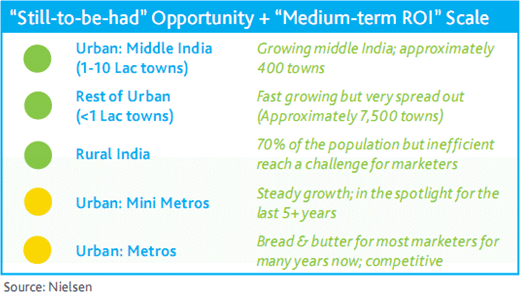
    While metros and mini metros are the flavour of the season for marketers on one side, and rural on the other, it is Middle India that is growing the fastest as far as consumerism is concerned, as per the Middle India Gold Rush, a study released by Nielsen India in December 2011.


    To define Middle India, it comprises 400 towns of population between one to 10 lakh per town. Put together these towns have an approximate populace of 100 million.


    Interestingly, the study states that Middle India would benefit disproportionately from consumerism of middle class (classified as strivers – annual household income of Rs 500,000, and seekers – annual household income of at least Rs 200,000). The reason is simple, a large percentage of the middle class resides in Middle India.


    In these towns, the markets benefit from the fact that they are easier to penetrate than metros due to sparse competition, and also easier to penetrate than rural areas due to better infrastructure.


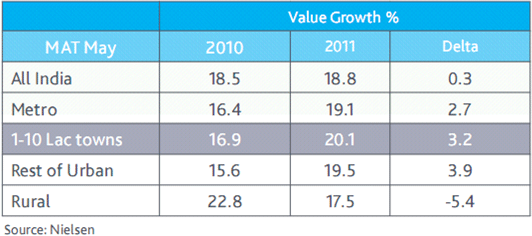
    Nielsen tracks 81 FMCG categories, and in early 2011, 49 saw faster growth in Middle India. As per the study, Middle India is showing strong value growth and as per MAT May 2011, it has moved from 16.9 per cent to 20.1 per cent growth, while for metros, the growth has moved from 16.4 per cent to 19.1 per cent, and on All India level, from 18.5 per cent to 18.8 per cent.


    Middle India is growing at a much faster pace vis-a-vis all India. From the year 2002 to 2010, Middle India saw 3.5 times growth in FMCG sector, vis-a-vis 3.2 of All India. Per Capita FMCG consumption too is much higher in Middle India as compared to All India. In the year 2010, both stood at Rs2,800 and Rs1,200 respectively.


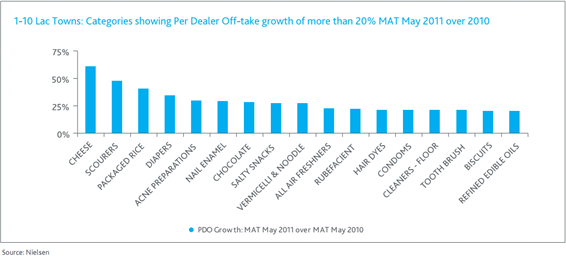
    FMCG players, obviously, are not oblivious to these growth numbers. Top FMCG players have added Rs35.8 billion from these 400 towns in the last two years. As of May 2011, FMCG per dealer off take increased to 14+ per cent in Middle India, up 2.7 points as compared to 1.5 points of metros.


    This, in turn, led to increase in number of FMCG stores in these 400 towns, at an average, 250 stores were added per town in the last three years. The total number of stores in these towns increased from 8,23,000 in June 2008 to 9,26,000 in May 2011.


    The growth story becomes even more interesting, if one looks at the subsection of 350 towns with population of 1 to 5 lakh. These towns are growing at over 20% and 56 of 81 FMCG categories outperformed All India growth rates.


    Marketers, thus, ignore Middle India at their own peril, because people residing there want to check out all the categories from potato chips to skin care and from shampoos to fragrances. They do not only want options in categories they have been using, but newer categories as well.


    Click here to download the complete report.

    http://nielsen.com/us/en/insights/reports-downloads/2011/managing-the-middle-india-gold-rush.html

  • The MxMIndia LookBacks for 2011


    LookBack 2011 coordinated by Ritu Midha


    By Ritu Midha

    The year 2011 has been full of ups and downs for the global economy. While it started on an optimistic note, the projections have been revised downwards several times since.


    LOOKBACK 2011
    The Year in News Media (Ranjona Banerji)
    Middle India on overdrive (Nielsen report)
    Top TV & Print Spenders
    The Year for GECs
    The Year for News TV
    What creative & media agencies won
    People Movements
    The winnings
    Filmwallahs dominate endorsements
    11 Noteworthy Happenings (Tuhina Anand)

    India was no exception – though it was largely due to the global slowdown – the government’s foot-dragger approach to many a policy, and high inflation rate did not help the matters any.


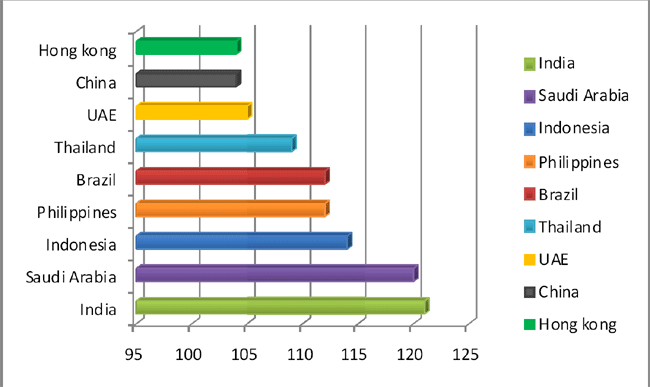
    The slowdown has led to tightened purse strings, however as per a Nielsen report, ‘Global Online Consumer Confidence, Concerns and Spending Intentions – 3rd Quarter, 2011’:  consumer sentiment in India is the most optimistic in the world, for the seventh quarter in a row. (Data Source: Nielsen global consumer online confidence survey, Q3, 2011)


    Click here to download the report from Nielsen website


    As for the economy, in January, World Bank predicted that in the year 2012, India would grow at a pace of 8.7 per cent (and the oft-compared economy, China would grow at a slower pace of 8.4 per cent).


    There is too much water under the bridge since then, and current fiscal is now expected to show growth figures of around 7%, as per Fitch, the credit rating agency.


    However, hope is back for 2012, with credit rating agencies reaffirming India’s ratings in the fag end of 2011.


    Moody’s, in a recently released report, reaffirmed India’s sovereign rating at BAA3. Though it has added that growth downturn is likely to persist for two more quarters.


    As per data released by Fitch in December 2011, the economy is likely to grow by 7.5 per cent in 2012-13. Though, in the current fiscal it is likely to be around 7 per cent.


    Interestingly, the government’s forecast is 7.5 per cent growth in the current fiscal. In its mid-year review released in mid-December, the government revised the growth projection to 7.5 per cent from 9 per cent forecasted in the pre-Budget survey.


    Another good news coming at the end of the year is easing out of food inflation. The index stood at 1.81 per cent in the period up to December10, 2011, while in the previous week it was at 4.35 per cent. The reason behind the improved numbers is the fall in the prices of cereals and vegetables.


    Inflation, till now, has led to a sharp increase in raw material prices, hurting the FMCG companies. As a result, leading FMCG companies like Hindustan Unilever, Procter & Gamble, Reckitt Benckiser, Godrej Consumer Products, Marico and Dabur were compelled to increase their product prices.


    However, according to a report by FICCI, the Indian FMCG market is now expected to grow at rate of 10 per cent (current estimates: Rs 2,600 crore) over the next 10 years and reach a size of Rs 4,13,000 crore by 2015, which would further increase to Rs 6,65,000 crore by 2020. It is good news for media fraternity, as FMCG is their main stay.


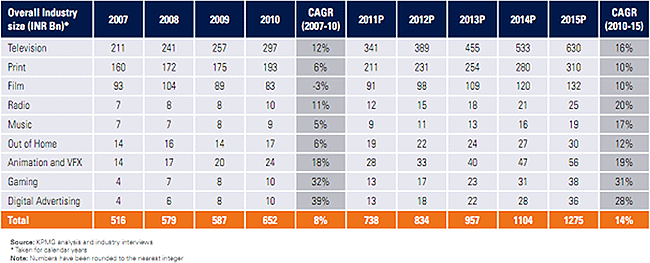
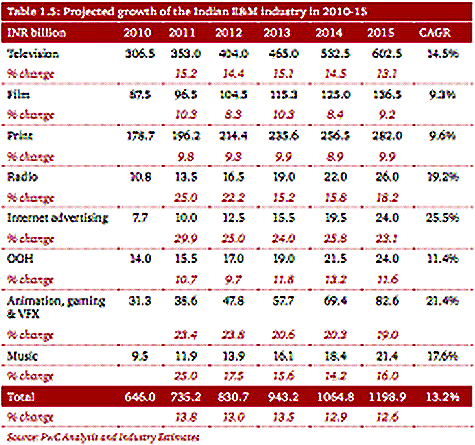
    In this back drop, let us check growth expectations of the media industry. In the beginning of the year, KPMG had predicted that the industry size would grow to Rs 341 billion – an approximate growth of 16 per cent.


    Meanwhile, as per PricewaterhouseCoopers estimates, the entertainment and media (E&M) industry in 2010 stood at Rs 646 billion as compared to Rs 580.8 billion in 2009.  This was lower than the projected growth rate of 15.1 per cent for last year. The reason for lower growth rate was the decline witnessed in the film segment. The other two key industry segments: television (15.4 per cent growth as compared to 15.6 per cent projected) and print (10.7 per cent as compared to 8.5 per cent projected), showed good growth. As per the estimates, the E&M industry size would have been Rs 735 billion for 2011, but this does not look achievable now.


    In December, both Zenith Optimedia and group M indicated a sluggish growth for 2012 globally.


    As per Zenith Optimedia, global ad spending in major media will grow to $486 billion (4.7 per cent growth). It had earlier predicted a 5.3 per cent growth in 2012. However, Asia Pacific (excluding Japan) is expected to grow by an average 10.4 per cent a year and 33 per cent of the global growth is expected to come from the four Bric markets (Brazil, Russia, India, China).


    Group M, meanwhile expects a 6.4 per cent increase in global ad spending in 2012, As for 2011, it expected to show a 5 per cent increase in ad spends over 2010, to $490 billion.


    As for India, the experts believe that growth rate in 2011 would be in single digits, while Zenith Optimedia prediction of around 11% growth might hold true of 2012.


    Look out for the second part of our yearenders tomorrow