Tag: MRUC

  • IRS revalidation will not happen by March 31

    By A Correspondent


    In what is a blow to the readership measurement mechanism, it is reliably learnt that the revalidation exercise that the Readership Studies Council of India (RSCI) and the Media Research Users Council (MRUC) were supposed to conduct along with Nielsen India hasn’t really started in right earnest.


    A meeting of a small taskforce created to look into the concerns on IRS 2013 has been appointed with senior industrypersons as members.  A meeting of this group happened last week, on March 13.


    Although the MRUC statement on February 19  had categorically stated that IRS 2013 was to be in abeyance till March 31, sources tell MxMIndia that the process will take at least another month and even more given that all stakeholders are busy with the budgeting exercises in their own organisations.


    Meanwhile, there is some confusion in the market as a few publishers continue to quote the IRS 2013 figures as it suits their business. A few others have got back to the earlier numbers. A media planner who spoke to MxMIndia on anonymity that there is much confusion and vagueness in buying decisions. “The bosses of stakeholder bodies like the INS, AAAI, RSCI and MRUC should realise that short-sightedness is self-defeating.  Had they waited for a month more earlier and revalidated all numbers properly, we would not have got to this.”


  • IRS 2013 will not be accessible on servers after tomorrow, MRUC tells Bombay HC

    By A Correspondent


    The IRS 2013 may have been in abeyance till March 31 but is still accessible to subscribers.  That is what emerges from the statement issued by the Media Research Users Council (MRUC) to the Bombay High Court where it states that all links from its servers will be disabled with effect from the evening of February 28 so that the report is inaccessible.


    This is part of the Court order which MxMIndia accessed from the Bombay High Court website*. The Order issued on Monday, February 24 was post an Arbitration Petition filed by Diligent Media Corporation, publishers of dna against the MRUC and Nielsen India.


    On February 19, at a meeting of the Readership Studies Council of India (RSCI), it was decided to keep the IRS 2013 report in abeyance till March 31 by which time a detailed probe and revalidation will be conducted.


    At the February 19 meeting, it was decided that a process for revalidation would be be finalised by February 24 and the process will be completed by March 31.


    Meanwhile, as per the communiqué, all subscribers and MRUC members were to be contacted the RSCI and its joint stakeholders – the MRUC and ABC  – to hold off usage of the study until the re-validation process is completed. With this statement by the MRUC, any fresh access to the IRS 2013 will not be possible.


    *http://bombayhighcourt.nic.in; Case  No 315 of 2014. Arbitration Petition, , Coram: Justice NM Jamdar


  • IRS 2013 in abeyance till March 31, 2014. Numbers to be revalidated [updated]

    By A Correspondent [updated]


    The much disputed Indian Readership Survey 2013 has been temporarily suspended. The findings have been put in abeyance till March 31, 2014.


    Confirming this, Hormasji Cama, Chairperson of the Readership Studies Council of India, told MxMIndia that there will be revalidation exercise that will happen until then. Until the detailed scrutiny is done, the IRS 2013 findings released on January 28, 2014 will be on hold and all will be advised not to consider it for making advertising and sales decisions.


    This decision was taken at a meeting of the RSCI board in Mumbai today (Feb 19)


    Meanwhile, MRUC has issued a press release the text of which is as follows:

    RSCI decides the way forward for IRS 2013 The RSCI Managing Committee and MRUC Board met in Mumbai earlier today. The meeting was called to discuss the way forward for the Indian Readership Survey 2013 with all its stakeholders. The meeting decided the following: * The IRS will be held in abeyance until March 31, 2014 * A process for re-validation of the study is being developed. The process shall be finalised by February 24, 2014. * The re-validation process will be completed by March 31, 2014 * Observations and recommendations arising from this process will be presented to RSCI by early April 2014 * Once adopted, the recommendations will be formally incorporated into the future architecture of the IRS. All subscribers and members will be immedaitely contacted by RSCI, MRUC and ABC to hold off usage of the study until the re-validation process is completed.


  • IRS 2013 Update: DNA sends legal notice to MRUC, Nielsen. Bhaskar gets stay order on IRS

    By A Correspondent


    The six-edition English news daily dna has sent a legal notice to the Media Research Users Council (MRUC) and Nielsen India as it “believes its readership figures are grossly misrepresented”.


    Announcing this in an announcement next to the masthead on the front page of the daily, dna communicated this move.


    Meanwhile, MRUC has pulled out the topline numbers of the IRS 2013 possibly in deference to a stay order of the District Court of Gwalior. Subscribers though can reportedly still access the data.


    According to the information received, the next hearing is on February 28 where an appearance has been sought of the MRUC representatives. The case by Bhaskar Publications and Allied Industries was filed on January 31, three days after the release of the data. The first hearing was on February 7.


  • Currency Research Crisis: IRS Today, BARC Tomorrow?


    By Shailesh Kapoor


    The new IRS results have thrown the print industry in a tizzy. The change in research design, and a fundamental one at that, has led to drastic shifts in results, in turn influencing potentially drastic shifts in ad revenues over time. While some of the concerns expressed by the print industry areabout the credibility of the data, almost 80-90 percent of the concerns can be answered by the way of change in the research design.


    But print companies (at least the publications impacted negatively) are right in saying that the research design change is not their problem. For them, IRS is IRS is IRS. If MRUC decided to refurbish its research design, and that led to a sea change in results, are they implying that the earlier results, which have been used as currency all these years, were “inaccurate”?


    Seeming “anomalies” like Hindu Business Line showing higher readership in North-East than Chennai weaken the MRUC argument considerably, by creating a sense of “flaw” around the execution of the design on field. But the real issue still revolves around a fundamental design change.


    In six years of extensive media research, I have realized the futility of even attempting to use one research to forecast the results of another research. The error margins can multiply like rabbits, and before you know, you are handling senseless data in an attempt to achieve research-to-research parity.


    For example, there are channels whose viewers we just don’t find in field research. But their viewership data suggests they exist in sizeable numbers, much more than some competition channel’s viewers, who are much easier to recruit on field. Like a radio station in Delhi is rated high by RAM, but in extensive radio research in the market, finding its listeners has always been a challenge.


    Every research has its design, based on certain underlying assumptions. And this design has a large role to play in how the results play out. There is a fairly strong element of “lottery” when the design changes. Some players are bound to benefit and some bound to lose out. Who’s on which side of this lucky dip is anybody’s guess, till the first results of the new design come out.


    When the first BARC data is released later in 2014, this situation is bound to repeat. Some channels are bound to gain and some bound to lose vis-à-vis their TAM performance. It will be easier for BARC for two reasons. One, the TAM design has been under attack anyway, so even broadcasters who show a loss of viewership will be cautious in protesting. Two, BARC is industry-backed in the true sense, and hence, voices of dissent may be handled behind closed doors in most part.


    Yet, overnight shift in numbers can create sufficient market disruption and loss of morale in the ill-affected companies. To that extent, a ratings-dark period can provide a silver lining. If new data shows major shifts after a six-month blackout, it will be difficult to isolate the impact of the shift as a result of research design change vs. a real shift in the viewership of the research universe.


    Currency research has widespread business impact and should always be packaged with a ‘handle with care’ board. Perhaps this is where MRUC went wrong. This is where TAM certainly went wrong.


    A lesson for BARC to learn?


    TV Trails is a weekly column written by Shailesh Kapoor, founder and CEO of media insights firm Ormax Media. He spent nine years in the television industry before turning entrepreneur. The views expressed here are his own. He can be reached at his Twitter handle @shaileshkapoor


  • IRS update: INS to decide future course today * Many papers withdraw * Legal action mulled to stop ongoing field research

    By A Correspondent


    The Indian Newspaper Society, the apex body of newspaper publishers in the country, had a specially convened meeting of its Executive Committee yesterday (Feb 5). According to sources, some members were incensed with the tough stand that the Media Research Users Council (MRUC) had adopted in its Governing Council meeting the previous day. “They can’t armtwist us. We are compelled to harden our stand, ” an INS member told MxMIndia.


    While discussing next steps, including legal action against the IRS, a smaller group is likely to meet in New Delhi today. The INS execom is reportedly piqued about a senior advertising honcho’s assertion that those opposing the new IRS should be banned.


    Meanwhile, many leading newspapers have written to the MRUC, RSCI and Nielsen, asking for their mastheads to not be included in the survey.


    On the legal recourse, according to one school of thought, since the IRS study is ongoing, the field work is on even as the controversy is raging. “The only way to stop the RSCI and Nielsen is by getting a stay,” an INS member told this correspondent.


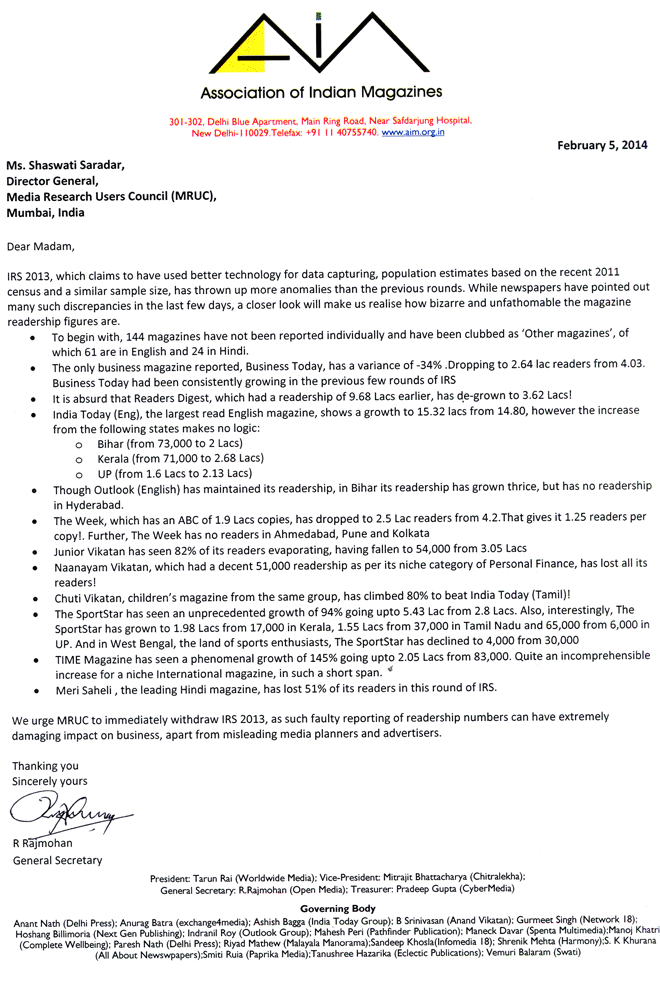
    As reported earlier, adding to MRUC’s woes is the Association of Indian Magazines communiqué asking for the IRS to be withdrawn. “The current round of IRS has many glaring glitches when it comes to magazine readership,” AIM general secretary R Rajmohan wrote in a letter, adding: “We urge MRUC to immediately withdraw IRS 2013, as such faulty reporting of readership numbers can have extremely damaging impact on business, apart from misleading media planners and advertisers. ”


     

  • Magazine body AIM asks MRUC to withdraw IRS report

    By A Correspondent


    The Association of Indian Magazine has also written to Media Research Users Council (MRUC) director-general Shaswati Saradar asking for the IRS 2013 to be withdrawn. “The current round of IRS has many glaring glitches when it comes to magazine readership. We urge to immediately withdraw IRS 2013,” wrote AIM General Secretary R Rajmohan in a mail to the MRUC.


    The text of the mail is as follows:


    “IRS 2013, which claims to have used better technology for data capturing, population estimates based on the recent 2011 census and a similar sample size, has thrown up more anomalies than the previous rounds. While newspapers have pointed out many such discrepancies in the last few days, a closer look will make us realise how bizarre and unfathomable the magazine readership figures are.


    To begin with, 144 magazines have not been reported individually and have been clubbed as ‘Other magazines’, of which 61 are in English and 24 in Hindi.


    > The only business magazine reported, Business Today, has a variance of -34% .Dropping to 2.64 lac readers from 4.03. Business Today had been consistently growing in the previous few rounds of IRS


    > It is absurd that Readers Digest, which had a readership of 9.68 Lacs earlier, has de-grown to 3.62 Lacs!


    > India Today (Eng), the largest read English magazine, shows a growth to 15.32 lacs from 14.80, however the increase from the following states makes no logic:


    o Bihar (from 73,000 to 2 Lacs)

    o Kerala (from 71,000 to 2.68 Lacs)

    o UP (from 1.6 Lacs to 2.13 Lacs)


    > Though Outlook (English) has maintained its readership, in Bihar its readership has grown thrice, but has no readership in Hyderabad.


    > The Week, which has an ABC of 1.9 Lacs copies, has dropped to 2.5 Lac readers from 4.2.That gives it 1.25 readers per copy!. Further, The Week has no readers in Ahmedabad, Pune and Kolkata


    > Junior Vikatan has seen 82% of its readers evaporating, having fallen to 54,000 from 3.05 Lacs


    > Naanayam Vikatan, which had a decent 51,000 readership as per its niche category of Personal Finance, has lost all its readers!


    > Chuti Vikatan, children’s magazine from the same group, has climbed 80% to beat India Today (Tamil)!


    > The SportStar has seen an unprecedented growth of 94% going upto 5.43 Lac from 2.8 Lacs. Also, interestingly, The SportStar has grown to 1.98 Lacs from 17,000 in Kerala, 1.55 Lacs from 37,000 in Tamil Nadu and 65,000 from 6,000 in UP. And in West Bengal, the land of sports enthusiasts, The SportStar has declined to 4,000 from 30,000


    > TIME Magazine has seen a phenomenal growth of 145% going upto 2.05 Lacs from 83,000. Quite an incomprehendable increase for a niche International magazine, in such a short span.


    > Meri Saheli , the leading Hindi magazine, has lost 51% of its readers in this round of IRS.


    We urge MRUC to immediately withdraw IRS 2013, as such faulty reporting of readership numbers can have extremely damaging impact on business, apart from misleading media planners and advertisers. ”


  • INS rejects MRUC response. Mulls alternative currency. Key publicatns to start withdrawing fm IRS

    By A Correspondent


    The Indian Newspaper Society (INS) has scoffed at the decision taken by the Media Research Users Council (MRUC) this evening rejecting the ultimatum the INS had issued to them yesterday to withdraw the IRS 2013 findings that were released last week (January 28).


    A senior publisher told MxMIndia that the INS may consider legal recourse if necessary and at least one or two big publishers have already sent letters of withdrawal from the IRS.


    On being told that the RSCI meeting is just a fortnight away, the publisher told MxM that the INS can’t wait for a fortnight as the data is in the market and is being misused. When alerted that the RSCI chairman (and a former INS president too) Hormasji Cama was travelling, the INS member and publisher told us that since the Executive Board was around, they could have met and taken a decision.


    The publisher said that the advisory issued to the MRUC yesterday (Feb 3) was clear: that the IRS 2013 should be withdrawn. The data would be then viewed, validated and re-released, if necessary. The MRUC decision can be read here: http://www.mxmindia.com/2014/02/mruc-issues-statement-decision-on-irs-by-rsci-on-feb-19/


    Meanwhile, the INS is mulling an alternative currency too, the publisher said.


  • MRUC issues statement. Decision on IRS by RSCI on Feb 19

    By A  Correspondent


    We have received the following statement from the MRUC director-general Shaswati Saradar:


    :: IRS 2013 was released on January 28, 2014.


    :: In the week since then, there has been considerable comment and discussion in the media about the quality of the study. Yesterday, the Indian Newspaper Society sought a meeting with the MRUC to discuss the situation and the way forward. Following on from this meeting, the MRUC Chairman convened an emergency meeting of the Board of Governors to crystallise the Council’s point of view. This meeting held earlier today has taken the following decisions:


    :: The Council asserts that the design, methodology and in-field execution of the study was benchmarked to and conducted at the very highest standards. The massive integration of technology, from DS-CAPI, through automated collation and tabulation, to a brand new UI (user interface) with a comprehensive suite of on-board analytics played a crucial role in this exercise. The Council intended to deliver a study that could legitimately carry the ‘Gold Standard’ appellation. It is satisfied that the study has moved many steps forward in that direction.


    :: The Council is conscious that it is now only one of the two constituents of the Readership Studies Council of India. With the RSCI now being in charge of governance of the study, the MRUC is no longer at liberty to make a unilateral determination of the way forward, particularly in a situation as contentious as it appears today.


    :: The Council looks forward keenly to the RSCI meeting called by the RSCI Chairman on February 19, 2014. All aspects of the study will be placed before the RSCI for helping the broader community of stakeholders convince themselves about the study’s robustness and integrity.


    :: A brief presentation is appended. This will elucidate many of the aspects referred above. (presentation embedded in this story)


  • Don’t reject new IRS, correct it: Amit Ray


    By A Correspondent


    Sometime in the afternoon today (Feb 3), the Indian Newspaper Society is meeting the top brass of the Media Research Users Council for a discussion on the new Indian Readers Suvey findings . On Friday, 18-odd publishers issued a joint statement. The basic message: “We, the leading newspapers of the country, condemn the newly published Indian Readership Survey (IRS 2013) in the strongest possible terms.  The survey is riddled with shocking anomalies, which defy logic and common sense. They also grossly contradict audited circulation figures (ABC), of long standing. We also strongly ask RSCI and MRUC, the conductors of the Indian Readership Survey, to withdraw the results of IRS Q4 2013 immediately and  as well as put a stop to all future editions of this survey, as their continued publication will cause irreparable injury to the reputation of established publications like ours.”


    According to the information available to MxMIndia, a senior INS officebearer wrote to the MRUC saying that members of the apex body of newspaper publishers will pull their subscriptions if the new IRS findings weren’t disbanded.”


    The print media ecosystem is divided on what should be done with the new IRS. While many publishers have damned the findings and pushing for it to be dumped in the scrapyard, there are a fair number of media agency professionals and advertisers who believe that the media research findings must be honoured.


    MxMIndia Comment: Post IRS, worries for broadcasters * When publishers hailed IRS * Likely outcome of INS-MRUC meeting

    By A Correspondent


    Guess who should be most worried after the IRS 2013 survey findings that were out last week? The entire broadcast ecosystem of course, especially the folks at BARC. While the monsieurs at tech vendor Mediametrie and the yet-unappointed panel manager may mouth a few ouis, nons or whatever, the knives and suparis will surely be out if there’s any dramatic changes from the present.


    Let’s look at a few hypothetical scenarios.

    Scenario 1: Sony is Hindi GEC #1, ratings of the #1 GECs drops 100 GRPs

    Scenario 2: India News turns #1. The current leaders fall by the wayside

    Scenario 3: In Tamil, Pudhu Yugam becomes GEC #1


    These are of course just scenarios, but if the results of the IRS 2013 out last week are an indicator, they aren’t impossible to happen. It’s going to be a change of methodology, a change of vendor (possibly not fully if TAM is selected as panel manager), a change of philosophy and an all-new Technical Committee ensuring the processes are followed and the system is robust. And above all: BARC with a chairman from the industry, a CEO and his secretariat and a techcom that has reps of a broadcaster, media agency and advertiser.


    The problem, as many industrypersons told us, is not the process, but in the final numbers. These are after all IRS survey. As in the case of BARC, even the IRS saw representatives of all stakeholders actively participating in the processes.


    In fact on the day the IRS was launched in Mumbai in March 2013, Peter Suresh, the much respect research head (Head-Strategy) at the Dainik Bhaskar told MxMIndia:  “The entire process is automated, and that is incredible. Attempt to report individually on a far larger number of geographical units is also very heartening. District cut too has increased - hence the data can be analyzed at a far more granular level. Bulk of action of late has been in rest of India, beyond six metros and hence granular cut is extremely important. Data slicing at a deeper level, and multiple ways of presenting it, make far more sense. Readership numbers are the cornerstones of most media marketing and sales strategies - and the finer they can be cut, the more robust they are. And, of course, these will help in delivering better stories to the marketers.”


    Dainik Bhaskar is one of the signatories of the statement issued on Friday against the IRS. Interestingly, a day after the IRS was released - on January 29, to be precise -several newspapers front-paged their successful showing in the readership study. These include some of the signatories to the statement.


    The meeting between the Indian Newspaper Society (INS) and the Media Research Users Council (MRUC) at 2/2.30pm today is most likely going to end in a stalemate. It may be remembered the RSCI was formed by the MRUC and INS-sponsored National Readership Studies Council to govern  the new IRS. So the buck is clearly in the RSCI court. For the INS to damn the IRS is tough because its members had endorsed the process.


    The MRUC is being represented by Chairman Ravi Rao, TechCom chaiman Paritosh Joshi and Director General Shaswati Saradar. At the time of writing, one is not aware of who will represent the INS. But Hormasji Cama, a former head of the INS and MRUC and now chairperson of the RSCI, is travelling, the decision will need to be finally taken by him.


    According to the grapevine, the MRUC/RSCI has already written to Nielsen, asking the research agency to clear a few doubts. It’s possible that the new IRS findings will be put under suspension for a few weeks until the clarifications come in and Mr Cama is back.


    MxMIndia spoke with veteran media professional and former chairman of the MRUC Technical Committee Amit Ray for his views and to suggest the way forward of the mess.


    1. Is there really any anomaly as it is being made out to be? And if yes, why has it happened?
    a. There appears to be a lack of experience in the current dispensation vis-à-vis readership research. Instead of letting go of the previous experienced professionals, MRUC and RSCI should have engaged them more significantly given that the task was assigned to the same research agency that had failed earlier. If you remember, AC Nielsen was the agency which did the NRS in the past.


    b. The questions that are now rightly being asked are: Was Nielsen the right agency? Does it have the requisite experience for newspaper readership study in India? Did we forget that NRS had failed thanks to the same agency?


    c. I strongly believe that publishers ought to have got their own experts to validate Nielsen’s methods and later the results. How can the publishers let a body like new MRUC decide about their future knowing fully well that the real pillar of the earlier IRS was the research agency and the techcom together?


    d. One of the reasons why the print media rejected the NRS and opted for MRUC’s IRS was the concept of ‘continuous research’. So why was this junked overnight? It is very likely that the current people will defend this by asking for more time. This time the publisher would do well to have their own team of experts with experience and not just blindly trust the experience (or the lack of it) of the current technical committee and the research agency.


    e. Everyone inside MRUC would’ve known about what has happened historically. Even MRUC had a problem in the past when circumstances forced MRUC to choose a new agency NFO. This was the around 2000/2001. If my memory serves me right the new Agency took almost 3 years to complete the research. May be the current office bearers were not aware of this


    2. What are the next steps? Scrap IRS?

    a. Rejecting the new IRS will be a regressive decision. Instead of rejecting it, we should look at correcting it. If we reject it, we will be starved of another 15-18 months of data which will be counter-productive to publishers.


    b. Call the people from the earlier MRUC technical committee especially those who took it to another level because of which the INS agreed to team up with the MRUC. May be a good idea to urge the veteran Roda Mehta who set up the IRS to intervene and suggest changes. I will be happy to help too and possibly pull in a few others.


    c. Ask AC Nielsen to allow a detailed audit of their actual work. Invite some of the senior folks at Hansa Research Group to come in as professionals – and not representing Hansa – to offer their advice. They are clearly best suited to find the soft spots where mistakes are committed so that we don’t repeat them


    3. Both RSCI and MRUC are part-sponsored by print publishers. The officebearers of both bodies have publisher representatives. So is it right for the INS to now play Big Brother to decisions taken by its own members?

    For the sake of the industry and the entire print media sector, it’s important that IRS 2013 is salvaged. As I stated earlier, publishers will suffer the most if it’s scrapped. Media studies like that of KPMG, PwC etc make sectoral assumptions and projections based on these. I believe the entire sector shouldn’t suffer because of the mistakes of some.


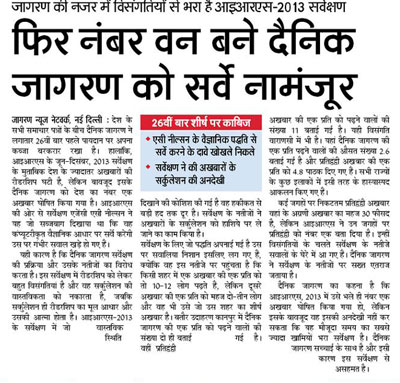
  • #1 daily Dainik Jagran damns IRS on its Page 1

    By A Correspondent


    When we wrote about dna’s questioning of the IRS findings, we had used the phrase ‘knives are out’ to describe the development. But now it appears newspapers are bracing themselves for the war.


    Leading news daily Dainik Jagran,  the numero uno daily in the  country as per the IRS 2013 study, has published a large front-page story say it doesn’t approve of the IRS findings. In fact it goes a step further and says the AC Nielsen’s claim of scientific method of surveying is ‘khokhla’ (Google translate: ~hollow, gossipy).


    Legal eagles are being consulted on how to combat the MRUC, RSCI and AC Nielsen in Court, but in the meantime those whose publications have gained much in the study or reflect favourably vis-à-vis competition are saying that it’s unfair to damn the readership study authorities.


    As reported by MxMIndia yesterday, some aggrieved dailies are considering collectively or individually filing law suits.  When alerted about this, a senior MRUC functionary told us that Court cases files by aggrieved members and newspaper groups after the publication of readership numbers is nothing new for the MRUC.


  • Key newspapers likely to contest IRS numbers in Court

    By A Correspondent


    Does it help having a stakeholder-led body supervise measurement exercises? Logically, it should, but often it could mean more problems.


    Paritosh Joshi

    Running the technical committee and the MRUC and RSCI is a thankless job, and as Paritosh Joshi, head of the MRUC and IRS techcom, told MxMIndia in an interview, “as a TechCom person, I have to do the best possible job of design and process management. The numbers are outcomes that distill the voice of respondents.”


    The problem is that a large number of the key newspapers are unhappy with the new set of readership figures. While the response was muted at the Mumbai launch of the new IRS, the murmurs got louder when the report was unveiled in Delhi on Wednesday.


    Sensing a negative outcome from the stockmarkets, a leading listed newspaper company even engaged investor analysts with data to point out what it consider as anomalies. As reported earlier, dna had also questioned the data by way of a front-page note.


    MxMIndia learns that a few leading dailies are planning to collectively and individual contest the IRS in Court. They are currently seeking legal opinion on the same.


    When alerted about this, a senior MRUC functionary told us that Court cases files by aggrieved members and newspaper groups after the publication of readership numbers is nothing new for the MRUC.