Tag: MRUC

  • Shashi Sinha & Shailesh Gupta to continue to helm MRUC

    By Our Staff


    Media Research Users Council India (MRUCI) held its 28th Annual General Meeting (AGM) on Tuesday, September 27, 2022 via Video Conferencing.


    Shashidhar Sinha, CEO – India, Mediabrands and Shailesh Gupta, Director, Jagran Prakashan Ltd. will continue in their respective roles as Chairman and Vice Chairman of MRUCI. The leadership duo was unanimously re-elected at MRUCI’s Board meeting which was held shortly after its AGM.


    New members have also been appointed to the Board of Governors, namely Shashank Srivastava, Senior Executive Director (Marketing & Sales), Maruti Suzuki India Ltd. and Vivek Malhotra, Group Chief Marketing Officer & COO Consumer Revenue, TV Today Network Ltd.


  • Shashi Sinha appointed as new BARC India Chairman

    By Our Staff


    Shashi Sinha, Chief Executive Officer at IPG Mediabrands India, has been unanimously elected as new Chairman of Broadcast Audience Research Council (BARC India) by the Board following its meeting held on March 25, 2022.


    Sinha, who also represents the Advertising Agencies Association of India as its Board member, has played a key role in the formation of BARC. He takes over from Punit Goenka, MD & CEO, Zee Entertainment Enterprises Ltd., who served as Chairman for the last three years.


    Sinha is also actively involved in various industry bodies such as the Advertising Standards Council of India (ASCI, Past Chairman of Audit Bureau of Circulation (ABC), Past President of The Ad Club, Current Chairman of Media Research Users Council (MRUC) and till very recently, before becoming a Board member, was the first Chairman of the Technical Committee of BARC India. He is also a member of the Facebook India Client Council.


    Speaking on the appointment, Sinha said: “I am excited to be given this opportunity as the Chairman of BARC at a time when the industry is undergoing many changes and the measurement body continues to grow. Over the last decade, BARC has evolved to become a robust currency and developed into a strong base for decision making for all stakeholders. I look forward to continue working with the team at BARC and I am confident that together we will be able to add and bring in more value to the broadcast ecosystem.”


    Added outgoing chairman Punit Goenka: “It has been a privilege to lead and serve BARC India as the Chairman, for two terms. The organisation has indeed grown and progressed substantially since its inception. I would like to welcome Shashi as he takes the helm of an industry-critical operation in a fast-changing landscape. I am sure that BARC India will soar to newer heights under his guidance. I also wish Nakul and the team at BARC all the very best”.


    Said Nakul Chopra, CEO, BARC India: “We would like to thank Mr Goenka, who has also been the Founder Chairman of BARC India, playing an instrumental role in setting up this measurement system. His strategic guidance and contribution made to BARC India, as its Chairman for two tenures, has added immense value,” adding:  “It gives us great pleasure to welcome Mr Sinha as our new Chairman. He is recognised for his deep understanding of the media industry, especially the broadcast sector and has been an integral part of BARC’s journey as well as India’s M&E industry. It was under his leadership that the BARC Tech Comm played a significant role in the formation of the world’s largest television measurement system. We look forward to working closely with him.”


  • Former measurement professional launches networking app for couples

    By A Correspondent


    Audience measurement professional Amit Nevrekar has moved on to set up CouPals, a networking site for couples. The rationale: While there are apps available in the social networking world, there is none that caters to couples and provides them a platform to connect with other like-minded couples.


    Amit Nevrekar

    Said Amit Nevrekar: “Only love isn’t enough! It is equally important to keep the Fun, Adventure, Mystery and Spark alive in the relationship. And there was really a need for such app as the market didn’t have any that focused only on couples, Apart from serving the relevant profiles, it would also recommend the options for dining, weekend getaways, tailor-made travel itinerary and more based on interests selection as well as couple tips & therapy through partnerships.”


    CouPals will be launched in phased manner starting with Mumbai, Bengaluru and Delhi in January 2021. Nevrekar is co-author of the book ‘The Advertising Mess’ in 2012 and worked with industry bodies BARC, TAM and MRUC. He has also worked with Kantar, GroupM and Zapr Media.


  • The Ratings Tangle: All 3 Standpoints Converge into Nullity


    By Shripad Kulkarni


    The current ‘scam’ on TV Ratings is suddenly primetime news, topic of newspaper editorials and has of course rattled the advertising and marketing industry a little. I want to look at this as a marketing communications industry event. For clarity, I will not be looking into the ethics of news journalism or the stance news channels have taken on India’s political affairs. These are very different discussions.


    So, let’s look at the ‘event’ from three standpoints in the marcom ecosystem viz the research science behind it, the users of this data and the direct stakeholders in the event.


    We will look at the research science behind it and its challenges and their implications. Next we look at the relevance and role in decision-making of this data for users. And thirdly, we will look at the direct stakeholders in play, the TV channels and the external regulatory system. We will logically examine the implications of this event from each standpoint.


    THE RESEARCH SCIENCE STANDPOINT

     At the heart of the science (statistics) of a measurement system like BARC is a statistician’s nightmare. Let me elaborate on this nightmare. There are, as is often said ‘Many Indias’ from the rural land labourers to the Zoomers (born between 1997 and 2012). To cover these audience segments, the consumer classification system (which by the way, already needs a refresh) used by current research defines elaborately 12 segments.


    In reality, this number is now multiplied manifold by the digital-led fragmentation of consumer video habits. It is impossible to be able to afford the sample size required to handle each of these segments adequately. It would take easily 10-15 times the current expenditure on research.  This is the statistician’s nightmare I am referring to. Naturally the scope and coverage of any audience measurement system will need to be restricted.


    The current system, broadly speaking, compromises on the upscale audiences and focuses where Big Advertising Monies reside viz Mass Viewership Categories like General Entertainment Channels and Cricket. Hence even a relatively big viewership category like Hindi News gets a lower representation in sample. English News is quite unrepresented. This just cannot change anytime soon – surely not because of this event.


    By simple deduction, the low sample size genres like News, stand to get massive ‘benefit’ with a slight tweaking of data. And since this is linked to the Revenues directly, every once in a while, it leads to a shot at gaming the system by some players. The current event is alleged to be this gaming of the system.


    A good research system has adequate checks and balances, without which it can’t exist. The current system does have all these and more. So, what will happen to the research science of BARC after a fresh look? It may, at best, need a few more checks and balances. That’s about it. In effect nothing much will change from a Research Science standpoint.


    THE USER STANDPOINT

    Typically, a Media Planner is the key user of TV Viewership data and in close consultation with the Brand Manager, takes decisions on Channel selection. The user is concerned about lower representation in the sample for Genres and Target Groups she/he is interested in for the Brand/s handled. Where the sample size is lower, the user finds other logical data points to estimate the relevance or popularity of Media. One way is statistical ‘normalisation’ (average over a period is the simplest example). Other ways are content analysis, specialised surveys, social media analysis and listening. Most of the users are experienced and use TV on an ongoing basis, and also have adequate past experience to rely on. In the case of Hindi News, such additional logic-based datapoints are used for validation while for significantly lower sample size situations like say English News; they could get a higher weightage.


    The Logical data points are even more important for the user when there is any consistent, significant change in the channel pecking order, like the rise of Republic TV Network in the recent past. And this change in ranking order of channels keeps happening every once in a while. Yes, sometimes due to fieldwork manipulation attempt, as is the allegation in the current case in point.


    If there is some kind of manipulation, which is missed by the checks and balances of BARC, it somehow always shows up in the logical data points. So the experienced users does own adjustment for it. By and large, gains from such a manipulation are temporary and can’t beat both these systems for a long time, is the industry experience.


    The current scam, and the plausible manipulation as a reason behind it, is pretty much what the experienced expert users have seen and handled a few times. Over and above what BARC will do to crosscheck and validate the news genre viewership, the user needs to take a rigorous fresh look at the logical data points. And needn’t do anything more.  So, again there will be no real change in the Users day-to-day life.


    THE DIRECT STAKEHOLDERS

    The media being measured are the biggest stakeholders here. In this case, however, there are also ‘external’ stakeholders due to the positions taken by News media vis a vis prevailing Political affairs. The outside stakeholders, by definition, will be involved for a temporary period. So when the dust settles, we will be left with only internal stakeholders.


    Now let’s look at the channels. As a rule, if Channel A shows better numbers, and Channel B doesn’t, both will take opposing positions, no matter what. Given the checks and balances of the BARC system, at worst, a Channel or two might be guilty of manipulation. Since BARC is an Industry body, there will mostly be a technical committee, which will probe impartially. If there indeed is a malpractice not captured by the existing checks and balances system, a newer better system has to be in place with action against the Media concerned. If despite the corrections, the pecking order remains, nothing changes.


    So, here again we pretty much arrive at the Nullity!


    Full Disclosure: I have been a user of all Media Research since the days of scientific calculators, and also served on various Technical Committees of BARC and MRUC


    *The concept of Nullity:

    I have drawn from linear algebra the concept of Nullity, a vector with all Zero values. I would define Nullity in Marcom as an event, which is a necessity, forced upon the ecosystem by an external stimulus trigger. Such an event seemingly affects various stakeholders in the ecosystem. But, in the end, whichever standpoint you choose, there is no gain or loss for anyone in the ecosystem. In other words it’s a ‘Nullity’.



  • Pratap Pawar & Shashi Sinha to continue as Chairman & Vice Chair of MRUCI

    By A Correspondent

    Pratap Pawar
    Shashi Sinha

    Pratap Pawar, Chairman of Sakal Media and Shashi Sinha, CEO of IPG Mediabrands India will continue in their respective roles as Chairman and Vice Chairman of MRUCI. This was decided upon unanimously at the Board meeting held immediately after MRUCI’s 26th AGM on Tuesday, September 29.


    Two new members have also been appointed to the Board of Governors. They are:

    1. Sivakumar Sundaram, Chairman, Executive Committee of Bennett, Coleman & Co. Ltd (BCCL).

    2. Sejal Shah, Managing Partner and Head of Publicis Media Exchange (PMX – Mainline).

    Said Pawar: “First of all, I congratulate and welcome our newly appointed board members. We look forward to their valuable ideas and suggestions especially in these aberrant times. MRUCI has always been at the forefront in advancing the cause of media research in India and we will continue to serve this cause and provide the industry and our members in particular a robust and reliable media research.” Pawar also thanked all the retiring members for their valuable guidance over the past years, and sought their continued support towards the Council’s objectives.

    Added Sinha: “The media and advertising industry is slowly, but steadily getting back on track. Our focus will be to work towards re-launching the IRS study at the earliest taking into consideration the ground realities, and to further enhance the IRS and its offering in the new normal world.”

  • The Internet Gets Mainstream, Finally


    By Indrani Sen


    On May 8, 2020, the Media Research Users Council India (MRUC) released its findings of the last and final quarter of Indian Readership Survey 2019. Fieldwork of IRS 2019Q4 covered the period from December 2019 through March 2020 and the report has data based on a rolling average of four quarters of IRS 2019 data i.e. Q1+Q2+Q3 and Q4 2019.

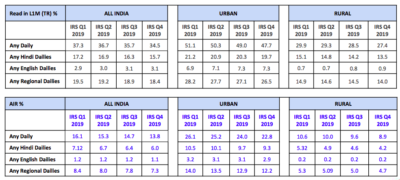
     

    The highlights of the readership trends among English and vernacular titles have already been reported and analysed by different industry websites. The highlights of the survey- presented jointly by Nielsen and MRUC – has noted that: “Newspaper readership, is on a slow decline and is a trend seen across Hindi, English and Regional languages”. Vikram Sakhuja, IRS Technical Committee Chairman and Group CEO Madison Media & OOH, Madison World has noted in the press release: “(The) ability to read and understand English has increased and while overall print readership is holding, daily readership has started showing signs of decline.”


    According to the highlights of the report, a “rapidly evolving media landscape with multi-media adoption is seen across consumer strata resulting in large media markets, both traditional and digital with substantial increase in Internet penetration lifting it to mainstream along with TV and Print.” Moreover, the report has acknowledged “There was more number of internet users (Last 1 month) in rural now then urban.”


    Source: IRS2019Q4


    If we consider that the fieldwork for March 2020 ended before the National Lockdown due to Covid-19 was imposed on March 25, 2020, we can easily guess a further surge of internet users has happened across urban and rural India in the last seven weeks. Unfortunately, as the IRS fieldwork also is on hold now, we will have to wait for sometime before we get a clear indication of the media usage during the total and subsequently partial Lockdown enforced by Covid-19.


    IRS2019Q4 highlights have also given us a glimpse of how Indian consumers today are more equipped and more connected than before as shown in the following chart. There would not be significant change in the connectivity except during the lockdown both ‘shop from modern trade’ and ‘online shopping’ may go down and ‘access social media’ may go up substantially.


    Source: IRS2019Q4


    This calls for a total change in the approach of media planning where TV and Digital would have to be planned simultaneously now supplemented by Print, Radio and OOH plans. It would also be beneficial to plan for TV and Digital under the same roof by the same media agency than to distribute the business by traditional media and digital media to two different media agencies.


    Unfortunately, we still do not have single source data for TV and Digital media users which is essential for preparing cutting edge media plans. BARC’s plan for providing such data have been shelved indefinitely reportedly due to non-cooperation by Google and Facebook and instead of finding a solution to that problem, TRAI has now created other problems for the ongoing research on TV viewership with their new directives about TV viewership research. So, as internet continue to surge ahead as a mainstream media, media agencies will keep struggling with data and insights for doing justice to their media plans.


  • IRS 2019 Q4 results out

    By A Correspondent


    The Media Research Users Council India (MRUC India) released findings of the last and final quarter – Q4 – of IRS 2019.


    IRS 2019Q4 is a rolling average of four quarters of IRS 2019 data i.e. Q1+Q2+Q3 and Q4 2019, the fieldwork (Q4) of which covers from December 2019 through March 2020. The sample size of IRS 2019 is 3.27L Households across India out of which urban sample size is 2.14L Households and rural is 1.13L Households. IRS 2019Q4 is the full-year report covering four quarters of a continuous and uninterrupted IRS 2019 fieldwork. Media landscape is rapidly evolving with multi-media adoption seen across consumer strata. Overall Media reach continues to grow even as the consumption of each media remains more or less stable, with internet making a noteworthy exception by leading this growth curve, particularly in rural India. Among other highlights from IRS 2019Q4 data – Electrification in India has surged, premium durable ownership in households have increased and so has individual’s online shopping and smart phone ownership across both urban and rural India.
     

    Said Pratap Pawar, Chairman of MRUC India and Chairman of Sakal Media: “We have successfully completed and released all four quarters of IRS 2019 data. I thank our Board of Governors and IRS Technical Committee for their unwavering commitment and their resolve in providing the industry with a robust, reliable and timely research study.”


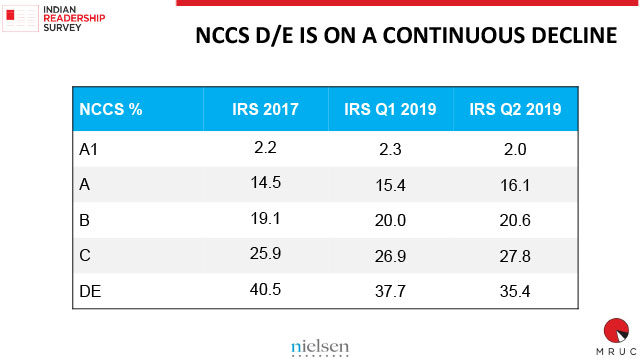
    Added Vikram Sakhuja, IRS Technical Committee Chairman and Group CEO Madison Media & OOH, Madison World: “With four quarters of 2019 data now complete we are reporting a complete year’s picture. Earlier quarters had also included some part of 2017 data. A few trends are emerging. Internet penetration has increased substantially and is now mainstream along with TV and Print; NCCS D&E are reducing quarter on quarter faster than HH socio economic status thereby suggesting the need to Relook at the NCCS definition; ability to read and understand English has increased and while overall Print Readership is holding, daily readership has started showing signs of decline.”


    IRS 2019Q4 is a rolling average of four quarters of IRS 2019 data i.e. Q1+Q2+Q3 and Q4 2019, the fieldwork (Q4) of which covers from December 2019 through March 2020. The sample size of IRS 2019 is 3.27L Households across India out of which urban sample size is 2.14L Households and rural is 1.13L Households. IRS 2019Q4 is the full-year report covering four quarters of a continuous and uninterrupted IRS 2019 fieldwork. Media landscape is rapidly evolving with multi-media adoption seen across consumer strata. Overall Media reach continues to grow even as the consumption of each media remains more or less stable, with internet making a noteworthy exception by leading this growth curve, particularly in rural India. Among other highlights from IRS 2019Q4 data – Electrification in India has surged, premium durable ownership in households have increased and so has individual’s online shopping and smart phone ownership across both urban and rural India.

    IRS 2019 Q4 Highlights_compressed

  • MRUC releases IRS 2019/Q3

    By A Correspondent


    Just last evening young Ramesh was celebrating with his family that his parents would celebrate New Years’ Eve at home with him. He still recalls how the big Independence Day holiday that he was hoping to celebrate got messed thanks to IRS 2019/Q2 being released. But alas, Ramesh’s dream of a holiday are going to be shortlived. Earlier today (December 28), at 5.08am to be precise, our inbox received the all-important communique:


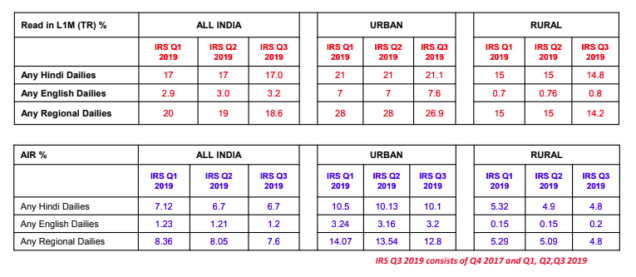
    The Media Research Users Council (MRUC) has announced the release of IRS 2019Q3 data. The 2019Q3 data is a rolling average of the last quarter of IRS 2017 (Q4) and three quarters of IRS 2019 (Q1+Q2+Q3). IRS 2019Q3 fieldwork covers August 2019 through November 2019.


    Notes a communique: “Multimedia consumption is the order of the day with each medium holding on to their loyal consumers. Overall media reach has grown with digital leading the growth trajectory.”


    In view of sample shortfall in Andhra Pradesh, the IRS Technical Committee has decided to release IRS 2019Q3 data excluding AP, as of now. The IRS 2019Q3 data including AP will be released in a fortnight’s time. Comparative analysis until then, at all India level, will not be permissible. While the reporting sample size at all India level (including AP) is 3.30 Lakh Households (Urban: 2.14L Households and Rural: 1.15L Households), without AP, the reported all India sample size will be 3.15Lakh Households (2.05L HH in Urban and 1.09L HH in Rural).


    IRS2019Q3 fieldwork in Jammu and Kashmir was adversely affected because of political and administrative developments in the State (now union territory). In consultation with the IRS Technical Committee, it has been decided to report J&K data  by utilising and projecting the last four quarters of IRS data i.e. Q3+Q4 2017 and Q1+Q2 2019 to the updated universe for the current round of IRS 2019Q3.


    Commenting on the release of IRS 2019Q3 data, Pratap Pawar, Chairman, Sakal Media and Chairman of MRUC said, “IRS being the world’s largest survey not only reflects the ground reality in terms of print readership, but also for other media and product consumption. The stringent field monitoring system, rigorous data validation processes and the overall methodology of IRS ensures the industry gets a robust and reliable data.”

    Added Vikram Sakhuja, Group CEO Madison Media & OOH, Madison World and IRS Technical Committee Chairman: “The IRS is a fascinating barometer of how India consumes Media.  From this round we see that Indians consumption of media continues to grow with digital growing on top of other mediums remaining steady. I would urge all marketers to deep dive into the data. There are fascinating insights about the diversity that is India waiting to be found.”


    Please click here for deck of IRS 2019Q3 Highlights

    Some pointers from the all-important AIR and TR slide:

    • English readership grows. Grows or stays steady in most of the country except for Uttarakhand where it has gone down by 1%

    • AIR Hindi dailies All-India is the same vis Q2. Urban has degrown by 0.03%. Rural goes down by 0.01%

    • AIR English dailies vis-a-vis Q2 All-India has degrown by 0.01%. Urban has grown by 0.04% and rural also by 0.05%

    • Any Regional dailies AIR: vis-a-vis Q2 AIR has gone down by 0.09% in All-India. Urban has gone down by 0.06%, and Rural by 0.29%

    • TR Hindi dailies All-India is the same vis Q2. Urban has grown by 0.1%. Rural goes down by 0.2%

    • TR English dailies vis-a-vis Q2 All-India has grown by 0.2%. Urban by as high as 0.6% and rural also by 0.04%

    • Any Regional dailies TR: vis-a-vis Q2 AIR has gone down by 0.4% in All-India. Urban has gone down by 1.1%, and Rural by 0.8%


  • MRUC issues RFP for research agency partner

    By A Correspondent


    MRUC has issued an RFP (Request for Proposal) inviting research partners to pitch for the contract to conduct the Indian Readership Survey. MRUC’s contract with the incumbent agency, Nielsen India, concludes with the release of the last and final quarter of IRS 2019data – Q42019.


    Pratap Pawar

    Said Pratap Pawar, Chairman, MRUC and Chairman of Sakal Media: “We are looking forward to receiving and studying each and every proposal from various research agencies. They will be evaluated basis their understanding on IRS, on meeting our research requirements stated in the RFP and of course what more they can offer beyond our stated requirements.”


    Shashi Sinha

    Added Shashi Sinha, Vice Chairman, MRUC and CEO of IPG Media Brands: “Security enhancements and measures taken to ensure accuracy in data will be some of the key objectives in selecting the new research partner. We will be working closely with industry stakeholders in the selection process and ensure the industry gets the best partner to conduct the world’s largest study – IRS”.


    Vikram Sakhuja

    Said Vikram Sakhuja, Chairman, IRS Technical Committee and Group CEO Media & OOH, Madison: “Over the years we have brought in a lot of automation, technology and controls to ensure that we get valid and reliable data for IRS – India’s most widely used Media establishment study. In this RFP we are looking for an Agency who can give us confidence in their mastery in Fieldwork, and who can impress us on enhancing the controls while minimizing the cost. I wish all participants the very best.”


  • Das ka Dum with Dr Bhaskar Das: Can one trust audience measurement data?

    It’s going viral. Each Q&A we hear is firing up the Whatsapp and mail circuit. People have been laughing, screaming out incorrigible reading a response… but there’s no denying that each question-and-answer is profound and funny. Presenting Das ka Dum with Dr Bhaskar Das. And do come back next week for another round of questions and answers.

     

    Please go to the Das Ka Dum tab on the website’s top navigation bar, to visit the archives of Q&As.


    Q. Can one trust audience measurement data?


    A. I am a strong advocate of data-based insights to complement decision-making processes. So any measurement data can at best be indicative and should be leveraged for directional purposes. Doubting the credibility of measurement data isn’t a constructive route to move towards an augmented intelligence.


  • Pratap Pawar is MRUC chairman for 2019-21, Shashi Sinha is vice-chair

    By A Correspondent


    Shashi Sinha

    It may have been raining cats and dogs in the rest of the city, but Media Research Users Council (MRUC) held its Annual General Meeting and unanimously elected Pratap Pawar, Chairman of Sakal Media Group as its new Chairman, and Shashi Sinha, CEO, IPG Mediabrands as its Vice Chairman. The announcement was made at the MRUC’s Board meeting following the 25th Annual General Meeting. Pawar took over from from Ashish Bhasin, CEO – Greater South and Chairman & CEO – India, Dentsu Aegis Network.


    Pratap Pawar

    Said Pawar while thanking the MRUC Board: “I thank Ashish Bhasin for his immense contribution to the growth of the Council and the IRS in particular. I assure the stakeholders of MRUC that together we will indeed take IRS to new heights and provide the industry with a more robust, reliable and accurate study. We will continue with our all-inclusive and democratic approach to address industry concerns and provide acceptable solutions which will help the industry make effective business decisions.”


    Ashish Bhasin

    Added Bhasin: “It was indeed an honour and privilege to helm such an august body of industry stalwarts over the past couple of years. There were challenges MRUC was faced with when I took over, with the existence of the IRS study itself being questioned, having been out of the market for almost four years. From there to today – where, not only is the IRS back on track with quarterly updates, butis now universally accepted as the currency for print – it has been an incredible journey.I truly appreciate the support of the MRUC Board as well as key industry stakeholders who helped us restore the IRS to its past glory. I am confident that Pratap Pawar will take the IRS and MRUC to even greater heights. My best wishes to him and the new Board members.”


  • MRUC releases IRS 2019Q2 data


    By A Correspondent


    For many this week given the number of public holidays meant an opportunity to take a few extra leaves and go for a quick holiday. Yes, there are some part of the country which have been impacted badly by rains – especially for Mumbaikars wanting a quick getaway around Maharashtra, Gujarat or Goa or even coastal Karnataka.


    For a weeks now, the industry is buzzing with rumours that the release of Quarter 2 of the Indian Readership Survey will be released in the second week of August. The MRUC Board and management would’ve reviewed the broad direction and identified the booboos, if any, if given the go-ahead.


    Now the decision to release it: by doing so on August 14, a day before the national holiday of Independence Day, ensures that the backrooms in newspaper offices and their consultants can work unhindered by the daily grind. But, also, if there’s some angst about the survey results, time works as the best healer.


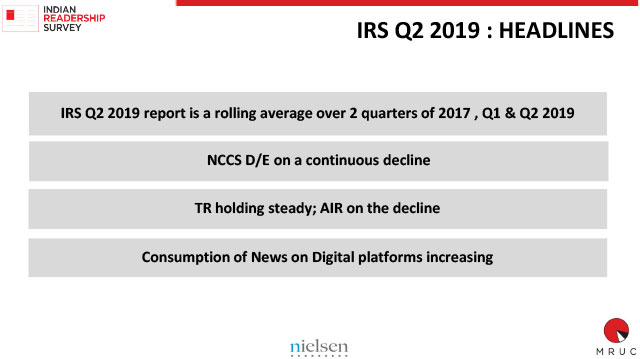
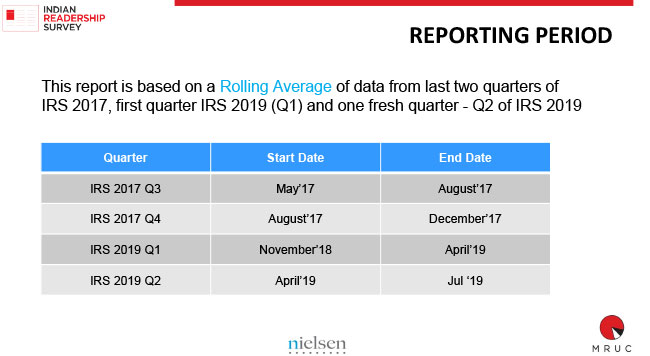
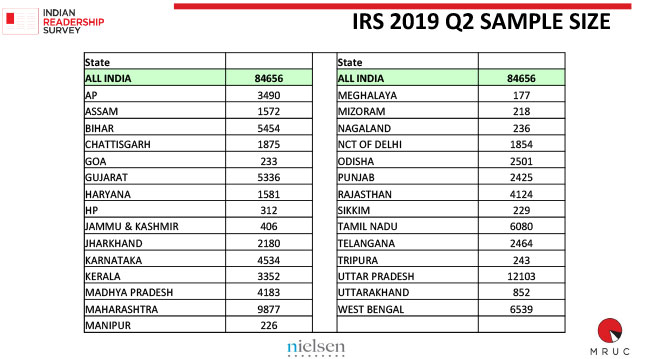
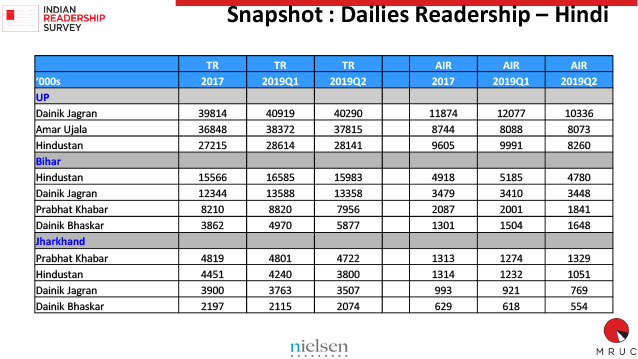
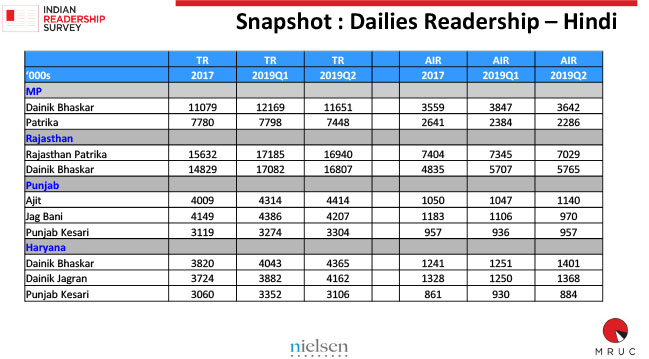
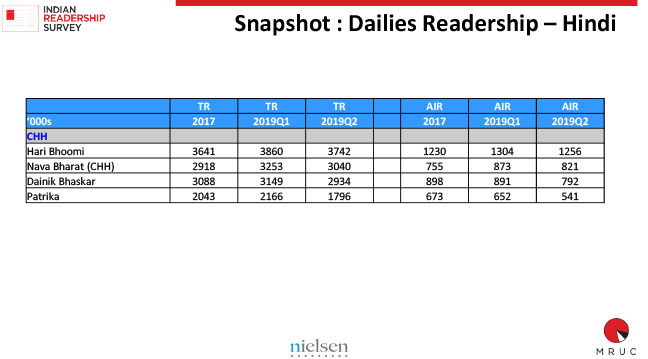
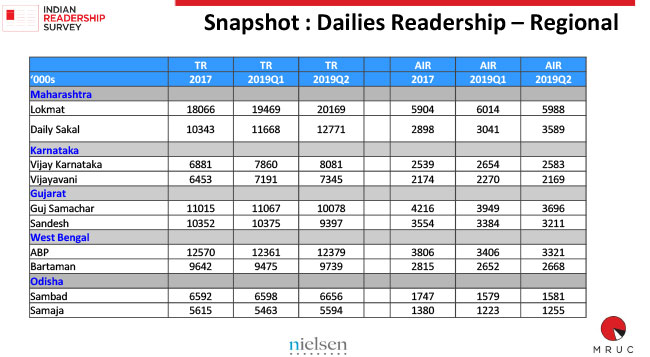
    What reached our inboxes on August 14 afternoon was news of the release of IRS 2019Q2 data. The 2019Q2 data is a rolling average of the last two quarters of IRS 2017 (Q3+Q4) and the first two quarters of IRS 2019 (Q1+Q2). IRS 2019Q2 fieldwork covers April 2019 through July 2019. The reporting sample size for this data is 3.36 Lakh households.


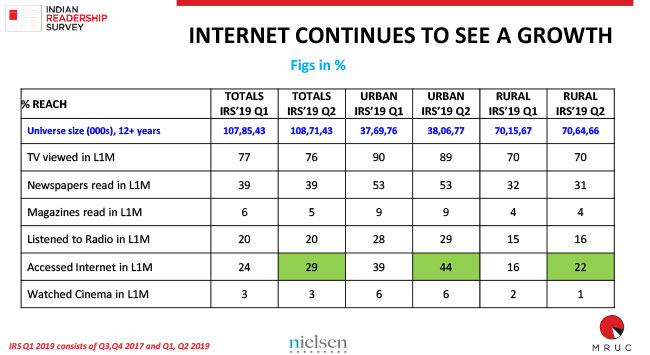
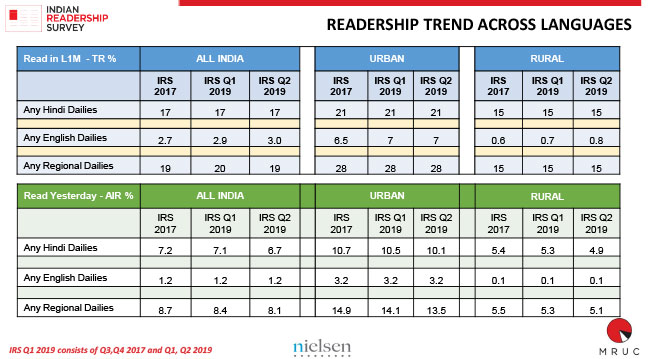
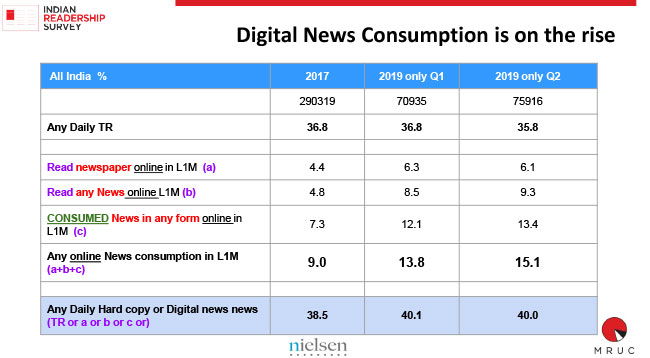
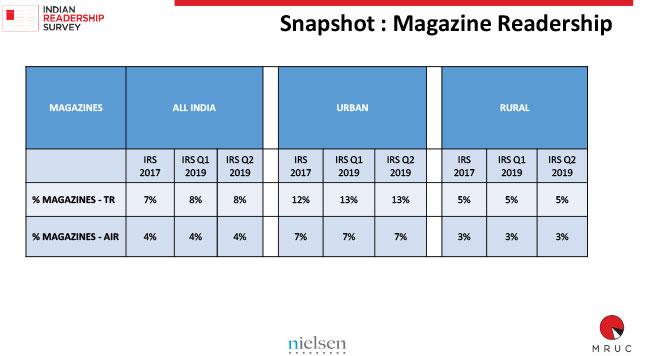
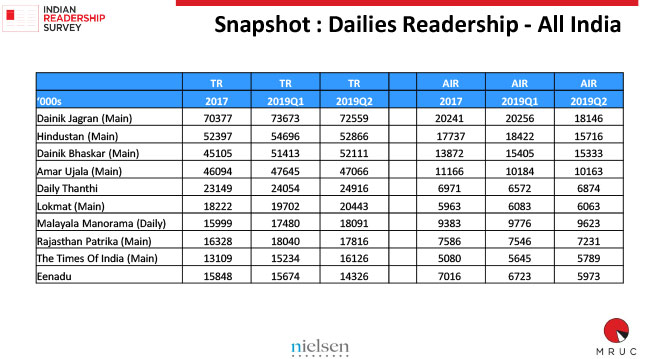
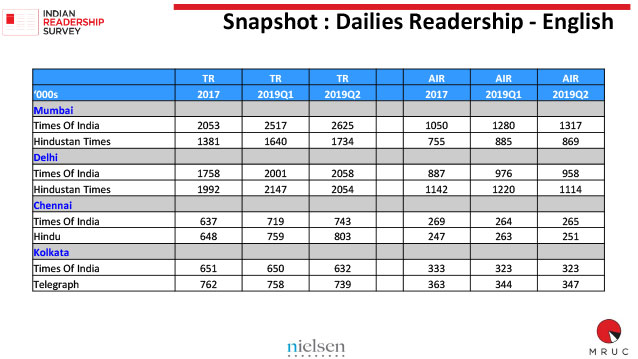
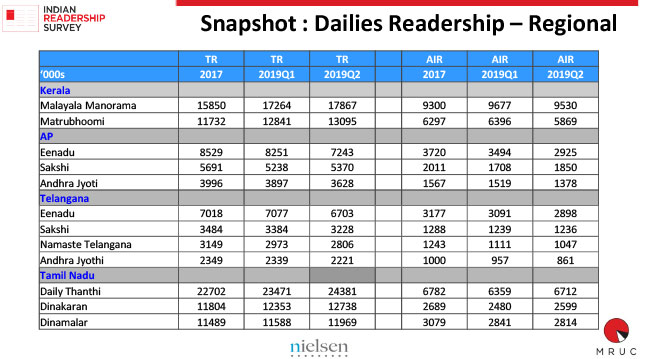
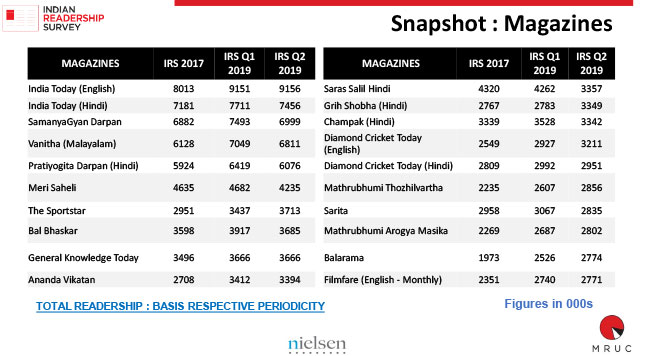
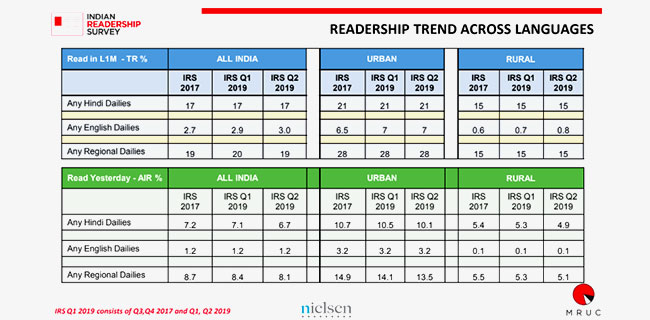
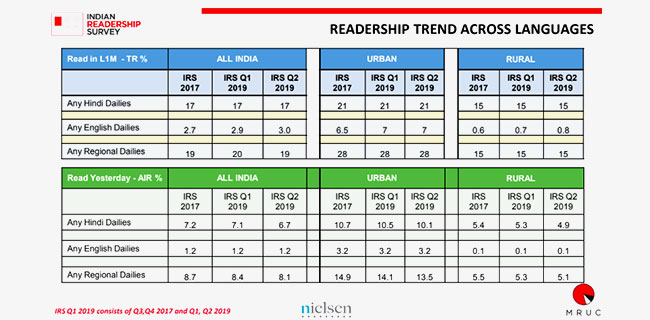
    Here’s the bottomline, in the words used by the MRUC communique, not by us: The reach of print, television, radio and cinema vis-à-vis the previous IRS quarter, largely remains unchanged. Internet as a notable exception continues to grow. Consumption of news on digital platforms is on the rise. And whilst Total Readership (TR) of publication remains steady, Average Issue Readership (AIR) has seen a marginal decline.


    Commenting on the release of IRS 2019Q2 data, Ashish Bhasin, CEO – Greater South and Chairman & CEO – India, Dentsu Aegis Network and Chairman, MRUC, said: “Firstly I must thank the MRUC Board and the IRS TechCom for their steadfast dedication in providing the industry with a timely and robust study. The findings of IRS 2019Q2 gives us a clear picture of the reality we all know – that digital is on a roll and continues to grow at a faster pace. Print readership remains healthy and I firmly believe the future lies in the power of two and not just one. I am very pleased to see IRS release every quarter. Not only is the IRS back on track, but has emerged much stronger and is being universally accepted as the currency for readership in India.”


    Added Vikram Sakhuja, Group CEO Madison Media & OOH, Madison World and IRS Technical Committee Chairman: “We are very pleased with the quality of data that is being released this quarter. India is consuming more media than ever before. Internet is now fast catching up with Print and these two along with TV are the dominant mediums that can be used to reach consumers.”


    The numbers you see here are just the toplines – these are the ones shared by MRUC. For the real thing, one needs to subscribe to the data. Valid point.


    So there’s no real point in us analysing anything. Even the marginal decrease in AIR is an overall number… one needs to look at how the AIR number of a particular genre or publication is to make an informed decision.


    INDIAN READERSHIP SURVEY Q2 2019 HIGHLIGHTS