The new Indian Readership Survey findings are scheduled to be released next week.
It may be remembered that on the basis of a recommendation of  the Readership Studies Council of India (RSCI), the Media Research Users’ Council had awarded the IRS contract to Nielsen. The decision was arrived at after a comprehensive nine month process that began in November 2011, with the formation of the RSCI by its sponsors, the MRUC (Media Research Users’ Council), and ABC (Audit Bureau of Circulation). The RSCI was mandated by the industry to oversee the conduct of a unified Indian Readership Study (IRS), billed as the world’s largest continuous readership study.
The Technical Committee meeting was held yesterday (Jan 22) and the first findings of the study are scheduled to be released before the month ends, and in all probability on January 28.
(See also:Â http://www.mxmindia.com/2013/03/new-improved-irs-hailed-by-industry/)
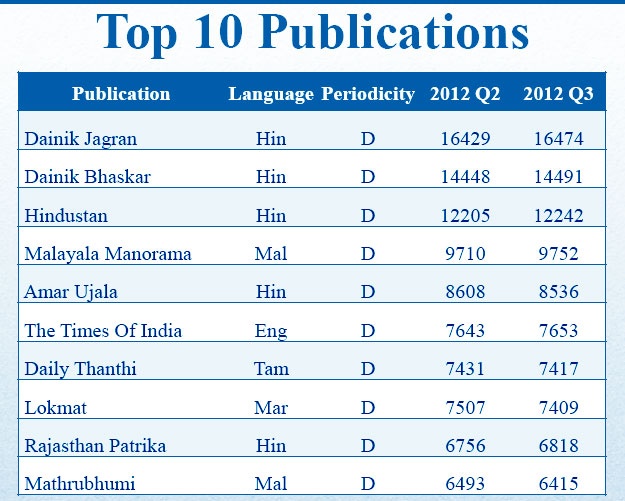
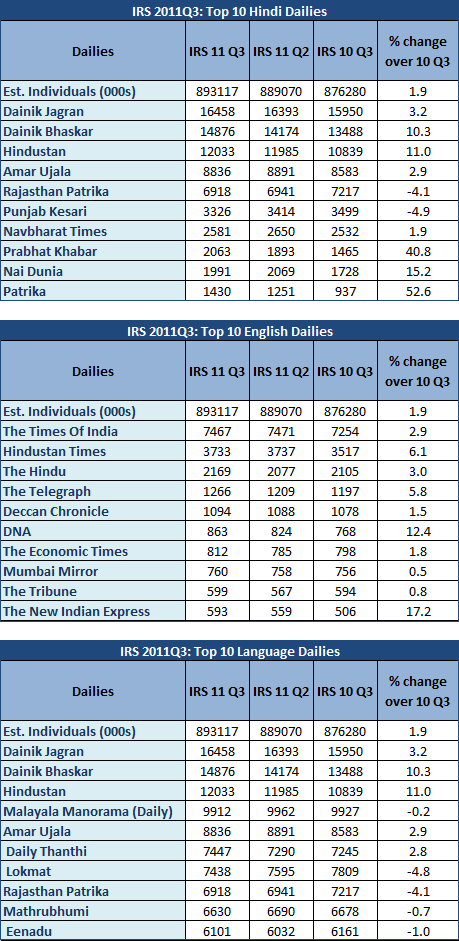
There are no major surprises in the numbers for the Indian Readership Survey’s findings for the third quarter of 2012 have just been released by the Media Research Users Council (MRUC).
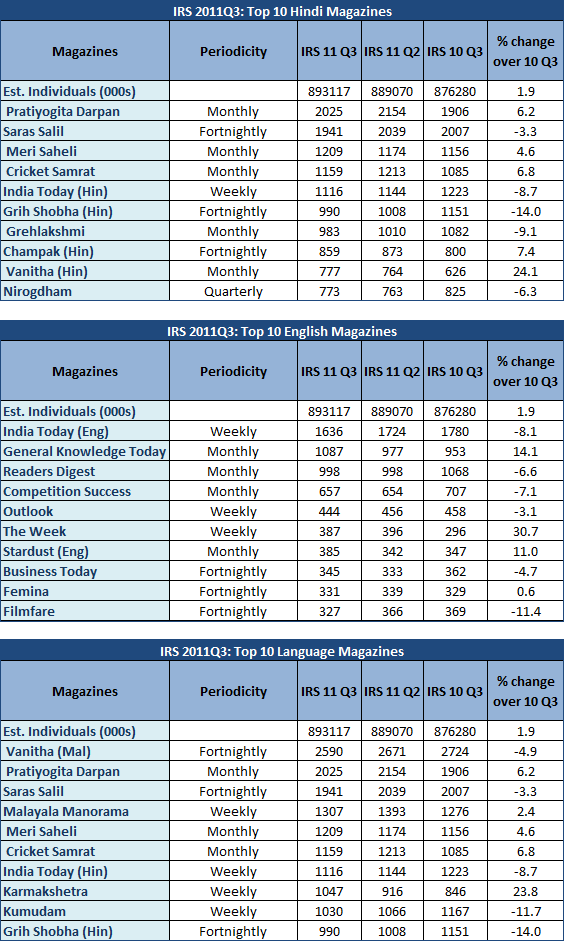
Jagran leads amongst all publications and dailies. Vanitha leads amongst magazines. The Times of India leads in English dailies and Malayala Manorama amongst regional-language dailies. Pratiyogita Darpan and India Today are the largest read Hindi and English magazines respectively.
(AIR numbers; All figures in '000)
There’s been a 0.7 growth in the print media between the second and third quarters of 2012. However, the growth in television has been 6.1& and specifically in cable and satellite homes it’s 10.5%. The growth in consumption of radio is 6.4% and cinema is at 17.2%. The growth in internet is on expected lines at 27.5%.
The Calcutta High Court has held that the arbitration clause embedded in software of the Indian Readership Survey, which is part of the terms and conditions a user must accept before accessing data, is binding. Disposing of a petition filed by ABP Private Limited and vacating an injunction earlier granted by the Court, Justice Nadira Patherya referred the dispute relating to IRS 2008 to arbitration, in a judgment delivered on September 25.
Responding to ABP’s petition challenging IRS findings, MRUC had contended that the dispute had to be referred to arbitration, as this clause was a part of the terms accepted by users. This was contested by ABP.
The court held, “The issue sought to be raised by the plaintiff in C.S. No.242 of 2008 is covered by the arbitration agreement as the same has been couched in the widest terms and encompasses the issue raised, and the same be referred to arbitration”.
A statement from MRUC said that it is a body constituted of media research users by media research users for media research users. It succeeds only when it advances the interests of its diverse stakeholders in the communications industries. MRUC recognizes that there will be situations in which users may disagree with some aspect of the conduct of various researches that it conducts. It is precisely to handle such disputes in a spirit of collaborative resolution that MRUC places so much emphasis on arbitration, the statement added.
Measurement has suddenly become a bad word in the Indian media. Over the last month, there has been much sound and fury over TAM Media’s television ratings with news network NDTV filing a 194-page lawsuit in New York. Since last week, the channel and WPP, principals of TAM’s part-owner Kantar, have been sparring via statements issued to the media.
But now MxMIndia learns that there could be rumblings in the print space too, over the appointment of the research company to conduct the unified Indian Readership Survey.
The Board of the Media Research Users Council (MRUC) which manages the Readership Studies Council of India (RSCI) is scheduled to meet today and announce the results of the contract following the RFP (Request for Proposals) issued last year.
In a departure from the prevailing system of the research body being a partner and pocketing 85 percent of the revenues earned from sales, in the proposed system, the researcher was to be vendor being paid a flat fee. Hansa which has been conducting the study for MRUC since around eight years tied up with Ipsos and presented a joint proposal demanding a fee of Rs 10 crore. Nielsen’s original proposal was of Rs 12 crore, but the research major has been beaten down to a little below Rs 11 crore.
However, ever since the news of the appointment of Nielsen was leaked last week, it appears that the controversy plaguing the television media research space could well lead to rumblings in print if it is indeed Nielsen which will be awarded the contract.
MxMIndia too learns from its sources that Nielsen will indeed be appointed vendor for the IRS. The relationship is not of partnership as of now, but that of a client-vendor, where the research company has to undertake the exercise as per a set of instructions and for a fee. A global tender was issued and a technical committee carefully pored over each of the proposals. Various proposals came in but were rejected. The Hansa-IPSOS proposal reportedly did not find favour with the decision-makers because of the consortium modeit followed. It is believed that there was opposition to Hansa from some quarters.
An MRUC member this correspondent spoke with raised some alarm. “While the work put in by the technical committee is commendable and selfless, they ought to have considered the mess that Nielsen has been in thanks to its co-ownership of TAM Media. The 194-page lawsuit sees the firm getting noteworthy mention. Moreover, there have been question marks over the retail audit too,” he said on condition of anonymity. “But it would be wrong to jump to conclusions on Nielsen’s appointment. If it is indeed true, we will raise the questions and convince ourselves. We clearly wish to be certain of the new vendors’ expertise in newspaper readership measurement – either globally or in India. We can’t afford to have any publisher, advertiser or agency questioning the measurement exercise and the bona fides of the vendor as has been the case with television.”
That last bit we agree with. The WPP statement came in at 10.43 pm IST last night.
If you are having trouble in viewing this video, see link
Like Day 1, Day 2 of the 6th INMA annual South Asia conference also witnessed some interesting panel discussions pertaining to issues facing the news industry today.
The first half witnessed an engaging session on, ‘Increased Circulation, Dwindling Readership: Is It Time to Measure “Access”?’ The session was moderated by Lynn de Souza, Chairman & CEO, Lintas Media Group. The panelists included Paritosh Joshi, Independent Media Professional & Board Member of MRUC; LV Krishnan, CEO, TAM Media Research Pvt Ltd; and Basant Rathore, Vice President-Strategy, Brand and BD, Jagran Prakashan Ltd.
The panel debated the need for new matrices of measurement which can complement the conventional audience measurement matrices, as today the audiences are increasingly becoming platform-agnostic.
Ms de Souza said: “People seem to be very attached to these numbers. But while numbers are important, we need a currency that goes across platforms. We need to be able to measure new forms of readership. From circulation and readership, we need to change our metric to media access.”
Lynn de Souza
If you are having trouble in viewing this video, see link
Mr Paritosh Joshi shared a similar view on the need to look beyond the primary level numbers which he felt are out of date. He said that there are two sorts of media consumption today, structured and unstructured. It is equally important to be able to measure and take into account unstructured media consumption. Just as there are enough screens available today and not just the traditional TV box, he said, the newspaper is not just in the traditional paper form, it is available in other forms across platforms.
Mr L V Krishnan talked of two news aspects coming out in the digital world: “One is the increasing access which is changing things dramatically. The other is multiplicity of brands transiting between different mediums. For instance, a Bombay Times with Zoom or an ET Now with The Economic Times. The nature of one medium declining and the other growing will depend on what the creator of the brand wants to deliver via a particular medium.”
While there was agreement on the importance of numbers and currency, the panelists also highlighted the need to move beyond the existing currency.
Mr Basant Rathore of Jagran said: “Digitization has blurred not just geographical boundaries but also boundaries between mediums. Today we don’t have a clue of numbers in digital media, but they are definitely going to grow. If these can’t be measured, monetization becomes a problem. The advertisers know that the game is moving beyond the existing currency. The research we had till date was about currency but the advertisers are now talking about engagement.”
Mr Joshi added: “The existing measurement systems are accused of fudging numbers. With the new IRS, even real time tracking of interviews is possible. It will be a like a core end satellite model and this will enable us to respond to changes that are happening in the environment. Earlier we looked at data in a cross-sectional slice but what’s of interest to an advertiser is what happens to a consumer through the day. With the new measurement matrices, we are thinking of capturing all digital research to get a horizontal longitudinal view of a consumer’s media movements.”
The panel also agreed on the need for industry to be willing to adopt new matrices of measurement and to support measurement that looks beyond primary access numbers. Mr Rathore concluded: “Numbers will continue to be important because that’s the benchmark for trade to happen. But if you need to grow, it’s important to leverage the media brand across media platforms and so we need to know what’s happening across platforms. And that’s why we need to be open to the measurement of other metrics.”
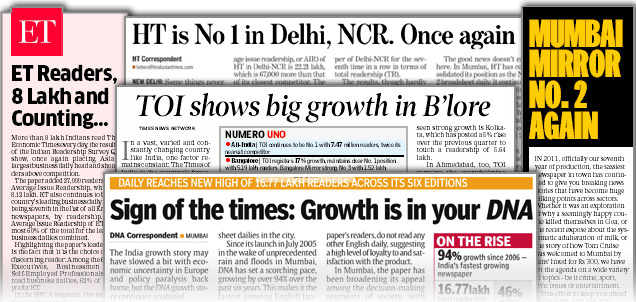
It’s ironic. Mumbai is where most of the biggie media agencies exist. Some of the largest spenders are headquartered here. Still, publications pull out all stops to make crazy claims.
Okay, they aren’t incorrect and the initiated amongst them can obviously see through the claims, but those who don’t – the lay reader, the young homemaker or the senior citizen who is not in the know – is sure to wonder what the truth. And if he/she subscribes to more than one paper, we are sure there will be some confusion.
Obviously, the belief is that the reader is an ass. But this is a policy that can backfire terribly.
But the confusion in a city like Mumbai is thanks to the two types of data that MRUC throws up in its IRSes – Average Issue Readership (AIR) and Total Readership (TR). Publications put up the data which throws them in better light. Also, newspaper X is a compact (tabloid- like-sized) newspaper while Y is a broadsheet. So one may be the #2 overall, another may be #2 broadsheet. Z may be #2 by TR and Y may be #2 by AIR.
Fact is AIR is the accepted currency and there is a section which believes that a newspaper that comes free with another paper shouldn’t be taken for review. But there is a section which says that if a newspaper is able to attract revenues separately, that’s decidedly the best yardstick for the product’s utility. Perceived or otherwise.
Sadly, the conferences which the Market Research Users Council and Hansa Research Group would conduct to release every round of the Indian Readership Survey have been done away with. The detailed dump is no longer handed out to the trade media. All of this charade of X, Y, Z could’ve been avoided had we got city and region-wise numbers from the MRUC (or via Hansa), but that’s not to be.
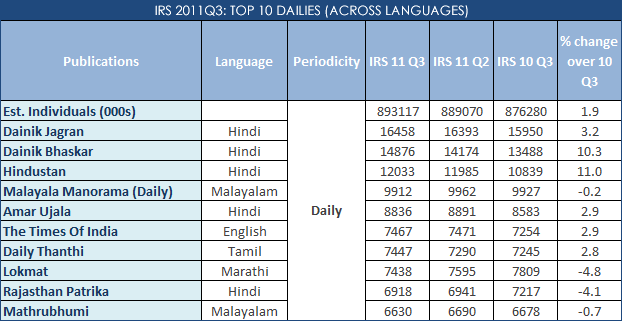
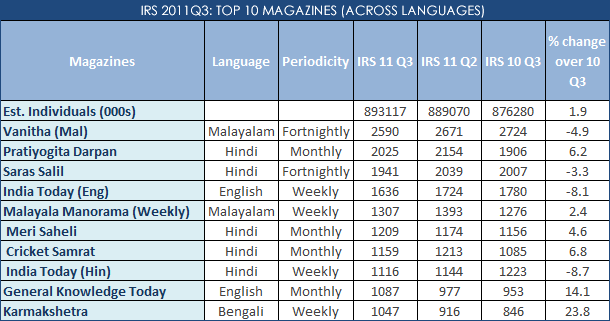
Let’s look at the tables in detail (that we have based on the toplines publicly available).
There’s no need of words. The growth or degrowth percentages tell the story. Some spectacular successes. Others not so.