Tag: MRUC

  • A Wishlist for the New I&B Mantri


    By A Correspondent


    We know that Information and Broadcasting is not only the ministry Union Minister Prakash Javadekar is going to be overseeing. The all-important, future-critical environment ministry is also something that the Pune politician is going to be concentrating on. And given the challenges that prevail on the environmental front as India races towards an infrastructure upgrade, clearly I&B will be Javadekar would do well to ensure the ministry runs on an auto-pilot.


    The minister is affable, even as he conscientiously follows the party line on all issues. He is friendly with the media, but that’s about it… we know how much the media – especially the part dealing with news – is truly independent.


    But there are many things we expect the new minister to do (and not do):

    1. Ensure minimum government intervention: The MIB should have minimal role in the functioning of MIB. It must monitor the role of the TRAI in broadcast and digital. Empower industry associations to take decisions, and if necessary have a body like TRAI to ensure these things happen. Just that. The TRAI shouldn’t be issuing diktats to the industry.


    2. Ensure self-regulation proliferates: And in order to be able to do that the government must ensure that all those who wish to take advantage of its largesse (DAVP ads), must be active participants in the self-regulation process


    3. Stay away from measurement: The MIB and the TRAI are actively engaged in television viewership measurement. Thankfully, for all players, not in print, radio, digital and outdoor measurement. The government must have no role in BARC, MRUC, RAM etc etc. These are funded by industry, and the forces within each trade will ensure that the measurement agency (and currency) performs.


    4. Allow news on FM Radio: This is an old demand that we have tried to impress upon every I&B minister. Insisting that private FM players can only air All India Radio news is pointless. If the government really wants Radio to grow, it must allow news on FM Radio. Let self-regulation and industry associations ensure that quality is ensured and national security isn’t compromised. If it’s okay to have news on TV, print and digital, why not Radio?


    5. Minimal controls on OTT: puhleez. OTT is set to grow exponentially and we hear that the government is planning to set rules on the content that will play on the platforms. If that happens, it would be unfortunate, and meaningless because there are enough and more ways to access content. Adequate viewing advisories should be enough, we think.


    6. Level and Just Taxes: The industry has been pushing for some relaxations on the GST front. This applies to advertising and the various media and entertainment entities. Minister Javadekar would do well to ensure a level and just playing field for everyone.


    7. Continuity: Can we have one single I&B Minister for the next five years, or at lease 2.5 years. Wishful thinking?


  • MRUC release HT Group data

    By A Correspondent


    Two-and-a-half weeks after data for the all-important print measurement currency, the Indian Readership Survey, the data for the Hindustan Times Media group which were curiously held back, have now been released.


    According to a communique received from HT Media, Hindustan Times continues to make strides in all the major markets and winning the faith of the readers who have made it the No. 1 daily in Delhi-NCR, the No. 1 daily in Punjab and it continues to dominate the largest English readership markets of Delhi-NCR + Mumbai, combined. It may be noted that the data (and its interpretation) has not been independently verified by MxMIndia. But, of course, there is no reason for us to believe that it is incorrect.


    Notes the communique: In Delhi-NCR, Hindustan Times continues to be the undisputed No 1 newspaper for the 16th time and is the most read daily with more than 18 lakh AIR, 37% higher than the closest competitor. HT continues to strengthen its presence in Punjab and has emerged the No 1 newspaper of the region yet again with an AIR of 3.21 lakh In Mumbai, HT has grown its readership significantly to reach AIR of 8.9 lakh. Mint, HT Media’s business daily, consolidated its No. 2 position among the leading business dailies in India with an Average Issue Readership of 3.42 lakh. Hindustan with 5.47 Cr readers is the second largest newspaper in India with dominance across its key markets


    Talking about the latest IRS results, Rajan Bhalla, Group CMO, HT Media Ltd., said “We are ecstatic about the trust that our readers continue to show in all our publications. We take the responsibility that comes at the back of this trust earnestly and like always, we will continue to deliver unparalleled value for both, our readers and advertisers”.


    Said Rajeev Beotra, CEO, Print, HT Media Ltd: “Print continues to be one of the most trusted media in India and therefore the latest IRS results come as no surprise with growth in both, Hindi and English readership. They are in fact validation to the faith of the readers and the advertisers, who continue to choose print as their go-to medium and we are delighted that this faith comes across even stronger in all the HT Group publications’ key markets.”

  • MRUC invites bids to develop its own user interface

    By A Correspondent


    Media research body MRUC has invited technology solutions companies to help develop a strong multidimensional user Interface that will enable users to not only access the IRS data, but also any future studies, on a single platform.


    Notes a communique: “Over the years, MRUC has heard feedback from its subscribers on various features that would add value for users, and to provide a user-friendly tool for deriving maximum value from the IRS Reports. By developing and owning its own UI, MRUC will have the flexibility of adding new modules and integrating different data sets as and when required.”


  • ‘It takes time to align everybody’


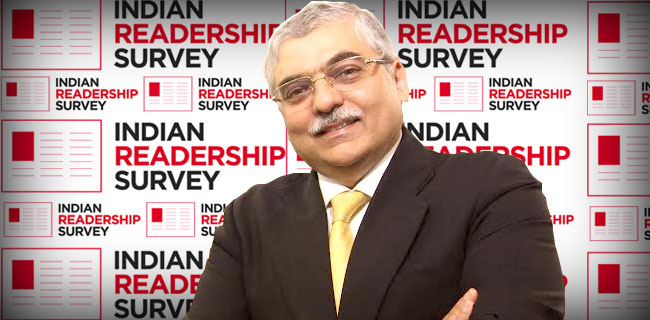
    The Media Research Users Council (MRUC) released the much-awaited 20019/Q1 edition of the Indian Readership Survey last Friday. MxMIndia spoke with Chairman Ashish Bhasin immediately after the release of the report. Editor’s Note: There’s a lot that Mr Bhasin has said on record. And there’s a lot that he hasn’t. With reason. However, MRUC and all the players in the ecosystem need to be commended on the release. Read on…


    Congratulations on the release of IRS 2019/Q1. As a media professional and media-watcher what is the biggest takeaway for you from this round?

    I think the biggest thing that I have seen is that print continues to grow, because the general feeling seems to be doom-and-gloom around print. It is a fact that digital and other media are growing fast but that doesn’t mean that print is not growing. And from a mediaperson’s perspective, if I look at the overall picture, I think India is the only major market in the world where all media are growing. We are in a lucky phase.


    But there is a marginal reduction in the AIR numbers.

    Yes.


    It may be be marginal, but it’s a degrowth for sure.

    So Total Readership is if I have read the paper in the last 30 days, even once. AIR is if I’ve read it yesterday, right. People today are travelling a lot more. People today are sometimes very busy, and don’t have time to read and therefore may not read the paper every single day. But that doesn’t mean they are not readers.


    That’s the currency which your media agency business uses.

    That’s the currency we were all used to.

    But now there is a new reality. So, what we have done is, we have given both the options for even more cuts. All the options are available to our users, to our subscribers. They can see a three-day cut or a five-day cut, one-day cut or seven-day cut or a 30-day cart. The more information that you have means the more informed a decision one will make.


    But that actually results in multiple currencies, right?

    No. Currency is IRS. How you cut and dice that, how you look at the data is different. Some body might want to look only at males, somebody might want to look at only north.

    That is up to you how do you want to analyse it. But the more information you give to people, the better decisions they will make. So why should we not give that.


    Back to the growth in readership. What would you attribute this to?

    I think one is, literacy levels are increasing in India, which is reflecting even in our socio-economic information that is coming in general. Secondly, by and large if you see, any developing country, readership increases are dependent upon two things. One is literacy level, and the other is disposable income… because only if you have money, will you go out and buy a newspaper otherwise you will wait for somebody else to buy it. Because we have had a reason very good monsoon, it is not a bad monsoon you had general economic growth happening because your English and literacy levels are increasing. I think that is what is really saving the day….


    Does it also mean that, digital hasn’t really grown as it should have?

    No, no not really. If you have seen digital has actually grown significantly, and today is a first time that IRS is now starting to reflect numbers in the same ball park as what…


    Given that if readership is growing and so is literacy growing…

    Well the universe itself itself is growing, so people who were consuming less media today are consuming much more media. Of course the growth is much more in digital and that is no doubt. Even digital newspapers if you see have been reported.


    E-papers

    It was the second time e-paper, e-publications, that has grown remarkably, but particularly in the larger areas and particularly in the NCCS A+, it has really grown very rapidly.


    As a media-watcher, in what way will the growth in digital impact print?

    I think for some time everything will grow and therefore print will also grow, because of various reasons that we have discussed. But in the long run, a consumer will not consume only one media, he will, he or she will consume several media along with each other and print as a medium will have to evolve and adapt to that. Like, for example, for a digital you might get more topicality, but you might get more analysis in the physical copy etc. And according to the readers evolving, I think print as a medium needs to evolve and keep up with what’s the need of the consumer and not go on doing what they are best at, learned best how to do over the previous hundred years.


    So, will we now see IRS being released quarterly?

    That is the intent, and we work very hard towards it. As we are speaking, the field work for next quarter has started. So the intent is that, every quarter we should have a release so that continuity remains. And that’s what we are working towards.


    It’s been 15 months since the last IRS was released. Why the delay?

    So it was supposed to be an annual report. It should have released around Feb-March 2019, that is what the intent was. But various factors came in, and the field work took much longer…  for example, the Kerala floods delayed us in the South states for a while. So maybe a month or two of a delay.


    But the IRS was always meant to be a quarterly.

    We didn’t move to quarterly then. The quarterly move is happening now.


    The buzz was certain publications were refusing to pay up because of unhappiness with data and the findings. Reportedly, some big players had reservations.

    That is true, that’s not untrue. Because you know, there were and there are various stake holders in this. There are publishers, there are agencies, there are clients. Within publishers, there are language, Hindi, English publishers etc. Now unfortunately each stakeholder looks upon it from his or her angle and not from the industry angle. So, it takes time to align everybody and equally takes, it’s a very expensive study.


    But as President of the Advertising Agencies Association of India, you are also a stakeholder in BARC. And the stakes are fairly high in television too. Perhaps more. But everything seems to be going right there, but not with print.

    Yes, the system set there is working very well and learning from them, learning from other things, we are trying to implement and hopefully we have been able to implement a similar system out here. The general belief was, and which was probably true in the past that print research didn’t need to be done very regularly because newspaper reading habits don’t change every day or every month. So if you are reading a newspaper you are likely to keep reading that for a long time. It takes a while to convince people that it’s not necessarily true, the more updated and the more regular data that you have, the better it is for the print industry. But you know if somebody has been working with the same mindset for 100 years and it has worked very well for them, it takes a little bit of convincing to get them to change. But what I am very happy about is that, at least I can talk about my team, I don’t know about the past and I don’t know about the future. Everybody has been very cooperative, it did take time and is taking time and effort to align everyone. But now that everybody is aligned, they are very-very supportive.


    There’s word that you’ve been very tough on some people, especially those who were hesitant on paying up.

    (laughs) I have.


    Who has been the toughest to deal with? You spoke about various stakeholders.

    I wouldn’t like to name any individual. So look, I have done 2-3 things, which has been non-compromising. One is that there were rumours of people trying to influence data etc etc. We clamped down very, very hard, we put in a lot of digital check. We digitalised the whole process. It’s all carried out, even though it meant a lot more investment. We closed as many possible loopholes that could have been in that. The other area was in reporting. People were comparing apples and oranges and actually misleading. Some of the advertising was misleading, so we put a code of conduct for reporting. And if somebody, if a subscriber does not subscribe to that code of conduct, the data does not get released to that person. I mean the software just doesn’t open. Ultimately, you need technology to open, control this. So you have to subscribe to an agreed code of conduct which the board has approved, the members have agreed to and therefore hopefully that problem should also get eliminated.


    But they are still using different (and confusing) metrics: TR, AIR, AIR +3 etc

    That is not a problem. So, you can use whatever you want to use, if you are comparing TR of one publication, you can only compare it with TR of another publication. What was happening in the past, was for example you would compare one thing of one publication and completely another thing of another publication. Data is something you can cut and dice in whichever way you want and make it tell a story. But it’s got to be told in a fair way and all the disclaimers should be clearly put. You will see that any ad around IRS data comes out now, hopefully if members continue to agree to do what they have agreed to do and will have a very clear mention of what it is referring to. So for example you can say this is TR of this state of this age group of this male/ female/ whatever.. they have to clearly specify that as a sort of a legend in the data that we are comparing.


    It is actually interesting that in the case of BARC’s television measurement, the top players have been the most mature and statesmanly in their outlook towards the findings. In the case of print and the IRS, it’s said that the top players are fighting and derailing the measurement system.

    I don’t want to talk or compare one versus the other but I can only say that from my prospective as a chairman of MRUC, they have all heard me out and have cooperated. People do have different points of view, but we have been able to convince all of them to cooperate. It hasn’t been easy, it hasn’t been a very quick ride but, then, they all cooperated


    While you said at the press conference that the Hindustan Times and Hindustan data are still bein processed, clearly all doesn’t appear to be well. Did HT Media ask for the data to be withheld?

    No, Hindustan Times did not ask for the data to be withheld. The data hasn’t been withheld. It is still under review and the review isn’t over. Until that is done, we cannot release the data. It will take a few more more days and as soon as it is reviewed, we will release it to the subscribers.


    I am sorry to push you on this, but if you have released all data, how come not Hindustan Times and Hindustan?

    Because we haven’t finished the review in it…


    Then why release all the other data?

    It’s not that Hindustan Times has asked us not to release the data. It is just that, that data is under review and we cannot release any data until Techcom finishes the review…


    Is there some kind of a deadline to it?

    See the next three-four days* will go in only getting the data out to the hundreds of subscribers. It’s a huge database so I don’t think Nielsen or the Techcom will be able to focus on anything else. Immediately after that, I am requesting them to straightaway start focusing on it and quickly finish it so it should happen soon but deadline actually Techcom chair Vikram Sakhuja would be the better person… (* this interview was conducted on Friday, April 26)


    But the absence of Hindustan Times and Hindustan means that a lot of juice of the entire IRS results is missing

    Frankly the ranking that happens is only when the trade media gets most excited about it. I don’t think the planners look at the ranking… they look at the leadership numbers and in few days hopefully…


    Trade media finally just mirrors what the trade tells them. So when is Q2 going to be released and what date is planned?

    The field has already started, typically while it supposed to be three months, it could well be four, because of rains or any other condition. It depends upon how long it takes and then Techcom takes roughly a few months to check it and so on. Quarterly is a bit misleading because people see it as a financial quarter.

     

  • The IRS 2019/Q1 Toplines Deck: Print continues to expand; total number of readers touches 42 crore

    Print continues to expand; total number of readers touches 42 crore… that was the headline of the IRS 2019/Q1 presentation. Since the readership numbers are all topline, there isn’t enough that we can write about them. So here’s the presentation deck that the MRUC and Nielsen big bosses made to the media on Friday, April 26.


    IRS 2019 Launch Deck

  • IRS 2019: Future of Print under Microscope


    By Indrani Sen


    Indrani Sen

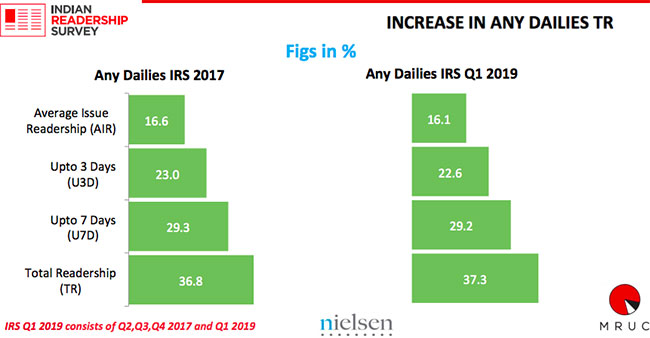
    The recent release of IRS 2019 by the MRUC did not have as dramatic impact as the release of IRS 2017 when the definition of readership was changed from “Average Issue Readership” (AR) to Total Readership” (TR). Yes, the TR has gone up by 2.7 crore from 40.7 crore to 42.5 crore with both newspapers and magazines contributing to the raise the numbers, but if we try to read between the information in the carefully drafted PPT released by MRUC for consumption of Industry at large, we find some red flags concealed in certain corners.

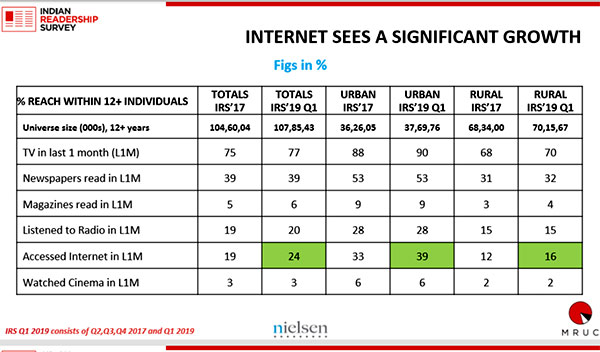
    Let us look at the slide on all media consumption highlighting the growth of internet. Internet accessed has grown by 5% from IRS 2017 to IRS’19Q1. No other medium has shown this kind of growth. While total readers have increased to 42.5 crore, the internet users are now 384 million, or 38.4 crore. With increase of another 5 to 6 million internet users, soon the internet penetration will be same as penetration of print on All India basis. Print media needs to plan for their digital strategy asap in order to survive.

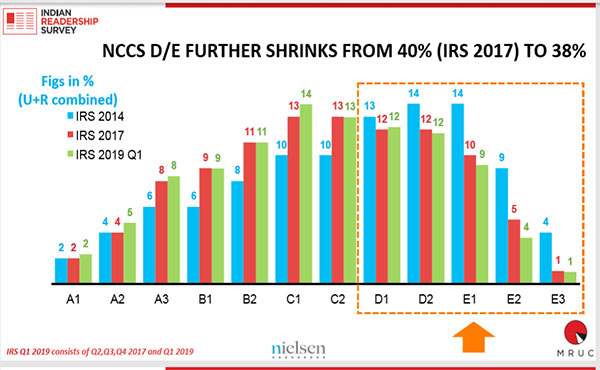
    The NCCS distribution going flat is a clear indication that MRUC needs to rework the definitions based on ownership of durables. The PPT has put in a flag in couple of slides saying “Need for a sharper socio economic discriminator?” No timeline for a working plan was indicated at the launch event.

    In this connection, I would like to mention that my students at SIMC did a survey last year on media habits of non-teaching staff working in all Institutes of Lavale campus of Symbiosis, Pune. They found that the need of giving good education to their students and the availability of easy EMI have made 90% of ‘bhaiyas’ and ‘mausis’ with their children in secondary schools have made them purchase either desktop or laptop computers for their use at home. I have been commenting on this need for a change in NCCS for some time. I am happy to see that MRUC has acknowledged it this time in their PPT on IRS 2019.

    Finally, I would like to comment that print players need to respect the findings of IRS 2019. MRUC should get a continuous flow of funds from them, so that no disruptions occur in the field work like it happened after the release of IRS 2017.


  • Ashish Bhasin and Pratap Pawar continue to helm MRUC

    By A Correspondent


    Ashish Bhasin

    Ashish Bhasin, Chairman and CEO – South Asia, Dentsu Aegis Network and President of the AAAI and Pratap Pawar, Chairman, Sakal Media Group, will continue in their respective roles as Chairman and Vice Chairman of Media Research Users Council (MRUC), until the next AGM. This was decided last week after the AGM.


    Said Bhasin: “After the successful launch of IRS 2017, our aim is to release the IRS more frequently and strengthen the focus on MRUC’s core objective of offering Media Research that goes beyond the flagship study IRS.”


    Pratap Pawar

    Added Pawar: “We thank all our members for their continuous support to the MRUC in ensuring the success of IRS 2017. We will carry the momentum forward and ensure the users of IRS do not have to wait long for the next launch of IRS.”


  • Hormusji Cama elected Chairman of ABC

    By A Correspondent


    Hormusji N Cama

    Hormusji N Cama, Director, Mumbai Samachar was elected Chairman of Audit Bureau of Circulations (ABC) for the year 2018-2019. Cama was earlier President of the Indian Newspaper Society (INS) for two terms as well as Chairman of Press Trust of India (PTI) and Media Research Users Council (MRUC). Cama continues to be an active member on the Board of INS, PTI & MRUC till date.


    Also, Madhukar Kamath, Chairman Emeritius, DDB Mudra Pvt. Ltd. representing the Advertising Agency category on the Council was unanimously elected as the Deputy Chairman of the Bureau for the year 2018-2019.


    Members on the Bureau’s Council of Management for the year 2018-2019 include:

    Hormusji N. Cama, The Bombay Samachar Pvt. Limited – Chairman

    Devendra V. Darda, Lokmat Media Pvt. Ltd.- Hon. Secretary

    Shailesh Gupta, Jagran Prakashan Ltd.

    Debabrata Mukherjee, Hindustan Media Ventures Ltd.

    Chandan Majumdar, ABP Pvt. Ltd.

    Raj Kumar Jain, Bennett, Coleman & Co. Ltd.

    Pratap G. Pawar, Sakal Papers Pvt. Ltd

    Riyad Mathew – Malayala Manorama Co. Ltd.

    Madhukar Kamath, DDB Mudra Pvt. Ltd.- Deputy Chairman

    Shashidhar Sinha, IPG Mediabrands – Hon. Treasurer

    Srinivasan K Swamy, RK Swamy BBDO Pvt Ltd.

    Sameer Singh, GroupM Media India Pvt. Ltd.


    Hormuzd Masani has been appointed Secretary General.


  • Vikram Sakhuja to Chair IRS TechCom

    By A Correspondent


    MRUC has announced the appointment of Vikram Sakhuja, Group CEO, Madison Media and OOH, as Chairman of the IRS Technical Committee (TechCom). Sakhuja takes over from NP Sathyamurthy, Executive Director, DDB Mudra, and President, OMD Max.


    Commenting on the development, Ashish Bhasin, Chairman, MRUC, said: “We are very excited at the prospect of Vikram leading the IRS TechCom as we take stronger strides in the direction of further improving the study and making it more robust.  IRS surely is in excellent hands. On behalf of the Board, I would like to thank Sathya for his excellent tenure”


    Added Sakhuja: “IRS has been the definitive baseline study for readership and other media measurement for the advertising and marketing industry for decades. It is an honour to chair the Technical Committee of this body. Will be my endeavour to ensure the data is valid, reliable and beyond reproach.”


  • Rejoice! IRS2017 is out!


    By A Correspondent


    There has been much sense of anticipation about IRS2017 since a few months when the finishing touches and validations were being conducted. And when the toplines were unveiled finally in the presence of around 250+ media professionals and over 10,000 others over a live webcast facilitated by MxMIndia and 24FramesDigital, there was a deep sense of relief.


    There were some who were dismay as they didn’t do very well in the basic data that was revealed, there were some others who were wondering why the MRUC and RSCI weren’t rolling out the bubbly.


    So first let’s read the official press release that we were given post the unveiling:

    The Readership Studies Council of India (RSCI) and Media Research Users Council (MRUC) are pleased to announce that the Indian Readership Survey (IRS) 2017 Report has now been released.


    For the record, the IRS 2017 Report covered a full year sample of 320,000 households – the highest ever in the history of any readership study in the world. The large sample size was backed by a meticulously designed methodology, which saw the use of 100% Dual Screen CAPI followed by a tighter scrutiny process via continuous backchecks, accompaniments, use of audio recordings, and third-party field audits. These enhanced levels of Quality Control deployed by the IRS TechCom has ensured veracity of data capture for all quarters. The robustness of capture of media consumption across all media has been significantly enhanced due to the increased sample size and better representation across all pop strata.


    All key stakeholders had been actively engaged by RSCI and MRUC all through the fieldwork period to keep them updated and aligned on the progress.


    Some exciting new features have been included in this round of the IRS.


    Reach analysis across all media types has now been brought to a common platform with the introduction of 1-month penetration numbers for all media types. This will now enable an apples to apples comparison across media types.


    The IRS 2017 Report also offers new readership metrics. Apart from the standard and well-established Average Issue Readership metric, one can now look at data from the perspective of Total Readership (TR), and Readership of publications by time frames of Last 7 days and Last 3 days.  These new metrics have been introduced to provide a true representation of the changing consumption habits among Newspaper readers.


    Another interesting development has been the capture and reporting of readership for the Main issue of Newspapers versus their Variants. Each of them are now reported separately in IRS 2017.


    Commenting on the release of IRS 2017 Report, Ashish Bhasin, Chairman, MRUC and Chairman and CEO – South Asia, Dentsu Aegis Networks, said: “According to the findings of the Report, 39% of Indians (12+ years) read newspapers, and 20% of all newspaper readers in 50 Lakh plus population towns read newspapers online. These numbers most definitely tell us that there is a bright future waiting for the Print industry. I’m also hoping that we will now begin to see advertisers and media agencies taking Print more seriously. Increased readership numbers for newspapers and magazines will pave the way for publishers to increase their revenues, which would in turn help increase the size of Print as a medium.”


    Bhasin further said: “The support we have received from across constituencies for bringing out this Report was phenomenal and it was very pleasing to see the key stakeholders contributing in many ways to improve the study that has been in existence since more than two decades.”


    Noted Shashi Sinha, RSCI Managing Committee Chairman, and CEO, IPG Mediabrands: “I’m delighted to share that the findings of the IRS 2017 Report mirrors the market reality in terms of media reach and the performance of individual media channels be it newspapers, magazines and broadcasters.  The methodology deployed to capture data quarter-on-quarter was the very best for a study of this scale and kind, and the sheer focus on Quality Control makes this Report a reliable one and a real stand out.”


    Said NP Sathyamurthy, Chairman – RSCI Technical Committee and Executive Director, DDB Mudra Group: “The IRS 2017 Report is the outcome of great minds from different streams working together toward a common and shared goal to come out with a research that sets the highest standards globally. Absence of readership data for four years meant that we had to work that much harder and smarter to bring the study back in action and in line with the market truths and expectations.”


    Sathyamurthy further noted: “From 2016, when we began the fieldwork, up till last month when we completed the validations for all four quarters, the journey wasn’t easy, and had its own special twists and turns. Furthermore, we have strengthened the Report with additions such as TR, readership numbers for 7 days and 3 days and the separate reporting of newspaper variants. IRS 2017 marks a new innings for this trusted Industry study.”


    There were murmurs against the return of Total Readership (TR) as a currency. At least two publishers and a former member of the thinktank rubbished the decision of using TR and alleged that it has been done at the behest of some powerful newspapers who want to project a healthy picture for the industry. When a senior functionary associated with IRS2017, he/she retorted that it was the Board’s decision to use TR, and not the whim of an individual.


    Another senior media agency professional told MxMIndia, that there is a crying need for an apples-to-apples comparison being thrown by audience measurement studies.The professional told us about how in the case of television audience measurement too, the metric deployed in public is impressions. Similarly, he/she told us that there is merit in a metric that will help planners make more informed decisions will help the agency fraternity considerably. Meanwhile, an advertiser who MxMIndia spoke with, underscored the need for a realisation that there is need for a good, solid currency for all media. “It’s time media owners realise that we will only put money, when we can be sure of performance… We are not in the business of charity.”


    Indeed.


    Meanwhile, the data is set to roll from the second half of today. However, it will be downloadable only if users agree to a Code of Conduct/Usage. What this Code contains, the heads of RSCI and MRUC didn’t tell us at the launch on Wednesday, but there are indicators that the Code could make it difficult for publishers to fool around much with the way they slice and showcase data.


    IRS 2017 Launch toplines

  • Exclusive to MxMIndia: IRS2017 Top 5 Takeaways by Shripad Kulkarni

    By Shripad Kulkarni


    The IRS Toplines were released yesterday. While detailed reports and software will throw better light, this is a quick decode:

    TAKE A BOW, RSCI, MRUC & NIELSEN!

    The people behind IRS 2018 must be commended for putting in herculean efforts to get IRS back on track after the last round fiasco.  Conducting the world’s largest such survey has its own challenges. Add to it a back-to-the-wall situation due to various anomalies of the last round, some of it caused by publishers themselves trying to beat the survey, litigations by some others and the challenge multiplies manifold. Various readership studies over the years had evolved and perfected a long drawn validation exercise, which the Techcom got back this time around with industry planners. This, in my view should have given RSCI an MRUC a huge confidence to release the findings. Many changes in methodology, cross-checks, use of technology would have no doubt helped. As always, some publishers gain, others lose. Some media too gain, some lose. Error margin is a reality all need to accept


    A NEW PECKING ORDER OF DAILIES

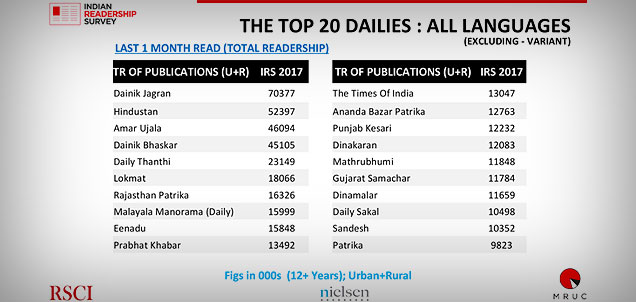
    Based on monthly readership, all Top 10 dailies are language newspapers. Jagran is #1, followed by Hindustan and Amar Ujala while Bhaskar is at #4 and Thanthi at #5! Hindi, Gujarati Kannada and Marathi newspapers grew 31 to 45%, Oriya by a big 83%. TOI continues to be the leader in English while Thanthi leads among non-Hindi regionals.


    INDUSTRY NEEDS A FRESH SOCIO-ECONOMIC CLASSIFICATION

    Any dramatic rise in penetration of some categories would disrupt the equilibrium of NCCS. A durable ownership based NCCS definition is challenged at the bottom end by a big growth in gas stove, mobile phone ownership and availability of electricity. As a result, suddenly many people have jumped to higher NCCS. So, while 65% of homes don’t have a 2-wheeler, 53% don’t own agri land, NCCS DE accounts for only 40% homes. At the top end of NCCS, despite a growth in AC and car-owning homes, NCCS A1 and A2, still remains stagnant at 2% and 4% resp.  The idea of one unified NCCS across Urban and Rural areas might be bringing in an averaging effect, so may need to be revisited. The challenge in relating this to the much smaller sample size of the TV viewership system is yet another dimension to the NCCS saga.


    READING INTENSITY IS AN ISSUE

    Circulation of newspapers is steadily rising @ of about 5% annually.  Readership (over a month) however, has grown @ 11% pa – 37% growth over last IRS. Rural markets readership has grown at a dramatic 15% annually, leading to a 50% growth over 2014. Yet, average issue readership (read yesterday) has remained stagnant. Newspaper variants covered for the first time too show low figures. This suggests a problem with the intensity of reading – number of issues/week and the time spent.


    MAGAZINES, FM READERSHIP CORRECTED BUT INTERNET STILL UNDERESTIMATED

    As per new IRS methodology for magazines, readership doubles (vis a vis last Round) to a respectable 8 crore base(as per periodicity). Radio too doubles reach to 19%


    The mobile penetration is at a whopping 90% with 9 out of 10 homes having a house member owning a mobile. IRS 2018, puts monthly internet reach at 19 %. A 30 Crore smart phone base, it would mean every other smart phone owner has 2 smart phones! Online newspapers have an abysmal 4% reach as per IRS. May be, we need a separate Internet baseline


    All in all a good comeback on the back of which more needs to be done!


    Shripad Kulkarni is a media agency veteran


  • IRS 2017 Live! Today, Jan 18, 3pm onwards

    The live webcast of the IRS 2017 was aired from 3 to 5pm today.

    We’ll post a link to the video recording in a few days.