Tag: MRUC

  • IRS 2017 to release on Jan 18

    By A Correspondent [updated with time and venue]


    So the verdict on how the various newspapers and magazines are doing will be known in a few days from now. On Thursday, January 18, from 3 to 5pm at the Jade Garden, Nehru Centre, Worli.


    Ashish Bhasin

    Confirming the date, Ashish Bhasin, Chairman, MRUC and Chairman and CEO – South Asia, Dentsu Aegis Networks, said in a statement: “IRS has played a vital role in shaping media research in India for the past two decades, and I’m confident that the 2017 report will further enhance its role and credibility of being an industry study. I would like to thank all the MRUC and RSCI Members for their contributions in making the study robust.”


    The IRS 2017 Report records the highest ever sample size of over 3 lakh individuals across the country. Apart from being the currency for print planning, it is the most authentic and widely used source of media and consumer insights for advertisers, publishers, agencies, and broadcasters, notes a communique.


  • MRUC appoints six new Board Members

    By A Correspondent


    The Media Research Users Council has announced the changes in its Board post its Annual General Meeting held in Mumbai earlier this month.


    As was reported Ashish Bhasin, Chairman and CEO – South Asia, Dentsu Aegis Network, is the new MRUC Chairman. The new MRUC Board consists of six new members, namely Raj Jain, CEO, Bennett Coleman & Company; Rajiv Varma, CEO, HT Media; Girish Agarwal, Director, DB Corp; Vikram Sakhuja, Group CEO, Madison World; Sandeep Sharma, President, RK Swamy Media Group; and Sameer Satpathy, Chief Executive – Personal Care, ITC.


    Other members of the Board include Inderjeet Singh, Brand Leader – Consumer and Market Knowledge, Procter & Gamble India;  Pratap Pawar, Chairman, Sakaal Media Group;  Ravindra Kumar, Editor and Managing Director, The Statesman; Satvir S Kataria, President, Marketing, Hari Bhoomi; Siddharth Kothari, Director, Rajasthan Patrika, Kartik Sharma, Managing Director, South Asia, Maxus; Anupriya Acharya, CEO,  Publicis Media India; NP Sathyamurthy, Executive Director, DDB Mudra Group and President, OMD Max; Shashi Sinha, CEO, IPG Media Brands; Rohit Gupta, President, Sony Pictures Network India, I Venkat, Director, Eenadu, Shailesh Gupta, Director, Jagran Prakashan; Punit Misra, CEO – Domestic Broadcast,  Zee Entertainment Enterprises; and Rajeev Singh, Member (Finance), Prasar Bharti.


    Commenting on his appointment as an MRUC Board Member, Vikram Sakhuja said, “It is a privilege to serve on the MRUC Board. In an era of burgeoning multiple media, the need to have a single credible media baseline is important. It is also critical to have a good fix on print readership to support and give confidence to one of the few markets where print continues to grow. The IRS has played this role all these years, and is now coming back after a gap. Inevitably there will be some gainers and losers. The challenge lies in holding all constituents together in this cause irrespective of how they fare. I see an opportunity in building robustness of data by collating both readership and circulation data under the aegis of RSCI.”


    On being elected as a Board Member, Girish Agarwal, said, “I am very excited to join the MRUC Board as I strongly believe that this is the most opportune time for the industry to provide relevant data to the stakeholders. MRUC has contributed a lot for the industry. In the given changed scenario, under the leadership of a new chairman, the high energy board will certainly do a lot going forward in terms of helping the stakeholders get the required and much awaited knowledge and information from research.”


    Added Sameer Satpathy: “The Indian media industry is witnessing a radical change in the way it is consumed. In an always-on social world, media and marketing research is set to become more dynamic. I am happy to be a part of the MRUC Governing Board and look forward to working closely with the Board to help create a robust research framework,”


    Said Sandeep Sharma commented on his appointment: “MRUC is a premier industry body and I am happy to be part of the Board. I look forward to encouraging multi-media research measuring “efficacy and impact” to aid better ROI driven decisions by the industry. Secondly MRUC should leverage new age media and technology to enhance the research process and offer new research products incorporating real time data.”


  • IRS announces India plans for 2016

    By A Correspondent


    The Readership Studies Council of India (RSCI), formed jointly by the Media Research Users Council (MRUC) and the Audit Bureau of Circulations (ABC), has announced the launch of the world’s largest continuous survey of media usage, product consumption and ownership – Indian Readership Survey (IRS) for 2016.


    The 2016 IRS data will be released by January next year, followed by regular quarterly updates. The survey increased its sample size by 40 per cent at an ‘All India’ level, targeting a total of 3.30 lakh respondents, across 91 Individual Districts and 101 District Clusters.


    I Venkat

    Speaking on the launch of the IRS 2016, I Venkat, Chairman, MRUC said, “The Indian Readership Survey is one of the most definitive surveys for print media; consumer demographic profiling and product consumption habits, anywhere in the world. India is one of those unique markets where the print medium is growing consistently even though we are on the brink of a digital revolution. After consultations with all relevant stakeholders we have finalized our research design and begun the field work. IRS is the only industry recognized readership and consumer profiling survey in the country and the team has worked hard to ensure it meets the high standards expected of it.”


    To ensure reliability of the IRS, the technical committee has enhanced the process of back-checks and included a third party auditor for monitoring the end to end process of survey design and quality control checks. The survey has also added numerous safety enhancement layers, powered by technology. Some of these include a tracker for GPS locations of interviewers, enhanced audio recording and electronically addressed forms.


  • CVL Srinivas appointed Chairman of RSCI

    By A Correspondent


    CVL Srinivas

    Readership Studies Council of India (RSCI) announced that CVL Srinivas, CEO, GroupM South Asia has been nominated as Chairman for a period of two years with immediate effect. Srini takes over from Hormusji Cama who was Chairman of RSCI for the past two years.


    RSCI was set up when the Audit Bureau of Circulations (ABC) and the Media Research Users Council (MRUC) agreed to undertake joint readership studies as equal partners. The RSCI is governed by a 20 member Managing Committee consisting of Publishers representing the print media, Advertising Agencies’ representatives and Advertisers. The managing committee of RSCI sets up the Technical Committee to work on the IRS. In a recent development N.P. Satyamurthy was made the head of the Technical Committee to work on the new IRS.


    Shashi Sinha

    Shashi Sinha Chairman of ABC said “From an ABC standpoint we are delighted that Srini has taken over as Chairman RSCI, as there can’t be better person with this stature to guide RSCI especially as we kickoff IRS 2016.”


    Commenting on this development, I. Venkat Chairman MRUC said, “Srini brings over two decades of rich and varied experience in media planning and buying having worked in some of the best known agencies. I am confident that Srini, ably assisted by N.P. Satyamurthy who has recently taken charge of the Technical Committee will help us bring out an improved IRS 2016 with a 3,30,000 sample the largest such study anywhere in the world.”


    Srini was till recently the Chairman MRUC, stepping in to complete the term of his colleague Ravi Rao who moved to Dubai in May 2015.


  • Can these three save the MRUC (& print)?


    By A Correspondent


    The deed was done in an AGM last month, but on Thursday, it was made official.


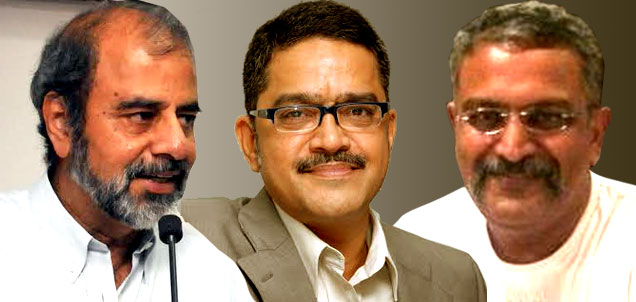
    The all-important Media Research Users Council announced the formation of a new top deck. It elected I Venkat, Director, Ushodaya Enterprises as Chairman for the next two years. It has also appointed Radhesh Uchil, formerly with Madison’s Platinum Media, as CEO.


    Venkat takes over from GroupM South Asia CEO CVL Srinivas, and Uchil comes in with the exit of Shaswati Saradar.


    To be fair to Srinivas, he took charge only in May 2015, taking over from Ravi Rao of Mindshare who had moved out. Rao helmed the MRUC from early 2014.


    The all-important position of Chairman of the Technical Committee, held by top media consultant Paritosh Joshi, will now be taken up by NP Sathyamurthy, Executive Director, DDB MUdra Group. Sathyamurthy, it may be remembered, successfully led the MRUC secretariat as Director General from March 2003 to September 2005. Nikhil Rangnekar, CEO, Spatial Access is the new Chairman of the Marketing Committee. Sanjay Tripathy, Senior EVP at HDFC Life is the new Vice Chairman of MRUC, taking over from Rohit Gupta of Multi Screen Media.


    Both Srinivas and Joshi will continue to mentor the Council, a statement added.


    Venkat and Uchil are seasoned players, but the MRUC job possibly requires the two to have the skills of a police commissioner and a High Court judge. Be just and tough.


    Given the rapid rise of the digital media and steady growth of all other media, print will surely not die, but advertisers could well lose faith in the reach. So even if you think this bit of ‘print is dying’ is bunkum given the large number of ads in The Times of India these days and the reliance of even big digital players on print, the growth of digital is decidedly going to impact print, especially in the all-important urban centres.


    But, as many professionals tell us, the enemy for the print sector, lies within. If print players do not invest in audience research and work towards growing the sector, these three men (and the various others) could be the last officebearers of the MRUC. Finito!


    Earlier this year, we saw The Times of India and Hindustan Times leaving no stone unturned in putting each other down. If better sense had not prevailed, they could well have been talking ill of their stakeholders. MxMIndia had taken a conscious decision then not to solicit any of these advertising as it wasn’t even worthy of cooler conversation.


    But if BCCL and HT Media got out in the open, there were others too who were flexing their muscles, if not in the open, at least in the trade.


    What now? There are only two ways the MRUC can go? Up or down. No status quo. In fact, may we advise the powers that be who have taken charge that if they do not wish to employ missionary zeal to cleanse the sytem, they should opt out.


    Yes, yes, we said that. You read it right.


    Since we are in Mumbai, let’s use a line inspired from Bollywood: agar dar gaya, toh print mar gaya!


    We are told that there are some big and bit players who have been playing bully. There is also this confusion about who is accountable for the readership study: the MRUC or the RSCI (the Readership Studies Council of India, which is formation of a group and not a legal entity).


    Thankfully, some of the officebearers at other key organisations like the Audit Bureau of Circulation (ABC) are progressive in their outlook. Venkat himself is associated with the ABC, and has done his bit for almost every industry association.


    It’s time for all print players to bury their differences and save their own future. These three men have it in them to make the difference.  While the ball lies in their court, it’s also lies in each of ours too.


    Some lessons may be learnt from the Broadcast Audience Research Council (BARC) which had equally killers sharks amongst its stakeholders. It need a strong secretariat and a committed Board to effect the changes.  Print is lucky that the I&B ministry is too scared to take on the biggies. Had the same happened in news television, all hell would’ve broken loose.


    Can the printwallahs do it? Yes, they can. The question is: do they want to do it.


    In all of this, they shouldn’t forget the not-so-poor advertiser.  For, the stick is finally in her/his hands.

     

  • Introducing new fortnightly column by Indrani Sen – MediaSENse: Why our Print Majors must come out of their Comfort Zones?

    By Indrani Sen


    In his recent digital pitch with media bosses in New York, our Prime Minister claimed that unlike manufacturing, in the world of media, India is almost as evolved as any other country. Does his observation hold good for our print industry on which the sun continues to shine? The print majors are basking in the comfort of the findings of FICCI-KPMG and other such industry reports which are predicting growth, but a comparison of the CAGR percentages projected over the years reflects erosion.


    Projections of Print CAGR CAGR 2011 to 2015 CAGR 2011 to 2016 CAGR 2012 to 2017 CAGR 2013 to 2018 CAGR 2014 to 2019
    Total Print Market

    10%

    9.10%

    8.70%

    9%

    8%

    Source: FICCI-KPMG Reports

    2011

    2012

    2013

    2014

    2015


    So, it is obvious that slowly but steadily the global trends have started to creep into Indian print industry.  Accelerated penetration of mobiles in smaller towns and rural areas will support the growth of digital and social media and may result in faster erosion of CAGR in the print market and the CAGR 2020 to 2025 may come down drastically.


    Instead of strengthening their arsenal with readership currency for protecting their share in the total advertising revenue, currently the Indian print industry seems to have taken up a negative stance against the IRS. Agreeably, many publications had genuine grievances against the findings of IRS 2013, but that should not be a legitimate reason for withdrawing their support from the readership survey. When the TV Industry has got a brand new currency from BARC which uses superior technology than its predecessor, the print Industry needs to rally around MRUC to ensure that IRS can also claim similar upgradation by introducing improved methodology.


    In a large scale ongoing quantitative survey, teething problems and relative errors are quite normal. Perhaps the magnitude of the errors in IRS 2013 crossed the tolerance level of some print majors, but they should recollect that initially NRS findings also had many issues which got corrected over the years. We saw emergence of MRUC and IRS as a protest against the methodology and findings of NRS and subsequently the merger of the two surveys. We are witnessing now a dark period of three years in print currency as IRS 2013 was rejected by the print Industry, IRS 2014 (based only on fieldwork of one quarter) has not been taken seriously by the advertisers and agencies, and the field work for IRS 2015 has not yet commenced. In a developed country, such a gap in a media currency is unheard of. The sooner all the stakeholders of MRUC resolve their differences and kickstart the field work, the better it would be for second and third line publications who are likely to suffer more due to lack of readership data. The media planners and buyers cannot determine the incremental reach/ OTS/ CPT for adding more than one publication in the plan and are likely to limit their print campaigns to only the established market leaders.


    Indian newspapers need to take up two challenges at two ends of the audience market. Firstly, they must try to reduce the gap between the literate population and the number of newspaper readers. Secondly, they must improve and promote their web editions and convert the internet savvy Indians to online readers. The concept of “Integrated Newsroom”, which is being advocated by many researchers and industry observers, is essential for achieving these two diverse tasks.


    According to IRS 2012, approximately 44 percent of literate Indians do not read any newspaper. This average percentage decreases as one climbs up the SEC ladder and increases in small towns and rural areas. It is obvious that the current combination of regional, national and international news dished out by most newspapers is not acceptable reading material by a large chunk of Indian population. Special, smaller editions with more emphasis on hyper-local news may be more acceptable in the small towns and rural areas.


    Most Indian newspapers have launched their e-editions, but there is lack of efforts in promoting as well as making them user friendly and interactive, perhaps due to the apprehension that the growth of online readership will cannibalize readership of the hard copies. There is a huge scope of growth for web editions of regional newspapers if they plan to ride on the growth of computer literacy in secondary schools in small towns and villages. Innovative marketing tie-ups with mobile manufacturers and service providers can increase the initial trial and subsequent conversion rate of the e-editions.


    In this connection, it will be pertinent to note the new trends in readership surveys in developed countries, particularly in UK, as we have traditionally followed the example of UK for setting up our media infrastructure, media regulations, etc. In the 1970s, Indian National Readership Survey was also modeled largely on the Readership Survey of UK. NRS PADD was introduced in UK in September2012 to provide a unique measure of combined print and online audiences to cater to the demand of a dynamic and changing digital media age. It is a fusion of data by RSMB from two independent surveys, print readership survey by Ipsos MORI and comScore digital survey. It provides a single database for planning across print and digital platforms of NRS publisher brands. (Source: http://www.nrs.co.uk). Apart from full NRS demographic and classification data for profiling and targeting, the NRS PADD provides the unduplicated reach of a print publication and its website, duplication of print titles and websites – which websites do a publication’s readers visit, and vice versa. NRS PADD: Mobile was launched in September 2014. The future lies in combining readership research across the print and digital platforms. The opinion leaders in the print Industry must realise that the digital trends are irreversible and steer the industry in that direction.


    The Global Media Report 2014 by Mckinsey & Co. predicted “Digital advertising is becoming a dominant force in the global media advertising market. Excluding the online and mobile components of TV advertising, in 2017 digital advertising will overtake TV, which for decades has been the largest advertising medium……….We project digital advertising to continue to increase at double-digit rates, growing 15.1 percent compounded annually to 2018 and accounting for 65 percent of the total increase in global advertising over the next five years. Most of that gain will come as advertisers substitute away from print media.” In India, the above trends are not likely to set in before at least another 5 years. Indian Print Industry needs to utilise this time period from 2016 to 2020 for protecting their future by ensuring immediate availability of print media currency, developing and promoting the websites and last but not the least, effectively converting more literates into readers.


    Indrani Sen is a veteran media agency and marketing services professional. She is currently an Independent Consultant and Adjunct Faculty, Media Management at Symbiosis Institute of Media & Communication, Pune. This column will appear fortnightly. The views expressed here are her own.


  • Ravi Rao appointed Chief Client Officer, Mindshare MENA

    By A Correspondent


    Ravi Rao

    Mindshare has announced the new role of Ravi Rao, Leader (emeritus) of Mindshare, South Asia. He will be taking over as Chief Client Officer, Mindshare MENA effective May 1st, 2015 and will be based at the Dubai office.


    In his vast experience in the media industry, Ravi Rao joined Mindshare, South Asia in 2008 and took over as Leader for the market in 2012. Under his guidance, Mindshare remains the largest media and marketing agency in India. Asserting his familiarity with the MENA market, Ravi was earlier a part of JWT Dubai and the Mindshare MENA team during its inception in 1999. He also worked with OMD in the course of his time in Dubai.


    Ravi Rao is the Chairman of the Media Research Users Council (MRUC) and has represented Mindshare and GroupM on several industry platforms.


    On his move to Mindshare, MENA, Ravi Rao said, “I am excited to take this new role within the Mindshare family. The market has exhibited good growth over the past few years and I look forward to strengthening our position in the MENA region.”


    CVL Srinivas

    CVL Srinivas, CEO, GroupM South Asia, commenting on this transition, “Ravi helped consolidate Mindshare’s position in the market over the past few years. He has led the transformation efforts of the agency in the recent past. This has helped Mindshare create cutting edge products for its clients, grow its digital business and retain its leadership position. He has made a significant contribution to our network and the industry at large. We are confident that Ravi will continue to play a stellar role in building the Mindshare network and we wish him well in his new role.”


  • Exclusive! BARC in talks to buy TAM?


    By A Correspondent


    Entertainment television is all about twists and turn in the fictional serials. Cricket, as you would’ve heard several times over, is a game of glorious uncertainties. So why then should there be surprise over the possibility of BARC buying up TAM.

    Okay, let’s cut the tease. Broadcast Audience Research Council (BARC) has indeed been in discussions to buy the television audience measurement business of TAM, the firm jointly owned by WPP’s Kantar Media Research and Nielsen. And, yes, it’s March 12 today, not April 1.

    According to reasonably reliable sources, there have been a detailed dialogue between the joint industry body-managed BARC and TAM owners Kantar and Nielsen. The talks haven’t concluded yet and the mid-point formula that was suggested by a WPP representative has been reportedly rejected by BARC bosses.

    Both BARC and TAM were unavailable for comment, but from what one learns, BARC was seriously considering the buy.

    So why gobble up TAM when the audience research measurement activity of the measurement body was under question? Well, even as doubts were being raised, there is no denying that broadcasters, advertisers and media agency use TAM as the currency for their buying decisions. Also, as industry analyst told us, TAM comes with a ready 12,000-odd panel, established processes and teams and archival data.

    And from TAM’s point of view, why sell out to BARC? Given that all stakeholders have contributed to the BARC kitty, it’s evident that sooner or later all TAM subscribers will exit the system or want to renegotiate. Given this, it’s best to sell the existing well-oiled measurement machinery to BARC which would find it of use, said the analyst we spoke to earlier.

    TAM has already made it known to subscribers (and the media) that it will continue operations even as there is a significant number (in billings at least) of subscribers who have said they would like to unsubscribe. If TAM continues to exist, there will be several comparisons made with the new measurement system, and those subscribers who may be rated poorly by the BARC system vis-a-vis TAM may quote the latter. This could even lead to advertisers questioning the BARC data and hence cause a confusion in the marketplace.

    As reported on MxMIndia earlier, the ghost of the Indian Readership Survey has raised anxiety levels in the industry. For, MRUC and RSCI, the bodies running IRS are jointly run and owned by various stakeholders in the industry. And despite it being an industry association, print players are up in arms against the new IRS.

    BARC, meanwhile, is said to be only in the discussion with the television audience measurement business of TAM. Other divisions such as the Strategy or S Group which offers advisory service on measurement, AdEx India, RAM for radio audience measurement, Eikona for measurement of earned media and PR activity and TAM Sports, which offers special analysis of sports ROI will not be part of the deal if it goes through.

    So where do things stand now? At the time of writing, the talks have been suspended. But as the date approaches for the launch of the system, and the stakes for both BARC and TAM grow higher, the deal could well be inked. Like on television, be ready for the climax.


  • Sanjeev Kotnala: Do we really miss the IRS?


    By Sanjeev Kotnala


    Media planning has spiritually come a long way. The sixth sense of media planner in Indian advertising industry is more powerful than that of the dog in Mahesh Bhatt camp. They are more accurate than the meteorological department in predicting tectonic shifts and minor tremors in media environment. The media weights are being reshaped by decisions taken using the black box with multiple-grid based complex tools.
     

    Advertising is an insight-mining business and is deeply research-oriented, yet we have adapted to the new reality. Other than TV where we hear rumours of fresh data emerging, we have nothing to go by in terms of print, radio (other than metros), outdoor and even digital. Almost all advertising investment for brands is based on the perception matrix, past trends, unilateral media studies and the internal pulls within these media planning groups. If at one place buyer is TV-centric, the other is torchbearer of digital agenda and the third been carries anti-print stance. They suggest, recommend, design and define every media intervention with these media skews. Let us have no illusion that forward buying, preferred media status and agency level incentives do not influence the sixth sense and in turn the media selection.


    Today is the anniversary of PRINT MUTINY of 2014. On January 28 last year, the all-new IRS was unveiled. The day when print brands started the revolt against IRS results. They were called many names including insensitive, inaccurate, polarised and highly biased. The brands substantiated their observations with examples that even the visually challenged could see. Since then a lot been said and undone. Yet, the only result we have is we have NO RESULT.


    Frankly, the users and the providers seem not in a hurry. Life has moved on. The users don’t give a #$@$ to what and when the new reader/ viewer/ listenership data would emerge and show them the right path.


    Scientifically, in 21 repetitions, the unconscious mind forms a new habit. Once it happens, it works on autopilot. Later on, it takes huge efforts to change. In absence of real data, a new habit of planning through sixth sense has taken over. International trending, small dipsticks masquerading as original research, dealer impression and perceptions are defining media selection and negotiations. This has taken the industry back by decades. There is no difference from the time when kitty party members of the boss’s wife could define serials for placing ads to today when the sixth sense is defining the media skews in a plan.


    Frustrated with repeated blocks and lack of data, proactive clients with large budgets have their own algorithms and internal feedback mechanism to detect media changes and fine-tune the media plans. They are all temporary and not an ideal solutions. In fact, it would have not only been interesting but also in interest of the industry IF ONLY the media practitioners (media agencies) and consumers  (clients) had forced the industry (and media owners) from living in this vacuum. Or maybe it works to their advantage.


    May be and I use MAY BE in all caps, it is time for large advertisers to force a solution demanding independent media research results. May be the government should help get an ordinance forcing media brands to compulsorily subscribe and participate in media studies. May be it ensures that the right to object to research findings is withdrawn. May be a 1% media cess is levied on all media investments creating funds for a tribunal solely engaged in media studies.


    I know this is an unfinished dream. Media organisations and their collective sixth sense will continue to rule for some more time. In the process we will further open doors to rampant corruption.


    ……………………………………………………………………

    Sanjeev Kotnala is Head Catalyst at INTRADIA and believes the best way forward for an organization is to enhance the potential of  internal teams instead of depending on external resources. He is a management- marketing-media consultant and also conducts specialised workshops in the area of ‘Harvesting and Liberating Ideas’ and Innovation.  To contact email netkot@yahoo.com or tweet at s_kotnala visit www.intradia.in  www.sanjeevkotnala.com. The views expressed here are his own.


  • Now, will newspaper publishers opt out of IRS?


    By A Correspondent


    Now that the MRUC and RSCI have decided to lift the abeyance on the IRS 2013 numbers released in late January this year, there is mixed reaction from stakeholders. While media agencies and advertisers are happy that they have data to base their buying decisions, a large number of publishers have express shock and dismay.


    Although none of them have done so in public, in the quiet, a majority of the big media groups – save the Hindustan Times and Rajasthan Patrika – are mulling their next steps.


    But first let’s read the press release that has been issued by the MRUC:

    “The Indian Readership Survey, 2013 was released on January 28, 2014. The release attracted differing views on the accuracy of the data and therefore the Readership Studies Council of India voluntarily requested subscribers to hold the study in abeyance and decided to undertake a revalidation exercise.


    Subsequently a sub-committee for revalidation was established with two co-chairs representing publishers and advertising agencies. The sub-committee unanimously concluded that the methodology used to conduct IRS 2013 was in order and decided to commission a Process Audit.


    This committee, after viewing several proposals unanimously agreed to award this audit to Mr Praveen Tripathi, (Magic 9 Media) India’s foremost expert on large-scale studies of media consumption behavior.


    The finding of the revalidation sub-committee and audit report, it was decided, would be discussed by the Heads of four industry bodies i.e. Chairman-MRUC, Chairman-RSCI, President-INS and Chairman-ABC, and a decision taken by them.


    The said Heads of the four bodies received and deliberated upon the report submitted by Mr. Praveen Tripathi and discussed the same with the chairman of RSCI – Technical Committee as well as the two co-chairmen of the revalidation committee.


    The Audit was conducted in two stages. Stage one involving direct back checking of respondent homes after which a much broader and deeper Forensic Statistical Analysis exercise was carried out to indentify and isolate both fieldwork compliance deficiencies and incidence of the occurrence of Unusual Publication Incidence (UPI) in respondent interview records. By sieving the aggregate data set for these issues, the audit was able to judge unequivocally whether the statistical deviations systematically changed any of the crucial readership output. The outcome was conclusive and unequivocal. The study results had not been impacted.


    After intense deliberations and careful examination of the audit report, Chairman-MRUC, Chairman-RSCI, President-INS and Chairman-ABC, have arrived at a unanimous and unambiguous decision to lift the voluntary abeyance placed on The Indian Readership Survey, 2013.


    The voluntary abeyance placed on The Indian Readership Survey 2013 is lifted with effect from 20th August, 2014.


    As has been reported, a large section of newspaper and magazine publishers had grouped together to take on the MRUC in February 2014. Among the actions proposed then were law suits and pulling out of subscriptions to the MRUC.


    According to an industry person in the know, there was a wide scale agreement that there is need for measurement data. Newspaper publishers which were earlier fighting the onslaught of television have in recent times been facing the heat from activation and OOH and the digital media. “With competition staring in our face, there was need to work things out. What’s worrying is that the crossfire we may see. It shouldn’t become a Times of India v/s Hindustan Times and a Dainik Bhaskar v/s Rajasthan Patrika duel.”


    A media agency captain who MxMIndia spoke to said: “Although IRS 2013 was kept in abeyance, we knew what those figures were and factored them in our decision-making. However, we must also say that we were not too convinced about the findings.”


    The newspaper industry marketer wasn’t too happy with the views of media agency professionals. “It’s fine for them to sit on their high horses now, but how will they react if they are subjected to a similar study. We should not forget we are part of the same ecosystem. This whole display of fiendish delight is unpalatable. We don’t want cowboys in the system!”


    Given that various the heads of various associations – Chairman-MRUC, Chairman-RSCI, President-INS and Chairman-ABC – took “a unanimous and unambiguous decision to lift the voluntary abeyance” as the MRUC press release states, there is little chance of any of the industry bodies crying foul. But it’s the news publishers are key components of the ecosystem and if they decide to dismiss the system or pull out of the IRS/MRUC or decide to have a competiting measurement body, we could see trouble.


    But, of course, one is expecting some fireworks.


    Watch this space.


  • Lloyd Mathias joins HP as CMO

    By A Correspondent


    Lloyd Mathias

    He has headed the marketing and strategy functions at organisations as diverse like Tata Teleservices, Pepsico and Motorola, and now after a two-year entrepreneurial stint with Green Bean Ventures, Lloyd Mathias gets back to the corporate world at Hewlett-Packard India as Chief Marketing Officer.


    As HP’s CMO, Mr Mathias will lead the offensive for the highly promoted HP printers and personal computers. Mr Mathias, who was named among the Top 15 international marketers of the year by Internationallist magazine in 2007, was Chairman of the Media Research Users Council (MRUC) and Co-chairman of the Device Strategy Council of the CDMA Development Group.


  • IRS 2013 in indefinite abeyance. Comment: Win-win for no one. Print will lose big sans measurement

    By A Correspondent


    The choice of the word indefinite may indicate that it could months or years, but if you read the statement from the MRUC director-general Shaswati Saradar and juxtapose it with the way things actually work, the end to the controversy is decidedly not near.


    First the statement:

    Headlined: RSCI MRUC decision on IRS 2013


    Main copy: RSCI Managing Committee and MRUC Board met yesterday and considered the preliminary report of the sub-committee appointed by them to critically assess the Indian Readershsip Study 2013.


    RSCI and MRUC accepted the finding of the sub-committee that the methodology and process adopted were robust. They approved the recommendation of the sub-committee that the revalidation and audit of field work by a third party commence immediately and be completed within four to six weeks.


    The IRS 2013 report will remain in abeyance until this process is completed.


    The document is signed by Ms Saradar.


    What we read from this:

    1, As reported by MxMIndia earlier, the IRS report is abeyance is still on. It’s not March 31, it now appears to be May 15 or 31.


    2. The RSCI and MRUC feel that the methodology and process followed is robust. Of course this doesn’t mean that the sub-committee felt the same, but we think a strong affirmation could influence the third party appointed. It also ensures that Nielsen can’t be fired for a wrongdoing because it can always come back and say that the process and methodology had the MRUC/RSCI sign-off.


    3. If the RSCI and MRUC indeed feel that its methodology and process are robust, so why then not go ahead with the status quo of a published report. Or is the field work not in order? Why take so much time for the review?


    4. Who is the third party entrusted with the job of revalidation and audit of field work? A consulting firm like EY or KPMG, another research firm… the identity has not been revealed, but we can be sure it’s a ‘robust’ entity.


    5. Four to six weeks is as vague as it can get. The February 19 statement said March 31 is the end-of-abeyance date. Assuming the R&A will take four to six weeks from March 31, that gets us to mid-May. Remember this is also a period when there are some chhuttis: Good Friday, Voting Day in Delhi, Voting Day in Mumbai, Labour Day/Maharashtra-Gujarat Day. Counting day is not a holiday thankfully, but don’t expect much/any work to be done that day. Last heard a well-known media company had already large screens and popcorn machines for the day.


    6. We don’t know if Nielsen is continuing with the field work for the next round, but mid/end-May is the time when the next round will be published.


    7. The legal tangles involving the MRUC are still on, and the final word from there could spin things around


    8. The views of the Indian Newspaper Society (INS) are not known on this.


    End-point:

    The scrapping (okay, abeyance) isn’t good for publishing in India. It only gives a handle to advertisers and media buyers to shift monies from print to other media (esp digital).  It’s also very unfair on the players who have been performing very well over the last year. The laggards will prosper and the agile will lose out. The industry and some of its representatives have failed themselves and the rest of us. It’s a win-win for no one.


    The industry seniors need to get together to hammer out a solution. Advertisers are already of the belief that digital reaches out better to the youth and urban set than newspapers, and wouldn’t mind playing around with cheaper buys.  Social media is most effective with a call-for-action and its virtues for brand-building are being noticed. Radio as a medium may not come very cheap but is indeed very effective for the retail trade. Once news happens, radio will get a lot more engaging.  And television’s virtues are well-known.


    Bottomline:  Let’s stop the ullu-banoing.  Kill IRS and you kill yourself. The industry needs to understand this.  It’s time the INS or the publishers get together and arrive at a consensus and a way out of the mess.