Tag: IRS

  • Key newspapers likely to contest IRS numbers in Court

    By A Correspondent


    Does it help having a stakeholder-led body supervise measurement exercises? Logically, it should, but often it could mean more problems.


    Paritosh Joshi

    Running the technical committee and the MRUC and RSCI is a thankless job, and as Paritosh Joshi, head of the MRUC and IRS techcom, told MxMIndia in an interview, “as a TechCom person, I have to do the best possible job of design and process management. The numbers are outcomes that distill the voice of respondents.”


    The problem is that a large number of the key newspapers are unhappy with the new set of readership figures. While the response was muted at the Mumbai launch of the new IRS, the murmurs got louder when the report was unveiled in Delhi on Wednesday.


    Sensing a negative outcome from the stockmarkets, a leading listed newspaper company even engaged investor analysts with data to point out what it consider as anomalies. As reported earlier, dna had also questioned the data by way of a front-page note.


    MxMIndia learns that a few leading dailies are planning to collectively and individual contest the IRS in Court. They are currently seeking legal opinion on the same.


    When alerted about this, a senior MRUC functionary told us that Court cases files by aggrieved members and newspaper groups after the publication of readership numbers is nothing new for the MRUC.


  • Knives out. dna questions new IRS numbers

    By A Correspondent


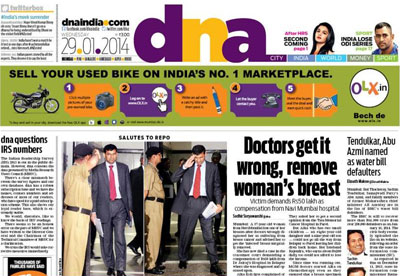
    Okay, it would be incorrect to suggest that a streetfight is on. But in what is decidedly not a common sight post the release of readership data, news daily dna, has put on a front-page unsigned note headlined: dna questions new IRS numbers.


    This is what the note says:

    “The Indian Readership Survey (IRS) 2013 is out in the public domain. However, dna contests the data presented by Media Research Users Council (MRUC).


    There’s a clear mismatch between the survey figures and our own database. dna has a robust subscription base and we have the names, contact numbers and addresses of most of our readers, who have opted for a paid subscription scheme. This also shows our loyal reader base, which is extremely stable.


    We would, therefore, like to know the basis of IRS’ readings. There seems to be an honest error on the part of MRUC and we have written to the Director-General and the Chairman of the Technical Committee of MRUC for a clarification.


    We trust the IRS would take corrective measures immediately”


    A senior media researcher who spoke to MxMIndia on anonymity said it was indeed unusual for a newspaper to frontpage its peeve on the readership numbers. “The stakes are high in a market like Mumbai, so dna could ill-afford a negative outlook.” But is the paper right in feeling aggrieved, we asked. “Everyone is right in feeling so. While there will be shifts in previous numbers when a research methodology changes, such a significant change is inexplicable.”


    Meanwhile, even though the fight hasn’t commenced, the knives are out for sure. And as we know from the past, the Zee group, of which dna is now an integral part, is known to put up a good fight.


  • New IRS study findings to be released next week

    By A Correspondent

    The new Indian Readership Survey findings are scheduled to be released next week.

    It may be remembered that on the basis of a recommendation of  the Readership Studies Council of India (RSCI), the Media Research Users’ Council had awarded the IRS contract to Nielsen. The decision was arrived at after a comprehensive nine month process that began in November 2011, with the formation of the RSCI by its sponsors, the MRUC (Media Research Users’ Council), and ABC (Audit Bureau of Circulation). The RSCI was mandated by the industry to oversee the conduct of a unified Indian Readership Study (IRS), billed as the world’s largest continuous readership study.

    The Technical Committee meeting was held yesterday (Jan 22) and the first findings of the study are scheduled to be released before the month ends, and in all probability on January 28.

    (See also: http://www.mxmindia.com/2013/03/new-improved-irs-hailed-by-industry/)

  • Newspaper degrowth: Reason to worry?

    By Ananya Saha


    Is the print market looking at bad times ahead? The recent IRS figures do compel one to think on those lines. Most of the print categories, including national and regional publications, have registered declining AIRs. Print Media witnessed a growth of 0.8 percent CAGR from 2012 Q2 to 2012 Q4. Though an increase, it is the least when compared to other media during the same period: TV (5.2%), Cable and Satellite (8.9%), Radio (1.9%), Cinema (11.6%), and Internet (24.2%). The 0.8 percent growth seems much less when literacy has increased at 3.7 percent CAGR during the said period.


    What the IRS says

    Jagran and Dainik Bhaskar, the top two Hindi dailies to lead in the Top 10 publications, have lost AIRs, going from 16.47 lakh in Q3 to 16.37 lakh in Q4 and 14.49 lakh in Q3 to 14.41 lakh in Q4 respectively. The only AIR gainers in the category are Dainik Bhaskar, Hindustan, Malayala Manorama and Rajasthan Patrika. Of the Top 10 Hindi Dailies, six show a decline in readership. The publications that saw a dip in AIRs include Dainik Jagran (1.04 lakh AIRs), Dainik Bhaskar (75,000 AIR), Amar Ujala (1.02 lakh AIR), Punjab Kesari 41,000 (AIR), Navbharat Times (6,000 AIR) and Nai Dunia (1.95 lakh AIR).


    TOP 10 PUBLICATIONS

    Publication Language Periodicity 2012 Q3 2012 Q4
    DainikJagran Hin D 16474 16370
    DainikBhaskar Hin D 14491 14416
    Hindustan Hin D 12242 12246
    MalayalaManorama Mal D 9752 9760
    Amar Ujala Hin D 8536 8434
    The Times Of India Eng D 7653 7615
    Daily Thanthi Tam D 7417 7334
    Lokmat Mar D 7409 7313
    Rajasthan Patrika Hin D 6818 6837
    Mathrubhumi Mal D 6415 6334


    The Times of India maintained leads the Top 10 English Dailies category but has registered negative growth and lost 38,000 AIRs: from 76.53 lakh in Q3 2012 to 76.15 lkah in Q4. On the second position, Hindustan Times has added 34,000 readers going from 37.86 lakh to 38.20 lakh readers. While the third daily in the category The Hindu has lost numbers, The Telegraph at fourth position has added AIRs. DNA, Mumbai Mirror and The Tribune have added AIRs while Deccan Chronicle, The Economic Times and The New Indian Express have seen a dip in readership.


    Top 10 English Dailies(AIR numbers; All figures in ‘000)

    Publication 2012 Q3 2012 Q4
    The Times Of India 7653 7615
    Hindustan Times 3786 3820
    The Hindu 2258 2164
    The Telegraph 1254 1265
    Deccan Chronicle 1051 1020
    DNA 962 972
    Mumbai Mirror 807 819
    The Economic Times 753 735
    The Tribune 653 671
    The New Indian Express 664 652


    Top 10 Language Dailies (AIR numbers; All figures in ‘000)

    Publication Language 2012 Q3 2012 Q4
    MalayalaManorama Mal 9752 9760
    Daily Thanthi Tam 7417 7334
    Lokmat Mar 7409 7313
    Mathrubhumi Mal 6415 6334
    Eenadu Tel 5957 5972
    Ananda Bazar Patrika Ben 5788 5750
    Sakshi Tel 5343 5379
    Gujarat Samachar Guj 5153 5114
    Dinakaran Tam 4912 4816
    Daily Sakal Mar 4403 4469


    The cause

    Sundeep Nagpal, Founder-Director of Stratagem Media, blames the decline on new media. Unsurprised by the degrowth he said, “Time has caught up with print media. Not-so-young people have been hooked onto tablets since nobody sees value in print media. I am not surprised by the figures.”


    A S Raghunath, senior print media brand consultant based in New Delhi NCR, disagreed and said, “The degrowth that one interprets on the basis of a quarter is not right. There is always a seasonality associated with print, and hence one should not look only at quarterly figures. There are seasons like monsoons or June-July when readership drops since people travel due to school holidays, or during exams etc.” According to him, due to new publications in a certain language, the universe of readers does migrate or changes. “According to the CAGR of one year, print has grown by one percent, and this is good news.” The worry should only be when the readers of a certain language decrease.


    English dailies have added 3.38 lakh readers in the last one year, and smaller dailies that have entered new regions have gained readers. In the past one year, the reigning leader The Times of India has lost readers while Hindustan Times has added readers. Hindi dailies have added 9.70 lakh readers in the last one year. Assamese, Oriya, Tamil, Telugu, Kannada dailies have added readers to its universe. However, Malayalam has lost the biggest chunk of 8.44 lakh readers in the last one year. The Bengali market, which saw the entry of TOI’s regional paper Ei Samay and ABP’s Ei Bela, has lost 5.16 lakh readers. “The reason could be the entry of new players or disenchantment with the existing dailies. Once the IRS figures of Ei Samay are out, only then would the reason be ascertained,” reasoned Mr Raghunath.


    One can say that new publications make the readers migrate from one product to another in a certain language universe but the losing readers is definitely a cause to worry. “For regional newspapers, the newer generation is not adapting to it. For them, news is not to be found in print or language paper. Obviously, there is a problem,” remarked Mr Nagpal.


    But Mr Raghunath is positive despite the figures. He maintained, “Major languages are doing well. For the languages that are losing readers, it is because the readers are migrating to newer platforms. News consumption, per se, has not gone down. News media cannot be threatened, individual platforms can be threatened.”


    Are the advertisers losing interest?

    The traditional media of print and TV has always managed to catch the fancy of an advertiser. While we are questioning the advertisers’ interest in internet and other new media, the loyalties to traditional media might also be undergoing a shift. Mr Nagpal reasoned, “Advertisers are also simultaneously moving to new medium since readers are moving. On the internet, ad dosage can be course-corrected according to usage. B2C believes in TV as a medium, so print loses out. Lots of categories are more internet-oriented. Hardly any e-commerce site has advertised in print.”


    Targeting a certain TG on the internet might obviously seem more cost-efficient and would also deliver ROI than advertising in print, which costs much more. Also, with the penetration of new devices such as phablets, tablets, smartphone, the lure of advertising in print media is shifting. What also needs to be considered is, that most of the news and in-depth news analysis (similar to as seen in print) available over internet, is English-based, and the universe of regional and Hindi news sites is still very small.


    Going forward

    Can print media revert to the days of glory? When magazines and newpapers did not fear the onslaught of online media? When digital was not a challenge? “Whatever print media could do to resurrect itself it has done. Anything more does not have cost benefit attached to it. The print has done lots of new things such as circulation schemes et al but it has not resulted in anything positive, given that revenues for newspapers are ad-driven. I cannot imagine change how and why it would change,” said Mr Nagpal.


    As Mr Raghunath sees it, the challenge for print is how to make news stand out for existing consumers and it is also a challenge for conventional journalists. While the signs do say that print media is facing tough times, the newer print publications are keeping the hope alive. Only if the degrowth story stops, will the picture be brighter.


  • Paritosh Joshi: Heads, you win. Tails, I lose

    By Paritosh Joshi


    The IRS is in a strange situation. If there are sharp changes in any statistic, it is accused of unspecified mischief. If there are no changes, it is pilloried for being inaccurate.


    The criticisms usually come in these flavours.


    1 Sudden, big moves: Publications launch new editions or prune existing ones on a regular basis. While there is no decision required when an edition disappears, the IRS needs to have a consistent view on incorporating a new edition into the study. Publishers clamour for inclusion no sooner than the edition goes to market. IRS takes the view that as a continuously 4-quarters moving total, it needs a whole year worth of data before the edition can be reported. This is not necessarily bad for the publication either. Basic statistics demand that if the readers actually picked up in fieldwork are below the ‘Normality’ threshold, they cannot be reported. A year’s worth of fieldwork gives every serious participant i adequate time to promote their new offspring so that it shows up in the study. Conversely, editions may sometimes be launched only tactically to preempt a competitor and may disappear once the short term objective is delivered. They certainly don’t belong in the study. Big moves happen when such editions go past the 1-year Rubicon and get reported.


    2 Little or no change: This one usually stems from anecdotal observation. A publication may have mounted a particularly visible, or even successful marketing initiative leading to an apparently significant impact on its popularity. The IRS seems unimpressed when the next quarterly round emerges. Easy to explain. Let us assume that a particular saw as much as a 10% improvement in the brand’s performance vis-à-vis the preceding three quarters. If it had on an average, 100 readers in the previous three, it now has 110. This is what the maths would look like:

    (100 x ¾) + (110 x ¼) = 75 + 27.5 = 102.5

    In other words, the ‘smoothing’ effect of the Moving Annual Total reduces the large Δ of 10% to a small 2.5% perturbation in the final outcome.


    3 Change in the wrong direction: Related to the previous observation, anecdote suggests an increase/decrease while IRS shows a decrease/increase. This is hard to explain without having some sense of the apparent capriciousness of Probability and Statistics. A simple random sample of adequate size yields convergent estimates of population parameters. However, samples can occasionally produce estimates that may have a wide variance from the underlying population statistics. These samples aren’t wrong. They just happen to be the outliers fully compliant with laws of probability. Such a sample will reveal estimates that are counter-intuitive but that doesn’t make them incorrect. If you never spot a estimate that seems to be out of kilter, you should be more worried about the reliability and/or integrity of a sample-based exercise than if you do, every once in a while.


    4 Further analysis produces contradictions and conundrums: My response to this one? Don’t. The IRS reports only those numbers that pass the test of statistical propriety. When you start attempt to dice down whatever has been reported at minimal granularity, you are working with samples that fall below Normality and can no longer be used as consistent and convergent estimates of population behaviour. This, tragically, is practiced almost entirely in the breach by the alarmingly large number of strategists, planners and the like who appear to have no understanding of Statistics.


    In exactly three months, we shall have another IRS release and notwithstanding these meek entreaties, the same rotten tomatoes will be hurled at it again.


    Comes with the territory.


    Paritosh Joshi has been a marketer, a mediaperson and a key officebearer on industry bodies. He is developing an independent media advisory practice. His column, Media Matrix, appears on MxMIndia, usually on Thursdays


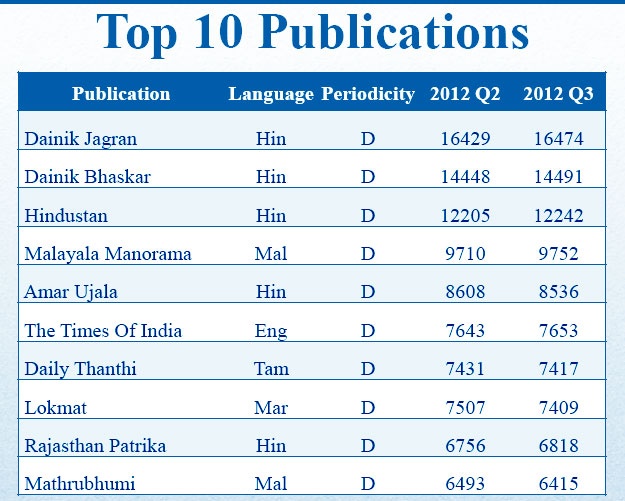
  • Jagran, Vanitha lead in Indian Readership Survey 2012 Q3. TOI & India Today are top Eng paper & mag

    By A Correspondent


    There are no major surprises in the numbers for the Indian Readership Survey’s findings for the third quarter of 2012 have just been released by the Media Research Users Council (MRUC).


    Jagran leads amongst all publications and dailies. Vanitha leads amongst magazines. The Times of India leads in English dailies and Malayala Manorama amongst regional-language dailies. Pratiyogita Darpan and India Today are the largest read Hindi and English magazines respectively.


    (AIR numbers; All figures in '000)


    There’s been a 0.7 growth in the  print media between the second and third quarters of 2012. However, the growth in television has been 6.1& and specifically in cable and satellite homes it’s 10.5%. The growth in consumption of radio is 6.4% and cinema is at 17.2%. The growth in internet is on expected lines at 27.5%.


  • Paritosh Joshi: Can we do without TV ratings from time to time?

    By Paritosh Joshi


    By now the trade is probably abuzz with concerns about how the suspension of TAM reporting is going to play havoc with the lives of broadcasters, agencies and advertisers. Must this be so?


    Broadcasters and agencies have got accustomed to trading in television inventory using the ratings as currency. However, here’s the simple truth: what the trading system prices is not what the advertiser buys.


    Peoplemeter markets represent not just a minority of the overall population, they represent a minority of the television household population too. Indeed, thanks to the rapid growth of DTH in rural India, they represent a minority of digital households.


    Here’s the truth hiding in plain sight. There is a study that covers 30 times as many households as TAM does which also picks up who watches what. And this study is possibly far better suited to picking up the ever lengthening ‘long tail’ of television channels better than the ~9000 TAM Peoplemeter homes. It is called Indian Readership Survey.


    The IRS, which everyone sees as a readership measure- and it does this role with commendable certitude- is actually a comprehensive study of all media, new and old. In addition, it picks up the household’s consumption of a very wide range of goods and services that enable strategists to develop a sharper understanding of how media consumption and product /category usage correlate with one another.


    While TAM takes a monadic view of television channel consumption and deals with nothing else, the IRS sees both sides of the picture: input (as represented by media consumed) and output (goods and services). IRS picks up demographic information in much more detail and actually takes a dynamic view of how different segments are changing in size and composition while TAM ratings have a population grid that stays unchanged for long periods of time- running into years. This, in a country that is experiencing change at unprecedented pace. Finally, IRS is based on a simple random sample, each home showing up in the study only once and not on a panel where familiarity may breed contempt.


    Today, instead of worrying about the absence of TAM in the weeks to come, use the opportunity to understand TV in IRS.


    Paritosh Joshi has been a marketer, a mediaperson and a key officebearer on industry bodies. He is developing an independent media advisory practice. He can reached via his Twitter handle @paritoshZero


  • Jaldi 5 with Suresh Nimbalkar: Print is not declining

    The findings of Quarter 2 of the Indian Readership Survey for the year 2012 published by the Media Research Users Council saw alarm bells ringing as there was a decline seen in print readership. Although we haven’t yet seen doomsayers out on the streets, the numbers did worry print evangelists. We asked Suresh Nimbalkar, Senior Vice President, Hansa Research (which conducted the IRS research) to comment on what lies beneath the numbers:


    01 What do you infer from the continuing decline in readership (IRS) numbers that the print players have been witnessing quarter-over-quarter?

    Let’s split this question into a) Changes in print reach and b) Changes in leading publications.


    a) The print reach has been continuously going up in absolute terms. If you look at the past 3 quarters, the numbers are 350347, 352115 & 352004. Thus, there is no statistical decline in reach.


    b) If you look at the top 10 publications, 3 publications have shown a growth in numbers. What the charts may not tell you is that some of the publications which seem to have shown decline in 2012 Q2 v/s Q1 have shown good growth in past two years. There are publishers who have launched new publications and have ensured overall growth.


    Hence the print market is not declining. We always advise people not to look at quarter-on-quarter changes but look at the long-term trend to arrive at a conclusion.


    02 Ideally, few publications should gain in readership numbers at the expense of other publications where loyalty is lost on account of readers migrating to newer titles. But that is not the case here as most titles have shown a decline. What could be the possible factors for the equilibrium not being maintained?

    You have possibly looked at the top 10 publications for this inference. If you look at a wider number of publications, this may not be true. The print market is undergoing change owing to other factors such as spread of C&S, good growth in internet penetration, resulting increase in number of media used (for information, entertainment & news), paucity of time for an average individual, decreasing title loyalty etc.


    03 Regional publications have somewhat bucked the decline trend to some extent compared to the Hindi and English players. Your comments?

    There has been a significant increase in the level of marketing, new launches, geographical expansion, investment on product and reader connect among language publications for the past 3-4 years. This is evident in their market presence as well as their reach.


    4 Within the space of regional dailies, publications from the south (like Daily Thanthi, Eenadu, Malayala Manorama etc) have shown good composure over publications from rest of India like Lokmat, Gujarat Samachar etc. Will they continue to emerge a potent force going forward too?

    Owing to relatively higher literacy levels and presence of one or two dominant players in the each of the southern states, you find quite a few southern dailies in the top 10 list.


    Also, it is difficult to predict the future. However, if you look at the level of competition, it has gone up in at least 3 southern markets of AP, Karnataka and TN. This suggests that there could be changes in market shares.


    05 Do you see advertisers taking a relook at their association with the medium given the  slide in readership?

    As I said, there is an increase in the overall reach of print medium. The budget allocation by the advertiser depends on the relative attractiveness of each medium.


  • IRS arbitration clause is binding: Court

    By A Correspondent


    The Calcutta High Court has held that the arbitration clause embedded in software of the Indian Readership Survey, which is part of the terms and conditions a user must accept before accessing data, is binding. Disposing of a petition filed by ABP Private Limited and vacating an injunction earlier granted by the Court, Justice Nadira Patherya referred the dispute relating to IRS 2008 to arbitration, in a judgment delivered on September 25.


    Responding to ABP’s petition challenging IRS findings, MRUC had contended that the dispute had to be referred to arbitration, as this clause was a part of the terms accepted by users. This was contested by ABP.


    The court held, “The issue sought to be raised by the plaintiff in C.S. No.242 of 2008 is covered by the arbitration agreement as the same has been couched in the widest terms and encompasses the issue raised, and the same be referred to arbitration”.


    A statement from MRUC said that it is a body constituted of media research users by media research users for media research users. It succeeds only when it advances the interests of its diverse stakeholders in the communications industries. MRUC recognizes that there will be situations in which users may disagree with some aspect of the conduct of various researches that it conducts. It is precisely to handle such disputes in a spirit of collaborative resolution that MRUC places so much emphasis on arbitration, the statement added.


  • IRS 2012 Q2: Magazines perform a tad better than dailies

    By A Correspondent


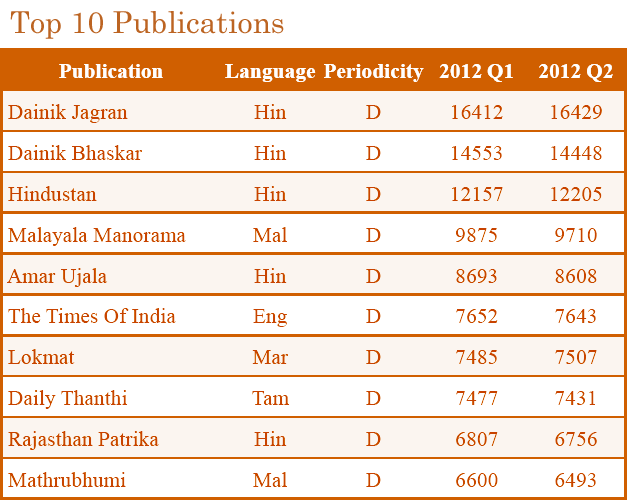
    Dwindling readership numbers for print players now seems to be a given as the just-released IRS 2012 Q2 numbers would suggest. If the Q1 readership numbers was about publications struggling to stay afloat, the trend hasn’t gotten any better for the second quarter with 7 of the top 10 publications reporting a marginal decline. But for Dainik Jagran, Hindustan and Lokmat that have shown a hike in readership, the other seven players that constitute the top 10 including Dainik Bhaskar, Malayala Manorama, Amar Ujala, The Times of India, Daily Thanthi, Rajasthan Patrika and Mathrubhumi have reported a downfall in their IRS numbers.


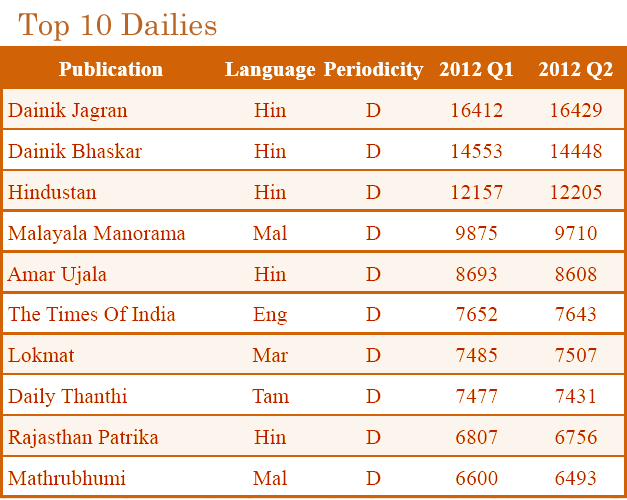
    In the list of top 10 publications, that also constitutes the top 10 dailies, Hindi daily Dainik Jagran emerges the clear leader yet again with an IRS 2012 Q2 AIR of 16429. This is slightly better than what it had registered in the previous quarter with an AIR of 16412. Emerging runner-up yet again is Dainik Bhaskar that has reported an AIR of 14448 a slight fall over last quarter’s number of 14553. Hindi daily Hindustan is third on the list with an AIR of 12205 compared to last quarter’s 12157. Malayala Manorama is fourth with an AIR of 9710 followed by Amar Ujala with an AIR of 8608. English daily Times of India too failed to elicit a keen interest amongst readers as it reported an AIR of 7643 as against an AIR of 7652 last quarter. Marathi daily Lokmat emerged a winner with an AIR of 7507 as against an AIR of 7485. Tamil daily Daily Thanthi recorded an AIR of 7431 followed by Rajasthan Patrika at the ninth spot with an AIR of 6756. Mathrubhumi concluded the top 10 list by recording a downward AIR of 6493.


    (AIR numbers; All figures in '000)


    (AIR numbers; All figures in '000)


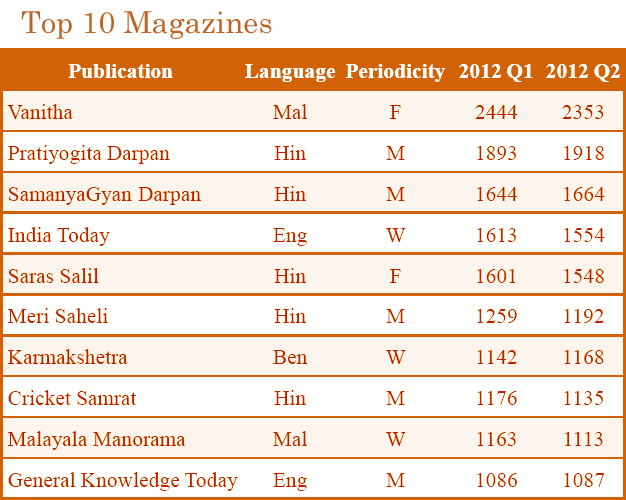
    (AIR numbers; All figures in '000)


    The magazines seem to be better placed compared to their newspaper counterparts with 4 out of ten magazines showing an upward growth. These include Pratiyogita Darpan, SamanyaGyan Darpan, Karmakshetra and General Knowledge Today. With an AIR of 2353 Malayalam magazine Vanitha leads the pack ahead of second-placed Pratiyogita Darpan that has recorded an AIR of 1918. At the third spot is SamanyaGyan Darpan with an AIR of 1664 followed by India Today with an AIR of 1554. Hindi mag Saras Salil is next with an AIR of 1548 followed by Meri Saheli with an AIR of 1192. Bengali mag Karmakshetra is next with an upward AIR of 1168. Cricket Samrat at 1135, Malayala Manorama at 1113 and General Knowledge Today with an AIR of 1087 wrap up the top-10 list for magazines.


    Where the language dailies are concerned, the trend is somewhat similar to that of the top 10 dailies with 7 out of 10 dailies reporting a decline. Malayala Manorama is at the top spot with an AIR of 9710 followed by Marathi daily Lokmat at 7507. Daily Thanthi is next with an AIR of 7431 followed by Mathrubhumi with an AIR of 6493. Telegu daily Eenadu is next with an AIR of 5925 followed by Ananda Bazar Patrika with an AIR of 5859. Another Telegu daily Sakshi occupies the seventh spot with an AIR of 5306 followed by Gujarat Samachar at the eighth spot with an AIR of 5205. Tamil daily Dinakaran is ninth with an AIR of 4999 followed by Daily Sakal at tenth with an AIR of 4437.


  • IRS will see a technology leap: Prashant Singh, MD-Media, Nielsen India


    By Johnson Napier


    Nine months since RSCI began the process for shortlisting the most bankable partner, it was jubilation time for the team at The Nielsen Company in India, having won the coveted contract of research work for the Indian Readership Survey. The victory is sweeter following as it does the controversies of the past few weeks.

    While the industry is still taking in the news of the appointment, for Nielsen India it is a chance to prove its authority in the print measurement space. And what better metric than IRS. The company plans to centre its focus on newer mediums – with increased dependence on technology – that will help ease data collection and analysis and more importantly bring about consistency in the readership numbers.


    MxMIndia interacted with Prashant Singh, Managing Director – Media, Nielsen India to gather his views on being appointed the new partner by RSCI for IRS. Though it is still early days, Mr Singh dwells on what the future will look like for readership studies in India and how they are geared for the big challenge that’s being watched closely by all concerned. He even had some words of comfort regarding the controversy that it is currently embroiled in thanks to its joint ownership of TAM Media but he assures that it won’t have any impact on how they continue to do business going forward. Excerpts:


    Q: This isn’t the first time the Nielsen Company has done a readership survey in India, though it is after a gap. How have things changed since then (other than the size of the population and hence sample size)?

    Things have changed within the market research industry itself. With the advent of technology there is so much that is available to us to tap into. Today, the scenario is such that any market research can be elevated to a level where one can get a much better read of the market without going through the peeves that are associated with it. For example, Nielsen is actively deploying Computer Aided Personal Interviews (CAPI) instead of the regular pen-and-paper format that was practised for market research. What that does is that while there is an interviewer who goes and interviews the person instead of using pen and paper, the person uses a computer/tablet/palm-device to capture responses. As I said, the entire market research industry has gone through a significant change in the past 5-6 years. With MRUC, we hope to bring significant technological upgrade even on the IRS.


    Q: What is it that you think won you the bid (we know it didn’t go to the lowest quote, because yours was higher)?

    I have no idea. This is something that you should ask MRUC. We are just happy that we bagged this prestigious project.


    Q: Do tell us what you are going to be doing from now to when your part of the study will start? When does work start for you?

    The MRUC and Nielsen teams will sit down and discuss what the plan will look like going forward. The first step for us is to sign the contract and start with those proceedings. Probably MRUC is the right body to talk about future plans, which we will do sometime in the near future.


    Q: For the benefit of the industry, what are a few of the salient differences between the IRS we see now and the IRS that we will see when you’ll be there?

    Multiple innovations in technology features are being brought in. Some of them would be visible to the users while some will be visible to MRUC. But at this point it is not fair for me to talk about the specifics of the proposals. There will be more clarity on what are the things that are coming to the fore in the near future.


    Q: Do you see any challenges cropping up with Nielsen planning to lay increased emphasis on technology?

    Where market research is concerned, with technology we’ve been fairly confident that there are benefits and not challenges. In fact there are challenges in doing market research in India whether it is about how you show inputs to respondents or about how you make sure that the right interviews are happening at the right time and place…and technology actually enables us to do a better job at it. In the last 3-4 years, we have taken multiple steps to embrace technology wherever we can right from data collection to data reporting, etc. So we see technology as an enabler and not a challenge.


    Q: One of the problems that any such vendor contract arrangement is about what do you do when the contract is not renewed? For instance, even after 8 years of working on, Hansa (and Ipsos) lost the contract to Nielsen?

    We do a good job and keep our clients happy; there is no reason that the contract will not be renewed. It is about how you deliver to the promises made. If one doesn’t deliver then obviously the contract could go away from you.


    Q: Will you hire some of the talent from Hansa if rendered redundant due to the loss of contract, later in the year?

    I cannot comment on this.


    Q: Media measurement is a tricky business these days and most often a thankless job. Your take on this?

    Not just media measurement but market research anyway is challenging. In India there are multiple challenges including sociological, geographical… and every market research agency has to understand these challenges and figure out ways to deal with them. Sometimes you can deal with them nicely and sometimes not so nicely. If we are open with our clients and talk to them about the challenges that there are then I think we should be fine.


    Q: One of the frequent peeves we’ve heard from the magazine sector is that IRSes don’t measure niche readership very effectively. How will you correct that?

    Again I cannot comment on that but it is part of the proposal and the RFP and you will hear more about that from us and MRUC together.


    Q: There have been some charges that while Nielsen is a specialist in television measurement, it isn’t with print readership?

    Globally, Nielsen is a specialist in television (measurement)…that’s what I can say. I cannot comment on what  others speculate. Yes, we do specialize in television measurement which does not mean that we do not do other things. People will speculate what we can and what we cannot but I cannot say much on that.


    To give you a higher perspective, Nielsen as a company globally looks at business in two key parts: we measure what people buy and we measure what people watch. Both the businesses are very significant in terms of revenue. So it’s not that Nielsen is just a ‘watch’ business we have a huge portfolio within the ‘buy’ side of the business too. It would suffice to say that we do a lot more than television.


    Q: One last question, and we know the matter is sub-judice: but we heard murmurs that Nielsen shouldn’t bag the contract because its name is stained in the TAM controversy. Also, a hitch with the retail audit earlier this month. Your comments.

    We are happy that the MRUC and RSCI have given due importance to the proposal that we submitted and have awarded the contract to us. We are working towards making sure that we do a great job in delivering IRS. As for the controversy, we have a policy of not commenting on issues that are under litigation and will stick with that. But I can say that it is business as usual for us amidst all that is happening around.

     

  • The Anchor: Jwalant Swaroop on 7 reasons why IRS is a valuable tool for measuring readership

    By Jwalant Swaroop


    Whether we like it or not, we cannot help but accept IRS as the currency for readership measurement. I do not think that we have an option.  In fact, I find IRS most valuable tool for its robustness and brilliant consistency. Over a period of time IRS as a product has evolved and is must for the media planning.


    1. IRS is the industry’s most acceptable currency. For the benefit of the professionals joining the industry now, let me share that there were times when we had NRS and IRS the two conflicting readership surveys. Now that the merger of both is official, IRS has emerged as the most acceptable currency.


    2. IRS is a technically sound product which encapsulates expectations of all the stake holders.


    3. Given the sample size IRS captures the readership trends having geographical and demographic details with precision.


    4. Despite the fact that it is largely industry funded, IRS has a neutral stance delivering value to clients and agencies equally.


    5. The product linkage data in IRS is significant for understanding the market size and set directions to brand and media owners.


    6. IRS can also be leveraged for setting directions for the content team to develop content for building attractiveness in the target readership which the media owners desires to build.


    7. Since the IRS results are out every quarter, it builds the excitement.


    Jwalant Swaroop is COO-Publishing, Lokmat Media Pvt Ltd