
Tag: IRS

  • Shailesh Gupta to stay MRUCI chair, promises return of IRS

    The Media Research Users Council India (MRUCI) held its 30th Annual General Meeting (AGM) on Thursday, September 12. Shailesh Gupta, Wholetime Director, Jagran Prakashan Ltd will continue as Chairman. Vikram Sakhuja was announced as Vice Chairman.  Sakhuja takes over the mantle from Shashank Srivastava.

    New members have also been appointed to the Board of Governors:

    1. Jayant Mammen Mathew, Director, MM TV Ltd.
    2. Partho Banerjee, Senior Executive Director (Marketing & Sales), Maruti Suzuki India Ltd.
    3. Pratap Govind Pawar, Chairman, Sakal Media Pvt. Ltd.
    4. Tejas Apte, Head of DMC and Media- South Asia, Hindustan Unilever Ltd.
    5. Vikram Sakhuja, Partner, Group CEO- Media & OOH, Madison Communications Pvt. Ltd.

    Said Gupta: “The past four years have presented us with unique challenges, but with perseverance and collaboration, we are now ready to resume the IRS Study. The commitment of our Technical Committee and Board members has ensured that we can move forward with a cost-effective solution, without compromising on the quality of the study. We deeply appreciate the unwavering support from our members during these trying times, and we are confident that together, we will soon realise our shared vision.”

    Said Sakhuja on his appointment: “It is a privilege and an honour to be elected as Vice Chairman of MRUC. I am grateful to the MRUC Board for this opportunity. We have a wonderful MRUC Secretariat and a committed and talented Technical Committee. We are committed to bringing back IRS as the Country’s definitive and most credible establishment survey in the coming months.”

  • Legacy Media Must Leap Ahead


    By Bhuvi Gupta


    Bhuvi Gupta

    The media industry the world over is in a state of flux. The internet has made us all both publishers and reviewers and the odd part of that is that it has made the world both biased and unbiased in equal measure. It has never been easier to publish and publicise your opinion and it has never been easier to polarise either. But leaving propaganda aside, the fact that we all have access to multiple media in function and form means that media models are themselves obsolete. While the pandemic has accelerate the print medium’s deceleration, aural media has had a comeback with podcasts going mainstream. But noteworthy in this comeback is the role played by the individual creator.


    This comeback will define what media will come to represent as a whole across the world.  Individual creators will define media because:


    Traditional Media Measurement is Broken

    In India, media as a whole has been slowly losing its credibility. In the earlier part of the last decade both, which I consider a load shed decade for media measurement, both IRS and TAM/BARC overhauled their entire systems to keep up with the times and both ended up getting boycotted or sued – IRS in 2013, and the TAM by NDTV  in 2012, which eventually  resulted in the formation of BARC (LINK – https://timesofindia.indiatimes.com/business/india-business/ndtv-sues-nielsen-for-fraud-negligence/articleshow/15302393.cms). The latest alleged BARC TRP-manipulatiom investigation highlights the flaws of a system based on extrapolation of a relatively small sample data set, especially in a country the size of India.   This is not to point fingers at a case currently sub-judice but to make a case for system which is not so advertising-dependent, that such misdeeds become commonplace. (https://economictimes.indiatimes.com/industry/media/entertainment/media/indian-newspaper-society-rejects-irs-2013-findings/articleshow/29871308.cms?from=mdr)


    Monetisation Models are Fragmented

    The media’s monetisation in itself has gone through many changes.  Once almost entirely run on ads (and later on advertorials as well), media houses realised that their strength lay in the deep networks and complementary relationships they had built with the elite and powerful, which was monetised via events. Then came the digital era when media houses put all their content on the web only for brand visibility with advertising as an afterthought (hence, letting the Google-Facebook duopoly control digital advertising which is now coming to bite them) and now finally the era of subscriptions and donations because survival for media companies has become harder.  What will work going forward is a system based on subscriptions with a content aggregator probably charging the consumer on the basis of the quantity of content consumed


    Media Biases are Clearer than Ever

    While I believe that all individuals have deep-seated biases which are hard to displace even when they try their best, media today seems to align strongly to either the Right or Left. This can become inexcusable when defending a political party in the face of visible wrongdoing.  Once biases become visible by the viewer, especially on major mainstream media, viewers/readers start deserting them.


    For entertainment, a lot of TV content seems to be scripted for audiences in the 90s – the quality of script, actors and direction especially when compared to international content easily accessible on OTT platforms. That has had an impact on TV viewership.


    So, Is there a Way Ahead for Legacy Media?

    Yes, of course, there is. I feel as platforms like Substack and the OTTs move towards the maturation phase in their product lifecycle, there will be further fragmentation in media consumption and clear market leaders will cease to exist. While consumers who are early adopters might have already given up their legacy media subscriptions in favour of Substack, The Ken et al, the majority of the market is yet to catch up. It is here that traditional media outlets must evolve to remain relevant enough.  They have the advantage of knowing what the audience wants, and robust role models like New York Times (NYT) which in November 2020 generated more digital revenue than print with 7 million digital subscriptions. There’s also pay-as-you like journalism which has been implemented in part by Newslaundry.


    Early signs of traditional media evolving are there. Today, most traditional media outlets whether Print, TV or Radio have robust video and print teams and soon-to-be-announced podcast teams as well.


    But as they all put their fingers in more and more pies, I hope they don’t lose the entire plot by spreading themselves thin too soon.


    Bhuvi Gupta is a marketer with over 10 years across industries, of which the last six have been in Media & Entertainment. She has been a part of many launch marketing campaigns – specifically at the Times of India group, Republic TV and the latest in marketing a Bollywood film. She will write on A&M (mostly marketing, but often on advertising too) every other Tuesday. Her views here are personal. She tweets at @bhuvigupta3


  • The Internet Gets Mainstream, Finally


    By Indrani Sen


    On May 8, 2020, the Media Research Users Council India (MRUC) released its findings of the last and final quarter of Indian Readership Survey 2019. Fieldwork of IRS 2019Q4 covered the period from December 2019 through March 2020 and the report has data based on a rolling average of four quarters of IRS 2019 data i.e. Q1+Q2+Q3 and Q4 2019.


    The highlights of the readership trends among English and vernacular titles have already been reported and analysed by different industry websites. The highlights of the survey- presented jointly by Nielsen and MRUC – has noted that: “Newspaper readership, is on a slow decline and is a trend seen across Hindi, English and Regional languages”. Vikram Sakhuja, IRS Technical Committee Chairman and Group CEO Madison Media & OOH, Madison World has noted in the press release: “(The) ability to read and understand English has increased and while overall print readership is holding, daily readership has started showing signs of decline.”


    According to the highlights of the report, a “rapidly evolving media landscape with multi-media adoption is seen across consumer strata resulting in large media markets, both traditional and digital with substantial increase in Internet penetration lifting it to mainstream along with TV and Print.” Moreover, the report has acknowledged “There was more number of internet users (Last 1 month) in rural now then urban.”


    Source: IRS2019Q4


    If we consider that the fieldwork for March 2020 ended before the National Lockdown due to Covid-19 was imposed on March 25, 2020, we can easily guess a further surge of internet users has happened across urban and rural India in the last seven weeks. Unfortunately, as the IRS fieldwork also is on hold now, we will have to wait for sometime before we get a clear indication of the media usage during the total and subsequently partial Lockdown enforced by Covid-19.


    IRS2019Q4 highlights have also given us a glimpse of how Indian consumers today are more equipped and more connected than before as shown in the following chart. There would not be significant change in the connectivity except during the lockdown both ‘shop from modern trade’ and ‘online shopping’ may go down and ‘access social media’ may go up substantially.


    Source: IRS2019Q4


    This calls for a total change in the approach of media planning where TV and Digital would have to be planned simultaneously now supplemented by Print, Radio and OOH plans. It would also be beneficial to plan for TV and Digital under the same roof by the same media agency than to distribute the business by traditional media and digital media to two different media agencies.


    Unfortunately, we still do not have single source data for TV and Digital media users which is essential for preparing cutting edge media plans. BARC’s plan for providing such data have been shelved indefinitely reportedly due to non-cooperation by Google and Facebook and instead of finding a solution to that problem, TRAI has now created other problems for the ongoing research on TV viewership with their new directives about TV viewership research. So, as internet continue to surge ahead as a mainstream media, media agencies will keep struggling with data and insights for doing justice to their media plans.


  • IRS 2019 Q4 results out

    By A Correspondent


    The Media Research Users Council India (MRUC India) released findings of the last and final quarter – Q4 – of IRS 2019.


    IRS 2019Q4 is a rolling average of four quarters of IRS 2019 data i.e. Q1+Q2+Q3 and Q4 2019, the fieldwork (Q4) of which covers from December 2019 through March 2020. The sample size of IRS 2019 is 3.27L Households across India out of which urban sample size is 2.14L Households and rural is 1.13L Households. IRS 2019Q4 is the full-year report covering four quarters of a continuous and uninterrupted IRS 2019 fieldwork. Media landscape is rapidly evolving with multi-media adoption seen across consumer strata. Overall Media reach continues to grow even as the consumption of each media remains more or less stable, with internet making a noteworthy exception by leading this growth curve, particularly in rural India. Among other highlights from IRS 2019Q4 data – Electrification in India has surged, premium durable ownership in households have increased and so has individual’s online shopping and smart phone ownership across both urban and rural India.


    Said Pratap Pawar, Chairman of MRUC India and Chairman of Sakal Media: “We have successfully completed and released all four quarters of IRS 2019 data. I thank our Board of Governors and IRS Technical Committee for their unwavering commitment and their resolve in providing the industry with a robust, reliable and timely research study.”


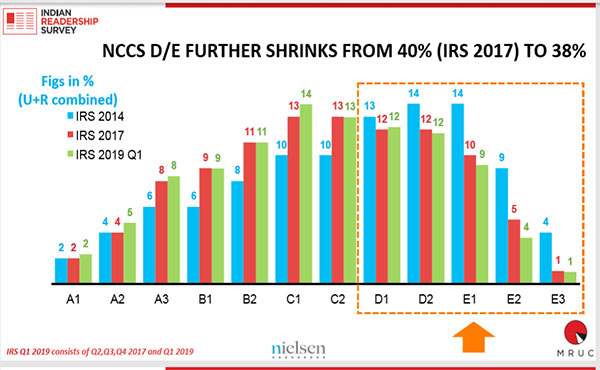
    Added Vikram Sakhuja, IRS Technical Committee Chairman and Group CEO Madison Media & OOH, Madison World: “With four quarters of 2019 data now complete we are reporting a complete year’s picture. Earlier quarters had also included some part of 2017 data. A few trends are emerging. Internet penetration has increased substantially and is now mainstream along with TV and Print; NCCS D&E are reducing quarter on quarter faster than HH socio economic status thereby suggesting the need to Relook at the NCCS definition; ability to read and understand English has increased and while overall Print Readership is holding, daily readership has started showing signs of decline.”


    IRS 2019Q4 is a rolling average of four quarters of IRS 2019 data i.e. Q1+Q2+Q3 and Q4 2019, the fieldwork (Q4) of which covers from December 2019 through March 2020. The sample size of IRS 2019 is 3.27L Households across India out of which urban sample size is 2.14L Households and rural is 1.13L Households. IRS 2019Q4 is the full-year report covering four quarters of a continuous and uninterrupted IRS 2019 fieldwork. Media landscape is rapidly evolving with multi-media adoption seen across consumer strata. Overall Media reach continues to grow even as the consumption of each media remains more or less stable, with internet making a noteworthy exception by leading this growth curve, particularly in rural India. Among other highlights from IRS 2019Q4 data – Electrification in India has surged, premium durable ownership in households have increased and so has individual’s online shopping and smart phone ownership across both urban and rural India.

    IRS 2019 Q4 Highlights_compressed

  • MRUC releases IRS 2019/Q3

    By A Correspondent


    Just last evening young Ramesh was celebrating with his family that his parents would celebrate New Years’ Eve at home with him. He still recalls how the big Independence Day holiday that he was hoping to celebrate got messed thanks to IRS 2019/Q2 being released. But alas, Ramesh’s dream of a holiday are going to be shortlived. Earlier today (December 28), at 5.08am to be precise, our inbox received the all-important communique:


    The Media Research Users Council (MRUC) has announced the release of IRS 2019Q3 data. The 2019Q3 data is a rolling average of the last quarter of IRS 2017 (Q4) and three quarters of IRS 2019 (Q1+Q2+Q3). IRS 2019Q3 fieldwork covers August 2019 through November 2019.


    Notes a communique: “Multimedia consumption is the order of the day with each medium holding on to their loyal consumers. Overall media reach has grown with digital leading the growth trajectory.”


    In view of sample shortfall in Andhra Pradesh, the IRS Technical Committee has decided to release IRS 2019Q3 data excluding AP, as of now. The IRS 2019Q3 data including AP will be released in a fortnight’s time. Comparative analysis until then, at all India level, will not be permissible. While the reporting sample size at all India level (including AP) is 3.30 Lakh Households (Urban: 2.14L Households and Rural: 1.15L Households), without AP, the reported all India sample size will be 3.15Lakh Households (2.05L HH in Urban and 1.09L HH in Rural).


    IRS2019Q3 fieldwork in Jammu and Kashmir was adversely affected because of political and administrative developments in the State (now union territory). In consultation with the IRS Technical Committee, it has been decided to report J&K data  by utilising and projecting the last four quarters of IRS data i.e. Q3+Q4 2017 and Q1+Q2 2019 to the updated universe for the current round of IRS 2019Q3.


    Commenting on the release of IRS 2019Q3 data, Pratap Pawar, Chairman, Sakal Media and Chairman of MRUC said, “IRS being the world’s largest survey not only reflects the ground reality in terms of print readership, but also for other media and product consumption. The stringent field monitoring system, rigorous data validation processes and the overall methodology of IRS ensures the industry gets a robust and reliable data.”

    Added Vikram Sakhuja, Group CEO Madison Media & OOH, Madison World and IRS Technical Committee Chairman: “The IRS is a fascinating barometer of how India consumes Media.  From this round we see that Indians consumption of media continues to grow with digital growing on top of other mediums remaining steady. I would urge all marketers to deep dive into the data. There are fascinating insights about the diversity that is India waiting to be found.”


    Please click here for deck of IRS 2019Q3 Highlights

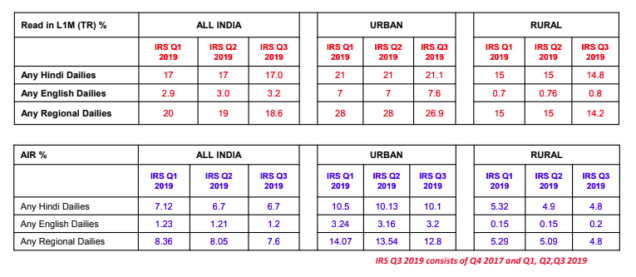
    Some pointers from the all-important AIR and TR slide:

    • English readership grows. Grows or stays steady in most of the country except for Uttarakhand where it has gone down by 1%

    • AIR Hindi dailies All-India is the same vis Q2. Urban has degrown by 0.03%. Rural goes down by 0.01%

    • AIR English dailies vis-a-vis Q2 All-India has degrown by 0.01%. Urban has grown by 0.04% and rural also by 0.05%

    • Any Regional dailies AIR: vis-a-vis Q2 AIR has gone down by 0.09% in All-India. Urban has gone down by 0.06%, and Rural by 0.29%

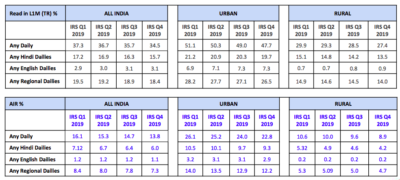
    • TR Hindi dailies All-India is the same vis Q2. Urban has grown by 0.1%. Rural goes down by 0.2%

    • TR English dailies vis-a-vis Q2 All-India has grown by 0.2%. Urban by as high as 0.6% and rural also by 0.04%

    • Any Regional dailies TR: vis-a-vis Q2 AIR has gone down by 0.4% in All-India. Urban has gone down by 1.1%, and Rural by 0.8%


  • MRUC issues RFP for research agency partner

    By A Correspondent


    MRUC has issued an RFP (Request for Proposal) inviting research partners to pitch for the contract to conduct the Indian Readership Survey. MRUC’s contract with the incumbent agency, Nielsen India, concludes with the release of the last and final quarter of IRS 2019data – Q42019.


    Pratap Pawar

    Said Pratap Pawar, Chairman, MRUC and Chairman of Sakal Media: “We are looking forward to receiving and studying each and every proposal from various research agencies. They will be evaluated basis their understanding on IRS, on meeting our research requirements stated in the RFP and of course what more they can offer beyond our stated requirements.”


    Shashi Sinha

    Added Shashi Sinha, Vice Chairman, MRUC and CEO of IPG Media Brands: “Security enhancements and measures taken to ensure accuracy in data will be some of the key objectives in selecting the new research partner. We will be working closely with industry stakeholders in the selection process and ensure the industry gets the best partner to conduct the world’s largest study – IRS”.


    Vikram Sakhuja

    Said Vikram Sakhuja, Chairman, IRS Technical Committee and Group CEO Media & OOH, Madison: “Over the years we have brought in a lot of automation, technology and controls to ensure that we get valid and reliable data for IRS – India’s most widely used Media establishment study. In this RFP we are looking for an Agency who can give us confidence in their mastery in Fieldwork, and who can impress us on enhancing the controls while minimizing the cost. I wish all participants the very best.”


  • Das ka Dum with Dr Bhaskar Das: Can one trust audience measurement data?

    It’s going viral. Each Q&A we hear is firing up the Whatsapp and mail circuit. People have been laughing, screaming out incorrigible reading a response… but there’s no denying that each question-and-answer is profound and funny. Presenting Das ka Dum with Dr Bhaskar Das. And do come back next week for another round of questions and answers.


    Please go to the Das Ka Dum tab on the website’s top navigation bar, to visit the archives of Q&As.


    Q. Can one trust audience measurement data?


    A. I am a strong advocate of data-based insights to complement decision-making processes. So any measurement data can at best be indicative and should be leveraged for directional purposes. Doubting the credibility of measurement data isn’t a constructive route to move towards an augmented intelligence.


  • IRSwala Aaya, IRSwala Aaya, IRSwala Aaya Re


    By Sanjeev Kotnala


    The latest round of IRS report is out. The reported readership figures have given soulless Print Rudalies a chance to cry in mourning or smartly find ways to celebrate minor victories.

    The comparative game has begun. Everyone is flogging the tired horse. The fight to sliced the data continues. Everyone is wishing for that somewhat relevant claim which can help them fight the festive season battle. And there will be some lazy advertising for these claims. The biggest game in print is on.

    It reminds me of the Kabuliwala poem that one has read and sung many times. A bit of a twist and a tweak somewhere and the bhands in newspaper title get to sing a new IRS song.

    IRSwala, IRSwala, IRSwala,
    English Newspaper kyun kumhlaya tera mukhda pyara
    Hindi Paper kyun kumhlaya tera mukhda pyara
    Kya khoyi hai Readership teri ya kisi ne circulation me mara,
    Roonth gaya kya tera reader, toot gaya kya hawker,
    Roonth gaya kyat tera reader, toot gaya kya hawker,
    Ya phir tujhse bichhad gaya tera koyi advertiser,
    IRSwala ha ha, kya wo quarterly report wala,
    Abhi mila dey tumko use, dekho khel nirala,
    Chalo readership  ke paar jaha engagement ki hai war,
    Kabhi Number 1 boley koi innovative kahani,
    Chalo readership  ke paar jaha loyalty ki hai war,
    Kabhi Number 1 boley koi innovative kahani,
    Jaane sabka wo haal, usse sabka hi khayal,
    Badi sachchi hai, Readership ki badalti wo syani,

    Everyone wants just that slice of data to help claim a share of advertiser wallet. No one is bothered about its relevance. There is no question about how the numbers match? What do the numbers mean? Will they engage the uninterested advertisers and immune media buyers?

    No one in the print media is willing to change. Something inside has broken. The sales team soul is not into the business. Everyone is looking at the brightness towards the end of rainbow called digital. Is it time to give up? I am not sure.

    There is a strong inertia to change. No one wants to invest in understanding the root cause of the audience behaviour. Everyone has theories which have been strengthened by the multiple nods of heads inside boardroom presentations. Everything is directed towards boosting numbers. It’s different that IRS is a huge (scientific) extrapolation of a robust but limited data. Here is where the print industry has gone wrong. It cannot be the start and end of everything good or bad.

    They have explanations. They have scapegoats. The undeniable truth keeps circulating in the corridors of print powerhouses. The enhanced availability, accessibility and affordability of data. The decreasing concentration of audiences. The fragmentation or multicity of interest.

    In all of this the voice that calls spade a spade is ost. It is print’s inability to continue giving a differentiated, relevant and not necessarily impactful content. Play on its strength of Trust and Faith, which itself is under threat. However, there is high inertia in thinking and ideation. No one wants to move and take a call proactively. Everyone wants safety first. The choice of failing and falling is not acceptable to print stalwarts, and that is the reason they are failing their audience.

    Nothing will change. IRS report will keep coming out. The changes will stop surprising the inert advertisers, media planners/buyers and the print saviours. We will find the IRSWALA and sing the last part of the song.

    Tara rum, tara rum,
    Readers se punchhenge hum, kyu roota hai who
    Tara rum, tara rum,
    Advertiser se punchhenge hum, Kyu badti TV digital se uski doosti.
    Pal pal chhin chhin kum hota jaye,
    Social linkage tode jaye

    Pal pal chhin chhin involvement kum hota  jaye,
    change ke pankh lagaye,
    TV jhoome Digital ghoome, har dam chakkar chalta jaye,
    TV jhoome Digital ghoome, har dam chakkar chalta jaye,
    Pal pal chhin chhin reader segment jaye,
    samay hawa ke pankh lagaye,

    IRSwala aaya, IRSwala aaya, IRSwala aaya.


  • The IRS 2019/Q1 Toplines Deck: Print continues to expand; total number of readers touches 42 crore

    Print continues to expand; total number of readers touches 42 crore… that was the headline of the IRS 2019/Q1 presentation. Since the readership numbers are all topline, there isn’t enough that we can write about them. So here’s the presentation deck that the MRUC and Nielsen big bosses made to the media on Friday, April 26.


    IRS 2019 Launch Deck

  • IRS 2019: Future of Print under Microscope


    By Indrani Sen


    Indrani Sen

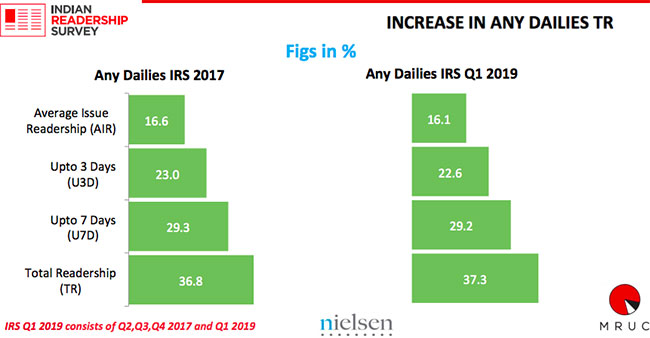
    The recent release of IRS 2019 by the MRUC did not have as dramatic impact as the release of IRS 2017 when the definition of readership was changed from “Average Issue Readership” (AR) to Total Readership” (TR). Yes, the TR has gone up by 2.7 crore from 40.7 crore to 42.5 crore with both newspapers and magazines contributing to the raise the numbers, but if we try to read between the information in the carefully drafted PPT released by MRUC for consumption of Industry at large, we find some red flags concealed in certain corners.

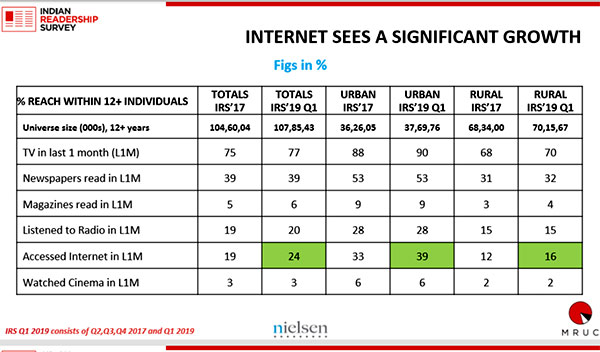
    Let us look at the slide on all media consumption highlighting the growth of internet. Internet accessed has grown by 5% from IRS 2017 to IRS’19Q1. No other medium has shown this kind of growth. While total readers have increased to 42.5 crore, the internet users are now 384 million, or 38.4 crore. With increase of another 5 to 6 million internet users, soon the internet penetration will be same as penetration of print on All India basis. Print media needs to plan for their digital strategy asap in order to survive.

    The NCCS distribution going flat is a clear indication that MRUC needs to rework the definitions based on ownership of durables. The PPT has put in a flag in couple of slides saying “Need for a sharper socio economic discriminator?” No timeline for a working plan was indicated at the launch event.

    In this connection, I would like to mention that my students at SIMC did a survey last year on media habits of non-teaching staff working in all Institutes of Lavale campus of Symbiosis, Pune. They found that the need of giving good education to their students and the availability of easy EMI have made 90% of ‘bhaiyas’ and ‘mausis’ with their children in secondary schools have made them purchase either desktop or laptop computers for their use at home. I have been commenting on this need for a change in NCCS for some time. I am happy to see that MRUC has acknowledged it this time in their PPT on IRS 2019.

    Finally, I would like to comment that print players need to respect the findings of IRS 2019. MRUC should get a continuous flow of funds from them, so that no disruptions occur in the field work like it happened after the release of IRS 2017.


  • The How, What and Why of Erroneous Claims by Newspapers


    By Sanjeev Kotnala


    Recently one of the top newspapers published a corrigendum on its circulation claim. Another newspaper hinted that the competition was lying. And a few others’ claims went unchallenged.

    When claims happen, you know the IRS (Indian Readership Survey) or ABC (Audit Bureau of Circulation) reports have been released. Reacting to competition,  calling them ‘liars’ and ‘unethical’ is very polite for the season.

    It’s not the first time and definitely not the last time when claimed circulation or readership data has error or is disputed. Surprisingly these originate from prominent publications fully aware of the rules and regulations guiding the research report usage. They know, what is allowed and what is not. Yet human errors creep in.


    Behind The Scene. Getting Ready.

    The release date and timing of the research reports is one of the worst kept secrets in the newspaper industry. Everyone seems to know it in advance.

    Just before the expected release, the marketing executives are stressed out. The anxiety level is high. The external interest is low. A few trade portals are still interested in the press conference, to report the change in hierarchy.

    Inside newspaper offices, predictions are made. The conspiracy and corruption theories are discussed over coffee and beer. Soon, the wait is over, the data is released.


    Readership And Circulation Data are Like the Board exams for Newspaper Industry..

    ‘IRS/ ABC data swing ki kimat tum media planners aur client kya jano.

    The swing in readership or circulation data can result in psychological metamorphosis within the newspaper taskforces. The employee’s confidence may get strengthened or be shattered beyond repair.

    The wait is agonising. The fears are not unfounded. The ‘Number One’ tag may fly away. ‘Largest’ may need a new definition. The gaps between rival newspapers may get widened or narrowed. Being second maybe reason enough to celebrate. The advantage in few strategically placed editions could be lost.

    These are like the Board exams for the newspaper industry. The data is expected to reflect the impact of all the efforts on Ground Zero. Hence, many unanswerable questions arise with every data release. Some questions get buried temporarily.

    That’s the power of readership and circulation data.


    You Have To Be Part Of The System To Know How It Feels.

    The management waits for the analytics team to truthfully present a favourable picture. The marketing department time and again crosschecks strategies and alternate presentations. The Excel sheets are verified at many levels. They are now ready to face anything other than a glitch in data.

    The sales guys are eagerly to get some good news. It can ease sales target pressure. It’s known that the good news comes with revised sales targets. But for the pride, they are willing to live with it. They will take even the bad news. It will make their life a lot tougher. However, they will get a new excuse.

    The circulation team is tense. Whatever may be the new data, circulation is involved and responsible. The earlier unconcerned editorial department too is dynamics stressed. The debate ‘circulation from readership’ or ‘readership from circulation’ is not yet settled. However, in the last decade, editorial too has been sucked into this not-so-unfamiliar number game.

    The numbers define power equations. They create new relationships. The newspaper’s perceptual positioning is validated, strengthened or destroyed. It has the potential of defining the order in which a media buyer or planner will meet the media sellers on a hectic day.


    The Claim League Starts.

    The moment data is out; the analyst’s fingers start moving n the keyboards with the practised smoothness. The fingers run with the rehearsed flow. The matrices and cross-references start whispering to each other. The colourful graphs are conceived with alarming speed.

    The marketing head, revenue heads and the top management keep their fingers crossed. There is an unheard prayer in their lips. They are like the expectant father outside the operation theatre, waiting for ‘the’ news.

    The instructions are unambiguous. The SOP for the situation is well-defined.  No slip is allowed. Only the top management must have access to the first cut data. They will in their strategic business huddle debate and define the new strategic implementations. No delay is allowed.

    Everyone is racing against time. It’s like the next sequel to Mission Impossible. Or like the Wild West, where the first mover and the fastest draw would survive to live another day.

    Before the close of the day, rightly slaughtered and supremely cut acceptable data is released. It will feature in the next day edition. The position of this news will depend upon how the newspaper edition or group has performed. It could be anywhere from the front page, back page, city page, business page or tucked in some unmentionable corner.

    You can’t blame any newspaper title for it. It’s a league of claims out there. If they don’t publish their interpretation and skewed impressions, the competition will. It is a necessity. They have to present their point-of-view.

    No one can risk to be branded by default. The readers and the advertising industry must not only get what the competition publishes.

    Some are in the race to catch the next morning e-mailers. They know most of the e-mailers land in the spam folder or are trashed without being opened. But, the tradition and internal SOP demands action.

    It is complicated. It is a multi-dimensional race. The numbers have to be interpreted differently for the readers, advertisers, employees, and trade partners, competition and in some cases investors and share market. After all they have different expectations from the newspaper title.


    In A Premeditated Surgical Strike, Collateral Damage Is Acceptable.

    It will be foolish to believe that stakeholders are unaware of what is going out in the public domain. How the data has been tweaked? What new interpretations have been unearthed? How the numbers are stacking? And what is the tonality of communication.

    Printing corrigendum is not a problem. Corrigendums don’t reverse the gained advantage.

    ASCI can be ‘handled’. Saying sorry, giving newer explanation and temporarily abandoning the campaign is acceptable practice. The process of interrogation and explanations gives enough time for small battles to be won. The art of self-regulation and ethical practices is not discussed in such forums.

    The pressure to meet timelines is a star excuse for the errors in data interpretation. The wiser ones know this game of self-congratulatory chest thumping news is of no real value. But, the serious players must play the league.

    The ABC rules are clear and the penalty for violation is high. Hence, the trade-off call always involves the top management.


    No Surprise for Repeated Errors.

    In time, everything is forgotten. The new claims and presentation lose their sheen.

    The newspaper sales and marketing comes back to the position it deserves. Dominance, arrogance, humility, relationship, negotiation and commoditisation become the norm. Everything is forgotten over field trips, parties, 3-D mailers, discounts, freebies and such facilitation tools.

    The wait for the next round of results begins. The essential steps in brand building are forgotten. The newspaper marketing with new found determination focuses on client and media-agencies. The sales team is back to their revenue mining activities.

    All forget that the results are mere reflection and directional in nature.


    The Fastest finger First Claim league must stop.

    No one wants to be left behind. No newspaper title will allow the competition even a 24-hour advantage in presenting the result. It’s a jungle out there. And to survive you must draw the gun first.

    Here is what can be done.

    A) Create Release And Usage Gap.

    It’s a fallacy that this readership and circulation data is a critical release. A few days or even a week’s delay has no consequences.

    What if such data was released on a Monday morning with 72 or 84 hours embargo? What if the newspapers are forbidden from releasing it in the public domain for some time? Even the trade portals are not allowed to release the story. The leading pink paper signs the Non-disclosure-agreement and honours it.

    The hurried analysis and a race for the data are removed from the system. Everyone gets the real breathing time to analyse and decide the course of action. No one plays ‘Fastest Finger First’. The chances of Fat-finger or surveyors error is removed. The stress decreases.

    B) Wrong Data Usage And Interpretation Is Severely Penalised.

    There should be strict no-tolerance policy on data usage and interpretation error.  It becomes totally unacceptable. Any violation debars the title, edition or group from further using the data, even if they have subscribed and paid for it. Repeat offenders are no longer covered. And to get back has a lag of two rounds!

    C) Facilitate And Educate.

    To ensure no-tolerance policy additional steps need to be taken.

    Every subscriber of these circulation survey and readership researches must have one person in trained by the research body. It is like a certification programme leading to chief interpretation officer.

    Moreover, for the initial month, the research body should provide a free-facility to crosscheck interpretation. Promise and deliver a response within 4-6 hours. Maybe that will help.


    No one is afraid of paper tiger. The bite must be felt if the industry has to stop playing fastest finger first.




  • Shailesh Amonkar: #IRS17 – Publishers must think Long Term. Discounting can be their Nemesis!

    By Shailesh Amonkar


    With #IRS2017 now behind us, it is time for publishers to look ahead.


    The IRS has indeed been a shot in the arm for publishers. Apart from pure numbers, the growth trends across the print media as well as inregions, has been really encouraging and would have in the normal course helped publishers to increase both yields as well as revenues.


    However, most publishers charted their own nemesis and months in advance.


    The two key happenings during the preceding months that affected the print media landscape more than the others were undoubtedly, Demonetisation and the GST Bogey.


    The way publishers reacted to these is what is creating a cascading effect on the road ahead for print.


    In November 2016, demonetisation was announced and with no cash in the system, coupled witha decline in consumption of products and services, advertising spends reduced drastically.


    Most publishers including the leaders in most markets dropped their advertising rates to pick up whatever business they could, to ensure profitability. By the first quarter of 2017, the cash crunch eased slowly, with the government pumping in cash as well as the increase in digital wallets and move to online banking etc.


    With the economy looking up, people felt the worst was over. However, the introduction of GST in the second quarter of the year was good enough reason for advertisers and clients to once again reduce spends.


    The net effect of both these key happenings ensured that most publishers reduced their advertising rates to garner revenues so as to achieve targets. The leaders started discounting which left no choice for the rest to follow. The general feedback across publishers is that the revenue growth for the current financial year has been either flat or grown in single digit.


    One needs to understand that during the last four years (which include the demonisation and the GST era), no updated research data was available for planning. Yet most publishers reduced their rates to garner revenues, now with IRS 2017 showing good numbers and growth, will these publishers be able to increase their rates?


    The question that comes to mind is whetherpublishers who have maintained growth or have grown in IRS  2017, would they able to increase their rates and reach at least the level they were operating before demonetisation? The publishers who have declined or lost their position to competition would have a tougher challenge to hold on to the rates they have been operating post-demonetisation


    With revenue pressure and profitability increasing, publishers find themselves at the crossroads. It is very clear that publishers must work to find their long-term solution and not rely only on quick-fix solutions to problems and issues.


    Will they?


    Shailesh Amonkar has over three decades of building and managing sales teams. He has worked with The Times of India and Sakal Media Group in senior positions and is Founder CEO of Kemistry Media Solutions Pvt Ltd and co-founder of Webmag India Pvt. Ltd.