
Tag: IRS

  • IRS 2011Q3. Digital growth bestest. Cinema, Radio decline

    By A Correspondent

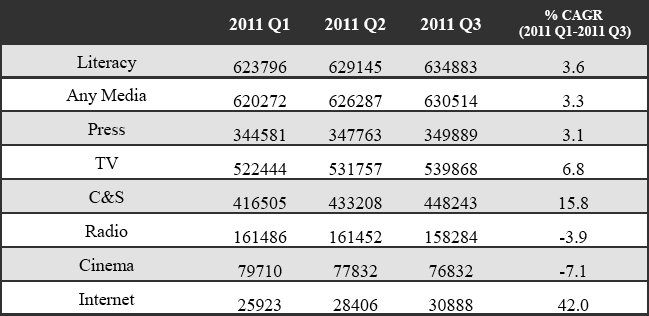
    As per the Indian Readership Survey (IRS) 2011 Q3 data, Cable & Satellite (C&S) and Internet are the two sectors which have shown the maximum growth in total reach. Radio, on the other hand, showed negative growth of 3.9 per cent CAGR with numbers declining from 161.45 million to 158.28 million. Internet, the fastest growing sector, recorded a growth of 42 per cent CAGR with the reach going up from 28.41 million in Q2 to 30.89 million in Q3.

    The total reach of the television media has also gone up by 6.8 per cent CAGR to 539.87 million in Q3 from 531.76 million in Q2 making it the third fastest growing sector.


    The Cable & Satellite (C&S) sector recorded a growth of 15.8 per cent, the only other sector to record double digit growth. C&S total reach is up at 448.24 million in Q3 compared to 433.21 million in Q2 2011. Cinema also recorded negative growth of 7 per cent with reach declining from 77.83 million in Q2 2011 to 76.83 million in Q3.


    All figures are in Average Issue Readership. Like media buyers, MxMIndia only endorses Average Issue Readership as the currency for readership measurement. Please note that these are only topline figures which have officially been supplied to the media. Sensible buying and planning happens when more data is available.


  • With animals, what you see is what you get. With human beings, it’s more complicated


    Make no mistake about this: Lynn de Souza has a soft, warm, chilled out, happy exterior. But inside that resides a steely, tough, hard-edged professional. And she needed all that internal strength to survive and thrive in an industry notoriously dominated by what she calls the ‘Old Boys Club’. Lynn and I go a long way back, and this made our conversation frank, fun and, yes, highly argumentative. And we discussed many issues ranging from the dubious media research, the future of various media, her role in promoting gender equality, her formula for cleaning up the otherwise scandalous Goafest. And why she, er, chooses dogs over men.  


    By Anil Thakraney


    What’s your exact job portfolio at Lintas?


    I look after Lintas Media Group, and our subsidiaries Karishma Initiative, Aaren Initiative and Lin TV. LMG and Karishma are media agencies, Aaren Initiative is the largest OOH agency and Lin TV produces and distributes branded content. I am responsible for their overall financial and reputation, health, corporate governance, etc.


    Who do you report into?


    Michael Wall, the global CEO of Lowe Worldwide.


    Would you not like a global role now, having been there and done that in India?


    Have I been there and done that in India? I don’t think so. India’s potential story is not even the tip of the iceberg, and I haven’t even travelled the whole tip yet! I would love to have a global role that is based out of India, because this is where it’s all happening. I am fiercely proud of India and all things Indian and it’s our time to show the globe a thing or two. We don’t need to be sitting in Manhattan or London to do that, in fact, that could be counterproductive.


    Would it be correct to say you’ve reached the top of the Indian media peak?


    More like the bottom of the ocean, which has the most beautiful creatures and colours in the world. There are so many challenges ahead, so much to learn and so much to do. Our lives as consumers of media are being transformed so rapidly it’s really hard to keep pace, and this rate of change is even faster in an emerging market like ours. What we thought we knew yesterday is no longer relevant today, and what we think we know today will not be relevant tomorrow. The only people who can be on top of all of this are those who want to keep learning and keep evolving and keep travelling. There is no place for those who think they have arrived.


    What’s your goal for the next 10 years? What else would you like to achieve?


    Goals are for footballers and 20-year-olds. I don’t have any. I am just happy to be alive, to have a wonderful family, to work with some awesome people, to have a few good friends, and to do my little bit for my four legged friends. I take each day at a time, that’s all, and just try to do the best I can for that day, honestly. When I was young, I did have plans and was ambitious, too ambitious. My values have changed. It’s important to be good at what you do, but it’s also important not to be so good that you become bad for everything else around you.


    Key challenges ahead for the media buyers.


    Look beyond the colour of money to the colour of advertising and media content, and the kaleidoscope of consumer insights. Get away from the keyboard and play some real piano now and then. Visit places they have never been to, in reality, and not only on 3G. Meet and talk to people from all cultures including, especially including, our villages in the length and breadth of our country. Data will never be a substitute for reality and as long as we hold on to it for dear life, we will continue to reduce the value of the media, and the consumers they deliver, to the lowest common denominator – a CPRP.


    Are our creative people ready for the new media? And the clients?


    I think the younger ones are. I have been meeting a lot of independent digital agencies recently, and it’s always great fun to meet their founders – usually young creatives and techies who have left traditional agencies and employers to write their own dreams and ‘apps’! You would also be surprised how many clients are now taking to what you call ‘new’ media like fish to water. There are lot of questions and uncertainties and domain knowledge issues of course, but there is no dearth of desire to learn, because user technology has become so easy and enjoyable that once they use the digital spaces for themselves, they want to start using them for their brands.


    Was media unbundling a good thing? You pioneered it.


    It was the best thing to happen to the media function. Till then, media planners were languishing in the backrooms with their big red NRSs and estimates, always at the tail end of a presentation and often sent home without even presenting. Making the function profit seeking in its own right attracted the right kind of front-room talent, investment in tools and databases and the ability to then cope with a magnifying media world. Which industry has seen such an explosion of new offerings in such a short time – 600 TV channels, 70,000 print titles, 350 radio stations, and countless websites, all in 15 years or less? Unbundling has allowed us to specialize enough to cope with this growth, possibly even enable this growth.


    Predict the future of the print media in India. Newspapers are shutting down all over the world.


    You need to separate form from content. Newspapers abroad have digital versions that have a much larger following than the newsprint version. I read the NY Times every day because the reading experience is so enriching, it doesn’t matter that I don’t live in that city. As long as people have eyes, they will read, and as long as they read, there will be something delivering the news to them in a written form… in newsprint or cyberspace, or Kindles, how does it matter? About India, do you know that the highest read newspaper in the world is a Hindi daily? Regional language papers have trebled in readership in the last ten years. Tier two and three cities, where literacy is still not even 70% and growing, register the highest growth.


    And what about television?


    TV will be fully digitized very shortly and this means that the convergence of content across digital broadcast, web and telephony platforms is almost here. My agency is already producing content for television, re-purposed for mobile, and developing web apps to go along. As are many others. Consumers follow and lead content, so to track them and predict their behavior will be very important, our measurement systems will need to keep pace and adopt new technologies to capture, retrieve and analyze data.


    There are too many complaints about media research in India. What can be done to change things?


    There’s an overload of data in some aspects. We have different data sources for different media. And there’s no one single source available. That’s why many of the media agencies invest in their own studies. We have our own, for example. What worries me is that nobody’s looking at the future. So that we have future-ready research which is truly centered around the consumer. I told the IRS people that they need to think ahead. They have a 10-year-old way of collecting data and that has to change.


    Also TV viewership measurement.


    That’s why you can’t recommend media only on that basis. Which is why a lot of us have our own proprietary research which picks up a whole lot of other aspects. You cannot rely only on these data sources.


    That’s no solution. We need few but reliable research studies which the whole industry can follow.


    It’s not necessary for everything to be done at the industry level. You do things at an industry level when you want a currency. When you want a common parked research where both the buyer and the seller access it, so it becomes a currency. But if you want to do things that are genuinely good for the brand, you develop a whole lot of other proprietary studies, which many of us do.


    Lynn, frankly I am disappointed with you. You’ve spent a lifetime in the media industry, you’ve done it all, you’ve made your money. Isn’t it time for you to think of the industry and take on the challenge of reforming media research so that everyone benefits?


    If I did that, I wouldn’t say it to you. If I had any ambitions that I want to change something, I would quietly go about doing it my way. Three years ago, I didn’t want that there should be two research agencies, the IRS and the NRS. I was sitting on both the committees and I found both doing the same things, both saying the same things, so I said why can’t they be together. So quietly, at both meetings, I would suggest let’s have only one study. It took three years of doing this before the RSCI got formed. They’ve elected me as the first Chairman and we had our first meeting only last week. I am hoping we will change the readership agenda of this nation. Print is still the largest medium in India, and if the RSCI works out, we will make a big change. But I won’t thump my chest and say ‘Hum yeh kar rahe hain, hum woh kar rahe hain!’ (Laughs.)


    Not enough. You should take on media research full-time, and become the Queen B who made a huge difference.


    (Long pause.) I promise to give it a serious thought just to please you. (Laughs loudly.) But I will not commit to anything you wish me to commit to!


    You’ve cleaned up Goafest. There were no scandals this year. How did you do it?


    I am a great delegator. And I give a lot of respect to people I delegate to. So we had Shashi (Sinha) completely given the role of running the awards. I gave Sundar the role of running the conclave. I looked after the organizing and the venue. The most important thing I did for Goafest was to create an impression of being clean. I looked for a very clean looking place, I changed the venue itself. So it looked fresher, cleaner, greener. That had a very subtle effect. Then, I roped in the ASCI and the IAA with the responsibility agenda on the first one and the sustainability agenda on the second one. That gave the impression we are doing something good for the industry, and not just pampering creative egos.


    How did you handle the problem of self-voting?


    Shashi led that and he did a fantastic job. People were not allowed to self-vote. One or two individuals who were supposedly high on self-voting in the past were not included as judges this time.

    But Lintas still won’t take part in the awards…


    We do not have any confidence in the awards given by our peers. I was given a job to do, to chair Goafest. I was forced to do it, and I did it to the best of my ability. But that’s different. You know, I served at the Cannes media jury in 2009 and it was a fantastic experience. It was professionally run, it was technically advanced. I have served on the Indian juries as well, and it was nonsense, though am sure this time around they did a better job. I have seen the behaviour of our peers, the kind of lobbying and planning that goes on. As an agency we are not into chest-thumping. But when our agency wins awards because our clients have won, I value those because the consumers voted us.


    But now that you’ve cleaned up the place, will Balki take part next year?


    That you have to ask him. But it has to do with the value you place behind awards. Not everyone thinks awards are the best thing in life.


    Looks like you’ve fallen in line with Balki’s ideology.


    (Laughs.) On the contrary he may be falling in my line! We have our own independent reasons.


    What’s this about women’s rights you’ve been promoting?


    Internationally, diversity and inclusion is a big agenda. As a part of that agenda, two years back, IPG asked me to set up and lead the women’s leadership network. Initially I refused. I didn’t think there should be segregation of any kind. Later I studied the subject in detail, and I realized there’s a very powerful economic reason why you have to support women. There are three ‘Ws’ that will transform this century: Web, Weather and Women. And the power that women are exerting on this century is enormous. It’s said if women were empowered at Wall Street in 2009. things wouldn’t have been the way they were. In India we have 29 women heading banks and financial institutions. So there is an approach that women bring to the table that improves the productivity of a team. So it’s important to keep and retain women. At IPG, 30% of our staff are women, and when you come to the top, it’s just 11%.


    How do we change this inequality?


    We need hardcore practices in place. We can have a hiring quota set aside for women. I believe last month Hindustan Lever hired only women. We need to make everybody conscious we are not doing anything special for women. We have to make men and women understand that when you work together, you do well. For example, Coca Cola has something called the ‘Power of 3’. They believe that in any big team, the minute you have three women in the team, the group becomes far more productive. And if you have just one woman in the team, she gets eaten up.


    But Lynn, women falling out along the way is a social problem. Babies have to be looked after. How will you change that?


    You try and keep them engaged in the work orce. Some of the things we’ve done include giving them the option to work from home when they are pregnant. By giving them a desktop mirroring system at home. That’s literally like working in the office. There are lots of such ways in which you can keep women productive even if they have babies.


    Personally, I am quite cynical about this whole thing. You can’t change deeprooted beliefs and attitudes so simplistically.


    Anil, you are basically cynical about everything! Anil ‘bloody cynical’ Thakraney! (Laughs.)


    Why are all ad agencies headed by men?


    In the creative agencies there is a very strong old boy’s club. It’s very difficult for women to break through into that club. And if they don’t play by those rules, they will not break into it. Read my blog on this (link).

    Exactly why were the 3As of I guys giving you stress? Why didn’t they want you in?


    (Long pause.) Because I am clean.


    You found corrupt activities going on?


    (A longer pause this time.) No comment.


    One rival media chief you admire.


    Sam Balsara. He’s awesome. A hardcore desi boy with so much energy, he does so much.


    The best boss you’ve had.


    Ravi Gupta. And Steve Gatfield.


    One thing you learnt to do from Roda Mehta?


    Two things. Precision and integrity.


    One thing you learnt NOT to do from Roda.


    (Thinks.) Over-precision. Beyond a point you have to just let it go, you don’t need perfection.


    Roda didn’t just do the media job, she built the media planning and buying industry in India. None of you guys have been able to do that. She was a game changer.


    It’s not needed. You don’t need a crusader in today’s world. You need inventors and innovators. In today’s world we need enablers. Twenty years ago it was different, it was the licence era, there were strictures and rules. Today there’s far more freedom. No one wants a crusader. Everyone wants an enabler.


    Would it be correct to say you love dogs more than men?


    (Laughs.) Why only dogs, any animal. With animals, what you see is what you get. With human beings it’s more complicated.


    Is that the reason you are still single?


    No, it has nothing to do with that. I didn’t find anyone as intellectually stimulating as… my dog! (Laughs.) Are you happy to hear that?


    Have you watched Balki’s two films?


    I haven’t watched ‘Cheeni Kum’ yet. And Balki hasn’t forgiven me for that. But he sent me the ‘Paa’ DVD, and I really liked it. I didn’t watch the last five minutes of the film though. Because I wanted to make my own ending. I wanted the character to live. So I made him into a dog. (Laughs.)
  • Magazine readership looking up

    By A Correspondent

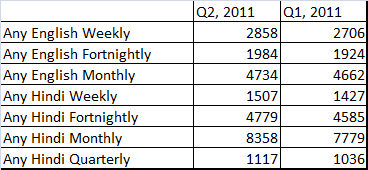
    Magazines have been witnessing a bit of rough weather of late. It is not an Indian phenomenon but is being witnessed worldwide. However, this IRS Q2, 2011 shows an increase in readership of both Hindi and English magazines as compared to Q1, 2011. Here is a quick look at AIR for the same:

    Readership in this duration has increased for Kannada and Telugu publications also. For Assamese, Gujarati and Marathi it has gone down – while for other languages the response is mixed.


    Keeping the focus on English and Hindi magazines for the purpose of this article, is it safe to assume that this IRS marks the revival of magazines? Says Anita Nayyar, CEO – Havas Media, India & South Asia, “This IRS certainly indicates better health for magazines but not necessarily revival.”

    Rajni Menon, Associate Vice President, Carat Media India, too believes that it is not really the revival of magazines and mentions two reasons for marginal upward trend for the magazines. She said, “The Week and Business World have been actively working towards increasing readership and it has had an impact in the market. Secondly, new magazines which were not captured in IRS earlier, eg 2010 Q2 IRS did not cover the following magazines – Outlook Profit, Economist, People, Life Positive. The biggies like India Today, Outlook have seen only marginal shifts only.”

    However the experts believe that there is definite scope of growth in niche and special interest publications, which have shown an upward trend. Ms Nayyar said, “Niche magazines are doing better than mass magazines.” Ms Menon endorsed this, “There has been growth in numbers for niche magazines : India Today Travel Plus, Good Housekeeping, Femina WTW, so that could show an indicative trend along with the fact that one does see more new magazines on the stands every few months. Travel, Women, Lifestyle. “

    However, a major issue faced by media planners and buyers is that a number of niche magazines are not tracked in IRS. As per Ms Menon, “We still can’t make a definite decision on magazines because there are so many in the market which are not covered by IRS. Mainline magazines like Open and Tehelka are yet to be covered, so seeing new niche magazine get covered is a long shot.

    Ms Nayyar too stated that niche and special interest publications are set to grow, but most niche magazines are not tracked.


  • IRS 2011: Metro watch and State watch

    By Ritu Midha

    This article is an attempt at a quick observation of  combined readership of eight metros: Mumbai, Delhi, Kolkata, Chennai, Bangalore, Ahmedabad, Pune and Hyderabad.  The combined data indicates a fall in readership for three publications: Anand Bazar Patrika, Hindustan and Lokmat over Q2, 2010.  All other publications except Daily Thanthi show a single digit growth. Daiy Thanthi shows a sturdy growth of 10 percent.

    If we look at eight metros – The Times of India emerges as the market leader – however, if we look at each metro in isolation, The Times of India leads only in Greater Mumbai. Publications presence in all metros, and that too in the top five, helps it in maintaining leadership position.

    Ananda Bazar Patrika, the number two publication in 8 metros, interestingly, is present in top 10 dailies only in Kolkata – where it is top of the pack.

    Hindustan Times, the number three daily in eight metros leads in Delhi and is number five in Mumbai. It is not in top 10 in the other six metros.

    Navbharat Times, the number four daily is at number three in Delhi and Number nine in Mumbai – it is not there in the top ten in rest of the metros

    Gujarat Samachar is at number five in eight metros  – it is at number two in Ahmedabad and number four in Gujarat. It, too has no presence in top 10 list of any other metro.

    Daily Thanthi leads in Chennai, and is at number eight in Bangalore – and this brings it at number 6 position in eight metros.

    Lokmat at number 8 in Mumbai, is at number 2 in Pune, and occupies number 7 slot in top 10 dailies in eight metros

    Daily Sakal leads in Pune with a big margin, and by its virtue sits on number eight slot in eight metros

    Hindustan Number 4 paper in Delhi is at number 9 in eight metros

    DIvya Bhaskar, the market leader in Ahmedabad completes the top 10 list


    DNA, in the top 10 in Mumbai, Bangalore and Ahmedabad does not find a place in top 10 eight metros.


    Mumbai: In terms of percentage growth – Hindustan Times show the sturdiest growth – a 27.2 percent jump vis-a-vis same quarter previous year. Interestingly all the Marathi publications show a negative growth, while all the English dailies grow positively. However, when compared with previous quarter seven publications show a negative growth.  Top three publications in the city are from The Times of India stable.


    If we look at Mumbai vs Maharashtra – readership patterns are quite different – Punya Nagri, Pudhari and Daily Sakal – among the top 10 in Maharashtra are not there in Mumbai. In its place are DNA, Navakal and Navbharat Times. While in Mumbai, three of the top five dailies are English. One is Gujarati and the other Hindi, in Maharashtra the picture is very different with  The Times of India being the only English daily in top five – and the other four being Marathi publications.


    Delhi: The gap between the market leader Hindustan Times and the Challenger The Times of India narrows as Hindustan Times sees a marginal fall of 0.7 percent, while The Times of India grows by 1.3 percent from Quarter 2, 2010. Nai Duniya needs a special mention as it has grown by 117 percent, though on a small base. Navbharat Times has also shown a double digit growth – some of it, perhaps at the expense of Hindustan, which has gone down by 3 percent.


    Bangalore: The top five publications have shown a positive growth. On the percentage basis growth over quarter 2, 2010, by English Dailies The Times of India (33.9 percent), Deccan Herald (22.6 percent) and Bangalore Mirror (151.6 percent)is much higher than the language counterparts.


    Bangalore and Karnataka top 10 have seven common publications – and the top two remain the same. However, three publications in Bangalore (two of which are English dailies) : Daily Thanthi, Deccan Chrocle and DNA are missing in Karnataka, and in their place are Samyukta Karnatak,  Sanjavani and Tarun Bharat.


    Hyderabad: Hyderabad is the only metro, where all the top dailies have shown a negative growth over the same quarter previous year. Interestingly, on Q on Q basis Daily Munsif is the only daily showing a negative growth, all the other publications show positive growth there, though not enough to cover the shortfall witnessed earlier.


    Andhra Bhoomi and Andhra Prabha are the two publications in the top 10 list of Andhra Pradesh, which are missing in the top 10 of Hyderabad. In their place are The Munsif and The Economic Times


    Chennai :  Six dailies show negative growth, three positive while one remains unchanged. Daily Thanthi, the market leader shows a healthy growth of 8.5 percent and is ahead of number two Dinakaran with a big margin.


    Chennai and Tamilnadu share the top nine dailies – though not necessarily in the same order. There is a change on the tenth position where Malayala Manorama is present in Chennai, while for Tamil Nadu it is, Tamizh Murasu.


    Pune: In Pune market leader Daily Sakal is ahead of its closest competitor Lokmat by a margin of 40 percent – it shows a 10 percent growth vis-a-vis Q2 previous year.  Most noteworthy growth is recorded by Maharashtra Times at a whopping 638.5 percent.


    Pune and Maharshtra, meanwhile have seven publications in common. Three in Maharashtra which are missing in Pune are Deshonatti, Gujarat Samachar and Mumbai Mirror. In its place Pune has Prabhat ka Anand and Samna.


    Ahmedabad: In Ahmedabad, all the English Dailies except DNA show robust growth over Q2, 2010– The Times of India grows by 44.2 percent, Ahmedabad Mirror by 32.1 percent, The Economic Times by 50 percent, and The Indian Express by 66.7 percent. Market leader Divya Bhaskar grows by 6.5 percent and is ahead of Gujarat Samachar by close to 20 percent.

    In Ahmedabad and Gujarat, the top four publications remain same, with Divya Bhaskar and Gujarat Samachar interchanging top two slots.  However three English publications that find a place in Ahmedabad – DNA, The Economic Times and The Indian Express are missing in Gujarat. Only English publication in both Gujarat and Ahmedabad is The Times of India.


    Kolkata: Market leader Ananda Bazar Patrika shows negative growth of 3.8 percent over same quarter previous year. However, in spite of it, it continues to be ahead of Bartaman, the number two daily by more than 100 percent margin. Five Bengali dailies show a negative growth in this duration. Of the English dailies only The Times of India shows a negative growth – of 4.3 percent.

    Kolkata is highly representative of West Bengal as eight publications are same in the capital and the state. Interestingly, the top three are at the same rank. Only two changes are The Statesman and Prabhat Khabar in Kolkata which are replaced by Uttar Banga Sambad and Sambad in West Bengal


    State Watch: Dailies – IRS Q2, 2011

    Here is MXM’s quick observation of the remaining states:

    Rajasthan:  Dainik Bhaskar and Dainik Navjyoti show a healthy growth over Q2, 2010. In spite of 0.9 percent drop when compared quarter on quarter Rajasthan Patrika continues to be the leader, with Dainik Bhaskar close on its heels. Of English dailies Hindustan Times shows the largest percentage growth at 64.1 percent when compared with same quarter in 2010. Five publications show a negative growth over previous quarter. Q on Q, Daininik Navjyoti, Punjab Kesari and Hindustan Times show a healthy double digit growth.


    West Bengal: Moving eastwards, seven of the top ten publications show negative growth over the same quarter previous year. Of these seven Ganashakti is the only one which shows a positive growth over  the previous quarter.  In spite of a 7.3 percent drop in readership over the same quarter previous year, Ananda Bazar Patrika continues to be the leader with a huge margin. Of the English dailies, The Telegraph shows a 1.2 percent growth and continues to be number three in the overall ranking for the state.

    Assam: Only Assam Tribune of 10 leading publications show a positive growth, over the same quarter previous year.  Both the new publications Dainik Jugasankha and Ajir Asom– surveyed from IRS Q1, 2011 also show a negative growth Q on Q.  Asomiya Pratidin, in spite of showing negative growth in both quarters continues to be the market leader with more than three times the size of number two publication Asomiya Khabar.

    Orissa: Unlike other states in East and North East, four English publications find place in the top ten – however The Telegraph is the only English publication to show a positive growth over the same quarter previous year – though on a small reader base. Seven out of 10 leading publications show a negative growth both Q on Q, and over the  same quarter previous year – and fall in numbers is quite substantial in case of Orissa. Sambad, the leader, shows a drop of 6.4 percent as compared to Q2, 2010. Meanwhile, number two, Dhaitri has shown a 10.1 percent growth in the same duration – closing the gap with the number One publication.

    Andhra Pradesh: Moving down South, in Andhra Pradesh, eight out of 10 publications show a down turn over the same quarter previous year.  Sakshi and Andhra Bhoomi are the only two publications to show a positive growth. Market leader Eenadu shows a drop of 2.3 percent over the same quarter previous year. Sakshi, the number two clocks a growth of 9 percent in the same duration – reducing the gap with the market leader.

    Tamil Nadu: Tamil Nadu emerges as an interesting market from a media watcher’s perspective. While six publications show a negative growth over the same quarter previous year, when it comes to quarter on quarter numbers, The Hindu is the only publication to show a negative growth. Daily Thanthi, in spite of a drop of 2.3 percent over the same quarter previous year continues to lead the pack with a massive margin.

    Kerala: Biggest blow in Kerala comes for The Hindu, which shows a percentage drop of 67.8 percent, over the same quarter previous year. Malayala Manorama with a positive growth continues to be the market leader. Five publications show a negative growth over the same quarter previous year.

    Karnataka: Karntaka emerges as the market with most positive growth figures. Nine of the 10 dailies show a positive growth over the same quarter previous year. Only publication to show negative growth is Tarun Bharat with a 36.1 percent fall in readership in this time duration. However, when compared Q on Q, the number of publications with fall in readership goes up to five. Viay Karnataka with a growth of 5.2 percent over the Q2, 2010 continues to be the market leader – however number two daily Prajavani grows at a much faster pace of 31.3 percent and closes the gap with the market leader.

  • IRS 2011Q2 | State Watch: Dailies

    By Ritu Midha

    A quick look at data for top 10 dailies in a handful of states brings out a few interesting observations. Do write to us at editor@mxmindia.com with your own observations and insights.

    Bihar: All the newspapers show a positive growth vis-a-vis the previous quarter. Even when compared with the same quarter previous year, all the publications show a good growth except I Next. Interestingly English dailies too have grown – and in case of Times of India, it has maintained the same level as the previous year same quarter.

    Jharkhand: When it comes to its neighbour and a part of Bihar till recently it is quite a different story – six out of top 10 dailies show a negative growth – and it is across Hindi & English dailies.

    UP: Just like Bihar, UP too has shown a growth in all the publications as compared to the previous year with the exception of DLA. Amar Ujala compact is growing the fastest with readership increasing to double in comparison to same quarter previous year.

    Uttaranchal: Uttaranchal too shows growth in all the publications but one, when compared to the previous quarter. Interesting thing however is that Amar Ujala compact that shows the fastest growth figures in UP, here shows a drop of 61%, as compared to same quarter last year.

    MP: If one compares data for Q2, 2011 with Q2, 2010, Nava Bharat (MP) and Raj Express are the only two publications that shows a fall. Another interesting factor here is that The Times of India is the only English publication in the top 10, unlike UP and Bihar where there is almost an equal number of Hindi and English Publications.


    Chattisgarh: In case of Chattisgarh, there are three English dailies in the top 10, however all three show a negative growth when compared to the previous quarter. Though, in case of The Times of India, if compared with Q2, 2010, figures show a 27.3% growth.


    Himachal Pradesh: Six out of top 10 dailies show a negative growth when compared with the same quarter in 2010. Amar Ujala, on the surface, seems to have gained at the cost of Punjab Kesai, while in case of The Hindustan Times, it is at the expense of The Times of India. A deeper analysis, perhaps, can throw more light on it.


    Haryana: In case of Haryana, q2 2010 to Q2 2011, three publications show a downturn, but when it comes to Q1 2011 vs Q2, the downturn is seen in seven publications – all the three English papers in the top 10 show a percentage fall when compared to the previous quarter.


    Punjab: In case of Punjab, only two publications of the top 10 have witnessed positive growth when compared to Q2, 2010 – These are Ajit and Dainik Bhaskar. However, if one compares Q2 2011 with Q1, 2011 even The Times of India and The Tribune show positive growth.


    Maharashtra: In Maharashtra’s top 10 dailies, Times of India and its co-publication Mumbai Mirror are the only two English dailies. Market, as expected, is dominated by Marathi dailies. Deshonatti is the only daily that sees a double digit growth when compared to Q1, 2011 – however, that too shows a 17% fall when compared to Q2, 2010.


    Gujarat: Gujarat too has just one English daily in its top 10 – The Times of India, and it shows good growth in both quarters. Other non Gujarati daily in the top 10 shows a growth of 83.9%, when compared to Q2, 2010.

    To be continued…

  • Claims and counter-claims start after IRS 2011Q2 release


    By A Correspondent

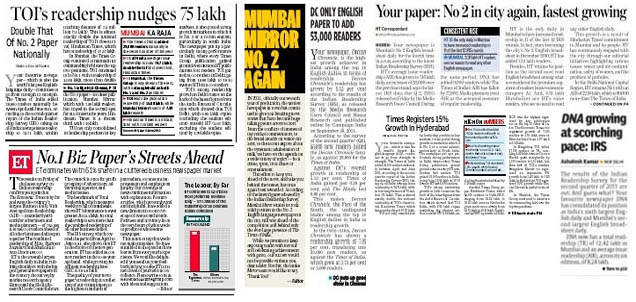
    The claims and counter-claims have begun. In Mumbai, Mumbai Mirror said it’s No 2 again. So did Hindustan Times. Both weren’t incorrect: Mirror may have the second-largest readership, next only to The Times of India, but Hindustan Times is the second-most read broadsheet English daily. DNA’s report too says it’s the second-largest broadsheet daily.

    Sadly, the conferences which the Market Research Users Council and Hansa Research Group would conduct to release every round of the Indian Readership Survey have been done away with. The detailed dump is curiously no longer handed out to the trade media.

    Consequently, what the MRUC and Hansa expect the trade media to do is to either carry unverified claims of various media entities. Or depend on friendly publications and agencies to give out data.

    MxMIndia.com requested veteran media consultant Sundeep Nagpal and his firm Stratagem Media to dig a little deeper and help us come up with a variety of insights given IRS 2011 Q2 data.

    For instance: the DNA report quotes a total readership (TR) figure for itself which most media agencies do not recognise. Media agencies and MxMIndia recognise Average Issue Readers (AIR) as currency. Interestingly,  when you look at the numbers for Greater Mumbai, while DNA is a distant third amongst English language broadsheets vis-a-vis The Times of India, it’s difference with #2 English broadsheet Hindustan Times is just 63,000. For HT of course the growth story in Greater Mumbai is tremendous: 27.2% year-on-year and 4.1% in the second quarter.

    We asked Strategem for the following:

    1. Given the toplines mailed to us by IRS, could we analyse it vis-a-vis the Q1 data for 2011 as well as the Q2 data for 2010 so that we can do a year-on-year analyses?

    2. Can we also similary analyse the data region-wise – Hindi belt and North, West, South and East and North East?

    3. Can we look at the numbers for the 8 metros combined and separately?


    Stratagem has provided us this data, and we present these to you as follows:


    First, take a look at the table withe the Top 10 publications across the country – urban and rural India.


    Publications

    IRS 2011 Q2

    IRS 2011 Q1

    % growth in IRS 11 Q2 over 11 Q1

    IRS 2010 Q2

    % growth in IRS 11 Q2 over 10 Q2

    Est. Individuals (000s)

    889070

    885122

    0.4

    871443

    2.0

    Dainik Jagran

    16393

    15910

    3.0

    15925

    2.9

    Dainik Bhaskar

    14174

    14016

    1.1

    13303

    6.5

    Hindustan

    11985

    11810

    1.5

    10143

    18.2

     Malayala Manorama (Daily)

    9962

    9938

    0.2

    9841

    1.2

    Amar Ujala

    8891

    8747

    1.6

    8417

    5.6

     Lokmat

    7595

    7486

    1.5

    7402

    2.6

     The Times Of India

    7471

    7442

    0.4

    7088

    5.4

     Daily Thanthi

    7290

    7187

    1.4

    7402

    -1.5

    Rajasthan Patrika

    6941

    7033

    -1.3

    6900

    0.6

     Mathrubhumi

    6690

    6800

    -1.6

    6566

    1.9


    Let’s also look at the combined numbers for the eight metros of Mumbai, Delhi, Kolkata, Chennai, Bengaluru, Hyderabad, Pune and Ahmedabad.


    Combined 8 metros-Mum,Kol,Ahm,Bang,Pune,Chen,Del,Hyd

    Publications

    IRS 2011 Q2

    IRS 2011 Q1

    % growth in IRS 11 Q2 over 11 Q1

    IRS 2010 Q2

    % growth in IRS 11 Q2 over 10 Q2

    Est. Individuals (000s)

    73117

    72672

    0.6

    71138

    2.8

     The Times Of India

    5114

    5073

    0.8

    4879

    4.8

     Ananda Bazar Patrika

    2708

    2725

    -0.6

    2821

    -4.0

     Hindustan Times

    2690

    2675

    0.6

    2566

    4.8

     Navbharat Times

    2392

    2349

    1.8

    2216

    7.9

     Gujarat Samachar

    1606

    1641

    -2.1

    1503

    6.9

     Daily Thanthi

    1365

    1319

    3.5

    1233

    10.7

     Lokmat

    1224

    1268

    -3.5

    1295

    -5.5

     Daily Sakal

    1175

    1213

    -3.1

    1089

    7.9

     Hindustan

    1128

    1142

    -1.2

    1167

    -3.3

     Divya Bhaskar

    1124

    1129

    -0.4

    1039

    8.2


    The growth story is undoubtedly that of Hindustan which has grown 18.2 percent over the second quarter of 2010, though the growth in the second quarter of this year has now steadied at 1.5 percent. But the winner of the quarter from the toplines of 2011Q2 for across the country is undoubtedly Dainik Jagran with a 3% growth. On a base of 1.59 crore this is big.  The other stories of the big players is also noteworthy. Bhaskar 6.5% y-o-y, Amar Ujala 5.6% y-o-y and The Times of India too at 5.4% y-o-y. Jagran’s y-o-y is 2.9% and Lokmat has grown 2.6 percent over 2010 Q2.
    We urge you to click on the links below (these will come up later in the day) for detailed numbers.It is important to note that the numbers thrown up in the above table are not truly indicative of the power of the various publications. Remember, these ratings are only for metros, and the picture is dramatically different for an ABP in West Bengal, and Gujarat Samachar in Gujarat or Thanthi in TN and Sakal and Lokmat in Maharashtra. Ditto with Hindustan and Bhaskar.

    Links:

    IRS Q2 2011 Hindi Belt & North


    IRS Q2 2011 – South


    IRS Q2 2011 – East


    IRS Q2 2011 Maharashtra & Gujarat

    Information courtesy:


  • Anil Thakraney’s Hard Knocks: Are newspaper owners in sleep mode?

    The latest IRS figures are in. And as usual, newspaper edits get busy boasting about rise in readership. Or, they’ll work out ingenious ways to interpret the findings, to keep their board of directors and advertisers in good cheer. By the way, I often wonder if everyone’s readership is healthy, who’s taking the fall? Anyway, that’s not the point of my article. And neither do I wish to discuss IRS’s methodology.


    What I want to say is this: Newspaper proprietors in India should be thrilled even if there is no growth for their brands. India is that unique nation where dailies continue to thrive even as they struggle to survive in the rest of the world. And that’s purely because, as Indian Express chief Shekhar Gupta said to me in an interview for GQ mag, and I quote: “India has more space for media than most societies. People read multiple newspapers. We may see a shakeout, but not in the near future. Simply because of the demographics. India is adding nearly three crore literate people to the market every year. That’s the size of a large European country.”


    Shekhar is right. India’s large population base and rise in education will sustain newspapers for a pretty long time. But the proprietors will do well not to get complacent and sit on their laurels. Because the global trends will sooner or later catch up with India. Soon the tech revolution will hit India hard, and many newspaper brands will be compelled to shut shop.


    And innovations and out-of-the-box thinking must start NOW before it’s too late. Sadly, I haven’t seen any signs of that so far. Almost every single news that gets ‘broken’ on the covers of our dailies, I have already been made aware of the previous night by TV and/or Twitter.


    So people, do gloat if you wish on the IRS figures. But also do take care to smell the coffee.


    ***


    PS: I badly wanted to stay inside the Bigg Boss house this time. But couldn’t think of anyone to kill, rape, molest, abuse or cheat. So I didn’t qualify. The loss is all mine.