Tag: Hindustan Unilever

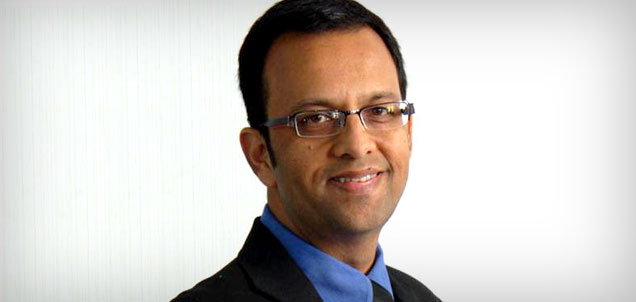
  • Gaurav Jeet Singh to head media services at Unilever South Asia

    By Pritha Mitra Dasgupta


    Gaurav Jeet Singh, marketing manager, Hindustan Unilever (HUL), has replaced Atit Mehta as the head of media services, Unilever South Asia. Mehta, who was promoted to a regional media role for one of the international markets, has quit the company. Mr Mehta may be joining Sequoia Capital as vice-president, media, from January 6, sources said.


    HUL’s spokesperson said, “Gaurav Jeet Singh has been appointed as head, media services, for HUL. Gaurav Jeet Singh succeeds Atit Mehta who has left Unilever to pursue an external opportunity.”


    As head of media services, Singh will be responsible for driving effectiveness and impact of HUL’s media investments through a combination of strategic planning, media innovations and partnerships, said the spokesperson. He will also lead the digital and mobile agenda of the company. He will also oversee media services for Unilever in Pakistan, Bangladesh and Sri Lanka.


    Mr Singh started his career with L’Oreal in 1997, then launched his own venture called Unique Transport in Hyderabad in 1998. He joined HUL as regional sales and customer manager in Kolkata in 2008 and was promoted to branch sales manager in 2010.


    Source:The Economic Times

    Copyright © 2015, Bennett, Coleman & Co. Ltd. All Rights Reserved

    Licensed to republish


  • How Sanjiv Mehta wants HUL to Win in Many Indias


    By Kala Vijayraghavan


    A year into his tenure as CEO of Hindustan Unilever, Sanjiv Mehta has made his most significant move yet. Convinced new consumers can be found in heaps in the mosaic that is the Indian market, Mehta is giving his managers a new structure to go find it. In challenging HUL managers, he’s taking forward the process of embracing the market his predecessor Nitin Paranjpe began.


    When Sanjiv Mehta moved to Mumbai last October to take charge of Hindustan Unilever, India’s largest FMCG company, it had been 21 years since he last worked in the country. Yet, the son of an RBI accountant who grew up in Mumbai intuitively describes this melting pot of India as “home” and himself as a “Mumbaikar”. “When I reach the turn around the museum at Colaba, the years go by in a roll,” he says. “Mumbai has been my home for so many years. My mother lives in Colaba.”


    Still, for Mr Mehta, returning to India with some sense of permanence, and travelling across it, has been about renewing old attachments and finding new ones. That question of identity – just what is India, especially as a consumer – lies at the heart of the change Mr Mehta is trying to sell to his own managers, many of whom have built Hindustan Unilever into a Rs 29,233 crore company and who, at various points in time, have shrugged to say there’s little room for this giant to grow in the India they know. It’s a notion Mr Mehta is challenging.


    “None of the categories in which we operate are saturated. Not even soaps and detergents, which are highly penetrated categories,” says Mr Mehta. “If the per capita consumption in fabric conditioner was to increase to the same level as Vietnam, the market in India for fabric conditioners would be 40X larger.” Mr Mehta is laying down the marker in the inimitable way that has come to define the 55-year-old a leader: firm without being rude, purposeful rather than preachy, looking ahead and not back. The admittance that HUL could have done better on the growth front is implicit in his argument, but is subdued in its expression. The expression, instead, is all about structure.


    That structure is formally named ‘winning in many Indias’, or WIMI, and it was rolled out on September 21. In his one year at HUL, which he will complete this October 10, this is Mr Mehta’s most significant move.


    Previously, HUL made sales via a structure that broke up India into four regions. As part of WIMI, a fifth region has been added. More importantly, sales will now be flanked – and fed – by consumer insights from a parallel geographical structure that carves out India into 14 parts. The philosophy is to change HUL’s responsiveness from a place of being largely homogenous (seeing India as a few big markets) to a place that is a lot more heterogeneous (seeing India as a mosaic of markets). The idea is identify sales gaps and market-creation opportunities – of which, Mehta believes there are ample, even for a large company like HUL – and to infuse it with a growth mindset again.


    It’s the classic HUL leadership template, quips a former senior company official, and every new CEO does this. “Everyone has to justify changes,” he says, on the condition of anonymity. “Undeniably this focus will help… but HUL has been around for 70-80 years. What new findings are there that they haven’t yet discovered in India?” He believes that no what matter what HUL does, it will struggle to fend off the scatter of regional players.


    CK Ranganathan, founder-chairman of CavinKare, a South India-based competitor, is more circumspect in his assessment. “They seem to be focussing in small parts through smaller structures and sharper teams,” says Mr Ranganathan, whose company owns brands such as Nyle, Chik and Fairever. “That will help them win in various smaller markets. One of course needs to wait to see how effective that is.”


    The consolidation

    Mr Mehta could not wait. He began his homework on India between his appointment as the new HUL chief and his actual move from Dubai, where he was handling 20 emerging markets for parent Unilever as its chairman, North Africa and Middle East. “I had sent a note to my management-committee members, seeking detailed insights and information into their part of the business,” he recounts. “And when I moved here, I did the deep-dive sessions and met a large cross-section of people, from managers in my team in groups and individually to consumers for feedback about my business.”When he did move here, the Indian economy was facing economic headwinds. HUL had used price hikes and cost control to not only protect its operating margins, but even grow them. The issue was growth. For the year ended December 2013, its sales grew a lame 8%.


    Mr Mehta began incrementally: for example, renovating and innovating in several big brands, including Pond’s men range of personal care products, Tresemme hair care and Magnum ice-creams. Meanwhile, economic sentiment improved. At 13%, HUL’s revenue growth in the April to June quarter was the its highest in five quarters.


    At 21%, its operating profit growth was its highest in eight years. In the last three months, the HUL stock has gained 20%, against 9% posted by the BSE FMCG Index


    The strategy

    In the background of all this, a pilot was underway at HUL to gauge whether, and by how much, the company’s formidable sales and marketing machinery was missing. The pilot was in HUL’s South India sales branch, which was broken into two consumer clusters: TAP (Tamil Nadu and Andhra Pradesh) and KK (Karnataka and Kerala).


    From the pilot emerged instances where HUL had under-assessed market size and under-sold its products. One of those instance was of Wheel, HUL’s mass-market washing-powder brand, being absent in a small town in South India because its official did not see it as a market. The consumer insights team, however, discovered that a local player – with a product inferior to, and costlier than, Wheel – was building scale. HUL introduced Wheel, and it’s now overtaken that local brand and is number two in that market.


    It became apparent from the pilots to Mr Mehta that, as an organisation, HUL was not peeling the layers deep down in the market as well as it is capable of. Its officials were seeing India as a certain number of parts, but Mr Mehta wanted them to slice and dice it in many, many more ways – to pry open, what he describes as, “many small Indias”. That’s the big idea the 14 consumer clusters will try to service. The 14 new positions of cluster heads will be filled internally.


    “We are empowering our younger managers with challenging roles,” says Mr Mehta. The company declined to share the geographical boundaries of the clusters or the identities of the cluster heads. Mr Mehta is empowering these 14 consumer clusters to change the direction of operations. So, a cluster head can take an insight from her market – say, why Wheel should be launched there – to the sales, planning and category heads, make a case to roll it out, and reorganise planning and supply chain to that end.


    “This is very clearly the result of extreme aggression shown by smaller players across categories and across markets,” says an FMCG analyst at a foreign brokerage, not wanting to be named. “This is an initiative HUL should have taken a couple of years back as the country’s largest marketer.” There is a view that Mr Mehta, with his commercial background, is focussed on controlling costs. “That was an uninformed view,” he says. “My educational background is that of a chartered accountant, but I am running a marketing organisation. My focus, therefore, will be on brands and our people. Having said that, productivity and efficiency too are essential as they provide fuel for growth.”


    The orientation

    By essentially demanding a greater market orientation, Mr Mehta is looking to take forward the philosophical shifts in HUL his predecessor Nitin Paranjpe embarked on, with a fair degree of success. Mr Paranjpe pushed managers into the field and made them listen more to consumers. He wanted an HUL that was less complacent and more humble in the marketplace. One of his initiatives was ‘Mission Bush Fire, which required about 4,000 HUL managers to engage directly with customers. Another was ‘POPeye’, which called on HUL employees across departments to flag off product shortage in any store.


    In an internal email to employees, Mr Mehta is believed to have urged employees to continue with both. The way Mr Mehta has envisaged the consumer clusters, execution of the market plan can feed off a pet concept of Mr Paranjpe: micro-marketing, where the marketing team, once it identifies a smaller market for a brand, goes all out in activation and advertising promotion of a brand.


    Under Mehta, HUL is also doing a rethink on marketing, allocating more to non-TV spends and mobile. “About 25% of our spend will be on non-TV mediums like digital, mobile, print, outdoors and wall paintings,” he says. Amin Babwani, a former senior sales and marketing official at HUL and now an independent consultant, likes the concept of these consumer clusters.


    Asserting it is a continuity of the geographical emphasis HUL has consistently aimed for, he says: “With these clusters, focus is more accentuated and there is greater accountability since it is now enshrined in the structure.” Some observers feel a new structure is great, but the challenge posed by regional players goes deeper than that, and national players don’t understand that. “The issue is with their (HUL’s) portfolio,” says a leading brand expert on the condition of anonymity.


    “Some of their brands do not have a relevant proposition in the local markets and this is a typical MNC problem.” Vimal Pande, CEO of Vi-John Group, which owns the Vi-John brand of personal care and grooming products, says regional players are striking better partnerships in the marketplace.


    “Retailers and wholesalers are very happy with our proposition, which ensures they make reasonably good margins,” he says. “Ours is not a push-down (approach), and laying down of terms and conditions that larger players tend to do.” Mr Mehta points out that the bottom-of-the-pyramid has halved in size, drifting into HUL territory. “We want HUL to be futureready to tap into this opportunity,” says Mr Mehta. And the consumer clusters are being positioned to play a pivotal role in that architecture.


    (With inputs from Kiran Kabtta Somvanshi)


    Source:The Economic Times

    Copyright © 2014, Bennett, Coleman & Co. Ltd. All Rights Reserved

    Licensed to republish
     

  • KKT undertakes initiative to fight corruption

    By A Correspondent


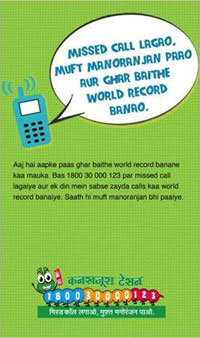
    India’s first free and on-demand entertainment mobile radio channel Kan Khajura Tesan has undertaken an initiative that will take the fight against corruption to every Indian’s doorstep. Since the issue strikes a chord with every Indian, the anticipated response might go on to create a world record.
     

    This ‘Independence Day’ week, Kan Khajura Tesan aims to set a world record by getting as many missed calls as possible in 120 hours from the people of India on its toll free number 1800-30-000-123 (Atharasau tees hazar ek do teen). To pledge against corruption, the audience has to give a missed call on Kan Khajura Tesan’s toll free number 1800-30-000-123 from their mobile phones. In return, Kan Khajura Tesan will donate Re.1 for every 100 missed calls received between 13th August and 17th August to the National Anti Corruption Investigation Bureau. Once the consumer gives a missed call to Kan Khajura Tesan, in a few seconds the consumer will receive a call back from the channel to confirm their participation in the endeavour to set a World Record along with 20 minutes of free entertainment.


    Speaking about the initiative, Priya Nair, Vice President at Hindustan Unilever said, “Kan Khajura Tesan is one of India’s biggest, free and on-demand radio channels with over 1.4 crore subscribers and more than 25 crore minutes of radio engagement. With this initiative, we want to use this powerful platform to drive a social change. The initiative of pledging against corruption has never been attempted at this level anywhere in the world yet, and with the support of Indians we want to create a record of which every Indian can be proud.”


  • Oh, Mitwa! ‘Kan Khajura Tesan’ 3 Gold Jeetwa!


    By Delshad Irani


    It’s been a long time coming but India’s finally scored the campaign equivalent of a killer app. Kan Khajura Tesan or “centipede station”, a programme by Hindustan Unilever to provide radio over mobile to the media dark parts of North India has scored a massive three gold trophies; two in Media for PHD and one in Mobile for Lowe and Partners Worldwide. Although Lowe Lintas is the creative agency behind the work, the agency is absent at award shows because of its chairman R Balki’s famous no awards policy. However, the creative council of Lowe Worldwide headed by Jose Miguel Sokoloff picked the pathbreaking work to throw into the toughest ad competition in the world.


    Note with the winning Media Lions entry on Kan Khajura Tesan:
     

    Results and Effectiveness:

    “Single largest media channel in Bihar and Jharkhand”


    Over 8MM subscribers in two states in 6 months. KKT reaches 60% of the non-TV households in these states. Consumer base growing at an average of 35,000 daily


    Unilever ads have been heard over 70MM times  Increase in Spont Awareness for all three brands associated
    – Wheel – 20%
    – Ponds White Beauty – 56%
    – Close Up – 39%

    All of this at 4 cents cost per contact.


    Creative Execution:

    In a media first for India, we brought together telcos and content providers to create a FREE, ALWAYS ON, ON DEMAND entertainment channel accessible through even the simplest mobile phone.


    Outbound dialers promote KKT and educate consumers on how to access free content. The content is personalised through a Radio Jockey, who also reminds users to call again to get more content. Consumer traction is increased through relevant and contextual content like movie clips, Bollywood songs and jokes. The content is refreshed on a weekly basis and engagement spikes are created through blockbuster movie tie-ups.


    The Unilever advertisements are placed within the content in a non-intrusive manner.


    Consumers can consumer upto 60 minutes of entertainment content per month, absolutely free.


    Insights, Strategy and the Idea:

    82MM Households in India are media dark!


    Imagine a world where your basic source of happiness; entertainment on TV is cut short by long daily power cuts. What a mundane existence that would be.


    With 86% ownership, mobile phones are the only saviours. Movie clips or songs downloaded from telcos or purchased via pre-loaded chippis (sim-like chips) are the only things to turn a frown upside down.


    80 cents for limited movie clips coupled with the cost of connecting and downloading content from telcos makes mobile entertainment an expensive option.


    So to plug this famine of entertainment content, we created the ‘Kan Khajura Tesan’ KAN KHAJURA TESAN (ear worm channel) is the first of its kind, free advertiser-owned entertainment channel accessible through mobile. Just give a missed call to the branded number and receive entertainment content interspersed with Unilever adverts, free of cost.


    Reacting to the news, Priya Nair, vice-president at Hindustan Unilever says, “It’s always great to have work recognised especially in a well respected forum.” Long regarded as a tough formula-driven marketer, Unilever has over the last decade turned its reputation around and is now regarded as a client encouraging of creativity. However as Nair clarifies, “Obviously, we are in the business of business. But while you do that, if the work delights the senses and builds a historical pathway for others to follow it’s a vindication of being in the right direction. It helps build an ecosystem of people thinking differently.”


    Bagging Gold comes as a welcome surprise to the notoriously award averse Lowe Lintas which apart from abstaining from local awards for over a decade, has dragged its feet about sending entries to Cannes. When we called R Balki for a comment he was in the middle of a shoot in Helsinki, but texted back ecstatically with, “Awesome!! Ya!! Good for ideas!! It’s a super kickass idea.”


    Speaking of the win, Deepa Geethakrishnan, president, Lowe Lintas says, “Kan Khajura Tesan is truly a collaborative effort between the client, who birthed the core idea, the creative and account and media teams. The insect has travelled all the way from Bihar to the South of France.” Sources at the media agency PHD were unavailable for comment at the time of writing.


    Often Indian campaigns are too desi for their own good at Cannes. Kan Khajura Tesan is the exception. Nair believes it’s because, the idea is “simple, inventive and not difficult to explain no matter where you belong. We are sometimes guilty of complicating the idea.” Arun Iyer, national creative director, Lowe Lintas, opines that the idea matched the judges’ sensibility of India. He adds, “Winning at Cannes is a good recognition. But this is a bonus; beyond a point we don’t think about awards.”


    Many creative leaders complain young Indian ad folk spend more time trying to crack relatively new and therefore presumably ‘easy’ categories like Mobile and Digital, while ignoring the meat and potatoes of television and print. This win proves that convincing ideas on big brands beat all statistical finagling or hedging so popular with agencies. Not that we expect them to stop anytime soon, though.


    Source:The Economic Times

    Copyright © 2014, Bennett, Coleman & Co. Ltd. All Rights Reserved

    Licensed to republish


    Also see/read:

    A four-minute film on the project:

    https://www.facebook.com/photo.php?v=674274805978726&set=vb.1289914 50507067&type=2&theater


    Unilever Brand story:

    https://www.facebook.com/UnileverDiaries India/app_819181691443540


    We are republishing a story we had published in March 2014 on the HUL offering (link: http://www.mxmindia.com/2014/03/bihar-mein-no-1-radio-station-kaunbaa-aapan-hindustan-unilever-ke-kan-khajura-tesan/):


    Bihar mein No 1 radio station kaunbaa? Aapan Hindustan Unilever ke ‘Kan Khajura Tesan’


    By Sagar Malviya


    At Gosaidaspur, a village near Ganga river basin in Bihar, people regularly listen to movie songs, dialogues, radio jockey talk, jokes and shayari on their mobile phone. There’s no FM station covering this village 250 km east of Patna; villagers owe this special service to Hindustan Unilever.


    The country’s largest consumer goods maker has come up with a free radio-on-demand service to reach out to villagers in remote areas. And it says its lone channel – Kan Khajura Tesan, or ‘centipede station’ – is already the largest radio station in Bihar in terms of subscribers.


    This is how it works: any mobile phone user in Bihar can give a missed call to a specific number to immediately get a return call that will play Kan Khajura Tesan for 15 minutes. Besides a series of entertainment programmes, the channel of course plays advertisements of HUL brands.


    HUL has Stopped Ads on Radio

    “There is a lot of demand for content or entertainment in media-dark villages and mobiles become their only route to that world. So, we thought, can we institutionalise missed calls into an entertainment channel,” said Hemant Bakshi, executive director for home and personal care at HUL.


    “For consumers, it’s just like any other free radio station. But the one big difference compared with a radio is that we know who’s listening to our programmes,” he said.


    Mr Bakshi said the company has stopped advertising on radio in Bihar because its own channel reaches more people than any radio station. The company has printed the phone number for the channel on some of its product packs and has put up banners outside stores to increase its reach.


    It has already acquired more than 5 million subscribers, and interacts with about 1 lakh consumers everyday. That means about 25,000 hours of engagement daily with consumers in Bihar. And the company says it has more than 26 million ad impressions till date.


    Buoyed by its success in Bihar, Hindustan Unilever has launched this service in neighbouring Jharkhand and plans to take it to other states including Uttar Pradesh, Madhya Pradesh and Rajasthan.


    Experts said Hindustan Unilever has reinvented “The notion that more advertising could mean more sales is diminishing. Also, impact of paid media is waning. HUL’s initiative is like a viral which will give much bigger bang for the buck,” said Alpana Parida, president at brand consulting firm DY Works.


    So, where did the company get this idea of running a parallel radio station? From a radio campaign for Wheel detergent it ran more than two years ago.


    The Active Wheel advertisement on All India Radio in Uttar Pradesh and Bihar asked listeners to give a missed call from their mobiles to a particular number.


    When they did so, they promptly got a call back with a recording of actor Salman Khan’s dialogues from his blockbuster film Ek Tha Tiger and his endorsement of Wheel.


    HUL got 16 million missed calls in four months and, by the end of the campaign, brand awareness scores for Wheel had increased 25% and its sales jumped three times in the region.


    To ensure quality programmes, HUL has roped in several third-party firms to generate content and services for the channel, which it had initially named ‘Mobile Vani’ before opting for a more sticky and colloquial name.


    Also, similar to a loyalty card system for retailers, HUL plans to develop strategies once it gets profiles of the listeners over a period. “Content and advertising are becoming more linked with each other than they used to be in the past.


    As we go forward and have richer profiles of our listeners, we can leverage the database and plan customised strategies for our brands,” Mr Bakshi said.


    Source:The Economic Times

    Copyright © 2014, Bennett, Coleman & Co. Ltd. All Rights Reserved

    Licensed to republish


    Editor’s Note: Many thanks to Sanjay Singh, senior journalist and now communications specialist based in Patna, for help with the Bhojpuri headline


  • HUL, McCann win big at IAA’s Olive Crown Awards for green advertising

    By A Correspondent


    The Holi weekend got off to a green start with the International Advertising Association India Chapter’s Olive Crown Awards on Friday, March 14 in Mumbai. The crème de la crème of the Indian advertising business was in attendance for the fourth edition of what is India’s first and only recognition for creative excellence in communicating sustainability.
     

    Mc Cann Erickson was crowned Green Agency of the Year. The agency also bagged the coveted Campaign of the Year for ‘Wake Up, Clean Up’. Dentsu Creative Impact got the Silver in the Campaign of the Year. Hindustan Unilever was awarded the Corporate Social Crusader of the Year as well as the Green Brand of the Year. Mathrubhumi too received the Corporate Social Crusader of the Year while the DDB Mudra group bagged the Silver in the Green Brand of the Year category.


    The Green Advertiser of the Year award went to the Bruhat Bengaluru Mahanagara Palike (BBMP), Karnataka State Government. The Green Crusader of the Year was awarded to Maneka Gandhi, Member of Parliament. The chief guest at the event was actor Amitabh Bachchan, who was also accorded the Honorary Membership of the IAA India Chapter.


    Srinivasan Swamy

    Said Srinivasan K Swamy, Chairman, R K Swamy BBDO and President, India Chapter and VP-Development Asia Pacific, IAA: “These awards have acquired the hue of a ’cause’ and this is one of the reasons for their universal acceptance.”


  • 9 Indian entries shortlisted for FOM Awards

    By a correspondent


    After much deliberation, the 70 strong judging panel, led by Sameer Singh, VP, head of global media of GSK have cast their votes for the much anticipated Festival of Media Awards.


    A shortlist of 191 campaigns across 19 categories has been selected, recognizing the very best in media thinking from around the world including countries such as Australia, Brazil, Denmark, Germany, India, Japan, Mexico, Poland, Singapore, Sweden, UAE, UK, US and many more


    The entries from India that have managed to make it to the shortlists include Hindustan Unilever (HUL)’s Kissanpur 2.0 “Where What You Grow Is What You Eat” campaign in the Best Communication Strategy while Madison Media Infinity’s ‘How Radio triggered 1.6 years of engagement around an unspeakable problem’ campaign for Mediker Anti-Lice Treatment Naturals was shortlisted in the Best Engagement Strategy category.


    In the category of Best Event / Experiential, Mindshare found three of its campaigns vying for the top prize including ‘106,000 Found’ for Closeup Toothpaste; Sunlight – It’s Raining Roses for Sunlight Detergent Powder and Surf EW-Worshipping the Lord with 10 Hands for Surf Excel.


    Mediacom’s Soldier for Women for Gillette India was nominated in the Best Use of Content category, while PHD had two of its entries ‘Mobile Entertainment Box’ for Kaan Khajura Teshan and ‘Good Life Club’ for Brooke Bond that were nominated in the Best Use of Mobile category.


    In the Effectiveness Award, Madison Media Infinity’s ‘Convincing consumers to become our sales force’ for its client Parachute Advansed Ayurvedic Hair Oil was the final shortlist that was nominated from India.


  • Bihar mein No 1 radio station kaunbaa? Aapan Hindustan Unilever ke ‘Kan Khajura Tesan’

    By Sagar Malviya


    At Gosaidaspur, a village near Ganga river basin in Bihar, people regularly listen to movie songs, dialogues, radio jockey talk, jokes and shayari on their mobile phone. There’s no FM station covering this village 250 km east of Patna; villagers owe this special service to Hindustan Unilever.


    The country’s largest consumer goods maker has come up with a free radio-on-demand service to reach out to villagers in remote areas. And it says its lone channel – Kan Khajura Tesan, or ‘centipede station’ – is already the largest radio station in Bihar in terms of subscribers.


    This is how it works: any mobile phone user in Bihar can give a missed call to a specific number to immediately get a return call that will play Kan Khajura Tesan for 15 minutes. Besides a series of entertainment programmes, the channel of course plays advertisements of HUL brands.


    HUL has Stopped Ads on Radio

    “There is a lot of demand for content or entertainment in media-dark villages and mobiles become their only route to that world. So, we thought, can we institutionalise missed calls into an entertainment channel,” said Hemant Bakshi, executive director for home and personal care at HUL.


    “For consumers, it’s just like any other free radio station. But the one big difference compared with a radio is that we know who’s listening to our programmes,” he said.


    Mr Bakshi said the company has stopped advertising on radio in Bihar because its own channel reaches more people than any radio station. The company has printed the phone number for the channel on some of its product packs and has put up banners outside stores to increase its reach.


    It has already acquired more than 5 million subscribers, and interacts with about 1 lakh consumers everyday. That means about 25,000 hours of engagement daily with consumers in Bihar. And the company says it has more than 26 million ad impressions till date.


    Buoyed by its success in Bihar, Hindustan Unilever has launched this service in neighbouring Jharkhand and plans to take it to other states including Uttar Pradesh, Madhya Pradesh and Rajasthan.


    Experts said Hindustan Unilever has reinvented “The notion that more advertising could mean more sales is diminishing. Also, impact of paid media is waning. HUL’s initiative is like a viral which will give much bigger bang for the buck,” said Alpana Parida, president at brand consulting firm DY Works.


    So, where did the company get this idea of running a parallel radio station? From a radio campaign for Wheel detergent it ran more than two years ago.


    The Active Wheel advertisement on All India Radio in Uttar Pradesh and Bihar asked listeners to give a missed call from their mobiles to a particular number.


    When they did so, they promptly got a call back with a recording of actor Salman Khan’s dialogues from his blockbuster film Ek Tha Tiger and his endorsement of Wheel.


    HUL got 16 million missed calls in four months and, by the end of the campaign, brand awareness scores for Wheel had increased 25% and its sales jumped three times in the region.


    To ensure quality programmes, HUL has roped in several third-party firms to generate content and services for the channel, which it had initially named ‘Mobile Vani’ before opting for a more sticky and colloquial name.


    Also, similar to a loyalty card system for retailers, HUL plans to develop strategies once it gets profiles of the listeners over a period. “Content and advertising are becoming more linked with each other than they used to be in the past.


    As we go forward and have richer profiles of our listeners, we can leverage the database and plan customised strategies for our brands,” Mr Bakshi said.


    Source:The Economic Times

    Copyright © 2014, Bennett, Coleman & Co. Ltd. All Rights Reserved

    Licensed to republish


    Editor’s Note: Many thanks to Sanjay Singh, senior journalist and now communications specialist based in Patna, for help with the Bhojpuri headline


  • Cadbury misses a hat-trick as Ogilvy misses 5th consecutive crown + Effies 2013 Tally tables

    By Our Research Associate


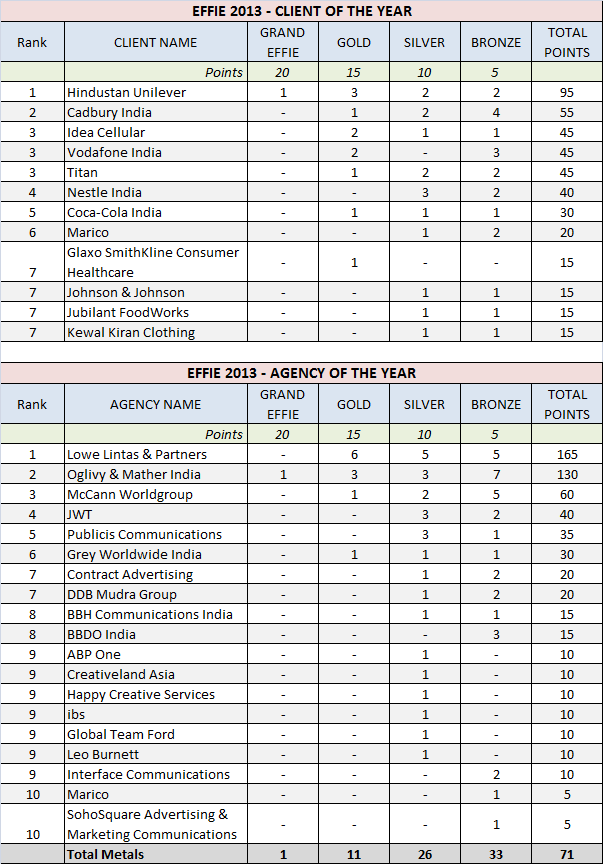
    The last time Lowe Lintas & Partners was Agency of the Year was in the year 2006. Hindustan Unilever was Client of the Year that year too. In 2008, the Effies were awarded on the day when the terrorist struck Mumbai – November 26, and JWT was the Agency of the Year (AOY) while Bennett, Coleman & Company was Client of the Year (COY).


    From 2009 onwards, Ogilvy has been AOY. But the COY title has moved around a bit – in 2009, Vodafone, in 2010 to Tata Teleservices and in 2011 and 2012 to Cadbury.


    Cadbury would’ve scored a hat-trick but this time thanks to both Lowe Lintas and Ogilvy contributing to its kitty, Hindustan Unilever forged ahead.


    According to a member of the jury who requested anonymity, entering the Effie requires some extra effort on the case study presentation. Remember you need to prove the fact that creativity has worked for the advertiser, and unless that’s done, you won’t win.


    A senior member of the industry told MxMIndia that given the body of work that Ogilvy had done, it could’ve surely been #1 had it presented some of its cases better.


    Perhaps.


    Meanwhile, take a look at the AOY and COY tally tables:


  • We can’t be without a measurement system: Hemant Bakshi, ISA Chair & ED, HUL


    What appeared to be a quiet start of the year emerged as an action-packed one as the ghost of the TV measurement scare emerged yet again with the Union Cabinet approving guidelines on television audience measurement issued by the TRAI.  Hemant Bakshi, Executive Director – Home & Personal Care of Hindustan Unilever (HUL) and Chairman, Indian Society of Advertisers (ISA) spoke with Shobhana Nair on how no measurement system is no good for the ecosystem, and the television sector in particular. The ISA, it may be remembered, had opposed the stand of several broadcasters who had unsubscribed from TAM last year. Excerpts from an interview with Mr Bakshi


    The danger of no measurement system hangs on the industry again though the reason is different this time around. How have you thought of handling it as the ISA Chairman?

    Firstly, it has just been announced and we need to get clarification on exactly how it is going to be amended. We are trying to figure that out right now. Meanwhile, ISA’s position on this remains the same that we do need a robust measurement system and I think the guidelines will help us get that. In the short term, we can’t be without a measurement system because ratings are the currency with which we buy television and the absence of the currency will affect the industry. We want to avoid that scenario at any cost.


    Have you discussed the situation with other members of ISA and what is a possible solution that has come out?

    I think we will come to conclusions but, as I said, right now we need to understand the details of the guidelines on how things will pan out, etc. And we are working on it.


    What are your thoughts on the guidelines by TRAI for TV Rating Agencies? Do you think it is a good attempt to create a manipulation-free environment?

    I haven’t seen the guidelines fully, so I don’t want to comment on it.


    BARC has many months before it becomes operational, what is on your agenda to speed up things there?

    BARC has already been working quite well and the progress has been outstanding. We need to keep in mind that to create something of this nature takes time and can’t be done overnight. Having said that, the work on BARC is at a good pace.


    After everyone came to an agreement last year on the need for a television audience measurement, we still have many  sections in the industry against TAM…

    I think we should look ahead and not look back. Going forward, the three bodies (IBF, ISA & AAAI) are working together through BARC to create a ratings system which will be acceptable to everyone. I think we should put all our energies in that.


  • Taking Citi to #1 Bank Brand


    By Rahul Sachitanand


    Sanjeev Kapur followed the conventional marketer’s career path when he joined Hindustan Lever (now Hindustan Unilever) and quickly notched up his first career highlight by revitalising the sluggish Lux brand in the 90s.


    He helped reinvigorate the brand, adding as much as Rs 100 crore to the topline. Then, in 2007, he gave up the stability of consumer goods to move to financial services, specifically to work at Citibank. In 2010 Citibank India cards segment was ranked No 5 and the ‘Citibank’ brand No 3 within the Citibank Asia network across nine countries. Mr Kapur, 38, along with the various product teams at Citibank, has helped change this perception.


    Today Citibank India, despite having a relatively small footprint in the country, is the strongest brand in Asia and the third-strongest brand globally within the network, according to the monthly internal ‘brand track’ survey conducted by IMRB in India and other such research agencies elsewhere.


    “As a marketer, he took his brand from a challenging situation to success, based on specific interventions that he drove passionately,” says Anand Kripalu, managing director of United Spirits. “Sanjeev is a person who is intellectually and operationally agile, who challenges the status quo in whatever he does, taking the job and himself to the next level.”


    Mr Kapur was rewarded for his efforts a couple of months ago. From being just the marketing chief of Citibank in India (with a team of 20), he was made the head of customer franchise management. Not only does he now head a 60-member unit, but his role also goes beyond the confines of traditional marketing, he says. Now, he has been tasked with improving client experiences across all segments and products and expanding the use of analytics and big data to make business decisions.


    Punching above its weight (the bank has barely 40 branches in India compared with 16,000 for SBI, over 3,000 for HDFC and about 3,000 for ICICI) is becoming a habit for Citibank India.


    Restricted by banking norms from expanding the branch network, Mr Kapur has used other means to give the bank a disproportionate brand recall. “Sanjeev is a transformational marketer – under his guard brands move forward – and he combines data with intuition and is not afraid to take bold brand decisions,” says Vikram Sakhuja, CEO, Maxus Worldwide, a media planning and buying agency. Citibank has had to take the long route to becoming a well-recognised brand in India. Although it was the first bank to launch phone banking and text message alerts for transactions, its history is a mixed bag in India.


    Three years ago it was rocked by a 250-crore scam at one of its branches and it also struggled with Citi Financial, its NBFC, and indiscriminate personal loan lending and credit card issuance. Since then, it has rolled things back, focusing on building its own sales force (rather than rely on third parties) and picking its clientele carefully. At the end of the last financial year, Citibank India became the largest foreign bank in India ahead of Standard Chartered.


    Mr Kapur is looking beyond, hoping to build a very different perception for Citibank India and he’s discarded conventional marketing norms. “Consumers today are assimilating the same content across multiple platforms, making traditional concepts such as offline and online, as well as below-the-line and above-the-line less meaningful,” says Mr Kapur.


    Mr Kapur, who spent three years in eastern UP as a rookie manager with HUL, is looking beyond consumer goods for marketing insights. Citibank, for example, can better deliver marketing messages to constantly connected customers (via Twitter, Facebook or a mobile ad). “Citibank, has the ability to provide targeted marketing messages to its customers using the social, mobile and ATM platforms, allowing for a richer customer connect experience than most other consumer sectors,” he adds.


    For example, Citibank wants to help customers not only find Chinese restaurants in Bandra, but get directions also using My Privilege app’s mapmyindia application. Then there are discounts and freebies too to be availed of. Mr Kapur thinks technology can help sharpen marketing – pinpoint ads when you’re in an airport (for a Premier Miles card) or in a shopping mall, with tailored offers.


    “Location-based connected experiences are the future of marketing,” says Mr Kapur. Citibank has used social media to find the most convenient locations for its ATMs and devised an application to make social media-based dining and shopping recommendations.


    “The future of marketing lies in creating and delivering customized information to our consumers who are constantly on the move.” This content may be location or time based and displayed on multiple platforms including mobile phones and ATMs.


    An admirer of brands such as Nike, Starbucks, Apple and Ikea, this mechanical engineer by training is adding some new gears to Citi’s marketing engine. Citibank’s Dil v/s Bill campaign did not just crank out cookie cutter print ads, but ran an aggressive twitter promotion (15 tweets a day) and had it as the trending topic for 53 hours. As a marketer, Mr Kapur is clearly focused on the profile of his customers.


    “Over 60% of our banking transactions are online… We attract digitally savvy early adopters as customers and we have turned our distribution disadvantage (of a small branch network) into a technology advantage,” says Mr Kapur.


    Citibank’s ability to use the internet and mobile aggressively, he adds, demonstrates its ability to leverage technology efficiently across platforms, providing easy access, more control and a superior customer connect experience. Citibank India built on the success of its Dil v/s Bill campaign with the Happiest Diwali initiative. While the final results of this campaign will take a couple of more weeks to crystalise, Citibank has reached out to 1,500 merchants and is confident of making a splash in the market. Like its previous campaigns, Mr Kapur is focusing on converting purchases from heavily rationalised ones to those driven by the heart.


    Mr Kapur, a university level football player, is also changing the rules of the marketing game. So, the Dil v/s Bill campaign had someone else (for example, a consumer electronics firm) create the demand, while Citibank only cashed in on it later. “Consumers tend to splurge beyond their means during the festival season on their family and friends,” he says. “Our brand is about providing financial solutions to fulfil the individual aspirations of our customers responsibly.”


    Source:The Economic Times

    Copyright © 2013, Bennett, Coleman & Co. Ltd. All Rights Reserved

    Licensed to republish


  • What makes P&G’s India head Shantanu Khosla outlive peers


    By Kala VijayaRaghavan & Sagar Malviya


    The company he heads is coming off its worst financial year. Yet, an unfazed Shantanu Khosla wants to look back longer at how Procter & Gamble’s Indian operations have come along in its 24 years in the country, creating spaces for itself while going head on against the might of fellow multinational offsprings like Hindustan Unilever and Colgate-Palmolive.


    Just as well for him, for Mr Khosla has been at the helm of P&G India for the last 11 of those 24 years. Seen through the prism of P&G’s global template, Mr Khosla’s tenure, since 2002, is standard stuff. Seen through the prism of what’s happening in his neighbourhood, Mr Khosla is an outliver.


    Hindustan Unilever-P&G’s rival number one in india and against whom it is measured the most-has seen a change of guard four times since 2002.


    As has Colgate-Palmolive. As has Nestle. “The comparison (with HUL) pleases me because I know we are winning,” says Mr Khosla, managing director of the operation that posted combined revenues of Rs 7,561 crore in 2012-13. “In every category we have competed with HUL, we have grown. Ten to eleven years back, they were 20 times our size; today, they are three to four times.” And then, he fires a salvo. “Reliance has grown faster than HUL in the same period. So, is there a comparison?” But growth is one thing, profitable growth another. P&G’s speedy expansion has come at the cost of margins, especially in the last three years, when the quantum of losses posted by it- Rs 1,167 crore-wiped off all the profits it had made till then.


    A lament among industry observers is it’s not clear what P&G wants to do in emerging markets like India. They say its growth could have been faster given its parent’s size and product portfolio, its board of directors in India is aging, and is low on ideas and risk appetite, its strategy to opt for fewer stockists is puzzling. “P&G’s strength is top-end, high margin,” says Amin Babwani, a former senior sales and marketing official at HUL and now an independent consultant. “Hence, even if they become big, say, in the mid-priced detergent segment with the success of Tide, it will not meet their margin aspiration. It should leverage its global portfolio and quickly launch some of its big global brands in India.”


    P&G is upping the stakes in India. Its US parent has invested about Rs 2,000 crore in the last two years in its Indian arm to ramp up production and distribution, especially in relation to, who else, HUL. What makes that narrative more interesting is that, on October 1, HUL completed one of its regular successions, with Sanjiv Mehta stepping into the rather big shoes left behind by Nitin Paranjpe.


    Barely half a km away in Mumbai, at P&G, the footprints, as far as one can see, are those of only the indefatigable Mr Khosla. “Shantanu is like Sachin Tendulkar in the P&G system,” quips a senior company official, not wanting to be named.


    The Man

    The 53-year-old Mr Khosla says this is where he wants to be. “I love the job, I am learning everyday,” says the 53-year-old. “The consumer base in India is still underserved. And we have this young talent and leadership pipeline the P&G system consistently works on.”


    Mr Khosla heads all three P&G companies in India. There’s P&G Hygiene and Health Care (which makes Whisper and Vicks), Procter & Gamble Home Products (Ariel and Tide) and Gillette India (shaving products of the same name). Mr Khosla became a part of P&G when the Cincinnati-based company acquired Richardson Hindustan in 1985, in 1985. After leading several business units for it around the globe, he took charge of India in 2002.


    In 11 years under Mr Khosla, P&G’s revenues have multiplied about six times at Rs 7,561 crore. That’s faster than Colgate-Palmolive, Nestle and HUL, though the last name on the list has a significantly larger base. Personally, for Mr Khosla, it’s an unusually long stay in a Gen Y environment, where boards and CEOs are getting younger.


    “There is nothing unusual about it in the P&G system,” he says. “Over its 175 years of existence, P&G has had only 10-11 CEOs.” In India, before him came Gurcharan Das, David Thomas and Helmut Meixner.


    According to a senior company official, who did not want to be named, Mr Khosla has been refusing global positions that come with promotions. At present, in P&G’s global hierarchy, Mr Khosla is a vice-president. He reportedly has clout and commands respect for his leadership skills. “He could have been president-level talent any day, but he has chosen to be in India by choice,” says this official. In P&G, the president is a notch below chairman & CEO position.


    Declining to answer questions about global roles and older boards, Mr Khosla insists leadership development and succession planning is core to P&G’s culture. “I know who my successor will be as, with all positions within the P&G system,” he says. “Nothing happens by chance here. These are all pre-planned career decisions done with what is good for business and what is good for the employee. I am no exception.”


    The Company

    Departures from that template happen, even at the highest level. This March, the US parent brought AG Lafley-credited with the $57 billion acquisition of Gillette in 2005 and all of 66 years-out of retirement to be its chairman and CEO and revive growth. On a visit to India three months later, Mr Lafley admitted that P&G in India had fared better in categories where established FMCG was not strong, like women care, baby care, hair care and skin care.


    Part of the reason, he said, was because HUL had a headstart and FMCG talent. “It wasn’t until we were there for a decade or two that we began to hire some really good people out of universities, and we did acquire some good people with Richardson-Vicks and Gillette and other acquisitions,” he said in July. “But it is very hard when you haven’t been there for 100 years and you don’t have the reputation of HUL to hire the best.”


    Gautam Duggad, FMCG analyst at Motilal Oswal Securities, a brokerage, says comparing P&G with HUL is unfair. “Both have different histories,” he says. “HUL is a 100-year plus organization in India compared with P&G’s 20-odd years, of which, it has been aggressive only for the last 10 years.”


    Mr Duggad feels P&G is putting many pieces in place. “The losses are not worrying. It is the result of its investments in critical areas,” he says. “It is focused on long-term growth. Now, it is investing in critical areas: brands, distribution and infrastructure. For FMCG companies, management roles have marginal impact.


    Once the critical parameters are addressed, it is on auto pilot.” Ashok Chhabra, former P&G general counsel for Asia-Pacific & Australia says the company is guided by the consumer, not the competitor. “And Shantanu is driven by data and facts,” he adds. “He understands issues on the ground and is an excellent leader to guide P&G.” Mr Khosla says he maintains a 9 to 6, clear every mail in less than a minute, schedule. Mr Khosla, who is fond of gadgets and cars, meets as many colleagues he can, often seeking them out.


    “We have an open office, flexible work hours and are more virtual,” he says. Independent marketing consultant Kamini Banga gives a thumbs up to Mr Khosla. “A new entrant combating a large entrenched player is no mean feat, and what is essential is continuity and stability,” she says. “And if things are working well, it would hardly be prudent to bring change at the top and experiment with new strategies. As a challenger, Shantanu has brought stability and continuity while putting it squarely on the path to growth.”


    Source:The Economic Times

    Copyright © 2013, Bennett, Coleman & Co. Ltd. All Rights Reserved

    Licensed to republish


  • Why Unilever CEO Paul Polman doesn’t like to worry…


    By A  Correspondent


    Paul Polman’s Unilever has announced a profit warning and is battling slowing growth in emerging markets, but the CEO of the world’s biggest consumer goods company says he doesn’t worry about anything. “You can write that Mr Polman doesn’t like to worry about anything and you will be pretty close to the truth,” he told a meeting of select journalists in the Hindustan Unilever house in Mumbai. “If I sleep then at least I come to work with little bit more energy and think about what to do versus the others who worry too much and don’t sleep enough.”


    Mr Polman may not have much to worry about Hindustan Unilever whose second quarter profit and sales growth beat estimates, but a slowdown in emerging markets, combined with uncertainties in Europe and the US, is likely to occupy his attention for quite some time. HUL, the Indian unit of the Anglo-Dutch giant, has trebled its rural network, accelerated sales growth, developed new products and has consistently grown ahead of the consumer market.


    Mr Polman, who took over as CEO in 2009, has combined an unconventional approach with some plain-speaking in an attempt to refurbish the image of multinational giants tarnished by charges of corruption and heavy-handedness in the run-up to the global financial meltdown of 2008.


    He has abolished quarterly results, urged his company to invest for the long term and championed a business model built on sustainability and healthy living. In Mumbai he said that capitalism needs to evolve and that companies can no longer allow forests to be burned down and children to die of hunger. On Thursday, he said “there will always be bumps on the road to development,” adopting a measured stance on the governance crisis which has pitted businessmen and politicians against each other. Mr Polman said that politicians and businessmen are not against each other and that countries such as India and Brazil have similar problems.


    “In two weeks time, we are in Brazil to discuss the same issues with Dilma (Roussef, Brazilian president). My point with them is it is not politicians against business… (there are) so many major issues that this world faces… (it’s about) what we can do together,” Mr Polman said.


    Emerging market countries like Brazil and India have been rattled by a severe crisis of investor confidence after a dramatic slide in the value of their currencies felled stocks during the July-September period after the government fumbled on key reforms. India, along with other emerging market economies, contributes nearly 60% to Unilever revenues.


    India is facing a slump in corporate investment and Polman tried to assuage concerns by saying that the road to development is not always smooth. “We don’t run business on the basis of short-term concerns or financial markets. We run it on the basis of opportunities. Nothing has changed there. As I said to the PM, any road to development has some bumps. It is same in every business. Every quarter is never a straight line,” he added. Unilever, he added, has shown confidence in India by investing ¤2.5 billion to increase its stake to 67.35 from 52.5%. Over the past three years, HUL added about Rs 8,000 crore – bigger than the size of some mid-sized rivals – to its top line.


    However, what may seem like an achievement is also perhaps Mr Polman’s biggest worry. “The only worry is that if we become so big, we could become internally focused versus externally focused and might lose passion about the consumer.” “You have to think about how to make the company more agile, how to think of new opportunities to grow, how to reach more people in the bottom of the pyramid when governments don’t,” he added.


    Polman’s ambition of doubling Unilever’s 2009 size by 2020 by following a business model built on sustainable development has some lessons for India as well.


    “Yes, you create billionaires here, but there is one out of 20 children not making it to the age of five,” said Polman, who once wanted to be a doctor or a priest.


    Harish Manwani, HUL chairman, said that the company should focus relentlessly on costs and in increasing market share. “Business as usual in the long term and business unusual on cost.”


    Messrs Polman and Manwani together have around 70 years of experience in selling consumer products across markets.


    “The growth may have slowed down but people are still buying more premium products. We have multiple portfolios and brands and we must stay at top of the game in both urban and rural and across price-points,” said Mr Manwani.


    While a section of analysts and investors consider stocks of consumer goods companies, including HUL, fairly overvalued given the current slowdown, MR Polman isn’t perturbed. “HUL is a very attractive stock in India and when people have the opportunity to invest in Indian equity, HUL is among the top five choices,” said Polman referring to HUL’s stock price that has almost doubled since 2009 when he became the first-ever chief executive officer from outside Unilever.


    Source:The Economic Times

    Copyright © 2013, Bennett, Coleman & Co. Ltd. All Rights Reserved

    Licensed to republish