Tag: Hindustan Unilever

  • PVR explores charging ads less for flops

    By Ratna Bhushan


    Multiplex operator PVR plans to link its advertising rates to ticket sales to make its cinemas more attractive to advertisers.


    PVR has approached advertisers such as Hindustan Unilever, Bharti Airtel and Hero Group with a first-time concept of charging for advertising at the start and during the interval on the basis of the number of tickets sold, a top PVR executive said.


    This does away with the practice of advertisers having to pay on the basis of projected box office collections of a movie.


    “There’s a captive audience, no remote control and least amount of spill over. Most of all, it’s completely validated because we can’t over-state ticket sales,” said PVR COO Gautam Dutta.


    The concept means advertisers can fix the reach and duration for which they pay to advertise. So, for example, if Agent Vinod flopped, advertisers would have the option of pulling out midway, and instead put their money on another flick-say, Kahaani.


    The bulk deal they would have committed to PVR gets carried forward to the next movie.


    Media-buying houses, which have been rooting for higher accountability on television ad spends, are keen on the new concept.


    “This could be a significant step towards making cinema advertising more accountable. Though small compared to television, it at least guarantees returns on investment,” said Basabdutta Chowdhury, CEO of Platinum Media, a division of media buying group Madison World, which buys media for Bharti Airtel.


    Ajit Varghese, MD, South Asia of Group M-promoted media buying firm Maxus, which buys on behalf of Hero Group, says: “Cost per audience is always a better measure in cinema advertising. It’s an ideal way of moving ahead, as long as it is implemented well.”


    The cost of in-theatre advertising works out about eight times cheaper than mass media, say media buyers. Theatre operators are allowed 18 minutes of advertising per movie screening.


    The buys can be segmented for consumers in tier II cities – at PVR Talkies, or at the high-end PVR Premiere, or at the luxury cinema Director’s Cut.


    Mr Dutta says the rates are flexible and would vary: “If Hero wants to advertise in our theatre in Baroda, rates will obviously be lower. If they want to buy screen time on theatres in Juhu in Mumbai, we will charge more.”


    PVR operates 179 screens across 24 cities. The move targets 28 m viewers in a year across PVR screens.


    Below-the-line advertising and promotions are common for most cinema and multiplex players. India’s largest carmaker Maruti, for example, had used sound technology to promote the launch of its new Zen model, while toothpaste brand Close Up had run a promotion where seats were sold only for couples.


    In 2011-12, cinema advertising contributed 13.5 per cent, or Rs61 crore, to PVR’s revenue of Rs492 crore. The company is projecting Rs85 crore in advertising revenue this fiscal. The concept could catch up among rival multiplex players as well.


    Source: The Economic Times

    Copyright © 2012, Bennett, Coleman & Co. Ltd. All Rights Reserved

     

  • HUL, LG etc look beyond regular advtg

    By Bhanu Pande & Ratna Bhushan


    PepsiCo is organising seven-a-side soccer tournaments in neighbourhoods, LG is showcasing its durables in residential complexes, Cadbury is standing outside super markets with its cookies, Hindustan Unilever is standing with a shampoo to assess the state of your scalp… These are some of the biggest companies, with hefty advertising budgets. Yet, to market their wares, they are increasingly looking beyond conventional, passive advertising and spending more on marketing activities where the connect with the target consumer is active and direct.


    In marketing lingo, such on-the-ground events and promotions are called ‘brand activation’, and they generally form the largest chunk of a company’s non-advertising activities. Spurred by brand activation spends, such non-advertising spends, called below-the-line (BTL), are gaining share over advertising spends at several leading consumer companies.


    According to LK Gupta of LG Electronics, 60 per cent of the company’s marketing

    budget is going towards BTL activities, against 35-40 per cent three years ago. “With increasing choices, the consumer has become more discerning,” said Mr Gupta, vice president-marketing. “Therefore, ground activations are gaining traction due to the added impact they give beyond the media clutter.”


    Elsewhere, Homi Battiwalla, category director, PepsiCo India, labels the increase in his company’s BTL spends as “significant”. “Today, consumers have started saying, ‘show me something real’,” he added. In April, in its advertising, PepsiCo India switched from cricket to soccer, and launched a campaign, ‘change the game’.


    Alongside, it hit neighbourhoods with ‘T-20 Football’ – a seven-a-side, 20-minute soccer tourney. “We realised plain advertising wasn’t enough,” said Mr Battiwalla. “We wanted to build the idea, and create an experiential engagement that is grassroots with our target audience.”


    All this is translating into more business for firms like New Delhi-based Candid Marketing, which helps companies with their brand-activation strategies. Its managing director Atul S Nath says its business is growing 25 per cent a year. “Clients are questioning the delivery from plain advertising,” he said. “Delivery from brand activation is almost immediate, though the latter has its limitations.”


    Mr Nath predicts that, in the next five years, the split between BTL and ATL (above-the-line, or advertising) spends will be equal. Currently, companies spend more on mass-media advertising than on events and promotions. He, however, feels, advertising budgets will not fall in absolute terms, but more of the incremental allocation will be to BTL activities. “Overall spends on BTL will significantly rise as people begin to see its impact,” he said.


    Mr Gupta of LG agrees, and attributes it partly to the rise of online marketing and social media, which conveys details of a product quicker than conventional advertising. “The influencing touch points are shifting,” he said. “The customer comes armed with his own research. So, conversion with demo and explanation has become an area of great focus.”


    It’s also the current tight business environment, said brand consultant Harish Bijoor, who sees advertising symbolising ‘theme’ and BTL representing ‘sales’. In a tough market, cash flows are an imperative. “So, they are putting their big bucks on BTL, and money is certainly moving from theme to scheme,” he said.


    Mayank Shah of Parle Products says the idea is to engage with the consumer despite the higher costs. “In case of traditional advertising on television or print, cost per contact is very low,” said Mr Shah, group product manager. “BTL activation is costlier, but it’s the quality of engagement with the consumer that makes a lot of sense. He feels, it is very important to generate trials in food products, which is the company’s main product category. “Sometimes it’s necessary to make consumer sample your products,” said Mr Shah. “And where there’s a big rural and semi-urban opportunity, we need to go BTL.


    Dabur India too has been relying heavily on BTL activities in tier-II and tier-III towns. “With rural consumers increasingly moving towards branded products, just leveraging mainstream media is not enough to connect with them,” said George Angelo, executive director-sales, Dabur.


    The company has the Dabur Amla ‘banke dikhao rani pratiyogita’, a rural beauty and talent hunt where rural women are groomed by trained beauticians. Another of its recent BTL activity was the Dabur Gulabari Miss Rose glow contest – a regional model hunt from state capitals, with the eventual winner receiving a wildcard to the Femina Miss India contest. “A BTL initiative involving Vanya Mishra (a wildcard who was one of the winners at the Miss India contest) resulted in Dabur Gulabari reporting its highest ever monthly sales in April,” said Mr Angelo.


    Source: The Economic Times

    Copyright © 2012, Bennett, Coleman & Co. Ltd. All Rights Reserved


  • Beware! Walmart will not do business with corrupt businesses!!!

    By Rasul Bailay


    Walmart Stores plans to snap ties with companies that supply products to its stores if they are involved in any kind of corrupt practices, making it the first retail company to undertake such a stringent initiative in India.


    Stung by the bribery scandal that surfaced recently in Mexico, the world’s largest retailer has recently hired consultancy firm KPMG to conduct due diligence on hundreds of existing vendors as well as potential future suppliers to ensure that they are not involved in any unethical or illegal activity.


    Bharti Walmart, the equal wholesale retailing joint venture between the US retail chain and New Delhi-based Bharti Enterprises, sources supplies from vendors ranging from multinationals such as Hindustan Unilever and Colgate Palmolive to hundreds of small and medium enterprises.


    As companies in India, like in Mexico, are susceptible to pay bribes at various levels to get reams of licences required to start and operate businesses, Walmart wants to make sure they do business with only those vendors who don’t indulge in such activities.


    This is second such anti-corruption initiative launched by Walmart in India in recent months. Earlier, as reported by ET, the world’s number one retailer mandated KPMG to educate and create awareness among the Bharti Walmart’s staff about anti-corruption practices.


    As an American multinational, Walmart is bound to abide by the Foreign Corrupt Practices Act (FCPA), a US law that prohibits companies registered in that country and its subsidiaries across the globe from indulging in any sort of corrupt practices.


    A company spokesperson said this move was part of its “previously announced” worldwide review of its anti-corruption programme that was initiated in March 2011. “This includes developing and implementing recommendations for FCPA training, anti-corruption safeguards, and internal controls,” said the spokesman.


    The latest initiatives by Bharti Walmart are the direct fallout of the bribery scandal in Mexico, a person with the direct knowledge of the situation said.


    Earlier this year, a scandal surfaced in Walmart’s Mexico unit accused the subsidiary of bribing government officials in almost all the provinces in that country where the Bentonville-based retailer has operations. The US Justice Department has started its own probe against Walmart over the allegations of the systematic bribery to obtain licences in Mexico.


    In India, KPMG will scrutinise the vendors and classify them in three categories of red, amber and green, the person quoted above said asking not to be named. Bharti Walmart will continue to do business with vendors rated ‘green” by KPMG while it will immediately snap ties with retailers rated ‘red’. It will be Bharti Walmart’s choice to engage with vendors that are placed in the ‘amber’ category by KPMG.


    A KPMG spokesman said the firm does not comment on “company-specific matters”.


    The head of one of Bharti Walmart’s local vendors said his company has already passed the KPMG test more than a month ago and he added that such a scrutiny has happened for the first time in the last few years that his company has done business with the cash-and-carry joint venture.


    “It’s a very good step. It will help the retail industry if more and more companies undertake such initiatives,” says Saloni Nangia, president, Technopak Advisors, a consultancy firm. “Supplying goods to modern retailers are a huge opportunity and the vendors will not jeopardise this opportunity with companies like Walmart by not complying.”


    After unsuccessfully lobbying with various Indian governments to open the country’s closed retail sector, Walmart finally entered the country in 2007 through a joint venture with Bharti in the cash-and-carry or wholesale retailing segment, an area where India allows fully-owned overseas ownership. So far, Bharti Walmart has opened 17 Best Price Modern Wholesale stores in various cities, which sells multi-branded products, but only to other retailers and businesses.


    Source: The Economic Times
    Copyright © 2012, Bennett, Coleman & Co. Ltd. All Rights Reserved



  • Paresh Chaudhry joins Madison PR as CEO, Veena Gidwani to retire

    Paresh Chaudhry

    By A Correspondent


    Madison PR has appointed Paresh Chaudhry as its CEO, who will be based in Mumbai. Veena Gidwani, current CEO of Madison PR will retire on June 30, 2012.


    Mr Chaudhry has over 24 years of Brand Communication and Reputation Management experience across industries and key global markets. He has been a business communication professional with Reliance Industries, Hindustan Unilever, Ranbaxy and Wockhardt. His last assignment was as Group President-Corporate Communications, Reliance Industries, reporting to Mukesh Ambani. Prior to Reliance, he was Head of Communications at HUL and Communications Leader, Unilever South Asia.


    Veena Gidwani

    From building the Corporate Brand of Ranbaxy in N America, Europe and India, to aligning regional communication country teams to bring alive “the transition to one Unilever brand” and driving the Corporate name change from “HLL” to “HUL”, to putting together systems and processes for effective global (internal & external) communications at RIL, Mr Chaudhry has experience and expertise in all areas of Corporate Communications.


    An MBA (Marketing) with a Public affairs diploma from Hong Kong University, he is the founder President of the Indian Forum Of Corporate Communicators (IFCC).


    Sam Balsara, Chairman and Managing Director, Madison World, added, “I am delighted to have Paresh join us. His cross client category and cross country experience should help him add great value to our FMCG clients. Veena has done a wonderful job in building Madison PR into a specialist Brand PR consultancy and meeting the professional needs of our over 40 clients in Mumbai, Delhi, Bangalore and Pune and I wish her a very happy and fulfilling life ahead”.


    On his joining Madison, Mr Chaudhry said, “I am delighted with the opportunity to work with Madison PR, that has carved out a distinct and distinguished niche within the industry and is known for its strong values and relationships with some of the best known companies in Corporate India. I look forward to working with Sam and his team of professionals to take Madison PR to the next level.”


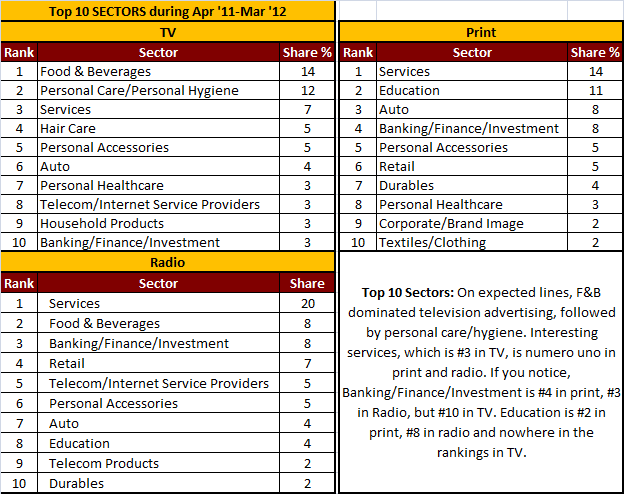
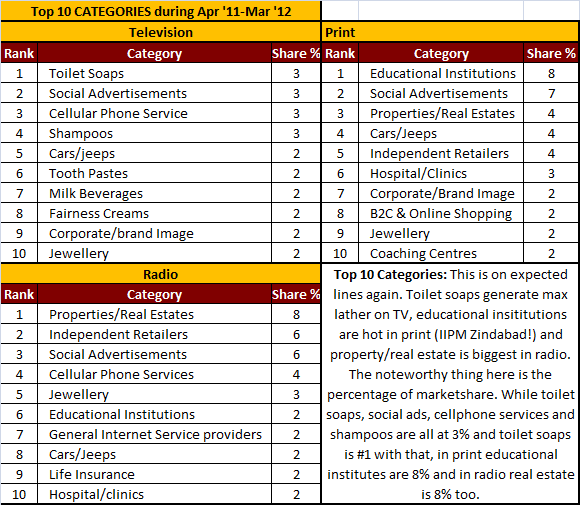
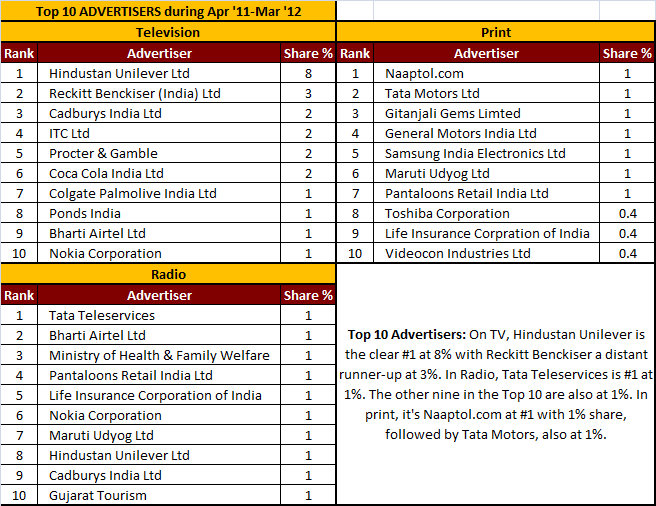
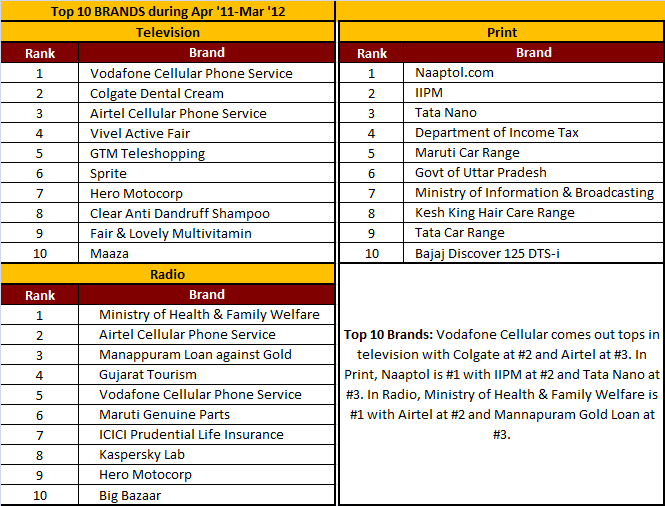
  • AdEx 2011-12: Print grows 14%, TV 11%, Radio 0%


    By A Correspondent


    This is perhaps the shortest Big Story you’ve read in the eight-month existence of MxMIndia. But then more than words, it’s numbers that have got to do to the talking.


    MxMIndia requested TAM Media Research which painstakingly computes data for ad volumes for the television, print and radio sectors. The growth figures are indicative of how these are doing: print isn’t down and out yet with 14%, TV is growing but it’s not as dramatic as we thought it would and Radio hasn’t degrown. In fact we must urge radio practitioners to interpret the 0% in a positive way because there were enough naysayers willing to rubbish the potential of the business.


    Note: the analysis is based on ad , that is duration in seconds/CCMs and excludes promos.


  • Shoppers at retail chains buy premium items

    By Sarah Jacob & Writankar Mukherjee


    Shoppers at food and grocery retail chains appear disconnected from the overall weak consumer sentiment in the country as they upgrade to premium products and buy bulk packs, helping big retailers and consumer goods firms boost average realisation per sale.


    Daily use products like hair oil, refined edible oil and toothpaste, and impulse-driven categories such as biscuits, beverages, salty snacks, instant noodles and chocolates are growing much faster in sales value than the number of units sold in modern trade, a report by market tracker The Nielsen Company says.


    Modern or organised retail within food and groceries refers to convenience stores, supermarkets and destination outlets called hypermarkets. This is opposed to the traditional kiranas or neighbourhood stores.


    Modern retail shoppers seem to be less impacted by economic factors like inflation, high interest rates and slower growth, says Nielsen’s April report.


    Industry officials say this trend also has to do with consumer’s shopping motivations. “Consumers are purchasing larger packs, and more value-added products in modern retail since they are showing a tendency to complete their monthly shopping in such stores. They are topping up with smaller purchases from kiranas,” said Dabur India CEO Sunil Duggal. Value growth of one-litre Real juice pack is almost double in modern retail than kiranas.


    Manish Tiwary, executive director-sales and customer development at the country’s largest consumer goods company Hindustan Unilever, said modern retail consumers are comparatively better off. “The profile of shoppers in modern trade clearly reflects a higher living standard measure. This is one of the main reasons for the slightly more premium portfolio (in big chains),” he said. HUL’s largest brands within the personal wash category in modern trade are Dove and Pears, while Lux and Lifebuoy rule the roost overall.


    Nielsen says stronger purchasing power of modern trade consumers and wider product assortment at such chains encourages impulse purchases and deal-based large-pack buys. “This mix of affluence and experimentation is an invaluable asset for all stakeholders. This can be useful in times of uncertainty like 2011 since the sharp increases in value growth indicates resilience amongst them,” said Adrian Terron, Nielsen Company’s executive director (retailer and shopper).


    He said refined edible oil and instant coffee are examples of categories where value growth outpaced volume growth by 2-3 times. Of course, product prices have increased 2-8 per cent over past year, but Nielsen says the effect has more to do with shopping behaviour.


    Spencer’s Retail chief (operations and merchandising) Mohit Kampani said nearly 30 per cent of growth that Spencer’s Retail posted across its 189 outlets was from consumers upgrading purchases last year. “This is also because the price points of products being stocked have widened considerably. A year ago, skincare brands would have been priced between 10 and 800 while today it is between 10 and 2,200,” he said.


    Devendra Chawla, president (Food Bazaar category) of India’s largest retailer Future Group, said value-added categories are incubated at modern trade outlets: “A lot more cookies, cream and health biscuits have been launched in the past 18 months than mass biscuits, which makes value contribution higher, although the category is growing double digits by volume.”


    Even in personal care, anti-ageing and performance creams are growing much faster than general-purpose creams.


    HUL’s Tiwary said it sometimes launch certain pack sizes in modern trade first and then in other channels. Future Group’s Chawla said launch of international foods is also contributing to this trend. This includes packaged cheese, international pasta and brands like Choco Pie among biscuits and Ferrero Rocher in chocolates that are resulting in faster value growth than volume. Overall, modern trade is proving more profitable for marketers because profit margin is higher on premium products and large packets.


    Meanwhile, mobile phone and durable makers too report higher sale realisation in large chains due to rising demand for premium products. Research in Motion (RIM), makers of the BlackBerry smartphones, said Indian consumers are upgrading from feature mobile phones to smartphones. “This is boosting the average selling price of the handset market, even though overall demand is yet to pick up,” RIM India Managing Director Sunil Dutt said. He estimates that the smartphones market is growing 60-70 per cent a year in the country, while feature phones at 10-15 per cent.


    Panasonic India Managing Director Manish Sharma said: “Consumers are increasingly going for large screen televisions, which is pushing up value sales.” The average selling price of the company’s flat panel TV business has gone up by more than 5 per cent in six months.


    Korean brand Samsung too says sales of its high-end split ACs, frost-free refrigerators and smartphones are growing faster than lower-end products.


    Source: The Economic Times
    Copyright © 2012, Bennett, Coleman & Co. Ltd. All Rights Reserved

     

  • Hindustan Unilever to study how we shop

    By Sagar Malviya


    World’s third-largest consumer goods firm Unilever has set up a Customer Insight and Innovation Centre in Mumbai to study how consumers shop FMCG products – its first such hub in India and seventh in the world.


    The centre at Hindustan Unilever’s headquarter at Andheri will be used by several group companies in developing and emerging markets to understand how people shop in both neighbourhood stores as well as modern trade. This is the first such centre that provides shopper insight for both general stores as well as retail chains.


    “The learning will go typically in developing and emerging markets where traditional trade is big,” said Punit Misra, vice-president, customer development, at Hindustan Unilever. “We have been doing consumer marketing forever where the basic premise is consumers are truly the same,” he added.


    The insight centre will simulate the retail environment of any supermarket or neighbourhood store and then invite consumers to shop the virtual store. A device will scan their retina to track the movement of the eye, and then a map will display the spot that catches the consumers’ attention.


    Simply put, the centre will help the Anglo-Saxon consumer goods maker advice grocers on how category growth, profit per sq ft and availability can be improved using virtual reality tools.


    The company will use the data and insights from the centre to plan packaging design for future products. It will also test new product through virtual reality platform and use the facility for their promotions. So far, the company has engaged grocer outlets with promotions, display materials and margins. The development is seen as a part of Hindustan Unilever’s efforts to increase its sales and widen lead over rivals such as Procter & Gamble, ITC and Godrej Consumer.


    Analysts say the company wants to connect more with the trade at a time when millions of kirana stores it sells products to are being increasingly covered by its rivals too. While Hindustan Unilever still enjoys the country’s largest retail network of over 7.2 million outlets as per Nielsen estimates, its closest rival Procter & Gamble now reaches around 5.6 million outlets.


    “This means the company wants to come as close to the customer as it can get,” said Anand Mour, senior FMCG analyst at brokerage Ambit Capital. “It will not only increase the category but also help in getting more sales of its products since HUL is present in most FMCG categories,” he added.


    But getting millions of kirana stores to sport a look that HUL advises is a challenge. Mr Misra knows that, and feels that the company is ready to overcome that problem. “Modern trade is simpler. General trade is a bit tricky on how do you disseminate a repeatable model to five lakh family grocers,” said Mr Misra. “So we do the creation, the testing, the learning and the models, and then our execution teams on the field convert them into ready-to-use kits which they can take to the retailers,” he added.


    The maker of Lux soaps and Pond’s cream has been taking several initiatives to increase its sales and consumer base in the country. One of the recent such projects was Mission Bushfire – an employee-led market execution and customer interaction exercise initiated in 2010 to get the home and personal care giant to connect with the market place in order to increase product visibility.


    Bush Fire resulted in over 40 per cent spike in sales in store wherever the initiative were implemented, according to internal company estimates. Recently, a company official on condition of anonymity told ET that Hindustan Unilever has set a target to more than double its turnover to Rs50,000 crore by 2015 in a plan christened ’50 by 15′.


    Source: The Economic Times
    Copyright © 2012, Bennett, Coleman & Co. Ltd. All Rights Reserved
     

  • Shahs to drop Anchor’s oral care portfolio; Emami close to buying toothpaste brand

    By Kala Vijayraghavan & Sagar Malviya


    Mumbai-based consumer products Anchor Healthcare has had several rounds of discussions with the Kolkata-headquartered Emami to sell its oral care business, top officials close to the development said.


    Kotak Mahindra, the investment banker to the deal had also approached other personal care companies such as Godrej, Dabur and Marico for a potential transaction, added the officials.


    However, interest in Anchor’s only other brand outside of oral care, Dyna soap, was lacklustre, with buyers more interested in Anchor White toothpaste, Anchor Gel as well as a toothpowder and toothbrushes. When contacted, Atul Shah, promoter of Anchor, denied any sale plans. However, a senior executive at a domestic investment bank confirmed that the company has been sounding off various buyers.


    In early 2011, Business Standard had reported that the Shahs had plans to sell the entire consumer products business, lock, stock and Dyna. However, a banker privy to the proceedings pointed out that valuations of the business may have deterred the promoter family from selling in single transaction.


    The Shahs are expecting over Rs1,000 crore for the consumer business, added the banker. The company is estimated to have closed the year ended March 2012 with sales of Rs450-500 crore, said a research analyst covering the fast-moving consumer goods sector.


    Emami, for its part, has created a war-chest to fund acquisitions. In 2010, the board of the cosmetics and toiletries marketer had approved plans to raise long-term resources up to Rs2,000 crore through the issue of securities as well as to double the borrowing limit to Rs3,000 crore primarily to fund potential buys.


    In 2008, Emami had acquired Zandu Pharmaceuticals, but subsequently hasn’t had much luck with buyout attempts. Last year it lost out to Reckitt Benckiser in the race to buy Paras’ personal care business that includes brands such as Livon, Borosoft and SetWet. Early this year, Reckitt sold some of Paras’ personal brands to Marico in a deal that Emami too was keen on.


    “Emami will continue to explore avenues for inorganic growth, but we do not wish to comment on any speculations,” said NH Bhansali, CEO, finance, strategy & business development, Emami.


    In 1997, Anchor challenged multinational giants like Colgate and Hindustan Unilever by finding a unique proposition in a tough-to-differentiate category by launching a ‘vegetarian’ toothpaste. In the initial years, Anchor managed to grab a market share of close to 10 per cent in a highly-competitive market.


    In 2007, the Anchor group had sold an 80 per cent stake in the business of electricals to Japan’s Matsushita Electric Works – owners of the National and Panasonic brands – for Rs2,000 crore. Personal care became the family’s focus area. Soon after the sale of Anchor Electricals, the group bought Forhans, one of the country’s oldest toothpaste brands, from John Oak Remedies. However, the Shahs didn’t make much headway with Forhans, which does not figure amongst Anchor Healthcare’s brands on its website.


    Source: The Economic Times

    Copyright © 2012, Bennett, Coleman & Co. Ltd. All Rights Reserved
     

  • Rohit Surfactants to launch mid-premium laundry brand Uni Wash to challenge HUL & P&G brands

    By Sagar Malviya


    Maker of India’s largest-selling detergent brand Ghari, Kanpur-based Rohit Surfactants plans to launch a mid-premium laundry brand to take on Hindustan Unilever’s Rin and Procter & Gamble’s Tide.


    “We want to tap into mid-priced category which has good potential as well as offer higher margins,” Rahul Gyanchandani, director at Rohit Surfactants, said. Ghari competes in the highly competitive mass-priced segment, where companies are under margin pressure due to high raw material costs. “In addition, apart from brands such as Rin and Tide, there is a vacuum in the segment which we want to fill,” said Gyanchandani.


    The new brand, Uni Wash, will be launched in the next 2-3 months and be priced similar to Rin and Tide, the company said. Rin’s 1-kg pack costs Rs50, while Tide Naturals’ 870-gram pack is sold at 30. Spokesperson of HUL and P&G said as a company policy they do not comment on competitors.


    Rohit Surfactants’ Ghari beat HUL’s Wheel late last year to become the top brand in the 13,000-crore laundry industry. The firm’s entry into the mid-premium segment is expected to make the infamous Rin-Tide fight even murkier. HUL, early this year, priced Rin lower than P&G’s Tide and released an advertisement asking consumers to choose the better brand-the latest in a series of aggressive commercials from either brand targeting the other. Some blatant ads even attracted legal recourse from the other side.


    According to an industry insider, Tide’s share has doubled in the last two years to over 13.7 per cent in 2011 while Rin’s share has grown from 4 per cent in 2009 to around 6 per cent.


    TOUGH MARKET

    Analysts feel that Rohit Surfactants’ entry could further dent margins in laundry, one of the largest segments that contribute to more than a quarter of the revenues for both HUL and P&G.


    “The category has limited pricing power already and a new brand entering will surely affect the exiting brands in the long term,” Gautam Duggad, an analyst at brokerage Prabhudas Lilladhar, said. Mr Duggad, however, added that it would not be easy for Rohit Surfactants to build a brand from scratch.


    “Launching a completely new brand altogether would be a challenge in this cut-throat market as it will take a long time for a brand to start from scratch,” he said. Rohit Surfactants has been building its distribution network to reach most of the country and believes it now has the wherewithal to compete with established brands.


    “We already have a solid platform now, which we can leverage for the new brand to push it,” Mr Gyanchandani said.


    Rohit Surfactants entered 10 new states in the last three years to expand its reach to 19 states through more than 3,500 dealers. It has 21 manufacturing units, 15 of which were added since 2006. The company now plans to expand its distribution and build manufacturing plants in markets such as Bihar, Raipur and Karnataka.


    Launched in 1987 by brothers Muralidhar and Bimal Kumar Gyanchandani, Rohit Surfactants had sales of over Rs2,500 crore in the year ending March 2012.


    But there is increasing pressure on the margins of detergent makers due to increasing prices of key raw materials such as LAB, or linear alkyl benzene,  that has increased 19 per cent, and soda ash that climbed 4 per cent in the last three months.


    HUL, the Indian unit of Anglo-Dutch Unilever, has indicated that it is facing the heat of inflation in categories such as soaps and detergents, and has tried to moderate its advertising spends to protect margins.


    At the same time, P&G is looking to expand production capacity in India so that it can make products cheaper locally.


    Source: The Economic Times
    Copyright © 2012, Bennett, Coleman & Co. Ltd. All Rights Reserved
  • Ghari ousts Wheel to be Detergent No 1 (in Oct & Nov 2011)

    By Sagar Malviya


    Twenty-five years after launching a laundry brand inspired by Nirma, Ghari detergent appears to have edged out, at least temporarily, Hindustan Unilever’s Wheel from the number one slot in the Rs 13,000-crore laundry industry.


    Ghari, manufactured by Kanpur-based Rohit Surfactants Pvt Ltd (RSPL), had a higher share in October and November than Wheel, a brand that contributes over Rs 2,500 crore, or 12%, of the Rs 20,000-crore top line of Unilever Plc’s Indian unit.


    “As per value market share data, on a 12-month average share basis, the gap between Wheel and Ghari now stands at just 30 basis points; however, Ghari’s shares were higher than Wheel for the last two months,” said brokerage firm Prabhudas Lilladher in a report, dated January 2, quoting numbers from market research firm The Nielsen Company.


    In November, Ghari had a 17.4% share compared with Wheel’s 16.9%, according to people familiar with the numbers. The market researcher will generate data for December in the third week of January.


    Ghari’s achievement is reminiscent of the feats of Ahmedabad-based Nirma, whose eponymous washing power evicted HUL’s Surf from the top slot in 1985. Nirma achieved this by pricing its products considerably lower than Hindustan Lever (HLL), as the company was then known as.


    The resultant rumpus and the incumbent’s fierce response are part of Indian business folklore and have made it to management textbooks.


    HUL, which contributed 6% to Unilever’s top line in 2010, eventually prevailed as Nirma’s challenge faded in the early years of this century, with the global consumer giant stepping up marketing and advertising spend to levels its homegrown rival could not match. Wheel, the detergent whose market leadership is under threat, is very much a product of that period.


    HUL still dominates


    A powder variant of Wheel was introduced in 1988 to take on Nirma’s challenge. Despite the wobbles in October and November last year, HUL still dominates the detergent market with Wheel as the country’s largest brand on a yearly comparison, though the gap has been narrowing each quarter. The Hindustan Unilever spokesman declined comment on the data.


    “Our laundry category has grown significantly ahead of market in both volume and value in the period from January 2011 to September 2011. Wheel also contributed significantly to this with strong double-digit growth driven both by volume and price,” the spokesman added.


    The company said it could not validate the Nielsen data. “We cannot confirm the factual correctness of the market share data you have emailed as it is proprietary data of Nielsen. We request you to contact Nielsen to validate the data.” The Nielsen Company’s spokeswoman said: “As per company policy, I will not comment on brand specific data and will not be able to verify and validate the data.”


    Big hitters from Kanpur


    Both Wheel and Rin, another detergent from the HUL stable, have increased their market shares compared with the same year, but have been lapped by the faster growth achieved by Ghari, which was launched in 1987 by brothers Muralidhar and Bimal Kumar Gyanchandani.


    The Ghari phenomenon, emerging as it did from Kanpur, a business backwater, has been widely celebrated by many as an example of small town entrepreneurial chutzpah. “Losing share isn’t as big as losing leadership in its largest brand.


    In trying to maintain its margins, HUL didn’t adjust the pricing at the challenger’s level and that did the trick,” says a former HUL senior executive who was directly involved with HUL’s operation STING (Strategy To Inhibit Nirma’s Growth) in the late eighties.


    In 2011, Ghari gained not only by growing faster than Wheel but also yesteryear’s price warriors such as Nirma, which has less than 6% share now. “While Wheel may have maintained its market share, its other brand Rin has been consistently gaining share clearly reflecting the company’s premiumisation strategy,” said Anand Mour of Ambit Capital.


    “On the other hand, Ghari has taken share from smaller regional players, especially brands from the southern states, where it entered last year.”


    Ghari’s expansion


    RSPL attributes its growth to a variety of factors, including expansion to more states. The company has entered 10 more states in the last three years and now peddles its ware in 19 states, through more than 3,500 dealers. It has 21 manufacturing units, 15 of which were added since 2006.


    “We will be setting up plants in Bihar, Raipur and Karnataka soon to catch up with our sales growth of over 25% in the last nine months. Even in volume terms, we have been growing more than 10%,” said Mr Sushil Kumar Bajpai, president (corporate affairs) & company secretary, RSPL.


    Also, what’s helped Ghari is the sheer size of its home market Uttar Pradesh, which contributes 17% to total FMCG revenues, according to The Nielsen Company. Judging by its past, HUL is likely to respond fiercely.


    “Hindustan Unilever has a tremendous capability to fight back and they will do it soon,” says Mr Amin Babwani, an independent consultant who has spent three decades with HUL.


    It clearly has the marketing muscle to do so. The company’s existing distribution footprint in rural India, where a brand such as Wheel would sell, reaches nearly 200,000 villages, which is nearly double the industry average.


    “The growth in soaps and detergents segment will come from gradual upgradation of cheaper alternatives, ” said Mr Vijay Chugh of BNP Paribas Securities India in a recent report.


    Source: The Economic Times

    Copyright © 2012, Bennett, Coleman & Co. Ltd. All Rights Reserved
  • Lever wants more lather from personal care products

    By Kala Vijayraghavan & Sagar Malviya


    In the 1920s and 1930s as radio caught the imagination of Americans, Procter & Gamble (P&G) moved in to sponsor programmes, giving birth to the term ‘soap opera.’ Over the decades, P&G even began producing soap operas. Suddenly something changed a year ago. The maker of Tide detergent and Ivory soap discovered Facebook, Twitter, Youtube and its countless cousins. By the end of 2010, P&G announced that it had bid goodbye to its association with soap operas and instead embraced social media.


    Back home, P&G’s global rival Unilever too is moving along similar lines. It’s not as if the Indian affiliate, Hindustan Unilever Ltd (HUL), is washing its hands off soaps. Rather, soaps and detergents are no longer the biggest winners for HUL. The new hero: the personal care portfolio – from Pond’s cream to Dove shampoo – which now accounts for three fifths of profits as against two fifths eight years ago.


    At 47%, soaps and detergents still contribute the most to the top line but only a third of profits. Personal products (PP) account for 28% of sales and that will keep increasing in the years ahead on the back of new product launches, new category creations and brand extensions. Consumer analysts at Standard Chartered Research expect “continuous launches in the fast growing personal care segment such as Vaseline for men, Pond’s Gold radiance, Dove hair care range to increase PP’s contribution to 32 per cent in 2013.”


    That shift will be even more pronounced in the years to come. For two reasons: Unilever’s CEO Paul Polman wants three fourths of the global operations’ sales to come from developing markets. And most of that growth is going to come from health and personal products as awareness levels and exposure to new lifestyles increase in countries like India and China.


    What’s more, soaps and detergents are well penetrated categories where growth rates have to taper off sooner than later. Cut-throat competition on price with P&G and a rush of domestic brands will also play its part in slowing growth in this segment. On the other hand, penetration levels in personal care and packaged foods are still in low double digits.


    “Our strategy is consumer-led,” explains HUL CEO Nitin Paranjpe in an emailed response. Growing affluence levels, a younger population and changing aspirations and attitudes towards consumption are driving growth in personal care and packaged foods, Paranjpe points out. “Our investments in these segments reflect the changing consumption structure in India.”


    Hair care or shampoo is clearly HUL’s mainstay in PP. With brands like Clinic Plus, Sunsilk and Dove, the consumer products giant has a share of just under 46% of the shampoo market. The other pillars of growth are skin care where, in the premium fairness category in urban areas, HUL has almost 38% of the market in the bag.


    Meantime, HUL has also been entering other categories. Over the past year, for instance, it extended the Dove brand into face wash and launched the Sure brand of antiperspirant deodorants for men. Fair & Lovely(FAL) has also been extended to FAL Multi Vitamin Face Wash and to the Anti Marks Eraser Pen.


    Bringing in international brands like Sure is one part of the game plan. Extending some of HUL’s timeworn brands – including those of soaps and detergents – is the other prong. For instance, mass soap brand Hamam can now be seen in the hand wash segment; and the Rin detergent bar has been stretched into fabric whitening. And one of HUL’s oldest brands Vaseline has found its way into male grooming segments such as skin cream, face and body wash.


    In a recent internal presentation, marketers let on that HUL has a 30% share in the hair conditioner category worth 27 million euros, which is growing at 40% annually. Business in the face cleansing segment has doubled in a year through deployment of a portfolio of brands including Ponds, Pears, Lakme and Fair & Lovely. The presentation also made the point that “in the case of premium skin care products we are focusing on premium skin lightening and anti-ageing with Ponds, Vaseline in hand, body wash and men’s grooming.”


    If Paranjpe and the HUL top brass are keen to pump up the PP volume, it’s also because profit margins are higher there. Analysts reckon that operating margins in PP are 25% whilst in soaps and detergents they have declined from highs of 14% a few yeas ago to 7.5-9% now.


    Rivals, however, sound a note of caution. “The personal care industry was seen as a high margin business, but the recent spike in raw material prices and the disruptive competition in the market have seen margin profile of this business change completely,” says Dabur India CEO Sunil Duggal. Analysts reckon that margins in PP would have come down by 150 basis points over the past 3-4 quarters.


    Adds Harsh Agarwal, Director, Emami: “There is a misnomer that the personal care segment has very high margins. But it may not be so in mass-priced products where gross margins depend purely on the brand’s pricing power.”


    Just like in soaps and detergents, HUL too has to reckon with intensifying competition in PP. Emami with brands like Fair & Handsome, which is a market leader in skin care for males with a 60%share. In 2010-11, Dabur’s skin care portfolio reported a near 17% growth led by robust growth across the Fem, Gulabari and Uveda brands.


    And a clutch of international cosmetic and personal care majors from L’Oreal to Shiseido are keeping HUL on its toes in higher end segments. Still, with relatively new-found categories face wash, hair conditioners and anti-ageing creams opening up, HUL may well be looking at a fairer and lovelier in the road ahead.


    Source:The Economic Times

    Copyright © 2011, Bennett, Coleman & Co. Ltd. All Rights Reserved