Tag: Hindustan Unilever

  • HUL stars in Kantar Creative Effectiveness Awards India

    HUL stars in Kantar Creative Effectiveness Awards India

    Kantar, the leading marketing data and analytics company, unveiled the ads that were most effective and creative across India in 2023.  The company tested more than 12,000 creatives for its clients around the world in 2023. Over 11% (1,400+) of those creatives were tested in India. Today,


    In the awards, consumers are the jury. The India report shortlists close to 300 ads, tested across categories, markets, TG’s and media channels.


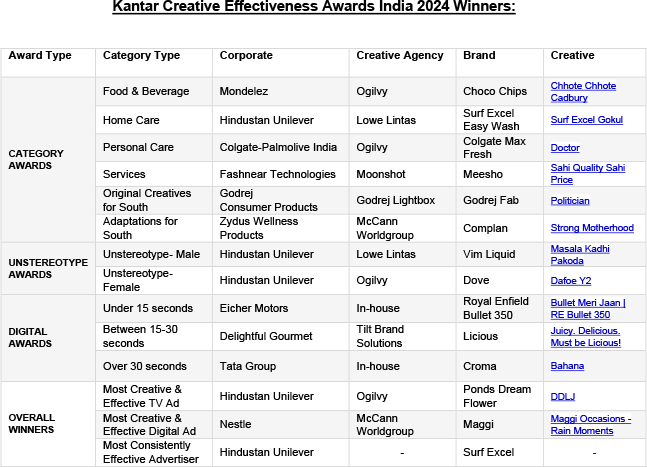
    The winners list has doubled from last year, with Kantar awarding 10 standout performers in the television ads category and 4 in the digital ads category.


    Television categories include Food & Beverage, Home Care, Personal Care, Services and Unstereotype. New categories introduced include ‘Original Creatives for South’, ‘Adaptations for South’, Most Creative & Effective TV Ad (overall) and Most Consistently Effective Advertiser. Creatives for Digital continue to grow this year as well, with Kantar awarding standout performers in 4 categories- 3 based on ‘Ad Length’ format and one for the Most Creative & Effective Digital Ad, for bringing to life the exciting storytelling possibilities in the digital world.


    All ads exemplify essential characteristics of being creatively engaging and landing persuasive stories that enhance brand sales, notes a communique.


    Commenting on this year’s findings, Soumya Mohanty, Managing Director & Chief Client Officer- South Asia, Insights Division, Kantar said: “Earlier this year, Kantar launched the Blueprint for Brand Growth– a breakthrough understanding of how businesses build strong & profitable brands. One of the growth accelerators for building strong brands is to pre-dispose more people. Great advertising builds pre-disposition and loads the dice in favour of the brands. Creative content can and should punch above its weight”.


    Added Prasanna Kumar, Head of Creative Domain & Executive Vice President- South Asia, Insights Division, Kantar: “Truly creative ads are the ones that are effective. The journey from being just creative to being effective starts by including your key stakeholders – your target consumers, into the process by pre-testing your ads. This year we have seen some original creative ideas shine through by ensuring that they have brand and consumer at their heart.”


    Key highlights from this year’s report: 

    1. Learnings from Kantar’s Blueprint for Brand Growth indicate that great advertising is rocket-fuel for building predisposition: growing meaningfully different brands in a more effective and efficient way. Creative quality, second only to brand size, greatly influences campaign profitability, with double the impact that reach does on brand salience.


    1. Kantar research emphasizes that ads must persuade and convey messages that are novel, credible, relevant, and different to enhance short-term sales. But high-quality ads, which leave a lasting impression, generally perform well in both short-term sales and long-term brand-building (Kantar LINK database), thus reducing the need to spend money on performance marketing.


    1. Beyond brand recognition, generating a strong emotional response is key, because emotion helps build strong memory structures, and most advertising effects are not immediate. Emotion plays a critical role in effective creative- and not just in TV content. 


    Ad learnings from 2023: 

    1. Make purpose personal: 65% of Indians will buy brands that stand for something they can identify with. While purpose or value led creatives open possibilities for highly emotively engaging creatives, the effective ones execute it in a manner such that it becomes personal to the consumers.


    1. License to surprise: Consumers are open to original creative ideas- ones that are hyper creative or break existing category codes. The reward for the brand lies in the ability to integrate the persuasive and meaningful impressions into the creative idea. Pre-testing helps identify the possible risks of comprehension and resonance.


    1. Going Native: Only 28% Indians (vs Global average 75%) have watched any ‘foreign’ content. Over 25 years of Kantar Link™ ad evaluation reveal a striking truth- ad transference across Indian regions is just about a third. This challenges the assumption that a single pan-India creative approach, even with universal and validated consumer insight, will yield positive returns on objectives. Brands are now refreshingly taking on the challenge and opportunity of engaging the Southern consumers differently from Hindi-speaking markets. Investing in original creatives, by going native on multiple dimensions- insights, creative idea & treatment and execution ensures maximizing of reward for the brand.


    1. Go deep & wide: The most efficient route to optimize budgets for creating ads that effectively crossover the transference challenge across the many India’s, is to create regional adaptions by playing with backdrop, celebrity, casting, product window visualization, slogan etc. Go deep and wide is about taking a campaign pan India by starting with a pan India insight, creative idea & treatment but execute with some nativity elements to amplify the resonance with the regional markets. Pre-testing helps to identify whether the mix of insight, story & elements work together as intended and identify opportunities for improvement.


    1. Embed the Brand: The value of creativity starts with the brand. While executional elements like distinctive brand assets and consistency in advertising style are undeniable aids in ensuring that the brand takes credit for the impressions left behind by the creative, it’s potential is amplified when the brand is integral to the story.

    **In our top quartile ads compared to the bottom quartile ads, we observed more consistency (+49%), greater use of established branding devices (+14%), and the inclusion of related music (+26%).


    1. Weave in the product story: Executions that can creatively integrate the specific competitive reasons to consider the brand into the narrative tend to be impactful. The role of creativity is thus not just to entertain but also leave behind vivid impressions that make the brand more meaningful to the consumers.


    1. Specific learnings for the digital landscape: 
    1. Precision targeting is officially giving way to mass media avatar of Digital and there’s an increasing recognition of the importance of brand marketing on digital platforms. Creative Quality getting increasingly critical for ensuring ROI for digital- could unlock 35%+ incremental sales per impression.
    2. Effective content on TV does not automatically mean success in digital – Ads that perform well in TV have only a ~50% chance of performing well in digital.
    3. Emotional resonance significantly enhances digital advertising’s impact on brand building. Ads that evoke stronger emotions are 3x more likely to drive long-term brand equity and 2.75x more likely to generate impact compared to those with weaker emotional connections.
     

  • Kiara Advani is brand ambassador of Pond’s Skin Institute

    Pond’s Skin Institute ropes in Kiara Advani as its latest brand ambassador. She will feature in Pond’s new TVC that is set to take over traditional and digital platforms across the country soon.

    Elaborating on the association, Pratik Ved, Skincare Head, Beauty & Wellbeing, Hindustan Unilever Limited said:  “We are delighted to welcome Kiara to the Pond’s family, as we usher in a new era of Pond’s Skin Institute. Being a remarkable celebrity, she’s also renowned for her iconic beauty and style across the country. This strategic partnership underscores our dedication to merging innovation with aspirational beauty, ensuring Pond’s Skin Institute’s leadership in skincare.”

  • Brooke Bond Taj Mahal & Ogilvy come together

    By Our Staff


    Brooke Bond Taj Mahal Tea has partnered with its creative agency Ogilvy to make the extraordinary Megh Santoor, a one-of-a-kind musical installation in Vijayawada.  Inspired by the rains and activated by them, the instrument was conferred a Guinness World Record for being the ‘Largest Environmentally Interactive Billboard’. The billboard measures 209 meter square in total surface area and achieved this record-breaking feat on September 10, 2023.


    Said Kainaz Karmakar & Harshad Rajadhyaksha, Chief Creative Officers, Ogilvy India: “We’re extremely proud of the Megh Santoor piece. It has taken months of planning, testing and failing, before we finally succeeded in making this happen. Taj and Indian classical music have been each other’s companions for very long now. We added rain to it for this experiment. We call it an experiment because it was filled with ‘what ifs’, with no guarantee of result until the day it rained, and the drops hit the keys and created music. Important to mention our Taj team at Unilever’s belief and support. Also, kudos to Fritz Gonzales, Jayesh Raut, Nikhil Mohan and his team at Ogilvy who saw it through from conception to execution. The world needs as much music as it can get and we’re happy to add our little bit to this.”


    Added Shiva Krishnamurthy, Beverages and Foods Head, Hindustan Unilever: “We are thrilled to have ‘Megh Santoor’ recognized as the world’s largest environmentally interactive billboard by The Guinness Book of World Records. Vijayawada is one of the biggest citadels for Taj Mahal Tea, and creating this extraordinary experience is our way of extending heartfelt gratitude to the city in a way that fits us best, with Hindustani classical music! This achievement reflects our unwavering commitment to Hindustani classical music, the beautiful people of Vijayawada and to sheer tea enjoyment in the rains. We have created history, and we invite everyone to experience this extraordinary blend of art and technology.”


  • Do not berate brand purpose purposelessly


    With apologies to none at all

    By Vikas Mehta


    Vikas MehtaThe last two weeks were very purposeful. I was a panel member at a leading institute discussing the importance and genuineness of brand purpose in recent times. Coincidentally, two big brands in India, Stayfree and Dove also released some new work on their brand purpose.
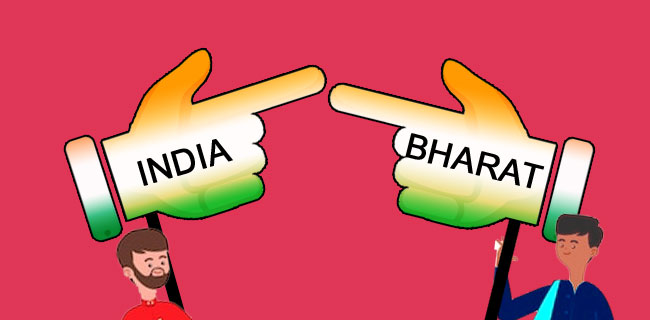
    Both the pieces of work, have been panned by some marketing pundits and marketing gurus. While everyone has a reason and right to do so, I find the arguments put forward illuminating the ignorance of what is actually happening in the country. Most of the critics are metro-based with hardly any connect with the real India, Bharat, as it is called by some. Some of course also presume that every consumer is as marketing savvy and informed as they are. Let’s get into the details.

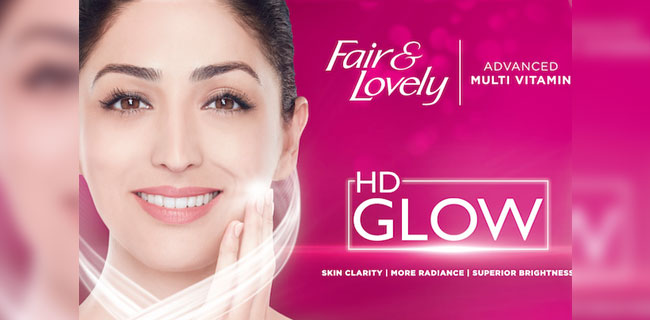
    First a look at Dove. And before I begin, here is a disclaimer. I was involved with Unilever brands for more than a decade at a global, regional and local level in South Asia, Middle East, North Africa and Far East and this includes Fair & Lovely now known as Glow & Lovely.

    Dove, for many years now, has been talking about body positivity. Very famously, Dove has in the past refrained from using models for its soaps and were using real homemakers, sans glamour and beauty, even in India. So, the body positivity was a natural progression with a scope to use various elements like colour, race, gender, depending upon the market they are in. The current campaign in India is about girls facing beauty issues as parents prepare them for the ‘marriage market”

    The issue that critics have raised is first, not with the brand but with the company Unilever. They have chided Unilever who have profited very well with Fair & Lovely in the same marriage market. And I concede it’s a valid point. It does sound hypocritical. But then if a brand is calling out a practice which another brand in the company stable maybe encouraging, is it wrong or gutsy? Sure, the company must look inwards but should it stop raising issues that are real in the society. The marriage market is still a reality. The focus on the daughter’s marriage is still an issue. Or are they saying that the issue is not important. I found some critics mentioning that. And that highlights a bigger problem. If we think that because our daughters or our friends’ daughters or even our driver or help’s daughter are getting educated and are building a career or niche for themselves, it does not mean that the problem does not exist. I live in a small town in North India and I find the focus on the girl’s marriage still takes centrestage from an early age. Prosperity has meant that more money is being spent on the daughter’s beauty issues. Visits to dermatologists, increase in use of facewash, is a sign of the times. But the issue has not subsided or lessened in its importance.

    And let us not forget that matchmaking, dowry etc have assumed gigantic proportions. When I started working in marketing more than three decades ago, the big society evil was dowry. Most of public service ads focussed on dowry problems. Now we hardly see any such communication or message. That does not mean that dowry problems or dowry as a society evil has lapsed. It’s in fact more monstrous. A cursory glance at vernacular newspapers in the Class 1 town editions reveal a spate of dowry-related death and torture stories on a continuous basis. The marriage market and the problems associated with someone who is not traditionally beautiful (read fair or blemishless skin) having to shell out more in dowry is a stinking reality of our times. Let us not wish it away. I moved to a small town almost a decade ago and not a month goes by when my wife is not reminded about our daughter’s future in the marriage market and what she should do to help her look better. And my daughter follows in amusement what some of her friends are forced to do.

    It’s a bigger hypocrisy that we are trying to attack a purpose which is most relevant just because another brand from the same stable partakes in the marriage market. In fact, I will stick my neck out and claim that Glow & Lovely had stopped partaking in the marriage market even in its earlier avatar of F&L. So that too actually does not hold good. The real issue that Dove has highlighted is the marriage market.

    I see similar issues in the panning of the Stayfree communication. Critics claim that the society has moved on from the “period talk is uncomfortable” issue. We have had movies like the Padman and some brands are showing in their demos red colour of blood, so why are we stuck with the same old issue of male friends and relatives uncomfortable with the talk of blood? I am afraid the critics again have a “big city” view. In metros, the issue of periods may not be uncomfortable anymore but in small towns and villages it is still taboo. Actually, I doubt if it has overcome the society stigma even in big cities. Just before the pandemic, I was attending an awards show in a 5-star hotel in a metro and a gent on our table noticed that a lady on the adjoining table had a stain. He pointed it out to his wife and was immediately admonished for making the observation so loudly and openly in front of men too. She then proceeded to discreetly inform the “victim” and help her cover it up with a stole, She was so embarrassed that she left the show, with a fuming partner in tow.

    The situations in the Stayfree communication are very common and prevalent in small towns. It’s actually quite irresponsible to think that the issue isn’t relevant anymore. Just because we had many anti-dowry communications did not mean that dowry as an evil was vanquished. Or just because our circle of friends and relatives, even in smaller towns have risen above the period issue does not mean that the society has. The brand has actually opened a new window to the same issue. Teach the boys that talking about periods is not taboo. Just like one detergent brand talks about sharing the load by teaching sons the same at a young impressionable age.

    I genuinely think that the metro, western influence phenomena continues to blindside our marketers. We also get overwhelmed by our own rhetoric. Yes, India has done very well. We have taken great strides in pulling up the society and breaking some myths and taboos. But the battle is far from over. A myopic metro-centric view is more detrimental than even the societal woes. Why, the most amusing comment I read was the one in which the marketing person stated that he is not sure that an average Indian user isn’t aware of Unilever, Axe and Glow & Lovely. Did he actually mean that an average Indian user knows that Axe, Glow & Lovely and Dove are all brands belonging to Unilever? Really?

    It tells me all about an average Indian marketer.


    Vikas Mehta is a senior business and marketing strategy consultant and educator. He is based in Dehradun. This column will appear every other Tuesday (and sometimes on other days as well). His views here are personal


  • Kantar launches 2nd edition of  Creative Effectiveness Awards

    By Our Staff


    Kantar, the marketing data and analytics company, has announced winners of the second edition of its now annual Creative Effectiveness Awards. The firm tested more than 13,000 creatives for clients around the world. Around 10% (1300+) of those creatives were tested in India alone. The India report shortlisted over 350 ads, tested across categories, markets, TG’s and media channels.


    Across television ads tested in India, Kantar has awarded standout performers in five product categories- Food & Beverage, Personal Care, Durables, Home Care & Services. Kantar has also included a special segment on social causes and this edition spotlights


    ‘Un-stereotype’ which all about celebrating gender progressive advertising.


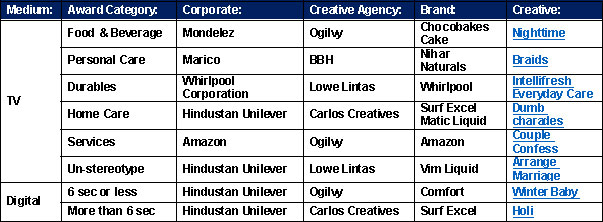
    Here are the Kantar Creative Effectiveness Awards 2022 India Winners:


    Commenting on this year’s winners, Soumya Mohanty, Managing Director and Chief Client Officer, Insights Division, Kantar said, “The spread of ads that consumers have perceived to be both creative and effective is an affirmation of the fact that the space for creativity even in context of marketing ROI is infinite. While there is no magic formula for creating such ads, we can start with the right ingredients and refine them by testing them out with consumers. Kantar is pleased to share the learnings that we have had in the area while working with the leading marketeers in India.”


    Key highlights from this year’s report:


    >> Kantar’s Strategic Sparks identified for effective and creative TV advertising:


    1. Indians love to ride fulfilling story arcs: Stories create room for empathy, engagement, and vivid memories through which one could influence the way in which consumers think & feel about the brands.

    2. Touch of drama helps: Just the right kind and quantity of spice delivered through creative storytelling and filmmaking,  elevates even the repetitive themes, to make them more personal, relevant and aspirational.

    3. License to be extravagant in visualization: Indians are open to suspending their disbelief for the well visualised film

    4. Layer in emotional meaningfulness: Emotive contexts have the potential to make the consumers warm up to even the dry functional categories.

    5. Show, not tell: Integrating brand payoffs as an organic plot event in the script is a timeless approach toward creating vivid and persuasive memories.


    >> Kantar’s Strategic Sparks for effective and creative digital advertising:

    1. Customized and integrated content yields significantly higher ROI​: Carrying forward creative stories and elements from other media amplify the impact of digital assets.

    2. Shoot for instant meaning: Given the attention poor consumers and short window available, it pays to ensure that the consumers are not called to do any additional work for decoding what they are supposed to think and feel about the brand

    3. Ride the moment: Embrace the topical issues and trends, to engage and be relevant

    4. Strike an emotive chord: Well told stories open up consumers for longer format videos

    5. Hook them early:  Promise of a fulfilling story arc, emotive journey and humor help in ensuring that consumers stay invested beyond 6 seconds.


    >> Unstereotyping: Time to mainstream progressive gender portrayal


    Kantar’s collaboration with the Unstereotype Alliance has led to the development of the Unstereotype metric (UM) which Kantar now includes as a measure of gender portrayal in advertising as an integral part of its Link™ communication pretesting solution. Thus, setting a foundation for marketers to review the potential of their creative executions on this dimension to monitor progress over time.


    Unstereotype metric* (UM) in the long term provides learning and context for gender progressive advertisements. UM is now measured for 14,000+ ads across 70 countries, 3,300+ brands and 251 categories.


    :: Unstereotyping in advertisements is predicted to unlock higher marketing ROI. It signifies strong brand equity and is likely to impact short term sales as well. This impact is not only true for women, but progressive male role models also impact business outcomes across categories.

    :: Progressive ads are more effective and trigger positive engagement. They are in general seen to be more enjoyable, relevant, different and even pleasantly surprising.

    :: Unstereotyping affects various aspects of the brand- power, meaningfulness, difference and saliency especially seen in food & beverage, household and personal care categories.

    :: There are clear and present rewards for brands that seek to be at the forefront of embedding progressive gender roles


  • Alia Bhatt entices with Cornetto in new film

    By Our Staff


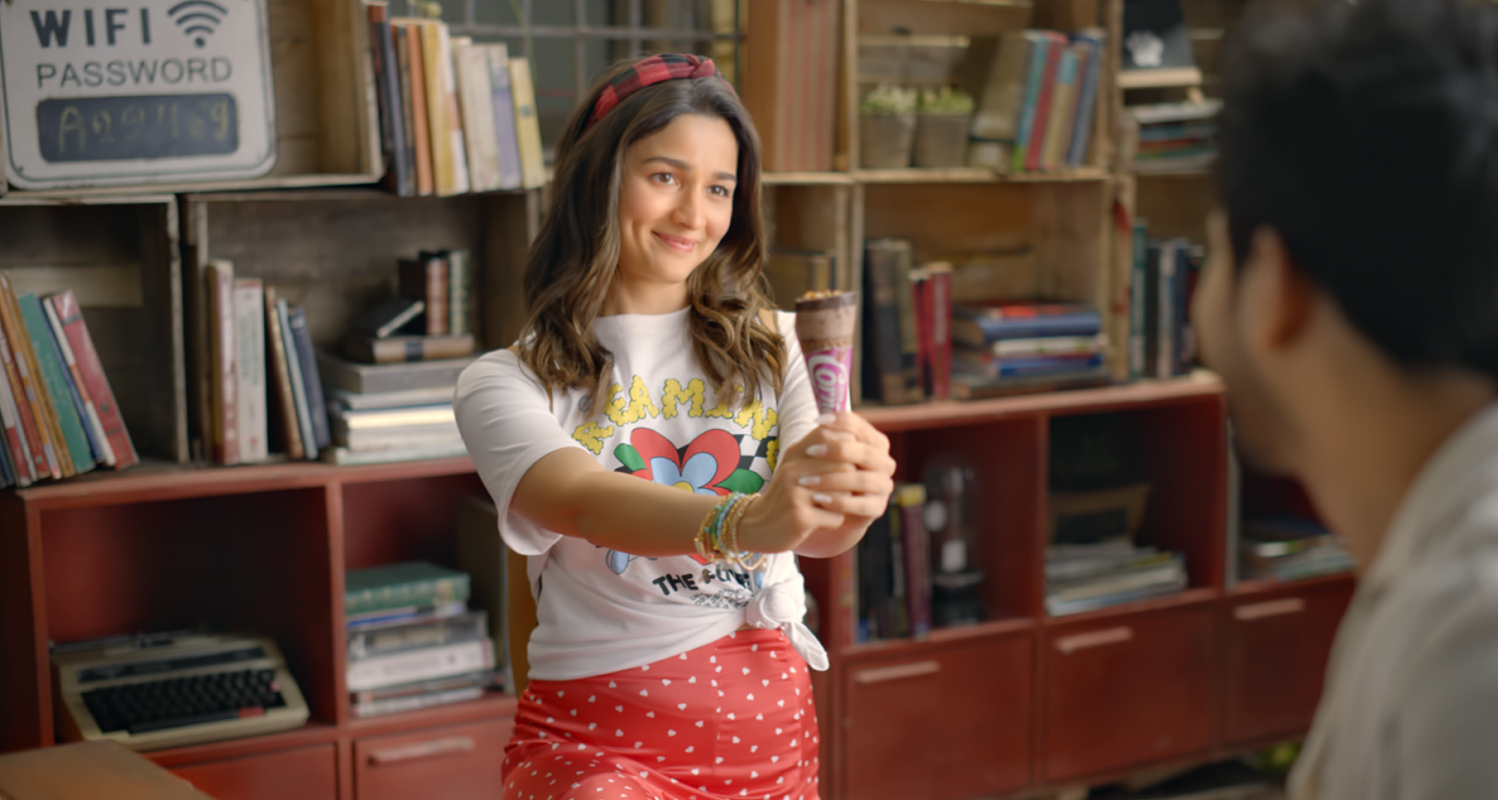
    Cornetto, the frozen desserts brand by Hindustan Unilever, has launched a film featuring Rohit Saraf and brand ambassador Alia Bhatt. The campaign, ‘Make the first move’, is aimed at breaking the stereotype around the expression of love, which expects men to always make the first move.

     

    Speaking on the campaign, Maya Ganpathy, General Manager, Kwality Wall’s said: “Cornetto has always been the wingman for youngsters to express love and make the first move. In our latest campaign, Cornetto goes a step ahead to change the language of love by asking one out ‘with a Cornetto’ and ‘to be their Cornetto’. It also breaks stereotypes by entrusting the girl to make the first move, an idea that is sure to spark a conversation and perhaps a new trend. We couldn’t have asked for a better team than Alia, Rohit, and Gauri (Shinde), who have done a spectacular job of bringing this idea to life!”


    Added Pallavi Chakravarti, Creative Head – West, DDB Mudra: “It’s not easy telling that special someone you like them. So, the next time words or even emoticons fail you, don’t worry. A Cornetto will suffice when you want to make your move. The campaign is light, sweet and ends on a high note – much like the Cornetto itself.”


  • UN Women launches Unstereotype Alliance’s India Chapter

    By Our Staff

    The Unstereotype Alliance has aunched the India national chapter with a coalition formed to tackle harmful stereotypes advertising with support from EU funded WeEmpowerAsia Programme. The Alliance will centre its work in India on broadening the representation of women and girls in non-traditional roles in advertising with a focus on women returning to the workforce.

    Convened by UN Women, the United Nations Entity for Gender Equality and Women’s Empowerment, the Unstereotype Alliance is a thought and action platform that seeks to eradicate harmful stereotypes from advertising and media. India is the ninth national chapter to launch worldwide, and the second in Asia.

    The Unstereotype Alliance’s India National Chapter Founding Members include: Hindustan Unilever (Champion), Diageo, WPP, Publicis Groupe, Havas Group, Advertising Standards Council of India (ASCI), Advertising Agencies Association of India (AAAI), The Advertising Club and Samhita Social Ventures.

    Said Phumzile Mlambo-Ngcuka, Executive Director of UN Women: “The launch of the India national chapter is a significant milestone for the Unstereotype Alliance. It shows that the India advertising and media industry is coming together in all its strength and diversity to tackle the harmful stereotypes that hinder progress towards gender equality. This is critical to addressing the drivers of inequality such as violence against women and girls, intergenerational poverty and the lack of women in leadership and decision-making roles. We hope that you will join us in making unstereotyped advertising and content the norm rather than the exception.

    Stereotypes in advertising perpetuate negative social norms and hinder progress of gender equality. Harmful social norms contribute to increased acceptance of gender-based violence, lack of economic decision-making for women and constricted opportunities in the job market. The chapter has defined strategic priorities to address gender stereotypes with a focus on harmful patriarchal traditions and norms to broaden the representation of empowered and autonomous women in private and public life, including in business leadership; and to ensure progressive representation in media and advertising.

    Unstereotype Alliance research into gender equality attitudes shows that there is a clear role not only to remove stereotypes in advertising and media, but to challenge widely-held beliefs and norms in society. Data from the Gender Equality Attitudes study, conducted across 10 countries including India, shows that whilst many Indians recognize the importance of women’s rights, outdated beliefs persist. Specifically:


    Here’s what a host of spokespersons have said:

    Susan Ferguson, Country Representative, UN Women India: “UN Women India is excited to launch the India chapter of the Unstereotype Alliance. I am confident with the support of such committed partners, we will generate a positive and enduring impact in the advertising and media industry and contribute to shaping a gender-equal world.”

    Priya Nair, Executive Director,-Beauty & Personal Care, Hindustan Unilever: “Across the globe, consumers are increasingly expecting brands to take a stand on the issues they care most about – gender stereotype has been one such issue. At HUL, we are committed to driving gender equity, including stepping up of brand programmes, advocacy to challenge the status quo and #unstereotyping advertising. With one billion people using our products every day and even more seeing our advertising, we know we have the power to make a real difference. Various organisations need to come together to bring about this systematic change and set new standards of empowerment and equality. As a founding member of the Unstereotype Alliance, we look forward to supporting UN Women, to drive social change, encourage action, and put an end to gender stereotypes and discrimination”

    CVL Srinivas, Country Head, WPP, India: “WPP is delighted to be a founding member of the Unstereotype Alliance – India Chapter. We look forward to working with the Alliance to bring about positive change to the issue of Gender Equality through the creative use of our skills and the passion of our people in this area.”

    Deepika Warrier, CMO, Diageo India: “Diageo India is proud to be associated with The Unstereotype Alliance – India Chapter, which will work to  accelerate progressive gender portrayal in advertising. Together, we will lead the creation of a framework that encourages increasingly progressive codes with themes ranging from empowerment to celebrating the power and imperfections of womanhood to challenging stereotypes to ultimately moving beyond gender codes. We hope our efforts would contribute to empowering women regardless of their race, class, age, ability, religion, sexuality, language, education etc.”

    Anupriya Acharya, CEO, Publicis Groupe South Asia:  “Publicis Groupe through Viva la difference is a company that celebrates talent, inclusivity and diversity. Our core values and people-first culture synergise seamlessly with the Unstereotype Alliance’s larger mission and objectives and we are pleased to be a part of its India Chapter. Publicis Groupe India looks forward to collaborating with other future-facing companies in building narratives that are progressive, purposeful, gender-equal, human and authentic.”

    Rana Barua, Group CEO, Havas Group India: “We are delighted to be coming on board at a crucial time as a member of the UN Women Unstereotype Alliance as they begin their chapter in India. At Havas Group, we are clear on driving gender diversity and want to bring about a cultural transformation and mindset shift that will encourage many more women leaders in the group. Our alliance with UN Women Unstereotype Alliance will surely help us in this journey.”

    Manish Kapoor, Secretary General, Advertising Standard Council of India: “Positive gender portrayals and depictions in advertising are high on ASCI’s agenda, and we aim to shape this narrative in the coming months through different initiatives. Partnering with the Unstereotype alliance is an important step in this journey. Working together helps synchronise voices of different stakeholders and we are very pleased to be a part of the alliance.”

    Sudhesh Kapoor, Secretary General, AAAI: “We are sure that this Alliance will go a long way in taking down some popularly held myths about genders which are consciously or sub-consciously propagated by popular media and advertising.”

    Namrata Tata, The Advertising Club: “While many organizations are taking initiatives to drive gender diversity & equality, collaboration at an industry level is needed to see the needle movement. As an integral part of the advertising industry ,The Advertising Club believes in driving real change when it comes to the portrayal of gender norms. We are delighted to join The Unstereotype alliance convened by UN women , which aims at removing negative gender stereotypes in Advertising and Media”

    Priya Naik, Founder and CEO, Samhita Social Ventures: “Companies, media and content companies, advertisers, and creative agencies have a social and ethical responsibility to break gender stereotype, as well as the capability to do so on a large scale. I am proud to be a part of the Unstereotype Alliance movement to dismantle traditional gender roles and their related”


  • Ad volumes drop 3% in 2020: BARC

    By A Correspondent


    Advertising volumes dipped by 3 per cent in Calendar Year 2020, with the volumes dipping as 18% in the H1 period January-June over the corresponding period the previous year. In H2 – that’s July to December – the growth over the previous H2 was 12%, and over H1 of 2020 the growth was in fact 34%.


    Hindustan Unilever was the biggest advertiser in 2020 with a 30% growth in ad volumes over 2019, followed by the RB Group, with their ad volumes growing by 37% in 2020 over 2019.


    Said Aaditya Pathak, Head – Client Partnership & Revenue Function, BARC India: “Television continues to be the screen of the household and the most important medium for all the major advertisers to reach their audience pre-pandemic and post lockdown too. Return of originals along with the festive season and live sporting events boosted the ad volumes, taking the overall growth in ad volumes to 34% as compared to H1, 2020 and eventually minimising the reduction in volumes to a marginal -3% for the overall year, as compared to 2019”.


    The movies genre saw significant growth in ad volumes in 2020 as compared to 2019. Hindi GEC witnessed the highest growth in ad volumes with 10% as compared to 2019. Other Regional GECs saw a growth of 8% as over 2019. News genre in 2020 too had the highest volume, while ad volumes dropped by 1%


    A heightened consciousness of safeguarding our health, understandably gave a boost to the antiseptics and personal care categories. Ad volumes for Dettol Toilet Soaps and Dettol Antiseptic Liquid, went up by 118% and 136% respectively. Horlicks ad volumes also surged by 60% in 2020 as compared to 2019.


    During the peak lockdown in April and May, the ad volumes for digital brands was the highest with 16% and 13% respectively as compared to the month of January 2020. The highest ad volumes share for digital brands in 2019 was at 9% in the months of March, September and December.


    For PDF of the Advertising-Related Data, please click here: BARC India Ad Volumes Report – An Insight

  • GEC AdEx in 2020: Commercial ads: 55% share, Promos 45%


    By Our Staff

    TAM AdEx has released the second of its reports on 2020 for television advertising. This time it focuses on advertising on general entertainment channels.

    Here are some highlights

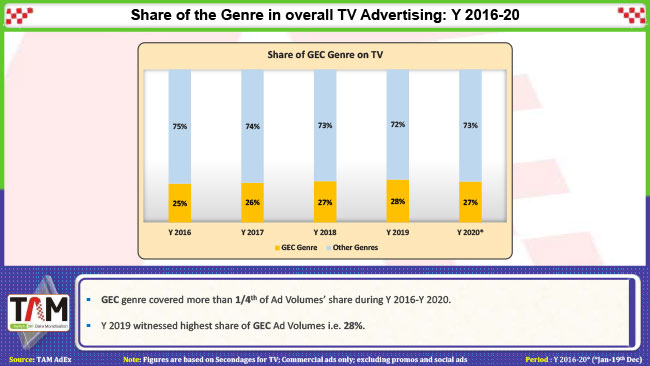
    GEC genre covered more than 1/4th of Ad Volumes’ share during Y 2016-20.

    True Shield Hand Sanitizer was the top brand during Apr’20 to Jun’20 & Aug’20 in GEC Genre.

    Toilet Soaps leads among the Top 10 categories of GEC Genre with 9% ad volume share in Y 2020.

    Ecom-Media/Entertainment/Social Media saw highest increase in ad secondages during Y 2020 compared to Y 2019 in GEC Genre.

    In GEC genre, HUL topped among the GEC advertisers followed by Reckitt Benckiser on 2nd position during Y 2020.

    6 out of Top 10 brands on GECs were from HUL and 3 were from Reckitt Benckiser.

    1.3K+ advertisers & 2.7K+ brands exclusively advertised during Y 2020 on GECs compared to Y 2019.

    Primetime is the most preferred time-band on GEC genre followed by Afternoon and Morning time-bands.

    20-40 second ad commercials were most preferred for advertising on GECs during both Y 2019-20.

    Commercial advertising added 55% share of Ad Volumes on GECs whereas Promos had 45% share in Y 2020.

    Highlights of the report are Advertising Trend during Lockdown versus Unlockdown, Covid Prevention categories, Celebrity Endorsement, Social Ads by Govt. etc.

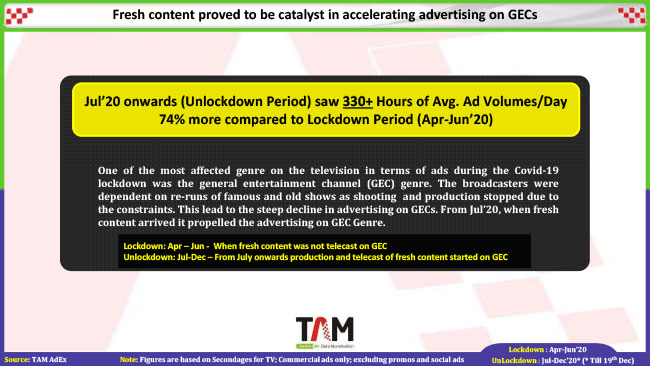
    According to the report, advertising volumes in 2020 saw a marginal rise versus what it was the previous year (2019). Average ad volumes in the all-important fourth quarter of the year rose 39% over the average ad volumes in the first three quarters of the year. There was 90% growth in Average Ad Volumes/Day witnessed during Post Lockdown period.

    FMCG players ruled the list of Top 10 advertisers with HUL leading the list. Four of the Top 10 brands advertised were from Hindustan Unilever and three were from RB. Personal Care/Personal Hygiene sector had 20% share of Ad Volumes followed by F&B with 18% share.

    Please click on this link for the report:

    TAM AdEx – Mirroring Y 2020 for GEC Genre


  • The Unfairness of It All


    By Prabhakar Mundkur


    When Hindustan Unilever announced its decision to rename its moneyspinner $500 million brand Fair & Lovely to Glow & Lovely, it was a classic case of doing too little too late.
     

    To imagine that the decision was perhaps based on the greatest upheaval of racist stereotyping of our time with the excruciating George Floyd pinned to the ground doesn’t say much for Hindustan Unilever’s decision. There is nothing to congratulate them about.  There can be no appeasement of public emotion. There can only be guilt and shame.


    Activists through the decades have objected to Unilever’s fairness cream but it needed a revolt as ugly as George Floyd’s death, for the great marketer to make this small move.  Not since Rosa Parks was denied a seat on a bus in Montgomery has the world been so affected by the colour bias of the human race.


    But how good is the new name Glow & Lovely? Decades of skin care research has shown that ‘Glow’ is a major benefit in for the skin care regimen. Just like ‘Shine’ is. a major benefit for hair. So, taking a benefit from research and planting it in a brand name is perhaps not the most creative way of configuring brand names. But then Unilever has not been particularly known for its creativity. That lesser brands like Emami had already pre-empted this thinking by naming their brands Glow & Handsome is a bit of a shame. After all, one expects leaders to show the way. Not follow in the footsteps of their smaller competitor in the FMCG business.


    But is Glow and Lovely a good name?


     There is a reason why Glow and Lovely doesn’t sound right given the vagaries of the English Language. The reason why it doesn’t roll of the tongue as easily as Fair and Lovely has to do with the English language. Both Fair and Lovely are adjectives. Glow on the other hand is either a verb or a noun depending on how you use it. Glowing & Beautiful would have sounded better in English. Because Glowing is an adjective. But it then lengthens the brand name. And Unilever might have decided they would stay close to the current syntax. Anyway to the large majority of Indians it would hardly matter. It’s just another name for Fair & Lovely. Fair and Glow are both four-letter words. But how the name changes the advertising need to be seen. Will the new ads have dark and glowing faces to make amends with the brand’s past? That is anybody’s guess.


    How Darkie changed its name


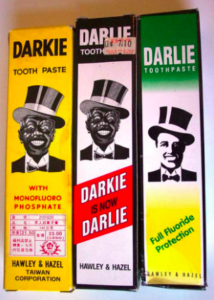
    It may interest people to know that the exact opposite of Fair & Lovely existed as a toothpaste in Asia many decades ago. A toothpaste called Darkie. Produced by Hawley and Hazel, the brand was very popular in Asia. The pack showed a smiling black performer. The brand was then acquired by Colgate Palmolive which faced a lot of racist flak on the brand. In 1989, Colgate Palmolive decided to change the brand name to Darlie.


    “It’s just plain wrong,” Reuben Mark, chairman and chief executive of Colgate-Palmolive, said about the toothpaste’s name and logotype. “It’s just offensive. The morally right thing dictated that we must change. What we have to do is find a way to change that is least damaging to the economic interests of our partners.”


    Seems like a shame that another global company had thought about this so deeply more than 30 years ago. So Unilever in many way is 30 years too late.


     What will posterity say about Fair & Lovely?


     But what this would mean for the generations to come is anybody’s guess.  Will Generation Alpha which may use the brand a few years from now warm up to the brand given its history? (Generation Alpha is the demographic cohort succeeding Generation Z. Researchers and popular media use the early 2010s as the starting birth years and the mid-2020s as the ending birth years.)


    How will these young people see our racist past? One piece of research showed that Generation Z are as racist as their millennial parents. But will this continue on to Generation Alpha? Technology is likely to change a lot of mindsets in the future. And that may change the fortune of the brand called Glow & Lovely.


    Prabhakar Mundkur is an advertising veteran, a lateral thinker, storyteller and musician. He has spent several years in advertising – in India and elsewhere in the world – including at JWT China where he headed the Unilever business, amongst other functions. In fact he worked on Unilever brands for a good 17 years… though never on F&S ;-). A prolific writer now, he was LinkedIn’s #1 Top Voice for 2016 and YourStory’s 100 Emerging Voices 2018. He writes frequently on MxMIndia.

  • HUL’s Ouch Mummy is Kantar’s 9th most effective ad

    By A Correspondent


    Hindustan Unilever’s ‘Ouch Mummy’ creative for Bru Instant has ranked #9 amongst the top performing global TV ads for 2019. It’s the only ad from India to win an award across all categories- TV, Digital and OOH/ Outdoor – in Kantar’s inaugural Creative Effectiveness awards.


    BP’s Blind Date (Spain), Milka’s Christmas ad Give to those who give the most (Germany) and HSBC’s CSR Birmingham (UK) are the most effective ads from around the world in 2019 in these new awards that were set up to celebrate the world’s best performing ads across the three key media channels based on actual consumer feedback.


    Here’s what a communique noted:

    Spanning three categories (digital, print/out of home and TV) and from 78 different markets, the winners represent the most creative and effective work from over 10,000 ads tested with consumers in 2019 using Kantar’s Link creative testing, which measures any advert’s potential to deliver against short and long-term brand goals. These first award winners perform in the top 4% for short-term sales likelihood, and the top 1% for long-term brand building when measured against the Link database of over 200,000 ads analysed over the past 30 years. The winning ads are all at least twice as likely to drive sales than an ad that performs at the median evaluation score and ten times more likely than a weak ad.

    The winners show that distinctive creative is central to advertising success, falling in the top 15% of ads for distinctiveness in Kantar’s database. In a world flooded with content, brands need to ensure their advertising captures people’s attention.


    Digital effectiveness: Engage don’t enrage

    Analysis of the digital category revealed the most effective ads reward the viewer with entertaining content that breaks through the ‘ad filter’ in consumers’ minds and compels them to view it. Milka’s Christmas ad Give to those who give the most tops the digital ad awards, demonstrating the power of storytelling for driving engagement by evoking strong emotions. The beautifully touching film, centred around a strong, seasonally relevant message of thoughtful gifting, was created in partnership with the European Union of the Deaf and promotes inclusion in a very moving way.

    Digital Ranking Brand Ad Name Agency Country
    1 Milka Milka Christmas: give to those who give the most Wieden + Kennedy, Amsterdam Germany
    2 Google App Search the lyrics with Google Zula Alpha Kilo Indonesia
    3 Dulux Let’s colour experiment: escalator Road 381 UK


    Print & Out of Home ads: Spark a response in seconds

    The winners here illustrate the power of creative to deliver an instant impression about the brand. Immediate impact is essential as consumers give just seconds of their time to print and out of home (OOH) ads, in which the content needs to communicate its message or hook the viewer in for longer.

    HSBC evokes an immediate emotional reaction through its winning OOH execution. The shocking statistic that 1 in 45 people living in Birmingham have no address, therefore can’t have a bank account, a job, or a home, helps highlight the work the bank is doing to support the local community. The impact of the message is heightened by delivering it in situ enabled by the medium of OOH.

    Print and OOH Ranking Brand Ad Name Agency Country
    1 HSBC HSBC CSR Birmingham Wunderman Thompson UK
    2 Estrella Damm Silja &Rosàs UK
    3 Camden Hells Juicer static Forever Beta UK


    Top-performing TV ads tell great stories

    The TV winners demonstrate the continued sales-generating and brand-building ability of broadcast content, particularly when strong distinctive assets are weaved into great emotional story telling. Crowned as  Kantar’s most powerful TV ad of 2019 globally, BP’s Blind Date is a great example of how a distinctive approach to a category can create differentiation. The ad shows how a functional message can be intrinsically sewn into an amusing, brand-centric story that is quite different to what you would expect to see from the category.

    TV Ranking Brand Ad Name Agency Country
    1 BP Blind Date Ogilvy&Mather Spain
    2 Tim Hortons Ask a Timbits Kid Zula Alpha Kilo Canada
    3 Unox Tijden veranderen TBWA Netherlands


    Said Daren Poole, Global Head of Creative at Kantar: “The first ever Kantar Creative and Effective awards showcase some of the most impactful advertising work from around the world. The commonality across all the winning ads is distinctiveness, and how strongly the brand is integrated into the narrative. Our winners – real consumers’ favourites – take on many forms and employ a range of creative tactics to convey their message; proving there is no ‘one-size-fits-all’ approach that can be employed to achieve great content. Interestingly, many of the winning ads in Kantar’s Creative Effectiveness awards are heart-warming stories or contain humour, in contrast to the broader industry trend, which is to incorporate humour less.” Just over one third (34%) of 2019’s adverts were intentionally light-hearted or funny, compared to more than half (54%) of ads evaluated by Kantar in 2000.


  • Lifebuoy unveils series of initiatives in fight against Covid-19

    By A Correspondent


    Taking the cause of preserving health and preventing the further spread of Covid-19, Lifebuoy has launched a nationwide public awareness campaign educating people on the importance of and steps to hand sanitization, urging citizens to use any soap at their disposal.


    The campaign kicked off across print, television and digital platforms with a message that placed emphasis on the importance of handwashing while also boldly naming its competitors and urging consumers to use any soap that is available to them.


    Commenting on the public awareness campaign, Srirup Mitra, Vice President, Skin Cleansing, Hindustan Unilever said: “Until a cure is found, a simple act of handwashing, when done correctly, can effectively contribute towards reducing the spread of this deadly virus. We at HUL have ramped our production capacities to ensure that Lifebuoy hygiene products are available to consumers and continue our commitment to support the nation and its citizens in this fight against corona virus.”