Tag: Google+

  • SC ruling on homosexuality: Steps by India Inc to end discrimination may be hit

    By Shreya Roy & Saumya Bhattacharya


    A slew of measures rolled out by leading companies such as IBM, Google, Infosys, etc, to ensure that employees with an alternate sexual orientation are not disrespected, harassed or discriminated against, may be undone by the Supreme Court ruling on Wednesday, HR, legal experts and gay rights activists say.


    The top court pronounced that gay sex is illegal, overturning a 2009 Delhi High Court judgement that had decriminalised homosexuality.


    5-10% of India Inc’s workforce

    “With Section 377 being upheld, companies will find it even more difficult to have the tough conversations that are required in order to be fully inclusive,” said Saundarya Rajesh, founder-president, Avtar Career Creators & Flexi Careers India.


    “This gives leeway to discriminate against colleagues from the LGBT community, and more room for taunts, and harassment,” Anjali Gopalan, founder, Naz India Foundation added. “In the minds of people, this criminalises the homosexual individual and sets back years of work companies have done for inclusion.”


    “The focus at Infosys has been to ensure employees have a safe and harassmentfree workplace irrespective of their sexual orientation or gender identity,” an Infosys spokesperson said via email. “We do not foresee any changes to the policies that we have.” Infosys Gay Lesbian employees and You (IGLU) aims to create a safe and respectful work environment for employees from the LGBT community.


    It conducts awareness programs and exclusive events to create awareness and foster inclusion. “We are reviewing the situation and will want to understand the full legal implication of the ruling,” a Google spokesperson said. The company set up it Gayglers network aimed at creating an inclusive work environment by sensitising staff and increasing awareness on LGBT issues in India in 2010.


    The LGBT community makes up about 5-10% of India Inc’s workforce, according to a LGBT Resource Guide created by Google, IBM, Goldman Sachs and Community Business last year. Nearly a third of 455 LGBT employees reported facing harassment in the workplace, according to ‘Out’ number in India, LGBT Workplace Diversity and Inclusion Survey 2011-2012, conducted by Mingle (Mission for Indian Gay and Lesbian Empowerment).


    As many as 80% report hearing homophobic comments, jokes or anti-gay rhetoric at their workplace.


  • In Google & Facebook-dominated world, Yahoo invites entries for Big Idea Chair Awards India 2013

    By A Correspondent


    A few years back when this correspondent was invited with some media maharathis to an event organized by a premier Ahmedabad-based management institute (not the IIM), the large student crowd expressed its unfamiliarity with the Yahoo! brandname to a senior functionary from the internet giant. Evidently, to a generation for whom Google, Microsoft, Facebook and Twitter are the most visible digital brands, Yahoo’s name belongs to sepia-tinted history books.


    Sad because Yahoo and Yahoo India in particular have done some pioneering work in the business ever since they announced their entry to the country with a mother-of-all-parties at Mumbai’s Taj Mahal Hotel over a decade back.


    Yahoo! is of course still relevant in the Indian digital media scenario, and it ensures it stays there by hosting the fourth edition of the Yahoo Big Idea Chair awards by inviting advertising and media agencies in India to showcase their best work in digital. Spread over nine categories, the call for entries will be open till November 25, 2013.


    Interested teams can now register for free at www.bigideachair.in. The winners will be announced next month (Dec 2013)


    Announcing the Yahoo Big Idea Chair call-for-entries, Nitin Mathur, the normally out-of-bounds Senior Director & Head of Marketing, India and South-East Asia, Yahoo, said:  “India is seeing some amazing creativity in digital advertising, helping brands integrate more meaningfully into consumers’ everyday lives.  Yahoo Big Idea Chair Awards honours individuals and agencies who are pushing the boundaries on digital in their search for the next big idea with the highest impact.”


    Last year, as many as 376 entries were received, with over 100 brands and 57 agencies participating in the Yahoo Big Idea Chair awards, noted a communique, adding: Acknowledging the increasing importance of content marketing in brands’ digital marketing strategies, Yahoo has added a brand new category of Best Content Marketing, to the existing stack of awards. Advertising and media agencies can now submit their exceptional creative and innovative ideas across 9 award categories including:


    Best Use of Display Advertising to recognize the most creative and innovative use of display advertising.


    1. Best Online Video Advertising for excellent work on video ads or video series created for digital


    2. Best Use of Social Media for the most innovative use of social media for brand advertising


    3. Best Use of Technology recognizing innovative use of technology for digital advertising on the Internet or mobile (includes technological innovations such Augmented Reality, applications, blufi, other tools).


    4. Best Use of Mobile Advertising to recognize campaigns that use mobile as a medium for to effectively communicate the brand message and engage consumers


    5. Best Use of Search – to recognize creative and innovative use of search advertising in a brand campaign


    6. Digital 360 degree Award -This award recognizes campaigns that strategically used digital as the core medium and implemented all digital channels including display, search, social, mobile.


    7. Best Content Marketing Award to recognize campaigns that strategically use content to ensure targeted message delivery and high levels of consumer engagement


    8. Yahoo Big Idea Chair Award flagship award to recognize fantastic digital campaigns which combine ideas, content, execution and real innovation to deliver with impact


    The entries will be judged by a panel of eminent industry leaders and professionals drawn from diverse sectors, including marketing, advertising and media planning. The jury panel will be announced soon.


    Now if only the digital generation would do a Yahoo! for Yahoo after all of this.


  • Apple, Google topple Coca-Cola out of top slots in Interbrand’s Best Global Brands report

    By A Correspondent


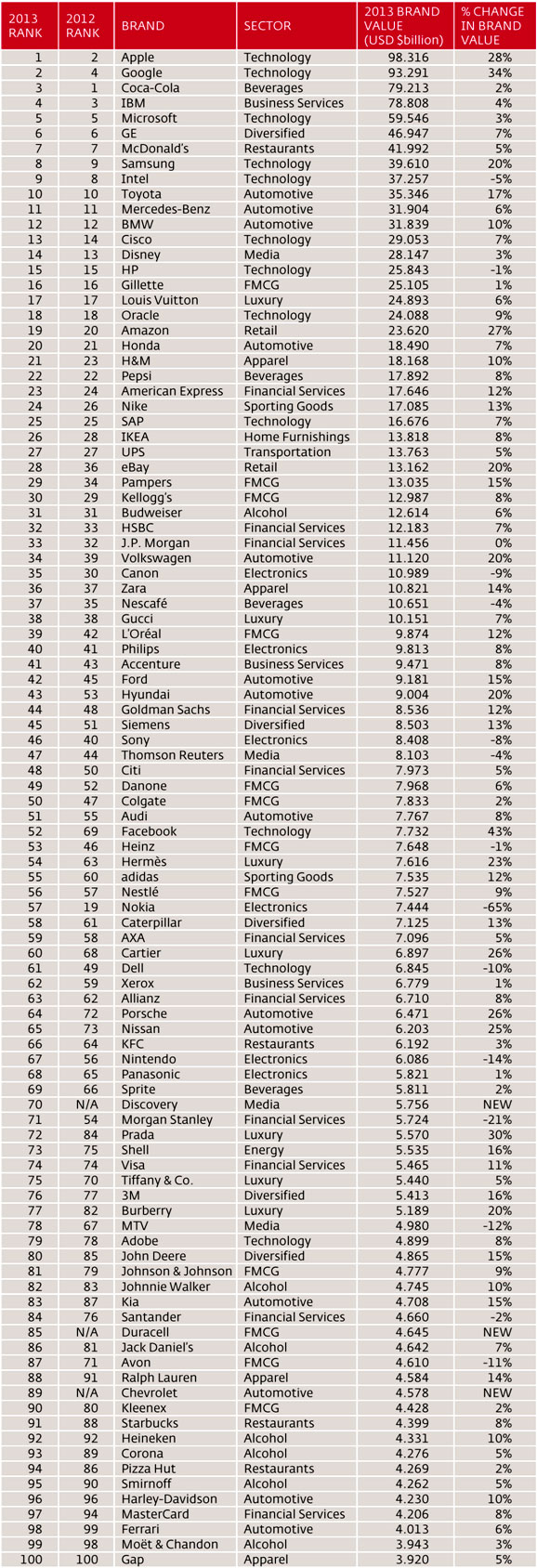
    For the first time in the history of Interbrand’s Best Global Brands report, there is a new #1 brand: Apple. Leading brand consultancy Interbrand publishes Best Global Brands on an annual basis, identifying and examining the Top100 most valuable global brands.


    With Apple claiming the top position this year, Google jumps to #2 and Coca-Cola, the brand that held the #1 position for 13 consecutive years, moves to #3.This year, the total value of all 100 Best Global Brands is USD $1.5 trillion — an 8.4 percent record increase over the total value of the 100 Best Global Brands in 2012.


    Apple hasappeared on Interbrand’s Best Global Brands ranking since 2000, when the ranking debuted. In 2000, Apple ranked #36 and had a brand value of USD $6.6 billion. Today, Apple’s brand value is USD $98.3 billion- almost 15 times the amount of its brand value in 2000.


    “Every so often, a company changes our lives-not just with its products, but with its ethos. This is why, following Coca-Cola’s 13-year run at the top of Best Global Brands, Apple now ranks #1,” said Jez Frampton, Interbrand’s Global Chief Executive Officer. “Tim Cook has assembled a solid leadership team and has kept Steve Jobs’vision intact – a vision that has allowed Apple to deliver on its promise of innovation time and time again.”


    Ashish Mishra

    Adds Ashish Mishra, Managing Director, Interbrand India – “Yes, for the first time in the BGB’s 14-year history, Coca-Cola is no longer #1. This year, Apple claims the top spot – and Google captures the #2 position.This to our minds is the single biggest story of the new times, of a changed world. Of who really leads the brand – the marketer or the consumer, or both? And how anticipation, co creation, conversation, innovation, investment in people &big data, strategic CSR and new leadership is the new way”.


    When determining the Top100 most valuable global brands, Interbrand examines three key aspects that contribute to a brand’s value:

    :: The financial performance of the branded products or service
    :: The role the brand plays in influencing consumer choice
    :: The strength the brand has to command a premium price, or secure earnings for the company

    Interbrand’s 2013 Best Global Brands (Top 100)


  • Net savvy smartphone users book travel from their phones: Google report

    By A Correspondent


    With the growing adoption of smartphones in India, Google India released a study conducted by research agency Ipsons titled ‘Multi-screen traveller’. The study was conducted to understand the behaviour of smartphone users in India and its impact on the travel vertical – focusing on a target group which uses multiple devices to get online for their travel related needs.


    The study revealed that 76% users use both computer and mobile across the travel stages (dreaming, researching, booking, experience, sharing) while 60% users move from one device to another when they switch from researching to booking. Out of the 1500+ leisure travellers surveyed – 87% users said that they have used mobile phones to research about their trips and 66% respondents also booked a trip element on it. 60% said that the information they find while researching on their mobile phones influences their booking decision.


    In terms of triggers for holiday planning, online sources were rated higher than offline mediums with Internet getting five touch points in comparison to offline which offered two touch points. The biggest triggers for holiday destinations/planning were online pictures – where 88% users said that online pictures trigger their holiday planning. Browsing pictures on social networks, blogs, travel sites get users to start thinking of their next vacation destination.


    In the planning and research phase, the target group did not differentiate between their choice of Internet access device – user’s rated using desktop, mobile and tablets at over 85% – clearly highlighting the multi-screen behavior of the users for holiday or trip planning.  Smartphone’s & tablets were also the first go to devices for travel researchers even at home.  Convenience was rated as the biggest motivator for use of mobile.


    Speaking about the study findings, Vikas Agnihotri, Director – Travel & BFSI, Google India, said “We already know that smartphone users on an average spend 76 minutes on the internet through their mobile. The Smartphone user base is set to explode in India to touch 70 million by end of this year. Over 1/3rd of travel related search queries on Google India are now coming from mobile and tablet devices, with queries from smart phones growing at 397% YoY. This study establishes that today’s hyper-connected, hyper-informed Smartphone user is consuming online content across devices. This impacts the complexity in engaging users from a marketer’s standpoint. With travel being the most evolved and mature vertical, we believe that the findings from this study will help them to devise strategies to engage the users across multiple online screens/devices.”


    The study also looked at the booking behavior of the smartphone and tablet users, wherein 66% respondents said that they’ve booked using a mobile phone and 69% on a tablet. While the absolute numbers of transactions is low in the real world, the report does indicate the growing trend of bookings being completed on mobile devices from mature users.


    From the respondents – 36% users said that they booked a flight on a mobile, while 25% have booked a hotel room and 13% have submitted a holiday lead from their mobile device. The study also revealed significant cross-device attribution. Out of 87% who researched on their mobile phones, 76% booked on mobile and 80% booked on a computer as well. Concerns around security were cited as the biggest barrier for booking on mobile.


    The respondents also highlighted the convenience and preference for mobile applications over using mobile browsers for booking their trip and sharing information on the trip. For booking and sharing, mobile app usage was 12% to 15% higher in comparison to mobile sites.


    The study highlighted that the Indian travel planner goes through a variety of resources around destination research, like browsing through pictures on social networks (74%), reading trip information on travel sites & apps (56%) and watching videos about destinations (52%).


    While on the trip – users also showed high usage of Internet from their mobile phones. Mobile was used as the information and communication wallet when traveling. 74% respondents said they shared or posted on their social network and 46% respondents re-scheduled a trip element using the phone. Over 30% checked maps, weather and events from their mobile phones on a vacation. Post holiday, over 50% respondents said they uploaded photos and posted reviews using their phones and interestingly over 10% had started researching for their next holiday.


  • Desi travel portals not amused as Google is set with flight search in India

    By Indu Nandakumar


    A fledgling effort by Google portending the launch of its flight travel search service in India is creating jitters among online flight aggregators, who fear their business model is under threat.


    Google, whose services include Gmail and YouTube, is “very close” to introducing Flight Search in India, according to people with direct knowledge of the plan. Flight Search – first launched in the US and then in parts of Europe – lets users compare fares offered by airlines and book tickets directly from airline websites. This could, in effect, make flight aggregators such as Makemytrip, Yatra and Cleartrip redundant, industry observers said. Another website, kayak.co.in lets users compare flight options from hundreds of travel sites at once.


    In response, the aggregators are considering steps to protect their interests, including a possible complaint to the Competition Commission. They claim discrimination by Google when it comes to search results for queries relating to online travel.


    Separately, Google is the subject of investigations by the Competition Commission based on complaints that it is abusing its dominance in the country’s search-engine market. In February last year, matrimonial site Bharatmatrimony.com had filed a complaint against it.


    Company already faces probes in US, Europe

    Last month, Google launched a ‘Start Searching India’ campaign aimed at providing users with instant responses on weather and flight status, among other things. This move was read as precursor to the eventual launch of Flight Search in India. Google India said in May that it does not comment on future plans or speculation when asked about its plans to launch Flight Search in the country.


    Hrush Bhatt, founder and director of travel portal Cleartrip, refused to count Google’s Flight Search as a direct threat but conceded that it could alter the way aggregators allocate their online marketing budget. “We are not sure what value Flight Search would add to consumers, especially if it can only let you compare prices,” he offered.


    Online travel firms such as Yatra.com, Makemytrip and Goibibo declined to comment. Google denied any knowledge of market participants planning to approach the Competition Commission but said that in the event of that happening, the company will extend “full assistance and cooperation on the matter.”


    “We’re always happy to answer questions about our business,” the company said. KPMG’s Tuteja said that Flight Search is likely to be popular among India’s fast-growing internet user base-150 million at the end of 2012-that has been increasingly been booking travel tickets and hotels through online portals.


    In Europe, Google’s Flight Search is under pressure from travel portals such as Expedia and Trip Advisor, which have filed antitrust complaints against Google with the European Commission for promoting rival services and disrupting fair competition in the online travel space. Flight Search makes use of the vast amount of flight-related real-time information from US based travel information company ITA Software.


    Source:The Economic Times

    Copyright © 2013, Bennett, Coleman & Co. Ltd. All Rights Reserved

    Licensed to republish


  • Bharti Airtel & Google join hands to launch Free Zone in India

    By A Correspondent


    Bharti Airtel and Google have announced the launch of Free Zone powered by Google, which will give Airtel mobile customers access to mobile web search and feature-phone-friendly versions of Gmail and Google+ in India. The first page of a website linked from search results is provided at no data cost.


    Airtel mobile customers can access the service by visiting www.airtel.in/freezone and start using the internet without having to sign in to the service. Any user can create a Gmail account instantly on the Free Zone homepage and enjoy a multitude of connectivity and social media services from Google.


    Rajan Anandan

    Rajan Anandan, VP and Managing Director, Google India said, “The mobile internet user base is growing really fast in India. Working with Airtel on this exciting trial means that we can offer internet services at no cost to anyone with a phone. This gives people easier access to information in a way that benefits everyone, whether it’s an individual or a small business that wants to reach more people on the web. We hope this initiative will encourage more Indians to experience the value of the internet and gain from it. Students can easily look up facts to work on their assignments, housewives will be able to easily check on recipes and connect with their friends and family from their mobile phones.”


    “In this market, where feature phones predominate, our association with Google to bring Free Zone to India will encourage millions of users to discover the power of mobile internet for the very first time and leverage the amazing world of information search, email and social collaboration – at no incremental cost,” said N Rajaram, Chief Marketing Officer, Consumer Business, Bharti Airtel.


    Free Zone aims to make the web accessible and affordable to all mobile users. The set of powerful internet services available via Airtel includes Google Search, which will take Free Zone users to websites matching their search query, Gmail, and Google+ which enables users to share photos and messages with social groupings of family, friends and business or work associates. While Airtel subscribers will not incur any data charges to access these services on Free Zone powered by Google, access to more advanced services such as Attachment Download or browse through to web sites from the ones accessed in the Free Zone would be enabled through the subscription to a standard data package.


    Airtel mobile customers will be able to access the following services from mobile phone browsers through Free Zone powered by Google:

    – Gmail: Users have unlimited access to Gmail from their mobile browser. If users click on a link or attachment within the email they are directed to a page where they can purchase a data package.

    – Google+: Users can share online photos and messages with circles of family, selected friends or the public; follow updates on the things they are passionate about – from cricket to photography, music to news; and follow people they’re interested in.

    – Google Search: Users can search the entire internet and access the first page of websites from the results for free. If they click further into a website after that, they are directed to a page where they can purchase a data package.


    When users leave the Free Zone to navigate deeper into a website or download an attachment they are informed about the data charges and given the option to purchase an appropriate data package.


  • Simplify360 offers support for Google+ pages

    By A Correspondent


    Simplify360 Inc, a social business intelligence firm started in Bangalore in 2009, has added another feather to its cap with the support of Google+ pages becoming the first social media analytics platform from Asia offering this integration.


    With this offering Simplify360 envisions to increase its social data coverage and enhance the analytics offerings to its existing enterprise clients and agency partners.


    Bhupendra Khanal, CEO Simplify360, remarked, “Google+ is one of the most futuristic social networks and has shown great potential to be leveraged by businesses. This integration will be crucial for us to develop and provide value to our customers to take advantage of the full potential of Google+.”


  • Industry, guardians & gurus discuss Net impact @ Google summit


    By Ananya Saha


    It is not every day that one witnesses a high-power conference like this; in fact it was being held in India for the very first time. The one-day Big Tent Activate Summit, organized by Google in association with The Guardian and MediaGuru saw Indian and international thought leaders focussed on issues relating to the Internet and its impact on economy, politics, culture and society in India.


    Kapil Sibal: Committed to Freedom of Expression

    While delivering the keynote address at the Google Big Tent Activate Summit, Kapil Sibal, Union Minister for Communications and IT made it a point to highlight that the government is committed to the cause of freedom of expression. “There should be no doubt that we are wedded to the freedom of expression,” he said. He underlined that the Internet is the most important and transformative forum as there are no borders on the net, he stated, “we must move slowly but surely towards making internet the equinet.”

    He underlined the three important points for making the internet a truly empowering, transformational and inclusive force. He said that from the point of view of the State, “we must have an enabling framework – rules and regulations must not come in the way of the growth of the net. Secondly, networks in terms of fibre-optics and also wireless must be developed to facilitate access to the net. Thirdly, affordable access devices are needed for a true inclusive transformational internet revolution.” Mr Sibal also said that it will be truly transformative, if through the internet, “we can reach people in their traditional languages.”


    Haves and Have-nots

    Deep Kalra, Founder & CEO, MakeMyTrip.com spoke about how according to a recent study “SME’s who invested in internet presence have grown by 10% and those who did not, have not grown by that much.” Giving the example of China-based e-Commerce giant Alibaba, he said that a single website has helped the entire economy by hand-holding the SMEs. Elizabeth Bramson-Boudreau, Director, Economist Intelligence Unit, reasoned, “Why don’t we have Indian Google or Indian Apple? Apart from talent probably, it is also about regulation. In our research, we have found that within Asia there are many challenges facing the SME and thus, global frontier is not a focus for them. They do not know what regulations are applicable to their internet presence, there of lack of clarity about content and third-party content services and policing of content.”


    Even as India witnesses increasing internet penetration, Anu Madgavkar, Senior Fellow, McKinsey Global Institute stated, “The urban and rural penetration ratio stand at 20:2 percent. Rural ecosystem will flourish provided there is equality.”


    The very Social media

    It is a fact that many big ticket announcements, and now even political statements, are made on social media platforms. Stephanie Cutter, Political Consultant, who was also the Deputy Campaign Manager for Barack Obama’s re-election campaign, spoke about how investing in social media helped them to communicate outside of the media filter, helped them to generate donations and organise online with offline actions. While saying that he is not a big fan of Section 66A, Shashi Tharoor, Minister of State for HRD stated that social media is usually used to create brand identity for the person. Even as Ms Cutter said that all US politicians are on social media, Omar Abdullah, Chief Minister, Jammu and Kashmir said, “Social media is now taken more seriously. And hence, I have to be more careful. I am reluctant on social media because it is now taken as statement of record.” Mr Tharoor concurred.


    On the question of media restriction in volatile J&K, Mr Abdullah said, “What we say on social media is picked by traditional media. People ask me that what they say on social media is deleted or blocked, and what I say is not. What I need them to know is that what I say on social media will not get people killed.”


    Narendra Modi, Chief Minister,Gujarat, joined in the Big Tent summit via Google Hangout. He said, “The internet has therefore truly empowered the citizen. It has forced the politician to perform, not just promise.” He focussed on how the internet has been a gamechanger in the realm of information-based decision making and has transformed the policy making process. He concluded, “Technology in itself is neither good nor bad. That depends on how it is harnessed. While technology in politics plays a crucial role, it would do us great good to stay away from letting politics into technology.”


    Google’s play

    Eric Schmidt, Executive Chairman, Google shared a fireside with Alan Rusbridger, Editor, The Guardian at the summit. Mr Schmidt began by saying that there are 600 million mobile phone users in India, 130 million Internet users and only about 20 million broadband users. “India is under-penetrated. Many of the next five billion users of internet will come from India, of course in many more languages.” Talking of non-English users, he said, “You want entrepreneurs to take risk but definitely not go to jail for it in India. Fearing the outcome, many Indians might not join the Internet.” He said that interconnectivity might help the telcos and intermediaries like Google to help the entrepreneurs. Talking about privacy issues on internet, he said, “We need to fight for our privacy. As technology becomes pervasive in Indian society, privacy issues need to be considered.”


    On Mr Rusbridger comment that Google is talking about privacy, Mr Schmidt said, “If Google was not even present, the privacy issues would still be there. There is no delete button on the internet. But of I would still say that the despite the negative like privacy issues, value of internet is profoundly positive.” Talking about how mobile can adapt to a profitable business model, Mr Schmidt said, “Mobileads need to be more valuable since it is more personal. Mobilegives more info where the consumer is, what is the consumer doing unlike other screens.” In the end, being asked about India and China, he said, “In short span, China gets all the attention, but the math favours India.”


    View from the industry

    Jeff Jarvis, Professor, CUNY Graduate School of Journalism; Raghav Bahl, Managing Director, Network18; Siddharth Varadarajan, Editor-in-Chief, The Hindu and Sanjay Salil, Managing Director, MediaGuru discussed how traditional media is adapting to online media and if online is proving to be a challenge to traditional media.


    Mr Jarvis said, “It is of course challenging to cannibalise yourself to new media.” Mr Varadarajan said that while print media in India is dependent on advertisements to get revenues, online media cannot yet capitalise of ads for revenues and neither would the readers pay more for online version of news. Mr Bahl said that while India did leapfrog the disruption, “as internet infrastructure catches on, the transition is going to be very fast,” even while adding later that India been a subject of bad regulation, especially internet.


    The panellists agreed that news has become platform-agnostic as Mr Jarvis argued “we should be seen as a service industry.”


    As Mr Bahl said that TV has made an easier migration to internet, compared to print media, Mr Varadarajan said, “Even today, when there is a breaking news situation, one turns to TV since it is centrally-curated product.” However, he insisted that The Hindu is getting ready for internet, “We ask our journalists to file two reports: one for print and one for internet. The only challenge is how to integrate different forms of narration: reading, listening and watching. No one has industrialised or scaled it.”


    Photograph: video grab from an NDTV.com webcast of the Q&A that Guardian editor-in-chief Alan Rusbridger had with Eric Schmidt, Executive Chairman, Google


  • MxM Mondays: Why do marketers not spend enough on digital media?


    By Ananya Saha and Robin Thomas


    According to the latest IAMAI-IMRB report on Digital Advertising, as of March 2012, the total advertising spends, including classifieds, was valued at Rs2,850 crore. It is expected that by FY2013 the digital advertisement spends will be Rs4,391 crore.


    Search advertising constitutes about 20 per cent of the total online advertising spend or about Rs570 crore. Display advertisement, which has many components, forms a sizeable portion of advertising spends. Advertisements on portals and vortals form 13 per cent of the overall pie (Rs369 Crores). Advertisements on Social Media, Email and Videos over the Internet form 3 per cent (Rs94 Crores), 5 per cent (Rs144 Crores) and 2 per cent (Rs59 Crores) respectively. Mobile ads form nearly 4 per cent (Rs90 Crores). A major proportion – around 53 per cent of the overall digital advertising spends – are classifieds listings (Rs1,496 Crores).


    These numbers seem impressive, but there has been some concern that marketers are not spending enough on Digital Media. The theme for this week’s MxM Mondays is ‘Why do marketers still not spend enough on digital?’ While marketing spends may be shifting to the digital media globally, in India, television and print still rule. Is it because digital still doesn’t reach the masses, and homemakers, in particular? Or is that the bucks (hence commissions) are still big in TVCs? MxM spoke to some players in the industry to find out:

     

    Ambika Sharma

    Ambika Sharma, MD and CEO, Pulp Strategy

    The shift to digital media is not happening as fast as the industry would like it to be. However, we are witnessing an increase in aptitude and attitude with regards to usage of digital media. Marketers are not using the media aggressively as they prefer to wait-and-watch. Even then, they are aggressive on ‘search marketing’, but not other aspects of digital media.


    There is hardly any youth brand which is currently not on digital platform. Education is one prominent category that has been using digital media. The cents for digital, however, remain restricted. But as the impact of digital media grows, the impact of mobile advertising has seen a decrease as most people now do not prefer to click on banner ads on mobile screens. Some studies show that in the past one-and-a-half-year, the user has been ignoring banner ads.


    The digital spends depend on ROI, search and impressions, which needs robust backend engine. E-commerce websites have been the heavy users of digital advertising to create impressions. But there is little or no response mechanism on impressions and the visibility is highly fragmented. The numbers, like there is TAM for television, are not available for digital media. If a marketer advertisers on three digital platforms, every platform gives their own numbers. So, there is no comprehensive measurable strategy.


    Going forward, digital media will grow, but it will be a long while before it catches up with other media vehicles. Lotof factors such as measurability, reach, people not preferring to buy online are affecting the growth.

     

    Gyan Gupta

    Gyan Gupta, CEO, I Media Corp Limited (IMCL), Dainik Bhaskar

    In the US, the online spend is 29 per cent of the total advertising pie; in UK, it is 26 per cent. Now if you see the figures in India, it is not even 5 per cent. The trend shows that there will be 50 per cent increase.


    But I will not say that marketers in India are spending enough yet. The typical spender (who spends on television) is yet not on-board. Till the main spenders come on-board, the growth will be limited. FMCG’s have a deep share of the pocket, and it is necessary that they spend on digital media. Auto companies, e-commerce companies, financial companies have been heavy spenders on this medium.


    What are the marketers spending on, and how they spend also becomes important. What needs to be analysed is if the cost of acquisition is happening, if the leads are getting generated, how much a brand is spending on digital activation vis-a-vis on brand promotion. Trending is happening. This year will actually showcase the brands spending on digital media.

     

    Harneet Singh Rajpal

    Harneet Singh Rajpal, Vice President-Marketing, Domino’s Pizza India

    The use of digital media is picking up in India. For any marketer present in India, the digital media is beginning to become a part of their media plan. It is on radar for everyone, especially in the categories where youth is the target.


    For Domino’s, digital media has been important ever since we began our online ordering platform. Currently, it helps us drive traction. Hence, our media spends for digital medium have increased over the last two years. For us the return-on-investment is visible for every buck we spend on this media, since it results from direct conversion from inventory to revenue generation.


    We now spend close to 4-5 per cent of our total advertising budget on digital marketing, from almost nothing in the last two years. We work with leading publishers in the domain to create applications for Google search, Facebook and social media. I must say that on Facebook, we have the largest number of fans in the food category, and also followers on Twitter.


    Social Media management needs time and investment. It is important that the brand keeps the target in mind when planning the digital activations. Going forward, marketers will have to evaluate the prospects digital media brings. Of course, that depends on category to category. Digital media is still limited because of its reach, whereas traditional media garners higher reach. Also, the confidence about using the media is not too high among the marketers since there are no hard numbers to prove its success. The penetration of internet and the efficacy of the media will be tested over time.


    Jonathan Bill, Senior Vice President and Business Development, Vodafone India

    Digital Advertising is a growing medium in India. It will be everything we are hoping it to be and that too quicker than we think, so I think the business is starting to get in a healthy shape. The advertisers are starting to embrace digital more openly and they should do so, because India has the third largest internet population on the planet.


    On TV and Print bagging bigger ad share, I think that is a legacy issue among advertisers, but I do get a sense that it is fast changing. In the West, however, TV and Print advertising have declined in favour of online advertising. Print, therefore, has very less revenue share from advertisers as compared to online advertising and now online is beginning to even threaten television as a medium.


    I think we just need to continue on the path we are going. The quality of sales and, to a certain extent, the market needs to be made. The West took nearly two or three years to be made as far as the start of digital advertising market is concerned and in India we are only about a year ready. So, I am very bullish on digital advertising in India, particularly on mobile on three to five years timeline.


    Narayanan SP

    Narayanan SP, Senior Vice President, and Head VAS Mobile Commerce and Long Distance, Idea Cellular

    Compared to the global benchmark, certainly advertisers in India are not spending as much money on digital or mobile, but this is something which will change over a period of time. Marketers are experimenting to see if it makes sense for them to connect digitally for certain set of products/features and whether digital is the right medium to communicate or engage their brands. Thus, lot of experiments are happening.


    On the internet front, we are already seeing a significant traction which may not be as big as the international market because of the low internet penetration in India. So if you are looking at a certain type of product wherein the target audience are already digitally connected, then it makes immense sense to go digital. Digital, I believe, will evolve as more and more customer profiling is done and advertisers are able to target their customers precisely. When advertisers are able to measure the ROI (Return on Investment), then we definitely believe that a lot more investment will come into digital.


    The fact that TV and Print still bag more advertising share will definitely change over a period of time in terms of mobile being one of the vibrant channels. This does not mean print and television advertising disappear but, you will see an increase in spends on digital advertising and mobile advertising in particular over a period of time. This is because mobile is able to give the advertiser not only a more precise profile of the customer which makes it a lot easier for the advertiser to reach out to its consumers effectively, but it also allows the advertiser to interact with customers and measure the results of their campaigns effectively.


    Mobile industry, for instance, has a wealth of data in terms of customer usage, but there has not been much mining of the data which can be heavily leveraged by the advertisers. However over a period of time, you will see a lot more advertisers leveraging this data.

     

    Rakesh Rao

    Rakesh Rao, National Sales Head, Zapak Digital Entertainment

    The digital media has been growing exponentially. The year-on-year growth of this media vehicle is close to Rs2,800 crore, and is supposed to reach close to Rs4,000 crore in a year. So to say that it is not a preferred media would not be the right statement. Of course, it is not a dramatic growth, but given the growth of internet and smart phones, digital media is becoming a part of our daily life. The marketers are also following the trend.


    The ROI, when compared to TV and radio, is much more measurable. Cost per lead and cost per click measure actual conversions. This is the only interactive platform too, while rest of the media only give reach.


    Education, travel, finance are becoming the biggest spenders on digital because of conversion aspect. E-commerce, and categories like travel that look at selling inventory believe in digital media.


    The challenges that this media is encountering is getting TV-centric brands such as FMCG onboard because of reach. It is a given that while TV is cost-effective when it comes to reach, digital media will catch up in some years. About 60 per cent of these brands are on digital, but 40 per cent need coaxing. There is no hindrance apart from the fact that broadband numbers need to grow. Digital media is here to stay and grow.

     

    Sandip Tarkas

    Sandip Tarkas, President (Customer Strategy) and CEO, Future Media and T24

    As far as Future Media is concerned, our advertising spends on digital have been increasing year-on-year. Despite a lot of digital activities done by marketers specifically on social media, it does not reflect in spends. The problem with digital is not a lack of a credible or universal measurement system, but the fact that it is too measurable as people try to measure every little thing. Although there are so many metrics which evaluate the digital medium, I don’t think it is a lack of measurability at all, as in digital we are clearly able to measure our CPM’s (Cost per Thousands) and so on. Digital is something we use for more engagement rather than reach because it does not offer reach.


    We look at advertising based on two things – reach and cost efficiency. And then you look at everything else – whether the medium is interactive and so on. So, it is primarily about reach and cost efficiency. Digital media spend in India is a reflective of India’s internet penetration, whereas in a lot of markets digital penetration is very high. In those markets both print and television advertising have declined and digital advertising has been growing.


    In India too, digital is growing much faster than the traditional media, and the growth of the media certainly shows the growing importance of digital. The current size of the digital advertising pie is reflective of the kind of inroads it has made in the country.


    On digital being a 360-degree medium in itself and the role of online video and social media advertising, the biggest gain happening in digital at present is the fact that it is changing quite rapidly. Since the late 90s when we first started using digital advertising until now, the role of the medium has changed quite drastically.


    Digital today not only offers more opportunities for engaging the consumers, but the vehicles used in digital have also been changing with time. For instance, in the early days television ads would continue for quite a lot of time, but today with more options, even the television channels have begun to announce that the programme will be back in say a minute or two. So as consumers have more choices, the way the medium gets utilized also changes. Digital, I believe, be it in any form – video, social, mobile – if it is not going to be interactive, it will not be very successful.


    For anybody targeting the youth, digital is an inescapable medium. I believe the biggest change in digital advertising will take place through mobile, particularly mobile VAS and the data cost. Growth spurt in digital advertising will also come through the increase in smart phone usage and the lowering of data cost will revolutionize digital advertising.


    This is because India has a very high tele-density and today mobile phones have reached the lower-most strata. I believe digital advertising in India will explode once mobile advertising comes of age but, right now it is still in its infancy.


    Eventually digital advertising will impact television and print ads as marketers will have to allocate their budgets for digital advertising, once it comes of age. It may probably hit print advertising first and then television but for that to happen there is still some time.

     

    Sanjay Tripathi

    Sanjay Tripathy, Executive Vice President – Head Marketing and Direct Channels at HDFC Life

    There is still limited spend on digital due to lack of knowledge about the medium and utilizing it effectively as a part of marketing plan; reach/penetration of the medium; and its ability to create impact in the short term. Digital still reaches about 10 per cent of the Indian population and there hasn’t been much of a development in building infrastructure to support the growth of internet. TV continues to be the mass medium which gets the maximum eyeballs and reach.


    While the ROI variables will drive spends to digital, marketing needs a serious mind shift to look at the additional advantages which digital brings along –  a medium which allows two-way dialogue  and measurability to the last mile.


    Thirty per cent of our budgets are dedicated to digital this year – a big move from the fact that we spent a negligible amount last year. As BFSI marketing and advertising becomes more ROI focused, digital media will play an important role. Digital budgets will have a healthy growth each year and will also account for a significant part of the marketing budget.


    While marketing spends may be shifting to the digital media globally, in India, television and print still rule. This is because reach plays an important role. Penetration of Internet in India is still low compared to international markets. The consumption of non-traditional online media is still low and 360 degree integrated communication planning in India has not evolved to have online as an integral part of marketing plans. Also, online medium do not works in sync with other media.


    While there has been a tremendous amount of growth in the usage of internet among SEC A, SEC B audience, internet is yet to gain as big an audience in tier 2 or tier 3 cities. TV continues to be the mass medium due to lack of digital infrastructure. It is the reach and channel affinity which mainly drives the spending and this is where a traditional channel like TV gets one up over digital. There is also a problem of lack of content on digital. Either the content has not been customized to cater to the audience or often the language becomes a hindrance in consuming the content.


    But digital media will make a huge impact. Level of engagement, interactivity and ROI afforded by the medium means it has big role to play. For brands which don’t engage their users online will tend to lose their relevance. As reach increases, the importance and level of competition will also increase –  YouTube already affords a higher reach compared to most of the TV channels and is increasingly becoming an important part of the traditional media mix.


    Digital offers tremendous potential for business – whether it’s about spreading awareness or generating business even in the face of a slowdown. In fact, as people tighten up their purse strings, they will want to do more research before they arrive at a purchase making decision and internet remains the primary medium of product research.


    I see the spends going up because the whole media pie has been asymmetric- if you look at the reach-frequency formula and compare it to TV, print, radio and then digital. There are more people spending time on digital in comparison to other traditional media touchpoints. I see the digital percentage increasing in the overall pie.


    Youtube and pre-roll videos have become a mainstay when it comes to hosting TVCs on digital and these unique ad formats are as effective in reaching out to audience as a TVC. For print QR codes help bridge the gap between offline and online world.

     

    Saugata Bagchi

    Saugata Bagchi, Senior VP, Tribal DDB India

    The primary challenge is the need of cracking an ROI metric, which is acceptable by advertisers across the board.  The media spends are happening, but is it delivering enough clickthrough rate goes unanswered. Digital media cannot ensure high reach like television, but with 12 per cent penetration among various categories it can definitely give high frequency. Currently, only 25-30 per cent of population is online; hence, the spending on this medium will remain lower than other mediums.


    The point of advantage is that there is a big influx of youth, and they are ready to spend. While the marketers would want to catch the youth online, they (marketers) get no justification in form of numbers to spend much on media. Hence, they prefer doing mall activation to spending on digital platform. The agency and publishing community need to be more forthcoming to speak to the marketers, and in their language.


    Digital media is currently registering 15-18 per cent year-on-year growth, but it is important to note the gap between digital and television media.


    Since the offices of MxMIndia are closed on Monday, August 20, there will be no MxM Mondays next week. We will announce the theme for the next edition on Tuesday, August 21.



  • Plagiarism… a common affliction with senior journalists

    By Ranjona Banerji


    “I apologise unreservedly,” said Fareed Zakaria’s most recent tweet on August 10. And here’s the statement attached:

    “Media reporters have pointed out that paragraphs in my Time column on gun control, which was also a topic of conversation on this blog, bear close similarities to paragraphs in Jill Lepore’s essay in the April 23rd issue of The New Yorker. They are right. I made a terrible mistake. It is a serious lapse and one that is entirely my fault. I apologize unreservedly to her, to my editors at Time and CNN, and to my readers and viewers everywhere.”


    This is how Zakaria describes himself on twitter: “Editor at TIME Magazine. Host of CNN’s GPS: Sunday @ 10am and 1pm ET in the U.S. Blogger at CNN.com/GPS.

    New York, NY”.


    Now he stands suspended from all his jobs, for at least one month pending investigation.


    The odd thing is, Zakaria need not have picked up those bits from Lepore’s article and passed them off as his own. He could have given her due credit, which would have been the right and honourable thing to do. He could have read as much as he could on the subject and drawn his own conclusions. He could have used facts from a variety of sources and made an argument based on that. But why pass off a few paragraphs from someone else’s work as your own?


    Sadly, this is a common affliction with senior journalists. Get someone junior to do the leg work because you’re so busy being a celebrity, obviously you don’t have the time to do it yourself. That obviously means that you don’t have the time to check either. Throw your opinion together, safe in the feeling that your name will carry you through.


    Or, it could be that you did the Google search yourself…


    Either way, there are no excuses which is why Zakaria hasn’t made any.


    Throw your mind back to almost two years ago when huge chunks of Aroon Purie’s publisher’s note in India Today was picked up from a column in Slate magazine. Purie apologised, but obviously, since he owned the magazine, nothing more could be done. Also, it turned out that he didn’t realise that the “research” sent to him by his employees (senior journalists though they may have been) was not written by them but by someone else.


    The funny thing is that these are rookie lapses, which come from arrogance, laziness and carelessness. This is not the work of a scientist trying to get published in some respected journal or a PhD student trying to finish a thesis – not that cheating is justified – who thinks they have just one chance to make it. What are the stakes involved for a columnist who writes regularly? Your whole reputation is built on those daily, weekly, fortnightly or monthly words you come up with. Imagine throwing it away in this sloppy manner?


    Unfortunately for Zakaria, this puts all his work under the scanner. Trust is so ephemeral.


    The odd thing is, one suspects this kind of plagiarism is possibly far more common than this. Stupidity is after all universal. Common sense is not.


    Ranjona Banerji is a senior journalist and commentator based in Mumbai. She is Contributing Editor, MxMIndia. The views expressed here are her own. Twitter: @ranjona


  • ‘By 2015, we want to be the top 3 player in every single sphere we operate in’

    What led you to shortlist Communicate2 as the partner of choice?

    Communicate2 is one of the largest and oldest firms in the area of search & performance marketing in India. Vivek Bhargava, as you’d know, is considered to be the guru of search inIndia. He is also one of the guys to be Google-certified and has been in this business since 1997 – a time when the internet and search was in its absolute infancy. In our view, nobody else managed the quality and scale of the business that he has built up, and therefore he was a preferred partner of choice.


    The other important reason for choosing Communicate2 was chemistry – Aegis Media has a certain vision and value outlook which is very close to our heart and Communicate2 seemed to have gelled very well with those attributes. There was a lot of comfort on both sides. So these were some of the key reasons for us to choose Communicate2.


    Will you be laying enhanced emphasis on Search with the current acquisition…

    The focus is on search because it is one of the fastest growing parts of our business. Clearly, Communiacte2 is the biggest player in the space and now with iProspect and Communicate2 together, we are straight away the number one player of search in India. So that’s how it is placed as of now.


    How long has it been since you have been pursuing Communicate2? Did you scan the market for other potential candidates?

    We were working with them about 4-5 years ago, but nothing more came out of that deal. This recent move has been in the works for a few months. Also, we did scan the market as anybody else would and we did have a few names that we shortlisted and we narrowed down to Communicate2.


    The deal seems heavy on the investments front. Would you share with us the monetary plans you engaged in towards snapping the agency?

    An agency that is the oldest and has a workforce of more than 130 people is not going to sell out cheap. I cannot disclose the amounts behind the deal, but I can say that it has been fairly priced.


    The market has been abuzz with news of big communication houses buying out specialist digital agencies in the recent past. What would you infer of this trend that everybody is taking a liking to?

    I cannot comment about others, but there is a clear strategy that Aegis Media believes in and that is by 2015, we want to be the top three player in every single sphere that we operate in – be it out-of-home, search or digital. As part of our strategy to be in the top 3, the best way of getting there was by partnering with Communicate2 because their expertise, their client base and their search professionals coupled with the iProspect tools and knowledge would be an unbeatable combination.


    In an acquisition it is very important that you have to see how the acquisition fits with the plans of your company. So the task of integration becomes key, which is why the quality and type of people and the chemistry become important. So companies that are blindly going out and buying companies will fall flat on their face, but those who are able to acquire and integrate companies and have a great bond with the partners will be successful in the long run.


    Globally, digital contributes more than 35 per cent for Aegis Media. What is it that you anticipate from the Indian market post the acquisition of Communicate2?

    We are looking at being the clear No 1. Globally, iProspect is the world’s largest search network, and in India we now become No 1 with this venture. But we want to be No 1 by a long distance. We want to be double the size of the No 2 guy in a few years.


    What are the immediate changes that will be seen on ground?

    There is a new office that we are in the process of doing up in Mumbai; their staff will be moving into that new place soon. Likewise the Delhi team too would be amalgamated in our office. With this the entire Aegis Media clients will have benefits from Communicate2 and vice-versa.


    As for people, Vivek will be the MD of the new venture. He already has a management team. Of course, as growth happens we will keep recruiting more people. All other aspects remain the same.


    The announcement comes just weeks after Dentsu acquired a stake in Aegis Media. Has this deal been inspired from that takeover…

    These things do not happen overnight; it has been ongoing much before that. The two are not related.


    Future plans from Aegis Media…

    As I said, we will be the top 3 player in every space that we operate in. In some instances we will do that organically, in others we will do that inorganically – provided we get a good partner. We are not on the lookout as of now but if any new opportunity does come up we will not be turning a blind eye to that.


  • ‘It was a meeting of the best minds of the world’

    The buzz was that you were being hounded by most big communication players in the market for a takeover and now you’ve finally given in to Aegis Media. How would you describe the takeover journey?

    We had the opportunity to talk to every single large player and we found that the way the market is growing, there is going to be a lot of technology components required in it and iProspect globally has the best technology in the world. Also, we are a very dominant agency as far as search and performance marketing is concerned inIndiawhile iProspect was the world’s largest search company, so it was a meeting of the best minds of the world. The digital market inIndiahas matured to the level where clients are looking for the best in the world and we felt that with the expertise that iProspect had to offer, it was a perfect solution to offer to our partners. And we endeavour to take decisions for our partners as much as it helps us.


    What is your view on big communication players showing sudden interest in digital in India?

    Digital marketing inIndiahas now arrived. More promoters and senior management people now believe that digital is a very critical part of their marketing endeavour. So they are spending a lot of time around the medium. About 3-4 years ago we were talking about digital being the future and today digital is now considered as present. Earlier digital used to attract a small budget from marketers, but now they position it as their first priority and question whether they need conventional media or not.Mobilehas given digital three times the reach of television. So I believe digital is going to be the dominant medium in the future.


    What is the value that you’d be leveraging from this partnership?

    Globally if you see, there are clients like GM, Nokia, Philips and others who have operations in 60-70 countries and they are aligned with Aegis Media. I see tremendous opportunities there. As for us, we are a 140-people agency which makes us the largest digital agency in the country. So with the clients we have and with the kind of team we have in the enterprise sector, I see it as a perfect marriage of the two. I see tremendous value in the venture.


    How have clients responded to this move of yours?

    I had spoken to clients even before this venture and they seemed pretty positive about it. Also there is no change as such in the team and talent, so there was a comfort level there. Generally they are happy with the merger.


    Do you see the gap between digital and advertising being bridged?

    If you ask me the demarcation between digital and conventional media will probably go away. This is going to be an advertising agency and digital is going to be an integral part of the advertising medium, probably the largest. Demarcation is something that we have created for ourselves but it is about giving out advertising solutions.