Tag: FMCG

  • Kishore Biyani aims to fashion a $1bn biz in 2 years

    By Samidha Sharma


    Kishore Biyani plans to re-build his fashion retail play into a $1-billion business in the next two years. The retail magnate who just unveiled a restructuring – de-merging of fashion , foods and FMCG, hypermarkets and supermarkets into three separate entities – hopes to list the retailer’s fashion arm, which is now named Future Fashion.


    Future Group founder Mr Biyani began his retail play with fashion but lost a big chunk of it when he sold department store chain Pantaloons to Aditya Birla earlier this year. Future Fashion will consolidate his other lifestyle retail assets, including Brand Factory, Central and a portfolio of 20 fashion brands, in a renewed push.


    The group’s core fashion business is estimated at Rs 2,800 crore post the sale of Pantaloons stores, in which he continues to be a minority investor.


    Mr Biyani’s FMCG brands and KB’s Fair Price will be housed under Future Ventures. Big Bazaar, Food Bazaar and gourmet retailer Foodhall will be parked under the erstwhile holding company Pantaloon Retail India, which is being renamed. Future Ventures and the Pantaloon Retail will remain listed on the bourses.


    “Over the last 6-8 years, Pantaloons and Big Bazaar became the overarching businesses for the group and the fashion brands were hidden behind these two mega brands. After the sale of Pantaloon Retail, we wanted to simplify the business and give it the push it deserves. The fashion play will enter a new phase of growth going forward ,” Mr Biyani said. He said the recent restructuring will help the group push its portfolio of fashion brands into e-commerce and also take some of these businesses international.


    “We have plans to take brands like Biba, Holii and Urban Yoga to neighbouring countries as they have reached a considerable size,” he said. There will be a separate strategy for each of the brands on the e-commerce front as well and some of the private labels will get standalone stores going forward.


    Mr Biyani’s other notable lifestyle brands include Scullers, Indigo Nation, Bare and John Miller. He also operates foreign brands Lee Cooper, Celio, Clarks and Manchester United apparel.


    “It is like going back to where he started. His core competency has been fashion and he understands how to build brands. There is a huge opportunity in the branded apparel space across all categories , so there is no reason he should not be able to scale this up,” said Arvind Singhal, chairman, Technopak Advisors , a retail consultancy.


    Source:The Economic Times

    Copyright © 2012, Bennett, Coleman & Co. Ltd. All Rights Reserved


  • Is metric-driven advertising killing creativity?

    By Ravi Balakrishnan


    A car commercial prominently featuring a child hits the market in 2011 to a tepid response. Advertising industry sources believe the child was included purely because kids score well in ad pretesting. If the pretests were anything to go by, both client and agency believed they had a blockbuster on hand. However, a year later, the brand revamps its communication, featuring a youthful bunch of friends embarking on a spontaneous road trip.


    A prominent Indian FMCG receives ideas for commercials from competing agencies during a pitch. It then runs these through ad pretesting programmes. The enthusiasm with which the scripts are greeted is among the factors in deciding the agency partner it opts for.


    Beat the Test


    Let’s assume you’ve got a huge ad pretest coming up. It’s giving you the jitters you thought you’d left behind for good with the last college exam. Except several creatives in the know claim to have figured how to game the system at least some of the time and let a script sail through with minimal damage. The caveat being the jury is still out on this from a marketer and research agency point of view. Keep in mind there are no carved in stone rules or a 100% success rate, but here are some of general guidelines.


    1. It’s not too hard to find people in the industry who believe that the best TV script from a pretesting point of view will include all of the following: a celebrity, a child and a dog. While one cannot really recall an example which foists all three on a viewer, it’s no secret that children especially babies, pets and celebrities or judicious permutations and combinations of these do very well at pretests. So try to include a precocious tot chiming in with some bon mot, an áww’ inducing mutt (real or animated) or see if you can replace a generic model with a cricketer or Bollywood film sensation du jour.


    2. If the marketer has demanded script options, don’t fret. There are still ways of getting your favourite film made. A creative at one of India’s biggest agencies vividly recalls the time two of his scripts went in for test at the animatic (a roughly animated storyboard of the main film) stage. It was highly likely that the plain vanilla script would score better than the more radical idea. And so the creative claims he slipped in an Amitabh Bachchan clone doing the voiceover for the idea he preferred. Sure enough, it scored better at testing. Even if a celebrity is beyond your grasp or perhaps irrelevant to your script, their equity with the audience can still be leveraged.


    3. Sure, we said something very similar when we were telling you about the best ways to win an award. But given the multiple benefits it offers, try to make a friend of your client. Brand managers and CMOs even in notoriously process driven organisations have been known to flout company policy when it comes to ideas they are personally passionate about, signing off scripts that failed the pretest, or modifying the parameters it’s being evaluated against, so it does better. Just make sure that the film you create is worth the risk of bucking the system.


    Two films from an agency are up for research. The creative director who is present at the pretesting session is shocked to hear one of the scripts which features a scene in a restroom being referred to disparagingly as “the toilet film.” No consumer, he argues, will claim a preference for a film with such a descriptor.


    Almost every ad person with a few years (or maybe even months) in the business has some research related horror tale to narrate. Of late, a number of the stories are focussed around ad pretesting. It’s a process in which scripts in the form of animatics or in rarer cases, a rough cut of the film are presented to consumers for their feedback.


    Always popular with the multinational FMCG companies, pretesting is now in its Golden Age. “Its growth has been much higher than the overall growth of the market research industry,” admits Vivek Gupta, senior vice president of research firm IMRB. And it’s not just the usual suspects like FMCG, but telecom, automobiles, retail, clothing and financial service brands who’ve all been recent converts. Some of this has been a natural progression. Says Shubhranshu Das, executive director and head of Ipsos ASI, India “Previously you were talking to the consumer but now you need to build a dialogue. As brands extend their reach the nuances change.”


    The vast majority though just blame it on the recession. Among the largest gainers is Millward Brown whose Link is widely acknowledged as the most popular pretesting regimen. Says Muder Chiba, Millward Brown’s managing director – Mumbai and chief marketing officer, India region, “In a slowdown, people do not have enough money to throw around. Many marketers start focusing on getting a metric driven culture. The second reason is getting discipline in the fuzzy areas of branding and communication.” Adds Mr Gupta, “The need to monitor every rupee spent and being sure about airing the most effective campaign has led clients to be more favourable to pretesting rather than a post mortem (post launch) when the money is already spent on an ineffective campaign.”


    However the discipline has almost no fans in advertising. It’s successfully managed to infuriate both creative types who swear by instinct as well as planners and suits who see in pretesting a direct challenge to the rigour they apply to business. Says Ambi Parameswaran, executive director and CEO, Draftfcb + Ulka, “If this test is all it takes, why is there a need for anyone other than writer and research agency? Why go through three rounds of meetings with a client, arrive at a script that all of us love and then bury it, if it fails research? It’s effectively saying your judgement is worth nothing.” A small panel of 200 consumers in a single city is starting to wield a disproportionate amount of influence and often end up determining whether a film gets made or scrapped.


    Besides, some films just cannot be researched. Maverick director Michel Gondry is famously said to have walked into a pre production meeting with Smirnoff empty handed, claiming the film was all in his mind. What he went on to make, a melange of action sequences that all start with a view through a Smirnoff bottle went on to become one of the most iconic ads for the brand. Citing this tale, Abhijit Avasthi, national creative director at Ogilvy argues, “I believe if you ask the man on the street to name 10 commercials, 8 of those will be ones that have not been researched.” He believes that animatics and storyboards, the stock in trade of pretesting can never convey the scale and scope of a finished film. Nor can they be used for off kilter scripts like Vodafone’s Zoozoos.


    Chiming in is Sunil Kataria, EVP – marketing, Godrej Consumer Products Limited, “If you were to consider the Hrithik Roshan ad for Cinthol from 2008 versus 2012’s Alive is Awesome – the scale of visuals in the latter creates the cut through. No matter what you do in animatics, conveying that is impossible. Ads that are clearly about product led benefits are more researchable.”


    According to the ad men, a number of ads fail in spite of pretesting. They see in this evidence of some disturbing trends. The first is that a lot of advertising that passes muster is of the plain vanilla variety which makes no discernible impact on the consumer. The second is that pretesting is often done asking the wrong questions and for the wrong reasons. And the third is that it is a cynical exercise by some clients to not accept personal responsibility for a disastrous campaign, having ticked a box that exonerates them. Mr Avasthi says, “There are marketers who use it purely to save ass and there’s no hope for them. There are systems that reward taking risks and others that reward not failing. It depends on which system you are with. Only the really intelligent guys know what to filter.”


    Ad agencies claim to welcome pretesting geared at fine tuning commercials and alerting them to cultural nuances. Some marketers like Godrej claim to be more creative friendly and don’t do the “go /no go” research as a matter of policy. However given that marketers are backing pretesting all the way through, it looks like advertising agencies have little choice in the matter. Both independent studies by brand owners and of course by research agencies themselves indicate that pretesting has the desired results. If a film that emerges from this process is almost never a clutter busting, Cannes Lion sweeping masterpiece, it’s not something that bothers either client or researcher. Says Nilanjan Mukherjee, head – marketing, personal care products, ITC “We engage extensively in pretesting. It has helped uncover significant insights in brand communication such as identifying high points of interest, effective product demonstrations and the role of celebrities and children in delivering higher interest and persuasion.”


    If there’s anything to be optimistic about, it’s the fact that research driven companies like P&G and Unilever are also starting to be counted among the most creative. A spokesperson for P&G says, “We believe research encourages creativity. It gives us that deep, strong insight into our consumers’ everyday life which enables our teams – both at P&G and our agency partners – to come up with breakthrough innovation. Strong business results reinforce this.” Research for instance helped P&G determine that its communication on Project Shiksha, an education driven initiative needed to change. Consumers wanted to know the real impact of their contributions, rather than be reminded about how they could contribute. Says the spokesperson, “Pretesting is an opportunity to stop, introspect and make modifications to strengthen our communication.”


    However with several marketers including the ones new to the process still using it as a final arbiter on the life and death of a script, frustrated creative people are starting to create ads exclusively meant to score well at pretests. A grim Mr Parameswaran says, “Scams are a by-product of a system where a creative guy feels he cannot get an interesting ad through.”


    Source:The Economic Times

    Copyright © 2012, Bennett, Coleman & Co. Ltd. All Rights Reserved


  • FMCG biggies HUL, Godrej, Dabur report higher sales growth numbers than estimated by Nielsen

    By Sagar Malviya & Ratna Bhushan


    Market research firm Nielsen and India’s consumer goods companies are in sharp disagreement over growth rates in the sector. In the April-June quarter of 2012, sales growth in value terms of some of India’s biggest fast-moving consumer goods companies is higher than Nielsen’s growth estimate for the overall FMCG market, raising concerns over the world’s largest research firm’s accuracy in India.


    Seven listed domestic companies, which control over 70 per cent of the FMCG market, have posted an average value sales growth of 19.28 per cent in the first quarter of fiscal 2013. A Nielsen spokesperson says their figure for this period is 17.6 per cent. Even in categories such as soaps, juices, oral care and hair oils, leading players, which contribute between 60 per cent and 75 per cent to each segment, have posted much higher volume growth than what Nielsen’s data suggests. When contacted, Nielsen did not validate the numbers that ET has obtained from the research firm’s FMCG clients.


    For instance, Godrej Consumer Products Ltd saw a 24 per cent spurt in soap volumes even as Nielsen estimates growth for the overall segment at a sombre 5 per cent in the April-June quarter. “There is a bit of under-reporting by Nielsen. The issue lies with its statistical method,” said Adi Godrej, chairman of Godrej Group.


    “We generally use Nielsen’s data for market share as there isn’t any other option for us. However, for category growth, we rely on our sales numbers and listed companies’ performance,” said Vineet Agrawal, president at Wipro Consumer Care & Lighting, which saw a 15 per cent jump in volume growth in soaps in the first quarter of the fiscal year.


    It’s a similar story in toothpastes, a category that grew 9 per cent in volumes according to Nielsen; however, this doesn’t tally with internal sales data of Colgate and Hindustan Unilever Ltd (HUL), which together command roughly 80 per cent of the market. Colgate saw a 13 per cent rise in volume growth. For HUL also it was higher, said CFO R Sridhar at a recent financial results’ presentation.


    In packaged juices, Nielsen says the category grew 18-19 per cent in the April-June quarter in value terms and that Dabur grew 24 per cent. But Dabur’s quarterly sales numbers show its juice business grew 34 per cent. Dabur leads the packaged juices market with the Real brand, which accounts for more than half of all juices sold.


    Dabur CEO Sunil Duggal said: “Our quarterly growth numbers are generally ahead of what Nielsen reports. So we prefer to study Nielsen numbers as a longer-term trend – over a 12-month period – because that evens out errors.”


    Nielsen counters that the retail audit cannot be compared with sales numbers that companies report. A Nielsen spokesperson said: “The retail audit is focused on sales offtake through a sample of retail stores that tracks sales to the end consumer. It is technically incorrect to compare it to the financial results of companies, which report sales to distribution channels.” The research firm also said sales reported by companies may include those beyond retail stores from institutions such as army canteens, restaurants and transport hubs, which are outside the scope of its retail audit.


    An FMCG analyst points out on condition of anonymity that ignoring the Canteen Services Department (CSD), which caters to the Indian defence services, may be one explanation for the discrepancies.


    After all, CSD can easily qualify as India’s largest retailer with some 3,500 outlets across the country. Nielsen is no stranger to controversy on the market share front. In May 2009, HUL disputed the researcher’s data that showed a steady fall in the company’s market share across segments, saying it contradicted internal estimates as well as data from household research firm IMRB. The issue snowballed into a crisis when Dabur, Godrej and Marico echoed similar doubts over Nielsen data. Dabur and Perfetti Van Melle even went so far as to cancel Nielsen’s subscriptions in categories such as hair oils, juices, candies and confectionery.


    A year ago, Unilever CEO Paul Polman questioned the accuracy of Nielsen’s data for India, underlining that the country’s largest consumer product maker was still unhappy with the market researcher two years after first raising the issue. “I know you all like to write about it. But they (Nielsen) are not very accurate with what their numbers are,” Mr Polman had said while commenting on the performance of Unilever’s Indian arm.


    Nielsen has increased its sampling size to 22,000 outlets from 16,000 over the past three years, included more modern trade outlets and uncovered channels in rural markets, prompting some companies to be optimistic about the research firm’s data. “We are worried, but the fact remains that at least it is not deteriorating. They have been changing panels and we have to pick up points where there are issues and work with them on it,” said Saugata Gupta, CEO of Marico, which saw its hair oil business grow over 15 per cent in volumes while Nielsen’s data shows a growth of 4.7 per cent for the category.


    Also, companies are now slightly at ease after Nielsen decided not to share data with market analysts and investors who depend on the data to track the performance of consumer product companies and rate the stock accordingly. “While we are glad that analysts can’t access the data easily, even we have stopped taking the research seriously and rely on it just for trends. Nielsen’s numbers is not a bible to us,” said a CEO of a leading homegrown consumer firm who didn’t wish to be identified.


    Source: The Economic Times

    Copyright © 2012, Bennett, Coleman & Co. Ltd. All Rights Reserved


  • … but rejoice! Dabur increases its adspends

    By Jwalit Vyas


    Dabur India delivered a good performance in June 2012 quarter. The major surprise of the June quarter numbers was the year-on-year 51 per cent jump in its advertising and publicity expenses.


    Dabur had kept its advertising cost in control over the past several months in order to maintain its profitability. However, the strategy seems to have changed as the company again has started pumping money in marketing its products.


    Its advertisement to sales ratio increased by 310 bps year-on-year to 15.7 per cent in March 2012 quarter. Its sales grew by 20 per cent y-o-y to Rs1,462 crore, which its net profit grew by 17 per cent to Rs 150 crore. Operating margins remained flat at 16 per cent which is positive for the company considering the additional advertisement expense.


    The second most diversified Indian FMCG company showed a healthy growth across segments. Its food business which contributes to around 15 per cent of the company’s net sales grew by 31 per cent, while its consumer care business which is 80 per cent of its total sales grew at 15 per cent. Its retail business (Kaya Skin Clinic) continues to be loss making but the size of this business is negligible when compared to its overall business.


    Dabur’s stock closed 0.1 per cent up at Rs 118 while the Sensex was down by 1.7 per cent. The company’s stock is trading at a price to earning multiple of 31.


    Source: The Economic Times

    Copyright © 2012, Bennett, Coleman & Co. Ltd. All Rights Reserved


  • FMCGs brace for a weak monsoon

    By Ratna Bhushan & Sagar Malviya


    Consumer goods companies are busy firming up contingency plans to stem any decline in volume sales in case a deficit in monsoon rainfall hit crop yields, escalate food prices and impact consumer spend.


    Companies such as Dabur and Parle Products said they will delay price increases, emphasise on low-priced packs of Rs2, 5 and 10, explore new value price points and step up promotions to prevent possible downtrading, or consumers switching to cheaper products, in case of a crisis.


    “If there’s a monsoon deficit, we would obviously look at protecting volumes,” said Sunil Duggal, CEO of Dabur, which makes Vatika shampoo and Babool toothpaste.


    “Contingency plans could include a combination of things like putting off price increases, accelerating focus on smaller packs and allocating more spends on consumer promotions, depending on where the deficit is,” he added.


    BK Rao, general manager at top biscuits maker Parle Products said the maker of Parle-G, Monaco and Hide & Seek biscuits will focus on smaller price points if the situation is bad.


    The monsoon has revived significantly in the past week to reduce total deficit in the country so far to 22 per cent from 31 per cent and accelerated crop planting. But crop yields may still be lower as rainfall has been uneven, with some regions, including parts of Karnataka and Maharashtra, remaining practically dry for three weeks. Economists warn that food prices may rise sharply if rainfall weakens again.


    FMCG companies have been bucking the overall slowdown in the economy and posting an average 15 per cent growth, but a weak monsoon could change it.


    “A weak monsoon will naturally reflect on costs and we will have to work around that. The industry will feel the impact around September-October,” said Chitranjan Dar, divisional chief executive of tobacco-to-chips maker ITC Foods.


    While impact of inflation on the premium urban rich is not very significant, mid-rung and rural demand is strongly linked to the monsoons. Thus, top FMCG firm Hindustan Unilever, Dabur and biscuit maker Britannia, which have large rural presence, could be hurt more than Nestle and GlaxoSmithKline Consumer, which have an urban focus for their products, say experts.


    Analysts say consumer goods companies tend to push ‘magic price points’ of Rs2, 3, 5 and 10 in an inflationary scenario to minimise any negative impact on discretionary spends. Such low-unit packs account for over 25-30 per cent sales of makers of shampoos, hair dyes, biscuits and snack foods.


    Also, with local competition always posing a threat, established players would have to step up volume discounts and consumer promotions in a weak monsoon scenario. A significant 70 per cent of low unit packs are sold through kirana shops (mom and pop stores).


    “Small SKUs and distribution expansion may save the day. Downtrading too would be arrested at the small-pack level,” Shirish Pardeshi, executive director and co-head, research, at financial services firm Anand Rathi Securities, wrote in an investor note two weeks back. “Rural expansion of distribution (for example, HUL’s Project Shakti and Emami’s Swadesh initiatives – both aimed at accelerating expansion in rural markets) would help arrest drop in consumption,” the note said.


    Some analysts, however, believe the impact of a weak monsoon will be limited on rural consumption because dependence on agricultural income has been declining. “Our discussions with rural trade and consumers have always highlighted that one bad monsoon does not result in consumption declining. Instead, it leads to trade credit terms becoming more onerous in rural India,” Ambit Capital’s Anand Mour wrote in a report.


    Some companies such as Marico, maker of Saffola edible oil, say they would wait for some more time before start worrying about monsoon. “The June-July period is too early to take any decision. We will have to wait for August to check the monsoon trend and get a clearer picture,” said Marico CEO Saugata Gupta.


    Source: The Economic Times

    Copyright © 2012, Bennett, Coleman & Co. Ltd. All Rights Reserved


  • FMCGs saved on advertising cost in the March quarter

    By A Correspondent


    FMCG companies managed to rationalize their costs this March quarter. And one of the areas where they have managed to cut corners is the area of advertisement and promotion expenses.


    For 24 FMCG companies, the selling expenses as a proportion of net sales stood at 12.1 per cent – the lowest in at least the last ten quarters. This proportion stood at 12.9 per cent in the December quarter, 12.6 per cent in the September quarter and 12.7 per cent in the June quarter. Lower spend on advertising has helped companies to fairly protect and in some cases boost their operating margins. Most companies focussed more on below-the-line marketing activities rather than above the line ones.


    HUL has managed to bring down its ad spends by 100 bps from the previous year to 12 per cent of its total domestic sales for the quarter ended March 2012. ITC’s other expenses (comprising its expenditure on advertisement and promotion) stood at 22.6 per cent of net sales – lower than 22.9 per cent in the preceding December quarter.


    Another MNC, Colgate spent 8.5 per cent of its revenues on advertising – the lowest in the last four quarters. It spent 16 per cent and above in the first three quarters of this fiscal on advertising and promotion. Marico was one of the few companies whose advertisement and promotion spend was exceptionally higher at 14.3 per cent of its net revenues.


    Source: The Economic Times
    Copyright © 2012, Bennett, Coleman & Co. Ltd. All Rights Reserved


  • The Anchor: Ruby Bana on 6 reasons FMCGs need to look beyond TV

    By Ruby Bana


    For years I hear again and again from FMCG clients that 90 per cent of our budget goes into TV first, we need to handle that well. Sure we DO! TVCs are what helps us stay in place (unless a brand is a new entrant). TVCs help us maintain SOV, and hence market share by helping remind consumers close to purchase that we are still there. But TV is such a passive medium and consumers are becoming active. They are educated, demanding and skeptical…. So to complete our communication we need to look beyond TVCs


    1. Tell the whole story: Nothing does it better than magazines.


    2. Immerse the consumers in the brand experience: Nothing does that better than the events.


    3. Interact and engage them: Nothing does that better than online website or social networking and consumer forums.


    4. Win credibility: Nothing does that better than Socially Responsible Marketing.


    5. Become local: Nothing does it better than newspaper or radio.


    6. Become part of lifestyle: Nothing does it better than ambient media.


    All of these add competitive advantage to our brands and help us get noticed, remembered and enrich our interaction with our consumers. The older and better established a FMCG brand becomes, the lesser and lesser must it rely on TV. It’s a fundamental truth… the strategies/tactics that get us to the top are not necessarily those that keep us there OR help us evolve to the next level.


    Ruby Bana is Chief Strategy Officer, Madison


  • Trusts of Baba Ramdev, Art of Living etc emerge as large consumer product makers?

    By Writankar Mukherjee & Sarah Jacob


    Spiritual gurus and ashrams are widening their reach among the populace not just through their teachings but through products as well.


    If Osho slippers are a craze among fashionable youngsters, Baba Ramdev’s Patanjali line of personal care and packaged food products and Art of Living’s body lotions and ayurvedic energizers too are finding takers beyond their followers.


    “These products have the potential to challenge some of the top FMCG brands in the market,” Sanjiv Goenka, chairman of hypermarket chain Spencer’s Retail, says.


    Industry observers say spiritual trusts such as Sri Sri Ravi Shankar’s Art of Living, Baba Ramdev’s Patanjali Ayurved, Aurobindo Ashram, Pujya Bapuji’s Sant Shri Asharamji Ashram, Coimbatore-based Isha Foundation and the organisation that runs Swaminarayan Akshardham are all on the cusp of emerging large consumer product makers.


    Some of them plan to widen distribution of their products-so far largely sold at their ashrams-through kirana stores, supermarkets and online retailing. Some are entering into back-end integration for commodity sourcing and are building distinct brands.


    Spencer’s plans to sell such products at its outlets-there are more than 200 of them-and is open to offer larger shelf space than even some mainstream brands.


    “These organisations have huge brand pull and Ayurveda products always do well. It is a potent pull factor,” says Mr Goenka.


    Advertising veteran R Balki thinks it would take a while before these products compete with the established brands, but says they can create a niche for themselves. “These products have a great base or personality-they tend to connote health, nature and purity,” says Mr Balki, chairman of advertising agency Lowe Lintas & Partners.


    PROFITS FOR CHARITY

    Baba Ramdev started retailing his Patanjali line of FMCG products via through kiranas and modern retail in April. Acharya Balkrishnan, promoter of Patanjali Ayurved Products and a close aide of Ramdev, said this would allow the firm more than quadruple its sales to 2,000 crore this fiscal from 455 crore in 2011-12. If achieved, this would make Patanjali larger than Fair & Handsome and Boroplus-maker Emami and at nipping distance of Colgate-Palmolive. Patanjali Ayurved says it achieved a net profit of 100 crore last fiscal.


    Being not-for-profit organizations, spiritual trusts plough back all their profits to sustain their organisations and charitable work.  If Patanjali has decided that none of the board members will earn from the company’s profits, others too say profits from sales will be used to support their activities.


    “Through the sale of the products, Art of Living funds its various service initiatives like the 185 free schools which it runs in the Naxal and the tribal belts of India,” says Umesh Pradhan, trustee at Sri Sri Ayurveda Trust, the FMCG arm of Art of Living. The trust makes creams, shampoos, body care lotion, scrubs, cleansing milk, soaps, ayurvedic energisers and juices.


    Isha Foundation, which has recently ventured into the FMCG space, says the foray is to support its various activities. Pondicherry-based Aurobindo Ashram, which forayed into FMCG products as vocational development for its inmates, now retails incense sticks, soaps, candles, perfumes and furniture through Khadi Bhandar and even in overseas.


    HOME, AWAY & ONLINE

    Consumer goods companies take years to build a distribution channel and consumer base while devoting large investments into branding. Big ashrams already have a loyal consumer base among their devotees running into millions.


    “Our devotees are our primary consumers,” says Mr Pradhan of Art of Living, which claims it has more than 300 million followers across the world. It sells its products through ‘Divine Shops’ set up at locations where it organises its programmes, as well as through the world’s largest online retailer Amazon.


    Ahmedabad’s Sant Shri Asharamji Ashram sells its products through outlets at ashrams, mobile vans and at devotees’ homes.


    Bochasanwasi Shri Akshar Purushottam Swaminarayan Sanstha (BAPS), the socio-spiritual Hindu organisation that runs Swaminarayan temples and Akshardham in New Delhi and Gandhinagar, retails at 800 temples across India, US and UK. Its chyawanprash, honey, oil, tea, shampoo and dental care products, sold under BAPS Amrut brand, are also retailed online.


    Baba Ramdev, meanwhile, has big-ticket plans for rural India. His Patanjali Ayurved plans to launch swadeshi seva kendras with self-help groups by August.


    “We hope to open around one lakh swadeshi kendras, especially in villages with less than 3,000 people so that they become self-sufficient and empowered,” says Mr Balkrishnan of Patanjali Ayurved.


    BETTING ON HEALTH, CULTURE

    So what ties spirituality with consumer goods? “Once you come into the spiritual path, you understand how it is connected with the body and mind. You tend to become conscious of chemicals being used on your body and prefer more organic food,” says CR Sudarshan, a volunteer at Art of Living’s ayurvedic clinic and its retail chain Divine Shop in Bangalore.


    Sant Shri Asharam ji Ashram’s brochures say its products extend the benefits of “the pristine rishi culture to the masses at lowest cost possible”. Patanjali Ayurved is pitching its products as “swadeshi,” claiming they are at least 30% cheaper than national brands.


    Inputs from Sagar Malviya in Mumbai


    Source:The Economic Times

    Copyright © 2012, Bennett, Coleman & Co. Ltd. All Rights Reserved



  • FMCGs like HUL, Dabur, Godrej, Marico on consumption-driven growth

    By A Correspondent


    India’s fast-moving consumer goods, or the FMCG sector, has been able to weather the impact of an economic slowdown and rising input costs yet another quarter, as firms led by HUL beat street expectations both on top line and bottom line growth.


    A study of the aggregate financial performance of the leading 10 FMCG companies over the past eight quarters shows that the industry has grown at an average 16-21 per cent in the past two years with average operating margins being 22 per cent.


    Very few other industries can boast of having such a performance track record. “The consumer sector typically is the last and the least to suffer during a slowdown,” said Manoj Menon, senior analyst at Kotak Institutional Equities.


    Most companies are reaping the benefits of the direct distribution expansion mostly in rural India. HUL, for instance, has tripled its rural penetration in the last couple of years. Sales from modern trade have also been a strong growth driver for companies. Marico has posted a growth of over 45 per cent in revenues from its rural and modern trade businesses during FY12.


    The quarter to March performance of FMCG companies like HUL, Dabur, Godrej Consumer Products, Marico, Asian Paints, GSK Consumer Healthcare, Procter & Gamble Hygiene and Healthcare and Jubilant Foodworks is also a reflection of consumption-driven growth.


    Half of HUL’s 20 per cent revenue growth during the March quarter was volume driven. Dabur’s domestic sales rose 19.2 per cent with volumes rising 9.5 per cent. Godrej Consumer Products logged 30 per cent sales in soaps in India – 17 per cent of which was volume-driven. Asian Paints registered 29 per cent growth in its revenues from domestic business, of which 15 per cent was volume growth.


    The company had raised prices by close to 12 per cent on its portfolio during the quarter. Jubilant Foodworks, owner of the Dominos Pizza franchise in India, reported 26 per cent same store growth, which was almost entirely volume-driven despite the company raising its menu prices by 10 per cent. Marico has been able to achieve a 17 per cent volume growth for the March quarter from a total revenue growth of 23 per cent for the quarter.


    GSK Consumer Healthcare registered 14.5 per cent increase in net sales – 7 per cent of which was driven by volume growth and the rest through higher realisations on account of price increases. Nestle was probably the only company to have a largely value-driven revenue growth of 13 per cent during the March quarter.


    Exceptional value growth always carries the risk of hurting volumes. Till now, most FMCG companies have been able to perform well while balancing between volume and value growth. “Over the long run, we see consumer demand being resilient,” Nitin Paranjpe, chief executive officer of HUL, had said at the press conference following the company’s results. According to Mr Paranjpe, the secular trend of consumers is towards uptrading rather than downtrading.


    “The demand for consumer goods is relatively inelastic compared to that of other products,” explained Milind Sarwate, group chief financial officer, Marico. An earlier ETIG analysis of the growth in revenues and profits of leading FMCG companies revealed that companies registered a much faster growth in revenues and profits during periods of high inflation (in 1994-98 and again from 2006 till date) compared with periods of low inflation (1999-2005).


    “During an inflationary period, there is a likely market share gain for organised players from the unorganised regional players,” Mr Menon explained. Larger firms enjoy economies of scale on account of bulk buying and higher pricing power on their reputed brands.


    The ET FMCG Index has a price to earnings multiple of 36 against the Sensex P/E of 16.1. Stocks of Godrej Consumer Products and Asian Paints hit a new high ahead of the companies’ result announcements. Stocks of HUL, Marico, Dabur, Glaxosmithkline Consumer Healthcare and Jubilant Foodworks are hovering near record high levels.


    However, their current valuations are still lower than their all-time record levels. In case the broader economy is sluggish, analysts fear that the going may not be good for the sector in the coming quarters. “Moderation is very much on the anvil,” cautioned Mr Menon. For now, FMCG companies continue to live up to their reputation of being a defensive investment play.


    Source: The Economic Times

    Copyright © 2012, Bennett, Coleman & Co. Ltd. All Rights Reserved


  • Marketers make hay in Rural India


    By Ritu Midha


    There’s no denying the unprecedented push being issued by marketers in getting their brands to reach out to rural cities and towns. Most marketers, who earlier had shied away from reaching out to these markets, are now reviving their interest and want to be a part of the action in the so-called Rural India. Till recently, the interest was not translated into action due to various issues like lack of infrastructure, information and consumers loyalty to a few brands that braved adversities and made inroads into these difficult-to-reach markets. However, things are changing now and, to a large extent, the change can be attributed to information access and the penetration strategy adopted by the mobile networks, which were closely followed by handset marketers.


    Harish Bijoor
    Avinash Oza
    Mihir Mody
    Mayank Shah

    As per Harish Bijoor, CEO, Harish Bijoor Consults, the rural consumer is just getting the taste of experimenting and owning, and hence a larger opportunity lies there. He elucidates: “I would segment the hinterland into urban, rurban and rural. The hunger deepens as you go from urban to rurban to rural. The opportunity for marketers therefore deepens as one penetrates further down this strata.”


    There are a number of pull factors attracting marketers to these areas; one also shouldn’t ignore the emphasis being laid by the government in improving infrastructure and education levels across the country. Avinash Oza, Director Brand Communications, DDB Mudra Max reflects on this sentiment: “The government’s infrastructure vision of connecting rural with urban through construction of roads and rail network has led to migration, mobile working population, and better education – it has also provided an opportunity for marketers to reach out to rural areas, thereby increasing accessibility across categories. In addition to infrastructure, Doorsanchar Kranti (Telecom Revolution) has bridged the rural-urban divide via satellite cable, and DTH connections.” He, incidentally, believes that it is a crime to call them villagers – they are distant urbanites.


    Presenting his outlook, Mihir Mody, Founder & CEO, Adwallz, said: “There is awareness and good spending power. Gradually these markets are becoming urban in attitude and awareness, thanks to the medium of television. Marketers, too, are exploring a new world in rural – FMCG and telecom success stories are now attracting other product categories… the sheer numbers are formidable.”


    Marketers have taken note of this evolution, and there is an increased focus on rural markets across product categories. Mr Krishna Mohan, CEO, Sales, Emami Limited said: “The great rural-urban divide in household consumption patterns has reduced drastically. Bharat is indeed keeping pace with India when it comes to spending on most fast-moving consumer goods. Rural sales contribute more than 40 to 50 per cent of total sales in various categories for Emami. We have increased emphasis on engaging rural consumers. The market is huge with a lot of potential.”


    Mayank Shah, Group Product Manager, Parle Products too is of the opinion that rural markets are indeed opening up, however there might be a difference in purchase behaviour and consumption pattern. He states: “In case of rural buyers, it is smaller units. Instances and opportunities of buying are less and they buy if the right quality is delivered at the right price.”


    It is not only the FMCG marketer who is witnessing an increased awareness and demand, but also the durables and electronics sectors. Kamal Nandi, VP – Marketing & Sales, Godrej Appliances explains: “It is not only the towns in these areas which are seeking a metamorphosis, but demand in rural markets too has increased. Though it might still be the entry level products that are being sold there – the aspirations are high, and demand is increasing. For instance, we have seen remarkable growth in sale of single-door refrigerators in these markets.”


    The consumerism in rural areas is being led by youth who are better connected, informed and travelled than the generation before. As Mr Oza stated: “Youth here are fast adopters, acceptors and can be termed as change agents. To reach households, the route is to bring youth on your side. Marketers can use youth by following ‘learning with livelihood’ model when they plan to penetrate hinterlands.”


    Another trend that has shown marked improvement is penetration of media in rural areas. This has resulted in more number of consumers who are being exposed to brands and their promises. However, the success of a brand in rural areas, to a very large extent, lies in the retailer’s hands – and it is important for the marketers to win them over. Citing an example, Mr Oza said: “Each retail store has 3-4 shop boards. On my visit to Khandwa in Madhya Pradesh, I came across unique shop boards. One brand – Pariwar tea, even deployed shop boards with retailers’ photographs. This shows that Maslow’s hierarchy pyramid works the opposite in the hinterland.”


    Beyond being in the good books of retailers, marketers have also realised the importance of educating consumers in these markets. The objective, of course, is to increase awareness levels and thereby consumption. Krishna Mohan stated: “The way forward is to help consumers, especially in the rural areas, to make the switch from loose to branded products or aid new consumption habits, either with novel products or new formats. We have embarked on a project called Swadesh, where Emami through its field staff would cover rural markets directly through dedicated organisation structure for rural operation.” He added: “Communication is another vital factor in ruralIndia. We need to reach out the consumers through innovative ways and create brand recall.”


    Though a number of theories have been floating around on the scope that rural markets throw up for brands, what is certain is that this is where the action would come from – and obviously more moolah. This would be driven largely by consumers from these belts that are increasingly becoming savvy, have better disposable incomes and are ready to spend. However, at the same time, the consumer is discerning, price conscious and desires to take small steps. The need of the hour is to communicate to him in a right manner and offer him the right product in the right size – win him over by giving the right advice and see your brand grow. But it must be mentioned here that word-of-mouth or buzz marketing is still the key to a making higher purchase decisions. As one jilted consumer might lead to many being drawn away and that’s the last thing a brand might want to confront itself with.


    Imaging: Rafiq, Photograph: Fotocorp


  • Of Haldi, Chandan & all that makes Santoor

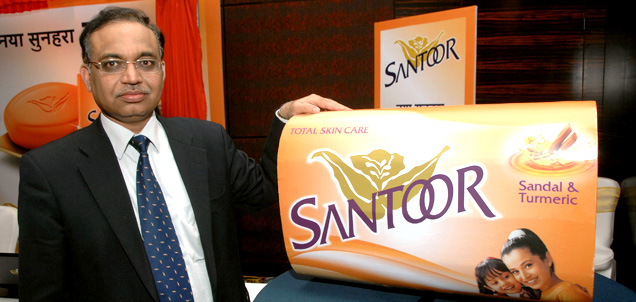
    Consistency in Communication: Anil Chugh, Senior VP, Wipro Consumer Care with a Santoor signage


    By Tuhina Anand


    Did you know that Santoor is the third largest soap brand in India? The brand, belonging to Wipro Consumer Care, has done well for itself by beating the international biggies and carving a niche for itself since it was launched in 1986. In the past 25 years, the run for the brand was not always so good, but a consistent and strategic communication has played a pivotal role in its success. Santoor is a Rs1,000 crore brand and has been growing at a CAGR of 23 per cent for the last five years.


    The communication has always focused on ‘younger looking skin’, but the portrayal has changed with the times to appeal women, who were earlier seen as homemakers to now those who excel in various professions – mirroring the changing aspirations of Indian women.


    Giving an insight into the Santoor story, Anil Chugh, Senior Vice President, Wipro Consumer Care, said: “Santoor is the third largest soap brand in India and the largest selling brand in the South + West India (value MS – 13.5 per cent). The ‘ageless skin’ campaigns and innovative marketing strategies have helped Santoor grow faster than the industry and gaining share over the years. One of the reasons for this is the consistency in communicating our core proposition of younger looking skin while keeping the message contemporary over the years. Also, our focus on providing the right value to the customer has contributed significantly to the brand’s success. The growth was also achieved on the back of a strong distribution network and communication in rural areas.”


    He added: “The strength of Santoor has been its promise which is consistent, powerful and eternally relevant to consumers. For over 25 years, the brand has delivered on the promise of ‘younger looking skin’ through superior product offerings which have used deep acting and trusted natural ingredients. Our campaigns have reinforced this message consistently. Over the years, Santoor has carefully chosen celebrities to endorse the brand and it has worked well for the brand.”


    While factors like distribution cannot be overlooked in the success of Santoor, the communication has been one of the key pillars. However, this was not the case always. MG Parameswaran, Executive Director & CEO, Draftfcb + Ulka elaborated: “When Ulka Advertising was assigned the brand in 1988, it was in a bit of a limbo, growth had stalled. The agency evolved the ‘younger looking skin’ and ‘mistaken identity’ as the key pillars for the brand. The advertising created history of sorts. The brand growth picked up momentum and Wipro has ensured that marketing money was well spent, through judicious correction in the messaging of the brand.”


    “In 1989, Santoor was basically selling in two states of Kerala and Karnataka. It was selling a fraction of what brands like Hamam, Rexona, Cinthol and Liril were selling. By focussing advertising on one promise and evolving it over time, Santoor has become one of the top three soap brands in the country.


    The advertising has evolved in many ways, but the core message of ‘natural ingredients for a young looking skin that will get you accolades’ has not changed. But the Santoor woman has evolved from being a pretty woman at a wedding to a confident woman who is doing aerobics, to a woman who plays cricket with her daughter, to a dress designer, to a TV anchor to a choreographer to a photographer. In a sense, the brand has reflected the aspirations of the new Indian woman,” added Mr Parameswaran.


    He is very clear that the success of its communication is purely because it tells a timeless story that always appeals. As he puts it succinctly, Santoor is about consistency in communication that adds a new layer with every new piece.


    In fact, as Santoor completes its 25 years, it has come out with a new campaign that is the Santoor anthem, giving it a contemporary look and feel yet telling the same story about a mother and daughter. The new advertising campaign features two ads – an anthem film that celebrates the achievement and pride of millions of Santoor women and a new theme film with new brand ambassadors – Saif Ali Khan and Mahesh Babu.


    Over the past few years, Santoor has grown from a single soap brand to talcs, deodorants, soap variants, liquid soap, facewash and so on. Mr Chugh said: “We will continue with our quest to keep the brand relevant and contemporary even in the future. The aim of new campaign is to take the Santoor brand to the ‘next level’. We are constantly looking at consumer needs and expanding/enhancing the brand to meet such needs. The brand has grown ahead of the competition in its core states and is now trying to break out of its traditional stronghold and make quick gains in other markets.”


    As a concluding note, Mr Parameswaran, who has been associated with the brand for almost two decades, said: “I am proud to have been associated with the brand for almost two decades. What is unique about the Santoor story is the great trust and regard this brand has spawned between the agency and client. It is has been a wonderfully rewarding experience and all of us in Draftfcb Ulka are proud of the association. It is not easy to take on large well-heeled multinational FMCG behemoths; we took them on and managed to find a place for Santoor under the Indian sun. The story is far from over. Santoor won against all odds and it will keep winning. I am sure of that.”


  • Indian adspends to see +8.7% growth in 2012: MPA study

    By A Correspondent


    Media ad sales will grow by 8.7 per cent in net terms this year, against the background of a slowing economy (~7 per cent real GDP growth versus historical range of 8-9 per cent) and the high first half of 2011 base last year resulting from the Cricket World Cup (which happens once in four years) plus an extended IPL season according to Media Partners Asia.


    The growth will be primarily driven by MNCs investing inIndiaand stronger MCG sector, and there could be upward revisions made in the second half of 2012. The outlook for advertising growth across key categories is mixed.


    Some of the highlights are:

    • FMCG 

    Media buyers expect robust growth from the FMCG sector, which is the largest advertising category, contributing 30-35 per cent to total ad spend. MNCs are expected to report robust numbers, while a few large MNC accounts (with annual ad budgets in the region of Rs2-3 billion) are looking to increase spends by 50-70 per cent for the coming year. Domestic FMCG companies are expected to see only marginal growth as the profits of these companies have deteriorated due to rising input costs.


    • Auto 

    Traditional companies such as Maruti and Hyundai have reduced their spends; but global car manufacturers investing inIndiaare driving the overall growth for the sector. As suggested in the recently held Auto Expo 2012, the sector will benefit this year from new launches in the two-wheeler and utility vehicle segments in subsequent quarters.


    • Life insurance

    The forecast is for a steady growth, a prevailing trend seen in this category since 2008. A reversal of interest rates will be the underlying factor influencing consumption and ad spend across sectors. The rising interest rate cycle seems to have peaked out. After raising interest rates by 13 times since March 2010, RBI (Reserve Bank ofIndia) may shift its approach towards the country’s monetary policy. Inflation is likely to fall considering the high base last year, and in order to bring the country’s economic growth back on track, the RBI is likely to reduce interest rates gradually in 2012. This will encourage investments and spending, in turn benefiting the ad market.

    Consumption demand has held up reasonably well though rural demand may be a concern, highlighted by a recent slowdown in sales of two wheelers and durables.


    Other key factors that will have an impact on the ad marker include:

    • Competition in Hindi GEC

    Competitive intensity in the Hindi GEC space is nothing new, though new competition is accelerating amongst second-tier channels. There has been a change in the pecking order of top three Hindi GECs, with Sony climbing up to the No. 2 spot while incumbent Zee TV has now slipped to No 4. Based on discussions with some of the major media buyers, the genre currently has limited supply of inventory, which should keep ad rates healthy.


    • Digitalization to create new niches

    Before the first phase of digitalization is implemented in June 2012 (it may be delayed to December 2012), broadcasters are already rolling out new niche channels in various genres like action and comedy. This will attract advertisers who are willing to target and segment their audience, not just from demographic but also psychographic parameters.


    • FDI in single-brand retail

    Opening up of FDI in single-brand retail (precursor to opening up multi-brand retail) will benefit regional print companies.


    • State elections

    In the near to medium term, print media will benefit from the upcoming closely contested elections to be held in five states: Uttar Pradesh, Uttarakhand, Punjab,Goaand Manipur.