Tag: DNA

  • Knives out. dna questions new IRS numbers

    By A Correspondent


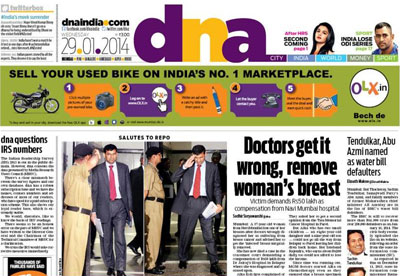
    Okay, it would be incorrect to suggest that a streetfight is on. But in what is decidedly not a common sight post the release of readership data, news daily dna, has put on a front-page unsigned note headlined: dna questions new IRS numbers.


    This is what the note says:

    “The Indian Readership Survey (IRS) 2013 is out in the public domain. However, dna contests the data presented by Media Research Users Council (MRUC).


    There’s a clear mismatch between the survey figures and our own database. dna has a robust subscription base and we have the names, contact numbers and addresses of most of our readers, who have opted for a paid subscription scheme. This also shows our loyal reader base, which is extremely stable.


    We would, therefore, like to know the basis of IRS’ readings. There seems to be an honest error on the part of MRUC and we have written to the Director-General and the Chairman of the Technical Committee of MRUC for a clarification.


    We trust the IRS would take corrective measures immediately”


    A senior media researcher who spoke to MxMIndia on anonymity said it was indeed unusual for a newspaper to frontpage its peeve on the readership numbers. “The stakes are high in a market like Mumbai, so dna could ill-afford a negative outlook.” But is the paper right in feeling aggrieved, we asked. “Everyone is right in feeling so. While there will be shifts in previous numbers when a research methodology changes, such a significant change is inexplicable.”


    Meanwhile, even though the fight hasn’t commenced, the knives are out for sure. And as we know from the past, the Zee group, of which dna is now an integral part, is known to put up a good fight.


  • Malcolm Mistry joins dna as CEO

    By A Correspondent


    The Zee group’s English daily dna has appointed Malcolm Mistry as CEO.


    Mr Mistry has over two decades of experience across the India Today and Indian Express groups. As Publishing Director at the former, he was responsible for the flagship India Today magazine and all its language avatars, Business Today and Readers Digest amongst others. In addition, he was the chief architect of the sales synergy process as he created a unified sales team across various brands. His last stint saw him turning entrepreneur and launching Ushta Te HR Consultancy Services to provide recruitment solutions across key verticals like media, advertising and luxury. The appointment, say industry observers, will be a boost to the sales function at dna which needed a ‘face’.


    Commenting on the appointment, Subhash Chandra, Chairman, Essel Group said: “We are delighted to have Malcolm on board. His extensive experience in leading strong media brands will help build on the momentum and navigate ‘dna’ into a phase of high growth.”


    On his new role, Mr Mistry said: “dna has strong brand equity. I am excited with the challenge of raising the bar and creating a more vibrant ‘print plus’ product with greater consumer traction and increased shareholder value.”


    dna is now part of the Zee Media Group which also comprises a slew of television channels and digital offerings. Dr Bhaskar Das, formerly President, Bennett, Coleman and Co and associated with several industry associations, is Group CEO. The position of CEO at dna has been vacant since K U Rao moved on to a Zee group firm and later exited the media conglomerate.


    In recent months dna has gone in for a new look, appointed an editor-in-chief and also undertaken an aggressive marketing campaign.


  • 10 on 10: Answers to The Sachin Tendulkar Quiz. Presented by dna + The 5 Prizewinners

    So here are the correct answers of’10 on 10′, the Sachin Tendulkar Quiz, that we carried yesterday (Nov 13). Set by Sorbojeet Chatterjee,  head of marketing at dna, a quiz addict and a huge Sachin fan.


    Here are the correct answers:

    1. When Sachin made his debut in Test Cricket against Pakistan – A cricketer was playing his 100th Test in the same match. Identify him?

    Answer: Kapil Dev


    2. Sachin wasn’t the first cricketer to score a double hundred in ODIs. Who achieved this feat before him?

    Answer: Belinda Clark (Australian Woman Cricketer)


    3. Tendulkar featured in which Bollywood film?

    Answer: Stumped


    4. Sachin was the first cricketer who was given out by the Third Umpire. A brilliant effort by which fielder resulted in his dismissal?

    Answer: Jonty Rhodes


    5. Sachin lost his father during the 1999 World Cup. He returned back to join the team and scored a century in the first match. Against which team?

    Answer: Kenya


    6. Tendulkar teamed up with Shoaib Akhtar and Brett Lee to promote which brand?

    Answer: TVS Victo


    7. Sachin was forced to open the innings in ODI when a regular opener got injured. Identify the opening batsman?

    Answer: Navjot Sidhu


    8. Against which team did Sachin play his last ODI?

    Answer: Pakistan


    9. Sachin has the highest number of 150+ scores in test matches. Whose record did he surpass

    Answer: Brian Lara


    10. Before attending the Wimbledon finals in 2012 Sachin had tweeted – “Just got fitted in my _____ suit. Feels like second skin”. Identify the brand?

    Answer: Savile Row


    And here are the winners (and the last four digits of their cellphones):


    1. Nidhi Pandey

    Last 4 digits of cellphone: xxxxxx1877


    2. Ravish Manchanda

    Last 4 digits of cellphone: xxxxxx5260


    3. Rakesh Sharma

    Last 4 digits of cellphone: xxxxxx4228


    4. Ananya Tiwari

    Last 4 digits of cellphone: xxxxxx1715


    5.Vivek Vijay

    Last 4 digits of cellphone: xxxxxx6275


    We will write to each of the winners individually and let them know from where they can collect their prizes.


  • dna kicks off campaign to promote celeb columns

    By A Correspondent


    To coincide with a power list of celebrity columnists that the After Hrs section of dna will carry from Monday, October 14, a 360-degree marketing campaign with the theme – “Meet Our New Joinees” has been initiated print, television, digital and out of home media.


    Other than Shah Rukh Khan, the list of columnists include: Twinkle Khanna, Suhel Seth, Sandeep Khosla, Superna Motwane, Ashiesh Shah, Kinita Kadakia Patel and satirist Khamba.


  • dna to evangelise governance with 500+ multi-lingual social platforms

    By  A Correspondent


    Zee Media’s dna has launched ‘I Am IN – dna of India’, an ambitious technology-driven initiative, that promises to “enlighten, engage and empower citizens of India in getting involved in  the cause for better governance”. It gives power to the people to be vocal about local issues, to report news, connect with governance representatives and like-minded fellow citizens and more by way of a multilingual, hyperlocal, pan-India digital platform that will encompass over 500 local circles and neighbourhoods across the country over the next few months, notes a communique.


    Said ZEE Media Corp chairman Subhash Chandra: “We keep complaining about India, we keep saying we don’t know what to do and how to do it. We try to look at the big picture, not realising that it is made up of smaller problems. Solve the smaller problems and the big problem will be solved.  The change in India has to be ground up, and with the launch of “I am In – dna of India” we hope that can be achieved, enabled by technology and powered by the desire of 1.2 billion plus Indians who want a better tomorrow.


    Dr Bhaskar Das, Group CEO, Zee Media added: “The power of hundreds of hyperlocal networks, each made of thousands of people, all of who act in a focused manner to improve their locality can surely bring the much needed qualitative change in our country. ”


    The hunt to find volunteers for around 200 localities / neighbourhoods that the platform is launching with, has already begun.


  • Guest Column: Newspaper archives would be morgues if news would die

    By Anita Pujari


    It was my first day at work at the nation’s biggest newspaper house. I could hardly suppress my eagerness to see the famed old lady who had set sail in 1838 and had meandered into homes and lives across the country like no one else had. I expected to find the historic first issue befittingly holding pride of place in the Archives, probably in a temperature-controlled vault, safe and secure from man and nature.


    I was stunned to find that no one knew where it was and no one particularly cared. It was going to be six months of playing Sherlock before I prised out from beneath mounds of newspaper bound volumes, this solid paper box, boxes in fact with those priceless original copies of what everyone knows as The Times of India the name which came about much later in 1861. At birth on November 3, 1838 the name was The Bombay Times & Journal of Commerce. The bi-weekly at Rs 30 per year turned daily in 1850. The history of the newspaper is what legends are made of and one could safely say that ensconced in the pages of this longest running chronicle lies the history of India.


    Did I say history of India? I’ll add a rider – not chronicled always as it really happened. I will never forget the week spent going through the TOI of April 14, 1919 to a few days beyond. The issues had been preserved on microfilm and it was easy to roll from page to page, enlarging the tiny text and looking for Jalianwalla Bagh massacre (April 13, 1919) for a visiting researcher who had not found it. How could there be no coverage of the incident? We found it eventually – less than 100 words, lost amongst the other national news, saying there had been an incident of rioting in a public garden in Amritsar (!).


    In talking about newspaper libraries, one often comes up against the metaphor of the “newspaper morgue.”  I have often wondered on this choice of word and who or what led to its global usage. Was it apathy or lack of vision or perhaps both? As I see it, newspaper archives must have existed since the newspaper itself. Unless an effort was made to save a copy and put it into safe custody (the erstwhile morgue), the day’s edition would have been truly a ‘has been’ like its ephemeral nature.  This effort by publishing houses the world over to build and maintain an archive of what is said to be “a chronicle of the times we live in” has ensured that the history and socio-political-economic development of people, thoughts, events, and nations did not get lost. This primary information rarely if ever gets into books that one could easily buy or borrow. If not collated and preserved, the news happenings around the world would be lost for good.


    Several nations have their National Library as the depository (compulsory deposit of every issue of newspaper, book published) and the archive (ensuring preservation and access) of what is considered the nation’s heritage. Where nations failed, newspaper publishers have stepped in to preserve and share their news archives. The British Library’s newspaper collection comprises 52,000 titles from all over the world, dating back to the 16th century and is housed on nearly 50,000 km of shelving.  The National Library of Australia has a collaborative programme named Australian Newspapers Digitization Program (ANDP) digitising historic Australian newspapers published between 1803 and 1954 and making them available online. It uses Web 2.0 technology and is truly innovative and unique as it allows users to interact, contribute and add value to the newspaper content – tag, add comments and correct the electronic translated text


    Storage and access of newspaper archives has been a problem with every collection which was partly addressed by preserving on microfilm – high on long term integrity but low on search and retrieval, and in recent times as Digital Archives – high on ease of retrieval and dissemination but plagued with technology obsolescence issues. A mix is ideal if you have the budget.


    Having handled print, microfilm and digital archives, I can say that news research is medium-agnostic and has much to do with the archivist’s research skills and passion to find answers. Every newspaper house that has a Library/Archive would have a recollection of a person/s who made that difference and added that value to the business of newspaper production. Mr Roy of Anand Bazaar Patrika, Ram Kolhatkar of The Times of India archives, and many others that scribes would remember.


    News clippings, the most important source of reference and research in a news library at one time has been replaced now by Digital Archives, but the key to search and retrieval is still the indexing or in digital parlance – metadata. Else it will be as exhausting as Google. I often joke with my editorial colleagues that Google is not just exhaustive but exhausting – whether you admit it or not you rarely go beyond five pages of results and that’s when you are the diligent kind. What gets served therein rarely gets checked on authenticity let alone authoritativeness. How many bother about corroboration. Wikipedia has become the first and last stop for research, oblivious to its basic tenet of freely editable information. This makes it all the more critical for a newspaper house to develop and maintain its own authoritative and wholesome Archive and professional researchers.


    A newspaper archive is an important repository of the history of the paper’s interaction with its community. It is also a reflection of the changing mores of the community and society as a whole. I have seen research studies on umpteen anthropological issues get addressed from the archives of newspapers. Say the matrimonial columns over the decades – terrific insights on values, religion-caste, education, aspirations. Interesting study when ads by parents started getting replaced by ads by the groom/bride and how tone and tenor of expectations changed.


    Advertisements – the ever-changing creative sphere of communication between seller and buyer. Tracing back advertisements by say HLL, LIC, the colas or film releases through newspaper archives is like looking into a treasure trove and coming up trumps. You would be surprised to know that in the newspapers of yore, the front page was fully advertisements. Anything from a hat to a horse carriage found ad space. The creatives make for delightful reading of commerce in the 1800s and 1900s.


    I remember a particularly impressive exhibition held by the Delhi Public Library to celebrate their 60th anniversary in 2010. They called it – The Newseum – a unique display of their newspaper archives, presenting a visual history of Hindi & English newspaper advertisements since 1951 as well as memorable photographs, cartoons, articles giving a telling insight on those decades.


    At a conference held in February 2013 by the Association of Media Libraries and Archives (AMLA), a young research student of JNU Library shared his work on creating an Archive of Indian Newspaper Cartoons as a resource-base for socio-political economic research.


    So are archives and archivists important in the media industry? Yes, of course, and more so in the days of unauthenticated internet content and with the advent of a Digital Archives Management System (DAMS). Add to that the instantaneous needs of 24×7 news delivery and new media. Morgue? It is time for a new metaphor, perhaps.


    Anita Pujari was until recently Vice-President, Research Archives & Syndication at DNA and Head- Archives and Syndication of the Zee News cluster. She was head of the archives at The Times of India group


  • dna on do-good mode, launches brand campaign

    By A Correspondent


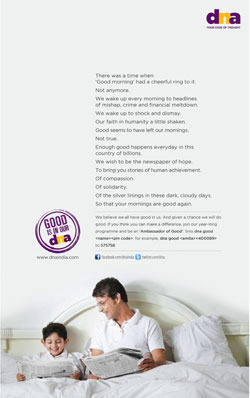
    English daily DNA (now written in lower-case – dna) has unveiled a new brand campaign – ‘Good is in our dna’.


    The attempt is to offer an all-year programme that will connect with good samaritans and provide citizens with a platform to contribute and spread the ‘good’ cheer. The campaign has been conceptualized and designed by Infectious, the ad agency set up in April this year by former Saatchi & Saatchi honchos Ramanuj Shastry and Nisha Singhania.


    Sorbojeet Chatterjee

    Said Sorbojeet Chatterjee, Senior Vice President – Marketing, dna: “This is a start to try and put the good back in the mornings. While, as a responsible newspaper we need to cover everything taking place around us, we plan to focus on the positive stories of human achievement and courage. The campaign has kickstarted with readers being able to sign up as Ambassadors of Good and the response has been overwhelming.”


    Ramanuj Shastry, Director – Infectious added: “In a day and age where we are surrounded by negative stories there is a desperate need for some good news. The people of our country need hope and something positive to start their day on. And who better than a media brand like dna who can not only give us the good news but also mobilise the people in our country to do some good.”


    The campaign will see an extensive use of print (naturally!), outdoor and radio. “Unlike a typical campaign that just looks at a spike, this is a year-round plan with a lot of editorial integration and reader engagement,” said Mr Chatterjee. And will we see any activations? “There will be one tent-pole activation every month which will see readers participate for a noble cause.”


    The first leg of the campaign has invited readers to sign up as “Ambassadors of Good”, and the response has been overwhelming, informed Mr Chatterjee.


    dna has been on an aggressive advertising campaign ever since its relaunch in April. The first two brand campaigns were done by the publication’s creative agency Genesis which continues to be the primary creative agency. A recent campaign for the graphic novel series that has been introduced in the paper was executed by an inhouse creative team.


  • DNA launches Augmented Reality application

    By A Correspondent


    English daily DNA has launched an augmented reality application (‘DNA It’) to further enhance the reader experience. Most of the important stories are supported with multimedia features including video playback, audio transcripts, image galleries, related web articles, etc.


    DNA Editor Ravi Joshi said, “In today’s age when the young urbanite prefers to Google it, Tweet it and even WhatsApp it, we give our readers an opportunity to DNA it. The ethos of the new paper is to ensure that the connect between DNA and readers is no longer a one-way street. Interactivity is the only way forward and we are taking multiple steps to remain the most vibrant newspaper product. The response has indeed been overwhelming.”


    The ‘DNA It’ app can be downloaded from the App Store for Apple and Android devices. Readers can also download it from www.dnaindia.com/apps. The entire application and the technological backbone has been built by Prisma Global.


    Amitabh Roy Chowdhury, Executive Director & COO of Prisma Global, said, “This unique technology provides an excellent opportunity to amalgamate the print media with the mobile digital world, thereby providing relevant, timely, handy and augmented information to increasingly discerning readers. For today’s increasingly info-hungry, Google-addicted generation, this app whets their appetite for augmenting real news with add-ons in the palm of their hands.”


  • Is there room for DNA in Delhi and Mail Today in Mumbai?


    By Ananya Saha


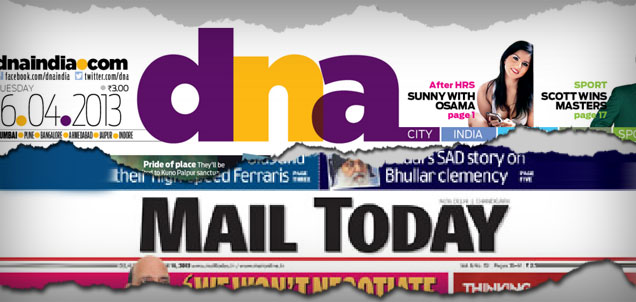
    Mumbai-based DNA is reportedly galloping ahead towards the capital. Launched on July 30, 2005, in Mumbai, DNA (short for Daily News & Analysis) is an English broadsheet daily owned by Diligent Media Corporation, now an Essel Group company. With presence in Mumbai, Bangalore, Pune, Ahmedabad, Jaipur and Indore, the recently refreshed daily is scheduled to be in Delhi on May 13. While NCR is seen as a battleground for the English heavyweights Times of India and Hindustan Times, many English dailies do not boast of good readership numbers in this market. Does the Delhi market need yet another English daily?

     

    Sundeep Nagpal

    “I don’t think there is too much room for another English daily in Delhi, at least in terms of readership,” says Sundeep Nagpal, Founder-Director of Stratagem Media, an independent media agency. “The English daily readership as a category, went up by about 5% around the turn of the last decade, but it’s back to the level that it was at, in 2008. However, what seems to be happening in most major markets, is that they seem to be able to absorb additional circulation to some extent. So, basically this suggests fragmentation,” Mr Nagpal adds.


    Anwesh Bose, Senior Vice President- Media, DDB Mudra is of the view that DNA is launching Delhi more with an image perspective in mind than revenues, for now. “With the Delhi launch they would be able to call themselves a national daily, finally,” he said. DNA has plans to eventually be present in all the four metros, and then launch its financial daily too in these markets. The Ahmedabad, Jaipur and Indore editions are franchised to the Dainik Bhaskar group, formerly joint venture partner of Zee in Diligent Media.

     

    Anwesh Bose

    But to capture readers and advertisers in Delhi, DNA would have to be aggressive in its positioning, and promotions, and adopt a push and pull strategy. As Mr Nagpal viewed it, DNA will have to create a market of its own and that would mostly happen in terms of a share of time spent on reading, and not as much in terms of new readers. Meanwhile, DNA has firmed up its team in Delhi with senior journalist Saikat Datta being appointed as the Resident Editor.


    Mr Bose said, “DNA would have to step into Delhi with deep pockets as they need to sustain for a long period of time before they can see profitability. Their strategy ideally should be of first of all establishing themselves as a brand that stands for something.” The new daily, according to him would have to come up with interesting ways of increasing their circulation, since the old methods of free gifting on long-term subscription does not hold any value anymore.


    While DNA is planning to enter Delhi, the capital’s compact daily newspaper – Mail Today – is getting set for a Mumbai launch this year. Mumbai has seen a reasonable healthy growth of 40 percent in readership of English dailies over the last six years, whereas Delhi has been at about 18 percent only, vis-a-vis 2005, asserts Mr Nagpal.


    Having launched in Chandigarh recently, Mail Today will have to compete with Mid-Day and Mumbai Mirror in Mumbai.
     

    AS Raghunath

    AS Raghunath, a senior print media brand consultant based in the capital, is of the view that Mail Today will be able to carve the niche in Mumbai. He said, “The Chandigarh and Delhi editions of Mail Today usually have a front ad jacket. So they do have a permanent source of revenue. Content-wise, Mail Today is a mixed bag and carries an ‘exclusive’, usually every day, which no other daily has. Even Twitter and Facebook communities quote Mail Today. Also, given the fact that Mumbai is a multi-newspaper market with English, Hindi, Telugu, Tamil, Gujarati dailies and publications, I am sure Mail Today will be able to carve a niche for itself.” He further added that while size will not be a challenge for Mail Today, any daily going in Mumbai would probably not add numerically to the market.


    On Mail Today’s stint in Delhi, Mr Bose remarked, “Mail Today is by no measure a success in Delhi… although, they have tried their best. It is bought more on relationship with the India Today Group than because of its content differentiation.” Mr Nagpal concurs that for a large cross-section of advertisers, Mail Today did not offer a unique/significant enough benefit.


    According to Mr Nagpal, “Mumbai Mirror (MM) has been able to create a huge dent in the market”. “It has stalled other competitors right where they were in their tracks and even eaten away their share considerably over the last five years, so I think MM is quite a success. But that does not mean that every new tabloid will do as well” he added. Mr Bose, however, holds a different view. He said, “Even with the might of TOI behind it, Mumbai Mirror could not make a huge dent, therefore it will be an uphill task for Mail Today to achieve success.” Mr Nagpal is of the view that Mumbai ought to be an easier market for Mail Today, for a whole lot of other reasons such as being more cosmopolitan, more adaptable, etc.


    The advertisers, obviously, would watch with interest as to the direction in which each of these publications grow in the respective markets. “It is sure that a lot of advertisers would get free space or space at a very marginal cost to begin with as the publications would want the advertisers to sample their product as well as it becomes a talking point with other advertisers for the publication. Also, there would be a lot of freebies during the circulation drive, so the consumer is going to make merry,” opined Mr Bose.


    Success or not, only time will tell. But it is sure a sign of healthy growth for the print sector. As Mr Bose concluded, “Print has seen a growth in 2012, where it grew by 9 percent compared to 2011. This year print would gain more as a lot of TV-friendly categories have shown interest in print, primarily to drive sales in a period of slowdown.”
     

  • DNA to launch Delhi edition on May 13


    By A Correspondent


    The six-edition Daily News & Analysis (DNA) is set to launch an edition in Delhi on Monday, May 13.


    May 13 is also Akshay Trittiya, a day normally considered auspicious for starting new projects or buying gold, automobiles or property. The editorial team at DNA is in place with Saikat Datta as Resident Editor. An aggressive marketing plan is scheduled give the newspaper prominence in a market dominated by Hindustan Times and The Times of India.


    In the last quarter, under the leadership of Dr Bhaskar Das, group CEO, News Cluster, DNA has gone in for a new look – in the paper as well as in the team bringing it out and running the company. The subscription offer has been withdrawn and the emphasis is on profitability without compromising on editorial quality.


    DNA is now owned and managed by the Zee group. With the Delhi launch, the newspaper will have editions in seven centres. Currently, while Mumbai, Bengaluru and Pune are managed by DNA, the Ahmedabad, Jaipur and Indore editions have been franchised to the Dainik Bhaskar group, which co-owned the paper until a few years back. The Delhi edition will be managed by the Zee-owned DNA.


  • Ranjona Banerji: Can DNA get back into your dna?

    By Ranjona Banerji


    The most welcome aspect of today’s news is the return of the edit page to DNA. The page was done away with a couple of years ago but returns – together with a re-design – in the April 2, 2013 edition of the newspaper.


    Rumours suggest that it was the arrival of new CEO Bhaskar Das which brought the edit page back but there is no way of confirming that and it could well be a decision taken by the new editorial dispensation – one of the many which DNA has had in its lifespan of almost eight years. Either way, the prognosis is positive.


    The edit page is called ‘dna of thought’ – a clear tip of the hat to the domination of the internet and its language, as is evident in ‘dna of mumbai’ and so on. There are two leaders – as is the trend these days – and two columns. Or, that is, it is too early to tell whether the lead article will be an analysis on current affairs rather than a comment as it is now. Cartoonist Manjul is the lead on the edit page with his ‘Politickle’ comment. A section called ‘net pickings’ presents snapshots of columns and opinions from around the world and there’s the mandatory nod to ‘positive thinking’, usually beloved of newspaper owners who feel or are told by their friends and family that their “products” are too negative.


    On the whole, the return to the edit page is an excellent decision. It anchors the newspaper and makes its own viewpoint clear to the reader. In fact, the second edit the welcoming the IPL is a refreshing change from all the usual fake breast-beating that this cricket tournament brings. (Also ironic, as IPL was verboten in DNA for first season because the then part-owner of DNA had started the Indian Cricket League!) As to why DNA stopped the edit page, those interested in history can look back at a discussion at the Mumbai Press Club which was organised by exchange4media when mxmindia.com founder-editor Pradyuman Maheshwari was editor there:

    http://www.exchange4media.com/40971_edit-page-gone-with-the-winds-of-change.html


    As far as the whole paper is concerned, the design will take some getting used to. Every DNA page always had too many elements in my opinion – a complaint I made even when I worked there – and now that has been compounded by a plethora of fonts. However, I also find Hindustan Times to be a bit cluttered as far as design goes and I have got used to that. DNA is clearly looking to blend with the digital media as well as with up the branding quotient – the DNA name is repeated in various forms through the newspaper. The concept of a large front page photograph is great – if they stick to it.


    I rather like the gimmick of having the old style on the front page which then reveals the new look as you turn the page and get a letter from the editor. It says, among other things, “…we have made the new paper more navigable, readable and classier”. The website is also going to be more “responsive” which means all that phone-tablet stuff.
    There are few questions for the newspaper. DNA was once the second-read paper in the city of Mumbai by a pretty good margin, until it lost that advantage to Hindustan Times. Will this design help to regain its status or is it just window dressing? The content has not so far changed and unless that improves no design can save you. And how do you re-engage with readers who have moved on from you?


    DNA has many challenges ahead. One can only hope for the sake of the industry that it will find a way to fight an effective battle.

    I have to confess here at the end that I worked for DNA for some years, soon after it was launched. Most of that, as it happens, on the edit page!


  • DNA dons new look, brings back edit page

    By A Correspondent


    The six-edition English newspaper DNA, is sporting a new look from today. The newspaper has added the edit page and an oped page as well. Along with the newspaper, the website has also gone in for an overhaul.


    Informing the readers of the changes, Ravi S Joshi, Editor, DNA wrote in his communique, “Starting today, your DNA has changed. Because your needs and aspirations have changed. Because your reading habits have changed. Because you have changed. To address that change, we have made the new paper more navigable, readable and classier.” The redesign has been done inhouse by Design Editor Nitin Tuse


    He further added, “In our quest for the 2020 of news media, we’ve redesigned our website and made it responsive – it dynamically fits to screen of any device, be it your PC, phone or phablet. That’s a first for any newspaper website in India is also dynamic. And in the days to come, you’ll see a lot of innovations not only in the website, but also in the paper.”


    A readers’ page also also been added. With an aim to become more interactive, the stories in the newspaper would give out Twitter handles. DNA has also formed a Shadow Editorial Board, which is “college-going men and women regularly sit in our newsroom and tell us what they want us to do. You’ll find their contribution to this paper on Page 4.”