Tag: DNA

  • Ready, Steady, Melt!


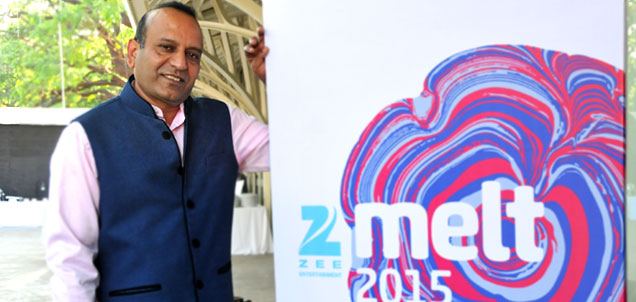
    Last year, Rajesh Kejriwal, Founder and CEO of Kyoorius, created waves with the slickly produced and D&AD-backed Kyoorius Advertising and Digital Awards. This year, he has extended the offering to a two-day festival called Melt to be held in Mumbai on May 21 and 22. Not unexpectedly, comparisons are being made with Goafest, the three-day event organised by the Advertising Agencies Association of India and the Advertising Club. In a freewheeling interview with Pradyuman Maheshwari, Kejriwal takes pains to explain that there is no rivalry between the two. In fact, as he says, he created his events out of a desire to stimulate and encourage youngsters in the profession. Read on…


    A day to go for the inaugural Melt… your thoughts? All set?

    As set as one can be a day or two before the event. There always will be challenges but there are no hurdles or any real surprises, and that is a good thing.


    Are you satisfied with the way things are going? The speakers, the arrangements, the registrations?

    Very satisfied with the speaker list and topics being covered, satisfied with the arrangements, just about satisfied with the registrations in the inaugural event.


    You appear determined to take on the folks at the AAAI and Ad Club. Last year, you organised the Kyoorius Awards and this year, there’s Melt.

    There are two ways to look at this. First, I think the media is actually pitching us as competitors much more than we ourselves are doing. I don’t think there is any direct competition between the Goafest, Abby or Kyoorius, whether it’s Melt or the awards. I don’t even think the industry says it’s either this or that, except may be to those who have a slight budget constraint.


    Everybody has a budget constraint.

    But I’m painting a larger picture here. I don’t think it should be either/or. Goafest does what it needs to do, and we’re doing what we need to do. We’re exploring gaps that exist in the industry, especially for young people.  I’m not saying an advertising award itself was a gap that we’re filling; it was simply a space that allowed us to do something to stimulate the industry, and we did it. It wasn’t to say, ‘hey Goafest is doing badly so let’s do something’. I don’t think Goafest is doing badly. They need to tweak some things and it can come back on track. Like any other country with multiple festivals and award shows, India too can have that. What clearly needs to be defined is, can we make sure that these two festivals are positioned differently? As I mentioned last year, we are more of a critics’ event, while they are more popular. They have a gold-silver-bronze structure, while we have a certain standard that we maintain, and all the best works win. So there might be nine winners in a category, or none at all; it doesn’t matter. There’s a difference in how they view things and how we do, and that difference works for the industry too.


    Secondly, if you look at Melt, I don’t think this model exists anywhere in the world except perhaps with something similar at Cannes Lions. Cannes is obviously much bigger, more popular and with much more of everything. Melt, I would say, is a unique convergence of five segments — marketing, media, advertising, digital and emerging technologies. Other conferences have more straightforward sessions. People [in our industry] have a lot of questions but there are no ready answers. Nor are the possible answers all black-and-white, but more in shades of grey. Melt offers everybody an opportunity to look at these shades of grey critically.


    Let’s talk about the difference in the awards. First, you mentioned that one is a Critics’ Award, while the other is a Mass Awards event. But the entrants for both these awards are almost the same – it’s the same agencies

    I agree.


    Hence the thing of competition, because you’ll are catering to the same set of entrants…

    At the end of the day, I also compete with Cannes; with D&AD globally; with One Show, Clio, Adfest, all of them, because all the money an agency can provide, comes out of only one budget, right? As for Goafest and us, I agree that the universe is the same. The difference is, for instance, between having international and Indian jury members. We have an open jury system. We have an awards night which brings creativity and production qualities into the awards night itself. So there are a lot of differentiating ways in which we do things and those are what we think can stimulate the industry. There must be something beyond winning which motivates an agency.


    But you’ve still not been able to convince Lowe to participate.

    Last year was the first year. So if in our first year we’ve been able to convince and get 1,000 entries, I think that’s a great first year. Maybe Lowe will come in this year, or maybe they’ll come next year.


    You had Arun Iyer on the jury

    Yes, Arun was on the jury, but that has got nothing to do with the fact that we want him to participate.


    Maska?

    No maska.


    Give us more on Melt? Was the idea to first organise an awards event last year, impress the world, and give people something to talk about?

    I don’t think Kyoorius, at any point in time, does anything to impress the world. I think the larger goal is to impress the people from a content curation perspective, not grandeur perspective. I think what really kicked off this whole aspect of Melt was an internal discussion. We were talking to a few people, and a few of them said, ‘Next time make it bigger and better’. So my first question to them was, if you’re asking us to make it better, can you please tell me what was wrong with last year? Better usually means there was something wrong, otherwise why make it better? And when people say make it bigger, does that mean I look for an 80,000 square-foot space instead of 60,000, or do I use a larger LED screen? I think for me the more meaningful words were, can we make it more relevant to the industry?  Can we help fill a gap, especially for youngsters in the industry that can help them in their professional life? And can we bring the industry together in some way that celebrates creativity? So Melt, for us, is a festival of creativity.


    Are you saying that all this doesn’t exist in Goafest, hence, the gap?

    I’m not saying there’s a gap. I don’t think it exists in Goafest to the extent that we are doing it. Also Goafest happens in Goa, this is in Mumbai, and so more inclusive. I think Goafest also does not have the unique convergence of the five segments that I’m talking about, with something happening for all of these five people at the same time in parallel sessions. So we have workshops, debate sessions, discussions, conferences, installations, interactive Q&A sessions and such. We probably will have a showcase area and are looking at having what we call on-the-flow. People in the audience could think of a subject, go to a room and inform that they’re going to have this discussion in the hall, and invite anyone interested, to join them.


    What I’m trying to say is this unique convergence of marketing, media, advertising, digital and emerging technologies — nothing like this is happening in India.


    Do you think somewhere associating yourself with media houses could mean that other media companies may not embrace your event. Because once you are associated with a big player, the others just ignore you. For instance, when a Filmfare Awards happens, a Screen does not report about it, and vice versa.

    Which is sad.


    Which is sad, but don’t you think that will alienate the others from Melt?

    If you’re looking at it from a sponsor’s perspective, may be yes. But as a rule, Kyoorius does not take on sponsors from the same industry any way. We are very clear that if we take a sponsor from one industry, we normally and we’ve been able to maintain that so far, we do not take on another sponsor from the same industry. It makes no sense.


    So you’re not worried about The Times of India group not doing anything about Kyoorius?

    Editorially, the event is open to everyone. It’s not restricted to anybody. So if HT is my partner, editorially they have no exclusivity. None of them have exclusivity, editorially, nor do any of them have any preference, editorially.


    But since Zee is the principal partner and it has its name prefixed to Melt, do you think you’ll have a situation where Star will not participate as wholeheartedly, may not send a busload of people for it as it would have otherwise done, if it was neutral.

    I don’t think Star is narrow-minded. Zee also sponsors our Designyatra, Zee is our principal sponsor and we get our largest delegation from Star.


    Yeah, but Designyatra is different. Melt concerns the advertising agencies which is the big bad world, which is where all the negatives exist.

    So Melt is not specific to advertising. Melt is at the intersection of marketing, advertising, media, digital…


    Changing tracks, how do things work. For instance, is Zee Mindspace being organised by Zee or are you doing it for them?

    We, together with the Zee team, are helping in curation of what Zee is doing, which is the Mindspace conference. So Mindspace is happening at Melt, but it is Zee’s property. We are helping in the curation of speakers.


    In case of a dispute, who takes the final call?

    We argue it out  and a decision is taken. But we are very clear that Melt cannot be a platform where the content is not right for the audience. In terms of content for that audience, we take the final call.


    So, what if a partner decides to get a certain speaker or a certain panel and you say sorry, that doesn’t work…

    No, it doesn’t work that way. We’ve had one partner who said no, I’m willing to come on board and I want this hall blocked for half a day to conduct a session. We didn’t feel it was right for the audience since it was more of a sales speech for their own business. So we didn’t accept it.


    Was this partner paying you?

    Yes.


    And you didn’t take it?

    We didn’t take it.


    I thought you were a smart Marwari businessman?

    I am, but I have to look at it long-term, because if people are not happy about something, I will have a problem next year. I’d rather have a problem this year than have one next year.


    I’ve also heard stories where you’ve had partners or sponsors wanting a speaker slot and you said no. You told another partner that its logo wasn’t creative enough and such. How do you manage to get away with all of this?

    I don’t think it’s a matter of getting away with it. It’s a matter of convincing the other person that what we’re trying to tell you, is good for you. Designyatra is a design conference, Melt is a creative conference. You cannot tamper with the overall look-and-feel visually. It’s a creative conference and if you mess up your own creative output, you’ll become a big joke.


    But creativity is subjective right? What seems creative to you could appear tacky to somebody else. How do you manage to convince others about that?

    The convincing point has to do with how I can make sure you get the value that you want to out of this event. Am I making sure you’re seen at all the right places? I can make your logo smaller or bigger and make sure that people engage with your brand in different ways.


    Sirji, last year at the Kyoorius Awards, even though Colors was the sponsor, it did not even get any standees…

    Oh, come on! There were standees outside.


    Shouldn’t they have been inside the hall?

    There were screens inside with the branding. The standees mess up the décor.


    But aren’t all these things a given in sponsorship deals?

    And how much does this spoil the décor of the place? You go to an event, you’ll see some 10 standees on one side in small hall and 10 standees on another side. These are creative awards and you can’t not be creative about your own place. You mess it up because you have 10 sponsors, five from the same industry, all wanting their standees.


    And we don’t allow them to bring their own standees, we ask them to send the art work, we print the standees. We make sure that all standees are of uniform size and placed in a way that catches the eyes of everybody who walks in, but not by making it like 40 standees. Even four standees can do the same job, you just have to be creative about it.


    It appears you’ve managed to convince people about it.

    Yeah.


    By the end of the day, repeat sponsors is an indicator of the fact that they are getting their RoI.

    We’ve always had repeat sponsors. I haven’t seen any time any of my sponsors walk away with a minimum of two years, but mostly all have been there for three years.


    Back to Melt, if I were to attend it on May 21 and 22, what would be my takeaways?

    First, irrespective of whether you’re from a creative or planning background, there is something or the other happening that you can attend. At Melt, we have four pillars — learning, showcase, celebration and networking. We are curating things around these four pillars so that you are able to have exposure to all of these four pillars during your time at Melt. You should feel, at the end of either the first or the second day that the event was worth your while.


    Will Melt move to other cities or will it stay in Mumbai?

    One of the reasons we didn’t call it Mumbai Fest or something is that we don’t want to tie it down to any one city. For instance, it could go to Delhi next year,. I think for us, the two good locations are Mumbai and Delhi. There’s a huge gap in the way events happen in Delhi. There’s nothing happening in Delhi largely, so we are looking at either taking Melt to Delhi next year, or alternatively, doing another version of Melt in Delhi after six months. It may not be as large as what we are doing here, but will be similar.


    There is much anticipation and expectations from Melt. Is that a good position to be in or are you worried about meeting all the expectations?

    I think it’s a position that one always should be in and that becomes the driver to ensure that you meet as much as possible the expectations of the audience. One cannot satisfy 100% of the people 100% of the time but if the majority of the audience come back saying that they benefitted from being at Melt, we would have achieved our expectations. And for the reminder – thats feedback and we learn more from this and be better the next time around.


    Does the absence of some key agencies or decision of some adpersons to stay away upset you?

    In the larger scheme of things: not really. The industry is not defined by agencies – rather by the talent. This is our focus. However looking at how the future globally is going to be built on co-creation, co-existence, collaboration, etc – then yes to certain extent – our objective is to be inclusive and we’re sure to work with them and have them with us in the near future. The fundamental question one should ask always with programmes and initiatives like this is: Is it Good for the Industry? And I’m sure the answer is a resounding yes.


    A word to those who are undecided and can still register on what they can expect?

    There is a fear in the minds of the people in the marketing communication industry today – am I still relevant? The marketing communication industry is changing furiously and those who do not keep in touch with the changing landscape will face issues where the application of their particular skills can become redundant. Melt helps answers the big question to all stakeholders. Given this, I would say that it’s essential to be in touch with what is relevant today and that means – Be At Melt!


    A much shorter version of this appeared in dna of brands on April 27. This interview has been updated with a fresh set of questions asked yesterday (May 19)


  • Sanjeev Kotnala: 8 ways Indian Media & Entertainment undermines women

    By Sanjeev Kotnala


    It was Women’s Day on Sunday and there were celebrations across our world for women. Every one of the events organised to commemorate the day screamed: “You are a lesser being, but this is the one day we will allow you to be you.” But only as per our ideas and standards.


    I write this when, in Mahrashtra, ‘beef’ is a worse four-letter word than rape. When the government stops you from viewing documentary films like India’s Daughter. Nowadays, we see many topical and tactical campaigns around women’s empowerment, safety and protection. But most of these are driven by commercial or brand advantage, than real intent.


    At every step, we tell women about their place in society. We remind them why instead of having a week, a month or even a year of equality, why they can only have just one day, on March 8.


    The media, advertising and entertainment industries play a big role in creating and perpetuating this sorry state of affairs. It is good that they are trying to make amends for this, but for now it appears that it’s all still lip-service. Here are eight ways in which these sectors have contributed to this situation


    1. Creating women stereotypes: In process, cleverly establishing stereotypes within various relationships

    2. Exploiting women’s bodies as the biggest-known sales and advertising prop in the business.

    3. Showing women as scheming and crooked on Indian television, in the roles of the mother-in-law, sisters-in law, the wife etc

    4. Creating the perpetual ‘paranormal’ bait. In case you haven’t noticed, it is always a woman who appears possessed. Oh, and this has nothing to do with the increased opportunities for skin show

    5. Promoting and glamourising unwarranted ‘item girl’ songs in films. Besides, the ‘item number’ is no longer the preserve of the vamp, but is now part of the territory of the mannequin-like heroines.

    6. Creating that ‘penny-wise pound-foolish’ Discount Queen image of homemakers who get drawn to ‘50% off’ sales tags.

    7. Creating media hype and sensationalising women-centric stories only to discard them when they hit the decreasing marginal commercial curve. The media industry has often been guilty of not seeing these through to their logical end.

    8. Awards felicitating women achievers are often created as a separate category. This is a reflection of the reality that as men, we remind women that we are superior and you have no chance of competing with us. Have you ever heard of a women-only jury selecting male achievers?


    If all of us decide that instead of talking global we will act local on this issue, taking it right into our micro-social environment. We will celebrate, respect, support and promote women throughout the year in their own right, and not as defined by some relationship to us. If we can do this, we will have won the right to celebrate women’s day as it should be done.


    Sanjeev Kotnala is a leading management, marketing and brand consultant is Head Catalyst at Intradia. He can be reached via Twitter at @s_kotnala. A version of this view first appeared in ‘dna of brands’ dated March 9.


  • Digital awaits breakthrough: Shashi Sinha


    Twenty-fourteen will be remembered for long because of two things, the general elections and the upsurge we saw in e-commerce. But if you were to remove these, I don’t think adspends have gone up dramatically. There is a lot of noise about ‘achche din’ but we haven’t seen any real change on the ground. In our business, the FMCG sector is the true indicator of performance and these companies are not reporting a big turnaround. I know it takes time after a new government settles in, but the fact is it hasn’t happened so far. The trends in e-commerce indicate that the upsurge will continue through the next year but if FMCG revenues don’t improve and they don’t start spending, then we could be in trouble.


    Digital has been a big talking point of the year but I think we are far away from a big breakthrough. It will grow at a particular pace. So consumers may adapt to it but advertising will take some more time. I have always believed that collective consumption of media is in our DNA, and purchase decisions still happen collectively in India as opposed to the western world where decisions are mostly individualistic. This difference is because of our culture. Our society is very outwardly-directed, unlike the US, which is an inwardly-directed society. When it comes to consumption and spends, societies and culture matter a lot. For instance, television viewing in our country is still perceived as a family thing. So while personalisation has happened with devices, the family still remains in our DNA. In fact the whole Hindu ethos is made up of the family and the principle of collectivity. And that’s not going to go away. Devices will help you, they are mere enablers. But our ethos, psychology and culture are not going to change.


    There has been a tremendous increase in numbers as far as the internet penetration and users go, and I believe India is the second biggest user of Facebook today. But have you ever wondered why is India such a big Facebook user country? That is because Facebook stands for a collective consciousness and it is the same as our ethos. As a country, the penetration of Facebook is higher because Facebook is an example of connected-ness. That culture is not going to change in a hurry. It will happen, with a lot of internalisation, but it will take time. At this point of time, it will all be collective.


    As for the talk of 2014 being the year of digital innovation, I think we haven’t scratched the surface yet. I think we have a long way to go for us to say that this is the year of digital innovation in India. India is a very strong content country, one of the few countries in the world where original content is done. In my mind, while creativity will stay, digital is just a format. A lot of people are experimenting with content but the truth remains that digital spends are still at 8 or 9 per cent of the overall spends.


    Digital is also a mindset. In our mindset, the transition to digital has happened, it may not reflect in terms of numbers and volumes. But as far as mindsets go, at least we are talking digital. It’s probably the fashionable thing to do or even the right thing to do but I’m not sure whether the numbers justify. Television and print are still very big in this country.


    Today, to get into digital, you have to make investments in people, for the right kind of talent, which is expensive. It’s a huge investment. We are making the investments and hoping that the returns will come.


    As for the next year, the situation on the ground is not good but there is collective hope.


    The forthcoming ICC Cricket World Cup will bring some hope of being a trigger to growth in ad spends. It’s all about activity around events. Cricket is a big sport in India and World Cup come once in four years. I see some advantages, it may not be as dramatic as last time because it was in India then but still, the World Cup is big enough.


    Reports indicate that the global economy is expected to improve and therefore global adspends will improve. Hope is what drives the economy, hope is what drives the stockmarket, hope is what drives sentiment, this is the hope for India and why should I go against that hope. But we have to be slightly cautious. We are hoping that with the new government and with their will to improve things, things should improve. It all depends on the budget. If the government can push through the budget, they can do a lot of stuff otherwise there is trouble.


    What I see as a challenge for myself is to ensure that our clients do well. I am not sure that it’ll be dramatic. But I feel if we can consolidate in the next year in spite of what everyone is saying, that’ll be a big achievement. If we can sustain, if we can just do what we have done in 2014, it should be alright.


    Shashi Sinha spoke to Shruti Pushkarna on the sidelines of The Advertising Club’s Media Review 2014 held last Thursday (Dec 18) in Gurgaon. A version of this appeared in the December 22 issue of ‘dna of brands’


  • dna reveals ‘Celebrity Columnists’ for season 2

    By A Correspondent


    After witnessing success in season one, dna has unveiled a fresh list of new Celebrity Columnists. The season two celebrity line-up comprises an eclectic group ranging from Bollywood to health & nutrition, and stand-up comics to personality consultants.


    In 2013, dna launched the concept of “Celebrity Columnists” where popular personalities like Shah Rukh Khan, Twinkle Khanna, Suhel Seth were amongst many personalities from various walks of life who became dna After Hrs celebrity columnists.


    The season two of dna Celebrity Columnists will feature actor Saif Ali Khan, actor Twinkle Khanna, Shweta Bachchan Nanda – daughter of Amitabh Bachchan, Niranjan Iyengar – screenwriter and lyricist, Aditi Mittal – an Indian stand-up comedian, actress and writer, Chhaya momaya – a renowned lifestyle expert and Nina Pillai – socialite and columnist.


    The initiative will be extensively promoted with a 360-degree marketing campaign with the theme – “dna Celebrity Columnists” across print, digital and out of home.


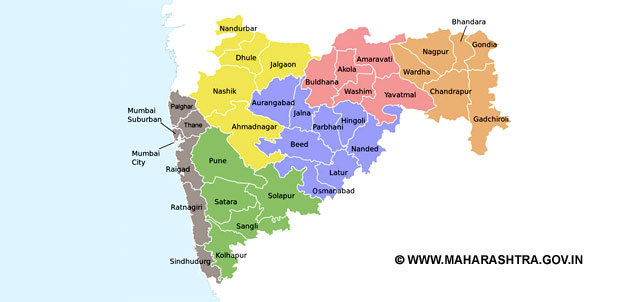
  • 4 must-dos to revive Brand Maharashtra


    By Avik Chattopadhyay


    To me, the ‘Brand Maharashtra’ needs to be revived doing four specific things.
     

    1. Maharashtra as a melting pot: Building an atmosphere of ‘inclusiveness’ is the first step. The state still needs to be the place where dreams are fulfilled and lives are made for an Indian from any part of the country. This has to be the core ethos of the ‘Marathi Manoos’, one who welcomes all with industriousness to his/ her home to build a prosperous Maharashtra


    2. Maharashtra as a Bridge: The state has few pockets of prosperity and development and the contrasts between the ‘haves’ and ‘have-nots’ are too wide and stark which need to be reduced consciously by building more pockets of development


    3. Maharashtra as a Technology Hotspot: Both in manufacturing and agriculture,  these two key economic activities need to be both harnessed as well as connected using technology. This needs to be both communicated as well as implemented at the ground level.


    4. Maharashtra as One Flag: This is the last but possibly most significant thing to be done, as a rallying point for all those who live, add to and take from the state. A communication pivot and an identity that connects with all – beyond religion, colour, caste and place of origin.


    Avik Chattopadhyay is a leading marketing and brand consultant. He was engaged in a rebranding exercise of West Bengal. This article first appeared in the ‘dna of brands’ section of dna.


  • dna unveils brand campaign highlighting new positioning

    By A Correspondent


    In the recent past, dna has come out with breaking news, some of which has been the reason for intense debate in the Parliament of India, leading to proactive steps taken by the Government to address the issues raised by the newspaper. Be it at national or state level to city level, dna strives to publish news which is of high reader value for an emerging, busy India.
     

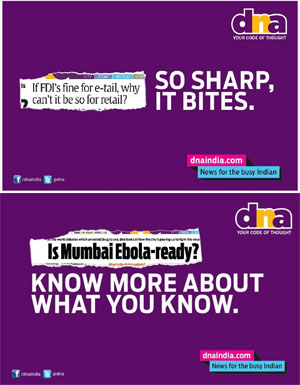
    Going with this thought process, dna launched a brand campaign focusing on the major news stories first broken by the newspaper. The new dna strives to be proactive and agile with many firsts being offered to its readers. Some of them being JBM – Just Before Monday, Celebrity Columnists, Special Interest Pages like Zeegnition, dna of Career, dna of Luxury, dna of Wealth, and many more.


    A second in series, dna recently positioned itself as ‘News for the Busy Indian’. dna continues to provide news which is relevant, unbiased and factual to its core reader which can be defined as “increasingly inquisitive” wanting to have a stake and pay a proactive role in the fast emerging socio-politico-economic scenario.


    The key thought behind the campaign is that newspaper should be able to offer perspective to its reader, news which impacts their own day-to-day life. Apart from being breaking news, it should also be waking news so much as to provide a perspective to the news that helps readers to wake up, react, and act.


    The campaign was launched on Thursday, October 21st 2014 and covers Mumbai.


  • dna executes innovative campaigns for clients

    By A Correspondent


    Since its inception dna has managed to redefine marketing through its innovative approach for its own branding and even extending it for its clients. Having undergone a complete brand and product revamp recently, dna since has introduced many firsts in the industry and have set new benchmarks through its innovative ideas which is evident not only for their brand & marketing initiatives but also for its clients & various stakeholders.


    In less than 60 days, dna has managed to bag and execute three innovations that has been the talking point for its clients. Colgate – Charcoal Toothbrush – dna front page goes black with white fonts; Bigg Boss Season 8 – dna delivers Air Sickness bag along with Bigg Boss Ad; Asian Paints – ezycolour


    The latest Asian Paints innovation is an exclusive-to-dna, blast of colour. On Friday, 3rd October every page of dna After Hrs was printed in a different colour. The idea was to showcase how a little colour doesn’t take away from the seriousness of a newspaper, it only adds more life to it. Similarly, according to Asian Paints, this rings true for any home, be it small, or large. The ezycolour concept by Asian Paints wants to break free of the myths and the stereotypes that bright and bold colours are only the luxury of a certain kind of home. With this innovation Asian Paints announces its new services where customers can seek expert guidance on usage of their favorite bright colors.


    Team dna worked closely with the Asian Paints brand team and their agency with an outside-in perspective & consumer insight to ideate and execute this innovation.


    dna aims to be synonymous for Innovation and wants to be the launch partner for its clients. dna looks to work closely with brands and agencies to provide customized solutions that are path-breaking, engaging and beyond just ad space.


  • dna to publish weekly window to ad & marketing business with ‘dna of brands’

    By A Correspondent


    Leading English daily dna has announced the launch of a weekly window to advertising, media and marketing. The special section – to be called dna of brands — will start publication with effect from Monday, October 6 and will be published on all Mondays thereafter.
     

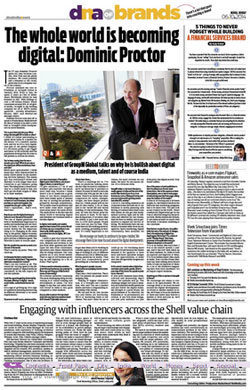
    ‘dna of brands’ will start as a one-pager, but will expand to multiple offerings, including a significant presence in the digital media.This new page serves as a perfect platform for the industry big wigs to share insights , learnings, forecast trends, discuss new launches and interact. dna of brands provides an interesting outlet for the makers of Brands and the entire fraternity to interact with readers.dna has appointed Pradyuman Maheshwari as consulting editor for this special page – dna of brands​ (* See Disclosure).​


    ​”dna is the only news daily that has been covering the advertising and marketing fraternity since its launch in July 2005.  There is much reader interest in these stories, and it’s good to have news and views on the business of brands move to the mainstream media,” said Mr Maheshwari.​


    ​* Disclosure​: Pradyuman Maheshwari is Editor-in-Chief and CEO, MxMIndia.


  • dna celebrates World Heart Day with unique song initiative

    By A Correspondent


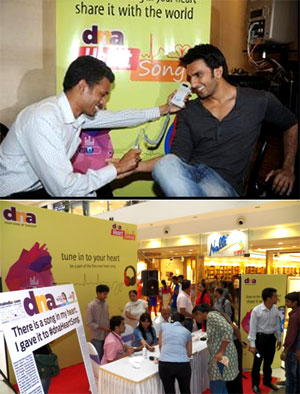
    dna came out with a first-of-its-kind initiative titled – “dna Heart Song” -  a video, bringing Mumbaikars together to celebrate World Heart Day on 29th Sep 2014.


    We can keep our minds sharp and muscles toned, but a healthy heart is extremely important as it helps to add emotion to our logic. It is the very beat that helps us connect with the world, keeps us smiling and lets us live a healthy life.


    What makes the #dnaHeartSong project unique is that it is the first ever crowd-sourced song made using actual heart beats of Mumbaikars including that of actor Ranveer Singh. The initiative was commenced by recording the heart beats of Mumbaikars at Oberoi Mall Goregaon.


  • Press Club Mumbai’s RedInk Awards on June 7

    By A Correspondent


    The Press Club RedInk Awards for Excellence in Journalism 2014, instituted by the Press Club Mumbai, have received a good response with over 800 entries from 75 print and internet publications. This year’s entries have also been characterized by a significant number of web-based and online journalists pitching their stories into the ring. This shows online journalism and web-based platforms becoming increasingly active and popular as vehicles of mass communication.


    The Awards have now moved to the stage of evaluation and judging, a humungous task by any standards. The Press Club has convened a transparent process of forming juries consisting of 3-member panels for each of the 10 sections of awards. The juries are a mix of industry experts, well-known knowledge leaders and senior journalists. The distinguished panels include eminent names such as ShyamBenegal for the ‘Entertainment and Lifestyle’ section, Rahul Dravid for the sports category, Dr Swati Piramal judging ‘Health and Wellness’ entries, Dr KC Chakrabarty, RBI Dy. Governor  for ‘Business’ section, noted lawyer Satish Maneshinde for ‘Crime’ and celebrity lensman Pablo Bartholomew sitting on the photography jury.


    The Grand Finale for the RedInk Awards will be held on June 7 at the Jamshed Bhabha Theatre, at the NCPA, in Mumbai.


    The Awards, which offer Rs One lakh to each of the winners, is in its 4th year now, and is the only recognition of merit for journalists from a professional platform. The Awards this year have expanded to include new categories like ‘Human Rights and Environment’. Juries will judge breaking news stories and features separately this year as the 2 categories involve different skill sets.


    Star India is the Presenting Partner for The Press Club’s Red Ink Awards for Excellence in Journalism 2014. The awards partners are Yes Bank, Glenmark Pharmaceuticals, Aditya Birla Group, Zee Entertainment, BSE, Eros International and the Adani Group; communication partners are DNA and exchange4media.


  • HT, TOI, others ink deal to start ‘One India Medianett’?

    By A Special Conespondent


    New Delhi, April 1, 2014: In a move that has been welcomed by several brands and party organisers, it is learnt from reliable sources that newspapers like Bennett, Coleman and Co Ltd and HT Media Ltd are getting together on a special project.


    It may be recalled that since 2005, the year when DNA was launched as were Mumbai Mirror and HT’s Mumbai edition, the two New Delhi-headquartered news media groups have got together on various projects. The HT’s print facility has been used by TOI. Then there’s a no poaching agreement between the two organisations so if an HT journalist had to join TOI, there would have to be interim employer in between. HT ads have appeared in TOI and vice versa. So while there is intense competition on the ad sales and editiorial front, there’s friendship too.


    Last week, HT Media and a few other top newspaper brands like Hindu and ABP got together to launch One India (not to be confused with the website company run by BG Mahesh and majority-owned by Rajesh Jain, now affiliated to the BJP). Many media planners, buyers thought it was a brilliant idea with pedigreed B-school graduates several thousand crores of adspend budgets appreciating the innovation of these media managers to create a pull for print.


    Buoyed by the success of this initiative, the high priests at a leading newspaper group had a whirlpool of an idea. Why not look at a combined deal for paid-for, promotional content.  Feelers were sent to competition, and after some reservations, a deal was struck so as to attract advertisers and individuals who appear on the party pages without paying. A formula has been hammered out, and the feature is likely to be announced soon.  This will be done at a tony nightspot in Mumbai and Delhi and will be held at no cost to the media organisations in question as the costs will be offset against free content space in the papers.

    For details, click here.


  • IRS 2013 Update: DNA sends legal notice to MRUC, Nielsen. Bhaskar gets stay order on IRS

    By A Correspondent


    The six-edition English news daily dna has sent a legal notice to the Media Research Users Council (MRUC) and Nielsen India as it “believes its readership figures are grossly misrepresented”.


    Announcing this in an announcement next to the masthead on the front page of the daily, dna communicated this move.


    Meanwhile, MRUC has pulled out the topline numbers of the IRS 2013 possibly in deference to a stay order of the District Court of Gwalior. Subscribers though can reportedly still access the data.


    According to the information received, the next hearing is on February 28 where an appearance has been sought of the MRUC representatives. The case by Bhaskar Publications and Allied Industries was filed on January 31, three days after the release of the data. The first hearing was on February 7.