Tag: DNA

  • Freaking News: Making sense of the army revelations

    By Ranjona Banerji


    Not surprisingly, the extraordinary revelations coming out of the army have consumed most of our days and nights. Kudos must go to DNA for first carrying the letter, which the army chief sent to the prime minister, about our lack of defence preparedness. Of course amidst all the high-decibel hot air about “high treason” and calls for sacking, we have as usual wandered into all kinds of marginal territories and taken a little time to put matters in perspective.


    Arnab Goswami on Times Now felt great shock that former prime minister Deve Gowda’s son Kumaraswamy said that arms dealers had tried to approach his father through him. Twitter took this as a joke with someone pointing out that Deve Gowda probably never took up the offer because he was asleep at the time. The innocence of television – is it endearing, annoying or just so put on?


    On NDTV and CNN-IBN, there were sometimes back to back discussions on the same subject with different anchors and guests. No great purpose was served by any of these – people who once wore uniforms claimed that the uniform-wearers were all purer than the driven snow, defence analyst Ajai Shukla said everyone always knew that India was badly prepared except probably Parliamentarians. Tarun Vijay of the BJP took great exception to being called ignorant but was told that he didn’t know what he was talking about for all his troubles. Brajesh Mishra felt that this government had spent too much money on development and “giving money to villages” and other unimportant stuff like that instead of presumably spending it all on national security. Luckily there was very little Chandan Mitra in all this.


    It, therefore, took the newspapers to explain to us the inner workings of the Tatra-Vectra-BEML deal, the connection between Ural trucks and army chief VK Singh and the problems with defence procurement. To be fair to Mishra however, he also said that the armed forces wasted time testing equipment in the snow, desert, mountains, plains, wind, water and so on till everything had become obsolete. All former uniform-wearers blamed the bureaucracy for the same.


    At the end of it all, you had to read the papers to find out who was who and who was doing what to who. This is a familiar pattern now and perhaps TV continues to be the saving grace for newspapers which have to make sense of the sound and fury. We now need some comprehensive stories on what appears to be some sort of internecine warfare within the army. It would also be good to know where the other service chiefs stand on all this.


    * * *


    As a break from all this, was the BRICS summit which just concluded in Delhi. TV did focus on that as well but sometimes when the reporters babble on and on saying the same thing in 16 different ways to guarantee their 2 minutes of air time, your eyes just glaze over. The business channels, however, had more focused coverage, including interviews with industrialists and so on. BBC and CNN were also more interested in the summit than in our military mis-manoeuvres.


    * * *


    A quick look at Pakistani papers this morning showed that in spite of all the fears of our former generals with moustaches quivering with rage, the Indian army’s lack of preparedness has not consumed them.


    * * *


    The Hindu has written a very welcome editorial, if a little late, slamming spiritual guru Sri Sri Ravi Shankar for his ridiculous comment that government schools are breeding Naxals. Does the media usually treat them too kindly?


    * * *


    The felicitation for Sachin Tendulkar by Mukesh Ambani provided the relief factor. TV, of course, pointed out that Bollywood attended in full force, leaving out the industrialists, politicians, artistes, literati and other movers and shakers in evidence. Where Bollywood ends, India ends I guess.


  • Water bottle for the front page of DNA

    By A Correspondent


    DNA initiates a path breaking front page innovation on the occasion of World Water Day DNA is known for its revolutionary approach towards almost everything it does and along with the daily news analysis; this English daily is impeccably marching ahead in making a change in the traditional newspaper industry.


    On the 22nd of March, when people grabbed their copy of DNA they experienced a refreshing change with a brand new colour on the front page. On the occasion of World Water Day, DNA and Tupperware had teamed up to showcase a new product by this well known high quality smart kitchen solutions company.


    Every newspaper, until today was getting printed in a four colour system through an offset printing machine, whose colours namely are CMYK (Cyan, Magenta, Yellow and Black) and occasionally various newspapers experimented with Gold or Silver. But the first time ever, in the history of Indian newsprint industry, a broadsheet has a shade of blue as a part of their printing colour palate and a live edit to make believe the trueness of the Tupperware bottle and making people comprehend a fresh and pure colour of blue on the well deserved occasion of the World Water Day.


    “Tupperware was launching their aqua fresh water bottles and we chose World Water day, March 22nd, as it was a perfect fit for the announcement. We wanted to do something exciting for Tupperware and this is when DNA came up with the concept of innovating it in a three-dimensional way. It’s the first campaign of the year for Tupperware and stands as a clear communication for all readers to drink fresh and healthy water”. – Surbhi C. Murthy, AVP, Allied Media This was done to launch the Tupperware bottle that is so pure and perpetual that it could be used for life. There could be no better gift for the readers than this, on the occasion, isn’t it!


    “Tupperware’s Aquasafe Bottles provide a quick, sustainable solution to safe, healthy water for consumers. Towards this, we have embarked upon an advertising campaign which is based on clutter-breaking innovation to generate buzz amongst the consumer. Committed to make the world a better place to live in, Tupperware endorses the idea and cause of effective water storage solutions and lends its whole-hearted support to the World Water Day.”  Anshu Bagai, Director- Marketing, Tupperware “Water bottles are a significant part of Tupperware’s range of products. The ‘Sip of Bliss’ campaign was created to celebrate water. What we wanted was to have an innovative kick-start for the campaign. And there could not have been a better way and a better day than the World Water Day, on March 22nd,   to launch it with a special innovation using a special colour to make it memorable and effective”  Jyotsna Chauhan, COO,  IBD India Pvt. Ltd.


    “Tupperware’s summer campaign is all about the romance and the sheer bliss of water.  The DNA innovation provided a refreshing twist in taking the idea further.” Jai Singh, Senior Creative Director, IBD Brands, Gurgaon. Explains Mr. Nirmal Kanthode, the DNA Production Head “The printing process had to be altered to create the depth of the Tupperware colour. After the normal 4 stage process, a 5th printing round with a special ink had to be done to create the magical effect. While this sounds easy, doing it for a full run of 6 lakh copies with high speed machines meant meticulous calculations & calibrations to ensure no delay & perfect output. Any shade change would be disastrous & we would have no way to stop it either.”


  • We are a silent partner in DNA: Girish Agarwal (on Video)

    The Dainik Bhaskar Group has been making rapid strides in publishing and its expansion into hitherto uncharted territories like Maharashtra have led to questions on where the group will head next. Girish Agarwal, director of the group, spoke to MxMIndia’s Shruti Pushkarna in an exclusive interview on the sidelines of Ficci-Frames 2012.
     

    Dainik Bhaskar was among the first to innovate in order to get more readership. What are the new frontiers… where are you headed next?

    We operate already in some 14 states in India. We have recently launched a Marathi newspaper, so we have some time to spend in Maharashtra as well as Jharkhand. At the same time, the states which we are already present in, like Rajasthan, Gujarat and Punjab, we need to work a lot there also to grow, because those states have a huge potential for us to grow. A large part of the growth we’ve been seeing in last 10 years, is coming from our existing states, so we need to work hard there.


    [youtube width=”400″ height=”250″]http://www.youtube.com/watch?v=UN43L63SCoU[/youtube]

    Technology and internet hasn’t really taken off as well as it was expected to have taken off. What are your views on the same?

    Internet penetration in India is roughly around 7 to 8 per cent, so with this kind of penetration, I don’t think we need to fear anything that they would take away from us. But at the same time we need to prepare for the future. For example, our website in Hindi today is the largest website in Hindi news as well as the Gujarati one, so we are preparing ourselves for the future. But at the moment, is the business shifting from the print platform to the internet? No.


    How do the readership wars affect newspapers?

    I think it is pretty good because anything that’s good for the market is good for the organization too. For the readership war, you actually go out and try to take more readers, for that you need to ensure that you are still relevant to the reader, because if you are not relevant, the reader won’t buy you at all.


    There is talk about Dainik Bhaskar opting out of DNA, how true is that?

    Yes, it is true that DNA is currently managed by our partner, Zee Group, which has the majority in DNA. We are a silent partner.


  • Freaking News: Tendulkar upstages the budget extravaganza

    By Ranjona Banerji


    Pranab Mukherjee owes a big debt to Sachin Tendulkar. By the time Saturday morning dawned, the newspapers it seemed were far more excited about the century of centuries than they were about fisccons, indirect taxation and how do you solve a problem like Mamata.


    The Times of India, Uttarakhand, had “Sachin, Thanks a Ton” as its lead headline and story. The budget was tucked below the fold. The Hindu went with convention and the budget, “Dr Pranab’s bitter medicine” but there was Sachin’s “century of centuries just below the fold. The Hindustan Times (Delhi) put Sachin as a banner on top of the budget – “God of All Things” and then said, “Reforms on Rewind”.


    The Times of India’s Mumbai edition put Sachin at the top and the bottom. There was the banner “Tondulkar goes where no one ever has or ever will”, then a graphicked-up finance minister with the headline, “Face it. Life’s got a lot more taxing” and then “Thanks a ton, Sachin” at the bottom. DNA, Mumbai went with “Budget bores, Sachin scores” which about put the matter in perspective.


    As far as headlines go, I would say Hindustan Times has won, DNA has come second, Times has tried too hard and Hindu not at all.


    Interestingly, Hindustan Times, Mumbai’s Sachin banner read “Man of the Century” which perhaps proves that HT thinks that either no one in Mumbai will get the Arundhati Roy reference in the “God of All Things” or that people in Mumbai can’t do maths (man of 100 centuries, surely?) or that the Mumbai edition just felt it had to be different from Delhi. Now that’s a legitimate desire, surely?


    Even The Economic Times could not ignore Sachin and tied the two together into one headline, “On Budget Day, Sachin scores”. The Vodafone tax case also got a cricket reference “Vodafone may have to face Pranab’s Doosra”.


    Thus the nation’s fascination with cricket and Tendulkar managed to upstage the annual extravaganza that newspapers go through every year.


    * * *


    In fact, Saturday must have been a news editor’s nightmare, trying to decide which story was bigger. After all, we’ve spent almost a year going on and on about Tendulkar’s 100th century and couldn’t give it second place even if it arrived on budget day.


    As for what the newspapers said about the budget, it was more of the same – some people liked it and some didn’t. More than likely: all will be forgotten as Mamata Banerjee plays out some new drama and Akhilesh Yadav loses some of his sheen. Pranab Mukherjee will probably have the last laugh.


  • IRS 2011Q4: Not much change in rankings but dailies witness significant growth

    By A Correspondent


    Top 10 Hindi Dailies:

    IRS Q4, 2010 v/s IRS Q4, 2011

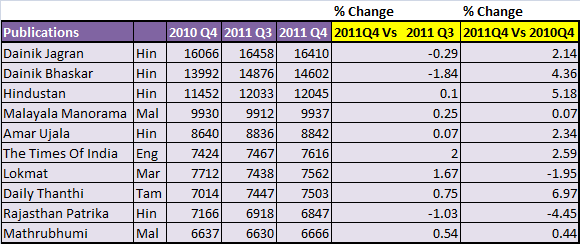
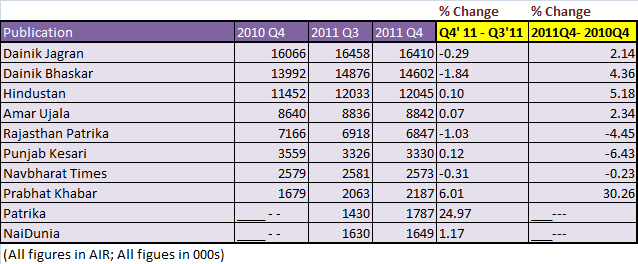
    There is not much of a difference in the rankings of the Top 10 Hindi Dailies. Dainik Jagran, Dainik Bhaskar,Hindustan, Amar Ujala and Rajasthan Patrika continue as the Top 5 Hindi Dailies. When compared to IRS 2010 Q4, IRS 2011 Q4 reveals the Top 4 Hindi Dailies, namely Dainik Jagran, Dainik Bhaskar,Hindustanand Amar Ujala have further strengthened their readership.


    A look at percentage change from Q4, 2010 to Q4, 2011 finds that Dainik Jagran has witnessed a growth of 2.14 per cent, Dainik Bhaskar grew by 4.36 per cent,Hindustanby 5.18 per cent while Amar Ujala grew by 2.34 per cent. The only Hindi daily to have witnessed double digit growth is Prabhat Khabar with a whopping 30.26 per cent growth in Q4, 2011 as against Q4, 2010. A total of five Hindi dailies have witnessed growth Quarter on Quarter.


    Q3, 2011 Vs Q4, 2011

    But the results for IRS Q4, 2011 Vs Q3, 2011 have a slightly different story to tell. The top two most read Hindi dailies – Dainik Jagran and Dainik Bhaskar – have witnessed a decline in Average Issue Readership (AIR), the decline is however marginal. Besides Dainik Jagran and Dainik Bhaskar, the Hindi dailies to have recorded growth in Q4, 2011 v/s Q3, 2011 are Hindustan, Amar Ujala, Punjab Kesari and Prabhat Khabar.


    Top 10 English Dailies:

    IRS Q4, 2010 Vs IRS Q4, 2011:

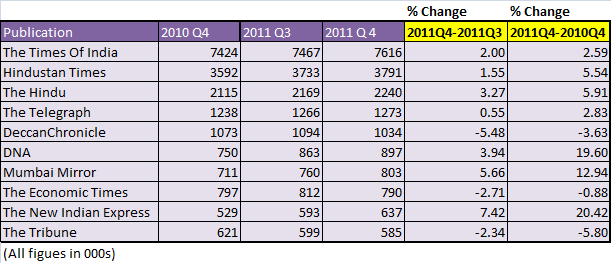
    The English dailies have performed exceedingly well in Q4, 2011. Seven out of the Top 10 English dailies have registered growth in their AIR. While DNA, Mumbai Mirror and The New Indian Express have registered growth in double digits, the top four English Dailies: The Times of India, Hindustan Times, The Hindu and The Telegraph have also witnessed growth quarter on quarter.


    IRS Q4, 2011 Vs Q3, 2011:

    The results for Q4, 2011 in comparison to the previous quarter also highlight the growth for most of the top Ten English dailies.


    Top 10 Language Dailies:

    IRS Q4, 2010 Vs IRS Q4, 2011:

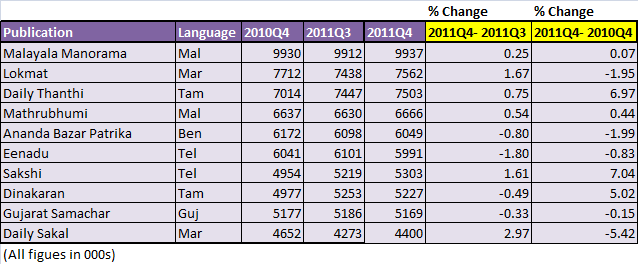
    The Q4, 2011 results as compared to the Q4, 2010 results have shown mixed reactions for Language dailies as only five publications witnessed growth since Q4, 2010 to Q4, 2011. Malayala Manorama continues to be the number one publication among the Language Dailies. According to IRS Q4, 2011 v/s Q4, 2010 findings, the Malayalam daily grew 0.07 per cent.


    Ranked second is Marathi daily, Lokmat which saw a decline of 1.95 per cent. The other Language dailies to have registered growth in their AIR are Daily Thanthi, Mathrubhumi, Sakshi and Dinakaran.


    Unlike the top two dailies, Daily Thanthi, ranked as third Language daily, grew by 6.97 per cent in IRS Q4, 2011 when compared to IRS Q4, 2010.


    It has been observed that the Malayalam dailies – Malayala Manorama and Mathrubhumi and the Tamil dailies – Daily Thanthi and Dinakaran have recorded growth in their AIR. Malayalam, Marathi, Tamil, Telugu, Gujarati and Bengali are some of the popular language dailies to have found a place in the Top 10 Language dailies.


    IRS Q4, 2011 v/s Q3, 2011:

    The top four Language dailies: Malayala Manorama, Lokmat, Daily Thanthi and Mathrubhumi have registered growth in their AIR numbers in IRS Q4, 2011 v/s IRS Q3, 2011. Besides the top four language dailies, Sakshi, the Telugu daily and Daily Sakal, the Marathi daily have also witnessed growth in their readership numbers.


    AIR or Average Issue Readership is defined as the readers of an average issue of a publication i.e. the estimated number of those who have read or looked at any issue of the publication within a specified time interval, which is equal to the periodicity of the publication (excluding the day of the interview). This is the preferred currency of media agencies across the country though often publications quote Total Readership (TR) when their AIR numbers are not impressive. MxMIndia only uses AIR in its IRS reportage.

  • IRS Q4 2011: Dailies flourish Year-on-Year


    The fourth quarter results of 2011 for the Indian Readership Survey were published on Monday and a quick look at comparing the numbers of IRS Q4 2011 versus Q4 2010 data, eight of the Top 10 publications – Dainik Jagran, Dainik Bhaskar, Hindustan, Malayala Manorama, Amar Ujala, The Times of India, Daily Thanthi and Mathrubhumi ­- have grown in their AIR (Average Issue Readership) Year-on-Year (YoY). Tamil daily Daily Thanthi and Marathi Daily Lokmat and Hindi Daily and the second most popular newspaper, Dainik Bhaskar  have registered the highest growths in AIR.


    When we compare Q3 2011 V/s Q4 2011, Dainik Jagran, Dainik Bhaskar and Rajasthan Patrika witnessed a slight decline in their readership. Dainik Jagran, Dainik Bhaskar, Hindustan, Malayala Manorama and Amar Ujala have retained their spots as the top five publications.


    After looking at the numbers, MxMIndia spoke to some of the publications for their views on the IRS Q4 2011 Topline numbers. Mr Rahul Kansal, Chief Marketing Officer, Times of India Group said: “Overall, I am quite happy with results, we have done pretty well in most of the markets including Delhi, Mumbai and Chennai, where we have seen very good growth.”


    However, Mr Rajiv Verma, CEO of HT Media Ltd, is disappointed with the IRS numbers but said in a statement, he will continue with investments in various markets. “While Hindustan Times has for long been No 1 in Delhi and No 2 in Mumbai, and Hindustan and Mint have consolidated their positions in their respective markets, as a group we are disappointed that these IRS numbers don’t reflect the full picture of our growth, and the reality of our investments and our efforts in the various markets across the country. However, we will continue to invest in various markets, to meet the needs of our readers and our advertisers, and will hope that the readership growth will be fully captured going forward.”


    Mr Sanjeev Kotnala, Vice President, Dainik Bhaskar Group said: “The IRS figures justify our focus on the urban, non-metro cities. Dainik Bhaskar is the only Gujarati newspaper to have a readership of more than 10 lakh in cities like Jaipur and Ahmedabad. If you see the figures for only the urban, non-metro cities, then you will realise that Dainik Bhaskar dominates the list. As far as the overall figures are concerned, we feel that it is a minor fluctuation, nothing major as far as our own perspective is concerned.”


    Speaking on trends from IRS Q4 findings, Mr Gautam Dalal, Vice President, Marketing, DNA said: “We observe that within Mumbai there is an increase in the overlap of English dailies readership – for every two readers there are three dailies being read. Mumbai, therefore, is seeing more penetration of English dailies and the trend of reading multiple newspapers is on the rise. Having such a high overlap percentage is a positive sign.”


    “In Mumbai we have had the highest number of growth for DNA, and these numbers are a testimony to our stand of having a high level of copy supported by the cutting edge editorial and by a focused market programme,” he added.


  • Is the Bhaskar group exiting DNA?

    By A Correspondent


    Since the day Zee supremo Subhash Chandra took charge of operations at Diligent Media Corporation (DMC), the company that publishes newspaper Daily News and Analysis (DNA), rumours are rife that co-owners Dainik Bhaskar are exiting the JV. This happened two years ago, and nearly every week since then we hear stories about the Bhaskars selling their stake. There have been times when we’ve heard the same about Mr Chandra too, but if a report on the BusinessWorld website is to be believed, the Dainik Bhaskar Group (DB Corp) is in the process of exiting DMC.


    “Following the exit of the Bhaskar Group, Subhash Chandra and his associates will have 100 per cent ownership of Diligent Media. The road map for decoupling the English language media project, launched in June 2005 as a 50:50 JV, was confirmed by a senior D B Corp executive; but the promoters of the Bhaskar Group, the Aggarwal family, said the deal was “yet to be consummated”, the report adds.


    (Link: http://www.businessworld.in/businessworld/businessworld/content/Dainik-Bhaskar-Exiting-DNA.html)


    The Agarwals are known to be hands-on and aggressive newspaper owners. So while the official reason being given was that Mr Girish Agarwal needed to concentrate on the power projects, it was evident that interest had waned. A Bhaskar spokesperson said he was unaware of any such development.


  • Leadership makes us tough, with ourselves first: DNA

    By A Correspondent


    Given Prime Minister Manmohan Singh’s recent statement that the “media should come together to exercise a degree of self-regulation and to combat perversions like paid news”, broadsheet Daily News and Analysis (DNA) announced its Code of Ethics on its front page.


    According to the paper’s leadership team and CEO Mr. KU Rao, the “road of integrity and honesty is always difficult but in the long run, we will come through as an organization that has greater value which will one day bear fruits for us as well as for our partners who work with us.”


  • Much admiration for glam add-ons

    By Ranjona Banerji


    Just to entertain myself, I decide to read the glamour supplements of The Times of India and Hindustan Times. Though now I am not sure whether entertainment or aggravation is what I was looking for. Since the arrival of Medianet and its variations in other newspapers, I usually ignore Bombay Times, HT Cafe and the entertainment/celebrity sections of all newspapers. Disclosure: I used to write a restaurant review for DNA After.Hrs but I haven’t seen that either for over a year and many years ago, I edited the Ahmedabad Times and Baroda Times. This takes nothing away from my life as I have minimal interest in Bollywood and tinpot celebs.


    So what have I learnt today? That a supermodel I had never heard of (though they told us her name) has agreed to launch a perfume (which was not named). This unnamed perfume will cost a million dollars and proceeds from sales will go to charity (named). So what do I make of this? That the supermodel paid Bombay Times, while the perfume and charity did not? Or that the editors just take the line of least resistance and do not name whoever had paying potential?


    This then turned into a fun game. Ekta Kapoor made an appearance (some new movie or something) on the front pages of both Bombay Times and HT Cafe. Money paid or not? Time Out has its food awards this week. HT Cafe covered it, Bombay Times did not. Because Bombay Times has its own awards or… By the way, these are the people whose pictures appeared in HT Cafe as guests or presenters at the Time Out awards: Abhay Deol, Malaika Arora Khan, Neha Dhupia, Shahana Goswami, Mahie Gill, Kalki Koechlin and Shruti Shah. Barring Deol and Dhupia (though it could be her large dress), none of the others looked like they’d eaten a meal in two weeks. Two winning chefs got a mention in the accompanying paragraph and no restaurants were mentioned (paid or not…?).


    A story on French producer (called veteran, which means just about anything) Marc Zermati is headlined ‘I’m not interested in Bollywood bulls**t’ is next to the Time Out story which perhaps shows someone in HT Cafe has a great sense of irony or none at all.


    Both Bombay Times and HT Cafe have the same people in the lead: Priyanka Chopra and Hrithik Roshan. Bombay Times says they both get ‘wet and naughty’. (Actually the headline says ‘Hrithik and PC get wet and naughty’ so for a moment I thought it had something to do with Hrithik and computer porn. The pic showed them really close, so give me a break). HT Cafe has Priyanka Chopra saying there is no “lip-lock” in this movie. So don’t get disappointed when you watch it, presumably.


    I was pleased to see that I no longer needed a magnifying glass to read my fortune in Bombay Times but was disappointed to see that it did not say reading “advertorial entertainment promotional features is bad for mental health”.


    Anyway, by this time I was so bored that I had to stop.


    Question for those who make them and those who read them: how do you guys do it? Full admiration!

  • The Anchor: 5 changes the publication industry is seeing

    By Adarsh Mishra


    #1 Nowadays circulation operates on an FMCG model. As most of the companies are subscription driven, they are able to track readers and their profiles. The conventional method of circulation has undergone revolutionary changes due to subscription module and publication aspirations to achieve higher numbers in terms of ABC and IRS.


    #2 Circulation, which is considered a cost centre in every organization, is playing a very important role in the present media scenario as media planners are giving more importance to numbers in comparison with class.


    #3 In the present scenario most publications are resorting to invitation pricing which helps them to get a larger base in a shorter time. The classic example can be Delhi where publications slashed their prices in order to get higher numbers.


    #4 In coming days it will be vernacular publications which make more money as against English publications. The reason being people’s inclination towards their own languages and lower operating costs.


    #5 The government should increase the scope of FDI as it will help the publication  industry in India to grow at a faster rate and also it will help small or regional players to compete in the national arena.


    Adarsh Mishra is Vice President, DNA.

  • Mediaah!: Of a toothless Press Council and spineless Editors’ Guild

    By Pradyuman Maheshwari

    Apologies for not being regular. A colleague has been indisposed. We’ve been getting our share of exclusives and firsts. So a good part of the day is spent in ensuring that MxMIndia turns into a broadbased media website. So all of you who’ve been missing your daily dose of Mediaah!, chill! I don’t think the blog will be a daily, but an update at least three to four times a week?!


    Mint editor R Sukumar’s ‘Edspace’ is a delight to read. Pity it doesn’t appear every Saturday. Delight for me because it deals essentially with the media, and often on ethics. For instance, last weekend, he wrote about journalists being responsible for the state in which the profession is in the India – the corruption levels given the direct and indirect favours journos take (see link). Like awards, being part of a government committee. Sukumar hopes the Editors’ Guild of India will debate these issues.

    Being a Delhi-based editor and “an unacknowledged member” of the Guild, I guess he hopes the apex association of editors will do something. My own belief is that it will not. It could do precious little when the paid political news controversy first surfaced a couple of years back and Medianet did a decade ago.

    If the Press Council of India is toothless, the Guild is spineless. And this is despite having editors like T N Ninan, M J Akbar and Rajdeep Sardesai at the helm. Guess it’s one thing writing about the government or demining, say, a Narendra Modi, but another to take on biggies in their own biradiri.


    Paid news and Mid-Day

    Mid-Day exec editor Sachin Kalbag makes a brave defence for the paid news practice that his paper indulges in. Quoted in The Big Story on MxMIndia.com earlier this week, he defends the ‘Centre Stage’ feature in his paper that contains advertorials. Just 15 percent of the content is paid for. He also calls the tagline under the Bombay Times masthead as a disclaimer.

    I don’t think people see it as a disclaimer. If The Times of India and Mid-Day are serious about informing their readers that some of the stuff in their papers is published not on the merit of its editorial content but the amount someone’s paid for it, they must clearly state that they are doing it. They must tell the reader that the content in question must not be construed as that done by the paper’s journalists. Just as Mint has been doing about its advertorials. So in every sense of the term, the 15% of the paper’s Centre Stage section is paid content.

    So, lemme repeat what Sachin says:

    My opinion on paid news is very simple: It’s an abhorrent practice. It demeans journalism. I don’t really know when this crept in, but it has plagued the media for decades. Unscrupulous journalists have been on the take for several years, and this is not a new phenomenon. The widely cited example of institutional selling of content space is Bombay Times which introduced a rate card for coverage in the supplement. Recently, the supplement began putting a disclaimer under its masthead. The phenomenon of institutional selling of content space crept into the media for various reasons – but the root cause was always to increase revenue.

    Our editorial policy is very clear: any “Advertorial” is placed in a two-page section called Centre Stage, which is part of the Classifieds section of the newspaper. Centre Stage in Mid-Day is differentiated in various ways from the editorial part of the newspaper. Here’s how: 1) The Centre Stage carries a prominent disclaimer in a large point size under the masthead “People, Parties, Promotions”. This has been happening since the day Mid-Day started Centre Stage, which was more than two years ago. In Centre Stage, we carry items on movie releases and profiles of actors, fashion designers, parties, etc, that happened in Mumbai that week, apart from product launches.

    Close to 85 percent of the Centre Stage advertorial section is non-paid, that is to say the Centre Stage team of writers (this team is not part of the Mid-Day editorial team) interviews people or writes about their parties or products. Around 15 per cent of the items are placed where the content space is sold by the sales team. Once again, these items are only about Bollywood, fashion, parties or product launches. There is a separate, specialized sales team that sells this space, and at no point in time do they dictate terms to

    Editorial, mainly because Centre Stage is not editorial space, but marketing real estate. In fact, there have been several instances when the Editorial staff in Mid-Day has trashed Centre Stage advertisers in the review section of the newspaper, and the sales team has gotten into trouble due to that negative coverage. Yet, we are very clear at Mid-Day that the Sales and Editorial wires do not cross, and that the Chinese wall between them stays even though we may be good friends outside the office.

    We are also very clear that Centre Stage will not carry any “news”, but only information on these three or four categories listed above. There is neither any opinion nor any recommendation made in the section that is endorsed by the editor. In the strictest sense of the term, it is an advertorial. Mid-Day, therefore, has stayed away from “paid news” and will continue to do so.

    Thus, Centre Stage in Mid-Day is institutional selling of content space which I guess has a rate card. I am told revenues are healthy and though they don’t run over a 100-odd crore as Medianet is said to be generating, but even if it’s 1/100th that, it’s too much to sacrifice for stupid things like editorial integrity.

    Guess for some publications, editorial ethics is also an abhorrent practice. It demeans ad sales!


    Dabbang Sinha!

    As a strategy, it’s a win-win. He took on the information broadcasting minister in public saying that ever since DNA went ballistic with the anti-corruption drive of Anna Hazare, the government stopped advertising in his paper. (Link to column)

    Now, from whatever I’ve known of Ambika Soni, she’s a pretty reasonable minister. Given all the complaints that every I&B mantri receives, she could’ve made life miserable for media players. Especially broadcasters. Like her predecessors did.

    A senior journalist in the Capital told me that Aditya Sinha’s column last Sunday is sure to see his scalp. Subhash Chandraji could find it too hot to handle, and the Zee supremo needs the government for his plans a helluva lot.

    But this is why I said it’s a win-win for Sinha. If he gets the sack, he will turn a martyr (that doesn’t help much, I can tell you from experience). And if he continues, he’ll turn into a hero because after all, few have had the balls to say the government is kinda blackmailing the press.

    Sample some gems from his column:

    > Soni’s statement led us to infer that our Anna Hazare coverage was being punished by a suspension of government ads, and that Soni met our ad executives just to ensure the point was driven home.

    >This was not surprising because DNA recently has faced suspicion and hostility from the government which has apparently adopted an attitude of “you’re either with us or against us”. The prime minister’s media advisor has privately accused DNA of an agenda against the government, and its Editor-in-Chief of being close to a political party in the opposition.

    >The day after the meeting with Soni, DNA started getting DAVP ads again. Presumably, from the government side, mission was accomplished

    >Loss of business can be measured, but the loss of credibility cannot. Above all, that someone in government tried to be petty and vindictive is, to us, validation that we were doing our job right

    The views expressed here are my own and are not necessarily those of MxMIndia and its editorial team. In fact often it’s in variance with their views. Meanwhile, buzz me if you have a story to tell. Confidentiality assured. There are various ways you can reach me: pradyumanm[at]mxmindia.com, 23050B5D, pradyumanm@gmail.com, @pmahesh, 98338 76278.


    Tomorrow:  Is The Times of India taking on Times Now?