Tag: Digitization

  • Jaldi 5 with Yogesh Radhakrishnan: I&B min has done its best on digitization deadline

    There’s more reason than one why we interview Yogesh Radhakrishnan today. While he is Managing Director and CEO of Media Networks and Distribution Ltd which runs Prime Connect, the content distribution platform he has formed in a jv with The Times of India group, Mr Radhakrishnan has also been one of the earliest entrants in the cable distribution space. He has been instrumental in shaping the landscape of distribution by setting up two MSOs and also a few satellite and cable television channels (ETC, CVO, In Mumbai).


    In the run-up to digitization, we interviewed the heads of the local cable operators (Roop Sharma) and MSOs (Ashok Mansukhani).  We presented the same set of questions to Mr Radhakrishnan…


    01 We have a little over a month to go for digitization in the four metros. If the government estimates of last week were to be believed, by now over 70 per cent of Mumbai, Delhi, Kolkata and Chennai would be digitized. Is that the case?

    I’m fairly confident that it will happen. Thanks to all the propaganda and advertisements done by the I&B Ministry, people are now aware that there is a deadline to digitization. And if they don’t do anything then they’ll be left with nothing but blank screens. So, there is enough and more awareness among people. Also, whatever percentage is left will get their act together and do the needful as soon as possible.


    02 Are the lower income groups in these cities buying set-top boxes?

    Today, if one takes a look at any income group, we’ll see that most people have mobile phones. And one needs to only pay Rs599 or Rs799 or Rs999 (different costs at which cable operators are giving set-up boxes) one time to get a connection which isn’t much. So, I don’t dont there is going to be any issue with lower income groups buying the set-up boxes.


    03 There is a worry that there will be some piracy in the form of pilferage of signals after November 1.

    Government is very clear about the actions that will be taken against anyone who does not follow the rules. It is a criminal offence and strict action will be taken. I don’t think the government and other authorities involved are going to let anything happen unlike what happened with CAS.


    04 What more would you like the government/others to do to ensure 100% digitization?

    I think the I&B Ministry is doing and has done the best to create enough awareness regarding digitization and the looming deadline. So, now all depends on people and how fast they change from analogue to digital. Hopefully, people will understand and convert at the earliest.


    05 The last mile which is managed by the local cable operators is the key to the implementation of Digitization. Are all cable operators working step-in-step with MSOs in the four metros about the implementation of the October 31 deadline?

    The two have to work with each other otherwise they know that their customers can be lured away by DTH companies. Hence, they need to take pro-active steps to enhance the corporation between themselves and to make sure people buy set-up boxes from them.


    Interviewed by Meghna Sharma

     

  • Jaldi 5 with Ashok Mansukhani: To achieve 100% digitization, govt must be a facilitator, not a schoolmaster

    Earlier this month, the government came up with a status report stating that 68 per cent of  the TV households in the four metros were digitized, a figure that was disputed by head of the Cable Operators Federation of India (COFI) Roop Sharma when we interviewed her yesterday (http://www.mxmindia.com/2012/09/jaldi-5-with-roop-sharma-govt-must-be-transparent-with-consumers-on-digitization/).


    We asked the very same questions to Ashok Mansukhani, President, MSO  Alliance about on-ground reality of digitization.


    We have a little over a month to go for digitization in the four metros. If the government estimates of last week were to be believed, by now over  70 per cent of Mumbai, Delhi, Kolkata and Chennai would be digitized. Is that the case?

    The information is the same as that of the government. However, 68 percent is not the national figure. It varies from city to city. With four weeks to go for the first phase of digitization, the question is about the rest of 30 per cent homes. Of course, it is not insurmountable. Lack of publicity from broadcasters is a problem. Then, there is no joint selling effort from  broadcaster and MSOs. The packages are yet to be announced. That is when the customers will begin to think of switching to digitization. Right now, they think DTH and cable is different.


    Are the lower income groups in these cities buying set-top boxes?

    The slums in Mumbai and Delhi sure have a television. But how do they know that from October 31 midnight, the analogue signals will stop? The digitization message says ‘box nahi to, TV bhool jaao’. One has to remember that digitization is a means to enable customer, not a retribution.


    The lower strata homes are being made used to use a set-top box and a remote. They have been told, ‘you see it, we will come and collect it later.’ Now this later will happen only when the packages are announced. The packages, however, have to be communicated door-to-door.


    There is a worry that there will be some piracy in the form of pilferage of signals after November 1.

    This is a rubbish claim that I have been hearing since long. The pilferage happens only when the broadcaster keeps his decoder ‘on’. Once that is switched off, there is no way that pilferage can happen. Yes, it can also happen if someone demodulates a cable signal. But the government has the power to take action against that person.


    What more would you like the government/others to do to ensure 100% digitization?

    The government needs to speed up the fiscal incentives, and should act as a facilitator. The fact is that it has become a schoolmaster instead. Since each city has different issues, which need to be tackled positively.


    The last mile which is managed by the local cable operators is the key to the implementation of Digitization. Are all cable operators working step-in-step with MSOs in the four metros about the implementation of the October 31 deadline?

    There is no issue with the cable operators. They have been pushing for DAS since 2000.


  • RBNL launches ‘Switch To’ campaign in run-up to digitization

    By A Correspondent


    With October 31 fixed as the D-Day for Digitization, Reliance Broadcast Network is all set to make the most of it with its new campaign titled ‘Switch To’. The campaign is designed to create enormous awareness amongst target audiences – to ‘Switch To’ the right service provider who can offer best value basis individual’s entertainment needs. The campaign also provides operators an effective tool to reach out through the marketing muscle and expertise of RBNL’s mediums across television, radio, on-ground, digital and outdoor, to gain increased visibility through this multi-media campaign.


    ‘Switch To’ launches on the back of earlier ‘Choose Your Set Top Box Wisely’ campaign that has been tailored to increase awareness and empower consumers with adequate information. The first phase of this campaign will be led across four metros: Delhi, Mumbai, Bangalore and Kolkata via BIG CBS Network’s key shows such as America’s Got Talent, The X Factor and American Idol.


    The campaign also aims at offering operators an excellent marketing campaign to strengthen their brand equity and gain optimally from the eminent revolution.


    Anand Chakravarthy

    Said Anand Chakravarthy – Business Head, BIG CBS Networks, “Digitization is an imperative step for the growth of the broadcast sector in India. While we have technologies available to improve efficiencies of broadcasting across the value chain, the lack of adoption from consumers slows the growth of the industry. This campaign enables consumers to Switch To the provider that meets their requirements, while at the same time offering the operators with an effective marketing campaign to partner with. Together, we are confident, we can bring about the much-needed Switch!”


  • Jaldi 5 with Roop Sharma: Govt must be transparent with consumers on digitization

    Roop Sharma

    She has been one of the most vocal voices in various discussions on digitization having been part of the cable industry for over two decades. While the government came up with a status report stating that 68 per cent of the TV households in the four metros was digitized, in the run-up to the Sunset date of October 31, we first asked Roop Sharma, founder President of the Cable Operators Federation of India, on what the reality is on the ground.


    1. We have a little over a month to go for digitization in the four metros. If the government estimates of last week were to be believed, by now over 70 per cent of Mumbai, Delhi, Kolkata and Chennai would be digitized. What is your information?

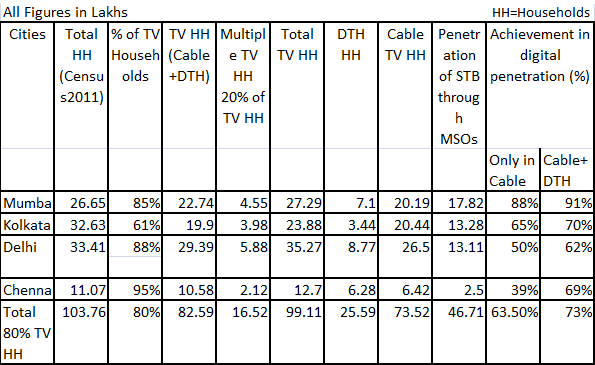
    Well, there are still some issues, but we think the government figures are off the mark. Our figures are as follows:


    Corrected STB Penetration Table -17 September 2012

    ( Includes DTH HH as part of Multiple TV HH not considered by I&B)

    Note:-
    1. Ministry has not included DTH TV HH in multiple TV HH where as it should have done so, being part of the same universe.
    2. Basis of % of TV HH in the Metros is hypothetical. Mechanism of its working out or its source has not been mentioned.


    The time has come to incentivize MSOs, but instead the licences have been cancelled of two of them.


    We are on September 24, and the price that consumers would have to pay is still not out, so things need to be moving faster.


    Broadcasters need to also ensure that there is availability of digital signals in all four metros.


    2. What is your information: are the lower income groups in these cities buying set-top boxes?

    They have been asking many questions. They want to know how much it will really cost them. Remember, some of them don’t even have colour television sets.


    Unfortunately, there is only one group representing consumers in the various taskforce meetings. Consumers would like to know how much it will really cost them.


    There will be an uproar if people don’t get to watch TV from November 1 because of this lack of information.


    3. There is a worry that there will be some piracy in the form of pilferage of signals after November 1…

    Why should there be any such pilferage? The broadcasters can simply stop the analogue signals. The question is: do they want to stop these? Will they fear loss of advertising if according to them digitization is not complete?


    4. What more would you like the government to do to ensure 100% digitization?

    Well, the government needs to do a variety of things.


    First, through the various advertisements, tell consumers very truthfully and clearly that one needs a set-top box for every TV set. And there’s an entertainment tax to be paid per TV set. So in Delhi, a consumer needs to pay Rs 20 for one set-top box and Rs 60 for three, if he or she has three TV sets.


    Second, consumers need to be made aware, that there is electricity consumption of around 18-20 watts per month which would roughly mean an extra spend of Rs 100. Also, they need to be aware that on these vanilla set-top boxes, they can’t get broadband or video on demand. There is no swap scheme and there is no portability currently.


    Third, consumers must also know where are the service centres for these set-top boxes in case the boxes need to be repaired.


    And broadcasters?

    Broadcasters also need to do more. For instance, in the various serials and reality shows, they must get the stars and anchors to talk about the need to buy set-top boxes!


    5. The last mile which is managed by the local cable operators is the key to the implementation of Digitization. Are all cable operators in the four metros about the implementation of the October 31 deadlline?

    Let me reiterate here that all cable operators want digitization. We will be happy to see consumers getting a choice and they will only pay as they watch.


    In fact had there been good availability of set-top boxes, we could have achieved things much faster. Right now, when a cable operator goes to the MSO for boxes on paying money, you don’t get the entire lot of boxes.


    We will be happy to see total transparency. We would like to also see deals between broadcasters and operators signed not on a lumpsum basis but as per the set-top boxes.


  • Paritosh Joshi | Digitization’s best kept secret

    By Paritosh Joshi


    The entire Television industry: Equipment makers, Broadcasters, Distribution Platform Operators like DTH Players or MSOs; and finally, the end consumer, are all on the verge of extreme anxiety. The government, having notified the “THE TELECOMMUNICATION (BROADCASTING AND CABLE SERVICES) INTERCONNECTION (DIGITAL ADDRESSABLE CABLE TELEVISION SYSTEMS) REGULATIONS, 2012”, is on pins and needles wondering whether full compliance is possible on time and hoping it won’t have another embarrassment on its hands.


    The analogue sunset for our big cities, while it has been pushed back, is imminent and even if it gets another postponement, it will have to be completed soon.


    What were the technologies that were considered by lawmakers when legislating digitization? A cursory reading of the ponderously named regulations will reveal that all options involve an intermediary “cable operator” defined as a “person who provides cable service through a cable television network or otherwise controls or is responsible for the management and operation of a cable television network”.


    Given that we have all but forgotten an era when a broadcaster (Doordarshan) provided its signals sans intermediary to consumers that they could pluck right off the air, it is scarcely surprising; but a good 30 million homes still receive their TV unintermediated. Remember the antenna?  (Evidently, none of those 30 million are reading this piece).


    And here’s another little factoid. As much as 44% of all TV consumption in the US is still from broadcast TV. We in India have apparently forgotten that terrestrial broadcast still represents the quickest and least expensive path to digitization.


    There are many reasons why terrestrial broadcast TV is ideal for India:


    • It is, by and large, FTA. Obviously you can run an encrypted channel as easily on broadcast as on satellite but in the main, broadcast TV works on advertising or public subsidy supported models.
    • It ends the tyranny of the intermediary and of all manner of anti-competitive piggybacking models.
    • It advances the cause of plurality of choice. So far we have only understood this in the context of programming but it is as legitimately an issue for platform plurality and choice as well. Remember that the MIB misses no opportunity to remind us about how important these virtues are.
    • It directly posits competition to the cable & satellite industry. (That doesn’t even need any elaboration, does it?)
    • It reasserts the citizens’ right over the broadcast spectrum, which is by definition a public resource.
    • It creates a new ‘spectrum auction’ style revenue source for the exchequer.
    • It enables the decentralization of TV. Terrestrial broadcast is line-of-sight. While a substantial portion of the content may be re-broadcast from shared, national channels, it opens huge possibilities for a new creative, and commercial, tier- local TV.


    So why has the private broadcast industry remained strangely silent on this issue?


    Let us remind ourselves that the metros are only the first milestones on the digitisation journey and a whole country must follow over the following years.


    Paritosh Joshi was until recently CEO, Star CJ. He has been a marketer, a mediaperson and on the Board/committees of various industry bodies. He can reached via his Twitter handle @paritoshZero


  • WWIL signs DAS interconnect deals with MediaPro

    By A Correspondent


    Wire and Wireless (India) Ltd. (WWIL), the cable television service provider, has signed DAS Interconnect arrangements with Mediapro Enterprises for about 70 channels, as part of its commitment for timely implementation of digitization.


    WWIL operates under the Siti Digital Cable Television brand name inDelhi, Kolkata and Mumbai.


    The Interconnect arrangement will allow WWIL to carry the encrypted TV channels signal on its digital delivery platform. With this arrangement, WWIL can offer channels of Zee, Star, Turner, NDTV, Fox and NGC bouquets to its customer under DAS regime.


    With about two and half months to go for first phase of digitization of cable TV networks in  metros, the company  is in active negotiation with all other leading content aggregators / broadcaster for DAS Interconnect arrangements.


    By inking all content arrangement the company will roll out channel packages which will be available for consumer, and with this the power will shift in the hands of consumer to choose what they want to watch.


    The company is seeding STB in its markets so that subscriber can continue watching cable TV even after the digitization deadline. The government is continuously monitoring the progress report on digitization of cable TV. TRAI has recently directed all MSO and broadcasters to enter into the interconnect agreements by August 21, 2012.


    As the digitization of cable will provide better viewing experience to the consumer in terms of the more number of TV channels with better quality picture and sound.


  • Audiences have given MTunes the best birthday present: Sunil Sahjwani

    [youtube width=”400″ height=”220″]http://www.youtube.com/watch?v=rreKrZ7F0B8[/youtube]

    By Meghna Sharma


    MTunes, the 24/7 music channel, completes one year today (August 10)  and can already boast of a 20+ GRP. Completing one year in a genre which revolutionized music during the 1990s isn’t a big deal. However, if one becomes a force to reckon with in such a short period, then it is, of course, a matter of pride.


    “When we started, we were at number five or six slot, but now we are number one in the slot. So, I guess we can call it a fast-faced and exciting journey with, of course, a lot of hard work,” said Sunil Sahjwani, Group Creative Director for Pioneer Channel Factory Pvt. Ltd. (holding company of MTunes and MExpress).


    Sunil Sahjwani

    Agreeing with him, Divya Radhakrishnan, MD, Helios Media which is strategic consultant to the channel said: “It’s wonderful to receive such a response for such a short period. They believed in our belief and helped us break convention with no VJ or no PJ on the channel only focusing on music.”


    Recently various prominent music channels have started a new trend of reality shows and now turning into youth general entertainment channels. Speaking about the same, Mr Sahjwani said: “There is no harm in experimenting and we are glad that they did that. Because the space vacated by them has given more space for music channels to grow. Also, we must realise that youth wants music, otherwise music channels wouldn’t have survived.”


    “In the name of ‘youth entertainment’, various channels forget where to draw the line and have created new lows of the Indian television industry,” rued Ms Radhakrishnan.


    Divya Radhakrishnan

    Apart from showing music in HD format which is its USP, the channel also prides itself in creating original properties like Asli Voice, Trending20, Kal ka Superhit and so on.


    “The channel’s aim is to reach out to various age groups and moods during the day and that is why the tempo of music keeps changing during the day. For instance, the day starts with fast-paced music, whereas in the afternoon the tempo reduces, only to increase again in the evening We want people to feel music and not just hear or see it,” said Mr Sahjwani.


    Music, today, is consumed across media – television, radio, internet, mobile, phones and other digital devices. So it is affecting the genre on TV? “No, we must realise that apart from a few urban homes, high-speed internet is still not available everywhere else. Having said that, there is also no denying the fact that youth consumes music on various platforms and internet is one of them. But the visual-audio treat provided by the television cannot be matched by others. Hence, it would be fair to say that other platforms act as a support system for TV. They only push the genre – which is great,” said Mr Sahjwani.


    And what about digitization? The channel isn’t available on platforms like Tata Sky. “We are aware of that and are working towards that. We are already there on Dish and Videocon and talks are on with other platforms. However, since we are a FTA channel, we don’t have much to worry about. And of course, we are hoping that digitization does happen this time around.”


    The channel opened its sales in April and hopes to do well in the coming years. “Our first motto was to build numbers, which we have been able to. So, now hopefully, we’ll be able to growth manifolds,” said Ms Radhakrishnan optimistically.


    The channel feels that Indians thrive on music, so the genre will only grow. However, one needs to be innovative and give the audiences what it wants to stay ahead in the clutter.


  • INMA 2012: ‘Industry needs currency that measures across platforms’


    By Shruti Pushkarna


    Basant Rathore
    If you are having trouble in viewing this video, see link

    Like Day 1, Day 2 of the 6th INMA annual South Asia conference also witnessed some interesting panel discussions pertaining to issues facing the news industry today.


    The first half witnessed an engaging session on, ‘Increased Circulation, Dwindling Readership: Is It Time to Measure “Access”?’ The session was moderated by Lynn de Souza, Chairman & CEO, Lintas Media Group. The panelists included Paritosh Joshi, Independent Media Professional & Board Member of MRUC; LV Krishnan, CEO, TAM Media Research Pvt Ltd; and Basant Rathore, Vice President-Strategy, Brand and BD, Jagran Prakashan Ltd.


    The panel debated the need for new matrices of measurement which can complement the conventional audience measurement matrices, as today the audiences are increasingly becoming platform-agnostic.


    Ms de Souza said: “People seem to be very attached to these numbers. But while numbers are important, we need a currency that goes across platforms. We need to be able to measure new forms of readership. From circulation and readership, we need to change our metric to media access.”


    Lynn de Souza
    If you are having trouble in viewing this video, see link

    Mr Paritosh Joshi shared a similar view on the need to look beyond the primary level numbers which he felt are out of date. He said that there are two sorts of media consumption today, structured and unstructured. It is equally important to be able to measure and take into account unstructured media consumption. Just as there are enough screens available today and not just the traditional TV box, he said, the newspaper is not just in the traditional paper form, it is available in other forms across platforms.


    Mr L V Krishnan talked of two news aspects coming out in the digital world: “One is the increasing access which is changing things dramatically. The other is multiplicity of brands transiting between different mediums. For instance, a Bombay Times with Zoom or an ET Now with The Economic Times. The nature of one medium declining and the other growing will depend on what the creator of the brand wants to deliver via a particular medium.”


    While there was agreement on the importance of numbers and currency, the panelists also highlighted the need to move beyond the existing currency.


    Mr Basant Rathore of Jagran said: “Digitization has blurred not just geographical boundaries but also boundaries between mediums. Today we don’t have a clue of numbers in digital media, but they are definitely going to grow. If these can’t be measured, monetization becomes a problem. The advertisers know that the game is moving beyond the existing currency. The research we had till date was about currency but the advertisers are now talking about engagement.”


    Mr Joshi added: “The existing measurement systems are accused of fudging numbers. With the new IRS, even real time tracking of interviews is possible. It will be a like a core end satellite model and this will enable us to respond to changes that are happening in the environment. Earlier we looked at data in a cross-sectional slice but what’s of interest to an advertiser is what happens to a consumer through the day. With the new measurement matrices, we are thinking of capturing all digital research to get a horizontal longitudinal view of a consumer’s media movements.”


    The panel also agreed on the need for industry to be willing to adopt new matrices of measurement and to support measurement that looks beyond primary access numbers. Mr Rathore concluded: “Numbers will continue to be important because that’s the benchmark for trade to happen. But if you need to grow, it’s important to leverage the media brand across media platforms and so we need to know what’s happening across platforms. And that’s why we need to be open to the measurement of other metrics.”


  • The Anchor: 5 reasons why Digitization may not happen even by Oct 31

    By Pradyuman Maheshwari


    It was unfortunate to see broadcasters forced to change their business projections and content strategies when digitization was less than a month away from the scheduled dates in June. And, now, the information one seems to be getting from the ground in the four metros is that the October 31 deadline also may not be met with.


    1. Momentum is lost: TAM CEO LV Krishnan said this in an interview to me last week. The urgency to go in for set-top boxes and the momentum that existed in April and May has been lost.

    2. The masses will wait and watch. Making it mandatory for cable operators and MSOs responsible for giving info is of no use. It’s the public – you and me – who have to be motivated enough to buy the box and go digital.  Don’t be surprised if the conversions fail  to pick up till the last week…

    3. Analogue will not vanish in the lower strata: TAM may not measure these homes in the four metros, but that’s not really a concern for lakhs of families who can’t afford a set-top box and the revised tariff.And just as it’s impossible to control petty crime, I don’t think the government will be able to nab the pirates in the metros.

    4. Old set-tops offer < 500 channels: Remember, the true pleasures of digitization will be felt only when you can watch those obscure television channels… Jewelry Television, may be. Or Create, a channel that shows D-I-Y and assorted instructional programming. Regrettably, many of those who embraced digital early own set-top boxes that may not be able to accommodate 500 without a tweak

    5. MIB must lead from the front: Any significant process for change must be led from the front and with the minister, her deputies and the secretariat on the ground. Are they doing it? No visible signs yet.


  • Digitization in 4 metros put off to November 1

    By A Correspondent


    Given the varied and protracted deliberations with stakeholders, the Government of India has announced that the sunset date will be October 31, 2012 for the four metros with a complete switchover from November 1 in Chennai, Kolkata, Mumbai and New Delhi.


    Here goes a prepared statement issued:

    The Cable Television Networks (Regulation) Amendment Act, 2011 has made it mandatory for switchover of the existing analogue Cable TV networks to Digital Addressable System (DAS) by December 2014, in a phased manner. In respect of four metros of Delhi, Mumbai, Kolkata and Chennai, the digital switchover is mandated to be completed by 30th June 2012.


    The Task Force, comprising of all stakeholders, constituted by the Ministry in April, 2011, has been monitoring the progress made by various stakeholders towards digitisation. The task force has also undertaken field visits and interacted with local stakeholders. Discussions have been regularly held with Broadcasters, Multi System Operators (MSOs), Local Cable Operators (LCOs), while the Ministry of Information & Broadcasting has been in regular contact with the concerned State Governments on this issue.


    Regulations on Tariff & Interconnection were issued by TRAI only on 30th April 2012 instead of being issued in January, 2012, as expected.  The Quality of Service Regulations and the Consumer Complaint Redressal Regulations were issued on 14th May, 2012 by TRAI. As per these Regulations, every Broadcaster and MSO was required to publish its Reference Interconnect Offers (RIOs) within 30 days of issue of the Regulation.  Another 30 days are required for negotiations between Broadcasters and MSOs.  Thereafter, the MSOs and LCOs arrive at agreements which enable the consumers to have a clear indication of the terms and conditions for installing Set Top Boxes and the prices of channels on an a-la-carte as well as on a bouquet basis.


    The second order of TRAI of 14th May, 2012, has mandated that every MSO or its linked Cable Operator has to put in place a Consumer Complaint Redressal System consisting of a complaint centre with toll free consumer care number, web based complaint monitoring system as well as appoint or designate one or more nodal officers and publish consumer’s charter for DAS.


    Both these orders of TRAI have not yet been substantially implemented.  As a result of this, the installation of Set Top Boxes has not picked up necessary pace for the completion of the process of digitalisation by 30th June, 2012.


    The assessment of these ground realities, compels the Ministry of Information & Broadcasting to set a new deadline.  It is, however, imperative that the modified target deadline is set with strict benchmarks to ensure that no complacency sets-in in the system and the new target date is achieved collectively by all the stakeholders.


    Therefore, keeping in view public interest and after intensive and extensive consultations, as well as written commitments from all the stakeholders, for fully implementing the regulations of TRAI, the Ministry of Information & Broadcasting has decided to modify the 30th June deadline for a complete switch over to 31st October 2012 for all four Metro Cities i.e Delhi, Mumbai, Chennai and Kolkata.


    All the TRAI regulations for DAS will come into effect from 01st November, 2012.


    The Ministry of Information & Broadcasting will closely monitor the process of digitalisation over the next four months.  The Ministry of Information & Broadcasting will issue warning letters to those going slow on their written commitments.  Needless to add that both, the Ministry of Information & Broadcasting and TRAI, will take action under the provisions of the Cable Act, wherever and whenever necessary.


  • I&B pussyfoots on digitization. Decision on deadline to be announced this week

    By A Correspondent


    Sad. MxMIndia learns that yet again no decision on the deadline on digitization was taken at the taskforce meeting that took place this afternoon in the Capital. Mr Uday Kumar Varma, Secretary, Ministry of Information and Broadcasting chaired the meeting and Ms Supriya Sahu, Joint Secy (Broadband & Policy) was also in attendance.


    It may be noted that June 30 is just 15 days away, and it’s unfortunate that the Government of India appears clueless on whether digitization in the four metros should be imposed or not. The charade thus continues. DTH operators have been advertising that cable is going to be history in the four metros, local cable operators are protesting and broadcasters are wondering whether they should factor in digitization in their forward planning.


    A routine meeting with discussions on issues and state of preparedness for digitization took place between the taskforce members and ministry officials. While no new announcements were made on the matter, news agency PTI reports that Mr Varma said that a frank discussion took place on all issues concerning digitization and the government had taken note of all stakeholders’ views on the matter. Mr Varma said that the ministry had more clarity now on the state of readiness of various stakeholders. PTI also reports that the government is likely to declare its final position on the matter by next week.


    In a meeting held on June 8 between Ms Ambika Soni, Minister, Information and Broadcasting and industry stakeholders, the government hinted at a comprehensive discussion on timelines in the scheduled June 15 taskforce meet. The ministry also collected duly filled forms from all stakeholders present in the June 8 meeting to study and assess the preparedness for digitization for Phase I. While the ministry has maintained so far that there will be no extension of the notified sunset date of June 30, it was suggested in the meeting held on June 8, that any discussion or decision would be deferred till the next taskforce meeting on June 15.


    A member of the taskforce told MxM India after the meeting today that no decision or announcement was made during the meeting by the government and that the ministry is likely to announce its decision later next week. Another member of the taskforce however hinted that discussion on new timelines led to suggestions of a possible extension upto December 31.


    Shortly after the taskforce meeting the Local Cable Operators (LCOs) protested outside Shastri Bhawan demanding that the ministry revisit the matter of revenue share of LCOs. Speaking to MxM India, a local cable operator based in East Delhi said, “We are protesting against Rs 45 share for LCOs. Also there is no clarity on STB price by the government so every MSO is offering it at a different price. And the quality of STBs is also very bad so we are facing a problem with the same.”


    Meanwhile, the hearing of the Mumbai Cable Operator V/S I and B Ministry case which was scheduled today, June 15, has been postponed till Monday, June 18.


  • Mediaah: Should Ambika Soni delay digitization?

    By Pradyuman Maheshwari


    Yes, she must. There’s no point making a charade of it when the on-ground reality is not what it should be with just 23 days left for the scheduled compulsory switch to digitally transmitted television in the four metros of Chennai, Kolkata, Mumbai and New Delhi.  Over the last five months, MxMIndia has been speaking to various stakeholders on digitization. In fact right from the day our countdown started when there were 100 days to go for the June 30 Sunset Date, key stakeholders have been telling us that the deadline is unachievable.


    The government has itself to blame. The digitization deadline has been known for a while, and one would’ve expected it to have moved faster if it was serious about the Sunset Date. The tariff order came in rather late, and one would’ve expected the babus to have worked backwards and establish a foolproof schedule.


    Now, we have a situation that’s going to embarrass all.


    A senior industry professional told me that after the June 1 taskforce meeting it was clear that deadline will be pushed by at least two months, if not three. Some influential cable professionals have been rooting for six months, but I think three months is fair, with a diktat that within six months, it ought to be total.


    I also believe that there ought to be a significant incentive for early birds. Those who’ve switched subscribed and those who will in by September 30. The government must cut its levies and ask for these to be passed on to subscribers. Something like: buy a set-top box and get free connectivity for six months! Ensure this offer is only for the first three months, and after that it should be withdrawn. Also, subscribers should be allowed to pay in instalments.


    Today, Anil Thakraney’s maid asked him for a thousand-buck loan. I am sure I am going to be asked for the same soon. It’s critical that the lowest common denominator in our country – and there is a sizeable population that can’t make ends meet – is finding it tough to embrace digitization. There’s of course the argument that no one likes to pay for software in India, but there is no denying that the move will impact the household budgets of crores of Indians.


    So what’s the solution. Extend the deadline, yes, but just by two or three months. Offer an incentive for this period, and then bring back the taxes. Let this be the first deadline and have a final one of six months and ensure that all comply post that. A ‘Good Night’ date after the ‘Sunset’.


    Buzz me if you have a story to tell. Confidentiality assured. There are various ways you can reach me:

    pradyumanm[at]mxmindia.com, BBM 23050B5D, Gtalk pradyumanm@gmail.com, Twitter @pmahesh and of course the mobile: 98338 76278.


    Disclaimer: Although he is CEO and Editor-in-Chief of this site, Pradyuman Maheshwari’s views in Mediaah! are not necessarily those of the rest of the team and MxMIndia.com.