Tag: Digitization

  • Tata Sky unveils plans for 4K STB

    By A Correspondent


    Tata Sky has announced its plans to launch 4k set top boxes in India by early next year. The launch plans were unveiled last week when Tata Sky showcased the first ever live telecast with 4K technology on Sony Six HD using a 4k STB.


    The 2014 FIFA World Cup football match played between France & Germany was telecast on SD, HD and an (4k enabled) UltraHD television from Sony Electronics with live 4k feed of the football match on Sony six HD. 4K at 8.3 Megapixels (3840×2160) has approximately four times the pixilation as 2K (1920×1080) the current HD standard, thus providing far greater clarity and more vivid colours on screen for viewers.


    Vikram Mehra, Chief Commercial Officer at Tata Sky explained, “Being the market leader, we are always at the forefront of technology and have worked on delivering world class TV viewing experience. In today’s day and age, following global trends is not enough, we try to leapfrog them. Launch of 4k UHD STBs next year is another example of the same. 4K is the future for our subscribers and we are very happy to bring this preview to India for the first time together with Sony Six, showcasing the world’s biggest sporting festival.”


    Prasana Krishnan

    Prasana Krishnan, Executive VP and Business Head Sony Six, said “We are thrilled to associate with Tata Sky and Sony Electronics in demonstrating for the first time in India how 4k feed can completely take sports broadcasting to the next level and there is no better way to do it than with the world biggest sporting extravaganza 2014 FIFA World Cup Brazil on Sony Six. I am confident that this enhanced viewing experience will appeal to our sports loving consumers in India and 4k will mark the beginning of the next generation of high quality broadcasting in the country.”


  • What’s-ON conducts study to plot behaviour changes post digitization

    By A Correspondent


    Asia’s leading EPG specialist company, What’s-ON, recently concluded a multi-city study in India to understand the way viewers search channels, discover new programmes and reach the channel they want to watch. The study, called as TSeND (Television Search Navigation & Discovery) is a path-breaking and comprehensive research study conducted to understand how viewers interact with digital TV using the set-top box (STB) post the cable digitization in major Indian cities.


    The in-depth study was conceptualized and designed by TV Street Maps, a division of What’s-ON that specializes in TV Channel Distribution Monitoring. Hansa Research was brought in to do the field survey across DAS1&DAS2 towns.


    TRAI plans to implement Digital Addressable System (DAS) for the cable industry in 4 phases out of which DAS1 & DAS2 have been implemented successfully in November 2012 and April 2013 respectively. This covers the top 40 cities in India. Implementation of DAS in these towns simply means analog signals get completely switched off in them and being replaced by Digital TV delivered via a STB.


    Post the first 2 phases of Cable digitization, millions of Indian homes in metro cities had to suddenly watch their staple daily TV content using the STB and navigating with an additional new remote control. The other complexity was in the way Digitization played out on the ground level – every operator’s STB and remote controls were different, the STB menus were varied, the way the channels were organized in every operator’s menu were different (i.e. the channel line-ups) – all leading to non-uniform viewing habits and practices at the viewers level.


    Given this massive switch at the TV Households level, there were many unanswered questions within the TV industry that perplexed the operators, broadcasters and distributors alike. Some of them were – How is the set-top box (STB) changing viewer behavior from their analog days? How are viewers locating and landing on their favorite channels and programs now that the STB has a structured menu as well as 4-5 times more channels? What are the factors affecting viewer navigation across channels and how much of it depends on viewer demography, operator’s offerings and various channel genres? Do viewers remember channel numbers to reach their preferred channel or use the STB channel guide?


    The T-SeND study proved to be a goldmine of insights. Some of the revelations of the T-SeND study are:

    :: There is a correlation between the operator STB menu and the way a viewer reaches a channel. The more complicated the STB menu, the more viewers dread using the remote forcing them to remember channel numbers and randomly surf channels.


    :: About 86 per cent of viewers across DAS1&2 towns were aware of EPG (Electronic Program Guide) features. However, substantial variations were observed across towns; where Delhi being the most aware with 99 per cent versus 70 per cent EPG awareness in Kolkata.


    :: About a quarter of Cable & Satellite homes in DAS1 & DAS2 homes have noticed advertisements on the EPG menu.


    :: Younger viewers seem more evolved in interacting with operator menu to reach channels. They displayed greater depth of the STB menu usage.


    :: Almost half of viewers or 46 per cent to be precise, were not aware of channel packs they are subscribed to; with viewers in metropolitanareas being least aware.


    This study puts the viewer at the center and the insights will help redefine strategies relating to all aspects in the broadcast value chain like channel marketing, distribution, placement, etc. It will also help Cable & DTH companies to understand the impact of some of their VAS and STB offerings on their subscriber constituencies.


  • Digital cable subscribers to get monthly bills

    By A Correspondent


    Digital Cable TV subscribers will now get monthly bills from their cable operators. The new facility, which has been introduced as per the Telecom Regulatory Authority of India (TRAI) regulations, will usher in greater transparency in billing, notes a communiqué from the MSO Alliance


    Beginning December 2013, subscribers will get a bill for their cable TV every month starting with that of November 2013.  Commenting on the introduction of monthly billing, S N Sharma, Secretary, MSO Alliance and CEO, DEN Networks said: “This move is important as it will ensure that there are no additional or random charges levied on the subscribers. Our viewers will thus pay only for what they watch and they must insist on a bill from their local cable operator or multiple system operator at the time of monthly payment.”


    The MSO Alliance has also launched an advertisement campaign through print media and cable television channels to spread awareness about the monthly billing system.


    As per the TRAI regulations, subscribers will get a time period of 15 days from the date of the bill to make their payment. In case the subscriber fails to make the payment after the expiry of the due date of payment, the MSO or the affiliate LCO (local cable operator) has the right to charge interest on the outstanding amount.


    The MSO Alliance comprises the major digital TV platforms of the country including DEN Networks, Hathway, SITI Digital Cable Television and Incablenet. Digital cable currently has over 19 million subscribers in the 41 cities covered under Phases 1 and 2 of digitization.


  • Digitization will help broadcast economics: ZenithOptimedia forecast


    By A Correspondent


    This is the season for annual adspend forecasts and global media agency network ZenithOptimedia unveiled its Advertising Expenditure Forecasts predicting a year-on-year growth in ad spends in India of 11.5 per cent in 2014. The growth number for 2013 (over 2012) is 8 percent. The global ad expenditure growth from 3.6% in 2013 to 5.3% in 2014.


    Anupriya Acharya

    Said Anupriya Acharya, Group CEO, India, ZenithOptimedia group: “Our outlook for 2014 is cautious, though we expect the growth to happen mid-year onwards.” According to Ms Acharya, there appears to be an upswing in the mood since the Assembly election results on Sunday. Added Satyajit Sen, CEO, India, ZenithOptimedia: “All policy-making has been in a limbo, but we expect a spurt in the second half with digitization happening in full-swing.”


    According to the agency’s research team, 2013 has “overall been a turbulent year for the media industry”. “In March/April we saw changes to the TAM panel following the second stage of the digitization process (of which more underneath), followed by changes in the TAM data reporting period from a weekly to a monthly format and finally the flip-flopping over the new 10+2 advertising regulations (a cap on advertising minutage set at 10 minutes of advertising and 2 minutes of programme promotion per hour), which was supposed to take effect from Oct 2013 onwards. However, some channels have been slow to comply.”


    “Growth will be driven by inflation measures and pricing actions due to the 10+2 advertising regulations, as the restriction of supply will lead to rising prices,” it notes. “All of which means that advertisers are looking seriously at redistributing budgets to other media. On the whole, quality of content will improve on TV and we expect a consequent ratings boost thanks to 10+2 regulation. The change comes at a cost, however. There was a two-week stand-off between TAM, broadcasters and advertisers when data reporting formats were in flux. During this period, the top seven advertisers pulled their ad spots from all TV channels.”


    The ZenithOptimedia research notes that digitization will help the broadcast sector: “Following the second phase of digitization of distribution in Q1 2013 in 38 cities, the TV broadcast industry has achieved approximately 77% digitization and expects to reach 100% within the next two years.” The report adds that even though viewership ratings have been impacted, in the long term, digitization is expected to improve broadcast economics significantly.


    Internationally, the research has been bullish on adspends in the mobile sector. Mobile is going to take off big time and has already crossed television in terms of number of units, said Ms Acharya. “The internet consumption is going to increasing on the mobile and even though the smartphone number is not very high, it’s rising rapidly.”


    “The increase in mobile phone connections continues to drive growth of mobile internet penetration in India,” notes the study. “Cheaper mobile handsets and affordable mobile data packages are helping increase content downloads, and millions of users are engaged with wireless internet on a daily basis. FM Radio listenership is rising and it is a key feature used by mobile phone brands to sell handsets,” the report adds.


    On activation and BTL, the report says: “Along with changing lifestyles and the emergence of modern trade and malls in India, there has been an increase in consumption of outdoor advertising. Brands are keen to connect with consumers via experience zones and activations to ensure greater recall and amplification of brand values.


    Activation/Events are becoming more and more of a key offering in the radio and print channels. Live Music Events/Festivals have been successful in attracting widespread audience and engaging youth across key cities. Hand in hand with proliferation has come the challenge of fragmentation among audiences. Hence, advertisers are increasing the number of touchpoints to cater to addressable audiences and are selecting media beyond TV, print and radio.”


    Government advertising spend has begun ramping up as a precursor to the 2014 general elections, the report adds even as the final quarter of 2013 has “seen lower levels of investment than usual because of the soft economic environment”


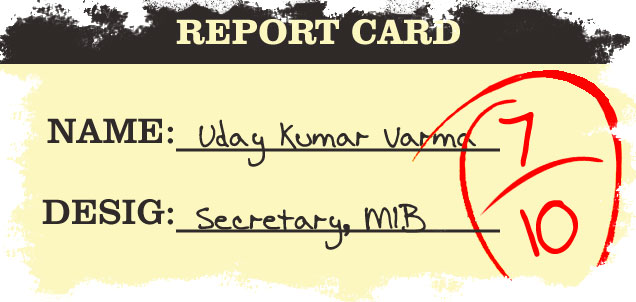
  • Mediaah! Report Card on Uday Kumar Varma’s tenure as I&B Secretary: 7/10


    By Pradyuman Maheshwari


    Uday Kumar Varma

    In October 2011, when Uday Kumar Varma had just been appointed Secretary in the Information and Broadcasting ministry there was much hope from the ace bureaucrat. He didn’t just have sound experience in the administration, but he also had spent a good time in the MIB.


    So he would be plug-and-play given the little time he would need to learn the nuances of the ministry.


    However, it’s one thing to be Special Secretary and another to be ‘the’ Secretary, especially when you know your stint is going to last two-odd years and you will be retiring after the tenure.


    MxMIndia had carried an article as a part of the Anchor with the headline: 5 Things the New I&B Secretary Uday Kumar Varma must do (see link: http://www.mxmindia.com/2011/10/the-anchor-5-things-new-ib-secretary-uday-kumar-varma-must-do/).


    There was a five-point tasklist. Here are the headlines:

    #1 Ensure new digitization announcement is implemented on time.

    #2 Must let self-regulators rule.

    #3 Should ensure paid contentwallahs are punished.

    #4 Push for news on FM Radio.

    #5 Empower government media – Doordarshan and All India Radio.


    I am not going to factor in #2, 3 and 5 here, because in a two-year stint there’s not much that you can expect any Secretary to achieve.


    Phase 3 of the FM radio regime has still not taken off and one can’t see independent news happening in a hurry on FM radio. It requires someone who believes in the medim to push these through with missionary zeal in what’s clearly a non-priority sector.


    Varmaji made the regular noise on self-regulation, measurement and paid content, the kind one expects from a Secretary.


    But it’s with digitization that the former Secretary has received the maximum bouquets and brickbats. At the outset, he deserves all the credit for digitization finally seeing the light of day. When the minister changed less than a week before first phase was scheduled to happen,  it was Shri Varma and his team’s conviction that ensured it takes place.


    But what happened before Phase 1 of digitization was effected was deplorable. The readiness numbers that the ministry declared were in sharp variance with the ground reality.


    It was Varma & Co’s resolve and understanding that the hiccups are inevitable is what led to the digitization been effected. Phase 2 was also pushed through, with its own share of problems, but by then the Secretary knew that it’s not switch-off-switch-on game. Every phase will have its own sub-phases.


    Had it been just the effecting of digitization, Varma would’ve got an 11 on 10, but the fact that the initial process had its share of big problems and that one had huge expectations from him given his knowledge of the functioning of the ministry, we give him a score of 7/10.


  • Ad cap effect: Rising customer satisfaction & ad rates


    By Ananya Saha


    Broadcasters have agreed to the toe the TRAI line on 10+2 minutes ad duration in a phased manner and fully with effect from October 1. Is it a good call? Will it impact the broadcast industry as the ad inventory comes down to almost half? What should be the broadcasters’ strategy to balance the revenue since it might take time for digitization benefits (subscription revenues) to shape up? MxMIndia asked industrywallahs what they think.


    PM Balakrishna, COO, Allied Media

    The regulation is certainly going to have an implication. There will be a huge change that the broadcast and media industry will have to make. The broadcast industry is skewed towards time bands, where prime time commands higher rates. With lack of ad space, the demand will see an increase. Price will become an issue. It is the medium that will start becoming a problem. At increased costs, the television medium will have to justify the cost to the clients. It is a preferred medium for many brands but with increased costs, they may start looking at other media options. It might create ripples.


    At the moment, brands and clients have not looked at it much. The industry is in the habit of not reacting till it lands on their head. But in the next one month, clients will start reacting. Going forward, a lot of advance booking will come into play. The move has been strategically placed around the festive time and hence may become chock-a-block. It will affect client and media agencies – we will have to plan much ahead.

     

    Punit Goenka, MD & CEO, Zee Entertainment Enterprises Limited (ZEE)

    Increasing rates – to keep pace with the increased reach of our media brands – is an on-going endeavour of the sales team. Now, in light of the TRAI directive, requiring us to reduce inventory which will enhance the overall viewing experience to a more engaged audience, the advertisers only stand to benefit multi-fold. So, with our advertisers getting a much better media proposition, the value for the same will also be at a premium. As such, our efforts to increase rates will only get further intensified. The extent of increase in rates will vary across genres and will be through a process of renegotiation of all contracts in a phased manner between July and October.

     

    Nina Elavia Jaipuria, EVP and Business head, Kids Cluster, Viacom 18 Media Pvt Ltd

    There are two implications of it: long-term and short-term. In the long term, it is good for all parties, including the advertisers, broadcasters, audience. It is a win-win situation in the long term, and it is important to keep that in mind when we look at the short-term implications. There is bound to a short-term pain for a long-term gain. The subscription revenues, to start showing results post-digitization, will have to wait. Ad revenues will fall. However, with limited inventory, the ad rates are bound to increase.


    The ad rates in kids category has not seen growth in a while. The only increase happens due to FCT or a new channel launch. Most of the growth has come from increased inventory, and it does not make sense since we tend to over-depend on it. With an increase in inventory, the ad rates do not go up. There, clearly, has been over-utilization by about 15-20 percent.


    We are looking at increasing ad rates by 25-30 percent. We have started working along with the clients and will comply with the deals and contracts. By the time October comes, we should be ready! However, this 10+2 ad cap assumes 100 percent usage of ad time, which might not be true especially in our category. So the ad rate increase will have to take care of it.

     

    Rahul Johri, SVP and General Manager – South Asia, Discovery Networks APAC

    Our core mission is to satisfy viewers with the highest quality and entertaining programming. We are equally committed to offer the maximum value to our clients who continue to appreciate Discovery’s networks’ efficient and effective inventory.



    Ashish Pherwani, Partner, Advisory Services, E&Y

    Basically, this regulation will have an impact on broadcasters. By reducing the available inventory, it will put pressure on ad revenues. Broadcasters will try to combat this in three ways: (a) reducing content cost (b) trying to increase ad rates and (c) trying to increase subscription income. Channels with a heavier skew towards prime-time advertisements will face a higher impact. What will be of interest to see is how advertisers react to the reduction in inventory available for prime-time shows.


    Shailesh Shah, Secretary General, Indian Broadcasting Foundation

    No one is being asked to, and no one is “toeing a line”. Every single broadcaster believes that advertising should be in line with the law enacted in the mid-1990s. There are no exceptions. Some believe this will happen naturally as consumers make choices; some believe it can be done in line with digitization. The zillion-dollar question has always been “by when”. None of the broadcasters are really ready for a fell swoop, however.


    Even though the law has been in existence for almost eight years (Advertising Code of the Cable Television Act), it never got enforced as the government probably felt a new industry needs to develop its roots before such a law can be enforced. The authority (aka government) apparently feels the roots have grown well and it is now time to enforce the law.


    Broadcasters formed a well-represented committee to find the least-resistant and least-harmful way to help make that happen. The transition it has worked out is best, under the circumstances.


    Will it hurt? Most certainly, in the short term it will be agony – to advertisers, to agencies and to broadcasters. On the flip side, it is an opportunity for the broadcasters to come together to ensure digitization is done completely and in a hurry so that the thus-far-elusive subscription revenue kicks in, alleviates the pain and, hopefully, makes it go away. Clearly, it will become difficult to survive if one is at the periphery of the industry or has not become relevant as yet. New entrants will find it difficult to get things going in the short term. Regional players will also face hardships. Over time, as alternative revenues come about, and the battle for lesser space intensifies, I believe the industry will find its new level.


    Advertising rates have always been addressed by market forces, and will most certainly continue to do so. Where the enforcement-related water-line settles is to be seen.


    The advertising inventory today is an average of just over 11 minutes per hour as measured from daily inventories. The inventory, where it matters, will come down, however, but much less than by half. In general, please understand that it has not been as bad as it is being made out to be.


    Here’s the irony. There are well over 60,000 local cable operators. No one in the Government has an estimate of more than 75 percent of these. There are close to a 1,000 MSOs. The Government knows about 60 percent of them. These distributors manage their own (mostly) local channels and, as if it were a cottage industry, are not regulated at all. It is estimated that there are well over 30,000 such television channels operated across the country and several of them produce and carry news too. In comparison, the broadcasters are licensed for just over 800 channels, operate just under 650 channels and quite a few are still reeling under the current economic circumstances.


    The broadcasters are the real Davids in all this and the distributors, who purport to catch a cold every time broadcasters sneeze, are the real Goliaths. I really have not understood what is being “regulated” as a result. The complex sagas of the world’s largest democracy are far more interesting than fictional dramas.


    To sum up, India needs to digitize at break-neck speed. The industry will hurt in the interim. The quintessential cultural undercurrent of the Indian populace and its businesses that says “this is my fate” will decide what really is the fate of the industry!

     

    Ashok Venkatramani, CEO, MCCS

    Eventually, it is a good thing – especially from the point of view of the consumer. However, the speed and abruptness with which it is being implemented is a serious cause for concern. It puts undue amount of pressure on a broadcaster who is yet to reap the benefits of digitization and is not sure how it will reflect on the revenues.


    In the long run, yes, it is good for everybody. It will put pressure on broadcasters like us to create much better content. And of course, it is healthy for the consumer.


    We are contemplating an ad rate increase, and will announce it very soon. An ad rate hike, when the regulation is being implemented abruptly, is inevitable.


    *Responses are in alphabetical order by last name

     

  • Data reporting is complex as of now: Neeraj Vyas

    The start to the sixth edition of IPL couldn’t have been better. At 100 million, the week 1 numbers from the tournament has generally surpassed expectations. But the sentiment is not as cheerful for Neeraj Vyas, Business Head of SET Max. According to him, the viewership numbers could have been more than what was reported had the digitization exercise not been underway. Especially data being reported from LC1 towns, which is turning out to be problematic for broadcasters, according to Mr Vyas.


     

    Mr Vyas shares his viewership sentiments with Johnson Napier of MxMIndia, and what he expects from the tournament in the coming weeks.


    The opening week numbers for IPL 6 seem impressive. Has the outcome been along expected lines?

    We have reported 100 million viewers this year compared to 78 million in the first week last year. So in a way it is good. But given the fact that TAM’s reporting of numbers has undergone such a sea change since September 2012 when the DAS exercise kicked off…that is when a change was observed in the Universe size. That was also a time when the LC1 data started to be reported and the weightage again changing to 20-25 per cent of the total Universe…this suddenly resulted in ratings coming out of rural India out of nowhere. If you were to do an apple-to-apple comparison, all of this was not happening last year. Also when the IPL 6 started off was when the phase II of DAS was underway…so it’s a fairly complex data reporting environment right now where there could be a lot of abnormalities. I am not saying there are but there could be. So given all the flux in the market, the fact that we opened to these numbers goes to show that there is a massive appeal in the IPL and that through our efforts we have managed to get viewers to come and sample the property by large numbers again this year.


    But digitization in a sense has helped you to attain high viewership numbers, hasn’t it?

    Digitization has indeed helped; if you see the GRPs of SET Max it has jumped from 134 last week to 245 this week. We have virtually driven the growth with this property.


    Despite the rise in overall viewership, the average match ratings for the first week have remained steady compared to last year. Why haven’t the numbers seen a spike?

    As I said, the LC1 data from markets like MP, UP etc have an audience base of 0-50,000 which translates to very minute and small towns but these places will never give you high ratings because of the problems faced like power shortage for 7-8 hours etc…so television numbers for channels including GECs have only come down due to LC1. Also, the advertiser doesn’t buy a spot in the IPL to reach out to the LC1 audiences…so if you remove the LC1 audiences and compare it to what it was last year then there is a growth at an all-India level of 4.1 and in HSM markets at 4.5. So it’s a hugely successful story for us.


    Do you think you were able to achieve the 100-million mark primarily due to the marketing initiatives undertaken? Any other factors that helped propel you to get there?

    The marketing initiative has indeed worked well for us. The track is something that is being loved and imitated by audiences across age groups. It has helped lift the happiness factor among the masses and the marketing execution has only fuelled in it getting there.


    Does this feat prove wrong the notion that cricket is seeing a downfall in India in recent times?

    IPL is a brilliant mix of cricket and entertainment. The matches have been good so far and the intensity has been phenomenal. So the start has been excellent so far.


    With such a bumper start, what are your expectations from the rest of the tournament?

    It’s too early to predict. As I said, because of the DAS 2 issue there is always going to be a fluctuation in the numbers that get reported…some places digitization is happening in other places it is not..and we are talking about 38 cities here. Had it been any other year I could have given an estimate but that looks difficult right now with the DAS exercise underway.


  • Digitization reaches 67% in Phase II cities: MIB

    By A Correspondent


    Fresh data from the Ministry of Information and Broadcasting states that 67 percent of the digitization target has been achieved in the 38 cities which are set for digitization by March 31. According to DTH operators and MSOs, a total of 108 lakh Set Top Boxes (STBs) have already been installed in Phase-II cities against the target of 1.60 crore, registering overall achievement of over 67 percent digitization.


    Hyderabad, Amritsar, Chandigarh and Allahabad have achieved nearly 100 percent digitization, according to the MIB, and 75 percent digitization has been achieved in eight cities – Jodhpur, Thane, Aurangabad, Jaipur, Pune, Faridabad, Nashik, and Ghaziabad.


    Analysis of the data further reveals that out of 38 cities to be digitized in Phase II, 28 cities have achieved more than 50 percent digitization individually.


    The ministry has also stepped up the public awareness campaign to sensitize consumers on the benefits of digitization, through print and electronic media. Both All India Radio and private FM broadcasters are airing radio jingles, the ministry has brought out a print advertisement in all 38 cities in the respective regional languages, SMS campaign is under way, and television channels have been frequently running video spots, blackout advertisements and scrolls.


    Meanwhile, the Indian Broadcasting Foundation (IBF) has reiterated its commitment to television broadcasting digitization. As mandated by the Ministry of Information & Broadcasting under the Cable Television Network Amendment Ordinance 2011, for the 38 cities notified in the Phase II sequence of the digitization roll out, television broadcasters will comprehensively switch off all analogue signals from midnight Sunday, March 31.


    The IBF board has stressed that such a move is necessary to smoothen the transition from analogue to digital cable TV. IBF members have been running regular awareness campaigns to educate consumers on the various benefits of digitization. Some of these benefits include better picture and sound quality, enhanced services such as high definition, video on demand content and eventually, higher quality content. In addition, digitization will also enable viewers to choose and pay for only those channels they want, rather than pick from packages with fixed prices. Digitization will also bring about greater transparency between broadcasters, cable operators and consumers.


    Man Jit Singh

    IBF President Man Jit Singh said, “IBF and its members are committed to the successful implementation of digitization in India. Our awareness campaign has received very good response. We are confident that the successful implementation of DAS-II will tremendously improve the quality of television content and consequent viewership in the country.”


  • MIB to launch Centralised Monitoring System for encrypted signals

    By A Correspondent


    In a major initiative to monitor the progress of digitization and to ensure the mandatory adherence of transmitting digital encrypted signals by Multi System Operators (MSOs), the Ministry of Information and Broadcasting is in the process of installing a Centralised Monitoring System to keep a tab on the encryption of channels by MSOs. The Centralised Monitoring System will be able to detect those MSOs which do not carry the mandated encrypted signals. MSOs are required to carry encrypted signals of TV channels in areas where digitization has been implemented as mandated by Section 4A of Cable Television Networks (Regulation) Act, 1995. Transmission or re-transmission of unencrypted signals would amount to violation of the terms and conditions.


    For the above purpose, a web based pilot project for the DAS monitoring system installed at Bangalore is undergoing field trials. Once implemented, it will enable the ministry to keep a watch on the implementation of DAS by all the MSO licensees through this system. To start with, this system will help the users to centrally acquire, log, analyze and prepare reports on the status of DAS parameters like total number/name of channels, encryption status etc of cable TV signals of head end of each registered MSO across the country in real time. This system can be augmented in future for content monitoring of the cable TV channels at local levels. It is expected that the system will also evolve as an alternative indicator of television viewing by consumers.


  • Digitization to facilitate transparency: Manish Tewari

    Manish Tewari

    By A Correspondent


    Minister for Information & Broadcasting Manish Tewari has said that the ongoing digitization process would help in building transparency in the system. As a mechanism it would also enable the growth of revenue models in the Broadcasting industry leading to the overall growth of the media and entertainment industry in the country. The process would also help broadcasters in identifying a balanced growth model through the increased share from the subscription revenues. 


    The minister stated this while delivering the keynote address at the Seema Nazareth Award function for excellence in print media.


    Elaborating further, the minister said that there was an urgent need for key stakeholders within the media to introspect in view of the trends that had emerged as a result of corrosive discourse on one side and responsible discourse on the other. Referring to the challenges that have emerged due to the social media, the minister said these tools had created an unprecedented potential to connect with target audience for the dissemination of news and information. The impact of this medium was so profound that it had also integrated with the print media in the dissemination mechanism. The changing paradigm in the media landscape had resulted in creating opportunities for the journalistic fraternity.


    Referring to the Seema Nazareth Award, Mr Tewari said that the institution of the award had provided an ideal platform to encourage and inspire young journalists in the print media. The minister conferred the award on Sushmi Dey and also gave two awards as a special mention to Shelly Walia and Debolina Sengupta. The Seema Nazareth Award has been instituted by Business Standard.


  • #Frames2013: Making Phase 2 of TV digitization a reality

    By Johnson Napier


    When phase 1 of digitization became a reality in India there was a sense of accomplishment that was witnessed amongst most factions within the broadcast industry. Apart from the huge advantages that it presented to the broadcasters and allied interests, it was also seen as an exercise that enabled the consumer to become empowered like never before. But while issues remain about the impending challenges emanating from phase 1 of the rollout exercise and also the non-interest shown by some metros, the industry seems to be waiting with bated breath for phase 2 of the rollout to take shape.



     

    In the session on ‘The second phase of TV digitization’ noted panelists from the sector came together to discuss and mull options of making the exercise a more robust and achievable one. The panellists comprised of N Parameshwaran of TRAI, Sameer Manchanda of DEN, Sunil Lulla of TTN, Man Jit Singh of Multi Screen Media, Raman Kalra of IBM, Tarun Katial of Reliance Broadcast and Anuj Gandhi of Indiacast. The session was moderated by Vivek Couto of Media Partners Asia.


    N Parameswaran

    N Parameswaran, Principal Advisor, TRAI began by highlighting the outcomes witnessed by rolling out of P 1 of digitization. “We all know what has happened with P1 of digitization where metros like Mumbai and Delhi have recorded a remarkable conversion rate. We may have questions about the metros of Kolkata not yet achieving their target and Chennai not yet taking off but rather than the negatives we should focus on the positives from this exercise, including the role that the industry players and stakeholders played in making this dream a reality.” According to Mr Parameshwaran, while P2 digitization would be kicked off from March 31, 2013 it would again require the coming together of industry players, trade bodies, MSOs/LCOs and the government itself in making this dream an achievable one.


    Sameer Manchanda

    Sameer Manchanda, Chairman and MD of DEN began by appreciating the efforts put in by all from the industry and added that “digitization has been the biggest change that has ever happened to our industry. While there are a lot of positives from this exercise, one of the big drawbacks as been lack of accountability. The MSO/LCO operators have to ensure that the KYC forms are filled by the consumers as it is mandatory and binding on them. There is still some time to go before that becomes a reality. Where I see it, P2 of digitization is a transition phase and will start rolling out over the next 60 days.”


    Anuj Gandhi

    Without wanting to sound too cynical, Anuj Gandhi, Group CEO, Indiacast said that while digitization has bought about a positive change for the industry there was some serious thinking that is needed. “If P1 of digitization is taking us about 7-8 months to become a reality we can imagine what P2 would be like. The onus lies on the MSO/LCOs to make this rollout a reality but I can assure you that this won’t be possible without the coming together of all from the industry.”


    Man Jit Singh

    Man Jit Singh, CEO, Multi Screen Media had a similar feeling to share as he voiced his excitement at the good that was seen from rolling out P1 of digitization. “Due credit should be given to one and all from the industry who made this a possibility and we can hope for a similar outlook from P2 as well. Even the government’s role has been encouraging but there are a few shortcomings that have to be worked upon if further rollout is to become more successful. There are issues that are cropping up at the MSO/LCO level regarding filling of KYC forms, data collection etc. All these have to be addressed immediately.”


    Raman Kalra

    Raman Kalra of IBM Global Business Services said, “We have entered an era where it is the end of digital. By that I mean that we are already in the know-how of how digital works and the benefits that the medium presents but the challenge now is how do we take it to the next level. There is need for the industry to come up with strategies to cater to the ever-evolving ecosystem.” Pointing out that the consumer today was faced with an array of choices to access entertainment, he said that consumers won’t mind paying more money to access content but it is essential that we know who our customer is and what are his likes/dislikes.”


    Tarun Katial

    Tarun Katial, CEO, Reliance Broadcast said that what DAS has done is enabled channels to have a wider reach and get carried more easily. “Early data has shown how most channels, especially those offering niche offerings, have benefitted in terms of ratings and acceptability from DAS. For new players, as you sharpen your positioning there are high chances of they getting lapped up more easily. The exercise has also opened new avenues for advertisers who will be looking at niche channels with renewed interest. I guess the advertisers will have to shell out more advertising dollars where niche channels are concerned.”


    Sunil Lulla

    Sunil Lulla, MD & CEO, TTN highlighted that the current economics do not fund the ecosystem as the industry is going through a transition and there is need for change. According to Lulla, it would do the industry a lot of good if the prices were to be lowered but that is not a logical thing to do. “In fact it is commendable to see how the industry has come together in making phase 1 a reality and the same can be expected from phase 2 too. At the end it is essential that we keep the customer at the centre of all that we do and keep on satisfying him so that he comes back to us for more.”


  • MxM Mondays: Stakeholders’ view on Phase II


    By Ananya Saha


    The data from DTH operators and MSOs indicates that more than 87.7 lakh Set Top Boxes (STBs) have been installed in Phase II cities against the target of 1.60 crore, registering an achievement of over 55 percent digitization. Out of 87.7 lakh, DTH connections accounted for 40.7 lakh, whereas cable STBs accounted for 47.0 lakh. A release from the Ministry of Information and Broadcasting said that it has been constantly monitoring preparedness for the implementation of digital addressable cable TV system in the 38 cities of Phase II. We speak to a cross-section of stakeholders for their views (in alphabetical order of their last names):


    Phase II: 38 Cities that need to be digitized by March 31, 2013
     

    1. Bangalore

    2. Hyderabad

    3. Ahmedabad

    4. Pune

    5. Surat

    6. Kanpur

    7. Jaipur

    8. Lucknow

    9. Nagpur

    10. Patna

    11. Indore

    12. Bhopal

    13. Thane

    14. Ludhiana

    15. Agra

    16. Pimpri Chinchwad

    17. Nashik

    18. Vadodara

    19. Faridabad

    20. Ghaziabad

    21. Rajkot

    22. Meerut

    23. Kalyan-Dombivli

    24. Varanasi

    25. Amritsar

    26. Navi Mumbai

    27. Aurangabad

    28. Solapur

    29. Allahabad

    30. Jabalpur

    31. Srinagar

    32. Vizag

    33. Ranchi

    34. Howrah

    35. Chandigarh

    36. Coimbatore

    37. Mysore

    38. Jodhpur


    Anuj Gandhi, CEO, IndiaCast

    All stakeholders are playing their role efficiently. We are playing our role and getting the deals done. We are using the learnings of Phase I when it comes to the issue of carriage fees. None of the MSOs are complaining this time. In Phase I, we did not have a refence point and now we have the signed deals of Phase I. This time it is a lot easier.


    Joydip Kapadia, Executive Vice President, What’s On India Media


    It will happen but in a phased manner. My logic is based on the fact that MSOs who are present in the metros are also present in these 38 towns. MIB has an upper hand now, and industry is prepared that Phase II has to happen unlike the Phase I where in the Delhi and Mumbai people thought that deadline would be extended. The towns like Ludhiana, Chandigarh, Pune etc are almost on track to become digitized while towns like Nagpur might take more time.


    Ashok Mansukhani, President, MSO Alliance

    Digitization has become a habit, and that is definitely good news. The consumers want the STB, doesn’t matter if it belongs to MSO or DTH operator. Of course, the markets in Phase II cities are more price sensitive than the Phase I cities. One also needs to understand that in the 42 cities that will be digitized by the end of Phase I and Phase II, a lot of people live in the slum areas. Hence, new packages will have to be announced on three price points: 100-150 Rs, 200-250 Rs and 300-350 Rs. The packages need to be tolerable to broadcaster, consumer and MSOs.


    My only request would be let us not bother too much about the date; we have achieved a big task. I am sure that out of 38 cities, 25 cities will meet the deadline but switch off pay channels in the cities that do not meet the deadline if you want faster progress. MIB has taken stricter stock of progress this time around.


    We MSOs have taken loan of about Rs 500 crore; no matter what we cannot afford to let digitization fail. I foresee that in the coming months, prepaid will gain more prominence as mode of payment.


    P Mohan, President, Karnataka Cable TV Chamber of Commerce

    I do not agree with the figures. The digitized homes are close to 35-40 percent in Bangalore. The national MSOs are focusing on meeting the supply for Phase I, only then would they concentrate on Phase II. We have been asking for boxes for more than four months, and even if they offer us STBs now, installation takes time. How are we supposed to install, offer packages, explain the packages to each customer is so less time when the deadline is approaching fast?


    We are not against digitization. It was in 2002 that we had proposed DAS. Today, MSOs, broadcasters and DTH operators have formed one group. And LCOs are not even asked or consulted.


    Bangalore has many additional TV homes. And the homes which installed digital boxes 4-5 years ago are today asking for replacements. The quality of STBs and the technology they support is also a concern.


    Mukund Babaji Pednekar, Distributor, Hathway cable at Thakurli, Dombivli & Kopar

    Digitization is happening at a smooth pace in our area, and we are positive of meeting the deadline. We have no problems or concerns regarding digitization. The consumer is aware and knows how they will benefit with digitization. Yes, the prices of STBs was Rs 600 when we ordered it two months ago and now it has increased to Rs 999. But thankfully, we do not need boxes as of now.


    Man Jit Singh, President, IBF

    The consumers are aware, the communication is reaching them. As broadcaster, we are aware that there will be a short-term reduction in profitability but we are positive that going forward, thanks to digitization, the ratio of our revenues from advertisements and subscription will be 50:50. The stakeholders have worked together, and are facilitating dialogue all across. With transparent systems in place, the industry will only progress. The numbers are impressive, and hopefully we will meet the deadline.


    Uday Kumar Varma, Secretary, Ministry of Information and Broadcasting

    We stand by our figures. The figures have been collated with industry feedback. We have not come across any negatives regarding meeting the deadline. Yes, some issues will obviously crop up but are sure to get resolved as well. Of course one issue leads to another: complete opaqueness, incomplete subscriber data etc will a little time to solve.


    My own understanding is that digital cable is a better platform than DTH as it can provide other services as well. In the long run, common sense suggests that digital cable will see a bigger comeback.


    Regarding the carrying capacity of STB, I am sure that domestic industry associations will step up to meet demands.