Tag: Covid-19

  • Why Brands have a Responsibility to Step Up & Help in Economic Recovery


    By Bhuvi Gupta


    Bhuvi GuptaIndia has been under a full lockdown since March 24, 2020. After three subsequent extensions, a relatively unsuccessful Unlock 1.0 & 2.0 in June and July, spikes in positive cases are forcing many Indian cities to go under full lockdowns, again.


    As the economy degrows, unemployment rises and sales decreases and every subsequent FY21 GDP forecast is worse than the previous one, the future seems bleak and unlikely to bounce back soon.


    Basis a GroupM report released in June 2020, India’s GDP will contract by 3.7% and subsequently overall advertising spends will decline by more than 20% this year.  This follows, as advertising in current scenarios is an after-thought, with most companies focused on reviving production and distribution. The drop in advertising has led to unprecedented job losses in the ad-dependent media industry, so much so that industry body International Advertising Association (IAA) has been running a campaign, ‘Let’s Advertise’ to spur advertising, since June 2020.


    The campaign seems to have made some impact  – brands in the Health & Hygiene categories or those that can pivot their messaging to sound Covid-wise have started advertising. However, this is a small portion of the market, and for the economy to revive, brands which can afford to, should, play a bigger role in recovery.


    As Keynesian economics espouses, spending spurs consumption during times of economic downturns. If brands (which can) spend monies, this will spur demand, and the money will help the economy as a whole. In such pandemic times, the messaging of many brands is irrelevant, a great way to remain visible is by running Public Service Announcements (PSAs) campaigns.


    While a decade ago, PSAs were issued by govt bodies, with the advent of social media, brands regularly run socially relevant campaigns because they help the brand earn respect and hence brand equity while also doing social good. Due to their affirming messages, PSAs also have higher than average trend-worthiness, i.e. audiences share these ads more because it helps them feel good about themselves to do something socially relevant.


    With the notable exception of Mumbai Police PSAs, most PSAs released by government bodies in India, are pedagogical spiels, which are not engaging, even when starring celebrities.
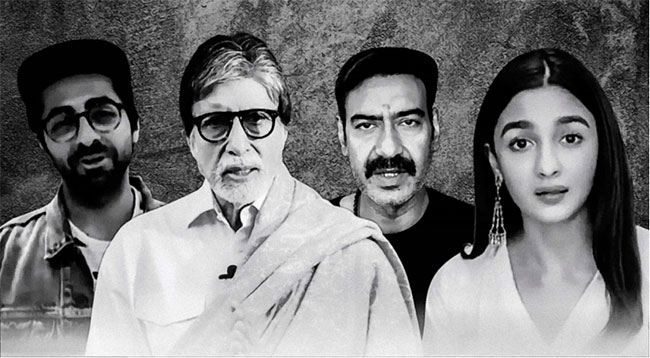
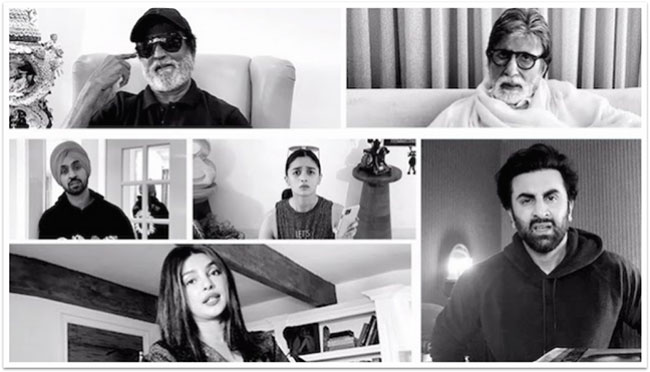
     

    In March 2020, just as the lockdown was announced, the Maharashtra government released a pedagogical PSA on Covid-19 headlined by the biggest stars of Bollywood including Amitabh Bachchan, Ranveer Singh, Ayushmann Khurrana, Alia Bhatt, Akshay Kumar etc. A month later, Sony launched a PSA with a similar Bollywood lineup but a much better storyline. (The PSA can be viewed here – https://www.youtube.com/watch?v=OQk0VrL2I-w


    Short film – ‘Family’, conceptualised and virtually directed by Prasoon Pandey for Sony Network starring celebs from across the country used storytelling creatively to communicate the importance of staying at home. It was telecast in April 2020. https://www.youtube.com/watch?v=ju7ku–S6F4


    Hence, in Covid-stricken times, effective PSAs can help brands kill many birds with one stone  – create brand equity, earn public goodwill, spur good behaviour, meet annual CSR target spends as mandated by Indian law and, most importantly, help the economy recover.  Earned goodwill will also spur trials for those whose loyalties lie with competitors.


    Budget-struck brands can collaborate with other brands; conduct digital-only campaigns to give the push to the economy to help its recovery.


    As brands with diverse target audiences release PSAs, different strata of society will get targeted which will help in overall compliance. This is backed by research conducted by 2019 Nobel laureates in Economics, Abhijit Banerjee and Esther Duflo. In a paper released last month, they have shown that frequent celebrity messaging, in addition to the existent large-scale government messaging on Covid-19, can positively impact behaviour by nudging people to follow best practices. The research also shows that there are spillovers of good behaviour in the entire community even when a few are targeted.
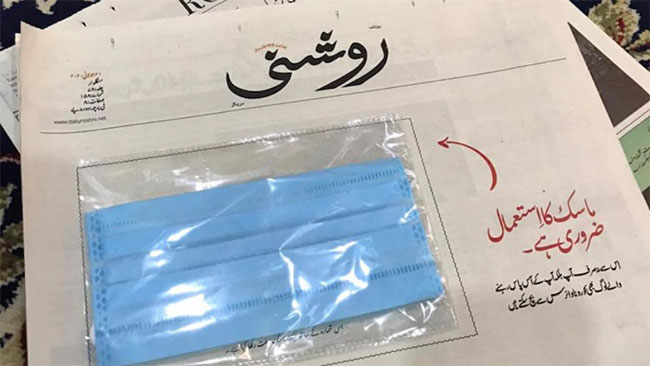
    In a CSR initiative, waiting to be replicated by national dailies, Kashmir ‘s Urdu newspaper Roshni, affixed a mask on the front page of the paper on July 20 to drive home the message about mask usage. Kashmir was under complete lockdown from 22-27 July, due to a rise in Covid cases.

    VIRALITY TO BEHAVIOURIAL CHANGE

    The challenge even for good PSAs is translating virality to behavioural change. The ease of communication brought on by social media has made armchair activists of the majority of the population. However, while these activists enable knowledge-sharing with other people they don’t bother much with acting upon the gained knowledge before moving on to the next trending topic. Which is why, despite the dangers of inobedience, many who wear a face mask, style it as a chin-guard.


    Hence, brands should be careful to create PSAs which are not just a retelling of facts, but facts communicated in way to appeal to their targeted audience, whether it is through high quality storytelling, a new ‘Hook Step’ or a ‘Challenge’ which is creative enough to warrant sharing.  Basis the research by Banerjee and Duflo, leveraging brand ambassadors signed on for lavish multi-year contracts will also help to drive behavioural change. So brands, any takers?


    Bhuvi Gupta is a marketer with over 10 years across industries, of which the last six have been in Media & Entertainment. She has been a part of many launch marketing campaigns – specifically at the Times of India group, Republic TV and the latest in marketing a Bollywood film. She will write on A&M (mostly marketing, but often on advertising too). Her views here are personal. She tweets at @bhuvigupta3



  • Is Legacy Media Recovering in the Unlocking?


    By Indrani Sen


    During the last two or three weeks, we saw many reports on how the AdEx has improved in June 2020 ensuring us that not only digital, but TV and print are also on the path of recovery after Covid-19. TAM AdEx for June has shown that TV advertising volumes increased by 74 per cent per day in June compared to April, when adspends declined sharply due to decline in demand during the nationwide lockdown. TV ad volumes saw 46% growth in June compared to May.
     

    Print, which suffered a bigger hit in terms of revenue due to distribution problems during lockdown, has recorded a higher increase of 325% in average ad volume per day in June 2020 when compared to April 2020. Most of the business newspapers and industry websites reported on the recovery of digital and TV media. None of the articles highlighted the comparison between the first quarter and the second quarter of 2020 which could have given a better idea about the recovery of ad volumes in digital and TV media.


    I saw only one article in details on Print AdEx on the recovery of Print AdEx which also did not have any such comparison (https://www.financialexpress.com/brandwagon/print-advertising-on-the-road-to-recovery-as-average-ad-volumes-per-day-rose-325-in-june-2020-tam-adex/2032701/). This trend of lack of reporting on print clearly indicates that the medium has lost its position to digital not just in terms of share of the advertising pie, but also in the share of mind map of the audience, the advertisers and agencies.


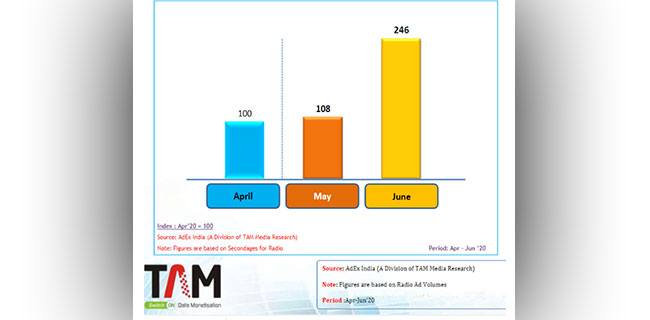
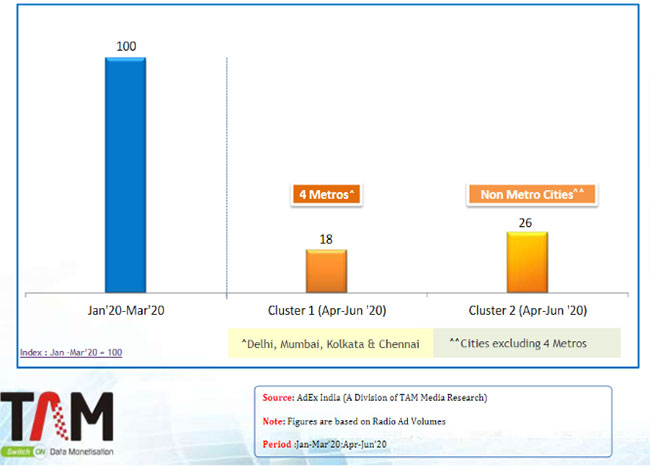
    The Advertising Report on Radio – April-June 2020 published by TAM shows that average ad volume per day increased by more than two-fold in June compared to April and May. However, a comparison with the first quarter of the year (Jan-March) shows that the ad volumes in radio are still much below the pre-Covid-19 phase. It is interesting to note that FM Radio ad volumes in Non-metro cities have recovered better than metro cities.


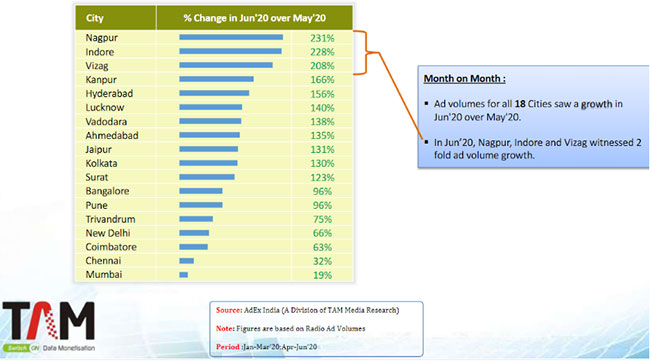
    The ad volumes of radio advertising in all 18 cities grew in June 2020 over May 2020. The chat below shows that the eight non-metro cities, Nagpur, Indore, Vizag, Kanpur, Hyderabad, Lucknow, Vadodara and Ahmedabad have shown much better growth in June 2020 compared the four metro cities. Kanpur, Indore and Vizag led the chart with each accounting for two-fold growth in ad volumes. Among the four metro cities, Kolkata has shown the highest percentage change in June 2020 over May 2020 with Mumbai showing the least percentage change. The listenership of FM radio increased during the period of lockdown and has retained the level, but advertisers across different cities are investing in the medium in different way.


    The report has detail analysis of radio advertising by categories, advertisers and brands as well as city wise analysis of the performance of radio AdEx. It also presents comparative analysis of TV and radio and digital and radio advertising during Jan-June 2020. The Top 10 common categories, advertisers and brands between TV and radio shows that during the first six months of 2020, Top 10 common categories, advertisers and brands added 33%, 14% and 4% on TV while they added 10%, 7% and 4% on radio.  Similarly, the Top 10 common categories, advertisers and brands between digital and radio shows that during the first six months of 2020, Top 10 common categories, advertisers and brands added 47%, 18% and 12% on digital while they added 19%, 2% and 1% on radio. The role of radio in the media mix needs to be reassessed by advertisers and agencies for the growth and survival of the FM radio industry during this period of unlocking and subsequent return to normalcy.


  • Mera Non-Metro India Mahaan


    Given the economic disruption caused by the Covid-19 pandemic, non-metro markets are likely to recover faster than metro markets, an EY survey finds. The report titled ‘Will non-metro markets propel India’s recovery’, reveals a higher percentage of respondents from non-metro markets expect to spend more than before on several categories compared to metro markets indicating that when the lockdown ends, green shoots of recovery would probably sprout faster from the non-metro markets.


    The survey covered a varied demographic mix of more than 4,000 respondents (2,000 each from metro and non-metro markets) to understand the potential impact of the pandemic from the consumer sentiment perspective. It covered key aspects linked to the current and expected attitudes, behaviors and spending trends of consumers as they adapt to the new reality.


    Ashish Pherwani

    Said Ashish Pherwani, Partner and Media & Entertainment Leader, EY India: “The Covid-19 pandemic has radically shifted our way of life. However, despite uncertain and challenging conditions, our research shows that non-metros express a higher degree of resiliency and a resolve to bounce back quicker compared to metros. We may see long-term and even permanent changes in consumption patterns”.


    The survey results reveal that the pandemic and the ensuing social distancing measures put in place have led to fundamental changes in how Indians are consuming media, necessities, luxury products education and travel.


    Some of the key insights from the survey include:

    :: Health, hygiene and online services will continue to grow


    While COVID-19 has impacted overall consumption, categories like heath products, household products, hygiene products, vitamins and supplements and online services (gaming, home entertainment, online education, online banking) are expected to benefit.

    :: Non-metro market recovery is excepted to be faster than metro recovery


    Categories like consumer goods, travel, entertainment, automobiles and white goods are all expected to see increased and faster recovery of demand from non-metro markets post the lockdowns.

    :: Increase in digital adoption


    Digital trials increased significantly during the lockdown period.  However adoption was higher for metros vis-à-vis non-metros.  Some of the obstacles stated by non-metro respondents included lack of technological knowledge, absence of smart phones and fewer language interfaces.

    :: Newspapers remain the most trusted medium


    The impact of coronavirus has unfolded at a dynamic rate, causing a sense of urgency to absorb information, increasing the consumption of news coverage at unprecedented levels. Newspapers continue to remain the most trusted news source. 42% respondents in non-metro markets spend more than 20 mins in reading a newspaper compared to 36% in metros.


  • New Emotions for Old


    By Shashidhar Nanjundaiah


    Unusually, the hashtag #Nonsense_Modi topped the Twitter trending list in the country for several hours earlier this week after a primetime debate, where a spokesperson of the Opposition repeatedly used the term “nonsense” to question the government’s apparent stance that any question around the Ladakh standoff was against the nation’s interests. Although the ruling party’s spokesperson tried to defend that charge, the opposition was loud and relentless. Under the hashtag, which emerged from behind and beat #Nonsense_Rahul to the top, went well beyond the Ladakh statement, tagging eclectic national issues from job losses to Covid-19 to GST.


    To a student of media communication, this is a sign. The nature of media audiences is that they look for new emotions to massage themselves with. You have to start to wonder–and fear–what lies next in BJP’s media-agenda armoury. Is the narrative using the same old emotive messages while the media users are hankering for new emotions? Fear, hatred, nationalism have played their part. What next? The popular media-alarm “Massive controversy erupts” may still evoke volcanic mnemonics in us, shaking us out of our bot-like social-media existence. But emotional appeals must evolve, it seems.


    GOING PARASOCIAL

    For, after all, emotions drive today’s audiovisual news more than ever before. The surprise lies in how late news got into the act, decades after motion pictures and non-news television—and the all-inclusive digital media—recognised the clear market for emotive messaging. Viewers play with the television screen in a “parasocial engagement”, according to media psychology scholars Horton and Wohl. Until the social media swept the audience attention, the audiovisual media continued to rely on rational appeal. Today, stung but clever enough to co-opt its competition, news television knows better.


    But that’s the nature of immersiveness. It is high-involvement but temporary. Emotions around issues, with the exception of long-term investments in emotional attachments, are often transient. “When India’s onboard [demonetisation], why isn’t the opposition?” asked a channel, more or less summing up the implied nationalistic emotion. Considering the trouble it caused on ground, that political detail would seem a sadly ironic emotion, in conflict with what people felt. The more recent “#ChinaGoBack” call, too, tied itself to narratives aimed at nationalistic emotions. 


    EMOTIONAL TRANSIENCE

    But are media houses running out of emotions? News editors’ stated role has been to set the agenda of what we must think about. But their new role is in setting an agenda of individual emotions that add up and galvanise themselves on social media to become public emotions. We can call this emotional agenda-setting. In a binary context, this role would be set against a traditional, editorialised form of agenda-setting.


    Aristotle had said that man is either a political animal or an outcast like a “bird which flies alone”. Individuals have personal, social and cultural needs that must be fulfilled through associations. The welter of social media messaging gives the individual a false sense of being the agenda-setter: One that must indulge, take sides, react. Some scholars have used a somewhat awkward term, masspersonal, to describe our current state of social media usership. The more conventional media routinely use the social media mores and norms to boost their own viewership, borrowing trending posts to create news. So it won’t be amiss to use this masspersonal nature of consumption to news television, which mobilises mass emotions by hashtagging personal emotions.


    News language’s new role is visual, drawing us in. The news media is there to help us construct our truths. One way is drawing our attention to ‘massive controversies’ erupting everywhere. To draw inferences that are more detached, we must feel a need to be media-literate in the new digital age. And as history will tell you, media literacy follows media technology and techniques. Regrettably, we can never really catch up or the game would be up.


    So sure, emotions are here to stay. But how to juggle those emotions periodically will determine how strategically a marketing head and editor can jointly manipulate public sentiment.


    As founder of BeingResponsible, the author Shashidhar Nanjundaiah is trying—really hard—to instil Responsible Media Literacy among younger citizens through courses at schools and colleges. The 20-hour courses are a combination of awareness, deep-reading media exercises, and basic rules-of-thumb forensics to recognise fakeness. Earlier, he has led media institutes of repute to positions of leadership. Prof Nanjundaiah can be reached shashi.nanjundaiah@hotmail.com. His views here are personal.


  • Bhupendra Chaubey goes for the Big. Joins India Ahead as Owner, Co-Promoter, CEO and Group Editor-in-Chief

    By A Correspondent


    Senior journalist and former main man of CNBC-News 18, Bhupendra Chaubey will manage the affairs of 12 editions of Telugu daily Andhra Prabha, English Language news channel India Ahead, and its foray in to regional spaces. He has joined India Ahead, the English national news channel beamed out of South India as Owner & Co-Promoter. He will be part of the core founding team, a release added. He will also be Group Editor-in-Chief and CEO.
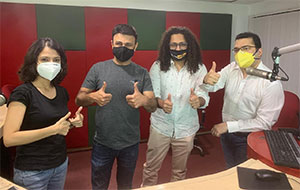
     

    “In the post-Covid world, the media landscape is changing dramatically. And there is no  one better poised than Bhupendra to take this Media company forward and create a new template for broadcasting.” Goutham Mootha, the Founder Promoter of the company said.


    Said Chaubey: “I have known Goutham for a while. He paved the way and invited me to become his partner that enabled me to get into broadcasting with my own creative and disruptive ideas, post moving on from Network 18. The sheer opportunity to build a disruptive business model and create  business as well as viewer value in the post-COVID world convinced me that this was the best time to take up this challenge,” adding: “Future is all digital. Some of India’s best minds have come together with me to layout an execution roadmap which makes for a very exciting journey ahead. We want to be local and global. India Ahead will not just be a TV channel or a print publication, this is the time for a Tech-enabled multi-platform news organisation.


  • TimesJobs & Radio Mirchi launch ‘Baat Baat Pe Jobs’

    By A Correspondent


    E-recruitment website TimesJobs and Radio Mirchi have re-ignited their CSR initiative ‘Ready Steady Jobs’ for Season 2 with the title- ‘Mirchi Par Baat Baat Pe Jobs with TimesJobs’. In its maiden season last year, the campaign had shortlisted over 3892 candidates were in just 21 days and finally helped 1,065+ professionals get jobs.

     

    Explaining the details about the campaign, Sanjay Goyal, Business Head, TimesJobs & TechGig said: “At TimesJobs, our endeavour has always been to help people find the jobs of their choice. In the Covid-19 crisis, we wanted to rise above our business scope and help professionals cope up with career crisis triggered by Covid -19. We are joined by an equally enthusiastic team at Radio Mirchi Delhi for the campaign. I hope ‘Mirchi Par Baat Baat Pe Jobs with TimesJobs!’ is as successful as its earlier edition – named, ‘ReadySteadyJobs’ – where more than 1100 professionals were hired and more than 3800 applicants were shortlisted in just 21 days. All candidates have to do is sign-up at the campaign page free of cost and update their resumes and relevant companies/recruiters will contact them.”


    Added Shivangini Jajoria, Regional Director-North & East, Radio Mirchi, said: “Mirchi as a brand is always known for spreading happiness. In these tough times, too, we intend to follow through on this principle by putting forward ideas and campaigns that directly address concerns facing people today. One important crisis being faced by people during this pandemic is a career crisis. Through this campaign we will not only handhold our listeners through various aspects of the pre-recruitment process but also provide them with access to some of the top recruiters. We at Mirchi are excited to drive this with the TimesJobs team and are looking forward to making this a success!


  • Big FM and Mcgarrybowen India launch #PrideFromHomeByBigFM

    By A Correspondent


    Big FM has together with Mcgarrybowen India, the creative agency from the house of Dentsu Aegis Network (DAN), taken its philosophy ‘Dhun Badal Ke Toh Dekho’ a step further in its latest campaign, #PrideFromHomeByBigFM.


    Notes a communique: “The Covid-19 induced global pandemic that enforced a strict national directive that everyone follow physical distancing, has led people to stop expressing themselves at public gatherings including the Pride March. Therefore, Big FM, in association with Mcgarrybowen India, decided to encourage everyone to be part of the Pride parade without leaving their homes and showing support by hoisting an unusual flag from the safety of their homes.”


  • ShemarooMe launches Box Office for new releases directly on digital

    By A Correspondent


    ShemarooMe has announced the launch of ‘ShemarooMe Box Office’, a platform that will give cinema curators/ producers an opportunity to access digital avenues.


    ShemarooMe Box Office is poised to create an ecosystem for small budget Bollywood and Regional movies that have an audience but limited avenues to reach out to the viewers. To widen the scope of relevant audience reach for such films, ShemarooMe has also inked a strategic partnership with BookMyShow, India’s leading entertainment destination to ensure more cine-goers have access to the rich content made available by ShemarooMe.


    Can book their tickets for these films by logging on www.bookmyshow.com or directly on the ShemarooMe App or www.ShemarooMe.com.


    Hiren Gada

    Commenting on the launch, Hiren Gada, CEO, Shemaroo Entertainment Limited, said: “During these trying times when moviegoers are missing watching new releases in theatres, we are glad that we can bring home some great releases. With ShemarooMe Box Office, we are creating a model for the film industry and audiences. Our association with BookMyShow will further redefine the consumer movie-going experience and bridge the gap for cinemagoers across India. We are absolutely confident that when cinemas are able to reopen safely, the public will once again respond to the unsurpassable big-screen experience, meanwhile our platform will be bridging the gap by entertaining audiences thereby living by the traits of Shemaroo being the platform for movie lovers at all times.


    Added Zubin Dubash, COO Digital, Shemaroo Entertainment: “Covid-19 has made every organisation, innovate at the speed of light. ShemarooMe Box Office is an innovation that helps not only one organisation but the entire ecosystem – viewers get to watch new releases, producers get a transparent platform for release, ticketing partners get a model for the new normal. And ShemarooMe ensure it lives up to its promise of entertainment at all times.”


    Said Ashish Saksena, COO – Cinemas, BookMyShow: “We are glad to partner with ShemarooMe to bring cinematic entertainment to the comfort and safety of audiences’ homes. We look forward to keep bringing newer options to experience entertainment for all our users.”


  • Woes UnLtd with Creative Pitches


    By Sanjeev Kotnala


    No one is surprised by the number of business pitches happening in the MAdTech world. There is a different world of uncertainties out there. To compete and succeed brands needs new thinking that comes from the collective efforts of many brilliant minds.


    A pitch is a process where multiple pre-identified agency organisations, in anticipation of co-partnering the brands in its success, willingly and freely provide inputs into thinking and strategy.


    Nothing has changed in the pitching, and the MAdTech world in spite of the Covid-19-forced lockdown and digital focus in media.


    YESTERDAY.

    Early November 2019, once again, there was a buzz in the industry. A large agency had publicly sued and taken on a large mobile brand for plagiarism.


    Everyone was watching. The case could have helped break industry inertia about pitches and idea shopping. The industry failed to realise, they were not just part of the problem, but the problem.


    Nothing happened, and the case as expected was settled amicably. The business part overshadowed the ethics and the pain of seeing the idea plagiarised. The will to fight for the cause died its natural death.


    No, it is not the only case. But it is a case people spoke about. It looked as if the industry was finally going to act. Many industry leaders raised voices and shared their solutions to the problem of idea shopping and plagiarism. But- nothing happened.

    Nothing ever changes. Nothing is changing.


    MULTIPLE IDEAS.

    Meanwhile, it is learnt that the Advertising Agencies Association of India (AAAI) defined norms for member agencies participating in media pitches.


    In case of Creative and Strategy Pitch, many ideas and suggestions to tackle the menace of pitches, idea shopping and plagiarism have been discussed.


    Starting a PITCH CREATIVE DIGITAL VAULT. A place where Pitch creative get registered and archived. They could be released in case of a conflict.


    Evergreen non-starter idea; PITCH FEE.


    Signing an NDA. The concept of client signing pitch creative and the deck. Agencies know how effective it can be.


    REGULATING PITCHES. If a client calls for a pitch, it gives notice of separation to the current agencies. It terminates the client-agency relationship or sets a dateline for termination. And, the client does not invite the current agency to the Pitch.


    But as expected, nothing happened. Or nothing that has been presented in the public domain. 


    TODAY.

    The pitching season is on. Agencies are willingly providing best effort collective thinking with no obligation to their so-called prospective client.


    The client enjoys the focus. They are the rule-makers, referee and the player in the pitching process. The pitch helps the client in gaining a better understanding of the possibilities and potential of the brands in the new scenario.


    As the agencies match in with their best pitch marshals, the client is getting wiser with free consultancy from agencies. Larger client teams sit through these presentations and get trained on thinking and market understanding.


    Multiple set of strategist and iterators are working on the brand. There is no obligation on the client to take a timely decision. There is no fee. There is hardly any cost other than maybe a few rounds of tea and working lunch. The business goes on. 


    YOUR IDEA, HER/HIS IDEA. MY IDEA.

    Wait for the festival period, when the war for a share of mind and wallet will peak. Brands hopefully will release new campaigns.


    Many agencies will be surprised to see uncanny similarities between their pitch work and the work released by a client. The agencies will discuss internally and come to the natural conclusion that the client’s agency got inspired by their work. They will abuse and craft choicest of creative expressions for the client. They will talk of it not being ethical over old Monk or Johnny Walker as the case may be. The agencies will accept it as part of the business. They will not take any offensive action. Nothing will change. 


    INACTION IS AN ACTION

    Inaction is always an alternative, and hence choosing it is a deliberate act in itself.


    It is a price the agencies are willing to pay. A price they will keep paying again and again when they enter the arena of free pitches. In the process, their inaction is an approval of this game.


    The client does not mind. S/he gets habituated of pitches whenever wanting a change of faces or the strategy. The client use pitches to understand the market scenario and blatantly idea shop. The hapless agencies accept it. The industry norm gets further strengthened. It is Okay.


    Oh, there will be newer excuses as to why they cannot do anything. Why in the new normal the business is tough and economy in tatters. Some would tell you, No one in the industry is doing it, and hence they cannot be leading the change.  Yeh toh hota hai 


    TOMORROW 

    Yes, the same talent will design purposeful CSR campaigns on the ‘power of one’. They will tell you how every act and vote matters. They will talk idea shopping pitches and plagiarism and how it is eating the industry. They will find inspiration to create scam ads while talking of originality, relevance and impact in their speech of acceptance.


    Meanwhile, some observant consultant having no idea of a possible viable solution to this highly rational problem will write a blog.


    Nothing has changed, and nothing will change. After all, pitching is as old as scam ads for awards.


  •  Madison OOH launches OTS Measurement Updates for Covid-19 unlock period

    By A Correspondent


    Madison has to launched an extension to its Traffic Count Tool to provide clients with legitimate data to help them note the actual changes in OOH mobility in the Post COVID lockdown era.  Madison’s technology partner for this is  AdMavi – a geo-spatial marketing solutions company, founded by alumni from IIT Madras.


    Said Vikram Sakhuja, Partner & Group CEO, Madison Media & OOH: “Thanks to traffic count data that we have built data tech partnerships in, it is now possible to track the post lockdown recovery of traffic on our metro roads. This should help build confidence amongst OOH advertisers.”


  • Rediff & Swayam campaign displayed across 79 cop stations in Cal

    By A Correspondent


    The Commissioner of Police and Kolkata Police is supporting a campaign #StopDomesticViolenceCampaign created by Rediffusion and Swayam, a Kolkata-based women’s rights organisation working since 1995 to advance women’s rights, facilitate women’s empowerment and end violence against women. As a drive to generate awareness, the camapign posters will be displayed across  all 79 Police Stations under the jurisdiction.


    According to Amrita Das Gupta, Associate Director of Swayam: “Domestic violence is a deep-rooted structural problem in our society caused due to patriarchy and gender inequality which prevents women from leading a live free from violence and dignity. Through this campaign, Swayam hopes to involve individuals, corporates and institutions to support the #StopDomesticViolenceCampaign and help raise awareness around domestic violence.”


    Added Nilanjan Dasgupta and Piyash Ghosh, EVP& ECD, Rediffusion: “During Covid-19 lockdown, incidents and reporting of domestic violence increased by 20-70% across the world and the National Commission for Women reported a two-fold increase in domestic violence reporting in India. UN Women recognised this situation as a ‘Shadow Pandemic’. The lockdown has hugely exacerbated the incidence and intensity of violence faced by countless women and girls, both in their parental and matrimonial homes, as they are locked in with their abusers 24×7. Even after the lockdown has been lifted partially, many women still cannot approach Swayam due to the COVID 19 pandemic, limited public transport, no access to money and difficulties in the home situation. We hope the #StopDomesticViolence campaign will help us raise awareness about the shadow pandemic and help survivors of violence reach out for support.”


  • Max Bupa asks people to invest in health insurance

    By A Correspondent


    Max Bupa has announced a 360-degree brand campaign to drive home the importance of having a health insurance cover. The campaign poses the question – Ab nahin khareedoge to kab?, implying that health insurance is an absolute necessity and priority for everyone, especially when Covid-19 cases are rapidly increasing in the country and medical costs are skyrocketing.


    Said Anika Agarwal, Director – Marketing & Direct Digital Business, Max Bupa Health Insurance: “Covid-19 has made people realise the significance of a health plan, unlike earlier when health insurance was considered an optional expense especially by the younger age segment. People across life stages are now more willing to buy adequate health coverage for themselves and their loved ones. Max Bupa’s recently conducted Covid-19 survey also indicates that people have become more concerned about their health and have regularly enquired about coronavirus treatment in health insurance plans. Hence, our intent with the campaign is to create awareness and further establish this need, so that consumers do not procrastinate health insurance purchase and buy a suitable health insurance plan. We have featured Boman Irani, a trusted voice who is encouraging people to take the right decision, to drive a simple message – ‘This is the most appropriate time to buy health insurance!’. The pandemic has made people take their health seriously, but a message of urgency for health insurance is needed. We therefore felt the need for a campaign that would strike a chord with most Indian households to bring about a mind shift to invest in Health Insurance.”


    The campaign has been jointly designed by Dentsu Impact and Isobar. Added Anupama Ramaswamy, National Creative Director at Dentsu Impact: “The fact remains that at a time like this, no matter how many rules you follow, you still need to be prepared for everything that’s not in your direct control. We wanted to highlight that stress is the prevailing emotion these days in most people, and one of the ways you could possibly lighten the load in your mind is by getting a health insurance. In the film, Boman Irani has effortlessly brought the message on the importance of a health cover in the light of Covid-19 pandemic.”


    Said Gopa Kumar, Chief Operating Officer at Isobar said, “The current COVID-19 situation has been an eye-opener for all of us that there’s always a possibility for the unexpected to happen. However, what we can do on our part is to stay prepared for it. With Ab nahin khareedoge to kab?, we are putting the spotlight back on the inevitable importance of health insurance in everyday life. Just like masks, gloves, sanitizers, etc., have become health essentials, we want to make health insurance also a part of that checklist. We hope that the film makes the audience realize urgency of the situation and inspires them to insure their health.”