Tag: BARC

  • Mediaah! It’s time English News TV ecosystem stops being sexist and considers women viewers watching Eng news + BARC Data Watch

    By Pradyuman Maheshwari


    The news channels keep debating about how women get a raw deal in our country. How India is a male-dominated society. Anchors and activists get your blood to a boil, an Arnab Goswami makes kheema out of anyone even talking about women in the negative.


    But these very broadcasters and their advertisers and media agencies who buy advertising on these channels keep pushing a regressive perception that only men watch English news channels and that advertisers buy spots on English channels because men watch them.


    This belief also suggests that women are typically not viewers of English news channels, that they don’t consume serious content and current affairs etc. Even if it’s not intended, the same progressive English news channel companies and those who run it are stereotyping women into what they quite definitely are not.


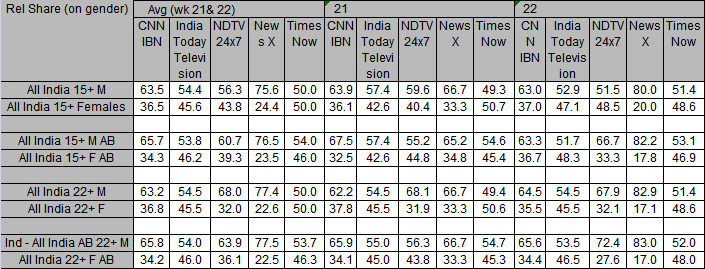
    A quick look at the English news channel viewership data from BARC  for Week 22 and Week 21 clearly indicates that women can’t be dismissed in terms of viewership numbers of English news channels (See Table Below). In fact, Times Now has an equal number of female and male viewers. India Today Television has women scoring a little less than men and even in the other channels it’s not that women form a miniscule viewership.


    Time that English news television ecosystem takes our women viewers seriously!

     Data Source: BARC


  • Shailesh Kapoor: Getting Used to BARC

    By Shailesh Kapoor


    The new (BARC) ratings are settling in and individual-level data is now available as well. As the market adapts to a new measurement system, there is a hint of confusion in the air. And there’s one dominant reason for it – the constant comparison between the old (TAM) and the new measurement systems.


    No two designs of a large sample study give similar results, especially when there are several conceptual changes in their design, like that of the NCCS being adopted instead of the SEC system. At best, one can compare ranks. For example, it is reasonable to expect that the No 1 channel in a category would not be different in the two systems, especially if there was a wide gap between the Top 2 in the old system.


    BARC has been built on the premise that it is more robust, secure and future-ready compared to the old system. It was created because there were widespread concerns about the old system. A comparison exercise, then, becomes a contradiction in itself. Hopefully, the dust will settle soon, and the focus will shift on the new data than its comparisons with the old. And there will be enough and more to unravel.


    The Hindi GEC programme ratings of the latest week (as well as recent weeks) tell their own story. The Top 5 programmes last week were Saathiya, Ashoka, Sasural Simar Ka, Balika Vadhu and Yeh Rishta Kya Kehlata Hai. Except Ashoka, which launched earlier this year, the other four are old horses, with an average lifespan of five-and-a-half years!


    There’s a clear consumer statement in this rather simple, back-of-the-envelope data point. More than 150 new fiction shows have launched over the last five years. Yet, the audiences have stayed with their staple primetime diet over half a decade! That’s less a comment on the high quality of the staple and more a comment on how the new attempts have not managed to take the offering to the proverbial next level.


    Even Diya Aur Baati Hum, which would have made it to the list in another week, is a 2011 show. What exactly happened to Hindi GEC fiction content in 2012-14? Equally importantly, because large proportion of viewership of the top shows isdriven by habit and nostalgia, wouldn’t there be viewership attrition (if and) when these shows are off-air? We would need many more Ashokas to keep the fiction flag flying high.


    Meanwhile, even as new fiction struggles, non-fiction continues to make some impact. It may not feature in the Top 5 this week, but the latest season of India’s Got Talent is by far its best. There’s little to fault in this reality show that combines outstanding talent with great production, and a jury that should get full marks for their chemistry alone.


    I was also impressed by the first two episodes of The Voice India. The format is strikingly different from other singing shows, and the casting of the four coaches makes it a near-coup. I’m curious to see how the show shapes up, especially once the team selection process, the current differentiator, is over.


    Yes, there’s enough to talk about on the content front, once we shift focus from TAM vs. BARC.


  • Zee, India Today big gainers as BARC India releases individual ratings

    By A Correspondent


    Joint industry body BARC India has rolled out its first set of data on individual viewership starting with Week 21 of calendar year 2015. That’s Saturday, May 23 to Friday, May 29, 2015. Starting Week 21, of BARC India will get both – household and individual viewership ratings data on their BARC India Media Workstation (BMW) user software.


    The following are the highlights from Week 21 of the data release:

    :: Among Hindi GECs, Zee TV moves up to No 3 position in Individual ratings data from its earlier No 4 position in Household ratings data (HSM 1L+ C&S)
    :: CNBC TV 18 is the clear leader amongst English Business News Channel (All India 1L+ C&S). This is important given the major ads by rival ET Now claiming supremacy
    :: IPL 49.4 mn individuals in 20.7 mn homes spent average of 1hr 8 mins watching the IPL Final. This corresponds to 11.24 mn Rat’000s (Between 7:30pm to 1:00am) (All India 1L+ C&S) – Combined for Sony Max, Sony SIX, Sony Six HD. BARC India categorises Max as a sports channel given the IPL telecast.
    :: Even as Times Now leads the English news category, India Today with its new brand name (from Headlines Today) has higher Reach and is No 2 this week (All India 1L+ C&S)
    :: Colors is primetime Hindi GEC leader in Individual ratings, ahead of Star Plus (7:00pm to 11:30pm) (HSM 1L+ C&S)
    :: Star Plus is leading Hindi GEC channel of the country (HSM 1L+ C&S)
    :: Sun TV is a dominant leader in Tamil Nadu market (1L+ C&S)
    :: Colors Kannada is the market leader in Karnataka market (1L+ C&S)
    :: Pogo is the market leader in Kids category (All India 4-14 yrs 1L+ C&S), marginally ahead of Nick.
    :: Discovery is the leader in the infotainment category (All India 1L+ C&S)
    :: Zee Telugu is a dominant leader in AP/Telangana market (1L+ C&S)


    Said Partho Dasgupta, CEO, BARC India:“While all Broadcasters were using the household data to their benefit – now with individual data releasing, media planners, buyers and advertisers will make the most of it too. This is the next launch in series of phased launches for the world’s largest and most modern audience measurement system.”


    FIRST LOOK AT DATA FOR WEEK 21 – SATURDAY 23rd TO FRIDAY 29th MAY 2015.


    1. Hindi GEC – Top 10

    Top 10 Channels

    HSM (1 Lac+ C&S Individuals)

    Hindi GEC

    Wk 21

    Rat´000 {Sum}

    Star Plus

    406,152

    Colors

    361,133

    Zee TV

    232,395

    Life Ok

    224,480

    Sony Sab

    187,228

    Sony Entertainment Television

    135,127

    &TV

    77,090

    Zee Anmol

    37,058

    Rishtey

    32,943

    Star Utsav

    32,265


    2.  Hindi GEC – Top 3 (Prime Time)

    Top 3 Channels (1900 – 2300)

    HSM (1 Lac+ C&S Individuals)

    Hindi GEC

    Wk 21

    Rat´000 {Sum}

    Colors

    212,418

    Star Plus

    206,654

    Zee TV

    131,215


    3. Hindi Movies – Top 3

    Top 3 Channels

    HSM (1 Lac+ C&S Individuals)

    Hindi Movies

    Wk 21

    Rat´000 {Sum}

    Zee Cinema

    175,798

    Star Gold

    170,535

    Movies OK

    124,634


    4. Tamil GEC – Top 3

    Top 3 Channels

    TN /Pondichery (1 Lac+ C&S Individuals)

    Tamil GEC

    Wk 21

    Rat´000 {Sum}

    Sun TV

    273,090

    KTV

    98,006

    Star Vijay

    82,015


    5. Telugu GEC – Top 3

    Top 3 Channels

    AP/ Telangana (1 Lac+ C&S Individuals)

    Telugu GEC

    Wk 21

    Rat´000 {Sum}

    Zee Telugu

    105,282

    Gemini TV

    95,704

    Maa TV

    90,063


    6. Bangla GEC – Top 3

    Top 3 Channels

    West Bengal (1 Lac+ C&S Individuals)

    Bangla GEC

    Wk 21

    Rat´000 {Sum}

    Star Jalsha

    73,916

    Zee Bangla

    47,864

    Jalsha Movies

    15,104


    7. Marathi GEC – Top 3

    Top 3 Channels

    Mah/Goa (1 Lac+ C&S Individuals)

    Marathi GEC

    Wk 21

    Rat´000 {Sum}

    Zee Marathi

    84,084

    Zee Talkies

    38,266

    Colors Marathi

    21,620


    8. Sports – Top 3

    Top 3 Channels

    All India (1 Lac+ C&S Individuals)

    Sports

    Wk 21

    Rat´000 {Sum}

    Sony MAX

    256,640

    Sony SIX

    51,286

    Ten Sports

    41,773


    9. Hindi News – Top 3

    Top 3 Channels

    HSM (1 Lac+ C&S Individuals)

    Hindi News

    Wk 21

    Rat´000 {Sum}

    Aaj Tak

    26,410

    ABP News

    22,898

    India TV

    22,487


    10. English News – Top 3

    Top 3 Channels

    All India AB Males 22+ (1 Lac+  C&S Individuals)

    English News

    Wk 21

    Rat´000 {Sum}

    Times Now

    497

    India Today

    175

    CNN IBN

    155


    11. Kids – Top 3

    Top 3 Channels

    All India 4-14 yrs (1 Lac+ C&S Individuals)

    Kids

    Wk 21

    Rat´000 {Sum}

    Pogo TV

    57,262

    NICK

    57,226

    Disney Channel

    39,161


    12. Infotainment – Top 3

    Top 3 Channels

    6 Mega Cities AB (1 Lac+ C&S Individuals)

    Infotainment

    Wk 21

    Rat´000 {Sum}

    Discovery

    5,776

    Animal Planet

    4,996

    History TV18

    4,100


    13. English Business News – Top 3

    Top 3 Channels

    All India AB Males 22+ (1 Lac+  C&S Individuals)

    English Business News

    Wk 21

    Rat´000 {Sum}

    CNBC TV 18

    127

    ET Now

    94

    NDTV Profit & NDTV Prime

    28

    Like earlier, BARC India will be releasing data for 1 lakh+ Cable and Satellite (C&S) markets which corresponds to a sample size of 47,293 Individuals and 10,760 Households utilising 12,000 Households data.

    Individual viewership ratings data will now be available in following cuts:


    Gender: Male, Female

    NCCS – The New SEC: New SEC A, New SEC B, New SEC C, New SEC D/E

    Life stages will be reported through relevant age cuts as follows:

    Kids (4-8 yrs), Tweens & Schoolers (9-14 yrs), Youth (15-21 yrs), Young Adults (22-30 yrs), Adults (31-40 yrs), Peak (41-50 yrs), Mature (51-60 yrs), Seniors (61 yrs+)


    Facts About BARC India for a recap:

    • Phase I: 1L+ C&S HHs – Empanelled – 12,000, Reporting – 10,760 households (1L+ C&S). Household universe is 54.99 mn and corresponding Individual Universe will be 231.67 mn.


    • Phase II: Including Less than 1 Lac – Urban + Rural – Empanelled – 22,000 HH, Reporting – 20,000 HH
    • 6 control variables -  Population Class, NCCS,  Gender, Education of Individuals, Mother Tongue, Household Size

    ·  Reporting Parameters are as follows:

    o   Minute by Minute Data

    o   Weekly Reporting

    o   Week Definition – Saturday to Friday

    o   Release Day – Thursday

    o   Reporting at Individual and Household Level


  • Premier league indeed


    By Nandini Raghavendra & Ravi Teja Sharma


    The final match of the Indian Premier League’s (IPL) eighth edition between Mumbai Indians (MI) and Chennai Super Kings (CSK) got an average rating of 6.4, according to data from Broadcast Audience Research Council (BARC), which tracks and monitors television viewership.


    About 49.4 million individuals across 20.7 million households spent an hour and 48 minutes on an average watching the IPL final, BARC ratings show. The data also shows that the final game delivered a rating of 12.8 for CS4+, All India Households. The average rating for the last 47 games of IPL 8 was 6.


    According to TAM Media Research, which also provides television viewership ratings, the final match of the T20 league garnered a rating of 7.4, which was much higher than any other match in the current season.


    Time spent by viewers per match during IPL 8 was 46 minutes and 17 seconds, which was 9% higher compared to IPL 7.


    Overall, IPL season 8 was sampled by 192 million unique viewers, according to TAM.


    While BARC and TAM both provided data on television ratings, BARC is the new industry currency that most broadcasters, advertisers and agencies currently use.


    “The rating of the final is in keeping with what has been happening with IPL and is at similar levels to last year. The format has retained its popularity and ended on a positive note,” said Rohit Gupta, president of Multi Screen Media (MSM), the official broadcaster of the T20 cricket league.


    TAM data shows that the average rating through the 60 matches played in IPL 8 was 3.8, which is 20% more than IPL 7.


    The cumulative reach of the IPL has risen from about 100 million in its first edition in 2008 to 160 million in IPL 4 to 191.4 million last year in its seventh edition. Last year, rating for the tournament grew 7% from 3.2 in 2013 to 3.6 despite a part of the tournament being played in the UAE and stiff competition from the Lok Sabha elections in the country


    While the league was plagued by controversy over the last few years, this year it was relatively controversy-free. MSM was able to sell most advertising inventory before the start and expects to make close to Rs 1,000 crore from IPL 8. It has signed up 12 sponsors that include e-commerce firms Amazon, Paytm, Magicbricks and Car Dekho and traditional advertisers such as Vodafone, Hero MotoCorp, Intex Mobiles, Pepsi, Vimal Pan Masala.


    Source:The Economic Times

    Copyright © 2015, Bennett, Coleman & Co. Ltd. All Rights Reserved

    Licensed to republish


    Everything worked out just perfectly in IPL8: Vaishali Sharma 

    Vaishali Shama, Head of Marketing at Sony Max, has reason to be elated with the success of IPL 8. But along with the cricketing action, a lot of credit would go to the preparatory marketing aggression before the tournament and even as it was on. Excerpts from an interview


    The 2015 edition was fantastic for you in terms of popularity and ratings, in specific.  This is despite the fact that it was on the back of a World Cup where India did well until a late stage  What would you attribute this success to?

    From a couple of perspectives really. One is that in last one or two years, it’s all become very exciting and unpredictable. The quality of the games has been fantastic, new players have emerged, and the whole dynamics of the game have become very interesting from a product perspective. So that definitely is a really strong point. Secondly. I think there are a lot of new audiences also who have walked into the existing base of audiences and therefore added fresh energy in terms of people watching and talking about it. So we’ve seen a growth in the last few years.  From a marketing perspective, in the last two to three years. we’ve tried to go down to newer, smaller markets to create an excitement around the property, and I think the returns of the consumer engagement activities are now beginning to show.


    Smaller markets like?

    Last year, we did a really big LC1 activation. In five states we went to over 400 districts. And then of course the one to one million-million-plus centres.  So from a marketing perspective you’re going out, it meant creating that excitement, and finally I would say that one of the biggest things is that this year we also hit the right note in terms of a campaign. We very consciously said we have to strengthen emotional affinity while not losing the ethos and losing the strength of what the IPL has always been known for, which is entertaining cricket. And how do we simultaneously keep things at the same platform, really reach out and touch people’s hearts. I think we’ve been really successful in coming up with a campaign idea of ‘India ka Tyohaar, which our agency has crafted very beautifully for us, which really says that this is the biggest festival, and this is the biggest event that any sport in this country would have and also give you the length and breadth of the largeness of the event from an idea perspective. The fact is families come together to watch the IPL, the fact is it’s a conversation starter, the fact is that you can bridge distances through it you know. And then adding another layer in the final campaign of ‘Isme Hai Dilon ka Pyaar’, so bringing people together really. Everything worked out just perfectly, and given that we had one of the largest cricket events which was the World Cup. However I think that we’ve really held our ground, because the IPL from a product perspective has something very different to offer, which is two to two-and-a-half-hour’s excitement… nailbiting excitement


    And this is despite the fact that unlike football in Europe where people are nuts about their teams…

    See I wouldn’t compare it to EPL etc, because those are very well-established for many years, but in the last few years we do hear conversations about alignment to teams. So, for example, the home team matches always score more than other team matches. And also while people do watch the IPL for the excitement of the game per se no matter who is playing, at another level, from a consumer or an audience-viewing pattern, you do tend to take some team’s side. There’s always that sentiment that I want this team to win, or I support this team. I’m sure it’s only going to grow further as people get more and more into it and the way that teams build themselves in the future.


    We’ve not seen weekend shows like Comedy Nights with Kapil go down in viewership thanks to IPL. Ditto with many fiction shows, as we noticed some years back. Given the rising popularity of the IPL, would you say we’ve seen the emergence of a new viewership base?

    Possibly, a hundred percent.  While new viewership you examine through reach, we have a very strong time spent also this year, so I would say that it also shows that the current base is spending a lot of time on it. I’m sure there is enough space for everyone to ensure that they watch what they want to, but I would also see it from two parameters of measurement. One is to see if new audiences are coming in or not, and the second is to see if the time spent is significant, so you know that your consumers are also watching it significantly.


    Given that you also the transmission on high definition feed on Sony Six, did you see divided viewership in urban and premium home segments?

    That’s led to expansion. Absolutely expansion. Plus more and more audiences coming in from our language regions. That’s been actually a very critical aspect of expanding our audience base as well.


    And how have the languages done for you?

    We’ve done fairly well. We’ve seen a significant growth even for Six and Kix too has performed very well. Overall I would say that it’s been a great strategy. We also promoted these channels in local markets very aggressively.  With Max, obviously the Hindi base in really huge, and in places where you expect a viewer to see regional languages, you have a strong significant base that watches English as well, and in the case of Kolkat, it’s English, Hindi and Bengali; all three languages, and of course in the South you have a lot of people who watch English, plus language versions.


    What are the learnings from this year?

    It’s too early actually. Unfortunately this year we do not have a comparative base, since it’s a fresh new BARC base. So the learnings will be highly qualitative if at all. We’re just waiting for the complete data to come in now, to really look on a week-on-week and then to take learnings on-board.


    From the Max point of view, how is it post IPL, after the 60 days of hyperactivity? You do always have announcements of film festivals, et al?

    No we continue hyperactivity every month. We never rest. We always have something to do in terms of consumer engagement, movies, so from a marketing perspective, there’s a lot of work that we do to even engage with our audiences in the realm of movies as well. There’s a lot of brand connect work we do. There’s a lot of engagement we do, there’s a lot of pushing our premieres. In these months our hands are full with movie promotions and Max Deewana Bana De and we also have a second channel which is Max2, which has worked brilliantly in the last one year.


  • Tweet hashtag #BARCTweet to get TV toplines

    By A Correspondent


    BARC India has partnered Twitter to offer weekly television viewership data on the go. This service is available free of charge even to non-subscribers.


    If one is looking for some particular data, all you have to do is tweet with the hashtag #BARCTweet followed by your request and you will receive a reply from @BARCIndia with the data.


    The aim is to create an aura of transparency and to engage with television viewers, stakeholders, broadcasters, advertisers and media agencies across the industry in India. Speaking about the service, Partho Dasgupta, CEO, BARC India says: “In keeping with our focus on technology, BARC India is geared to connect with all who are keen on knowing more about the television audience measurement service in India and are therefore proud to present a World First with the launch of hashtag #BARCTweet with the Twitter India team.”


    This effort by BARC in association with Frrole; a Social Data Intelligence Setup manning the backend software, will also help reach out directly to customers on a digital platform.


  • Nepal Earthquake and Salman Khan Case – Tremors in Television Viewership as per BARC data

    BARC India has shared with the media some interesting data and analyses on the viewership numbers and trends of the news channels given the news of the Nepal earthquake and the Salman Khan legal tangle (and untangle).
    Here goes:

    With published data for 3 weeks (Week 16, 17 and 18) for all BARC India subscribers to refer to, in this Press Note – we share exclusive analysis on News (Hindi and English) consumption on TV.


    Hindi News:

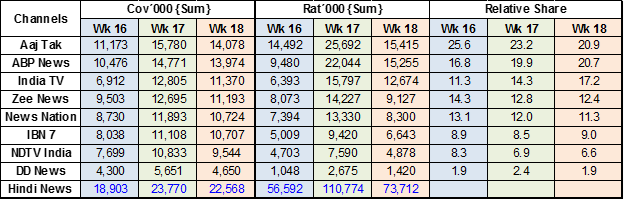
    We observe Aaj Tak has been the market leader for all 3 weeks closely followed by ABP News, among top 8 News channels


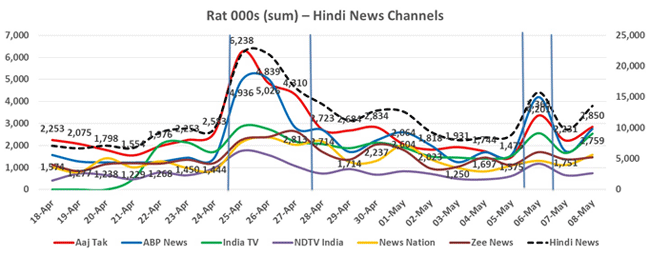
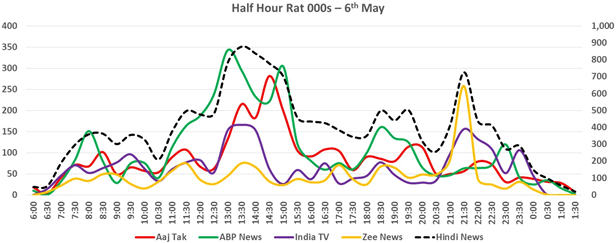
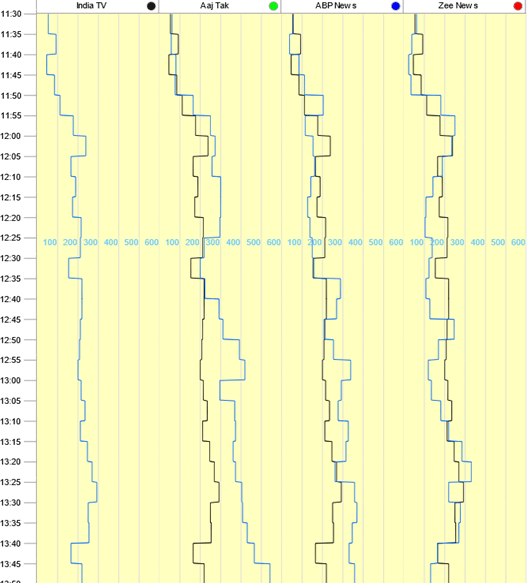
    We also observed ratings of Hindi News channels peaking on Apr 25 (Nepal Earthquake), the ripple effect is observed for next 3 days. On May 6, peak in viewership due to Salman Khan News


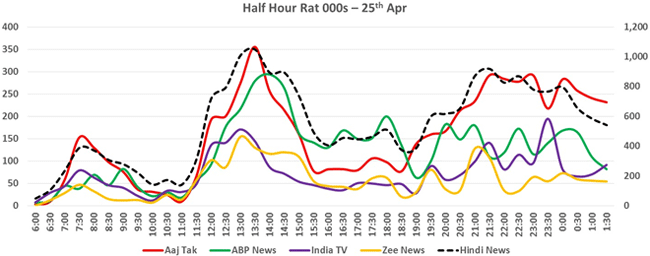
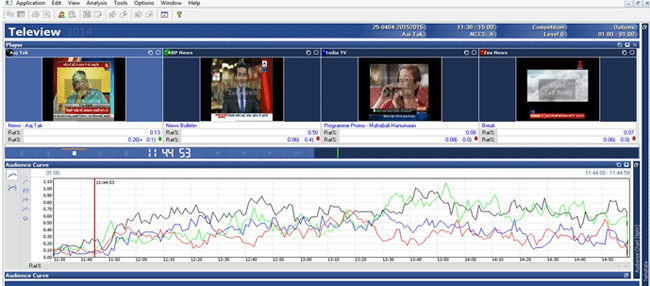
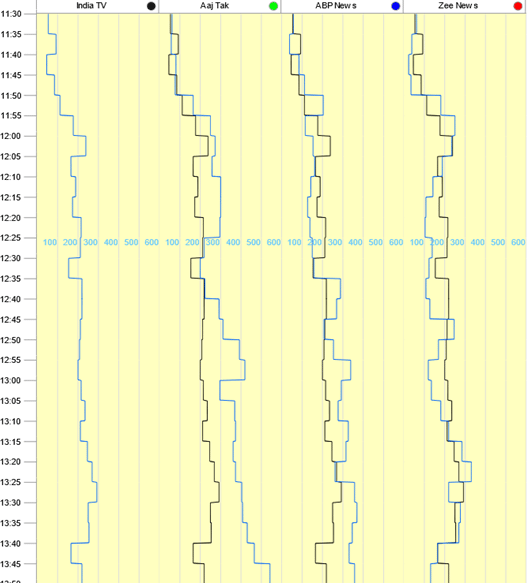
    News channels as can be seen in the graph below started peaking around 11:45 am on Apr 25 (Nepal Earthquake)


    ABP News as seen in the graph below takes over no.1 position (Salman Khan Story) on May 6.


    Apr 25 – Earthquake News:

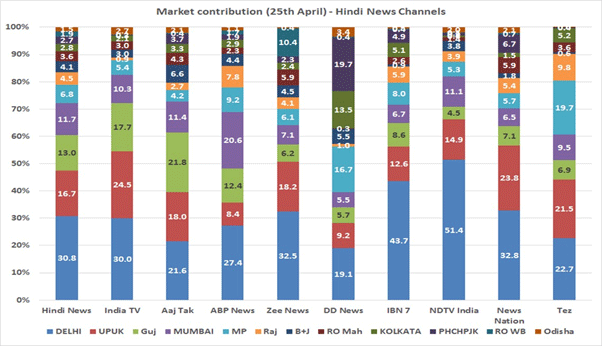
    Increased viewership on April 25 we can see – from Delhi, Guj for all Hindi News


    Our Teleview Report as seen under: Channels breaking news on Nepal Earthquake: ABP News at 11:44:53, Aaj Tak at11:44:54, India TV at 11:45:50 & Zee News at 11:46:30


    Here’s also sharing the Reach Grid on April 25: Reach is maximum for Aaj Tak, followed by ABP news


    May 6 and 8– Salman Case

    Interesting observation to take note of is ABP News rat ‘000s were highest on May 6, whereas Aaj Tak gained on May 8


    English News:

    In all 3 weeks Times Now is the clear market leader with around 38% channel share in the current week.


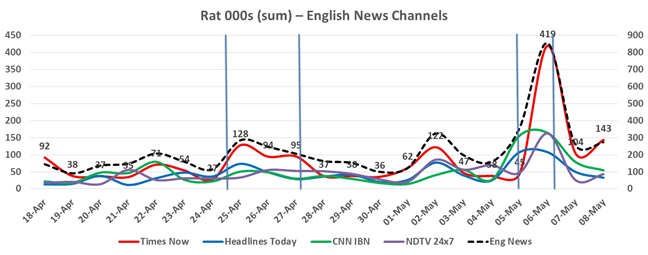
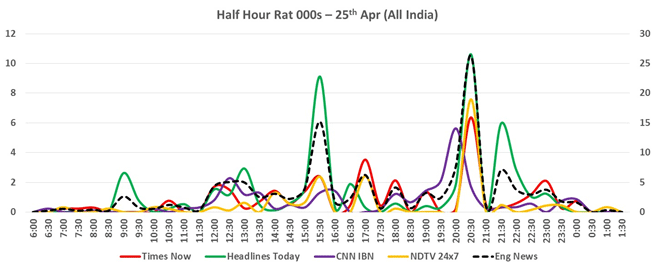
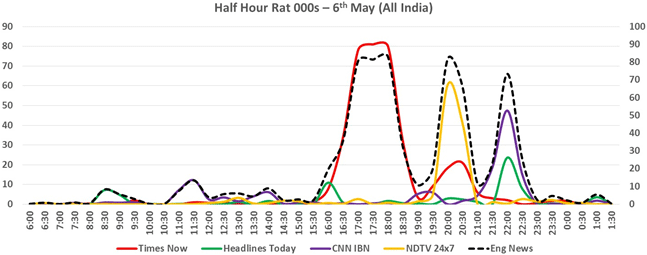
    We also observe that English News Channels peak in ratings on Apr 25 (Nepal Earthquake) & on May 6 in viewership due to Salman Khan News. Though unlike Hindi News, higher traction was seen on May 6.


    Clearly, English News Channels gets less traction as compared to Hindi News Channels on Apr 25 for the Nepal Earthquake News


    We also observe that English News Channels peaks post 4 pm on May 6, with different peaks for different channels as seen under


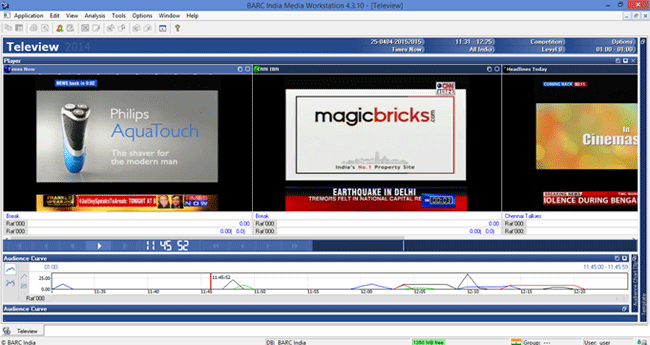
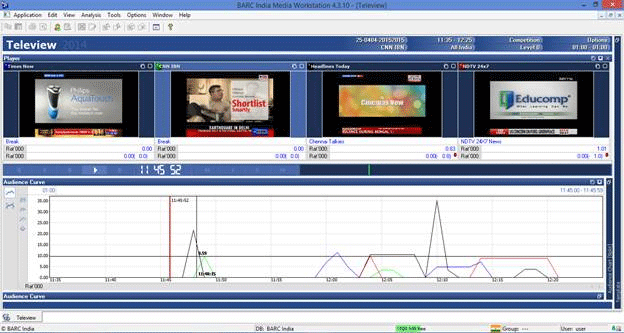
    Our Teleview Report as seen under: On April 25, we observe, CNN IBN breaks the news at 11:45:52 am followed by Times Now at 11:46:40 am, NDTV 24×7 at 11:46:43 am and Headlines Today at 11:48:43 am


    ​Meanwhile, Times Now’s persistence with the story gave them the viewership numbers.


    (for almost a minute after CNN-IBN broke news – other 3 channels were running ads as seen above)


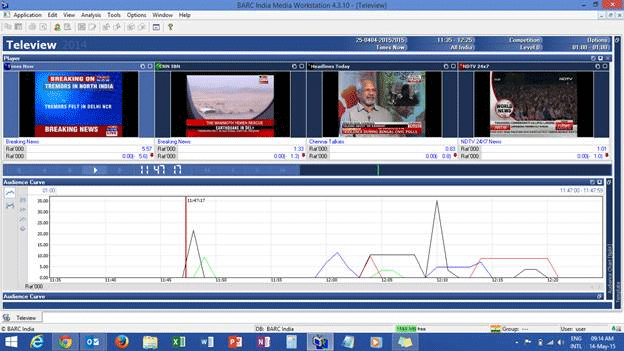
    Over a minute later, at 11:47:17 am all channels were showing the news.


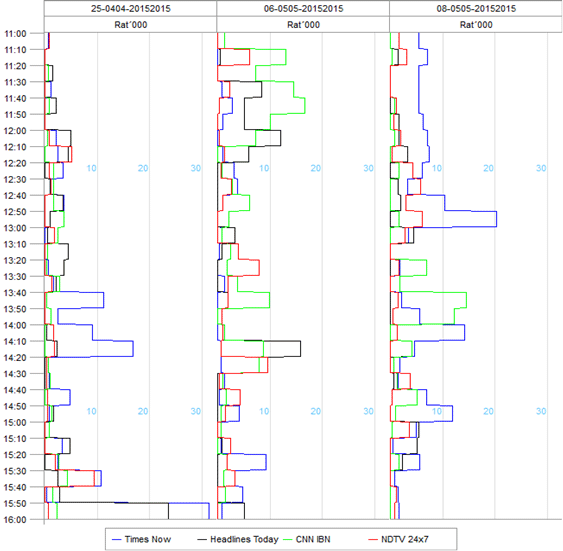
    And finally the Rat 000s Grid: Times Now getting traction on Apr 26. and May 8. Higher for CNN-IBN on May 6.


    Phew!


  • Why Sun shines more in Bengaluru


    By Our Research Editor


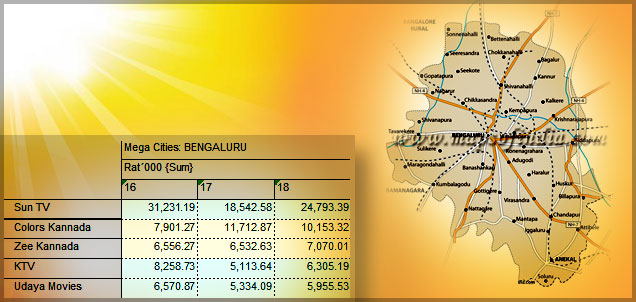
    This is the kind of news which could spark off some wild statements from political formations if it were to happen in a city like Mumbai. But we weren’t really very surprised when we heard that Garden City Bengaluru had such a significant viewing of Sun TV as per BARC data.

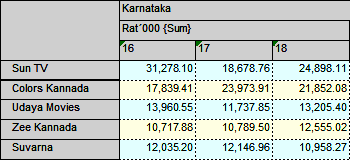
    First, let’s take a look at the pecking order of non-Hindi/English channels in Karnataka.


    Let’s re-look at the table above in the main image, sans the shining sun 🙂 :


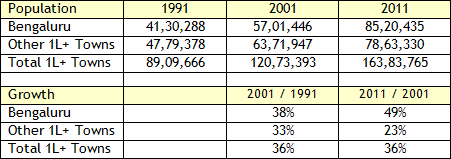
    Surprised? Well, for those who’ve been to cities like Mumbai and Bengaluru would know the large influence of Gujarati and Tamil in these two cities. The decadal growth in Bengaluru has been much faster compared to the Rest of Karnataka (1L+), as per the Census of India 2011. Bengaluru had 52% share of total 1L+ population of Karnataka in Census 2011, up from 47% in 2001.


    The population and growth numbers for the past two decades are as follows:


    As per BARC India estimates of TV owning households as on March 2015, Bengaluru has 58% share of the 1L+ population of Karnataka.

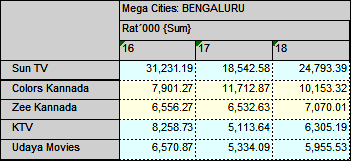
    As compared to an approximate 3% Tamil-speaking population in Karnataka, around 21% of the total population in Bengaluru speak Tamil. This leads to a significant viewing of Sun TV in Bengaluru.

    The viewing details of Sun TV in Bengaluru and the Rest of Karnataka are as follows:

    We posed this question to a Bengaluru-based media analyst and he said that while it’s not true that Kannada channels aren’t doing well in the city, it’s just that as a single channel Sun is ahead. If the content improves, one can be sure Kannada programmes will go ahead of Sun.

    Until then the sun shines for Sun in Bengaluru.


  • So who did the ‘keeda’ on BARC with the MIB?


    By Your Editor [updated]

    The issues with the information and broadcasting ministry have been resolved. According to a tweet by BARC CEO Partho Dasgupta, the data will be released at 3pm today.

    Some of those very people who would flock to the Ministry of Information and Broadcasting against TAM are now seeing their prized project BARC (short for Broadcast Audience Research Council) getting outwitted by the MIB.

    MxMIndia has had a simple, one-line view on this: The government must have no role in audience measurement.

    Not many moons ago, some of the private channels – the news channels specifically – would go to the Ministry of Information and Broadcasting asking for it to intervene on a variety of issues.

    At that time, many in the world were against TAM. NDTV took TAM and its parent to court. The allegation was that TAM’s measurement was flawed and there was corruption in the system. Or so it appeared because that’s precisely why some of the channels which the intelligentsia thought were superb didn’t score well on the ratings roster. The story is not dramatically different for some of the elite channels in the BARC regime.

    But this is not about the ratings of the English and assorted news channels. It’s about the role of the government in ratings and the tendency of channel-owners to go to Shastri Bhavan for all and sundry requests.

    Indulging the government is like playing with fire. Our government has enough dirt to clean as part of its Swachh Bharat campaign. Leave the dirt of the industry to the stakeholders themselves and to market forces.

    The government must step in only if players go out of hand or there is a cartel leading to unfair trade practices where the public suffers.

    In the case of print, where the players are benefactors of DAVP-issued advertising largesse, it looks away from readership survey imbroglios.

    For now, the industry must find who got someone in the ministry to point out a minor procedural flaw in the way things work. Frankly, with all the contacts that some of the BARC top deck has, this could’ve been taken care of.

    Perhaps they didn’t think much about it, and rightly so. The government has no business to get involved. And not even issue any advisories. There are enough checks and balances, and in a sense until TAM exists, there is no clear monopoly for BARC.

    Meanwhile, TAM has issued a statement: “For TAM Media Research, weekly TV Viewership  data release to the Industry will continue as normal. Pursuant to the interim order issued by the Hon’ble High Court of Delhi on Feb 12, 2014, 1.7(a), 1.7(d), 16.1 & 16.2 of impugned guidelines have been stayed till the disposal of the Writ Petition 494/2014 (Kantar Matter).”

    At the time of writing (10.15am), one learns that the Minister of State has been spoken with and he has promised to intervene. So BARC data will get released by the afternoon.

    So all those souls in media agencies and TV channel offices who came in early to the offices to do the analysis, our commiserations.

    Meanwhile, the BARC folks would do well to find out who did the ‘keeda’ to unearth the licence bogey. And ask its constituents not to flock to the mantrijis for all and sundry. Keep them at bay!


  • Shailesh Kapoor: BARC Is Here: New Ratings, A New Era!

    By Shailesh Kapoor


    Finally, the first BARC ratings were released yesterday. Ongoing debate, both reasonable and fallacious, around the credibility of the ratings system, that lasted over a decade can be set aside. We finally have a “solution” in sight. Just that BARC will have to earn its way into becoming that solution.


    Evidently, what was released yesterday was the first stage of reporting that BARC would eventually deliver. To begin with, it is household data, not individual data. I don’t remember seeing any peoplemeters-based household data in India over the last 15 years. So we definitely have a new measure to keep us statistically occupied, till BARC shifts to individual data. If they continue to report both individual and household data in the long run, we can be in the most interesting viewership analysis that you could potentially have.


    The coverage of urban LC1 and rural markets will be the next stage, which should hopefully be not too far away. And then, of course, is the big promise of increasing the sample to 50,000 over the next three years, a task of monumental proportions, the operational complexity of which is ill-understood by many, including many in the television industry and certainly many in the I&B ministry.


    Comparisons to TAM are bound to happen, though they are highly inappropriate, given that so much has changed, right from the market composition to the change from SEC to NCCS to the change from individual to household reporting in this first round. Yet, the big GEC headline that was doing the rounds in the industry last evening was ‘Life OK beats Zee TV to take the no. 3 spot’. Sometimes, the diagnostics are lost in the pursuit of headlines.


    I also saw BARC “on-air” last night. Never to skip an opportunity, Arnab Goswami had a promotional video airing in prime time, where he quoted the first BARC ratings freely, stressing on the wide gap between Times Now and “other small English news channels.” The promo ends with “Times Now Welcomes BARC”.


    Though a standalone, single-channel promo, it says a lot about how the data could be received by broadcasters in general. You can expect to see a flurry of e-mailers and one-on-one client communication by channels that have done well in these first ratings. And there are bound to voices of dissent from those who haven’t, though I suspect those voices will be more like murmurs, given the whole-hearted IBF backing to BARC.


    TAM, meanwhile, has been portraying the image of a battered soldier who refuses to surrender. It should be worthwhile seeing what they come up with. Clearly, we are not in for a two-currency system. So, it would have to an offering that’s distinctive from the BARC repertoire. We shall know, with time.


    From before-BARC to after-BARC, an era may have changed yesterday. Be prepared for an eventful 2015, where talk about ratings will dominate all talks about content and brands in the television space (so what’s new, some may say). After a two-year long trailer, the film has been released, but it will reveal itself reel by reel, scene by scene. Grab your popcorn!


  • BARC is ready, but IBF?


    By A Correspondent


    Update @ 1.49pm: The fears have been allayed. BARC’s future-ready TV audience measurement data will be released today

    The coconuts were ready to be broken. A new sun was rising today. Data analysts made it to their offices early. There was indeed much anticipation. We almost didn’t sleep. Okay, that last bit was an exaggeration. We did catch some winks. But you know why all this tamasha:  the first data from Broadcast Audience Research Council (BARC) was scheduled to be released today.


    Till late last evening though, the BARC big bosses were grappling with a new problem, and this didn’t concern set-top boxes, the technology, etc etc. Some members of the Indian Broadcasting Federation, the apex body of broadcasters, wanted the release of data to be delayed. They reportedly wanted some more stability.


    When we teased whether it was BARC’s IRS moment, given all the madness that happened (and is still playing out) with the print readership study IRS, we were told it wasn’t that bad. These were just reservations. Niggling problems. And no it wasn’t raised by a network whose sporting activity is getting many numbers. In fact all the GECwallahs are pretty happy with the way BARC is going about its task. It’s the smaller channels, specifically some news channels who are upset. There is a conference call scheduled at 12.45pm today to deliberate on the issue.


    Meanwhile, TAM, which was until recently subscribed by most broadcasters, still exists, but key stakeholders – television channels, media agencies and advertisers – and have in fact released data comparing household versus individuals. It may be noted that BARC is currently only due to publish household viewership data.


    Partho Dasgupta

    The diversity in cultural and media consumption in the country makes the work of the Broadcast Audience Research Council (BARC) India the most challenging service governed by a single joint industry body for the entire country, said BARC CEO Partho Dasgupta on the eve of the release of data. With the number of TV-viewing households likely to go up from 20,000 to 50,000 in four years, the process will become even more complex, he added.


    Over 300 channels having ordered for the watermarking technology, and with over 272 channels already live, BARC India’s stakeholders – broadcasters, media agencies and advertisers  have, got together some of the top vendors from across the globe offering technology and solutions.  BARC India, has invested 76% of its budget on technology, it is learnt.


    According to Dasgupta, around 3000 professionals have been trained with the BARC India Media Workstation (BMW). NCCS, or the new SEC system, will be the norm to follow for accurate classification and data analytics. The pre-launch and post-launch audit processes were conducted by Ernst and Young’s  Florida team.


    Meanwhile, TAM, a joint venture of Nielsen and WPP-owned Kantar Media, is considering an urban-centric audience measurement service. There have also been rumours that BARC could well either buy over TAM’s TV audience measurement facility or turn its sole subscriber. When asked what TAM and he plan to do after BARC data is released, CEO LV Krishnan, who has helmed TAM since 2000, told MxMIndia in an interview yesterday: “On May 1, I’ll still be in business and there is never an end-of-the-road for anything. There will be a new kind of a craft that we will create…”


    So what happens to BARC now? We’ll know for sure by 1.30pm what course the conversation takes. Hmmmm.


  • As industry gets set for a new measurement regime, TAM gears for new innings!


    The new BARC television viewership measurement service is scheduled to kick off tomorrow (Wednesday, April 29). While there have been multiple measurement providers in the past, for over a decade, TAM, a joint venture of the WPP-owned Kantar Media and Nielsen has been in existence.


    There has been some resentment against TAM over the years. Not all the reasons though were well-founded. The sample size was one, but stakeholders were unwilling to pay more for increasing the sample size then. Part of the problem these imported and hence attracted a customs duty. The other peeve was the integrity of data. And another was the frequency in which data was disseminated, a cause of great concern to the news channels.


    However, what can’t be denied is the contribution of TAM and its team to the broadcast ecosystem over the years. L V Krishnan, CEO of TAM for the last 15 years, took time off to chat with Pradyuman Maheshwari about life after BARC data gets released… which is tomorrow.


    So what happens to TAM after BARC starts releasing its data?

    Whether BARC exists or not doesn’t really impact TAM. There are two databases allowing users to look at information and analyis for decision-making. It’s a measure of what one wants depending on business needs. I believe the market is large enough for a BARC and TAM to co-exist as long as we provide service or information that covers the essential needs of a consumer…


    But most of your key, high paying clients like Zee and Star have opted out and you obviously need monies to run a service like TV viewership measurement.

    Clients can move out of the business and come back again later if the service is crafted back to what their requirements are. There’s no permanency in the evolving, constantly changing marketplace. When you become the only provider of data, bringing in change may be a little slower because there’s a large constituency of users you need to take into consideration before you make changes on a continuous basis. Yet, I think the productiveness of time during the digitisation phase as well as during the-ever changing environmental space of homes moving from analogue to digital in a non-DAS market reflects the fact that as the market has changed, the system has evolved by itself. If a customer feels that there’s another system that provides a better value, they’re all free to go and subscribe to that system. That doesn’t mean that TAM has to close its offices and cannot deliver information that it’s designed to deliver. What TAM needs to do is to re-craft its business because as of today there are different scales of thought that come into play.


    One, the mass volume game where I measure every corner of the country and try to deliver that information back to the user’s homes which is what BARC’s mission is…. cover urban, rural, J&K to Kerala, North East to Gujarat. That’s not TAM’s endeavour, we don’t have those kind of funds to do that kind of an enlarged exercise. But, we also realise what’s happening in the environment today. From 2001-11, the number of towns with a one million population has almost doubled from 35 to 55 towns. And if you do the projection for 2015, you’re talking about 62-plus towns in the 1 million market. We believe that you don’t need to reach out to the population, the population is reaching out to markets and areas where there’s growth happening and sustained possibility exists and at the same time where they believe that fundamentally the growth prospects for them and family are much more stronger. Migration is one of the biggest elements here.


    So what you’re saying is that TAM will continue as an urban index?

    We believe that urbanisation is going to continue to progress which is what we see in the overall data. When you look at the census data of 2011, it talks about a 65-35% of urban to rural where rural has come down from 2001 from 72 to 65%. Either the population is migrating to big urban markets or more and more markets are becoming urban in nature. In that kind of a situation, given the diversity of the population existing in the 1 million plus markets, does that create an opportunity for segmenting of audiences & bringing in understanding of the behavior of audiences toward media?


    Will your ownership pattern (of being a Kantar-Nielsen 50:50 jv) change when you adopt this new approach?

    Yes, very much, the ownership continues the way it is actually. The service may undergo a sea change. The urban places will be the focus, not the small towns.


    So, will LC1 will go off your serice?

    Possibly. LC1 may not be in the radar, as also rural. It’ll be a permanent urban market. With the focus on the 1 million plus markets which is where we feel segmentation and targeting are becoming more and more easier


    Will GroupM subscribe to this urban-centric service… given that despite being a sibling (owned by WPP),  it unsubscribed to your service?

    We’ve always looked at GroupM as a customer as much as a Star and Zee. From our perspective if they want to try out a new service, they’re welcome to do so. At the same time, we believe that there are opportunities in the market where we can craft the service to the needs of a new customer and we continuously have a dialogue with the old customers too and as and when they feel the new crafted service is important for the old customers, we’ll make it useful for them too.


    When are you announcing the new service?

    There need not be an announcement. It’s a gradual evolution. It’s not like one day we announce this and next day stop it. The way we graduated from analog to digital… it’s a continuous process of evolution.


    You’re not going to be switching off…

    There’s no switching off.. we’re in the data providing area and there are enough customers in the market.


    We’ve had heard rumors of TAM selling its service to BARC… some talks initiated by Sir Martin Sorrell…

    I’m not aware of it. If that’s so, I’ll go with what the industry wants. If they seek a combination of services provided by TAM with an existing talent pool to assist  BARC, I don’t see any reason why we shouldn’t.


    Would you recommend that as…

    I don’t see a wall between us and BARC. There’s always a bridge that can be constructed between two service providers if it’s in the benefit of the industry. Ultimately the customer needs to decide.


    It’s not just the benefit of the industry, it’s the ego too.

    We don’t have any egos that rule. We think it’s the customer and his needs that rules.


    As you see the industry rallying around BARC and as you look back on your 15 years, do you think you should’ve also got the same amount of industry attention and monies?

    TAM is an industry-supported service.


    But it was a joint industry body that endorsed it, right?

    I mean price or spend supported. When it was created, it was a formulated idea. There was  no seed funding for the formation of TAM. It was primarily from subscription itself. When ownership doesn’t exist and it exists with two multinational research firms, then obviously one expects the fact that they will fund and push the services ahead. The difference between the TAM and the BARC system is that in the latter the industry has put money behind it to fund it, and that’s why they are standing behind it. It ultimately comes down to stakeholders. If they are two giant international research companies, they’d want to put the money behind it, make it run and they’ve done that. From where we were with 750 meter and five cities in 1999-00 to a 12,000 meter running the urban panel, it’s a huge milestone that’s being covered. If the subscription money was higher, we could’ve increased it to even higher levels, but frankly speaking there are no regrets to that now. At the end of the day, the stakeholders of BARC believe that they’ll be able to take it to a much more higher level. No regrets at all.


    Do you think that this wouldn’t have happened had the various stakeholders been more actively involved?

    There are two parts to involvement. One is from a technical perspective and the other is a price or a value perspective. When you involve yourself in a technical perspective, some recommendations help in making the measurement sharper. When it comes to price or value part of it, it becomes an investment yield question, in respect to sample size. In the case of TAM, the joint industry body took a call in late 1999 saying they won’t involve themselves in the price or value part of it at all. They only wanted to be the advisory technical perspective. There’s nothing TAM can do about it. It had to then depend on the two parent companies to see how much funding can be possible to keep expanding on a continuous basis. There has been all kind of involvement from a technical perspective into even as late as in 2012 when digitisation was around the corner when the AAAI, ISA and IBF appointed a three-member technical committee to work with TAM to work from analogue to digital. From a financial perspective, could there have been better involvement from them? I don’t think we could’ve rejected it if they wanted to come into it. At the same time, they took a call they didn’t want it. So, we couldn’t push them…


    Do you think they should’ve taken you as one of the components of BARC’s new measurement system.

    We welcomed BARC right from the time they announced it and we also participated in the RFI and then RFP. We’ve no biases on not wanting to be a part of BARC or any industry movement.


    There was no response to RFI or RFPs and we expected the fact that there’ll be a discussion on some of the proposals we put forward.


    Perhaps there was an issue that the then government had about the ownership of TAM, given that GroupM is owned by one of your co-owners?

    I don’t know where the government got involved because it had no role to play on an industry issue. If that’s so then today the way BARC stands, they shouldn’t have allowed that till the information was an all-India service.


    Do you think the industry should’ve continued with TAM and let the BARC system settle in?

    Well, some of the small and medium level users of data are not taking calls at this time. They believe that both systems have their merits or demerits and they want to look at it from their business perspective at what’s important and what’s not. Many of them are taking a call saying there is a new measurement system coming up which will provide the same measurement that TAM has but will have a larger sample and may have more number of markets to cover up in future.


    What could you’ve recommended?

    3 to 6 months is a good time frame.


    What about the dialogue with AAAI and IBF?

    I was never given an opportunity. I was surprised more with the letters even before I could ask for a meeting with the industry body.


    Moving on to one of the fears we’ve expressed in MxM, we’ve seen a joint industry body like MRUC which is populated by key newspapers and publications having a problem like IRS. Here you have an industry populated body and when the results came out the members were up in arms. Do you think that’s a fear for the numbers that are going to come up in BARC? You yourself in a sense faced it. Very recently after LC1 and digitization there were some very dramatic shifts of data. Given that and given the IRS example, do you think there’s a reason for fear?

    One needs to reflect back on the industry and where it stands. Media is a very peculiar category which isn’t an industry but actually a power centre. It’s close what a government or judiciary is. When you look at it in from that perspective, the key factor governing these sectors is power. If power is the centre, nothing else other than remaining at the top or growing continuously matters. And sometimes you tend to know what the ground reality looks like, but at the same time you don’t have anybody to tell you what that ground reality is. It’s in negativism, demoralizes people, runs into quite a few other conundrums that you don’t want to think about at that point of time. From that perspective, measurement is a harsh reality. Whether it’s for the government and the government doesn’t like it, whether it’s for a judiciary who at least gives it a thought and sees how it can overcome that with some way or the other and for media, definitely it’s not something they’d like to see again and again. The only reason why media needs measurement is fundamentally because 50% of the money in print or 75% of the money in television or 100% of the money in radio all runs through advertising. Or else, I don’t think measurement will exist at all in a public, common platform.


    Given the experience that you’ve had in the recent past, reactions to LC1 etc, is there some kind of piece of advice that you would like to give to the BARC folks, as to how they should possibly tackle the media/

    Frankly the fact that it’s a service that is funded by industry bodies should take care of things….


    But in the case IRS that didn’t happen?

    But I don’t think over there, the funding happen with everybody.  The stakeholders were only the publishers.


    Did it upset you at all that TAM has over the years become the favorite whipping boy of everybody, whether it is members of Parliament, industry folks etc. And the whole degradation of content and television, the sensationalism of news television, everything is blamed on TRPs?  

    No, it doesn’t bother me because it was expected, because you are the only one who are providing that particular data. What bothered me was the politicization of that particular exercise…


    Politicization by the politician or by the people in the industry?

    I could say anyone who is doing it.


    Who was a tougher evil, industry folks or the politician?

    The politicisation couldn’t have happened just because of the fact that the government was interested in the measurement exercise…


    So the industry folks…?

    Now one can’t easily draw a line, because at the end of the day some of the broadcasters, owners are also politicians and some of the politicians have also become broadcasters, specifically, if you look at the regional level. So, it’s a very difficult to say where the politicization happened.


    What are your sentiments like as the transition to the new service happens? TAM and you were after all a hugely influential factor in broadcasting over the last 15 years!

    I need to set the emotional aspect of this business aside and look at it very rationally. I can get carried away with emotions of the past but what needs to be look at is the present and the future.


    Well, the fact is that it’s about emotions. I have seen you over the last few years and your contribution to the ecosystem has been tremendous but and you have been the the lone and the sole voice of the rating business… in fact things couldn’t have progressed so far without you!?

    I’ve been lucky to be in this particular phase, of how the industry has taken shape, and I’m thankful to God for giving me a team that actually saw the same objective as me in driving the industry through a measurement exercise. The team has done a herculean task in the last fifteen years and we have worked very well with the industry for whatever misses that we might have had with them or missiles they might have fired at us, that’s part and parcel of the game. On May 1, I’ll still be in business and there is never an end-of-the-road for anything. There will be a new kind of a craft that we will create…


    Any personal high, you would like to look at? Would like to do go on a holiday now?

    There was a high point whenever we came out from a meeting, having heard the client, and we offering our perspectives with the client accepting and implementing it and seeing results getting delivered. Beyond that, I don’t think there is any other major high point. For us it’s always been the fact that there is a customer at the other end, we’ve got to listen to him/her and resolving issues. That’s what finally mattered and matters.

     

  • Sumit Chowdhury appointed Technical Advisor at BARC

    By A Correspondent


    Broadcast Audience Research Council (BARC) India has appointed Dr. Sumit Chowdhury as Technical Advisor to the organisation. This is a move to align and streamline technology processes since almost 76 per cent of BARC India spends are on technology. As BARC India moves closer to launch,Dr. Sumit Chowdhury’smandate is to measure and automate all critical processes and to create a mission-critical infrastructure that scales to the requirements of the industry. Sumit will also contribute to the creation of other information products from the vast amount of data collected by BARC India.


    DrSumit D Chowdhury is the Founder of Gaia Smart Cities, an M2M/IOT company focused on telecom and ICT solutions for smart cities. Until recently, he was a President of Reliance Jio where he was initially the CIO and then establishing their Enterprise business. Prior to Jio, he was a Vice President of IBM, CIO of Reliance Communications and Partner with KPMG. He is an authority on Telecom, Media, Entertainment and Information Technology. He is an undergraduate from IIT Kanpur and MS and Ph.D. from Carnegie Mellon University, where he is an adjunct faculty teaching various aspects of industrial automation, telecom and Smart Cities.


    Partho Dasgupta

    Partho Dasgupta, BARC India CEO, said, “As we are gearing up for launch, Sumit’sexcellent background and experience in telecom, media entertainment and other industrieswill ensure all systems scale and are in sync and automated for the big data factory that we would be running.”